Architecture Over Prompts: Agentic Maturity
From code-as-action to autonomous skill acquisition, the infrastructure for the Agentic Web is finally settling into place.
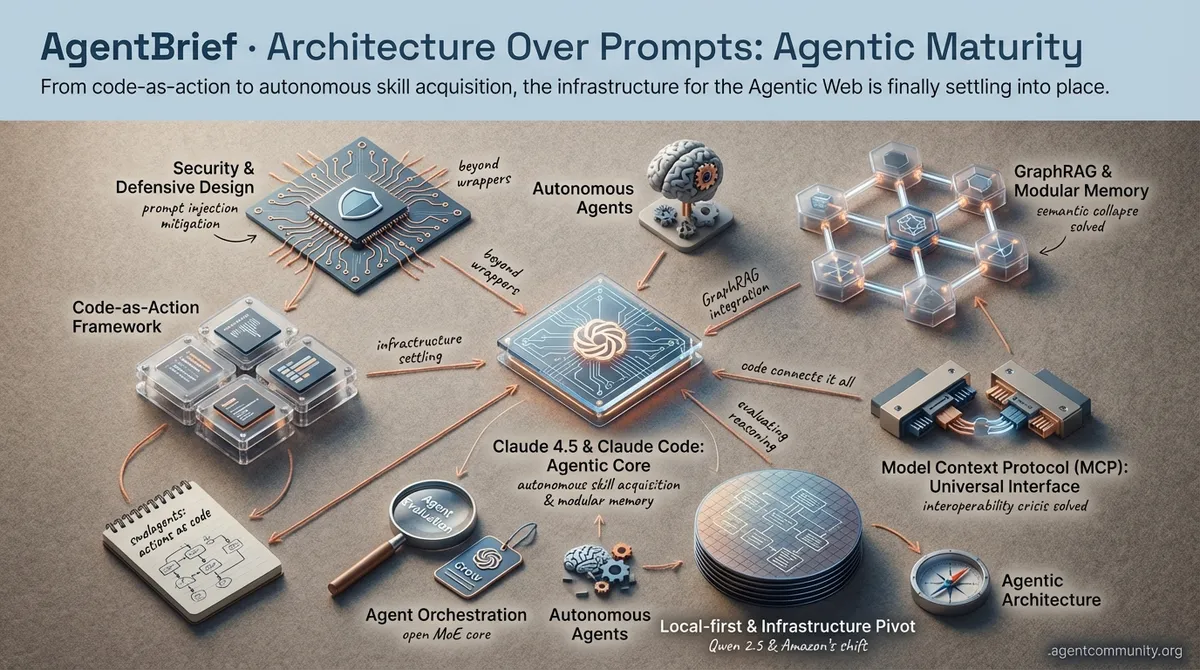
AgentBrief for Jan 02, 2026
The X Intelligence Feed
When your agent starts learning its own tools, the game board changes forever.
We have officially moved past the era of prompt engineering and entered the era of agentic architecture. For those of us shipping production agents, the signal this week is deafening: the foundation is shifting from static chat interfaces to autonomous systems that can learn, adapt, and self-correct. Anthropic’s Claude 4.5 and the 'Skills' feature in Claude Code represent a fundamental change in how we think about tool use—moving from hard-coded functions to agents that autonomously develop their own capabilities. Meanwhile, Nvidia’s NitroGen is proving that generalist agency isn't just for LLMs; it is coming for complex, multi-modal environments with zero-shot proficiency. Even the giants are reorganizing, with Amazon pivoting to an infrastructure-first AGI strategy that prioritizes execution efficiency over model vanity. This is the 'Agentic Web' taking physical and digital form. We are not just building wrappers anymore; we are building the infrastructure for a world where agents are the primary users of software. If you are not thinking about how your agents manage their own memory, budget, and skill acquisition, you are already building for the past.
Opus 4.5 and Claude Code Redefine Agentic Excellence
Anthropic's release of Claude 4.5 Opus has positioned the company as a leader in the agentic AI landscape, with developers lauding its real-world performance. As @bindureddy noted, the model is 'head and shoulders above others in real-world agentic scenarios,' a sentiment echoed across the builder community. When paired with Claude Code, this model showcases groundbreaking agentic capabilities, particularly through its new 'Skills' feature, which enables autonomous toolset development. This is a massive shift for developers; as @rileybrown emphasizes, Claude Code with Opus 4.5 is effectively the 'most powerful agent in the world' because it can autonomously build a skill for tasks like direct X posting, highlighting its immense potential for task generalization. The 'Skills' feature is drawing significant attention for enhancing Claude Code's adaptability beyond traditional coding. Builders are using it for context engineering and optimization, with @omarsar0 observing that 'Skills is easily one of the most effective ways to steer Claude Code' for building and testing tools autonomously. While some developers like @bkase_ have expressed disappointment in Opus 4.5’s coding performance compared to GPT-5.2 Codex, others like @mattshumer_ acknowledge its edge in broader agentic tasks. This release sets a high bar for the ecosystem, as @GregKamradt underscores how this standard benefits all developers. This isn't just hype; internal data cited by @deredleritt3r shows a 220% mean productivity improvement for staff using this agentic stack, redefining the ceiling for what we expect from autonomous coding partners.
Nvidia NitroGen Model Achieves Zero-Shot Gaming Generalization
Nvidia has unveiled NitroGen, a groundbreaking foundation model for generalist gaming agents capable of playing a wide array of video games without prior game-specific training. As highlighted by @_akhaliq and @minchoi, NitroGen is trained on an extensive dataset of 40,000 hours of gameplay across 1,000+ titles, achieving a remarkable 45-60% zero-shot success rate across diverse genres using a universal simulator. This represents a significant leap in AI development, moving beyond game-specific tailoring to true generalization, as further supported by @dispatchy_ai, which notes fine-tuning can boost performance by an additional 10-25% in specific tasks. Further insights into NitroGen's capabilities reveal its innovative approach to data and simulation. According to @connordavis_ai, the model learns directly from pixel observations without access to game state or reward engineering, relying solely on raw gameplay videos. The universal simulator, a critical breakthrough, wraps commercial Windows games in a Gymnasium-compatible interface, requiring no game modification, as detailed by @connordavis_ai. The broader implications extend beyond gaming; @BeginnersinAI notes that in unfamiliar games, NitroGen performed 52% better than models trained from scratch, hinting at its robustness for real-world adaptability. Additionally, @gp_pulipaka emphasizes its significance for robotics research, suggesting that such generalist models could revolutionize simulation-to-reality deployments.
Amazon Pivots to Infrastructure First for AGI Under DeSantis
In a significant strategic reorganization, Amazon CEO Andy Jassy has announced a leadership shakeup that signals a pivot toward the plumbing of the agentic web. Rohit Prasad, the former head of Amazon’s AGI organization, is leaving, while Peter DeSantis, a veteran AWS infrastructure executive, has been appointed to lead a new AGI group focused on custom silicon and quantum computing as reported by @StockMKTNewz and @actu_ia. This move suggests Amazon aims to dominate planetary-scale AI deployment by leveraging AWS as the most efficient platform for running others’ models, rather than just chasing the 'smartest model' title, a strategy highlighted by @nashvillebiz. Further emphasizing this pivot, Pieter Abbeel, a renowned expert in robotics, has been named Amazon's new AGI Head, bringing a potential focus on physical AI applications @bookwormengr. Reorganization under DeSantis could accelerate the roadmap for the Nova model series, including innovations like Nova Forge and Nova Omni, which aim to provide prebuilt models for enterprise needs according to @holgermu. The focus appears to be on enhancing cost efficiency and business automation @briefing_block_. Despite concerns about Amazon playing catch-up with Microsoft and OpenAI as noted by @nashvillebiz, the emphasis on infrastructure is yielding results. New releases like the Nova 2 models boast 70% performance on SWE-bench for Nova 2 Pro, suggesting a robust push towards redefining cloud workflows with agentic tools @testingcatalog and @N0uai.
METR Benchmarks Highlight Efficiency Gaps Between AI Models
Recent METR benchmarks have spotlighted significant efficiency disparities in long-task measurements among leading models. According to @scaling01, Claude 4.5 Opus significantly outperforms GPT-5.1 Codex Max in autonomous task duration capability, while @emollick notes that these benchmarks correlate highly with an AI's ability to handle complex, multi-hour workloads. While cost and pricing issues with newer models like GPT-5.2-xhigh are a growing concern for agent builders, as noted by @scaling01, the exponential progress in self-correction capabilities remains the key metric to watch. Research highlighted by @emollick suggests that even small accuracy gains lead to massive improvements in total task completion.
Windows 11 Introduces 'Agent Workspace' for Autonomous Tasks
Microsoft has rolled out 'Agent Workspace' in Windows 11, providing AI agents with dedicated desktop sessions and runtime environments for autonomous task execution. As @theagentangle highlights, this feature allows for independent file access and operations, though current security measures are already being questioned by industry observers. Experts like @JakeLindsay point to the broader cybersecurity threats posed by Shadow AI, which could exacerbate data breach costs if these agentic workspaces are exploited. While some see potential for 'super agents' to handle complex multitasking in the future as noted by @JakeLindsay, others like @theagentangle caution against the fragility of current data-driven paradigms.
Adaptive Coordination and Budget Awareness Transform Multi-Agent Systems
Multi-agent systems are shifting from rigid workflows to adaptive coordination frameworks that handle ambiguity through dynamic role assignment. As @omarsar0 notes, these systems allow agents to adaptively correct errors, while @dair_ai emphasizes that optimizing token usage during this coordination is critical for scaling these systems without exploding costs. A parallel focus is on budget-aware test-time scaling; @omarsar0 points to Google research indicating that more tool calls do not always equate to better agent performance. Instead, @dair_ai suggests that systematic adaptation of agents and their tools is a more effective lever for improvement than raw resource scaling.
Practitioners Converge on Human-in-the-Loop Memory Patterns
There is a growing consensus among developers on the importance of human-in-the-loop memory for self-learning agents. @ashpreetbedi champions a pattern where agents request permission before storing lessons in vector databases like ChromaDB, ensuring user control over what an agent retains. Practical hurdles remain, however, as @thdxr discusses how overly conservative model outputs can hinder the debugging process for these complex memory-reliant systems. To solve this, @ashpreetbedi stresses the need for distinct session, user, and learned memory types to enable agents to compound knowledge sustainably over time.
Quick Hits
Models for Agents
- Gemini 3 Flash introduces RL improvements that notably outperform Pro in speed and price @signulll.
- MiMo-V2-Flash rivals top-tier models like DeepSeek-V3.2 while using significantly fewer parameters @omarsar0.
Agentic Infrastructure
- Chroma Cloud now offers Customer-managed Encryption Keys (CMEK) for enterprise agent memory @trychroma.
- Agno is running in production with Gemini 3 Pro, utilizing native Google Search grounding for its agents @AgnoAgi.
- Cloudflare Tunnel management can now be handled via a dedicated Docker image with a web interface @tom_doerr.
Tool Use & Developer Tools
- The Claude Chrome extension can now be connected to Claude Code with a single '/chrome' command @rileybrown.
- Manus AI now ships with a browser extension that allows for agentic automation from a mobile phone @ivanleomk.
- A new SQL memory layer has been released for LLMs and agents to handle persistent state @tom_doerr.
Research & Benchmarks
- OpenAI introduced FrontierScience, a benchmark measuring AI capabilities in expert-level scientific reasoning @dair_ai.
- The FACTS Leaderboard from Google provides a new standard for evaluating LLM factuality @dair_ai.
Reddit's Autonomy Deep-Dive
As agents move toward 100% autonomy, security flaws and memory drift are becoming the primary bottlenecks for production systems.
The dream of 100% autonomous agents is hitting its first major reality check. Today’s issue highlights a critical shift: we are moving from 'can the model reason?' to 'can the system survive?' The demonstration of indirect prompt injection—where a simple email can hijack an agent—proves that our current security models are woefully inadequate for tools with write-access. At the same time, we are seeing the emergence of the 'vibe coding wall,' where agents lose the architectural plot as projects scale.
The solution isn't just a bigger model; it is a more structured one. From Microsoft’s push into GraphRAG to combat 'semantic collapse' to DeepSeek’s structural optimizations for ultra-deep Transformers, the focus is shifting toward architectural integrity. Even the benchmark wars are evolving; GPT-5.2 Codex is setting records, but the real story is the rise of Sovereign AI and hyper-efficient edge models like LiquidAI’s LFM2. For builders, the message is clear: the next phase of the Agentic Web isn't about better prompts—it is about better infrastructure, robust memory, and defensive design. Let’s dive into the tools and frameworks leading that charge.
Unauthorized Function Calls: The Growing Threat of Indirect Prompt Injection r/AgentsOfAI
A critical security vulnerability has been demonstrated where AI agents integrated with personal tools like Gmail and Claude Desktop can be compromised via a single incoming email. u/CIRRUS_IPFS demonstrated an exploit where an attacker triggers unauthorized function execution without user consent, effectively turning the agent against its owner. This highlights the escalating risk of indirect prompt injection (IPI), a vector where malicious instructions are hidden in data sources (emails, documents, or web pages) that the agent is programmed to process. Security researchers note that as agents move toward 100% autonomy, the lack of a 'human-in-the-loop' for tool execution creates a massive attack surface.
In response, the developer community is releasing specialized defensive tools like VibeDefender, an MCP server designed to guide agents through security assessments and vulnerability scanning r/mcp. Furthermore, formal frameworks like the OWASP Top 10 for LLM Applications now categorize 'Insecure Output Handling' and 'Indirect Prompt Injection' as top-tier threats. Industry experts like @rez0__ argue that autonomy is becoming a harder bottleneck than raw intelligence, as implementing safe judgment calls in adversarial environments remains an unsolved challenge u/Shyn_Shyn.
Agentic Benchmarks and the Sovereign AI Shift r/AIAgentsInAction
Practitioners are increasingly moving beyond static benchmarks to test the 'Big Three'—Claude Opus 4.5, GPT-5.2 Codex, and Gemini 3 Pro—on real-world agentic tasks within production repositories u/shricodev. Latest reports from the SWE-bench Verified leaderboard show GPT-5.2 Codex achieving a record 51.4% solve rate, while Claude Opus 4.5 trails slightly at 49.8% but demonstrates significantly lower hallucination rates during code verification phases @TechBenchmark_Live. As noted by r/AIAgentsInAction, intelligence only compounds when outputs can be autonomously checked, making verification the primary bottleneck for 2025 workflows.
Simultaneously, the Sovereign AI movement is gaining momentum, with the South Korean government-funded 'K-Foundation' project releasing five new models designed to reduce dependency on US-centric labs u/chibop1. Efficiency at the edge is also reaching new heights; LiquidAI’s LFM2 2.6B-Exp reportedly hits GPT-4 level performance on Android devices, maintaining a 42 TPS throughput and a 32K context window u/Competitive_Travel16. Industry analyst @AI_Hardware_Guru confirms that these 'small-but-mighty' models are outperforming 70B parameter models in specific RAG-heavy agentic tasks.
MCP Ecosystem Accelerates with Agent Delegation and Enterprise Adoption r/mcp
The Model Context Protocol (MCP) ecosystem is shifting from simple tool-calling to complex agentic workflows, with new servers enabling autonomous delegation. Agenters has emerged as a key project allowing AI coding agents to hand off sub-tasks, effectively orchestrating multi-agent swarms u/Particular-Tie-6807. This momentum is reflected in rapid tool adoption; for instance, Code Sentinel reached 400 downloads within its first 4 days, demonstrating high demand for MCP servers that can evaluate complex codebases for architectural flaws u/salRad22.
To lower the barrier for developers, tools like Gantz now allow users to tunnel local MCP servers directly to Claude without the need for complex port forwarding u/GantzAI. Simultaneously, the official MCP Server Registry has seen explosive growth, with popular open-source implementations for Google Search, GitHub, and Postgres becoming standard building blocks. Enterprise interest is solidifying as IBM released an MCP server for its FileNet Content Manager, signaling a move toward connecting LLMs to massive proprietary data silos r/mcp.
Hindsight and the Rise of Agentic Memory Infrastructure r/LLMDevs
The 'forgetfulness' problem in long-running agent sessions is being addressed by new open-source systems like Hindsight, which treats memory as a first-class system rather than just longer prompts or simple retrieval u/Conscious_Search_185. This is a direct response to developers hitting 'walls' in complex projects where agents begin to forget architectural decisions made in previous sessions u/cdaviddav. Beyond basic persistence, frameworks like MemGPT (now Letta) have pioneered an 'OS-like' memory management approach, enabling agents to manage their own context window via paging mechanisms Packer et al..
These systems are critical for maintaining context persistence over weeks of development, preventing the 'vibe coding' wall where complexity outpaces the agent's immediate recall. High-performance implementations like Zep AI are now pushing this further, offering sub-10ms retrieval of long-term memories to ensure agents remain performant even as their history grows into the millions of tokens Zep AI.
Solving Semantic Collapse with Agentic Knowledge Graphs r/AgentsOfAI
Recent Stanford research highlights 'Semantic Collapse', where traditional RAG systems fail at scale due to embedding drift and the curse of dimensionality u/unemployedbyagents. To combat this, developers are pivoting toward Agentic RAG integrated with Knowledge Graphs (KG). Microsoft’s GraphRAG benchmarks indicate that while vector-only RAG is efficient for local lookups, KGs provide a 70-80% improvement in comprehensiveness for global, multi-hop queries r/MachineLearning.
This hybrid approach treats the graph as a reasoning layer, enabling agents to navigate complex relationships that simple vector search misses u/According-Site9848. Specialized tools like clangd-graph-rag are leveraging Neo4j to map technical codebases for agentic navigation u/Barronli.
Unlocking 128GB Unified Memory and Efficient Edge Inference r/LocalLLaMA
A major breakthrough for local agent hosting has been popularized: Linux users can now allocate up to 128GB of unified memory to AMD iGPUs by modifying the amdgpu.gttsize kernel parameter u/1ncehost. While this allows running massive models like Llama 3 70B on consumer APUs, performance is strictly bound by system RAM bandwidth (DDR5 at ~50-60 GB/s), making it significantly slower than dedicated VRAM but highly cost-effective for high-capacity inference. Orchestration for these local setups is maturing with tools like easyvllmondocker, which provides a script-managed environment for vLLM with integrated monitoring and OpenAI-compatible access control u/_camera_up.
Simultaneously, the hardware ecosystem is diversifying; developers are successfully utilizing Intel Arc A770 16GB cards for budget-friendly LLM training u/hasanismail_, while the Radxa AX-M1 is emerging as a favorite for low-power, 24/7 agents processing financial reports using models like Qwen3-1.7B u/NashRajovik.
DeepSeek Unveils Manifold-Constrained Hyper-Connections r/ArtificialInteligence
DeepSeek has introduced Manifold-Constrained Hyper-Connections (mHC), a structural innovation designed to solve the "identity mapping" degradation in ultra-deep Transformer models u/gvnr_ke. By implementing manifold projections, mHC ensures that information flows more effectively through residual paths, resulting in improved training convergence and significantly reduced gradient vanishing in models exceeding 100 layers arXiv:2512.24880. This framework addresses the memory overhead typically associated with complex hyper-connections by optimizing the projection matrices, allowing for higher parameter efficiency and easier distillation into smaller, task-specific versions u/Own-Poet-5900.
Prompt Management Becomes Core Software Infrastructure r/PromptEngineering
The industry is undergoing a fundamental shift where prompt engineering is maturing from experimental 'tricks' into a rigorous discipline of software engineering. Developers are increasingly arguing that prompts must be treated as critical iteration artifacts requiring versioning, diffing, and audit trails u/Public_Compote2948. This evolution is exemplified by Canto, a neuro-symbolic language designed for prompt engineering that leverages Z3 constraints to provide 'soft' verification u/igt0.
Enterprise adoption of 'prompt-as-code' is accelerating through tools like LangSmith, PromptLayer, and Portkey, which integrate prompts directly into CI/CD pipelines. These infrastructure layers are designed to prevent production regressions—where a single word change can break downstream logic—by treating prompts as governed software components rather than static strings u/t0rnad-0.
Discord Developer Dispatches
While Anthropic's Claude Code hits usage walls, modular skills and local hardware hacks are giving developers back their agency.
The agentic web is currently caught in a classic pincer movement between frontier ambition and infrastructure reality. On one side, we are seeing the fallout from the 'Claude Code' era: Anthropic's new CLI tool is so context-hungry that Pro users are reporting 60% cuts in available capacity. It is a stark reminder that while the models are getting smarter, the compute debt is coming due. Simultaneously, whispers of a 'Claude 4.5' hitting 81% on SWE-bench suggest a future where agents do not just help code—they own the repository.
However, the most interesting developments today are not just in the big labs. Developers are fighting back against 'monolithic context' with Cursor’s new dynamic Agent Skills, effectively modularizing agent logic to save context and prevent model drift. We are also seeing a massive surge in high-capacity local infrastructure, with Qwen 2.5 Coder and clever AMD hardware hacks proving that you do not need an H100 to run a 70B model if you know how to tweak your system parameters. Today's issue explores this shift from 'one-size-fits-all' prompts to specialized, local-first architectures that prioritize control over convenience.
The Anthropic Squeeze: Claude Code Limits and Opus 4.5 Rumors
Power users are sounding the alarm over a drastic reduction in Claude's operational capacity, with internal community estimates pointing to a 60% cut in available tokens per session @scaredpelican. The launch of Claude Code, Anthropic's new CLI tool, appears to be the primary catalyst for these adjustments, as the tool's high-context requirements consume limits at an accelerated rate. Developers on the Pro plan have specifically documented session reset times stretching from the standard 3 hours to 4.5 hours without formal notice @vincsipe, a change that disrupts professional 'flow state' and high-frequency development cycles @skirano.
Amidst these constraints, unverified reports regarding a potential Claude 4.5 or Opus 4.5 have sparked intense debate. Early speculative leaks suggest a massive 81.4% score on the SWE-bench, which would represent a paradigm shift in autonomous software engineering @skirano. While industry analysts like @rowancheung caution that the figure may be a 'leaked' hallucination—considering it far exceeds the verified 37% achieved by Claude 3.5 Sonnet—the community remains on high alert for a model that utilizes 'reasoning tokens' to redefine the capabilities of AI coding agents.
Join the discussion: discord.gg/anthropic
Cursor Nightlies Introduce Dynamic Agent Skills and Modular agents.md Integration
Cursor is rolling out 'Agent Skills,' a modular framework allowing developers to bundle specific rules and commands that load dynamically based on the active task. Unlike static system prompts that consume valuable context windows, these skills function similarly to the community-driven agents.md standard. Early adopters like kkordikk note that this approach prevents model drift by ensuring domain-specific logic is only invoked when relevant to the current file or directory.
Currently available in nightly builds, the feature allows users to define custom 'sub-agents' for specialized tasks like database migrations or UI testing. The community has quickly coalesced around agentskills.io, a hub for sharing these modular configurations. Technical benchmarks shared by the community suggest that utilizing localized skills can reduce context usage by up to 40% compared to monolithic .cursorrules files @cursor_ai.
Join the discussion: discord.gg/cursor
Qwen 2.5 Coder and AMD GTT: Unlocking High-Capacity Local Agents
The Qwen 2.5 Coder series has rapidly ascended as the preferred choice for local agentic infrastructure, with the 32B and 14B variants consistently outperforming Llama 3.2 in complex tool-use and reasoning tasks. Benchmarks highlight Qwen 2.5 Coder 32B scoring 92.7 on HumanEval, positioning it as a near-SOTA open-source model for autonomous coding agents according to @bindu_reddy.
On the hardware side, Linux enthusiasts are bypassing VRAM limitations using the GTT (Graphics Translation Table) size hack for AMD APUs. By adding amdgpu.gttsize=131072 to the GRUB boot parameters, users can allocate up to 128GB of system RAM as unified memory for iGPUs. This allows running massive 70B+ models on consumer Ryzen hardware, effectively turning a standard workstation into a high-capacity inference server without enterprise-grade GPUs, as highlighted by @_le_valois.
Mastering Triple-Loop Architectures and State Persistence in n8n
Advanced n8n users are increasingly deploying 'triple-loop' architectures to orchestrate complex multi-agent data synthesis. This structure allows agents to iterate through multiple data sources, perform deep analysis, and re-evaluate results recursively. However, the primary challenge remains state synchronization across nested levels. To prevent data leakage, developers like joff recommend utilizing the 'Reset' function on inner Loop nodes and implementing custom expressions—often referencing the $index or $runIndex of parent nodes—to ensure the inner loop restarts correctly for every iteration of the outer loop.
Join the discussion: discord.gg/n8n
Developers Flag Recent Gemini Model Degradation and Restrictive Rate Limits
A growing segment of the developer community is reporting that Google's Gemini models feel 'lobotomized' or 'broken' following recent updates lum1nya. Issues include aggressive rate limiting—with some Pro users hitting walls after just 100 requests—and a perceived decline in the model's ability to follow complex instructions compared to its performance in late 2024. Consequently, some developers are shifting their agentic workloads back to GPT-4o or Claude 3.5 Sonnet, citing Gemini's current lack of reliability for production-grade autonomous systems despite its competitive pricing.
Join the discussion: discord.gg/lmsys
HuggingFace Open-Source Alpha
Hugging Face's 'code-as-action' shift is outperforming GPT-4o benchmarks while the Model Context Protocol solves the interoperability crisis.
Today marks a significant pivot in how we build autonomous systems. For the past year, we’ve wrestled with the fragility of JSON-based tool calling—the 'structured data trap' that often breaks when logic gets complex. Hugging Face is now putting a stake in the ground with smolagents, arguing that the future of agency isn't in parsing schemas, but in writing code. By treating 'code-as-action,' these agents are solving 60% more tasks on the GAIA benchmark, fundamentally shifting the ceiling for what 'small' models can achieve. But it's not just about how agents think; it's about how they connect. The rapid ascent of the Model Context Protocol (MCP) is finally addressing the 'N-to-1' integration nightmare, turning bespoke connectors into universal interfaces. From 'thinking' models that alternate between vision and logic to standardized GUI evaluation suites like ScreenSuite, the infrastructure is maturing. We are moving away from toy demos toward a modular, interoperable Agentic Web. This issue breaks down the frameworks, the protocols, and the new reasoning architectures making this possible.
Hugging Face Advances Agentic AI with smolagents and Transformers 2.0
Hugging Face has redefined its agentic ecosystem with the release of smolagents, a library prioritizing 'code-as-action' over traditional JSON tool calling. This shift addresses the inherent fragility of structured data for complex reasoning; internal benchmarks indicate that code agents can solve up to 60% more tasks on the GAIA benchmark than their JSON-based counterparts. By writing Python snippets, agents gain the expressivity needed for loops and data manipulation, a feature further enhanced by smolagents-can-see, which integrates Vision Language Models (VLMs) for multimodal reasoning. Simultaneously, Transformers Agents 2.0 introduces a streamlined 'License to Call' framework for tool orchestration. To ensure production reliability, developers can now utilize Arize Phoenix for full-trace observability. These tools emphasize accessibility, with Tiny Agents demonstrating that powerful, autonomous workflows can be implemented in as few as 50 lines of code.
Open Source Deep Research: smolagents Outperform Proprietary Baselines
The quest for autonomous research agents has taken a major step forward with the Open-source DeepResearch initiative. By freeing search agents from proprietary silos, Hugging Face is enabling a community-driven approach to complex information retrieval. This effort is validated by the Transformers Code Agent, which recently achieved a 40.1% score on the GAIA benchmark. This result is particularly significant as it surpassed the performance of previous state-of-the-art GPT-4o based agents, which typically scored around 30-35% on the same leaderboard when using standard frameworks. The underlying architecture relies on the smolagents library, where the model writes and executes Python code rather than just generating text. Practical implementations are already appearing, such as the MiroMind Deep Research Space, which leverages vision-capable models like Qwen2-VL to demonstrate real-time autonomous search.
Tiny Agents and the Rise of the Model Context Protocol (MCP)
The Model Context Protocol (MCP) is rapidly becoming the standard for tool-use interoperability, allowing LLMs to securely interact with local and remote resources. Hugging Face's m-ric demonstrates that an MCP-powered agent can be built in roughly 70 lines of code using the mcp Python SDK, removing the need for custom integration logic. This shift allows developers to focus on orchestration rather than infrastructure, as highlighted by @alexalbert__, who notes that MCP solves the 'N-to-1' problem by providing a universal interface for data sources. Community adoption is surging in spaces like the Pokemon MCP, while robust servers for PostgreSQL, Google Search, and GitHub are already being integrated into agentic workflows. As @AnthropicAI emphasized, the open-source nature of MCP allows for a 'plug-and-play' experience across any model provider.
Distilling Logic: The Rise of Interleaved Reasoning and Thinking Models
The landscape of 'thinking' models is evolving with ServiceNow-AI/apriel-h1, which uses a novel distillation method to transfer complex reasoning trajectories into smaller, more efficient architectures. This is vital for edge agents requiring low-latency decision-making. Recent benchmarks for hxssgaa/Qwen3-VL-32B-Interleave-Thinking demonstrate that 'interleave thinking'—alternating between visual perception and internal chain-of-thought—significantly improves tool calling success rates by verifying visual context before execution. Further advancements in formal reasoning are seen in AI-MO/kimina-prover, which explores test-time Reinforcement Learning (RL) search. This technique enables agents to 'pause and think' by searching through potential solution paths at inference time, effectively scaling compute to solve harder problems. DiffThinker also introduces generative multimodal reasoning for long-horizon state verification.
Standardizing the Desktop: ScreenSuite and the Rise of Local GUI VLMs
Building agents that navigate desktops is becoming standardized with ScreenSuite, a comprehensive evaluation suite providing 20,000+ GUI screenshots across OSs to test grounding and reasoning. ScreenSuite measures success via Step-wise Success Rate (SSR) and Element Grounding Accuracy. For deployment, ScreenEnv allows developers to run full-stack desktop agents in controlled environments. On the model side, Holo1 is a new family of VLMs from H Company designed specifically for GUI agents. Additionally, Smol2Operator demonstrates how small models like SmolLM2-1.7B can be optimized for computer use, retaining 85% of the accuracy of larger frontier models in local OS-specific UI tasks.
Unified Ecosystems: OpenEnv, Agents.js, and Multi-Step Evaluation
To combat fragmentation, Hugging Face introduced OpenEnv to provide a unified interface for agent-environment interactions. This is paired with the Unified Tool Use framework, establishing a consistent API across diverse LLMs. For web developers, Agents.js extends these capabilities to JavaScript for browser-based deployment. Evaluation is also maturing with DABStep, a benchmark for multi-step reasoning in data science pipelines, and FutureBench, which tests an agent's ability to predict future events to prevent data leakage. The Hugging Face Agents Course has catalyzed this growth, with technical leads like @aymeric_roucher and @m_ric driving the community toward 'code-first' design patterns.