The Era of Hierarchical Autonomy
The agentic stack is shifting from conversation to execution as hierarchical routing and open protocols break the planning wall.
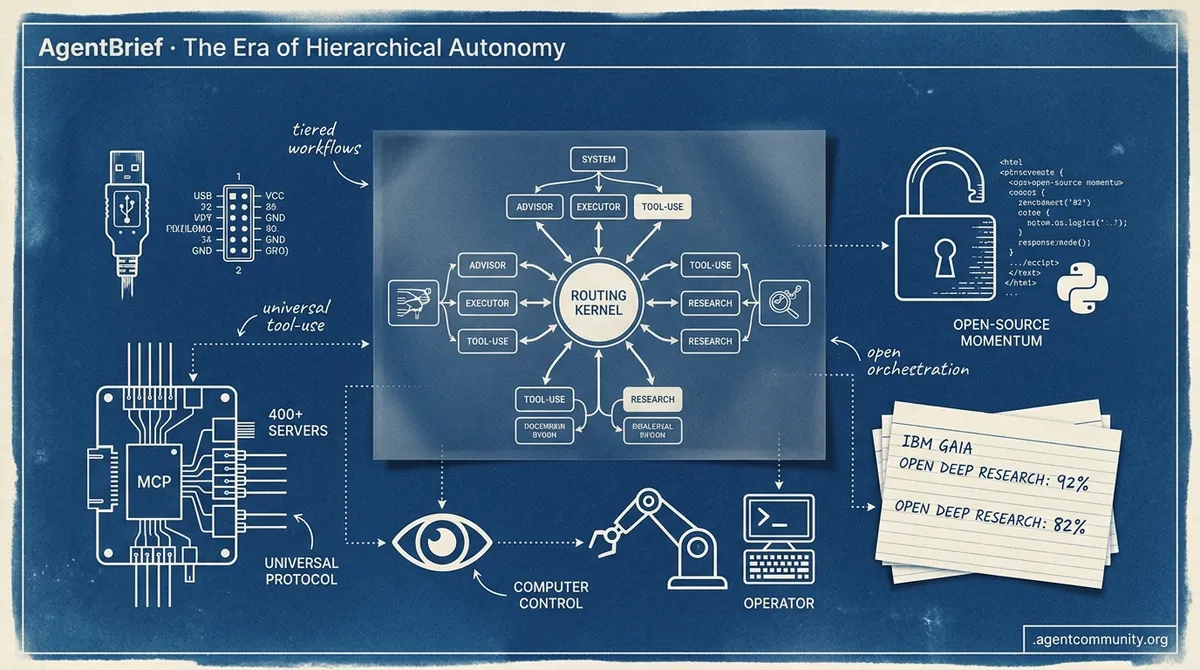
- Standardizing the Stack The explosion of Anthropic’s Model Context Protocol (MCP) to over 400 servers and the rise of code-centric frameworks signal a move toward a universal, USB-like ecosystem for tool-use.
- Hierarchical Over Monolithic Native Advisor-Executor flows and specialized models like GLM-5.1 are replacing brute-force reasoning, allowing builders to architect tiered workforces that manage costs and complexity.
- Crossing the Rubicon OpenAI’s Operator and vision-enabled models are pushing agents into direct computer control, though recent IBM and GAIA benchmarks remind us that autonomous verification and long-horizon planning remain the primary bottlenecks.
- Open-Source Momentum Open Deep Research initiatives are now reaching 82% of proprietary performance, proving that transparent Python execution is rapidly closing the gap with closed-source research agents.
X Intel & Routing
Stop brute-forcing your agent's reasoning and start orchestrating its hierarchy.
The agentic web is moving away from the 'monolithic model' fallacy toward sophisticated orchestration. For months, we’ve been custom-coding routing logic to save costs, but the infrastructure is finally catching up to the pattern. This week, Anthropic formalized the 'Advisor-Executor' flow, effectively giving us a native way to let a high-reasoning specialist supervise a fleet of cheaper workers. It’s a direct response to the 'agent cost wall' that hits every production-scale project.
At the same time, the open-weight world is proving that 'general chat' is no longer the target. GLM-5.1 is out-performing frontier models on SWE-Bench specifically because it prioritizes tool-use and long-horizon reasoning. Between native hierarchical routing and specialized open-source agent models, the developer toolkit is shifting from 'building a chatbot' to 'architecting a workforce.' If you aren't thinking about model tiering and specialized benchmarks like Terminal-Bench, you're building for last year's web. Today's stories highlight why the future of autonomy is cheaper, open, and strictly hierarchical.
Hierarchical Routing Unlocks Cheap Frontier Performance
Anthropic's advisor tool has formalized the hierarchical 'Advisor-Executor' pattern within the Claude Messages API, currently in public beta. This allows Sonnet or Haiku executors to consult Opus for 400-700 token strategic plans at critical decision points within a single API request @claudeai @claudeai. To activate this, builders must use the beta header anthropic-beta: advisor-tool-2026-03-01; notably, the advisor's output remains hidden from end-users and is billed at Opus rates only for the specific tokens used @akshay_pachaar.
Official benchmarks demonstrate that this native integration solves the context fragmentation typical of manual routing. A Sonnet + Opus advisor configuration achieved 74.8% on SWE-bench Multilingual, representing a +2.7pp improvement over solo Sonnet while actually reducing the cost per task by 11.9% ($0.96 vs. $1.09) @claudeai @aakashgupta. Even more striking is the Haiku + Opus pairing, which jumped to 41.2% on BrowseComp from a solo baseline of 19.7%, costing 85% less than running Sonnet solo @akshay_pachaar @brainmirrorai.
For agent builders, this pattern—echoed by those using GPT-5.4 Pro for planning alongside cheaper models for execution—addresses the persistent 'agent cost wall' better than custom orchestration @joshclemm @Vtrivedy10. While some contrarians point out that rate limits remain a hurdle for massive scaling, the consensus from researchers is that this validates the 'Advisor Models' approach as a standard for production agent architectures @saneord @AlexGDimakis.
GLM-5.1 Delivers Frontier Agent Performance in Droid at Half the Cost
The open-weight landscape has a new leader in GLM-5.1, a 754B MoE model from Z.ai that has secured the #1 open-source and #3 global spot on SWE-Bench Pro (58.4%). Designed for long-horizon autonomy, the model has demonstrated the ability to sustain 8-hour runs with over 6,000 tool calls @Zai_org @Zai_org. Integration into the Droid framework by @FactoryAI reveals its proficiency in handling modern stacks and legacy migrations alike, delivering frontier-level performance at half the cost of previous proprietary leaders.
Early production testers report that GLM-5.1 matches Claude Opus 4.6/4.7 on agentic coding tasks while costing approximately 1/12th the price on input tokens @migtissera @songjunkr. This efficiency is credited to the model's 'narrow, specialized intelligence' focus, which allocates parameters specifically toward tool-use and reasoning rather than general conversational chat @Vtrivedy10. In the Code Arena, it currently ranks #3, placing it on par with Claude Sonnet 4.6 and ahead of GPT-5.4 @arena.
Despite these gains, builders should be aware of specific limitations; for instance, GLM-5.1 struggled with creative coding tasks on the BridgeBench lava lamp test compared to Claude Opus @bridgebench. However, for technical agent workloads, its native 200K context and reliable multi-step iteration make it a 'legit' production contender @ZenMuxAI. Z.ai has already released a tool-calling fix for vLLM and SGLang deployments to further solidify its stability @Zai_org.
In Brief
Shopify AI Toolkit Grants Coding Agents Direct Backend Access via MCP
Shopify's new AI Toolkit allows agents like Claude Code and Cursor to manage store backends directly through MCP, enabling bulk inventory and SEO optimizations in seconds. While developers like @debarshi_019 praise the terminal-first approach for bypassing chatbots, the lack of native 'undo' functions or confirmation steps has sparked warnings from @MaxCurnin regarding the 'blast radius' of unconfirmed prompts. Builders are currently advised to implement manual backups and pre-execution checks to mitigate risks of accidental inventory wipes @GoKiteAI @jpaylor.
Hermes Agent Gains Traction Amid Claude Code Billing Controversies
Nous Research's Hermes Agent is positioning itself as a transparent, open-source alternative to Claude Code following reports of opaque API billing triggered by specific git files. Lead engineer @Teknium argues that pairing Opus with Hermes' 4-layer memory architecture creates a superior, auditable workspace experience that avoids vendor lock-in. Although Anthropic attributed the billing issue to a '3rd party harness detection bug' and issued refunds @trq212, the incident has accelerated the adoption of Hermes for routine operations and research due to its full prompt inspection capabilities @om_patel5.
DOJ Joins xAI Lawsuit to Block Colorado's AI Anti-Discrimination Law
The U.S. Department of Justice has intervened in xAI's federal lawsuit against Colorado, claiming SB24-205 violates the Fourteenth Amendment by imposing unconstitutional discrimination requirements on AI developers. xAI contends the law forces systems like Grok to embed state-preferred views on diversity, which chills speech and complicates the deployment of autonomous agents @GuntherEagleman @CivilRights. Agent builders see this as a pivotal test for national versus state-by-state regulatory frameworks, as a win for xAI could invalidate similar 'algorithmic bias' laws nationwide @aakashgupta @BSCNews.
Quick Hits
Agent Frameworks & Orchestration
- Jido agents can run 1,000s simultaneously on a 4GB Raspberry Pi using Elixir. — @mikehostetler
- AgentCraft creator @idosal1 keynoted on the framework at AI Engineer Europe 2026. — @idosal1
- New open-source platform released for orchestrating complex AI agent workflows. — @tom_doerr
Models for Agents
- GPT-5.4 Pro planning capabilities come with a high API cost of $30/$180. — @Vtrivedy10
- Tencent released HY-Embodied-0.5, a model family for real-world embodied agents. — @TencentHunyuan
- Gemini 3.2 Pro Preview Experimental has been spotted in the wild by testers. — @willccbb
Tool Use & Skills
- The OpenClaw marketplace now features over 5,200 AI agent skills. — @tom_doerr
- Best practice: MCP servers should include skills in resources with tool fallbacks. — @RhysSullivan
The Reddit Dispatch
OpenAI moves from conversation to execution with the rollout of its autonomous browser agent.
We have officially crossed the Rubicon from AI as a sounding board to AI as a digital workforce. OpenAI’s release of Operator marks a pivotal shift toward the Agentic Web, where models no longer just suggest travel itineraries—they book the flights and handle the forms themselves. This isn't just about a new interface; it's a fundamental change in how we architect autonomous systems. We are seeing a convergence of reliable state management in frameworks like LangGraph, the rise of 'push-based' memory through Mem0, and the realization that raw model power is insufficient without robust browser-level execution.
For builders, the challenge is shifting from prompt engineering to complex orchestration. It is about managing the 'messy reality' of production—handling silent JSON-RPC failures and navigating the inherent fragility of web environments. Today’s issue explores the benchmarks of this new era, comparing the reasoning of Claude 3.5 with the tool-use capability of Llama 3.1, and exploring infrastructure like Skyvern that bridges the gap to legacy systems. The era of doing has arrived, and it is stateful, persistent, and incredibly promising for those building the next generation of autonomous tools.
OpenAI Operator: The Browser-First Pivot to Autonomous Action r/AI_Agents
OpenAI has officially entered the era of 'doing' with the rollout of Operator, an autonomous agent powered by the new Computer-Using Agent (CUA) model, now accessible via operator.chatgpt.com for Pro Tier users in the U.S. While early rumors pointed to a January launch, the system is now demonstrating its ability to bypass traditional UIs by interacting with a virtual web browser to book flights, reserve hotels, and execute form-based workflows. Technical benchmarks reveal that while full OS control remains a 'frontier' task with a 38.1% success rate on OSWorld, Operator is highly proficient in browser environments, scoring 58.1% on WebArena and 87% on WebVoyager.
As noted in community discussions on r/AI_Agents, this transition is part of the 'Agentic Web' maturation, moving away from simple conversational prompts toward governed, autonomous systems that can handle production realities. However, developers in the r/mcp community warn that persistent cloud browsers remain essential to avoid the 'context rot' and silent JSON-RPC failures common in early tool-use implementations. This launch signals a competitive race for the desktop controller layer, challenging existing offerings that previously boasted high success rates in basic navigation.
LangGraph Formalizes Persistence with Checkpoint v4.0.2 r/LangChain
The developer community is increasingly pivoting from linear chains to cyclic graphs for agentic workflows to enable autonomous error correction and iterative planning. LangChain's LangGraph has solidified its position as the preferred framework for stateful, multi-agent systems, particularly with the release of LangGraph CLI v0.4.22 and Checkpoint v4.0.2 on April 17, 2026. These updates introduce 'deploy source tracking,' which significantly enhances deployment observability for long-running agents.
Practitioners report a 30% reduction in code complexity when migrating from custom state machines to LangGraph's native persistence layers, according to discussions on r/LangChain. This shift allows agents to maintain state through human-in-the-loop (HITL) interventions and resume tasks after extended inactivity. As u/algomart emphasizes, robust state serialization is now the foundation for reliable AI workflows, moving the needle from ephemeral chat to persistent, production-grade agentic labor.
Llama 3.1 vs. Claude 3.5: The Tool-Use Frontier r/LocalLLaMA
Meta's Llama 3.1 70B and 405B models have established a new baseline for open-source tool use, with Meta reporting state-of-the-art performance in function calling and complex tool selection. While Llama 3.1 405B is recognized as the largest publicly available model, independent evaluations suggest it still trails Claude 3.5 Sonnet in critical coding and reasoning benchmarks. Specifically, Claude 3.5 Sonnet achieved a 64% success rate in coding problem-solving, nearly doubling the performance of previous generations like Opus.
Practitioners at r/LocalLLaMA note that while Llama 3.1 rivals GPT-4o in basic function calling, fine-tuning for specific JSON schemas is often necessary to reduce hallucinations by 15-20% in production loops. However, testing by Vellum reveals a nuanced performance profile for the 70B model: while it demonstrated a 15% boost in math accuracy, it faced a 12% regression in reasoning tasks compared to earlier iterations. This indicates that frontier models like Claude 3.5 Sonnet maintain a lead in the multi-step reasoning required for autonomous agents.
Mem0 and the Rise of Stateful Agentic Memory r/Rag
Mem0 is shifting the industry paradigm from stateless, pull-based RAG to a stateful, 'push-based' memory architecture that treats user preferences as evolving data points rather than static chunks. While traditional RAG is often misused for context, Mem0 utilizes a dedicated Extraction & Update phase to maintain multi-session continuity. This shift is now measurable via the LOCOMO benchmark, a new standardized evaluation dataset designed for long-term conversational memory that validates the performance gap between simple vector retrieval and dedicated memory management.
Early pilot projects using this active memory approach have reported a 40% improvement in user satisfaction, while technical benchmarks show agents can achieve an 80% task completion rate, nearly doubling the 45% baseline of long-context models alone, as shared by u/snozberryface. By scoping searches to a specific USER_ID, Mem0 allows agents to adapt to nuanced workflows without the '70% ingestion tax' typically associated with traditional RAG pipelines, according to u/lucasbennett_1.
WebArena Benchmarks Reveal Agent Fragility
New evaluations on the WebArena benchmark reveal that while state-of-the-art agents are approaching a 55% success rate, they still fail on 45% of high-stakes autonomous workflows involving complex navigation. Researchers at the NeurIPS 2025 Workshop on SEA argue that these metrics often misestimate performance due to 'brittle checkers' and underspecified goals in the original environment. This has led to the development of 'WebArena Verified,' a more rigorous evaluation layer designed to filter out accidental successes.
Beyond raw completion, the industry is pivoting toward safety-first metrics like the Completion under a hierarchy of Policies (CuP) introduced in the ST-WebAgentBench. This metric penalizes agents that achieve goals while violating organizational safety constraints, highlighting that 'demo-ready' performance is insufficient for production-grade reliability where DOM changes and policy adherence are critical for enterprise adoption.
Skyvern Bridges the 'Last Mile' of Legacy Automation
Skyvern is establishing itself as critical infrastructure for agents interacting with legacy web interfaces that lack APIs. Unlike traditional RPA, which relies on fragile, rule-based scripts, Skyvern leverages LLM reasoning and computer vision to navigate complex, non-standard UIs with high precision. This 'reasoning-first' approach allows it to handle dynamic page states and edge cases that typically break autonomous multi-step agents.
A major differentiator for Skyvern is its native handling of CAPTCHAs and 2FA, which are historically the primary blockers for browser automation. By integrating built-in CAPTCHA solving directly into the AI browser workflow, Skyvern maintains high reliability in production environments where stealth and anti-bot resistance are required. The project has reached 20.5K GitHub stars, signaling massive demand for robust automation in sectors like insurance and procurement where legacy systems dominate.
Discord Dev Logs
Anthropic’s MCP hits 400 servers while frontier models face a 'planning wall' on long-horizon tasks.
The agentic web is rapidly moving from the 'can we build it' phase to the 'can we standardize it' era. Today’s lead story on Anthropic’s Model Context Protocol (MCP) highlights this shift, as the ecosystem has exploded to over 400 community-built servers in a bid to create a universal interface for AI agents. This isn't just about connectivity; it’s about reducing the friction that has historically plagued multi-tool systems, with early reports suggesting a 40% reduction in integration time. However, as we build these digital highways, the vehicles—our models—are hitting a significant 'planning wall.' The latest GAIA benchmark data shows that while agents have become excellent at tool invocation, their ability to reason through complex, multi-step tasks remains a bottleneck, with success rates stalling at 35% for high-level logic. We are seeing a divergence in the development stack: frameworks like PydanticAI are doubling down on type-safety and structural precision to solve reliability at the code level, while OpenAI’s 'Operator' and Llama-3.2-Vision are pushing the boundaries of how agents interact with the world through vision and direct computer control. For builders, the message is clear: the infrastructure is hardening, but the reasoning gap requires a move toward more structured orchestration and persistent state management.
Anthropic's MCP Standardizes the 'Agentic USB' Ecosystem with 400+ Servers
Anthropic’s Model Context Protocol (MCP) has rapidly transitioned from a theoretical standard to a massive ecosystem, now boasting over 400 community-built servers with a combined 960,000 GitHub stars tolkonepiu. Designed as a hub-and-spoke model to eliminate bespoke integrations, MCP provides a unified "USB port" for agents to access enterprise data across platforms like Google Drive, Slack, and GitHub TechTitans.
While early adopters in the Discord #announcements channel announcements have dubbed it the "HTTP of the agentic web," they also report a 40% reduction in integration time for multi-tool systems. However, latency in remote server connections remains a primary concern for real-time autonomy announcements. The directory of specialized servers is expanding beyond basic productivity tools to include high-performance infrastructure like Chroma for vector memory and ClickHouse for analytical queries CyberPress.
Developers are also leveraging reference implementations for Puppeteer to give agents native browser-control capabilities without custom scraping logic madhukarkumar. As the protocol matures, the community is exploring "meta-MCP" architectures that would allow agents to autonomously create and store new functionalities, effectively enabling self-growing toolsets Reddit.
Join the discussion: discord.gg/anthropic
PydanticAI Challenges LangChain with Structural Precision and Type-Safety
The launch of PydanticAI marks a significant step toward production-grade agent development by shifting the focus from raw orchestration to structural integrity. Leveraging Python type hints to ensure agent outputs are validated at runtime, PydanticAI reports a 40% reduction in runtime validation errors pydantic_dev, though it still faces an ecosystem maturity gap compared to LangChain's established support XPay.
Join the discussion: discord.gg/pydantic
OpenAI Operator and the Rise of the Computer-Using Agent (CUA)
OpenAI’s 'Operator' has transitioned into research preview, debuting a specialized Computer-Using Agent (CUA) architecture for autonomous web navigation. Engineered to interpret UI elements directly rather than relying on DOM-scraping, Operator currently maintains an 87% success rate on specialized browser tasks, positioning it as a direct competitor to traditional enterprise RPA tools The Decoder.
Join the discussion: discord.gg/openai
LangGraph Persistence Hardens Multi-Agent State for Long-Horizon Tasks
LangGraph has solidified its position in the enterprise stack by enabling agents to maintain state across extended periods of inactivity via its checkpointer API. This persistence layer allows developers to scale to 1,000+ concurrent sessions while providing a "time travel" feature to debug agent decision history, addressing critical reliability needs in legal and insurance sectors Pramod AIML.
Join the discussion: discord.gg/langchain
GAIA Benchmark: Level 3 Tasks Hit 'Planning Wall' at 35% Success
The GAIA benchmark reveals that while tool invocation accuracy has reached 91.5%, models struggle with complex Level 3 reasoning tasks, which remain stalled at a 35% success rate Towards Data Science.
Llama-3.2-Vision Fuels the Rise of Privacy-First Edge Agents
The Llama-3.2-Vision 11B model is emerging as the standard for local-first desktop assistants, achieving sub-100ms latency for vision-to-action loops when optimized with INT8 quantization Zilliz.
Join the discussion: discord.gg/local-ai
HuggingFace Open Research
Open-source deep research hits 82% of OpenAI's performance as the industry pivots from JSON schemas to raw Python execution.
The narrative of the 'agentic web' is shifting from monolithic, proprietary black boxes to transparent, code-centric orchestration. For months, developers have wrestled with the brittleness of JSON-based schemas and the latency of cloud-bound 'Computer Use' APIs. Today’s synthesis suggests those bottlenecks are finally breaking. Hugging Face’s 'smolagents' and the resulting Open Deep Research initiative have demonstrated that by treating actions as raw Python code, we can reduce logic steps by 30% while matching up to 82% of proprietary performance in just a 24-hour development sprint.
This isn't just about speed; it's about a fundamental change in how agents navigate the world. We are seeing high-throughput SSM models like Holotron-12B deliver 8.9k tokens/s, enabling desktop automation that rivals top-tier proprietary systems at a fraction of the latency. However, as we push into these new frontiers, the '20% success ceiling' identified by IBM Research in real-world IT environments reminds us that 'Incorrect Verification' remains a primary failure mode. For practitioners, the takeaway is clear: the tools are becoming modular and the 'USB moment' for AI tool-use is arriving via Unified Tool Use initiatives, but the reasoning depth required for autonomous verification remains the final boss.
Open Source Deep Research: Dismantling the Proprietary Search Moat
Hugging Face's Open-source DeepResearch initiative has successfully replicated the core reasoning loops of proprietary systems, achieving 72-82% of OpenAI's Deep Research performance on the GAIA benchmark within a 24-hour sprint. The architecture relies on the smolagents 'CodeAgent' framework, which utilizes a minimalist 'actions-as-code' paradigm to reduce logic steps and LLM calls by 30% compared to traditional JSON-based workflows. This move toward transparency allows for fully auditable multi-step research loops, addressing the 'black box' concerns prevalent in commercial alternatives.
Community adoption is accelerating through specialized environments like the MiroMind Open Source Deep Research space, which focuses on iterative synthesis, and ScholarAgent, a trending space for academic-focused autonomous research. These implementations frequently pair the reasoning capabilities of models like DeepSeek-R1 with high-throughput search APIs to navigate complex multi-hop queries. Meanwhile, Together AI has released its own open research workflow capable of generating 20+ page detailed reports, further proving that the performance gap between open and closed research agents is closing rapidly.
The High-Throughput Frontier: Holotron-12B and the New Desktop Agents
The 'Computer Use' frontier is shifting from high-latency cloud APIs to high-throughput execution engines like Holotron-12B. H Company has released this SSM-based agent which achieves a staggering 8.9k tokens/s on a single H100, driving WebVoyager success rates from 35% to 80% and rivaling proprietary systems in accuracy while maintaining significantly lower latency.
Beyond the 20% Success Ceiling: New Benchmarks for Agentic Reasoning Depth
Evaluating autonomous systems requires more than simple static tests, as new benchmarks like DABStep reveal a persistent 20% success ceiling in real-world IT environments. While Claude 3.5 Sonnet currently sets the baseline on DABStep with a 52.7% success rate, IBM Research identifies 'Incorrect Verification'—the inability to accurately assess environment states after tool execution—as the primary failure mode for agents in the field.
Quick Hits in the Agentic Ecosystem
DeepSeek-V4 has introduced a 1,000,000 token context window optimized for long tool-use trajectories across its Pro and Flash models DeepSeek-AI.
Standardizing the Fabric
The Unified Tool Use initiative provides a single, portable API across Llama, Mistral, and Command R, ensuring code remains portable with zero model-specific changes.
Physical Reasoning
NVIDIA is extending agentic logic into the physical world with Cosmos-Reason2-8B, a model designed to process spatial and temporal data for robotics NVIDIA.