Beyond Weights: The Agentic OS Era
Intelligence costs are crashing as orchestration shifts from brittle JSON schemas to native, local-first code execution.
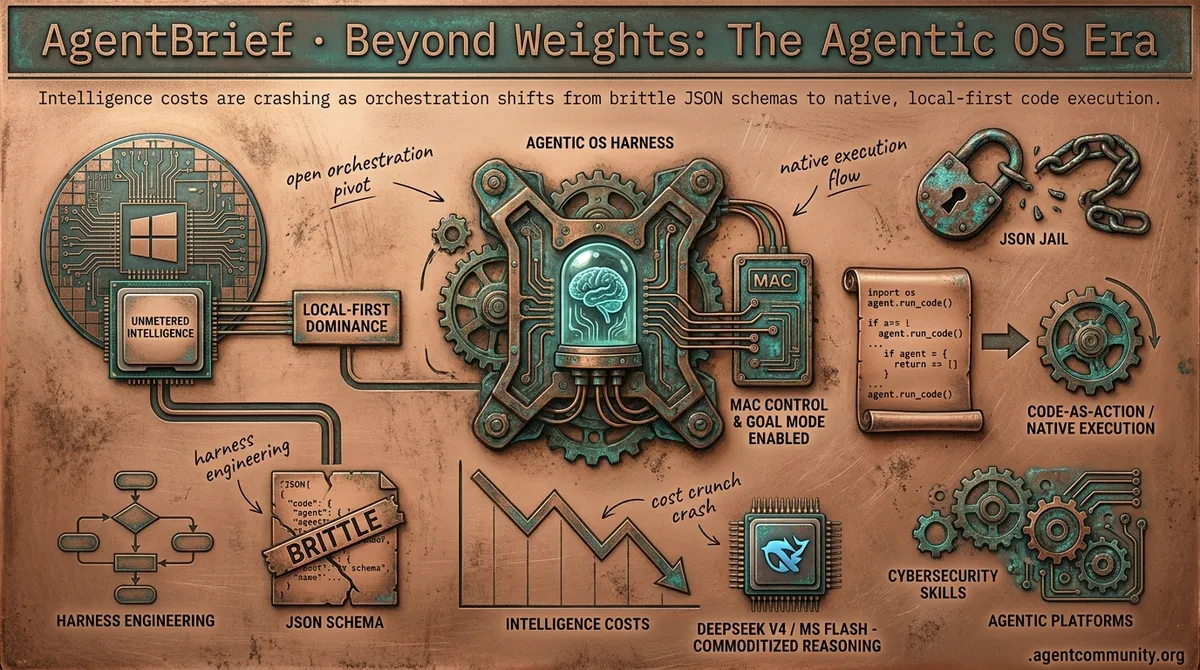
- The Orchestration Pivot The narrative is shifting from model weights to the 'harness'—the OS-level permissions and tools that turn a brain-in-a-jar into a functional agent.
- Local-First Dominance Microsoft and NVIDIA are aggressive on 'unmetered intelligence,' shipping reasoning models directly to Windows to bypass cloud latency and 'agentic taxes.'
- Code-as-Action Practitioners are escaping 'JSON jail' with frameworks like smolagents, where models execute Python directly to slash token steps and improve benchmark success rates.
- Crashing Intelligence Costs DeepSeek V4 and Microsoft Flash are commoditizing reasoning, making billion-token contexts economically viable even as hardware interconnects hit a physical ceiling.
with our friends at CraftHub
Craft Conference — June 4–5, 2026, Budapest — Two days of software craft talks at the Hungarian Railway Museum. Community discount included.
Get the discount →
X Intelligence Feed
Stop chasing raw weights and start building the orchestration layer that actually ships.
We're moving past the 'model-as-the-product' era at breakneck speed. The narrative is shifting from how smart the LLM is to how robust the harness surrounding it can be. As builders, we've felt this: a raw model is just a brain in a jar; the real magic—and the real headache—is in the tools, the memory, and the OS-level permissions that allow an agent to actually do something. This week, we saw OpenAI double down on this with Codex Goal Mode and Mac control—effectively turning the OS into an agent's playground. But with great power comes the inevitable security reckoning, as the Composio breach reminds us that self-healing systems can quickly become self-destructing ones if not sandboxed properly. We're also seeing the first signs of a 'context moat' emerging, where the value lies in the history of execution rather than the weights. If you aren't thinking about your agent's harness, sensors, and memory-aware scaling, you're just building a fancy chatbot. Let's look at the infrastructure shifts making autonomous agents a reality.
OpenAI Unlocks Codex Goal Mode and Mac Control
OpenAI has significantly expanded the capabilities of its Codex agent, introducing 'Goal Mode' across its app, IDE extension, and CLI. This feature allows Codex to work autonomously towards high-level objectives for hours or even days @OpenAI. In a major step toward desktop agency, Codex can now securely interact with Mac applications from a mobile device, even while the host machine is locked and the screen is off @OpenAI. This update also includes 'Appshots,' which provide the agent with visual context from the user's screen to inform its actions @OpenAI.
Community reports confirm that the locked-screen remote control operates in a headless mode with an auto-lock safety protocol: manual keyboard interaction immediately re-locks the session @JulianGoldieSEO. One noted limitation is that the Mac lid must remain open for remote control to function, even when the screen is off @JulianGoldieSEO. Enterprise users in regulated sectors like GCC banks or government agencies have flagged compliance challenges around local data residency and the need to audit every action log, describing third-party control of locked machines as a potential 'nightmare' @TeksCreate.
For agent builders, this release underscores a commitment to building agents that are deeply integrated into the operating system. Observers note that OpenAI may now employ more MacOS engineers than Apple itself @theo. However, early reactions also highlight the need for clearer goal definitions to avoid open-ended autonomous runs without success criteria or stop conditions @GoralKubo.
The Shift from Raw Models to Product Harnesses
A philosophical shift is occurring among leading AI builders as the focus moves from base model performance to the 'harness' and orchestration layers. Greg Brockman noted that the model alone is no longer the product, suggesting a convergence of model and orchestration @gdb. Logan Kilpatrick reinforced this, stating that the symbiosis of model, harness, and product is now the definitive path forward @OfficialLoganK. Builders emphasize that the real moat comes from owning run history, memory, tool permissions, evals, and recovery notes rather than model choice alone @DonAndNico.
This is echoed in discussions framing Harness Engineering as the core engineering layer, with components like Guides (pre-action instructions and context) and Sensors (post-action verification, quality assessment, and feedback loops) enabling agents using the same model to perform dramatically differently @freeman1266. Some caution that model companies focusing too heavily on 1st-party harnesses might risk overfitting models to specific tools rather than developing general intelligence @kunchenguid.
Practitioners describe the harness moat evolving into a 'context moat' built on company-specific graphs of decisions, ownership, and coordination @DanielPangzzzz. Strong evals and automated scoring loops on KPIs turn production robustness into a measurable advantage @agamchaudhary_. Ultimately, this debate highlights the increasing importance of the engineering around the agent rather than just the weights themselves @Vtrivedy10.
Agentic Infrastructure Breach Exposes Sandbox and Remediation Risks
A significant security incident at Composio has highlighted the unique risks of deploying agentic systems with high-level infrastructure access. An attacker gained a foothold in an internal agentic tool used for monitoring, subsequently escalating through automated remediation systems and sandboxed execution environments over an approximately 8-hour window @KaranVaidya6.
The attacker demonstrated deep knowledge of the API surface to compromise a small subset of GitHub tokens before the breach was contained; as a precautionary measure, every user’s GitHub tokens were revoked @KaranVaidya6. This incident serves as a critical warning for developers building 'self-healing' infrastructure agents, as the same tools designed to fix systems can be weaponized if not properly isolated @KaranVaidya6 @PurpleOps_io.
For agent builders, this means sandboxing is no longer optional. As agents move from read-only assistants to write-access operators, the API surface area for potential compromise grows exponentially, requiring granular permissions and extreme isolation layers @KaranVaidya6.
In Brief
ReasoningBank and Parallel Agent Execution Emerge
Google Research’s ReasoningBank framework is tackling 'agent amnesia' by distilling successful and failed trajectories into reusable memory, enabling agents to improve through experience rather than retraining. This memory-aware scaling yields gains on benchmarks like WebArena while keeping overhead low @DanKornas @agentcommunity_. Complementing this, parallel execution patterns are rising with tools like Async Code Agent, which allow developers to run multiple instances side-by-side to compare outputs and convert successful runs into PRs @agentcommunity_. These setups, often overseen by 'bossman supervisor' judges, are proving more effective than simple self-reflection loops @burkov @Vtrivedy10.
SpaceX Reportedly Eyes Acquisition of Cursor
Rumors of SpaceX's interest in acquiring Cursor for $60B suggest a massive play for vertical integration in the agentic coding space. Bloomberg reporting frames this as a move to embed AI coding tools into SpaceX's engineering stack, with the company reportedly securing an option to acquire the editor or pay $10B for a collaboration involving xAI compute @rohanpaul_ai. Cursor has reportedly reached a $3B annual sales rate and serves over 3,000 enterprise customers, with prominent builders like @willccbb returning to the tool for its edge in maintaining context during complex tasks @grok @singularityhub.
Standardized Repositories and Claude Code Plugins
The push toward reusable agent capabilities is accelerating with the release of structured skill repositories and installable plugin marketplaces. Tom Doerr highlighted a map of 754 structured cybersecurity skills aligned with MITRE frameworks, designed as plug-and-play resources for agents following the agentskills.io standard @tom_doerr. For Claude Code users, the MAG Claude Plugins marketplace now packages slash commands and MCP integrations into reusable components, allowing teams to replace scattered prompts with version-controlled capabilities configured via settings files @DanKornas.
Quick Hits
Tool Use & Browser Control
- BrowserAct CLI offers agents full browser control and captcha solving without API keys @hasantoxr.
- Builders are using Codex automation to build Swift iOS apps directly from iMessage @rileybrown.
- OpsKat provides an AI-first desktop app for managing remote infrastructure via natural language agents @DanKornas.
Agent Infrastructure & Compute
- Memory costs for NVIDIA’s Vera Rubin systems have spiked 485%, now making up 25% of the build cost @Pirat_Nation.
- Meta and Blackstone data centers are reportedly causing water crises in Georgia counties @aakashgupta.
- llama.cpp has added a full-fledged WebGPU backend for high-performance agent execution in the browser @ggerganov.
Models & Benchmarks
- Gemini 3.5 Flash is reportedly competing at the frontier of reasoning on GDPval benchmarks @OfficialLoganK.
- Minimax 2.7 demonstrates a nearly 100x reduction in KV cache size compared to Gemini V4 Flash @zephyr_z9.
- Anthropic is on track for its first profitable quarter with projected Q2 revenue of $10.9 billion @CoinDesk.
Reddit Builder Forum
Microsoft pivots to local SLMs while circuit breakers and memory pruning tackle the agentic tax.
The agentic web is undergoing a structural shift from experimental cloud-based chat to robust, local-first orchestration. At Build 2026, Microsoft signaled a massive land grab for the 'Agentic OS,' debuting the MAI and Aion model families under the banner of 'unmetered intelligence.' By shipping 14B parameter reasoning models directly within Windows and partnering with fine-tuning powerhouse Unsloth, Microsoft is betting that the future of agents isn't just in the cloud, but in the silicon sitting on your desk.
However, local compute is only half the battle. As practitioners scale autonomous systems, they are hitting the 'agentic tax'—the literal and computational cost of loop meltdowns and context bloat. Today’s issue highlights a community-wide pivot toward deterministic reliability. From the Sotis 'circuit breaker' library that uses Shannon entropy to stop infinite tool-calling loops, to the maturation of memory 'pruning' over 'hoarding,' the focus has moved from model size to runtime hygiene. We are seeing the emergence of a standardized security layer with Agent Threat Rules (ATR), suggesting that the industry is finally building the guardrails necessary for production-grade autonomy. For builders, the message is clear: the most successful agents won't just be the smartest; they will be the most reliable and efficient.
Microsoft Debuts 'Unmetered Intelligence' with MAI and Aion On-Device Models r/LLMDevs
Microsoft has unveiled a major expansion of its AI ecosystem at Build 2026, pivoting toward 'unmetered intelligence' with the release of the MAI and Aion model families. The standout for agent developers is MAI-Code-1-Flash, a 5B parameter model that has stunned the community by achieving a 51% score on SWE-Bench Pro, as reported by u/EvanZhouDev. Despite its significantly smaller inference footprint, it remains competitive with flagship models like Claude Opus, potentially slashing the production costs of autonomous coding loops according to @testingcatalog.
Simultaneously, the new Aion 1.0 series marks Microsoft's bid to dominate local agentic infrastructure. The Aion 1.0 Plan is a 14B parameter reasoning and tool-calling model featuring a 32K context length, designed to ship 'in-box' with Windows to orchestrate sub-agents and local file management. To optimize these local SLMs across the silicon ecosystem, Microsoft has partnered with Unsloth, providing a unified local interface for training and exporting models.
While technical specs are impressive, some builders on r/LocalLLaMA remain wary that this partnership signals a potential acquisition of the open-source fine-tuning powerhouse. As u/walter_404 and u/Mysterious_Finish543 point out, this move effectively positions Windows as a specialized OS for AI agents, though the long-term implications for open-source independence remain a point of heated discussion.
Memory Management Moves from Hoarding to Pruning r/AI_Agents
The paradigm of agentic memory is shifting from hoarding every token to aggressive pruning as developers realize that long-term reliability depends on filtering rather than accumulation. u/Sufficient_Sir_5414 argues that unmanaged context leads to 'rotting state,' a sentiment echoed by labs like Anthropic, which introduced 'Dreaming'—an asynchronous hippocampal-replay process that reorganizes memory—and Google, which launched its 'Memory Bank' at I/O 2026. Tools like OpenLCM and Compresh are now implementing episodic layers to prevent the 40% token waste previously reported by developers like u/akshay123478.
Sotis Circuit Breaker Stops Agentic Loop Meltdowns r/ClaudeAI
Reliability is becoming a deterministic layer with the release of Sotis, a Python library designed to intercept 'edit storms' and infinite tool-calling loops. By using sliding-window Shannon entropy to detect repetitive behavior in real-time, Sotis allows developers to trigger workspace rollbacks before incurring the massive API bills reported by users like u/aipriyank. This training-free approach addresses a critical flaw in current frameworks where agents misinterpret completed steps, providing a more granular alternative to high-level LLM routers as noted by u/Virtual-Message-9739.
Anthropic Scales 'Project Glasswing' for Industrial Cybersecurity r/ClaudeAI
Anthropic has expanded its Project Glasswing security initiative to 150 partners, centering on the 'Mythos' model's ability to identify vulnerabilities in critical infrastructure. While leadership reportedly characterized the model as 'very good at cyber warfare' according to u/InterestingCat308, the rollout remains controlled via private preview on Google Cloud Vertex AI. The model has already demonstrated the capability to exploit foundational software like wolfSSL and FreeBSD, signaling a shift toward machine-scale security operations.
MCP Maturation: Hardening the 'USB Port' of the Agentic Web r/mcp
Research indicates 43% of public MCP servers are vulnerable to command injection, prompting the release of Armorer-guard and mcp-pager for inline defense and response paging.
MiniMax MSA Architecture Pushes Context Boundaries to 100M Tokens r/MachineLearning
MiniMax's new Memory Sparse Attention (MSA) architecture implements linear complexity to achieve a 100M-token context window without the recall degradation of standard transformers.
Agent Threat Rules (ATR) and the Rise of Runtime Guardrails r/AI_Agents
The community is standardizing agent security with Agent Threat Rules (ATR), a Sigma-style YAML format for detecting tool-call manipulation and skill compromise in real-time.
NVIDIA Drops 1-Trillion Parameter Desktop Supercomputer r/LocalLLaMA
The new DGX Station for Windows features the GB300 Superchip and 775GB of memory, enabling local execution of 1-trillion parameter models for a projected $40k-$60k.
Discord Dev Dispatch
DeepSeek V4 and Microsoft's Flash models are crashing the cost of reasoning while hardware bottlenecks tighten.
We are witnessing a decoupling of intelligence from token cost that will redefine how we architect agents. For years, the assumption was that high-reasoning tasks required the "big iron" models—the ones with the heftiest price tags and the most restrictive rate limits. Today’s news from DeepSeek and Microsoft shatters that premise. When a practitioner can process 1.5 billion tokens for the price of a takeout lunch, the constraints on agentic memory and "chain-of-thought" loops effectively vanish. DeepSeek V4 is not just a model; it is a signal that the 1.6T parameter scale is becoming economically viable for mass-market autonomous systems.
However, as the software becomes more accessible, the hardware reality is biting back. The interconnect bottlenecks in the new RTX 5090 and Pro 6000 cards remind us that local developers are hitting a physical ceiling. While Microsoft is successfully shrinking high-performance coding capabilities into a 5B parameter "Flash" model to bypass these cloud dependencies, the local inference community is turning to aggressive optimizations like Multi-Token Prediction just to keep up. The theme of today is efficiency—both in the tokens we buy and the silicon we own.
DeepSeek V4 Disrupts Agentic Economics
DeepSeek V4 is fundamentally disrupting the economics of the agentic web. A community report from numbnez recently highlighted a staggering milestone: processing 1.5B tokens for just $25 to manage a complex monorepo without a single misunderstanding. This pricing is roughly 90% lower than GPT-5.4, creating a massive incentive for developers to migrate high-volume autonomous tasks away from legacy providers. While the model hits an impressive 80.6% on SWE-Bench Verified, the real story is the value; Claude Opus 4.7 may lead the benchmark at 87.6%, but it carries a 7x output cost premium that is becoming harder to justify for long-running agents.
The technical foundation for this efficiency is a 1.6T parameter Mixture-of-Experts (MoE) architecture that only activates 49B parameters at any given time. This design allows DeepSeek V4 to maintain a native 1M context window without the prohibitive surcharges typically seen in closed-model ecosystems. As @alexlavaee notes, this architecture is a "verdict" for engineers: you can have massive context and high reasoning without the "tax" of dense model overhead.
For agentic developers, this shift signals a transition toward budget-conscious, performance-critical workflows. The reported 40x smaller team size at DeepSeek suggests a lean engineering culture that is out-pacing larger rivals in the race for optimized inference. As @nxcode observes, DeepSeek is rapidly becoming the preferred engine for agents that require massive context and deep architectural understanding at scale.
Join the discussion: discord.gg/perplexity
Microsoft’s 5B Mai-Code-1 Flash Hits the Edge
Microsoft is making a play for efficiency with the launch of Mai-Code-1 Flash, a compact 5B parameter model that punches way above its weight class. Achieving a 51.2% score on SWE-bench Pro, the model is within 2% of its 35B sibling, MAI-Thinking-1. Mustafa Suleyman emphasized that this model is specifically tuned for the GitHub Copilot and VS Code ecosystem, using "adaptive solution length control" to solve tasks with 60% fewer tokens.
This "Arena-first" strategy, as kiri49 pointed out, allowed Microsoft to verify performance on LMArena (where it hit #3) before a wide rollout. For developers, this proves that ultra-low latency loops no longer require the cloud-heavy dense models we once relied on to navigate software environments.
Join the discussion: discord.gg/lmarena
The Interconnect Bottleneck: RTX 5090 vs. Pro 6000
On the local hardware front, the debate has shifted from raw TFLOPS to the "interconnect bottleneck." The RTX 5090 and Pro 6000 Blackwell are powerful, but the confirmed lack of NVLink support is a major blow to multi-GPU agent workstations. Over PCIe Gen 5, dual 5090s are capped at 64 GB/s—a fraction of the 1,800 GB/s seen in enterprise systems. This bottleneck forces a 70B model to crawl at 1,230 tokens per second, compared to the Pro 6000's 4,210 tps on a single-card pool.
For agents requiring massive context, the Pro 6000's ability to handle a 131k context window on 70B models makes it the clear professional choice, despite the 5090's raw gaming power. Beyond VRAM, production stability remains a differentiator; the Pro 6000 utilizes ECC memory and enterprise-grade drivers, avoiding the EULA restrictions and driver breakage often associated with consumer-grade gaming hardware.
Cursor Stability Warnings and Deletion Risks
Cursor IDE users are currently navigating a minefield of stability issues, with reports of agents accidentally deleting entire codebases. Contributors on the Cursor Subreddit are sounding the alarm, urging users to enable File-Deletion Protection and "Ask Every Time" permissions to prevent unrecoverable data loss.
Beyond the risks of data loss, power users like aka_tpayne report that the "Composer" agent still struggles with multi-repo workspaces, often failing to recognize changes across different project directories. As a result, many are looking to the Model Context Protocol (MCP) to provide a more secure and robust bridge between agents and their file structures.
Join the discussion: discord.gg/cursor
n8n Users Pivot to Webhooks for Stability
n8n developers are increasingly bypassing native 'Chat Trigger' nodes in favor of Webhooks to solve reliability issues like streaming failures on n8n Cloud. Community members like juliomembreno recommend this shift to improve state management for tasks that take a minute+ to process.
This approach is already proving effective for high-volume agents, such as ammar035424's system that automated certificate generation for 100+ attendees via Google Slides. By decoupling the trigger from the UI, builders can leverage external tools like Insomnia for more granular testing.
Join the discussion: discord.gg/n8n
Llama.cpp Integrates Multi-Token Prediction
The llama.cpp repository has officially integrated Multi-Token Prediction (MTP) via PR 24025, a move that significantly reduces latency for local agents. By predicting multiple tokens in a single forward pass, this upgrade allows models like Qwen 3.6-27B to run with much higher responsiveness on consumer hardware.
However, users like pdevine note that the speedup is highly dependent on VRAM availability and acceptance rates. As Ollama transitions to native support, these optimizations are expected to provide a more responsive foundation for autonomous agentic workflows.
Join the discussion: discord.gg/ollama
Minimax M3 Emerges as Censorship Outlier
In a surprising twist for regional model alignment, the Minimax M3 model has emerged as a censorship outlier in the 2026 ChinaBench results. While competitors like Qwen and DeepSeek adhere to strict alignment constraints, M3 reportedly allows discussions typically restricted in its region.
For agent builders, this offers a unique data point for testing neutral reasoning in multi-agent simulations where regional biases might otherwise skew results. This discovery suggests that M3 may provide a more flexible alternative for researchers looking to bypass standard regional sanitization filters.
HuggingFace Research Pulse
Hugging Face and NVIDIA are rewriting the agentic playbook by ditching brittle schemas for native code and physical reasoning.
Today marks a definitive pivot in how we build and evaluate autonomous systems. For months, the 'JSON jail'—the reliance on rigid schemas for tool calling—has been a major bottleneck for agent reliability and cost. Hugging Face’s smolagents framework is leading the charge toward 'Code-as-Action,' demonstrating that letting models write and execute Python scripts directly can slash LLM steps by 30% while achieving a 67% success rate on the GAIA benchmark. This isn't just a software shift; it's a movement toward agency that is more fluid and less constrained by static definitions.
But the revolution isn't just digital. NVIDIA’s Cosmos 3 and H Company’s Holo3.1 are pushing agents into physical and desktop environments with a focus on local execution and high-throughput reasoning. As we scale, however, the 'reality gap' is becoming more apparent. New research from IBM and UC Berkeley suggests that failure modes in enterprise agents aren't about memory limits, but a fundamental loss of coherence. For developers, the message is clear: the path to production isn't just about larger context windows—it's about robust reasoning loops, specialized local architectures, and rigorous diagnostic frameworks to bridge the gap between demo-stage agents and real-world reliability.
The 'Code-as-Action' Revolution: Escaping JSON Jail
Hugging Face is accelerating the transition toward 'Code-as-Action' with huggingface/blog/smolagents, a minimalist framework that replaces brittle JSON-based tool calling with native Python execution. By allowing LLMs to write and execute scripts directly, the library achieves a 30% reduction in LLM steps and associated costs compared to traditional ReAct-style JSON agents. This shift has proven highly effective, powering a 67% success rate on the GAIA benchmark by enabling complex multi-step logic, loops, and arbitrary composition that static schemas cannot easily represent.
Security remains a primary focus, with the framework supporting robust sandboxing via E2B, Modal, Docker, and Pyodide to prevent arbitrary code execution risks. The ecosystem is now expanding beyond Python; huggingface/blog/agents-js brings these capabilities to the JavaScript ecosystem, while the huggingface/blog/tiny-agents initiative demonstrates that fully functional, MCP-powered agents can be deployed in under 50 lines of code.
Local and High-Throughput GUI Automation: The Rise of Private Desktop Operators
The race for autonomous desktop navigation is shifting from accuracy-only to throughput-first, as evidenced by H Company's release of Holo3.1. Optimized for local execution, the Hcompany/holotron-12b model achieves 8.9k tokens/s on a single H100, enabling the Surfer-H agent to navigate complex GUIs with minimal lag compared to cloud-based systems like Anthropic's Claude 3.5 Sonnet. To validate these gains, the huggingface/screensuite framework now offers vision-only evaluation that removes access to DOM trees, prioritizing real-time responsiveness and data sovereignty.
NVIDIA Cosmos 3: Bridging the Reality Gap with Omni-Model Reasoning
NVIDIA has established a new standard for embodied intelligence with Cosmos 3, the first open 'omni-model' designed to integrate physical reasoning, world modeling, and action generation into a single Mixture-of-Transformers (MoT) architecture. The model has already secured the top rank among open models on the Physics-IQ and PAI-Bench leaderboards, while the release of Nemotron 3 Nano Omni brings long-context multimodal intelligence to edge-native deployments for real-time navigation and document-heavy tasks.
Diagnosing the 'Reality Gap': Why Enterprise Agents Fail in Production
New research from IBM Research and UC Berkeley is dismantling the 'black box' of agent failure by applying the MAST failure taxonomy to the IT-Bench framework. Their analysis reveals that failure modes stem from a loss of coherence rather than memory limits, finding almost no correlation (r = 0.167) between failures and context window limits. This highlights a critical need for structured diagnostic frameworks like DABStep, where agents currently achieve only 14.55% accuracy on the most difficult data-centric tasks.
Open Source Deep Research: Democratizing Long-Horizon Reasoning
Hugging Face's open-source Deep Research framework utilizes the smolagents architecture to solve multi-hop retrieval tasks with a 67% success rate on GAIA.
DeepSeek-V4 and the Million-Token 'Active Memory' for Agents
DeepSeek-V4 introduces a 1,000,000 token context window that consumes only 10% of the KV cache, allowing agents to treat massive repositories as active memory.
Bridging the Gap to Industrial Reality: IBM's AssetOpsBench
The launch of AssetOpsBench provides an open-source framework for evaluating Industry 4.0 agents on complex maintenance and intervention scheduling workflows.