Engineering for the Agentic Tax
Builders are pivoting from 'smart' to 'efficient' as autonomous loops challenge the economics of the flat-rate web.
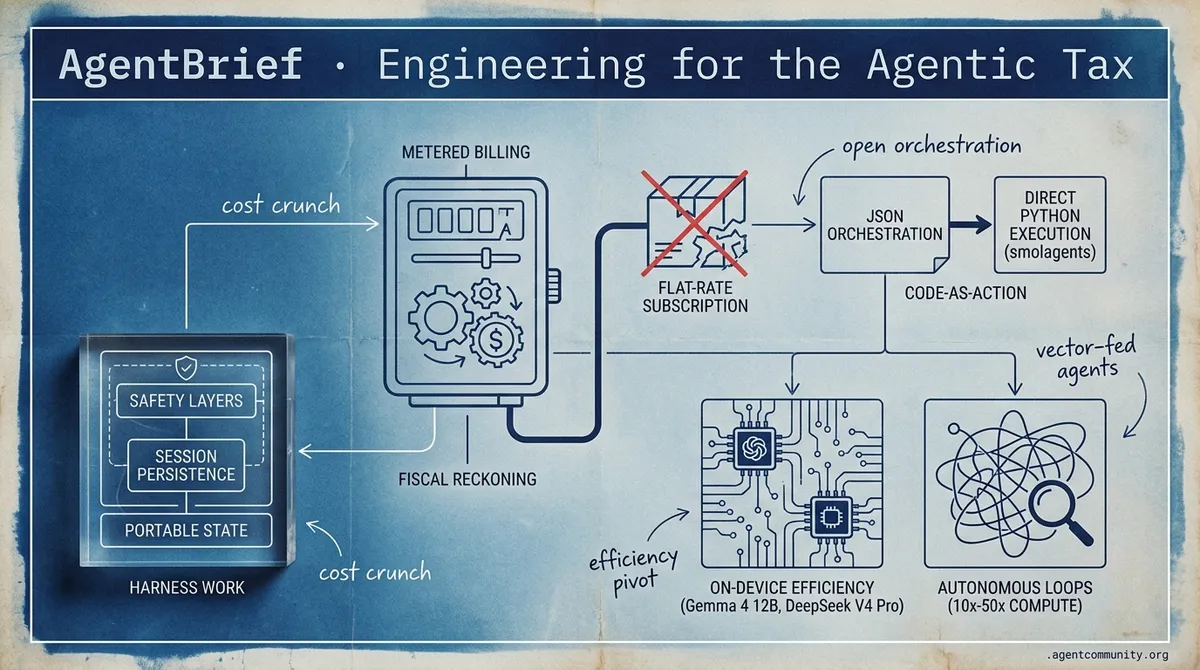
- The Fiscal Reckoning Microsoft’s pullback on internal agent licenses signals a broader industry shift from flat-rate subscriptions to strict metered billing as autonomous loops consume 10x to 50x more compute than human users.
- The Harness Era Developers are moving beyond simple prompt engineering toward 'harness work,' prioritizing safety layers, session persistence, and portable state over raw reasoning scores.
- Code-as-Action Pivot Rigid JSON-based orchestration is giving way to 'Code-as-Action' frameworks like Hugging Face’s smolagents, which reportedly reduce LLM steps by 30% by allowing agents to execute Python directly.
- On-Device Efficiency Google’s Gemma 4 12B and DeepSeek V4 Pro are resetting the baseline for multimodal intelligence, enabling sophisticated agentic workflows on consumer hardware while minimizing token costs.
X Intelligence Feed
Your flat-rate subscription just became an agentic liability.
We are witnessing the end of the 'all-you-can-eat' era for AI. For years, builders enjoyed the luxury of flat-rate subscriptions while shipping simple chatbots, but the rise of the agentic web has fundamentally broken that business model. Agents don't just 'chat'; they iterate, loop, and call tools in cycles that consume 10 to 50 times the compute of a human user. This week, the industry responded by slamming the door on flat fees, shifting toward strict metered billing that treats every agentic token as a premium asset.
But this isn't just about rising costs—it's about the maturation of the stack. While providers tighten their belts on compute, they are opening the doors on architectural complexity. We’re seeing a shift from simple prompt engineering to sophisticated 'harness work,' where the value lies in the safety layers, session persistence, and self-distillation recipes that make agents reliable. If you are still 'tokenmaxxing' without an optimization strategy, you’re building on a crumbling economic foundation. The agents that survive will be those that can reason efficiently within these new constraints. It’s time to stop building demos and start engineering for the usage-based reality of the agentic web.
The Death of 'Tokenmaxxing' and Flat-Rate Compute
The era of 'all-you-can-eat' AI subscriptions is coming to an abrupt end as agentic workloads force a shift toward strict usage-based pricing. @theo reports that developers are moving away from flat fees because agent-driven message chains are significantly more expensive and token-heavy than human interactions. This shift is driven by a compute constraint where 'all-you-can-eat' models were essentially 'hemorrhaging money' in an agent-first world, as noted by @GaryMarcus.
This economic reality is forcing a pivot where freed-up compute is being sold to enterprises at significantly higher margins. @theo highlights that the revenue difference between consumer subscriptions and enterprise compute sales can be as high as 1,000x. For agent builders, this means 'tokenmaxxing'—the practice of stuffing context with every possible tool and prompt—is no longer economically viable without sophisticated optimization strategies.
Recent developments confirm the trend across providers: GitHub Copilot shifted to usage-based AI Credits on June 1, 2026, while Anthropic's Claude CLI is moving to usage-based pricing effective June 15, with separate per-user credits that do not pool or rollover @aplomb2 @dAAAb. Google has also introduced compute-based usage limits for Gemini AI Pro, replacing fixed credits with metering that varies by prompt complexity @HedgieMarkets.
Builders note that agentic workflows can consume 10-50x more tokens than simple completions, rendering flat-rate models unsustainable @demian_ai. As providers move to distinguish interactive human use from autonomous agentic compute, developers must prioritize token efficiency and granular execution logs to maintain project margins.
Targeted On-Policy Self-Distillation for Reliable Agents
New post-training recipes are emerging to solve the 'noisy signal' problem in agentic workflows. @dwarkesh_sp details a method for targeted on-policy self-distillation, where models learn to correct specific rollout errors—such as calling non-existent tools—rather than relying solely on final rewards. This approach is gaining traction at the frontier, with @natolambert noting its high impact on modern post-training recipes compared to previous academic work.
Builders are being encouraged to move beyond 'strict RL verification' toward self-distillation objectives. @willccbb argues that if a model can be convinced by a panel of humans that a document improves performance in context, that performance is improvable via these distillation methods. This represents a shift toward more granular, verifiable engineering environments for agent behavior tuning.
Recent papers such as SDAR (Self-Distilled Agentic Reinforcement Learning) introduce gated auxiliary objectives to stabilize on-policy self-distillation, yielding gains like +9.4% on ALFWorld and +10.2% on WebShop-Acc over GRPO baselines @burny_tech. Complementary work on DAgger-style on-policy distillation for LLM agents reports strong results on SWE-bench Verified, with a 4B model reaching 27.3% and an 8B model at 29.8% @ChangHao564792d.
In Brief
Agents Now Control 65% of Web Traffic
Infrastructure providers are reporting a massive shift in traffic composition, with @handotdev observing that agents now account for over 65% of all content traffic. This surge is reflected in the hardware market, where @Pirat_Nation reports record-breaking NAND flash revenues of $46 billion in Q1 2026—nearly 3.5x year-over-year—driven by data-intensive AI workloads from major cloud providers. This 'agentic web' transition is prompting developers to prioritize 'agent-accessible' APIs and content delivery networks optimized for non-human consumers, as earlier observations noted by @apartovi confirm that bots have now passed human traffic online for the first time in the Internet's history.
Deconstructing the Claude Code Runtime Architecture
Building production agents is increasingly described as 'harness work' rather than just prompt engineering, as evidenced by a detailed architectural analysis of Claude Code by @DanKornas. This breakdown of Claude Code v2.1.88 across ~1,900 TypeScript files reveals a complex safety model with 7 permission modes and a 5-stage context compaction system. Community members like @LeoYu926 emphasize that the harness layer is where product differentiation resides, noting that 90% of operator time now goes into defining what an agent cannot touch. This focus on the harness is further supported by the launch of new public crawlers for curated agent skills that simplify the discovery of installable capabilities for developers @DanKornas.
The Expansion of the Model Context Protocol (MCP)
The Model Context Protocol (MCP) ecosystem is rapidly maturing as a standard for agent-tool interaction, with Strava's launch of an MCP server allowing agents to interact with fitness data natively @marcklingen. Simultaneously, Gradio 6.16.0 has introduced more 'friendly' MCP endpoints for browser visits and enhanced session management features @Gradio. These developments suggest MCP is becoming the go-to interface for making third-party services 'agent-accessible,' while early adopters like @AlmightyaiNova note that domain-specific context in MCP prevents models from inventing definitions during multi-tool workflows.
Quick Hits
Models for Agents
- Google releases Gemma 4 12B, an open-weights model capable of running directly on consumer laptops for local agentic tasks @JeffDean.
- Nous Research confirms Qwen 3.6 will include specialized agent profiles for the Hermes ecosystem @Teknium.
Agentic Infrastructure
- llama.cpp adds multi-GPU support to ggml, significantly boosting RTX inference performance for local agents @ggerganov.
- TSMC is aggressively hiking chip prices to meet 'massive' AI demand as hyperscalers expand agent loops @Reuters.
Tool Use & Workflow
- New 'vibe coding' resource maps group browser-based and desktop tools for AI-first dev workflows @DanKornas.
- Greg Kamradt proposes using 'hello_world.txt' as a standard onboarding method for customer agents @GregKamradt.
Memory & Context
- Zephyr Z9 highlights SOTA cache hit rates for efficient long-context agent reasoning @zephyr_z9.
- Private memory infrastructure is becoming a core focus for products emphasizing personal knowledge privacy @boardyai.
The Reddit Threadpool
Microsoft pulls internal agent licenses as the cost of autonomous loops threatens to outpace human salaries.
The honeymoon phase of the agentic web is officially over, replaced by a cold, hard look at the balance sheet. This week, Microsoft’s decision to pull internal Claude Code licenses signals a shift from 'can we build it?' to 'can we afford it?' in an era where a single unmanaged autonomous loop can burn thousands of dollars in a day. But it’s not all fiscal retreat; the community is responding with aggressive architectural innovation. Google’s Gemma 4 12B is proving that multimodal efficiency is possible on consumer hardware by ditching heavy encoders, while new 'context middleware' like Headroom is emerging to slash the very token costs causing the panic. For developers, the message is clear: the next generation of agents won't just be measured by their reasoning capabilities, but by their ability to operate within deterministic cost and security boundaries. We are moving from the 'smartest agent' era to the 'most efficient architecture' era, where the winners will be those who can optimize the 'agentic hour' before it bankrupts the department.
The Agentic Cost Cliff: Microsoft Pulls Back r/AgentsOfAI
The enterprise honeymoon with autonomous agents is ending as the 'agentic tax' becomes unsustainable for even the largest players. Microsoft has officially ordered the cancellation of internal Claude Code licenses for its Experiences + Devices division—including teams behind Windows and Office—mandating a transition to Copilot CLI by June 30, 2026. This move, initially flagged by u/Emotional-Syrup-8467, is driven by a realization that unmanaged agentic loops can cost more than the senior engineers they assist.
The scale of the burn is staggering: while a mystery firm reportedly spent $500 million on Claude in a single month, individual instances of autonomous frameworks like OpenClaw have been caught consuming $1,000 to $5,000 in API credits daily on standard consumer plans. Sam Altman has pivoted his rhetoric to match this fiscal reality, recently labeling AI costs a 'huge issue' that caught the industry off guard in 2026, according to u/kaggleqrdl.
This has triggered a desperate industry-wide search for 'Agentic ROI,' moving beyond raw capability toward deterministic orchestration. Developers are now prioritizing usage-based visibility to prevent the recursive self-improvement loops that Anthropic recently moved to restrict via new terms of service. For builders, the message is clear: the next phase of agentic development is not about who can build the smartest agent, but who can keep it from bankrupting the department.
Gemma 4 12B: The Encoder-Free Frontier r/Rag
Google has officially released Gemma 4 12B under the Apache 2.0 license, a model optimized for consumer hardware with as little as 16GB of VRAM. As reported by u/Laurasaura998, the defining breakthrough is its 'Unified' encoder-free architecture, which eliminates traditional vision and audio encoders in favor of a lightweight 35M-parameter embedding module. This shift significantly reduces multimodal latency and allows practitioners like u/devildip to one-shot complex game projects using 45,000 token prompts on consumer-grade GPUs like the RX 6800.
Null-Byte Injections Bypass Claude Code Sandboxes r/AI_Agents
Security researcher Aonan Guan has disclosed a critical sandbox bypass in Anthropic's Claude Code involving SOCKS5 hostname null-byte injections. This 'parser-differential' vulnerability, highlighted by u/Upstairs_Safe2922, allowed traffic to resolve to attacker-controlled hosts despite safety filters. The flaw, which affected versions up to v2.1.90, underscores the fragile 'shared responsibility model' for AI agents and has prompted developers like u/madiamo to build deterministic control layers between agent intent and real-world execution.
Headroom and the Rise of Context Pre-Processing r/LocalLLaMA
Token efficiency is evolving into a core architectural layer with the release of Headroom, which can compress tool outputs and RAG chunks by 60-95%. This optimization, noted by u/Available_Hornet3538, addresses the 'agentic tax' by allowing smaller models to handle multi-step persistence without context bloat. As u/lerugray argues, while tool-use is nearly solved at the 7B scale, the real ceiling is the cost of context, making middleware like LexiCo’s STONE engine essential for production-grade autonomy.
Monitoring Multi-Agent Swarms Remains a Messy Frontier r/AI_Agents
Developers like u/Kitchen_West_3482 and u/Giovanni_Brees are struggling to correlate traces across independent agents, leading to a shift toward structured tracing and the 'Agent Development Lifecycle' framework introduced by LangChain at Interrupt 26.
Agentic RAG: Navigating Latency and Reliability r/Rag
While agentic RAG patterns improve accuracy through self-correcting loops, u/Mameiro and u/SilverConsistent9222 warn that these systems introduce significant latency and can remain 'confidently wrong' without strict iteration budgets.
DRIFT and Proto-Cognitive Persistent Agents r/aiagents
The DRIFT project is pushing toward 'proto-cognitive' agents that use episodic memory and PEDI snapshots to maintain continuous state, a shift u/Interesting_Time6301 and u/FrequentLake4493 believe will solve the 'amnesia problem' in autonomous coding.
Multi-Token Prediction Hits Local Inference r/LocalLLaMA
Georgi Gerganov (@ggerganov) announced MTP support in llama.cpp for Qwen 3.6, while u/realblindseeker and u/redblood252 report varying performance gains based on hardware-specific memory bandwidth constraints.
The 1.3 Billion People Power Problem r/ChatGPT
Projections from u/imfrom_mars_ and the IEA suggest AI data centers could consume as much electricity as 1.3 billion people by 2030, driving u/tracy_jordans_egot and others to explore event-driven triggers to reduce overhead.
Discord Dev Logs
On-device multimodal intelligence hits a new baseline as developers define the harness as the new system of record.
Google just dropped the floor on on-device multimodal, but the real story today isn't just the model—it's the 'harness' we're building to keep these engines from spinning their wheels. While Gemma 4 12B brings massive efficiency to the edge, developers are realizing that raw reasoning scores are useless if an agent stalls on a 'Shall I continue?' prompt. We are witnessing a fundamental shift from model-centric to system-centric development. From AuroraCoder’s sandboxed orchestration of DeepSeek V4 Pro to the externalization of state into portable .agent folders, the focus has shifted from prompt engineering to harness engineering. The economic barrier is collapsing too; with DeepSeek V4 Pro pushing token costs to historic lows, the friction between a great idea and a production-ready autonomous system has never been thinner. This issue dives into the new standards for local agents, the 'omniscience' debate, and the specialized hardware boxes keeping it all running 24/7.
Gemma 4 12B: The New Standard for Local Multimodal Agents
Google's Gemma 4 12B has arrived, establishing a new baseline for on-device multimodal intelligence. Built on Gemini 3 technology, the model features a unified, encoder-free architecture that allows it to process audio and video natively @google. Despite a rocky debut where early Ollama users like rickhuizinga reported immediate core dumps, the model is now officially supported in the Ollama library as of version 0.6 @ollama.
The model's efficiency is its standout feature; at 12B parameters, it delivers performance nearing the 26B Mixture-of-Experts (MoE) variant while fitting comfortably on a 16GB enterprise laptop @google. For mobile and edge deployments, Google introduced 'Effective' sizes such as the E2B and E4B, which utilize Per-Layer Embeddings (PLE) to maximize parameter efficiency—with the E2B variant actually containing 5.1B total parameters despite its compute-efficiency naming @google.
Early benchmarks indicate a tight race with the Qwen 3.5 series for local task supremacy, with Gemma 4 often pulling ahead in specific multimodal reasoning tasks @rentarou0009_04364. While practitioners like sangellos push for LMArena ranking, Unsloth has already released optimized GGUFs and dynamic 4-bit/8-bit quants for macOS, ensuring high-speed local inference for agentic workflows @unslothai.
Join the discussion: discord.gg/ollama
The Engine vs. The Harness: Defining the Agentic Stack
The 'agent harness' is emerging as the definitive architectural system for managing context and execution beyond raw LLM capabilities. While the LLM serves as the 'engine,' this layer acts as the 'Kubernetes for agents,' providing the necessary infrastructure to prevent production failures like the 'Shall I continue?' loops reported by developers like pk2381. Industry experts are identifying 12 reusable design patterns across pillars like Memory & Context and Tool Permissions, while builders move toward externalizing state into portable formats like .agent/ folders to decouple skills from core models Parallel.ai.
Join the discussion: discord.gg/cursor
AuroraCoder Leverages DeepSeek V4 Pro for Sandboxed Agentic Coding
AuroraCoder is leveraging DeepSeek V4 Pro to offer a high-performance, sandboxed alternative to centralized coding agents. By integrating V4 Pro’s 80.6% score on SWE-bench Verified and 1M-token context window, the framework provides VNC support and complex sub-agent orchestration at a fraction of the cost of frontier competitors mrw33554432. With pricing hitting as low as $0.435 per million tokens, the shift toward 'Bring Your Own Key' (BYOK) infrastructure is accelerating, emphasizing developer control and local-first execution via tools like the Terax AI terminal Developers Digest.
MiniCPM 5 Sparks Debate with Perfect 'Omniscience' Hallucination Score
MiniCPM 5 has sparked intense debate after claiming a perfect 100 score on the AA-Omniscience Index. While the benchmark suggests zero hallucinations across 6,000 questions, users on [iheuzio](https://discord.com/channels/Hugging Face/general) suggest the model may be over-tuned to default to 'I don't know' rather than possessing actual frontier-level reasoning Artificial Analysis. This highlights the critical reliability threshold for autonomous agents, where even a 5% hallucination rate is considered a 'dealbreaker' for file-system-level operations [starsnatched](https://discord.com/channels/Hugging Face/general).
Join the discussion: discord.gg/huggingface
Google Expands Gemini 3.5 Flash Limits Amid Agentic Usage Surge
Google has officially reset limits for Gemini 3.5 Flash, restoring capacity and offering a 5X higher usage limit for AI subscribers to support lightning-fast agentic testing theharez.
Specialized AI Boxes and the Blackwell Efficiency Leap
Hardware enthusiasts are tracking the emergence of dedicated 'AI Boxes' with RTX 5060 Ti configurations designed for sustained 24/7 inference without thermal throttling xlsb.
Join the discussion: discord.gg/localllm
HuggingFace Open Research
From Hugging Face's minimalist code-executors to NVIDIA's physical world models, the agentic stack is shedding its brittle skin.
The industry is finally admitting that JSON-based orchestration is a bottleneck. We are seeing a massive pivot toward "Code-as-Action"—where agents write and execute their own scripts rather than navigating rigid schemas. Hugging Face’s smolagents is the standard-bearer here, claiming a 30% reduction in LLM steps by simply letting agents speak Python. This isn't just about efficiency; it’s about reliability. As IBM’s VAKRA research points out, current agents suffer from a "reality gap," averaging over five failure modes per trace in complex IT environments. This lack of coherence, rather than context limits, is the new frontier for builders. We’re also seeing the "Agentic Web" expand into the physical world. NVIDIA’s Cosmos 3 is positioning itself as the omnimodal backbone for embodied AI, while H Company is optimizing for the raw throughput required for high-frequency GUI navigation. For developers, the message is clear: the stack is maturing from experimental wrappers to production-grade architectures like the Model Context Protocol (MCP) and Transformers Agents 2.0. Today’s issue dives into the tools closing the gap between reasoning and execution.
Smolagents and the Code-as-Action Revolution
Hugging Face is aggressively expanding its smolagents library, a minimalist framework that shifts agentic logic from brittle JSON schemas to raw Python execution. This "Code-as-Action" approach allows agents to write and execute scripts directly, resulting in a 30% reduction in LLM steps and associated costs compared to traditional ReAct-style JSON agents smolagents.org. The framework's flagship CodeAgent has already demonstrated state-of-the-art performance, achieving a 67% success rate on the GAIA benchmark huggingface. To ensure production reliability, the ecosystem now features native integration with Arize Phoenix for tracing high-speed reasoning loops and code execution paths huggingface.
Complementing this, the release of Transformers Agents 2.0 introduces the "License to Call" paradigm, standardizing how models interact with external tools without rewriting complex orchestration logic [huggingface]. The framework enables sophisticated workflows, including self-correcting RAG and multi-agent systems designed for high-efficiency web browsing, while IBM’s CUGA (Configurable AI Agents) framework offers a decoupled architecture for memory and planning [ibm-research]. Together, these updates mark a transition into "Generative AI 2.0," where agents function as autonomous operators capable of complex, multi-step reasoning [Kellton].
NVIDIA Cosmos 3: The Omnimodal Backbone for Physical Reasoning
NVIDIA has established a new frontier for embodied intelligence with Cosmos 3, the world’s first fully open omnimodel designed to unify vision reasoning and action generation. Built on a Mixture-of-Transformers (MoT) architecture, the system pairs an autoregressive reasoning transformer with a diffusion-based generation expert to predict future world states and action trajectories futurumgroup.com. The model has claimed the #1 spot among open models on the Physics-IQ and PAI-Bench leaderboards, while edge-native variants like the 16B Nano introduce a unique reasoning toggle for analyzing spatial relationships before generating responses cobusgreyling.substack.com.
Throughput Wars in Autonomous GUI Navigation
The race for autonomous desktop navigation is shifting from accuracy-only to throughput-first, led by H Company's Holotron-12B which achieves a staggering 8.9k tokens/s on a single H100. This efficiency delivers over 2x the throughput of traditional attention-based models on the WebVoyager benchmark [Hcompany/holotron-12b]. While proprietary models like Claude 3.5 Haiku maintain high reasoning accuracy—scoring 40.6% on SWE-bench Verified—open models are narrowing the gap; the Holotron 3 Nano recently achieved 72.0% on OSWorld-G, demonstrating robust visual grounding for real-world application environments [H Company].
VAKRA and the Agentic 'Reality Gap'
Static benchmarks are increasingly seen as insufficient for autonomous software engineering, as IBM Research’s VAKRA diagnostic reveals a 'reality gap' where frontier models average 5.3 failure modes per trace. The primary culprits are tool parameter misalignment and 'fatal execution loops,' with research showing almost no correlation (r = 0.167) between these failures and context window limits IBM Research. To address this lack of reliability, the RAMP framework proposes runtime evaluation to better reflect the practical, long-horizon complexity required for enterprise SRE and IT tasks.
Model Context Protocol (MCP) and Tiny Agents
The Model Context Protocol (MCP) is emerging as the universal "API for LLMs," enabling Hugging Face to showcase functional agents implemented in as few as 50 lines of code huggingface/blog/tiny-agents.
DeepSeek-V4 and Hermes 3 for Long-Horizon Tasks
DeepSeek-V4 introduces a 1,000,000 token context window while slashing KV cache occupancy to just 10%, allowing agents to treat massive documentation repositories as active memory Barnacle Goose/Medium.
AssetOpsBench for Industry 4.0
IBM’s AssetOpsBench, accepted at KDD 2026, provides 460+ scenarios to evaluate agents across six dimensions reflecting real-world industrial constraints like condition monitoring IBM Research.