Reasoning Architectures and Token Economics
As reasoning-heavy models shatter leaderboards, builders are shifting from 'vibe coding' to rigorous, code-centric orchestration.
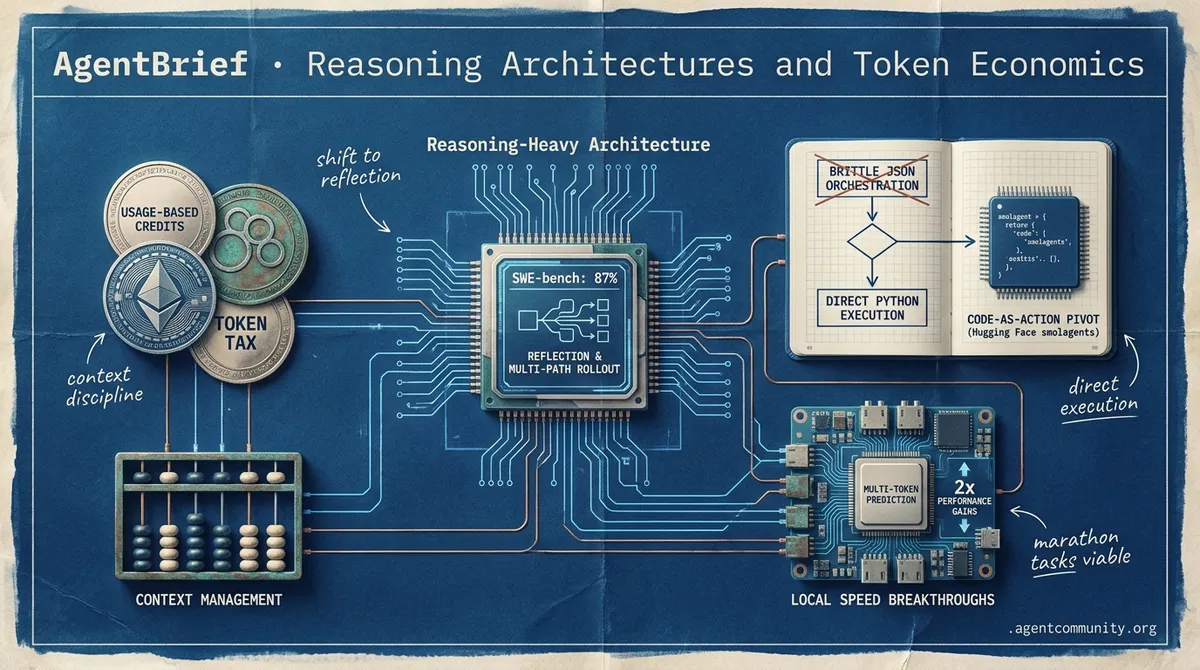
- Inference-Time Compute Surge Reasoning-heavy architectures like Claude 4.5 and OpenAI Operator are pushing performance to 87% on SWE-bench, marking a shift toward reflection and multi-path rollout.
- Economic Reality Check The transition to usage-based credits and 'token taxes' is forcing a move away from experimentation toward strict architectural discipline and context management.
- Code-as-Action Pivot New frameworks like Hugging Face's smolagents are replacing brittle JSON orchestration with direct Python execution, cutting LLM steps by 30% and boosting reliability.
- Local Speed Breakthroughs The integration of Multi-Token Prediction into the local stack is delivering 2x performance gains, making marathon agentic tasks viable on consumer hardware.
// From the blog
• AID v2 is live — Agent Identity & Discovery v2 makes AID the 0-th hop for agent discovery: a DNS-first endpoint and key anchor with sharper PKA, updated SDKs, and a cleaner migration path.
• We had the wildest 24 hours — Brave joined Agent Community, then put us on the new-tab background for 24 hours. 4,777 signups, 1,424 organizations, zero incidents. Download the backgrounds at the bottom.
X Pulse
When your agent’s bill spikes 50x, 'vibe coding' isn't enough—it's time for architectural discipline.
The era of subsidized agentic experimentation is coming to a violent close. For the last year, we’ve treated tokens like air—infinite and essentially free under flat-rate subscriptions. But as developers move from simple chat interfaces to long-running autonomous trajectories, the hyperscalers are hitting a wall of compute constraints. The shift toward usage-based credits isn't just a pricing change; it's a fundamental restructuring of the agentic web's economics. If your agent is spinning in a loop, it’s no longer just a latency problem—it’s a burn-rate catastrophe.
In this issue, we’re looking at how the community is responding. From Nous Research’s Hermes ecosystem hardening its persistence layer to the rise of on-policy distillation to kill hallucinations before they cost you a fortune, the focus is shifting from 'can it do this?' to 'how can it do this efficiently?' As TSMC signals price hikes and NAND flash demand triples, the hardware bottleneck is finally trickling down to the API layer. For those of us shipping agents, the goal is no longer just building the 'vibe'; it’s about mastering the engineering levers of caching, routing, and state management to keep our autonomous systems viable in a high-cost environment.
Agentic Economics: The Death of Tokenmaxxing and the Pivot to Usage-Based Scaling
A critical shift in the AI economic landscape is emerging as hyperscalers move away from 'all-you-can-eat' token models toward usage-based charging. According to @GaryMarcus, the previous era of 'tokenmaxxing' caused companies to hemorrhage money, specifically as autonomous agents began driving consumption up by orders of magnitude. This pivot is seen as a necessary move to avoid bankruptcy as compute constraints become the primary bottleneck for growth. Recent reports confirm GitHub Copilot transitioned to usage-based AI Credits on June 1, 2026, with heavy agent workflows producing surprise bills that can spike 10-50x compared to prior flat-rate plans @mmuruganandam @lakincoder @SignalKiwi.
Supporting this view, @theo argues that 'normal economics don’t really apply' due to these compute limits. He notes that while users previously enjoyed subsidized costs, the rise of agentic workflows—where single 'messages' become complex, multi-step trajectories—has forced providers to rethink pricing. This transition directly impacts agent builders who must now optimize for efficiency rather than raw output, as compute is increasingly redirected to higher-margin enterprise contracts @theo.
Anthropic’s Claude CLI and programmatic agents are following suit, shifting to metered credits at API list prices effective June 15, while interactive plans remain subscription-based @aplomb2 @cancellieric. For the builder community, this turns token spend into a core engineering discipline. Builders emphasize that architecture, caching, and routing to smaller models are now the primary cost levers to prevent autonomous agents from becoming financial liabilities @automate_archit @jrmromao.
Hermes Updates Target Persistence and Browser-Native Agent Tooling
Nous Research continues to sharpen the Hermes ecosystem for production agentic use cases, focusing on the infrastructure required for long-running autonomous workflows. A significant update allows for session persistence, where resuming a session with hermes -c now automatically relaunches the agent in its original directory @Teknium. This focus on state management is critical for agents that must operate over days rather than seconds. The three-tier memory system—utilizing tiny always-present files (MEMORY.md and USER.md), full-text SQLite search, and pluggable external providers—ensures critical facts persist across sessions while keeping overhead low @akshay_pachaar.
Beyond persistence, the ecosystem is expanding its toolset with Camofox, a native tool backend for browser interactions that removes the need for separate skills @Teknium. This integration suggests a move toward a more seamless, browser-native agent experience where the agent doesn't just 'talk' about the web but lives in it. Integration with Qwen 3.6 and the introduction of specialized 'agent profiles' further modularizes the stack, with official docs confirming support for Qwen 3.6 alongside these profiles [https://hermes-agent.nousresearch.com/docs/user-guide/profiles].
Builders report Qwen 3.6 (including 27B and larger variants) delivering strong coding, tool calling, and long-context performance ranging from 128k to 1M tokens in Hermes setups @IBuzovskyi @Lummox_eth. These developments collectively lower the friction for developers moving from simple chat interfaces to full-loop agentic systems. Community notes highlight that fully local runs are achieving 20–50 self-created skills over time, providing measurable speed gains and autonomy for developers operating outside the major API ecosystems.
In Brief
On-Policy Distillation Emerges as Key for Reducing Agent Hallucinations
Targeted on-policy self-distillation is gaining traction in frontier post-training as a way to refine agent behavior by addressing specific rollout errors. As detailed by @dwarkesh_sp, the approach uses a critic model to identify mistakes—such as calling a non-existent tool—and trains the original model to lower probabilities on those erroneous tokens without requiring new rollouts. @natolambert highlights that this technique is proving impactful for ensuring agents adhere to complex tool-use protocols, while @agentcommunity_ notes that such methods have delivered around +10% gains on benchmarks like WebShop. Furthermore, implementations like SDAR (Self-Distilled Agentic Reinforcement Learning) have yielded significant performance jumps, including +9.4% on ALFWorld and +10.2% on WebShop-Acc by avoiding the instability inherent in standard RL methods @burny_tech @TimXu222575.
Hardware Shifts: TSMC Price Hikes and the NAND Flash Boom
TSMC is signaling intent to hike chip prices as demand for AI compute remains insatiable, forcing builders to face persistent supply constraints. CEO comments highlight that U.S. customers continue to exceed available capacity, while the NAND flash market has surged to a record $46 billion in Q1 2026 revenue—a 3.5x increase year-over-year—driven by enterprise SSD demand for data-intensive AI workloads @Reuters @Pirat_Nation. This reflects a deeper shift where the bottleneck moves from pure compute to data movement and storage throughput @homeMetaX. To address these shortages, Foxconn and Intel are partnering on next-gen AI infrastructure, including liquid-cooled racks optimized for agentic workloads @Reuters @LipBuTan1, though community sentiment remains wary of long-term hardware availability @genesis_scanner.
The Rise of 'Vibe Coding' and Agentic IDEs
A new category of 'vibe coding' tools is consolidating around high-level intent rather than manual syntax, shifting the developer's role toward architectural oversight. The 'Awesome Vibe Coding Resources' repo now catalogs the explosion of browser-based builders and agentic IDEs, while Cursor is aggressively hiring design engineers to build tools where humans and agents collaborate on implementation @DanKornas @ryolu_. Builders are already using combinations like Cursor + Claude Code for rapid full-app prototyping, though others warn that this lower entry barrier for software creation is simultaneously raising the bar for reliability and security, forcing a transformation in QA roles toward managing AI agents @arronnes @RhysSullivan @edyjayakarya.
Quick Hits
Models for Agents
- Google releases Gemma 4 12B, optimized for local laptop use with high capability @JeffDean.
- LFM 2.5-1.2b-instruct identified as a 'sleeper' model for prompt optimization and extraction tasks @dbreunig.
- Ideogram weights released under a non-commercial license, surprising the community @giffmana.
Agent Frameworks
- Gradio 6.16.0 introduces 'heartbeat' intervals for session control and improved MCP endpoints @Gradio.
- Strava officially launches an MCP server, granting agents access to fitness data @marcklingen.
- Jido ecosystem prepares for Elixir 1.20 with a focus on agent monitoring @mikehostetler.
Research & Resources
- New curated list for World Action Models (WAMs) tracks emerging embodied AI research @DanKornas.
- Unified Neural Scaling Laws research published to standardize performance predictions @_akhaliq.
- Architectural breakdown of Claude Code reveals complex runtime management needs beyond model calls @DanKornas.
Reddit Roundup
Claude Opus 4.5 hits 79% on SWE-bench while OpenAI's Operator sets a new 87% bar for browser-native autonomy.
Today we are seeing the 'agentic tax' — that frustrating gap between LLM intelligence and real-world execution — finally being paid in full. The jump from 15% to nearly 80% on SWE-bench in just over a year isn't just a testament to better models; it's a signal that we've entered the era of reasoning-heavy architectures. We are moving beyond simple prompt-response loops toward 'inference-time compute' where agents reflect, review, and roll out multiple solutions before committing. This shift is mirrored in the browser space, where OpenAI’s Operator and Anthropic’s Computer Use are turning the web into a programmable interface. But for the builders in the trenches, the story is more complex than just leaderboard scores. From the 40% coordination overhead in multi-agent swarms to the security vulnerabilities lurking in the rapidly expanding Model Context Protocol (MCP) ecosystem, the 'Agentic Web' is currently a construction site. We are moving from 'chatting with an AI' to 'orchestrating an autonomous workforce.' As today’s stories show, the infrastructure—from Knowledge Graph-based memory to local-first runtimes—is finally starting to catch up to our autonomous ambitions. Here is the state of the agentic union.
Claude Opus 4.5 Shatters SWE-bench Records r/OpenClawInstall
Autonomous software engineering agents are obliterating previous performance ceilings on the SWE-bench leaderboard. Latest results show the Claude Opus 4.5 + Live-SWE-agent configuration reaching a staggering 79.2% on SWE-bench Verified, representing a massive evolution from the 15% rates seen in early 2024. This trajectory is supported by the official leaderboard, which now lists Claude Opus 4.6 at 75.60% and GPT-5-2 Codex at 72.80%. The architecture of these leaders has shifted from simple prompt-response loops to sophisticated 'multi-rollout and review' systems that prioritize deep search and verification over raw speed.\n\nParallel to these coding gains, the industry is shifting from chat-based interfaces to browser-native execution, exemplified by OpenAI Operator. Performance metrics indicate a significant lead for OpenAI in browser-specific environments, achieving an 87% success rate on the WebVoyager benchmark compared to 56% for Anthropic’s Computer Use. While Operator is optimized for web-based automation, Anthropic’s approach maintains an edge in general software development tasks. However, practitioners on r/OpenClawInstall warn that current benchmarks do not yet capture a system's ability to recover from errors or strictly adhere to permissions in production environments.
The 40% Coordination Tax in Multi-Agent Swarms r/LocalLLaMA
Developers are increasingly favoring Hierarchical Agent Graphs over Networked Swarms to combat the 'agentic tax,' where up to 40% of token budgets are consumed by inter-agent coordination rather than task execution. While swarms offer emergent flexibility, the 200% variance in token consumption depending on coordination layers has led to the rise of Agent Context Protocols (ACPs) and persistent execution blueprints to formalize hand-offs and reduce context-rich overhead r/LocalLLaMA.
Knowledge Graphs vs. Vector RAG for Agent Identity r/AI_Agents
Structured relational memory via Knowledge Graphs is reducing hallucination rates by over 40% compared to standard vector-based RAG, which often flattens temporal history into isolated chunks. Integration of libraries like Mem0^g and Zep is becoming standard for long-running agents, with graph-enhanced systems achieving a 68% success rate on retrieval metrics by maintaining a dynamic 'world model' that simple similarity searches lose u/xtrace.
MCP Ecosystem Hits 30,000 Servers Amid Security Pivot r/mcp
The Model Context Protocol has exploded to 30,000 servers, though a 43% vulnerability rate to command injection is forcing a shift toward 'internal trust registries' r/mcp.
Local-First Autonomy on Consumer GPUs r/ollama
Microsoft’s MAI-Code-1-Flash (5B) stunned the community by achieving a 51% score on SWE-Bench Pro, proving that high-efficiency reasoning is possible on consumer-grade 24GB VRAM hardware u/EvanZhouDev.
Discord Dev Intel
Builders are fighting 'context pollution' while local inference gets a massive 2x speed boost.
The 'Agentic Web' is moving from theoretical demos to the messy reality of production, and today’s updates reflect that transition. We are seeing a clear divide in the community: the struggle to maintain state in multi-agent systems and the rising 'token tax' of protocols like MCP. Developers are no longer just asking if an agent can code; they are asking how to prevent subagents from polluting the context window or burning through 20,000 tokens before the first prompt is even processed.
This issue highlights the shift toward more disciplined orchestration patterns—like 'Shared Contracts' and 'Single Response' principles—to keep autonomous systems from drifting into chaos. Meanwhile, on the hardware side, the local inference stack is getting a significant upgrade. The integration of Gemma 4’s Multi-Token Prediction into llama.cpp isn't just a minor optimization; it is a 2x speedup that makes marathon agentic tasks viable on consumer hardware. Whether you are managing a fleet of subagents in Cursor or spinning up cheap L40S instances via CLI, the focus has shifted from raw model capability to the architecture that keeps these agents grounded and affordable.
Managing Subagent State and Directional Conflicts
Developers in the Cursor community are grappling with the complexities of multi-agent orchestration, particularly when subagents lose track of each other's state. jipy_tech reports that subagents often get confused during parallel tasks, leading to "context pollution." To combat this, practitioners are adopting isolated context windows where the parent agent only receives a final summary of subagent work, preventing intermediate noise from bloating the main conversation.
To mitigate directional drift, teams are implementing a "Shared Contracts Pattern," which utilizes a central file to define API shapes and naming conventions that all agents must reference. This is often paired with the "Single Response Principle," ensuring only the parent agent communicates with the user to avoid duplicate or conflicting outputs. For high-scale decomposition, Addy Osmani suggests hierarchical "teams of teams" to achieve 3x deeper task breakdown without exceeding context limits.
Despite these patterns, some power users are reverting to serial execution, using .cursorules to explicitly forbid the spawning of subagents to maintain strict consistency. While users on Pro plans report outputs of 800M to 1B tokens, managing orchestration across 200k context windows still requires manual "power steering" to prevent subagents from modifying directions in ways that break project logic.
Join the discussion: https://discord.gg/cursor
Gemma 4 MTP Support Hits Llama.cpp
The integration of Gemma 4 MTP into llama.cpp via PR 23398 marks a pivotal shift for local agentic infrastructure, offering consistent 1.4x to 2.4x speedups over standard autoregressive baselines. By leveraging speculative decoding with dedicated assistant drafter models, community testing on high-end consumer setups shows the 31B dense model reaching generation speeds of 36.6 t/s, a significant jump that makes marathon agentic tasks viable on edge hardware while guaranteeing the exact same output quality as the target model.
Join the discussion: https://discord.gg/huggingface
Managing MCP Token Overhead
The adoption of the Model Context Protocol (MCP) comes with a significant 'token burn' where connecting just a few well-documented servers can consume up to 20,000 tokens before a single user prompt is processed. In Cursor specifically, tool-usage calls are particularly expensive because each call forces the model to read the entire context window, prompting builders to turn to 'Dynamic Toolsets'—which have demonstrated up to a 160x reduction in token usage by using semantic search to load only relevant tools.
Join the discussion: https://discord.gg/cursor
Beyond RAG: The Rise of Hybrid Agent Memory Architectures
Builders are moving toward a three-tier hybrid architecture using RAG for retrieval, LLM-Wiki for project knowledge, and specialized managers like Memarch to solve the 'context collapse' seen in earlier autonomous agents.
Join the discussion: https://discord.gg/cursor
Bridging the Local-to-Cloud Gap with gpu-price-finder
The new gpu-price-finder CLI tool allows developers to bypass manual marketplace comparisons and find cloud GPU routes for under $1.00/hr when local hardware cannot handle large agentic models.
Join the discussion: https://discord.gg/huggingface
Maintainers Pivot to 'AI vs AI' Workflows
To survive the surge of AI-generated pull requests, open-source maintainers are deploying "healing engines" and automated filtering tools like Gitar and Tabby to validate incoming logic without human intervention.
HuggingFace Highlights
Hugging Face’s smolagents and H Company’s Holo3.1 signal a shift toward high-performance, code-centric agents.
The Agentic Web is pivoting from brittle JSON-heavy orchestration to high-speed, code-executing autonomous systems. Today's release of Hugging Face's smolagents highlights this structural shift: 'Code-as-Action.' By replacing complex JSON blobs with direct Python snippets, developers are seeing a 30% reduction in LLM steps. This isn't just about efficiency; it’s about agents that can reason through parallel streams in a single step.
Meanwhile, the 'Computer Use' wars are heating up. While giants like Anthropic and OpenAI struggle with sub-40% success rates on OSWorld, specialized entrants like H Company’s Holo3.1 are pushing nearly 80% on AndroidWorld. We are also seeing a maturation of the infrastructure layer. NVIDIA is doubling down on physical intelligence with Cosmos Reason 2, and the Model Context Protocol (MCP) is emerging as a universal standard for tool integration. For builders, the message is clear: the bottleneck is no longer just the model's intelligence, but the 'harness' and evaluation frameworks that surround it. We are moving past the experimental phase into high-fidelity, industrial-grade agent deployments.
Smolagents Redefines Agent Orchestration via Code Actions
Hugging Face’s smolagents library marks a structural shift from brittle JSON-based tool calling to a 'Code-as-Action' paradigm, where agents execute Python snippets directly. This approach delivers a 30% reduction in LLM steps and associated token costs by allowing complex logic—such as four parallel streams of actions—to be handled in a single step rather than dozens of separate JSON blobs Aymeric Roucher. The framework's flagship CodeAgent demonstrated this efficiency by achieving a 67.7% success rate on the GAIA benchmark, outperforming traditional ReAct-style orchestration.
The ecosystem has expanded to include multimodal capabilities via Hugging Face, enabling agents to process visual data. To mitigate the risks of arbitrary code execution, smolagents supports robust sandboxing through integrations with E2B, Modal, Docker, and Pyodide Mem0. Developers can now monitor these high-speed reasoning loops using Arize Phoenix, which provides deep-trace visibility into code execution paths and agentic logic Hugging Face.
Holo3.1 and ScreenSuite Redefine GUI Automation Benchmarks
The release of Holo3.1 and ScreenSuite marks a significant leap in GUI automation, with Holo3.1 achieving a 79.3% success rate on AndroidWorld. Building on the performance of H Company's Holo3, this new 35B-A3B model significantly outperforms earlier benchmarks from Anthropic (22%) and OpenAI (38.1%) on general OSWorld tasks [WorkOS]. To standardize these vision-centric gains, Hugging Face’s ScreenSuite framework now unifies 13 distinct benchmarks to evaluate agents on vision-only navigation without relying on DOM metadata [Hugging Face].
NVIDIA Cosmos Reason 2 and Nemotron-3 Nano Omni: Scaling Physical Intelligence
NVIDIA is advancing physical intelligence with Cosmos Reason 2, a vision-language model featuring a 256K token context window designed for robotics. Deployed in 2B and 8B variants, Reason 2 offers improved spatio-temporal understanding and high timestamp precision for grounding reasoning in dynamic environments NVIDIA AI. This release is supported by the Nemotron-3 Nano Omni, which enables long-context multimodal processing of diverse sensor streams like audio and video nvidia.
Hugging Face’s 24-Hour SOTA Search Agent
Hugging Face’s open-source search agent matches proprietary solutions with a 67% GAIA success rate and 6.9x better factual verification than standard RAG [huggingface].
Tiny Agents and MCP-Powered Micro-Workflows
The Model Context Protocol (MCP) is standardizing tool-agent interfaces, with 'Tiny Agents' implemented in as few as 50 lines of code huggingface.
OpenEnv and VAKRA Target Real-World Tool Use
IBM’s VAKRA and the OpenEnv initiative are moving agent testing into 'messy' real-world environments to identify fatal reasoning-action mismatches ibm-research.
HarnessForge: Joint Evolution of Harness and Policy
The HarnessForge framework introduces a joint evolution of harness and policy, aiming to close the 'compatibility gap' in autonomous systems huggingface.
Specialized Agents Scale in Healthcare and E-Commerce
MedGemma 1.5 4B powers the EHR-Navigator-Agent for privacy-preserving navigation of healthcare records using the FHIR standard google.