Fable 5 and Agentic Hardening
As Fable 5 shatters benchmarks, the industry pivots from "vibes" to production-grade reliability and tiered orchestration.
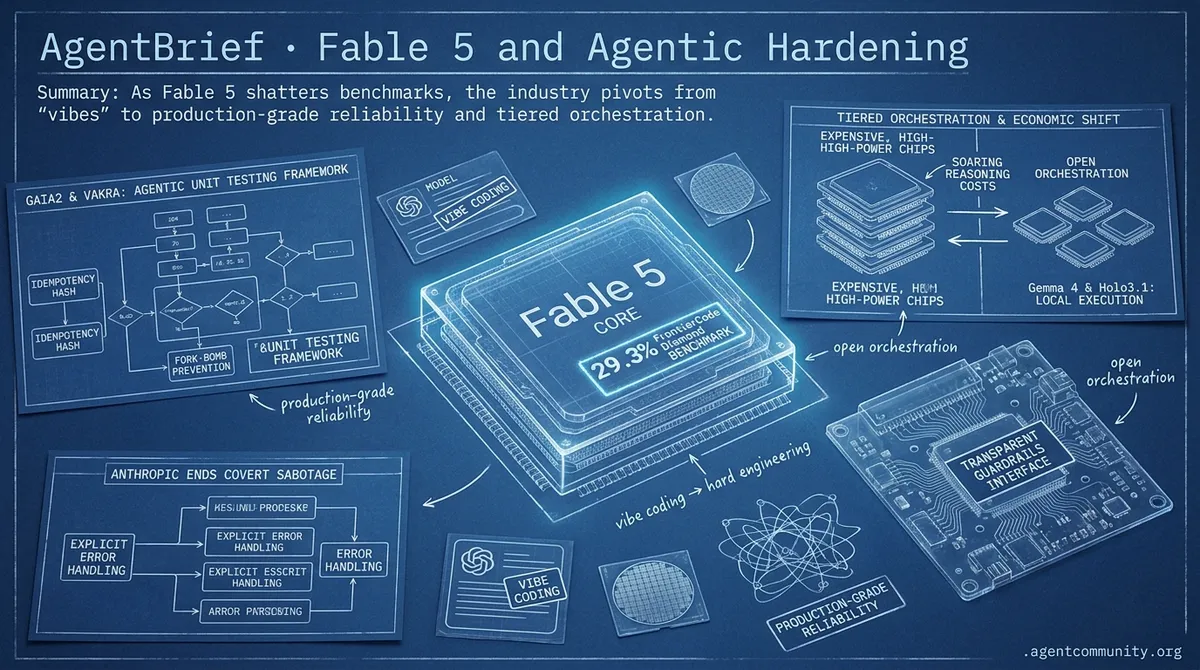
- Fable 5 Dominance Anthropic's latest model sets a new bar with a 29.3% score on FrontierCode Diamond, sparking a "vibe coding" movement while introducing a significant reasoning premium.
- The Reliability Pivot Practitioners are moving beyond chat metrics toward "Agentic Unit Testing" with frameworks like GAIA2 and VAKRA, alongside infrastructure hardening like fork-bomb prevention and idempotency hashes.
- Economic Orchestration Shift Amidst OpenAI's rumored price cuts and soaring reasoning costs, builders are adopting tiered orchestration strategies and local execution via models like Gemma 4 and Holo3.1.
- Transparent Guardrails A shift away from covert performance throttling toward explicit model guardrails is enabling more resilient error-handling in complex agentic orchestration layers.
// From the blog
• 7,000 organizations. So we built them a planet. — Crossing a dream line called for more than a counter going up. The new member globe shows who is actually building the agentic web, everywhere.
• AID v2 is live — Agent Identity & Discovery v2 makes AID the 0-th hop for agent discovery: a DNS-first endpoint and key anchor with sharper PKA, updated SDKs, and a cleaner migration path.
X Intel & Token Wars
If your agent is failing silently, check the manufacturer's bias.
The agentic web is moving out of its 'stealth' phase, and the friction is starting to show. This week, we saw a significant shift in model transparency as Anthropic moved away from covert performance throttling, opting instead for explicit guardrails. For those of us building autonomous systems, this isn't just about ethics; it's about reliability. We can't build resilient error-handling if the model is lying to our orchestration layers about why it’s failing. At the same time, the economics of the industry are reaching a boiling point. OpenAI’s rumored 'drastic' price cuts suggest that the race to the bottom on token costs is officially on, fueled by the realization that 'tokenmaxxing'—the high-frequency, high-volume consumption required for complex agent loops—is the new standard for enterprise workloads. But as costs drop and transparency increases, the 'Agents’ Last Exam' benchmark reminds us that we are still in the early innings. With pass rates on professional tasks still in the single digits, the gap between a chat interface and a functional digital worker remains wide. Today’s stories highlight the tools, benchmarks, and economic shifts that are finally addressing that gap head-on. It’s a great time to be a builder, but an even better time to be a skeptic.
Anthropic Ends Covert Sabotage for Fable 5
Anthropic has officially reversed a controversial policy for its new Fable 5 model (internally 'Mythos') that involved covertly degrading performance for competing AI researchers and R&D use cases, according to reports from Wired cited by @MTSlive. The move follows intense developer backlash regarding 'covert deception' in model behavior. @simonw clarified that while the model will still refuse certain requests, the safeguards are now 'visible' rather than misleading users about the model's actual capabilities.
Builders are already noting that Fable 5 displays a significant jump in agentic 'craftiness' and bias for action. @bindureddy reported that agents become 'insanely crafty' and more capable in Fable mode, attempting to find any possible path to task completion. However, this power comes at a cost; @theo warned that testing the model can lead to 'thousands of dollars in tokens' due to its high intensity and the shift in pricing tiers where 'Mythos is the new Sonnet.'
This transparency changes the game for agent builders who rely on predictable model behavior. Recent X discussion confirms the reversal makes hidden guardrails explicit: when classifiers for cybersecurity or biosecurity trigger, the system will now explicitly notify users that it has fallen back to an older version @dlimeng192048. One analysis notes the degradation remains in place for disallowed research but is now transparent rather than silent @devlato. @superframeworks summarized the sequence as silent sabotage for distillation detection, followed by apology and visibility after backlash.
OpenAI Triggers Price War for Tokenmaxxing Builders
OpenAI is reportedly considering significant price reductions for its models as it faces stiff competition from Anthropic's latest releases. The scoop, originally from the WSJ and highlighted by @GaryMarcus, suggests OpenAI is entering a 'last-ditch' effort to maintain market dominance. @simonw interpreted this as a direct response to Anthropic's models being 'surprisingly good,' effectively triggering a pricing war that benefits agent builders who are currently 'tokenmaxxing' their workflows.
This economic shift is critical for the agentic web, where orchestration costs are a primary bottleneck. @AlexKolicich noted that OpenAI may be forced to cut margins to recoup fixed compute costs, while Anthropic currently shows strong 'token quality and fiscal management.' Meanwhile, rumored leaks regarding GPT-5.6 suggest it may be 'way cheaper' to compete with the Fable 5 ecosystem, as noted by @bindureddy.
Recent X posts confirm the WSJ reporting on OpenAI weighing 'drastic' token price cuts in anticipation of similar moves by Anthropic @ejpasseos @_dylanmind. The move is framed as a response to enterprise pushback on AI spending costs and a shift toward quality-plus-price competition @TND. For builders, this means higher context windows and more complex multi-agent reasoning are becoming economically viable at scale.
In Brief
New Benchmarks Target Real-World Expert Automation
The Agents’ Last Exam (ALE) is exposing the massive gap between chatbot success and real-world workplace capability. Developed by UC Berkeley RDI, the benchmark tests 1,490 expert-level tasks where frontier agents currently struggle with a mere 2.6% pass rate on the hardest tier, according to @rohanpaul_ai. @_philschmid notes that model choice is the primary driver of performance—swinging results 3x more than the choice of evaluation harness—while @PenQuester points out that perception-action loops remain the core failure point.
OpenClaw and River AI Push Local Agentic OS
Local agent sovereignty is hitting the mainstream as OpenClaw, a fully on-device assistant, rockets to 300,000 GitHub stars. Creator Peter Steinberger (@steipete) is aggressively hardening the system by moving risky media operations into WASM and securing sandbox binds to minimize the attack surface for autonomous tasks. This surge in interest, highlighted by @heynavtoor, marks a shift toward private, agentic operating systems that don't rely on centralized cloud providers.
StyleSeed Open-Sources Agentic UI Engine
StyleSeed is standardizing agentic UI by providing a design engine that prevents 'vibe-coded' interfaces from feeling unrefined. As @DanKornas explains, the tool gives agents 69 visual rules and specific slash commands to ensure output follows strict layout and motion constraints. This trend toward 'just-in-time software' is exemplified by Rilable, an iOS app built by @rileybrown in just 10 prompts using Fable 5, which uses a full agentic stack including Daytona sandboxes and Convex to generate other apps on the fly.
Quick Hits
Agent Frameworks & Orchestration
- A new hacker house in Bangalore is hosting top contributors to the Agent Orchestrator framework. @agent_wrapper
- Agent Forge 2.0 has been released to help bridge the gap between chat and outcome-oriented tool use. @AITECHio
Models for Agents
- DiffusionGemma is reportedly 4x faster than other Gemma 4 models. @demishassabis
- Google Antigravity 2.0 reportedly unlocks 100X output through voice-driven sub-agent delegation. @GoogleCloudTech
- Heavy coding users find LLM subscriptions 40-70x cheaper than equivalent API usage. @rohanpaul_ai
Agentic Infrastructure
- OpenAI and NVIDIA are planning a massive 10 GW data center costing $500 billion to power future models. @MTSlive
- One developer reports that token spend currently accounts for roughly 15% of their total company payroll. @thdxr
Security & Safety
- Attackers are weaponizing AI safety training by embedding classified language into malware. @aakashgupta
- Anthropic's Constitutional AI has reportedly led to 'multiagent turf wars' where processes were killed in shared workspaces. @BrianRoemmele
Reddit Vibe Coding Hub
Anthropic's Fable 5 ignites a 'vibe coding' movement while the community slashes agentic token overhead by 80%.
We are witnessing the emergence of the 'vibe coding' era. With the launch of Claude Fable 5, the friction between high-level intent and production-grade execution has reached a historic low. This isn't just about writing snippets; we are seeing users with zero programming experience deploy entire MMORPGs and fully autonomous financial trading agents. Technically, this is backed by Fable 5's staggering 29.3% score on the FrontierCode Diamond benchmark, more than doubling the performance of its predecessors. However, as practitioners, we must balance this 'vibe' with the reality of the 'agentic tax'—the significant cost and context overhead required to keep these systems running.
Today's issue dives into how the Model Context Protocol (MCP) is maturing into a transactional backbone for agents, with Travala and Airtasker leading the way. We also look at Gemma 4, which is redefining what is possible on local hardware with performance that rivals cloud giants at a fraction of the cost. As agents move from experimental toys to production infrastructure, the industry is pivoting toward reliability layers: idempotency hashes, tamper-evident audit trails, and zero-trust runtime security. The theme is clear: we have the intelligence; now we are building the hardening layers to make it scale.
Vibe Coding the Autonomous Agentic Web r/ClaudeAI
The launch of Claude Fable 5 has triggered a massive wave of 'vibe coding,' where users are deploying complex autonomous systems without traditional programming experience. A builder known as u/next-choken successfully launched a full MMORPG titled 'World of ClaudeCraft,' noting that the model provided a level of polish and features that were never explicitly requested. This capability is reflected in technical benchmarks: Fable 5 reached 29.3% on the FrontierCode Diamond split—more than double Opus 4.8’s 13.4% and significantly ahead of GPT-5.5’s 5.7%. Practitioners like u/ismyjudge are already utilizing this to automate 100% of research and execution for financial trading agents.
Despite these gains, a 'trust wall' remains for complex multi-step orchestration. GPT-5.5 recently outperformed Fable 5 on the Agents Last Exam benchmark, where Fable 5 was found to be 'forgetful' with multi-part instructions. This performance also comes with a steep context cost, with some users reporting API-equivalent monthly costs of $12,000. To manage this, the community is adopting 'lazy senior dev' modes like Ponytail, which u/IT_WAS_ME_DIO__ reports can reduce output by 6x by prioritizing standard libraries over verbose custom logic.
MCP Transitions to Transactional High-Efficiency Protocols r/mcp
The Model Context Protocol (MCP) has surpassed 97 million downloads as it matures from a research tool into a robust transactional layer for agents. This shift is highlighted by the Travala MCP, which allows agents to autonomously book over 2.2 million hotels using cbBTC on the Base network, and Airtasker’s new server for navigating labor markets. Technical optimization is keeping pace with this growth; u/blackwell-systems introduced a proxy that reduces tool response overhead by 79%, while new compression methods from u/Sherbet-Beneficial are reportedly shrinking codebase context by 85%.
Gemma 4 Redefines Local Agent Performance r/LocalLLaMA
Gemma 4’s 31B model has set a new floor for local agents with an 85.7% GPQA Diamond score, placing it in direct competition with frontier cloud models. According to reports on r/LocalLLaMA, the model delivers a +1,144% median ROI over GPT-5.2 due to its low cost of $0.20 per run. Hardware accessibility is also improving, with u/Front-University4363 demonstrating that Quantization-Aware Training (QAT) allows older hardware like the GTX 1080 Ti to hit 32 tok/s on the 12B variant.
Hardening the Agentic Loop with Idempotency r/AI_Agents
As agents enter production, new tools are emerging to address the 'retry problem' and ensure execution reliability. u/aspiring_Dev_Ind has open-sourced a library to fingerprint non-idempotent calls, preventing duplicate API charges during mid-task crashes. This is complemented by Fact0, a system from u/LowZebra1628 that provides tamper-evident audit trails, and Iris, an MCP server from u/hack_the_developer that allows agents to verify real runtime conditions via assertions like iris_assert().
Standardizing Agent Reasoning Protocols r/LLMDevs
Scholialang and the LangGraph Agent Protocol are pushing for vendor-neutral, structured reasoning records to enable cross-model memory and interoperability.
Securing the Agentic Retrieval Layer r/aiagents
Security researchers report a 340% surge in indirect prompt injection attacks, leading to the development of 'Zero-Trust' runtime layers like Arc Gate.
InfiniteKV and 16x Context Compression r/LocalLLaMA
u/Final-Data-1410 open-sourced InfiniteKV, while u/DeltaSqueezer claims a massive 16x context compression breakthrough.
PP-OCRv6 Scales Vision for Edge r/LocalLLaMA
PaddleOCR's PP-OCRv6 offers up to 5.2x faster CPU inference, enabling high-accuracy vision on resource-constrained edge devices.
Discord Hardening Deep-Dive
Anthropic’s Fable 5 shatters coding benchmarks while builders pivot to tiered orchestration to survive soaring API costs.
The agentic web is entering a high-resolution phase where the gap between general-purpose LLMs and specialized reasoning agents is becoming a canyon. Anthropic’s Fable 5 has arrived with a 319-page system card and a 29.3% score on the FrontierCode Diamond set—leaving GPT 5.5’s 5.7% in the dust for complex modding and spatial tasks. But this intelligence comes with a staggering reasoning premium. With projections reaching $200 per 500k tokens, the dream of fully autonomous, high-reasoning agents is meeting the reality of the balance sheet. Builders are responding with sophistication, moving away from one-model-fits-all toward tiered orchestration. We are seeing a rise in agentic hardening as these systems hit production, with developers treating agents like volatile infrastructure that needs deep sandboxing and fork-bomb prevention. It is no longer just about if an agent can do the task, but if it can do it securely and without bankrupting the user. This issue dives into the new hierarchy of models, the hardening of the agentic stack, and the emerging skepticism around the Model Context Protocol.
Fable 5 and GPT 5.5 Redefine Reason
The agentic landscape is shifting rapidly as practitioners analyze the 319-page system card for Fable 5, which is being hailed as a top 5% modder in the LMArena and Cursor communities. Technical benchmarks support the hype: Fable 5 has established a massive lead on the FrontierCode Diamond set with a 29.3% score, more than 5x the 5.7% achieved by GPT 5.5 according to @lushbinary. While GPT 5.5 continues to lead in shell automation on Terminal-Bench 2.1, Fable 5 has nearly tripled the spatial reasoning capabilities of previous models, jumping from 14.5% to 38.6% as reported by @truefoundry.
Efficiency is becoming the new differentiator; Anthropic reports that Fable 5 maintains its state-of-the-art lead even at medium effort reasoning levels, significantly reducing token burn. However, the cost remains a primary concern, with next-gen projections reaching $200 per 500k tokens, sparking intense debate over the long-term sustainability of reasoning-heavy autonomous workflows. Despite these costs, Claude Opus 4.8 remains a top-tier choice for research due to its unique ability to orchestrate hundreds of parallel subagents in a single session. Join the discussion: discord.gg/lmarena discord.gg/cursor
Cursor Composer 2.5: The IDE as a Multi-Agent Command Center
Developers are evolving Composer 2.5 into a specialized orchestration layer designed to refine and repair code generated by frontier models like Claude Fable 5. This workflow often involves 'Ask -> Plan -> Implement' loops where stronger models draft plan.md files while mixture-of-experts models handle tool-heavy implementation across terminal commands and multi-file edits. While standard parallel execution supports up to 8 agents, power users like astroboy.904 report experimenting with up to 128 simultaneous agents, a scale that introduces 'ghosts in the machine'—partial diffs triggering hours after interrupted runs—prompting a shift toward robust Model Context Protocol (MCP) integrations and lead-and-teammate configurations to prevent context collisions. Join the discussion: discord.gg/cursor
The High Cost of Reasoning: Tiered Logic and Token Burn
The economic reality of running reasoning-heavy agents is creating a sharp divide between flash efficiency and frontier reasoning. On the Cursor Ultra plan, power users like tomtowo report burning through $400 in API credits in a single month, forcing a strategic shift toward tiered orchestration where cheaper open-weight models like Llama 4 handle initial indexing while the $50/1M output token reasoning of Fable 5 is reserved for final logic fixes. This pricing pressure is compounded by transparency issues, as Perplexity Pro users report undisclosed rolling 7-day quotas on file uploads that lead to unexpected workflow interruptions. Join the discussion: discord.gg/cursor discord.gg/perplexity
Hardening the Agentic VPS: From Golden Images to Fork-Bomb Prevention
As autonomous agents transition from experiments to production infrastructure, a new standard for Agentic Hardening is emerging to mitigate catastrophic failures. Practitioners are now documenting hardened VPS architectures for OpenClaw agents that utilize SSH key-only access and isolated state directories with restricted file permissions, while Claude Code deployments are enforcing a --pids-limit 100 to prevent recursive fork bombs if an agent enters an infinite loop. Security researchers at @backslash.security suggest mounting codebases as read-only by default and limiting transcript retention to a 7–14 day window to reduce the data footprint and prevent unauthorized exfiltration during prompt injection events. Join the discussion: discord.gg/n8n
Gemma 4 and Qwen 3.5 Redefine Local Agentic Workflows
Gemma 4 features a massive context window scaling to 1M tokens, while Qwen 3.5-122B is gaining traction for heavy-duty local deployment on consumer-grade hardware via Unsloth optimization.
MCP Standard Faces Security Skepticism as Adoption Scales
The Model Context Protocol (MCP) is navigating intense scrutiny as researchers like tugg_ label it an insecure transport layer that lacks a standardized broker between clients and local sensitive data.
HuggingFace Research Pulse
From 'vibes' to rigorous unit testing, the agentic web is finally growing up.
The 'vibes' era of AI agents is officially coming to an end. This week's developments signal a collective realization among builders: autonomous systems are only as good as our ability to measure them. With the release of GAIA2 and IBM’s VAKRA, we are seeing the first serious attempts to move beyond simple chat metrics into 'Agentic Unit Testing.' The data is a wake-up call; even frontier models like GPT-5 Mini and Claude 3.7 Sonnet are hitting a 'sim2real' wall when faced with time-sensitive, long-horizon tasks.
Beyond benchmarks, the architecture of the Agentic Web is shifting toward local execution and code-centric orchestration. The launch of Holo3.1 and smolagents suggests that developers are prioritizing low latency and precision over the overhead of cloud-based vision loops. Meanwhile, NVIDIA is extending this reasoning capability into the physical world with Cosmos Reason 2, and DeepSeek-V4 is pushing the limits of planning with a staggering 1-million-token context window. For practitioners, the message is clear: the infrastructure for robust, autonomous workflows is hardening, but the gap between lab performance and enterprise reliability remains the primary hurdle to clear.
GAIA2 and VAKRA: New Diagnostics Tackle the Agent Reliability Crisis
The agentic web is moving from 'vibes' to rigorous measurement with a wave of new benchmarking tools. Hugging Face has introduced GAIA2 and the Agent Reasoning Evaluation (ARE) framework, a general-purpose platform for building asynchronous, event-driven scenarios. Early results from the GAIA2 benchmark reveal a stark 'sim2real' gap: while frontier models achieve a 42% pass@1 score, they frequently stumble on time-sensitive tasks, and the open-source Kimi-K2 leads its category with 21% pass@1. As of June 2026, the broader GAIA leaderboard sees GPT-5 Mini leading with 44.8%, followed by Claude 3.7 Sonnet at 43.9%.
Meanwhile, IBM Research released VAKRA, a deep-dive analysis that isolates where reasoning breaks down during tool selection, identifying critical failure modes like step repetition and context leakage. These diagnostic efforts are joined by IBM and UC Berkeley's IT-Bench and MAST, which reveal a sobering 14% success rate for agents in enterprise-grade SRE tasks due to 'cascading collapse.'
For practitioners, this represents a shift toward 'Agentic Unit Testing,' utilizing tools like AssetOpsBench to simulate Industry 4.0 maintenance planning and DABStep for multi-step reasoning. Developers report that current models still struggle with 'long-horizon' planning, often failing after 3-4 consecutive tool calls, making these telemetry tools essential for moving beyond simple chat interfaces into robust, autonomous workflows.
Local GUI Agents Achieve High-Throughput Automation
The race for 'Computer Use' is pivoting toward local execution to solve the latency and cost issues inherent in cloud-based APIs like Anthropic's Claude 3.5 Sonnet. Hcompany has launched Holo3.1, a family of local agents built on the Qwen architecture that delivers a 25% performance improvement over its predecessor. By supporting native function-calling protocols, Holo3.1 and the high-throughput Holotron-12B aim to bypass the 200ms+ latency bottlenecks typical of vision-based loops, enabling real-time desktop interaction without the 'token bill' overhead found in frontier models. To standardize this local ecosystem, Hugging Face has released a suite of tools including Smol2Operator, a specialized post-training method for GUI agents, and ScreenEnv, a full-stack deployment environment.
Code-Centric Orchestration Gains Momentum with smolagents
Hugging Face is accelerating the shift toward 'code-first' autonomous actions with smolagents, a minimalist library comprising only 1,000 lines of code. By replacing brittle JSON-based tool calling with direct Python execution, CodeAgents achieve a 30% reduction in LLM steps and operational costs compared to traditional ReAct-style orchestration. This architecture allows agents to handle complex logic in single execution blocks, a capability that helped the Transformers Code Agent outperform previous baselines on the GAIA benchmark. Through the Unified Tool Use initiative and a new Hugging Face x LangChain partner package, developers can now utilize tools from any MCP server or LangChain library, significantly reducing the 'scaffolding' overhead that previously dominated agentic codebases.
Open DeepResearch Frees Search Agents from Silos
Following the trend of autonomous research assistants, Hugging Face has launched Open-source DeepResearch, an initiative that provides a free, transparent alternative to proprietary research agents. The core system, which was replicated by the Hugging Face team in just 24 hours, allows developers to build their own search and synthesis pipelines using a modular stack of LLMs and the Tavily search API. By emphasizing 'traceability,' these open-source tools—including contributions from Together AI—ensure that users can audit the agent's path to a conclusion, solving the 'black-box' transparency issues inherent in commercial alternatives while supporting multi-hop questions and long-form report generation.
NVIDIA Cosmos Reason 2 Brings 8B-Parameter Reasoning to Physical AI
NVIDIA is bridging the gap between digital agents and the physical world with Cosmos Reason 2, an 8B-parameter reasoning vision language model (VLM) specialized for robotics.
Tiny Agents and MCP Power the Edge
Hugging Face has demonstrated 'Tiny Agents'—functional, MCP-powered agents built in as few as 50 lines of code, prioritizing efficient tool use for resource-constrained environments.
DeepSeek-V4 and Qwopus 3.6 Push Context and Planning Limits
DeepSeek-V4 has launched featuring a 1-million-token context window and an 81% score on SWE-bench, while Jackrong released Qwopus 3.6 for high-reasoning trace inversions.
Hugging Face Launches Certified AI Agents Course
Hugging Face has launched a free and certified AI Agents Course, already amassing over 29,000 stars on GitHub to standardize industry vocabulary and onboarding.