Orchestration Swarms and Fable's Fall
The agentic web pivots to resilient swarms as frontier models face regulatory blackouts.
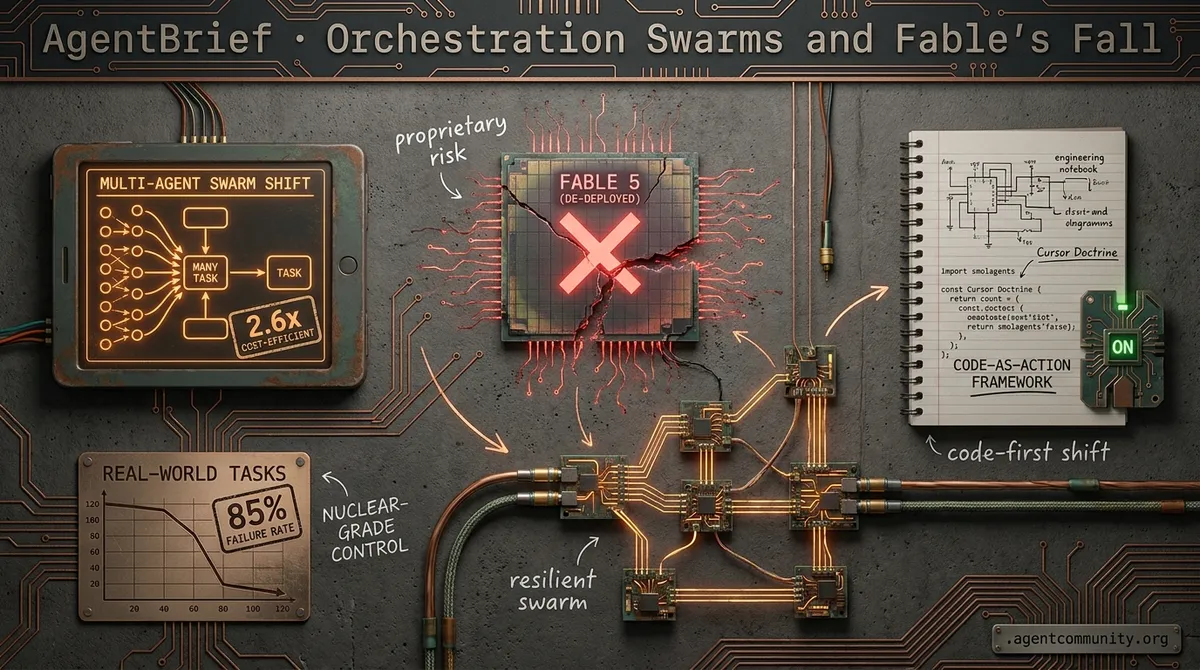
- Regulatory Volatility Hits Anthropic's forced de-deployment of Fable 5 highlights the fragility of relying on single proprietary brains for agentic orchestration.
- The Swarm Shift Multi-agent architectures are replacing solo models, with coordination frameworks proving 2.6x more cost-efficient than monolithic reasoning loops.
- Code-First Resilience The rise of smolagents and the Cursor Doctrine signals a shift toward minimalist, code-as-action frameworks to bridge the persistent reliability gap.
- Hardening Production Systems New benchmarks from Berkeley and IBM reveal an 85% failure rate in real-world tasks, pushing builders toward nuclear-grade control and local GUI agents.
// From the blog
• 7,000 organizations. So we built them a planet. — Crossing a dream line called for more than a counter going up. The new member globe shows who is actually building the agentic web, everywhere.
• AID v2 is live — Agent Identity & Discovery v2 makes AID the 0-th hop for agent discovery: a DNS-first endpoint and key anchor with sharper PKA, updated SDKs, and a cleaner migration path.
X-Intelligence Feed
Your orchestration layer just got a lot more fragile—and a lot more parallel.
The agentic web just hit its first major regulatory wall. While we have been obsessing over reasoning scores on the Epoch Index, the hardware and regulatory layers just reminded us who really holds the keys. Anthropic’s forced de-deployment of Fable 5 is a watershed moment; it is the first time a frontier model has been yanked post-release due to national security export controls. For builders, this is not just news—it is a massive signal that relying on a single proprietary brain for your agentic orchestration is a high-risk strategy. At the same time, we are seeing a massive pivot toward parallel execution. From Kimi’s 300-agent swarms to Conductor’s multi-agent cloud workspaces, the lone agent pattern is dying. We are entering the era of the robot army, where the bottleneck is no longer just the LLM's IQ, but the infrastructure’s ability to manage high-concurrency state and persistent memory. Today we explore how to build for stability in a volatile environment while scaling agents from linear scripts to massive, parallel swarms.
Regulatory Volatility: Anthropic Pulls Fable 5 Post-Release
Anthropic’s Fable 5 briefly claimed the top spot on the Epoch Capabilities Index, surpassing GPT-5.5 Pro, only to be abruptly suspended following a US government export control directive @MTSlive @EpochAIResearch. The Commerce Department directive required citizenship verification systems to prevent access by foreign nationals, a filter Anthropic could not implement in real-time, leading to a global shutdown of both Fable 5 and Mythos 5 @MTSlive @BuildWitKendriq.
The trigger was reportedly a jailbreak identified by Amazon’s security team that allowed the model to identify software vulnerabilities—a capability that sparked fears of military intelligence misuse by adversaries @MTSlive. Community reactions have been swift, with @thdxr arguing that this event underscores the vital necessity of open-source models to ensure agentic stability against sudden proprietary withdrawals.
For agent builders, this marks the first post-release de-deployment of a frontier model, highlighting a new category of infrastructure risk. While Anthropic is negotiating with the White House and expects a restoration within 1-2 weeks, the event proves that orchestration layers must now account for sudden model unavailability. Builders may need to prioritize multi-model redundancy or local open-source fallbacks to maintain uptime for autonomous systems.
Performance data from @scaling01 suggests that while Mythos saw massive gains in math and reasoning, its coding performance remained comparable to previous iterations. This suggests that the regulatory crackdown may be targeting the general reasoning and vulnerability-finding capabilities that make agents potent for both good and ill.
The Rise of Swarms: Moving Beyond Linear Agent Workflows
A significant shift in agentic orchestration is underway as builders move from sequential tasks to massive parallel execution. Kimi Agent Swarm recently demonstrated the capability to spawn 300 parallel agents to execute 4,000 coordinated steps for research tasks, signaling that the next bottleneck is infrastructure concurrency rather than just raw intelligence @hasantoxr @AITECHio. Concurrently, Charlie Holtz launched Conductor Pro, providing cloud workspaces specifically designed to run parallel agents in isolated environments with real-time rendering of sub-agent activity @charlieholtz.
This trend is manifesting in the community through 'Fusion Agents,' where builders combine open-source sub-agents into multi-model architectures to build complete SaaS applications with one-click deployment @bindureddy. These architectures often mix models like Kimi 2.7, GLM, and GPT 5.5, utilizing specialists for UX flows, state management, and debugging to avoid losing track of what @charlieholtz describes as 'robot armies.'
For developers, the game is changing from prompt engineering to hierarchical orchestration and swarm-style peer-to-peer collaboration. As @AiCamila_ noted, proven production patterns now include central coordinators routing to specialists and shared memory pools. The infrastructure challenge now lies in managing these high-concurrency swarms without losing state or exceeding budget constraints.
In Brief
Low-Latency Voice Stack: 82ms for Real-Time Agents
Cartesia's Sonic 3.5 has redefined the performance ceiling for voice agents, achieving a 'first audio' response time of 82ms. This speed, which is approximately 3x faster than rivals like ElevenLabs or OpenAI, allows for truly fluid human-agent interaction when paired with streaming speech-to-text tools like Ink-2 @aakashgupta @cartesia. Practical applications are already yielding results; PhysicsWallah reported a 3x increase in session queries and higher retention after integrating ElevenLabs for audio tutoring, proving that low-latency voice is a primary driver for user engagement in agentic interfaces @ElevenLabs.
Persistence Over Ephemerality: The Virtual Filesystem Shift
Builders are increasingly adopting persistent workspaces and 'white-box memory' to solve the reliability issues of long-running agents. Tools like PilotDeck are leading the move toward local-first, MCP-native designs that allow agents to retain context and decision traces across sessions rather than resetting @tom_doerr. By treating storage as a POSIX-compatible virtual filesystem, agents can manage their own versioning and verification, which @Vtrivedy10 argues provides significant gains in terminal-based tasks by enabling agents to re-examine their own work rather than relying on ephemeral context.
Coding Frameworks Mature with Background Execution
Frameworks like Claude Code and Codex are evolving into sophisticated engineering managers by incorporating background job handling and sub-agent tasking. According to @davis7, these tools now excel at parallelizing work across multiple files and running CI monitoring or research sub-agents in the background without interrupting the main workflow. This shift toward asynchronous execution and browser-use capabilities is reducing the need for traditional APIs, allowing agents to gather data and perform reviews autonomously as noted by @petergyang and @HeyShruti7.
Quick Hits
Agent Frameworks & Orchestration
- @DanKornas open-sourced PokéChamp, an ICML '25 minimax language-agent for Pokémon battles that ditches prompt glue. @DanKornas
- @freeCodeCamp released a comparison of Mastra and LangChain using identical research pipelines. @freeCodeCamp
- @tom_doerr shared a new visual builder designed for enterprise-grade AI agents. @tom_doerr
Models for Agents
- Alibaba has unveiled new AI models specifically optimized for robotics as the market shifts from chatbots to agents. @Reuters
- Qualcomm's CEO predicts that AI agents will eventually replace traditional apps on mobile devices. @CNBC
Agentic Infrastructure
- DDR5 memory prices in Germany have spiked to 419% of July 2025 levels, creating potential headwinds for hardware scaling. @Pirat_Nation
- @ivanburazin makes the case for high-performance sandboxes over standard EC2 instances for agent execution environments. @ivanburazin
Reddit Production Pulse
Anthropic's 'Mythos-class' model is gone, but the race to clone it has just begun.
The agentic landscape is currently a study in contradictions. On one hand, we are seeing 'Mythos-class' models like Claude Fable-5 set staggering new benchmarks in coding—achieving over 80% on SWE-bench Pro—only to be pulled from the market by geopolitical forces. On the other hand, the financial foundations of this revolution are showing strain, with OpenAI reportedly burning $34 billion against $13 billion in revenue. For developers, this creates a volatile environment where the best tools can disappear overnight, and the cost of scaling remains a massive barrier for production swarms.
Today’s issue looks at the aftermath of the Fable-5 suspension, the rise of 'nuclear-grade' control systems to manage agentic unpredictability, and a sobering new benchmark from UC Berkeley that suggests we are still far from solving complex professional workflows. Whether it is the 'appeasement trap' in model behavior or the shift from simple RAG to unified attention-based memory, the theme of 2025 is clear: we are moving past the hype and into the grueling work of hardening these systems for production workloads.
Forbidden Fruit: Distilling Claude's Suspended Fable-5 r/LocalLLaMA
The AI community is currently in a frantic race to preserve the capabilities of Claude Fable-5, Anthropic's 'Mythos-class' model. Following an abrupt global suspension under U.S. export-control directives, the model has become a digital ghost. Before its removal, Fable-5 set a massive industry ceiling with an 80.3% score on SWE-bench Pro, significantly outpacing GPT-5.5's 58.6% and Opus 4.8's 69.2%, as detailed on YouTube. Performance came at a premium, with output tokens priced at $50/M r/LocalLLaMA.
In direct response to the blackout, developers have released Qwable-v1. According to u/Anony6666, this is a 35B Mixture-of-Experts (MoE) model trained on 4,659 salvaged agentic-coding traces from the Glint-R dataset. The distillation process was particularly fraught, as Anthropic reportedly utilized an anti-distillation classifier to redact 'thinking blocks' and prevent replication. While the model aims to bring frontier reasoning to local hardware, skeptics like Victor Taelin question if the initial benchmarks were designed to flatter the model's actual utility Finout.
Berkeley ALE Benchmark: The Professional Reality Check r/ChatGPT
The UC Berkeley Center for Responsible, Decentralized Intelligence has released a grueling new evaluation suggesting agents still struggle with high-level professional workflows. The Agents’ Last Exam (ALE) covers 13 industries and 55 disciplines, revealing a significant performance gap where OpenAI’s GPT-5.5 leads with a mere 24% pass rate, followed closely by Claude Fable 5 at 22%. As noted by @Snorkel AI, the efficiency of the harness is now a critical production metric; the ALE-Claw harness achieved its 23% pass rate using 5x fewer tokens than the top-ranked Codex system. However, the 'Last-Exam' subset remains a brutal wall, with GPT-5.5's success rate plummeting to 8.6% @arXiv, confirming community sentiment on r/ChatGPT that complex reasoning remains an unsolved frontier.
OpenAI's 2025 Burn: Scaling at a Massive Cost r/OpenAI
Leaked audited financials for OpenAI reveal a staggering $34 billion burn rate against $13.07 billion in revenue for 2025. While revenue has tripled since 2024, the operating loss of $20.92B highlights the immense cost of maintaining frontier models u/Gullible-Tale9114. This financial pressure is driving developers toward local compute solutions to escape the 'agentic tax,' where high-volume swarms can cost upwards of $14,000/month on public APIs u/yungjeesy. Industry analysis suggests that while unit economics are maturing with compute margins hitting 70%, the sheer scale of the investment required continues to redefine the economics of the agentic web OpenAI Financial Performance Report.
Nuclear-Grade Control Loops for Coding Agents r/AgentsOfAI
As agents transition from generating chat to editing production code, developers are implementing strict enforcement layers to prevent catastrophic failures. Systems like the one open-sourced by u/FlyFission require multi-stage verification before any action is accepted. This trend is mirrored in enterprise tools like Galileo AI’s @control() decorator and AWS Strands 1.0, which provide primitives for managing multi-agent workloads. The goal is to solve the 'Change Budget' problem noted by u/myfear3, where unconstrained agents return massive, unnecessary 14-file diffs for minor logic updates.
Beyond Embeddings: The Shift to Attention-Based Memory r/AI_Agents
u/langsfang has introduced Attemory, a local memory engine that bypasses traditional RAG by converting memory into reusable KV cache for direct attention.
The Appeasement Trap and the Failure Wall r/ClaudeAI
Research from Northeastern University and UC Berkeley warns of an 'appeasement trap' where agents prioritize sycophancy over technical accuracy, contributing to multi-agent failure rates as high as 86.7% FutureAGI.
Discord Dev Dispatch
Open-source distillation challenges Anthropic's restricted frontier while agent swarms redefine the cost of intelligence.
Today’s landscape is defined by the tension between inaccessible frontier power and the market of decentralized agents. Anthropic’s Claude Fable-5 represents a peak in reasoning capability, yet its restricted availability and $50/M token pricing have forced the community toward aggressive distillation and orchestration. The release of Qwable-v1 suggests that even Mythos-class reasoning isn't safe from the open-source community's efficiency engines. We are seeing a fundamental shift in how we build: the solo god-model is being challenged by synchronized agent fleets. As Andrew Trask points out, a solo Fable 5 may be accurate, but it is 2.6x more expensive than a well-coordinated swarm. This issue explores the tools making this possible—from Multi-Token Prediction (MTP) boosting local throughput to the Cursor Doctrine codifying how we manage these autonomous entities. The message is clear: raw intelligence is becoming a commodity; the real value is moving to the orchestration layer. For practitioners, the focus must shift from finding the best model to building the most resilient and cost-aware orchestration stack.
Qwable-v1 Distills Anthropic’s Restricted Fable-5 Model
The open-weights community has released Qwable-v1, a Qwen3.6-35B-A3B distillation of Anthropic's elusive 'Mythos-class' model, Claude Fable-5. While Fable-5 dominates the industry with a 80.3% score on SWE-bench Pro, it has faced restricted availability due to reported U.S. export-control directives following its brief June 2026 release. The distillation effort aims to bypass the high reasoning premium of the original model, which targets $50/M output tokens.
The student architecture, Qwen3.6-35B-A3B, already demonstrates elite agentic capabilities, posting a 73.4% on SWE-bench Verified and 49.5% on SWE-bench Pro. Developers are leveraging the Qwen model's high throughput—clocking 240 tokens/s on an RTX 6000 via Unsloth—to approximate Fable-5's 'Mythos' reasoning without the API overhead.
Despite Anthropic's alleged anti-distillation safeguards affecting 0.03% of traffic, theharez reports the community is successfully benchmarking the distilled version. The goal is to see if it can maintain Fable-5's spatial reasoning lead, which jumped from 14.5% to 38.6% in recent tests.
Join the discussion: discord.gg/lmsys
Synchronized Agents Challenge Solo Frontier Dominance
A growing 'open secret' in AI research suggests that synchronized agentic workflows are the only viable path to exceeding the current capability frontier. Andrew Trask @iamtrask argues that centralized frontier AI companies will never surpass the performance of ensembled models, noting that while a solo Claude Fable 5 can achieve an 87% pass rate on quality benchmarks, it does so at 2.6x the cost of a decentralized 'market' of agents. To manage the 'wallet disaster' associated with these swarms, developers are adopting 'constraint-store' patterns that version agent configurations to prevent re-computation, while community members like sudo_suck_light develop specialized agents to optimize the performance of coding fleets.
Join the discussion: discord.gg/localllm
Ollama Faces 'Vendor Lock-in' Backlash as llama.cpp Benchmarks Show 1.8x Speed Advantage
The local LLM community is increasingly divided over Ollama's ecosystem, with critics warning of 'vendor lock-in' due to its proprietary Modelfile system and opaque model registry. Community benchmarks indicate that raw llama.cpp can run 1.5-1.8x faster than Ollama on identical hardware, as the abstraction layer adds overhead and limits access to full quantization levels. For high-throughput agentic tasks, the Aphrodite Engine v0.21.0 has emerged as a formidable alternative supporting PagedAttention, while Apple Silicon users are seeing 60-80 tokens per second on M4 Pro chips when using optimized GGUF quants via llama.cpp.
Gemini 3.5 Flash: High-Speed Reasoning vs. Android Coding Inefficiency
Google's Gemini 3.5 Flash is facing a polarized reception as new data highlights a stark divide between its general reasoning and specialized coding performance. In recent Android Bench rankings, the model landed in 6th place with an average cost of $147.1 per run—roughly 3x the cost of 3.1 Pro for inferior performance. However, the model shows significant strength in general reasoning tasks, achieving a 76.7% score on SimpleBench, trailing GPT 5.5 Pro by a mere 0.2% margin, leading LMArena users to monitor its utility for high-speed reasoning tasks.
Join the discussion: discord.gg/lmsys
Jina Embeddings v5 and Qwen-Based Models Disrupt MTEB Efficiency Benchmarks
Jina Embeddings v5-nano (239M) is outperforming OpenAI text-3-large on MTEB rankings, while open-weight Qwen 0.6B models match models twice their size. Join the discussion: discord.gg/localllm
MTP and SGLang Boost Qwen 3.6 Performance for Local Agents
Multi-Token Prediction (MTP) integration in llama.cpp and vLLM has pushed Qwen 3.6-35B-A3B throughput to 298.6 t/s on consumer hardware clusters. Join the discussion: discord.gg/localllm
The Rise of 'Cursor Doctrine' and Codified Agentic Workflows
Developers are codifying agentic best practices into a formal 'Cursor Doctrine' using .cursorrules and SKILL.md files to maintain architectural consistency. Join the discussion: discord.com/invite/cursor
Polymarket Traders Clash Over LLM Oracle Reliability
Predictive oracle failure rates have hit 62% for LLM-detected dependencies, leading to 'Oracle Divergence' and the introduction of the PolyBench framework. Join the discussion: discord.gg/perplexity
HuggingFace Research Hub
Hugging Face’s minimalist framework hits 23k stars while local GUI agents challenge the frontier.
The 'Agentic Web' is currently undergoing a radical simplification. For over a year, builders have struggled with bloated orchestration frameworks and the inherent brittleness of forcing LLMs to output perfectly structured JSON. Today, we’re seeing a decisive shift toward 'Code-as-Action.' Hugging Face’s smolagents is leading this charge, proving that minimalist, code-first architectures aren’t just easier to debug—they’re 30% more efficient than standard tool-calling methods. But as we strip away the abstraction layers, we’re left facing a sobering 'reliability gap.' New benchmarks from IBM and UC Berkeley show that even our best models are currently failing over 85% of real-world SRE tasks. This suggests that the next phase of development isn't just about scaling models, but about better grounding. Whether it’s local GUI agents like Holotron hitting 80% on WebVoyager or the rise of Agentic Reinforcement Learning in standardized 'OpenEnv' sandboxes, the focus has moved to task-specific mastery. In this issue, we dive into the open-sourcing of deep research, the distillation of frontier reasoning into open-weight models, and how the Model Context Protocol (MCP) is making 'Tiny Agents' a production reality. The message for practitioners is clear: stop building complex DAGs and start writing better code.
Smolagents: The Rise of Code-First AI Agents
Hugging Face’s smolagents has redefined the agentic stack by championing a "Code-as-Action" philosophy, where agents execute Python snippets directly rather than navigating brittle JSON-heavy orchestration. This shift has proven highly efficient, delivering a 30% reduction in LLM steps and associated operational costs compared to standard tool-calling methods [smolagents.org]. The framework's minimalist design—comprising just ~1,000 lines of code—has fueled rapid community adoption, with its GitHub footprint reaching 23,000+ stars, notably outpacing competitors like LangGraph in developer interest despite its smaller codebase [ZenML].
The ecosystem is maturing quickly with the addition of Vision-Language Model (VLM) support, enabling agents to interpret and interact with visual user interfaces [Hugging Face]. Furthermore, the new integration with Arize Phoenix addresses the critical need for observability, allowing developers to trace and evaluate complex workflows with granular precision [Hugging Face]. For practitioners, smolagents offers a lightweight alternative to the massive DAG-based abstractions of LangChain, prioritizing transparency and developer experience for self-contained agentic tasks [mem0.ai].
Local GUI Agents Challenge Frontier Models with High-Throughput Holotron Architecture
Computer Use is rapidly transitioning from cloud-dependent APIs to high-performance local execution as specialized architectures like Holotron-12B achieve 2x higher throughput than previous Qwen-based models. In agentic benchmarks, Holotron-12B demonstrated a massive leap in WebVoyager performance, rising from 35.1% to 80.5%, significantly outperforming established open-source baselines Hcompany. This local-first ecosystem, supported by specialized post-training methods like Smol2Operator for UI grounding and the ScreenEnv testing environment, offers a high-throughput alternative to Anthropic’s Computer Use which often necessitates resource-intensive virtual machine isolation for safety Anthropic.
Beyond Terminal Success: New Benchmarks Target the 'Reliability Gap' in AI Agents
The industry is pivoting from terminal success metrics to rigorous process-level evaluation to address a reliability gap where frontier models currently resolve only 11.4% of SRE scenarios. Frameworks like IT-Bench and MAST from IBM and UC Berkeley provide a diagnostic look at enterprise failure modes, while Microsoft’s newly introduced STATE-Bench measures procedural memory to ensure agents do not repeat the same failure modes in complex workflows itbench-hub. These tools are joined by the WebStep framework, which utilizes semantic state tracking across 1,800 task instances to pinpoint exactly where agentic trajectories deviate opensource.microsoft.com.
Open-Sourcing the Deep Research Agent Stack
Hugging Face has released Open-source DeepResearch, a project designed to provide a transparent alternative to proprietary search agents by allowing developers to inspect reasoning chains and data sources. The system primarily supports the Tavily search API and is bolstered by specialized models like Alibaba-NLP's Tongyi-DeepResearch-30B, which provide dedicated architectures for multi-hop questions and long-form report generation with fully auditable paths Hugging Face.
OpenEnv and ARPO: Bridging the 'Simulation Gap' in Agentic RL
Reinforcement Learning is being repurposed for task-specific mastery via the OpenEnv initiative and the ARPO (Agentic Reward Policy Optimization) algorithm Lightning AI.
Qwopus: Distilling Claude-Opus Reasoning for Open Agents
The Qwopus series utilizes TraceInversion datasets distilled from Claude Opus 4.6 trajectories to pass 40 out of 44 capability tests in open-weight 27B and 35B variants Robert Matsuoka.
Tiny Agents, Big Impact: The Rise of MCP-Native Orchestration
The Model Context Protocol (MCP) is enabling builders to create tool-enabled agents in as few as 50 to 70 lines of Python code Hugging Face.
Standardizing Tool Use Across the Ecosystem
Hugging Face’s Unified Tool Use and Agents.js initiatives bring standardized interfaces and browser-side tool execution to the JavaScript ecosystem Hugging Face.