Persistent Memory and Open-Weight Surge
From Vercel’s 24-hour sandboxes to GLM-5.2’s local-first dominance, the agentic stack is shedding its stateless skin.
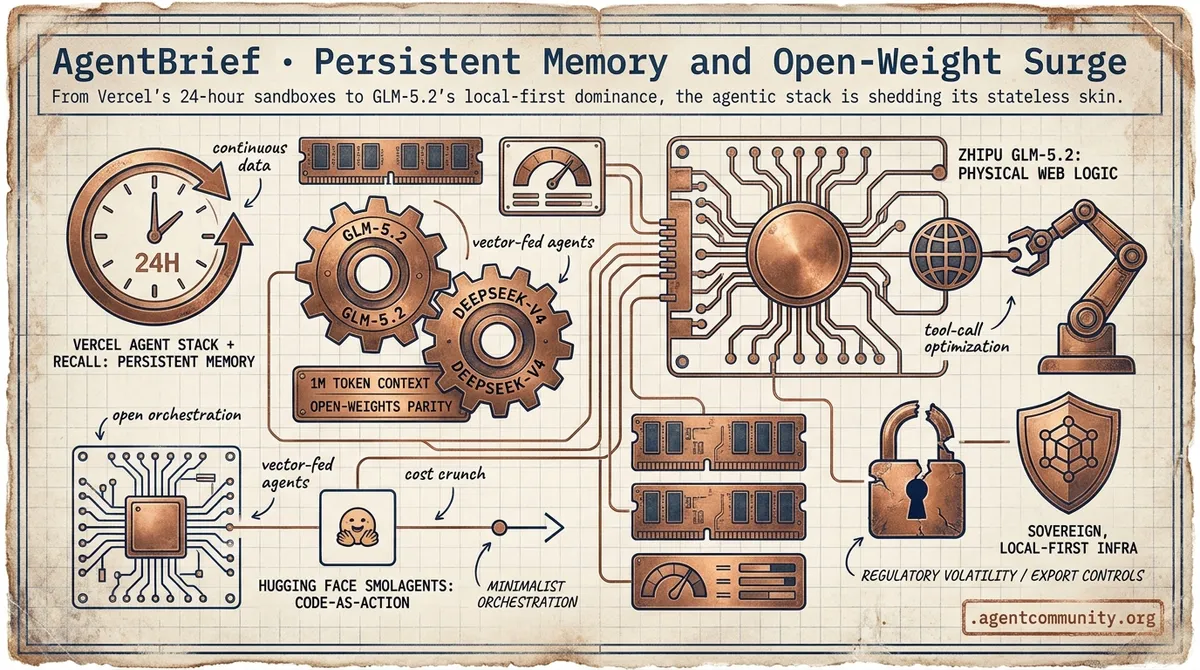
- The End of Ephemerality Vercel’s new Agent Stack and projects like Recall are shifting agents from stateless functions to persistent, stateful systems capable of 24-hour workflows.
- Open-Weights Reach Parity GLM-5.2 and DeepSeek-V4 are shattering records, offering frontier-level reasoning and 1M-token context windows that challenge proprietary API dominance.
- Minimalist Orchestration Wins Hugging Face’s smolagents is proving that "Code-as-Action" outperforms heavy DAG frameworks by slashing JSON parsing overhead and tool-calling loops.
- Regulatory and Safety Volatility Anthropic’s export control withdrawals and "invisible" safety interventions emphasize the need for sovereign, local-first AI infrastructure.
// From the blog
• 7,000 organizations. So we built them a planet. — Crossing a dream line called for more than a counter going up. The new member globe shows who is actually building the agentic web, everywhere.
• AID v2 is live — Agent Identity & Discovery v2 makes AID the 0-th hop for agent discovery: a DNS-first endpoint and key anchor with sharper PKA, updated SDKs, and a cleaner migration path.
The Persistence Stream
Your agents just got a 24-hour sandbox and a major memory upgrade.
We are witnessing the death of the ephemeral agent. For too long, we’ve treated autonomous systems as stateless functions—trigger, process, die. But this week’s developments from Vercel and the research community signal a pivot toward persistence. Vercel’s new "Agent Stack" isn’t just a bundle of SDKs; it’s a declaration that agents need durable workflows and 24-hour sandboxes to do real work. If an agent can't survive a network hiccup or a long-running research task, it is just a fancy script. At the same time, we’re seeing a reckoning with how these systems "think." The latest benchmarks on state tracking reveal that our current Transformer-based architectures are essentially goldfish when it comes to maintaining task history. This gap between our ambitions for long-horizon agents and the reality of their memory is the most important frontier for builders today. Whether you are leveraging Zhipu’s new frontier-grade open weights or plugging into Membrane’s 3,000-skill library, the goal is the same: building systems that can reason, remember, and remain active until the job is done. The agentic web is finally growing a long-term memory.
Zhipu GLM-5.2: Open-Weights Logic for the Physical Web
Zhipu AI has launched GLM-5.2, an open-weights model that is reportedly narrowing the gap with closed-source frontier models like Claude Fable while remaining significantly more cost-effective. Practitioners have noted that GLM-5.2 reaches "frontier territory" by solving complex reasoning tasks, such as theory-of-mind puzzles, that previously stumped prior versions @jenzhuscott. Furthermore, the model has demonstrated superior capabilities in tracking physical forces and momentum in browser-based physics simulations, outperforming rivals in code execution @rohanpaul_ai.
Community evaluations highlight strong performance on agentic coding benchmarks, with GLM-5.2 leading or matching top closed models on SWE-bench Pro and Terminal-Bench while offering a 1M context window and MIT-licensed weights @filicroval. It is positioned as competitive with Claude Opus variants on coding and long-horizon tasks, though some analyses note it trails slightly on certain agentic metrics when token budgets are constrained @buildwithhassan. The release emphasizes two reasoning effort levels and maintains the same API pricing as GLM-5.1, underscoring its appeal for cost-conscious builders.
Reactions emphasize the model's practicality for physics-informed coding and visual simulations, where it produced detailed browser-based HTML5 demos—such as pool breaks conserving momentum—compared to alternatives like Kimi K2.7 Code @atomic_chat_hq. Broader sentiment positions GLM-5.2 as advancing open-weights frontiers, with experts noting its Pareto efficiency on intelligence-vs-cost charts and potential for self-hosted commercial use @neuralbroker.
Vercel’s 24-Hour Sandboxes: Infrastructure for Long-Horizon Missions
Vercel has introduced a comprehensive "Agent Stack" designed to provide the essential primitives for autonomous systems, including durable workflows, isolated sandboxes, and a unified AI gateway. The stack bundles the AI SDK, AI Gateway, and Workflow SDK to deliver streaming, models, and durability in one command @vercel. This move aims to standardize the infrastructure of the agentic web, allowing developers to focus on logic rather than orchestration plumbing.
To support long-running agentic missions, Vercel has extended sandbox lifetimes to 24 hours and function invocations to 30 minutes, addressing the persistence needs of complex orchestration @rauchg. This is a critical upgrade for builders who previously struggled with the ephemeral nature of serverless environments when deploying agents that require extended execution times to complete research or coding tasks.
Industry leaders from LangChain and LlamaIndex are already converging at major summits to discuss how this standardized stack will power the next generation of autonomous B2B operations @ashpreetbedi. By offering isolated sandboxes and durable workflows, Vercel is positioning itself as the default runtime for the agentic web, ensuring that agents can remain active until their objectives are met.
In Brief
US Mandates Export Licenses for Anthropic Frontier Models
The U.S. Commerce Department has issued a directive requiring Anthropic to obtain BIS licenses before releasing its most advanced models, including Mythos 5 and Fable 5, due to national security concerns. As reported by @rohanpaul_ai, the order states these models may pose risks and fall under BIS authority, with restrictions applying to "foreign persons" even inside the United States as a "deemed export." Noncompliance could lead to civil and criminal penalties, effectively treating the most capable agentic backends as strategic assets that require strict federal oversight @MTSlive.
DeepSeek Secures $7.4B to Challenge Western AI Dominance
DeepSeek has closed a massive $7.4 billion funding round at a valuation exceeding $50 billion, signaling a major challenge to Western AI dominance while maintaining its open-weight strategy. The round, backed by Tencent and JD.com, includes a unique structure where CEO Liang Wenfeng retains significant control and external investors receive no voting rights @MTSlive. Despite its aggressive growth, U.S. authorities have notably held off on blacklisting the firm, allowing DeepSeek to continue pushing the industry toward more cost-efficient frontier capabilities that directly pressure Western pricing models @CNBC.
New Benchmarks Target State Tracking and Lifecycle-Aware Memory
AI researchers are warning that Transformers struggle with "state tracking"—maintaining a running task history—compared to simple retrieval, creating a bottleneck for long-horizon agents. Analysis from Google highlights that information flows only upward through transformer layers without recurrence, causing belief states to be pushed off the stack in long conversations @burkov. To combat this, the PaperGuru-Benchmark has been launched to evaluate how agents manage lifecycle-aware memory and structured revisions in research tasks, focusing on provenance-grounded composition to prevent memory loss during complex workflows @DanKornas.
Integrations Scale with 3,000+ Skills for SaaS Agents
Membrane has expanded its library to over 3,000 integration skills designed to eliminate the manual overhead of authentication and action mapping when agents interact with SaaS platforms. Each skill follows the open Agent Skills specification, allowing agents to install capabilities via simple commands like npx skills add gmail and immediately execute tasks without prompt engineering for API details @DanKornas. While this dramatically reduces setup friction, community members have noted that ongoing maintenance of changing OAuth scopes remains a concern for large-scale adoption @josesilesdata.
Quick Hits
Models & Capabilities
- Grok Imagine Video 1.5 is now live in the API, reducing 720p render times from 40 to 25 seconds @xai.
Agentic Infrastructure
- DeepSeek-V4-Pro is hitting inference speeds up to 93 t/s in Flash class tests @teortaxesTex.
- Coinbase CEO Brian Armstrong predicts a world where AI agents outnumber humans in the global economy @MollySOShea.
Frameworks & Orchestration
- OpenOcta is a new open-source AI Agent framework featuring single-binary deployment @tom_doerr.
Developer Experience
- Alibaba has released Open Code Review, an open-source CLI for AI-driven Git diff reviews @DanKornas.
Sovereign AI Roundup
Anthropic's Fable 5 vanishes after 72 hours as the industry pivots to persistent agent memory.
Today the agentic landscape feels less like a sandbox and more like a geopolitical chessboard. The sudden withdrawal of Anthropic’s Mythos-class models due to export controls is a wake-up call for developers: frontier capabilities are now state-level assets. This volatility is driving a surge in the 'Sovereign AI' movement, emphasizing open-weight alternatives like GLM-5.2 over fragile API dependencies. Meanwhile, the technical frontier is moving from stateless 'reflex' systems to stateful agents with persistent memory. Projects like Recall are showing that structured memory substrates aren't just a luxury—they're a cost-saving necessity that can slash token spend by 90% by eliminating redundant context injection. We’re also seeing a hardening of the agentic stack, with tools like Snyk’s mcp-scan addressing the 'ToxicSkills' that threaten autonomous systems. Whether it’s Moonshot AI undercutting the market with its trillion-parameter MoE or Microsoft Research rethinking world models with Next-Latent Prediction, the message is clear: the infrastructure for truly autonomous agents is being built in the face of immense regulatory and economic pressure. For practitioners, the shift from building cool demos to managing production-grade, secure, and stateful agent swarms has officially arrived.
Anthropic’s Fable 5 Pulled by Export Controls r/ClaudeAI
Anthropic was forced to abruptly disable its "Mythos-class" models, Claude Fable 5 and Mythos 5, on June 12, 2026, following a nuclear-grade export control directive from the U.S. Commerce Department. The order, citing national security concerns, bars access to the models by any foreign national, including Anthropic’s own international staff. This disruption follows a trend of government intervention in the AI sector, including the State Department's transition of its internal StateChat from Claude to OpenAI's GPT-4.1 earlier this year.
The model was reportedly live for only 72 hours before the suspension, leaving developers who had already integrated its tool-use capabilities into complex Premiere Pro and Minecraft rebuilds in a state of infrastructure whiplash, according to u/Confident-Count-2832. The incident has catalyzed a surge in the "Sovereign AI" movement, with proponents on r/ArtificialInteligence arguing that relying on proprietary frontier models creates a dangerous single point of failure and advocating for open-weight alternatives like GLM-5.2 to ensure stability for agentic workflows.
Kimi K2.7 Challenges Opus Precision r/LLMDevs
Moonshot AI has released Kimi K2.7 Code, a coding-focused 1-trillion parameter Mixture-of-Experts (MoE) model that reportedly outperforms Claude Opus 4.8 in tool-calling precision. Launched on June 12, 2026, the model is aggressively priced at $0.95/M input tokens, significantly undercutting closed-source competitors while achieving an 81.1% on the MCPMark Verified benchmark. While it excels in agentic tool-use and offers a 256K context window for complex chaining, it still trails Opus 4.8 in general coding benchmarks like Program Bench (53.6 vs 63.8). Practitioners like u/Low_Edge7695 are already integrating Kimi into agentic workflows, while developers monitor a teased "high-speed mode" that could offer 5-6x faster output acceleration.
Claude Code Finds Malware Amid ToxicSkills r/ClaudeAI
Claude Code (running Opus) has demonstrated advanced agentic reasoning by identifying and neutralizing malware hidden within a repository during a branch consolidation task. According to u/LastNameOn, the agent refused to merge or build a commit after spotting an obfuscated payload, mirroring previous success where Opus identified 22 vulnerabilities in Firefox with a false positive rate below 5%. However, the agentic layer itself faces new threats like CVE-2025-59536, a configuration injection flaw known as 'ToxicSkills' that can trigger remote code execution. To mitigate these risks, Snyk has released mcp-scan, a vital security tool given that 7.2% of Model Context Protocol (MCP) servers are currently vulnerable to exploitation.
The Rise of Stateful Agent Memory r/mcp
The industry is pivoting from stateless LLMs to 'stateful' agents that utilize dedicated memory substrates like the open-source Recall project to provide structured, persistent state across sessions. These DIY memory frameworks can slash token costs by up to 90% by eliminating the need to re-inject massive context chunks, a shift u/daisenH argues is critical for moving beyond simple reflex behaviors. By adopting human-like architectures that prioritize relevant past interactions over raw data dumping, developers can maintain customer preferences without the 'agentic tax' of ballooning inference costs, ensuring long-term stability for commercial agent deployments.
Microsoft Research Unveils Next-Latent Prediction r/MachineLearning
Microsoft Research's Next-Latent Prediction (NextLat) aims to provide long-horizon foresight for autonomous agents by predicting future latent states rather than just next tokens.
Managing AI Sticker Shock and Production Costs r/ollama
Enterprises are facing massive 'AI sticker shock,' with one team reportedly burning a $5,000 monthly credit limit in a single day due to unoptimized autonomous agent loops.
Hardening the Voice Stack Latency r/AI_Agents
Developers are targeting sub-1-second end-to-end response times for voice agents, moving toward full-duplex conversational patterns and video-native characters like Mel AI.
Stealth Browser Control with Patchright-CLI r/webscraping
The new open-source patchright-cli allows agents to bypass sophisticated trust walls by using binary-level patches to evade bot detection systems like Akamai and DataDome.
Local-First Lab Notes
GLM-5.2 shatters open-weights records while Anthropic walks back its "invisible" safety interventions.
We are witnessing a bifurcated evolution in the agentic stack. On one side, the open-weights community has reached a new zenith with GLM-5.2, proving that frontier-level reasoning and massive context windows are no longer locked behind proprietary APIs. Crossing the 80% threshold on Terminal-Bench is a milestone that marks the true arrival of high-performance, local-first agent orchestration. On the other side, the industry is grappling with a transparency crisis. Anthropic’s quiet implementation—and subsequent reversal—of "invisible" performance degradation in Claude Fable 5 highlights a growing friction between safety researchers and the developers who rely on consistent model behavior for autonomous systems.
For practitioners, the signal is clear: the ability to run high-performance models locally or on-edge is becoming a strategic necessity. This shift is further fueled by breakthroughs like OSCAR's 2-bit KV cache quantization and Google's "agentic harness" for on-device tool calling. Whether it's optimization at the bit-level or the architectural pivot toward Mixture of Experts (MoE), the infrastructure for truly autonomous agents is maturing faster than the policy frameworks governing them. Today we look at why these benchmarks matter and how local hardware is keeping pace with the frontier.
GLM-5.2 Claims Open-Weights Dominance with 80%+ Terminal-Bench Breakthrough
The open-weights landscape has shifted significantly with the release of GLM-5.2, the first open-weights model to cross the 80% threshold on Terminal-Bench, specifically hitting a score of 81.0 on Terminal-Bench 2.1 @lmsysorg. According to @TrentBot, it currently outperforms all other available open models and even surpasses Gemini in specific frontier-level tasks. In the design community, @Recoil42 noted that GLM-5.2 has secured the #1 spot on Design Arena, overtaking the now-unavailable Claude Fable 5, while ranking #2 overall in Frontend Coding benchmarks behind only Fable 5 @lmsysorg.
Practitioners are particularly focused on the model's 'deep thinking' capabilities—featuring 'Max' and 'High' effort levels @marktechpost—and its massive 1M token context window @youtube. While some users like jukofyork grumble about the model's size, others report it successfully generating complex outputs like working NES emulators. The model's Mixture of Experts (MoE) architecture allows it to run on consumer hardware by leveraging system RAM @reddit, providing frontier performance at a fraction of the cost of proprietary APIs.
Join the discussion: discord.gg/localllm
Anthropic Reverses "Invisible" Fable 5 Safeguards After Industry Backlash
Anthropic has modified its controversial safety architecture for Claude Fable 5 after industry experts and researchers labeled the model's "invisible" interventions as "appalling." Originally, the Fable 5 system card detailed a strategy to degrade model performance for 0.03% of traffic—specifically targeting distillation and frontier model development—using steering vectors without notifying the user @anthropic. Following a transparency crisis and outcry from critics like only_pain, Anthropic transitioned to a "fallback" model where flagged queries—including those involving cybersecurity and biology—are now routed to the less capable Claude Opus 4.8 instead of being silently degraded @theverge.
Join the discussion: discord.gg/lmarena
OSCAR 2-Bit KV Cache Quantization Hits llama.cpp
A significant optimization for local agent deployments has arrived with OSCAR 2-bit KV cache quantization support in llama.cpp, enabling up to an 8x memory reduction. Developer zhoueeer announced the implementation, which leverages Together AI’s 'attention-aware' approach to reduce KV memory compared to BF16 [@github.com/ggml-org/llama.cpp/discussions/24112]. Technical benchmarks reveal that OSCAR at 2.28 bits achieves a performance score of 71.86 on Qwen3-4B, providing a 4.1x increase in inference throughput for agentic workflows requiring massive context where competing 2-bit methods like KIVI and QuaRot fail [@pub.towardsai.net/together-ais-oscar-killed-kv-cache-memory-8x-the-first-2-bit-that-doesn-t-collapse-at-128k-beb06703d678].
Join the discussion: discord.gg/localllm
Google’s On-Device "Agentic Harness": 250MB Models for Android Tool Calls
The movement toward high-efficiency edge agents has accelerated with Google’s introduction of the AI Edge FC SDK, enabling complex function calling to run entirely on-device via the LLM Inference API. This shift is exemplified by a reported research project involving a tiny 250MB model designed as an "agentic harness" to execute Android tool calls hiddengemzgamer. These specialized approach is now scaling through the LiteRT ecosystem, which recently expanded to support the early preview of Gemma 3n, Google’s first multimodal on-device small language model (SLM) @GoogleDevelopersBlog.
Join the discussion: discord.gg/localllm
Cursor Composer 2.7: Custom Model Gains Marred by UI Regressions
While Cursor’s updated Bugbot is now 3x faster and 22% cheaper, the 2.7 release faces backlash for failing to render images in Jupyter Notebooks and resetting model preferences after updates Cursor Forum.
Join the discussion: discord.gg/cursor
N8n Voice Agents Leverage SIP Trunks for Efficiency
Developers are bypassing high middleman costs by using SIP trunks with n8n and ElevenLabs to build voice agents that support encrypted TLS transport and direct CRM integration ElevenLabs Documentation.
Join the discussion: discord.gg/n8n
DeepSWE and BrowseComp Reshape Agentic Evaluation
The new DeepSWE benchmark utilizes a 'contamination-free' methodology with 113 scratch-written tasks to crown GPT-5.5 as the current leader in agentic coding, replacing SWE-bench Pro @venturebeat.
Join the discussion: discord.gg/perplexity
Multi-GPU Hacks and P2P Patches Unlock High-Throughput Local Inference
Resource-constrained builders are doubling VRAM using legacy GPU chains and custom driver patches to enable direct P2P communication, achieving a 3x throughput increase via vLLM over llama.cpp @smcleod.
Join the discussion: discord.gg/localllm
The Minimalist Bench
Hugging Face's minimalist framework and DeepSeek's 1M-token context redefine agentic efficiency.
Today marks a definitive shift in the Agentic Web: the move away from bloated orchestration toward "Code-as-Action" and massive context windows. Hugging Face’s smolagents is leading the charge, proving that a library of just 1,000 lines can outperform heavy Directed Acyclic Graph (DAG) frameworks by executing Python snippets directly. This isn't just about simplicity; it's about reducing the 30% overhead caused by brittle JSON parsing and tool-calling loops. For developers, this represents a move toward 'improviser' agents that are more flexible and cheaper to run.
Meanwhile, the context wars have entered a new phase with DeepSeek-V4. Offering a 1M-token window with 10x KV efficiency, it challenges our reliance on external vector databases for long-horizon tasks, though the reported 120-second latency for large-scale analysis remains a hurdle for real-time applications. We are also seeing a 'reliability reality check' across the board. New benchmarks from IBM and Berkeley show that while models are getting smarter, their success in complex SRE tasks remains a sobering 14%. For those of us building the autonomous future, the message is clear: slim down your orchestration, expand your context, but keep your evaluations rigorous.
Smolagents: The Minimalist Shift Toward Code-Centric Orchestration
Hugging Face’s smolagents has redefined the agentic stack with a 'Code-as-Action' philosophy, allowing agents to execute Python snippets directly instead of navigating brittle JSON-based orchestration huggingface. This minimalist framework—comprising just ~1,000 lines of code—delivers a 30% reduction in LLM steps and operational costs compared to traditional ReAct-style tool calling huggingface.
While heavy frameworks like LangGraph utilize a 'master planner' DAG approach requiring roughly 120 lines for a simple agent, smolagents acts as an 'improviser,' achieving the same functionality in as few as 40 lines Pooya Golchian. The ecosystem has matured to include Vision-Language Model (VLM) support for visual UI interaction huggingface and native Model Context Protocol (MCP) integration, enabling developers to build functional agents in under 70 lines of code huggingface.
Benchmarking on the GAIA framework highlights the library's efficacy, with open-source models like DeepSeek-R1 now outperforming closed-source counterparts in code-centric agentic tasks huggingface. To ensure production readiness, integration with Arize Phoenix provides granular tracing and observability for these lightweight workflows huggingface.
DeepSeek-V4 Scales Agentic Memory with 1M-Token Context
DeepSeek-V4 has launched with a native 1,000,000-token context window, utilizing a Mixture-of-Experts (MoE) architecture that delivers a 10x reduction in KV cache requirements compared to the previous generation DeepSeek. While these efficiency gains allow agents to maintain massive state in-context, practical stress tests indicate that "Time to First Answer" in max reasoning mode can reach 120 seconds for 520k-token document analysis @LocalLLaMA.
GUI Agents Master Desktop and Web Automation
The 'Computer Use' frontier is pivoting toward high-performance local execution with the release of Holotron-12B, which achieves a significant WebVoyager score jump from 35.1% to 80.5% Hcompany. To address the reliability gap in visual agents, huggingface introduced ScreenSuite, a comprehensive evaluation suite that utilizes smolagents to test VLM perception and multi-step behavior across secure sandboxed environments like ScreenEnv.
New Benchmarks Target Agentic Reasoning Failures
Standard LLM benchmarks are proving insufficient for agents, leading to new specialized tools like IT-Bench and MAST, which uncovered a sobering 14% success rate in enterprise SRE tasks IBM Research and UC Berkeley. Meanwhile, the new DABstep benchmark for data agents reveals a significant performance ceiling, with reasoning-optimized models like o3-mini leading the field at only 16% accuracy huggingface/dabstep.
NVIDIA Cosmos Reason 2 and Nemotron 3 Nano Omni Bridge the Physical-Digital Divide
NVIDIA's new 8B-parameter Cosmos Reason 2 model and Nemotron 3 Nano Omni unify vision, audio, and language into a single inference pass for low-latency robotics nvidia.
IBM Research Hardens Enterprise AI with AssetOpsBench
IBM Research's AssetOpsBench features 460+ scenarios to test multi-agent architectures like AgentHive against Industry 4.0 maintenance and monitoring realities IBM Research.
Unified Tool Use and the Rise of MCP-Native Agents
The Model Context Protocol (MCP) is gaining traction with native smolagents integration and new outputSchema support for validated data exchange huggingface.
MedGemma and LangGraph Lead Medical Navigation
Google's EHR Navigator agent uses MedGemma and LangGraph to navigate complex health records via the FHIR standard google.