Beyond JSON: The Deterministic Pivot
Agent builders are ditching vibe-based prompts for code-centric architectures and deterministic firewalls.
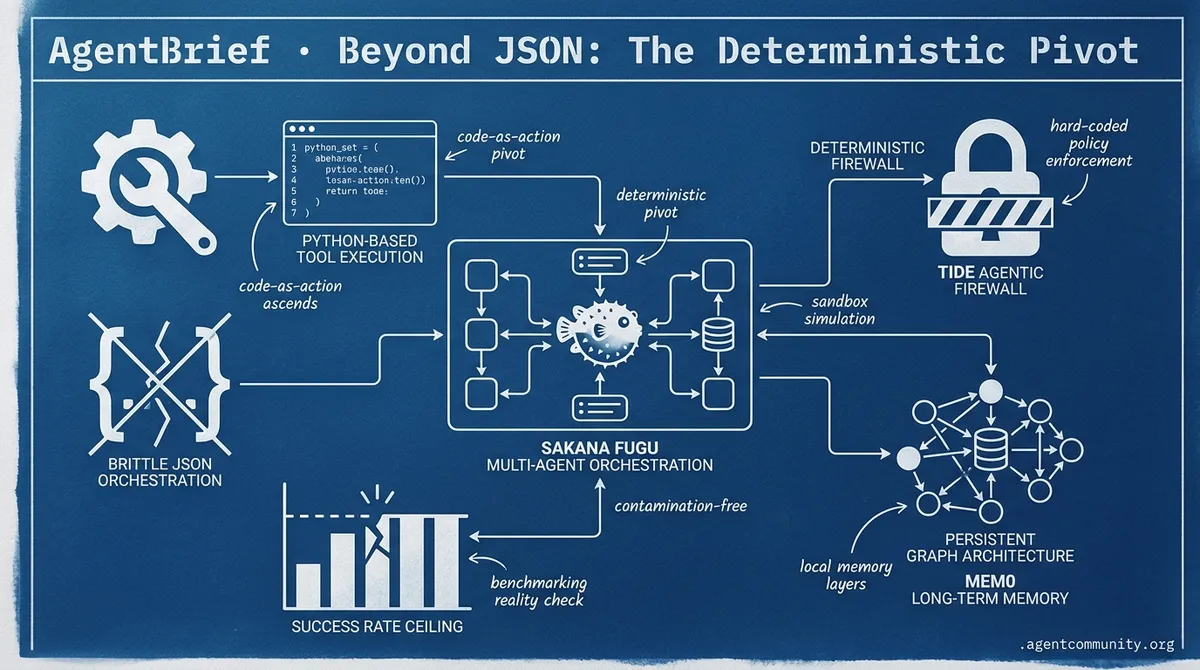
- Code-as-Action Ascends The shift toward Python-based tool execution via frameworks like smolagents is replacing brittle JSON-based orchestration to bridge the performance gap in enterprise production. - Deterministic Guardrails Emerging The rise of agentic firewalls like Tide and world models like Qwen-AgentWorld marks the end of vibe-based deployment in favor of hard-coded policy enforcement and sandbox simulations. - Memory and Persistence Infrastructure tools like RushDB and Mem0 are providing agents with long-term, local memory layers, moving intelligence from ephemeral context windows to persistent graph architectures. - Benchmarking Reality Check New contamination-free datasets like DeepSWE and IBM's tool-calling audits reveal that model smartness alone cannot overcome the success rate ceiling in complex, non-pattern-matched environments.
// From the blog
• 7,000 organizations. So we built them a planet. — Crossing a dream line called for more than a counter going up. The new member globe shows who is actually building the agentic web, everywhere.
X Intel & Orchestration
Why call one model when an ecosystem can work for you?
The era of the monolithic model as the sole source of intelligence is beginning to fracture. For agent builders, the focus is shifting away from simple prompt engineering toward complex multi-agent orchestration and persistent memory layers. Today’s news highlights a clear trend: we are moving from 'asking a model' to 'managing a system.' Sakana AI’s Fugu launch exemplifies this, turning a single API call into a collaborative session between expert models. Meanwhile, the infrastructure layer is maturing with tools like RushDB and Mem0 prioritizing local, persistent, and graph-based memory—effectively giving agents a long-term 'brain' that lives in the VPC rather than a ephemeral context window. However, a significant hurdle remains in how these agents internalize world rules. If we can't solve the world-modeling bottleneck identified in recent research, we risk hitting a reasoning plateau. For those of us shipping agents today, the winning play is clear: stop waiting for a smarter model and start building smarter architectures that can synthesize, verify, and remember.
Sakana Fugu Unlocks Frontier Performance via Multi-Agent Orchestration
Sakana AI has launched Sakana Fugu, a multi-agent orchestration system that presents a single model API but dynamically farms out tasks to a pool of expert models @SakanaAILabs. The system is trained to handle model selection, delegation, verification, and synthesis internally, matching the performance of frontier models like Fable and Mythos on rigorous reasoning benchmarks @SakanaAILabs. This approach signifies a shift from monolithic models toward collaborative ecosystems, allowing developers to access multi-agent complexity through a single OpenAI-compatible endpoint @rohanpaul_ai.
Early testers note that while single prompts might still favor direct models, messier tasks involving synthesis and verification highlight Fugu's strength @ChrissGPT. Community discussion emphasizes that actual spend scales with the number of underlying models called, and independent verification of per-benchmark token consumption remains limited @ManpreetBola. This 'ensemble-as-a-service' model challenges the traditional paradigm of scaling single-model parameters.
Fugu Ultra is now available on OpenRouter with pricing listed as $5/M input and $30/M output @_0xpainn @TimJayas. This positions it competitively against GPT-5.5 and Claude Opus 4.8. However, cost remains a point of contention; one tester reported ~$2 per run (roughly 4x GPT-5.5) with no clear performance edge justifying the cost after 10 runs @PawelHuryn.
For agent builders, Fugu represents a ready-made pattern for complex task decomposition. By moving the orchestration logic inside the model API, Sakana reduces the 'glue code' required to build high-reasoning agents. The next phase will be watching how OpenRouter and other providers handle the transparency of these multi-call workloads.
New Research Questions Agent Ability to Discover Hidden World Rules
Recent studies into LLM agents suggest a significant bottleneck in their ability to turn growing evidence into stable internal world models @rohanpaul_ai. While agents can sometimes identify hidden structures through interaction, they remain weak at planning, using memory effectively, and processing feedback to build reliable mental maps of complex environments @rohanpaul_ai. This gap in 'internal world models' is viewed by industry veterans as a critical hurdle that must be solved by 2027 to avoid an industry plateau @swyx.
A new paper titled 'Can LLM Agents Infer World Models? Evidence from Agentic Automata Learning' (arXiv:2606.16576) provides empirical backing, demonstrating sharp performance drops as hidden environmental complexity scales @rohanpaul_ai. Experts such as @sytelus argue that fundamentally different pre-training objectives beyond next-token prediction may be required to enable true agentic world-modeling. This suggests that current transformer-based agents may hit a hard ceiling when navigating novel, non-deterministic environments.
Alternative architectures are already emerging to address these flaws. 'Looped World Models' (LoopWM) from FaceMind Research explores iterative refinement of latent states via reused transformer blocks as a path to more efficient world modeling @romir_jain @romir_jain. Related research on latent reasoning in TRMs frames recursive processes as policy improvement operators, with potential efficiency gains up to 18x @machinestein.
This research suggests that builders should be wary of assuming agents can 'figure it out' on the fly. Until world-modeling improves, successful agents will likely require heavily structured environments or explicit rules provided via external context. The 'black box' approach to agent planning is currently showing its limits in high-complexity domains.
In Brief
Power User Workflows and Skills Emerge for Claude Code
Developers are rapidly formalizing production-grade workflows for Claude Code, centering on persistent CLAUDE.md files for project context and gated plan modes. A widely shared community guide from Boris Cherny's team has amassed over 58K stars on GitHub, recommending short CLAUDE.md files under 200 lines, Git Worktrees for parallel streams, and feature-specific sub-agents over general ones @techNmak @Zev_ee. Power users like @Krishnasagrawal and @gaganfoolish emphasize orchestrating these elements as a full system, utilizing 50+ production-grade skills and UX reviewers to reduce context pollution and enable reliable, long-running agentic development without manual wiring @101babich @tom_doerr.
Infrastructure for Persistent Agent Memory Gains Momentum
New solutions like RushDB and Mem0 are treating agent memory as a first-class infrastructure layer rather than a secondary database concern. RushDB has introduced an API layer that converts JSON objects into graph relationships and semantic search results without schema migrations, allowing agents to handle nested records and embeddings automatically @DanKornas @Shehu_Hikmah. Simultaneously, Mem0 has enabled self-hosting for 100% privacy, allowing builders to set a local server for automatic fact extraction and history compression across user and agent layers @Teknium @shesaidmewakeup. This shift toward owned VPC infrastructure for memory reduces external data dependencies and the need for complex glue code @AndreiOnel @Ifeanyiuchend @stretchcloud.
OpenClaw Maturation and Execution Improvements
The OpenClaw framework is maturing under a non-profit structure, prioritizing core stability and 'many agent' architectures over traditional VC-driven features. Founder @steipete notes that the project now benefits from token contributions from OpenAI while maintaining independence and improving quality @steipete @steipete. Developers using the framework are increasingly favoring architectures involving hundreds of specialized, smaller agents to mimic collaborative team dynamics rather than overloading single agents with complex cron jobs @RhysSullivan.
Quick Hits
Agent Frameworks & Orchestration
- Executor v1.5.16 adds Microsoft Graph support and improved attachment handling for multi-account workflows via @RhysSullivan.
- Agent Forge improves Resend API reliability and expands Human-in-the-Loop via Telegram @AITECHio.
- A new visual drag-and-drop builder for AI agent workflows is now live via @tom_doerr.
Models for Agents
- DeepSeek reportedly completed V4 Pro training on a 384 supernode in Mongolia via @teortaxesTex.
- GLM-5.2 architecture is under analysis for training readiness following cross-tool learning sightings in GPT-5.5 @QuixiAI.
Developer Experience
- Codex snapshots cited as a top feature for agentic development by @jxnlco.
- Curated index of 340+ AI agents and frameworks updated monthly for builders via @tom_doerr.
Reddit Reliability Roundup
New world models and policy-as-code runtimes are bringing deterministic reliability to autonomous agents.
The 'vibe-based' era of agent development is effectively over. For the past year, builders have relied on the inherent 'smartness' of frontier models to navigate complex environments, only to hit a reliability ceiling where hallucinations and authorization failures make production deployment a liability. Today’s issue highlights a fundamental pivot toward deterministic architectures. We’re seeing this manifest in two ways: the rise of 'Language World Models' like Qwen-AgentWorld, which allow agents to simulate consequences in a sandbox before execution, and the emergence of 'Agentic Gateways' that treat LLMs as untrusted users subject to hard-coded policy enforcement.
This shift is bolstered by a new generation of contamination-free benchmarks like DeepSWE, which reveal that even our best models struggle when pattern matching is no longer an option. As we move toward an Agentic SDLC, the focus is moving from the model itself to the 'deterministic shell' surrounding it—whether that is via 90/10 code-to-LLM ratios or silicon-level hardware geofencing. For the builder, the message is clear: the most autonomous systems of tomorrow will be the ones with the most rigid, verified boundaries today.
Qwen Debuts 'AgentWorld' Language World Models r/LocalLLaMA
Qwen has released Qwen-AgentWorld-35B-A3B, a 35B-parameter Mixture-of-Experts (MoE) model with only 3B active parameters, specifically architected as a 'language world model.' Unlike traditional models that focus on action generation, this system is trained on the WorldSim-1.2M dataset to predict environment state transitions across seven domains, including OS (Linux), Android, and the Model Context Protocol (MCP) u/nikhilprasanth. Performance benchmarks indicate the 35B variant achieves 94.2% accuracy in predicting terminal outputs and DOM changes, effectively serving as a high-fidelity sandbox for agent testing.
The community also identified a massive 397B-A17B variant, which reportedly reduces agentic hallucinations by 40% when utilized in an 'adversarial simulation loop' u/Shoddy_Bed3240. By simulating the consequences of an action before it is executed, these models allow developers to bypass deployment risks, moving toward a more deterministic Agentic SDLC where loops are verified in a latent world model before touching live production environments.
Policy Enforcement Becomes the New Agent Bottleneck r/AI_Agents
Authorization-as-a-Service is emerging as the primary bottleneck for production agents, as builders move away from prompt-based guardrails toward 'Agentic Gateways' like Tide. This policy-as-code runtime intercepts tool calls to evaluate them against deterministic local policies, addressing the reality that humans catch agent failures only 9–26% of the time u/brennhill. By treating the agent as an untrusted user within a zero-trust environment, developers are implementing allow/deny/escalate workflows that prevent 'state-bleed' where internal memory might otherwise bypass standard IAM checks.
DeepSWE Benchmark Targets Contamination r/MachineLearning
The newly introduced DeepSWE benchmark is gaining traction as a contamination-free alternative to SWE-bench, featuring tasks that are 5.5x more complex and require deeper reasoning rather than pattern matching. Initial results show Claude 3.5 Sonnet leading with a 26.4% success rate compared to GPT-4o's 18.7%, driving a shift toward Evaluation Driven Development (EDD) where automated local loops catch silent failures like fabricated IDs u/we_are_mammals.
One-Command Deployment and Specialized Grounding Fuel MCP Expansion r/ClaudeAI
The Model Context Protocol (MCP) ecosystem is rapidly evolving toward production-ready remote infrastructure with the release of one-command deployment tools for EU-hosted servers and specialized servers like Opinion.trade for prediction markets. New grounding capabilities, such as the Gemini Search MCP, are integrating real-time web results directly into agent workflows, while the top utilized servers now include GitHub, Slack, and PostgreSQL for robust code and data management u/Danielloesoe.
Local Qwen 3.6 Hits 100 TPS r/LocalLLaMA
Local users achieved 100.4 TPS on Qwen 3.6:27B using row-wise tensor splitting, noting that its instruction-following now rivals Claude Opus for specialized physics-based coding tasks u/codehamr.
The 90/10 Rule for Production Reliability r/AI_Agents
Builders are reporting that the most reliable data agents are 90% deterministic code, restricting the LLM to a 'natural-language shell' to prevent the recursive failures seen in unconstrained autonomous systems u/anilkr84.
AMD Radeon AI Pro R9700 Benchmarks r/LocalLLM
Initial data for the AMD Radeon AI Pro R9700 shows the Vulkan backend reaching 22 tok/s on Qwen 3.6, significantly outperforming the ROCm backend's 14 tok/s in Linux Docker environments u/illuvyn.
Chip Security Act and Silicon Kill-Switches r/LocalLLaMA
The proposed 'Chip Security Act' mandates hardware-level location tracking and silicon kill-switches, potentially allowing remote-disabling of high-compute hardware if it leaves sanctioned 'safe zones' u/alex20_202020.
Discord Swarm & Security
Pre-execution enforcement and swarm-arena architectures are professionalizing the agentic stack.
We are witnessing a fundamental shift from 'chatting with agents' to 'engineering autonomous systems.' The narrative today is the professionalization of the agentic stack, moving beyond experimental loops toward production-grade reliability. On the security front, we see the rise of deterministic firewalls like Tide and Poirot. These tools move safety to the protocol level, enforcing strict boundaries before a single tool call is executed. This isn't just about safety; it's about trust. If we can't bound an agent's behavior locally, we can't deploy it in high-stakes environments.
Simultaneously, the orchestration layer is evolving. Alibaba's Qwen AgentWorld introduces 'swarm arena' learning, where agents refine their reasoning during idle cycles. This architecture prioritizes tool-calling precision over static knowledge—a key differentiator for builders. Meanwhile, the community is archiving elite weights like GLM 5.2 as a hedge against geopolitical restrictions, framing weight access as a civil liberties issue. Whether it is optimizing 16GB VRAM for 'tool healing' or bypassing bot shields with Camoufox, the agentic web is building its own infrastructure, independent of frontier gatekeepers. The following stories detail how these components are coming together to form a coherent, autonomous OS.
Agentic Firewalls: The Rise of Pre-Execution Enforcement
The rise of autonomous tool use has prompted a new wave of security layers designed to prevent agents from executing harmful or unauthorized commands. A new open-source project called Tide Runtime Enforcement, part of the Rippletide ecosystem, is introducing a local Model Context Protocol (MCP) policy gateway that returns allow, deny, or escalate decisions before an agent tool call reaches the server scamir. This pre-execution enforcement allows developers to implement human-in-the-loop (HITL) triggers for high-risk actions, ensuring that agents operating in MCP-based environments remain within strict organizational boundaries and do not drift into unauthorized system modifications.
In parallel, the 'read-only' agent pattern is gaining traction for infrastructure monitoring and high-stakes troubleshooting. devopmh has introduced Poirot, an incident detective built on Claude Code that operates in a headless, zero-trust environment. By leveraging a strictly scoped IAM role with explicit denies on sensitive services like AWS Secrets Manager and KMS, Poirot can perform automated Root Cause Analysis (RCA) on CloudWatch alarms without the risk of data exfiltration or destructive configuration changes. These tools represent a critical shift in agentic engineering: moving away from post-hoc monitoring toward deterministic, pre-execution firewalls that enforce safety at the protocol level.
Qwen AgentWorld: Scaling Orchestration via 'Swarm Arena' and A3B Variants
Alibaba's Qwen team has officially launched Qwen AgentWorld, a specialized suite of models and frameworks designed to advance multi-agent orchestration. The release highlights the Qwen 3.6 35B A3B variant, which introduces a 'swarm arena' learning system allowing sub-agents to refine reasoning during idle cycles .plunder. This architecture targets 'Agentic Engineering' by prioritizing tool-calling precision and autonomous planning over static knowledge retrieval ryanstudio. Technical benchmarks for the A3B style-tunes show a significant reduction in 'rule following drift,' ensuring higher reliability for long-running agentic loops computerguy. Community practitioners are further enhancing stability via 'unslop' tunes and native tool-calling modes that minimize the 'quantization tax' on reasoning logic mister_spoogles. Join the discussion: discord.gg/localllm
Builders Race to Archive GLM 5.2 and Kimi as Legal Debate Intensifies
Amidst escalating geopolitical tensions, developers are mobilizing to archive high-performance Chinese models like GLM 5.2 and Kimi. ryanstudio has urged builders with at least 12TB of local storage to prioritize these weights before potential access restrictions. This preservation movement is increasingly framed as a civil liberties issue; mister_spoogles posits that model weights may constitute protected speech under the First Amendment, drawing parallels to the 1990s legal precedents that classified PGP encryption code as speech. The technical urgency is driven by GLM 5.2's efficiency, which reportedly achieves a 91.2% score on GSM8K lm_mod_16. While rumored to be a 700B parameter model, it challenges the performance of larger 1T architectures. Join the discussion: discord.gg/lmarena
Cursor 3.9 Eliminates Windows Lag, Solidifying 'Agentic Engineering' Workflows
Cursor has officially rolled out updates 3.8 and 3.9, specifically targeting the stability of its 'Agentic OS' infrastructure by eliminating Windows lag. A critical fix addresses long-standing DOM-related lag on Windows, which previously throttled IDE performance as chat context and Composer history expanded during deep architectural refactors wanqingxiexie. This technical debt clearance is essential for maintaining the 'spammable' reliability of Composer 2.5, allowing agents to operate within massive context windows without the UI degradation that previously plagued long-running sessions. This evolution mirrors the 'Cursor Doctrine' of protocol-level enforcement, ensuring that even as context grows, the agent's output remains surgically precise and deterministic. Join the discussion: discord.com/invite/cursor
Optimizing 16GB VRAM for Local Agentic Loops
Practitioners are gravitating toward Qwen 3.6 Cerebellum quants to maintain logical coherence and robust 'tool healing' on consumer hardware faeren.
Unlimited-OCR 3.3B: Scaling Document Intelligence for Agents
The launch of Unlimited-OCR 3.3B enables 'one-shot' document intelligence with a 32K context length, bypassing the crop-and-stitch limitations of smaller models @ModelScope2022.
Smol-Training-Playbook and the Backlash Against 'Benchmaxxing'
Hugging Face's new playbook demonstrates that data quality allows 1.7B parameter models to outperform larger competitors, while critics argue 'benchmaxxing' degrades real-world performance faeren.
Self-Healing Infrastructure and the Agentic Web Arms Race
Autonomous operations are maturing through 'tool healing' patterns and hardened scrapers like Camoufox that bypass modern anti-bot shields Camoufox Documentation.
HuggingFace Code-First Feed
Hugging Face pivots to code-first agents as benchmarks expose the 11% reality wall of enterprise reliability.
The agentic landscape is undergoing a fundamental architectural pivot. For the past year, we have relied on agents that use JSON blobs to communicate with tools—a method that is increasingly proving too brittle for the '11% reality wall' of production environments. Today’s synthesis reveals a decisive shift toward 'Code-as-Action,' spearheaded by Hugging Face’s smolagents. By allowing agents to write and execute Python snippets directly, developers are seeing a 30% reduction in operational steps and a significant boost in resilience on benchmarks like GAIA.
This move toward code-first execution isn't happening in a vacuum. It is being met by a surge in high-throughput local models like Holotron-12B, which are pushing GUI navigation success rates from 35% to over 80%. Meanwhile, IBM Research is providing the necessary reality check, highlighting that nearly half of agent failures stem from tool-calling errors. The message for practitioners is clear: the future of autonomous systems lies in minimalist, code-centric 'harness' architectures that prioritize execution over complex structural parsing. Whether you are building deep research loops or enterprise SRE agents, the focus has shifted from prompt engineering to agent logic.
Hugging Face Standardizes Code-First Agent Architectures
Hugging Face is fundamentally shifting the agentic paradigm with the release of smolagents, a minimalist library that replaces brittle JSON tool-calling with a 'Code-as-Action' philosophy. By allowing agents to write and execute Python snippets directly, the framework has demonstrated a 30% reduction in LLM steps and operational costs compared to traditional orchestration. This architectural pivot was validated on the GAIA benchmark, where code-based agents outperformed structural parsing methods by bypassing the errors common in JSON-heavy workflows.
The ecosystem's expansion continues with Transformers Agents 2.0, which introduces a robust API for tool use and complex multi-agent workflows, and Agents.js, bringing production-grade reasoning to the JavaScript ecosystem. Integration remains a key focus, evidenced by the partnership with LangChain via the langchain-huggingface package, allowing developers to leverage Hugging Face models within the LangChain framework seamlessly. These updates emphasize a move toward minimalist, 'harness' architectures where agents utilize standard protocols like the Model Context Protocol (MCP) for dynamic tool discovery.
This 'Code-as-Action' approach is already powering the Open-source DeepResearch initiative, which replaces static RAG with autonomous search loops. These agents are increasingly utilizing models like DeepSeek-V4, which provides a massive 1,000,000 token context window with 100% recall. Practical implementations like ScholarAgent and MiroMind's Deep Research handle rate limits and search costs by allowing users to provide their own API keys for services like Tavily or Serper.
Diagnostic Benchmarking Exposes the '11% Reality Wall'
As agents transition from simple chat to autonomous execution, new benchmarks from IBM Research and Hugging Face are exposing the 'brittleness' of long-horizon planning. IBM Research's IT-Bench and MAST found that frontier models resolve a mere 11.4% of real-world Site Reliability Engineering (SRE) scenarios, while the VAKRA framework reveals that 45% of agent failures stem from tool-calling errors. To bridge this gap, the community is pivoting toward the GAIA2 benchmark and the DABStep diagnostic tool, which emphasize multi-step reasoning in Python-based environments over traditional JSON-heavy workflows.
Local GUI Agents Reach High-Throughput Milestones
The frontier of local 'Computer Use' is reaching real-time viability with the Holotron-12B model, which achieves an unprecedented 8,900 tokens/sec throughput. By utilizing a hybrid SSM-Attention architecture, Hcompany has propelled WebVoyager success rates from a 35.1% baseline to 80.5%. This high-speed execution provides a low-latency alternative to cloud-based APIs, and is complemented by frameworks like Smol2Operator and ScreenSuite, which offer gymnasium-style environments to bridge the gap between pixel perception and software action.
Edge-Ready Agents Shrink Footprint with Intel and NVIDIA
Intel and NVIDIA are pushing agentic logic to the physical edge through hardware-optimized models and minimalist code footprints. Intel has optimized the Qwen3-8B Agent to achieve a 2x throughput improvement on Core Ultra processors, while NVIDIA's Cosmos Reason 2 introduces causal inference for long-horizon robotics tasks. This shift is further democratized by the Tiny Agents project, which demonstrates building a full, tool-enabled agent in just 50 lines of code via the Model Context Protocol (MCP).
Quick Hits: Vertical and Enterprise Orchestration
IBM Research's CUGA framework prioritizes 'Agent Logic' over prompt engineering to enforce consistent guardrails in enterprise apps.
Quick Hits: Google EHR Navigator
Google's EHR Navigator Agent uses MedGemma models to navigate electronic health records for clinical question answering.
Quick Hits: Voice Agent Evaluation
ServiceNow launched EVA to analyze real-time execution nuances like turn-taking and latency in voice-based agents.
Quick Hits: Scientific Discovery Agents
QSARion-smolagents applies the 'Code-as-Action' framework to quantitative structure-activity relationship modeling in drug discovery.