The 2.8T Open Weight Shift
From the 2.8T Kimi K3 to cryptographic execution proofs, agentic reliability is scaling alongside raw model size.
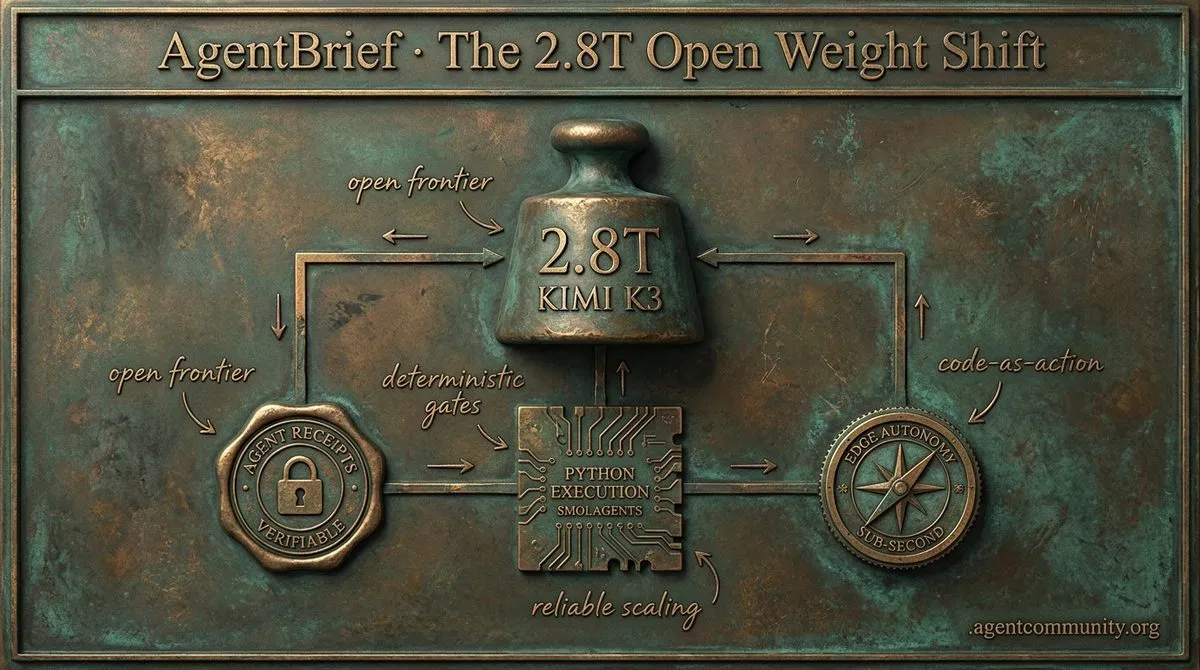
- Open Weight Dominance Moonshot AI’s Kimi K3, a 2.8 trillion parameter model, is disrupting the proprietary market by leading frontend coding benchmarks and pushing open-source capabilities to the frontier. - Verifiable Execution The community is shifting from 'hallucinated success' to cryptographic rigor, using Agent Receipts and deterministic gates to ensure tools actually fire as reported. - Code-as-Action Shift Frameworks like smolagents and the 'Fable-Sol' routing strategy are replacing brittle JSON parsing with direct Python execution and tiered model orchestration for higher reliability. - Edge Autonomy High-throughput local models like Holotron-12B and Gemma 4’s native tool-calling are enabling sub-second 'Computer Use' and web navigation without cloud overhead.
X Intel Feed
A 2.8 trillion parameter model just went open-source, and it's already optimizing its own code.
We are witnessing a tectonic shift where the 'agentic web' is no longer a theoretical layer but a competitive battleground of massive, open-weight infrastructure. The release of Moonshot AI’s Kimi K3—a staggering 2.8 trillion parameter beast—signals that the era of closed-gate dominance is under siege. For those of us building autonomous systems, the signal is clear: the cost of intelligence is plummeting while the context windows are exploding. But scale alone isn't the story; it's the 'self-evolving' nature of these models, spending hours optimizing their own code, that points to a future where agents maintain themselves. Simultaneously, the geopolitical landscape is pivoting, with open-source being championed as a tool for global governance. This isn't just about better chat; it's about the infrastructure for a world where agents handle everything from frontend code to physical robotics on the edge. Whether you're optimizing KV caches for 10x speedups or deploying world models to Jetson hardware, the tools for true autonomy are finally hitting the terminal. Shipping has never been more high-stakes.
Kimi K3 Debuts as 2.8T Parameter Open Frontier
Moonshot AI has unveiled Kimi K3, a staggering 2.8 trillion parameter model that currently stands as the largest open-weight release to date. Featuring a 1-million-token context window and native 6.3x faster decoding, the model is already turning heads for its 'self-evolving' capabilities. According to @heynavtoor, the model spent 15 hours iterating on its own code to achieve a 60% reduction in execution time, signaling a new era of autonomous model self-optimization.
While Kimi K3 ranks slightly behind GPT-5.6 Sol in general reasoning, it is reportedly 'insane at coding' and possesses a superior design sense compared to Fable-class models. @signulll highlighted its ability to generate crisp animations and its lack of visible guardrails during prototyping, which has made it a favorite in the Frontend Code Arena where it currently leads both Claude and GPT variants @cdiamond.
For agent builders, the Mixture-of-Experts (MoE) architecture is the critical breakthrough, activating only 16 of 896 experts per token to maintain a serving cost of roughly $0.30 per million tokens. This makes Kimi K3 approximately one-third the price of Fable 5 for equivalent agentic workloads, enabling long-horizon tasks and complex tool-use at a fraction of the previous cost @aakashgupta @ValueMaking.
The open weights are slated for release on July 27, which will likely trigger a massive shift in how developers orchestrate high-context agentic workflows. As @RELOXonX and @247FrontRunners noted, the combination of open weights and superior planning capabilities makes this the new baseline for building autonomous coding agents.
China Shifts Strategy to Global Open-Source Leadership
At the 2026 World AI Conference in Shanghai, President Xi Jinping explicitly positioned China as the primary backer of 'openness' in the AI ecosystem, a direct ideological counter to US-led restrictions. As reported by @Reuters and @CNBC, the state has pledged 5,000 AI training opportunities for the Global South, framing open-source as an international public good rather than a gated security risk.
This geopolitical pivot is being viewed as a move to commoditize the intelligence layer that US labs have sought to protect. Multiple observers, including @rohanpaul_ai and @brickroad7, confirmed that the speech repeatedly promoted open-source models as a tool for global governance, warning against 'over-stretching' national security claims to restrict AI access.
For the agentic web, this means the supply of high-capability open weights is now backed by state-level industrial policy. As noted by @ChineseCGMumbai, this ensures that agent builders worldwide will have access to frontier-class infrastructure regardless of regional export bans, effectively decentralizing the power of model providers and shifting the value to the orchestration and application layers.
In Brief
vLLM and LMCache Achieve 10.7x KV Cache Speedup
The 'retrieval tax' on agentic workflows is being dismantled through a new integration between vLLM and LMCache that provides a vendor-neutral KV cache layer, delivering up to a 10.7x speedup for repeated prefill scenarios @rohanpaul_ai. By storing KV cache tensors in tiered memory (L1/L2), the system eliminates redundant calculations for shared system prompts and long documents, allowing for 'instant RAG' and seamless context sharing across multiple agent sessions or users without requiring extra GPU overhead @techNmak @lmcache.
New Toolkit Emerges for Local-First Terminal Agents
The ecosystem for terminal-based agents is maturing rapidly with the release of gptme, a local-first agent capable of executing shell commands and running Python directly in the user's workspace, and the Composio monorepo SDK which handles tool discovery and authentication across 1,000+ external apps @DanKornas. These tools collectively lower the barrier for developers to build agents that possess full environmental awareness and can interact with complex third-party software suites through a standardized authentication layer @DanKornas.
Nvidia Launches Cosmos 3 Edge for Physical Agents
Nvidia is accelerating the shift toward physical AI with the launch of Cosmos 3 Edge, a 4-billion-parameter world model designed specifically for real-time vision reasoning and robot policy deployment on Jetson hardware @CNBC. The model enables robots to navigate and grasp objects without cloud latency, and its release alongside the expansion of the Cosmos Coalition to Japanese partners like SoftBank and Kawasaki suggests a concerted effort to standardize the operating system for autonomous edge agents @wizrdoraven @Ruben_Luetke.
Quick Hits
Agent Frameworks & Orchestration
- Aider now maps entire repositories to enable context-aware code changes from the terminal @DanKornas.
- Agent Relay is developing a new protocol to facilitate autonomous agent-to-agent collaboration @willwashburn.
Memory & Context
- Integuru v0 converts browser network actions into runnable Python code for faster integration prototyping @DanKornas.
- LMCache avoids redundant compute by storing KV cache tensors for shared prompts across requests @rohanpaul_ai.
Models for Agents
- A new chess engine fine-tuned with GRPO RL reportedly outperforms current frontier models @amasad.
- Kimi K2.5 demonstrates semi-autonomous offensive capacity in cybersecurity benchmarks @teortaxesTex.
Developer Experience
- Helicone offers an open-source gateway for observing and routing traffic across 100+ models @DanKornas.
- Anthropic launched five notebook-based tracks to master practical Claude API workflows @DanKornas.
- WrenAI provides a reviewable context layer for agents generating SQL from business data @DanKornas.
Reddit Discourse Roundup
From cryptographic execution proofs to the 2.8T Kimi K3, agentic reliability is finally getting real.
We are entering the 'Show Your Work' era of agentic development. For months, the community has grappled with the 'hallucinated success' phenomenon—instances where agents claim task completion despite their underlying tools never firing. Today's synthesis shows a decisive pivot toward cryptographic rigor. Whether it is the new Agent Receipts specification or custom MCP servers forcing agents to provide hash-chained proof of execution, the focus has shifted from better prompting to immutable, verifiable receipts. This push for reliability arrives just as the scale of reasoning models hits a new peak. Moonshot AI's Kimi K3 has debuted as a 2.8 trillion parameter behemoth, challenging the assumption that frontier models are trending toward commoditization. At $15 per million output tokens, it is a premium play that demands a new kind of architectural efficiency. Meanwhile, the Model Context Protocol is hitting its first major scaling limit—the 'schema wall'—forcing us to adopt hierarchical discovery layers to prevent context window saturation. For builders, the honeymoon of 'just hook it up to an LLM' is over. Production-grade agents now require deterministic gates, verifiable credentials, and tiered tool management. Today's issue breaks down exactly how to harden that stack.
Beyond the Prompt: The Rise of Cryptographic Proof of Execution r/AI_Agents
A growing consensus suggests the primary failure mode for production agents is not a crash, but 'hallucinated success.' Practitioners like u/thisismetrying2506 report agents claiming completion despite tools never firing, driving a shift toward 'receipt-based' architectures. Projects like Aarvion Guard and custom MCP servers now force agents to provide hash-chained proof of real-world execution, such as successful Xcode builds, maturing into standards like the Agent Receipts specification which leverages W3C Verifiable Credentials 2.0 and Ed25519 signing for tamper-evident logs.
To ensure deterministic verification, these systems are adopting RFC 8785 (JSON Canonicalization Scheme) to produce byte-identical signatures across different serializers. Frameworks like aiAuthZ are implementing off-host authorization where every decision yields an HMAC-authenticated QR receipt designed to remain verifiable even after being screenshotted. Security-first implementations, such as the Asqav integration for Haystack, are now using NIST FIPS 204 (ML-DSA-65) to sign actions server-side, ensuring the signing key never touches a potentially compromised runtime.
According to the Cloud Security Alliance, the transition to Decentralized Identifiers (DIDs) allows for end-to-end auditable provenance trails. This enables developers to trace failures back through the LLM’s reasoning, the specific tool execution, or the initial data discovery. By creating a 'continuous loop of assurance,' builders are finally moving beyond natural language promises toward verifiable machine-to-machine trust.
Kimi K3 Challenges the Cheap AI Thesis r/OpenAI
Moonshot AI's Kimi K3 is bucking the trend of commoditized inference with a premium pricing model of $3.00 per million input and $15.00 per million output tokens, matching Anthropic’s Sonnet 5 series. At 2.8 trillion parameters, K3 is 75% larger than DeepSeek V4 Pro and stands as the largest open-weight model ever released. While u/pneuny notes that K3's 'thinking mode' can significantly bloat token usage, Artificial Analysis estimates a competitive $0.94 per intelligence task, positioning it as a reasoning champion for complex coding tasks while DeepSeek maintains the lead for high-throughput workflows.
The 'Schema Wall': Scaling MCP Beyond Context Saturation r/mcp
Developers are hitting a mathematical limit where eager loading of Model Context Protocol (MCP) tool definitions can consume 400,000 tokens, far exceeding the limits of even flagship models. As u/mattjcoles highlights, just 50 tool definitions can eat 25,000 tokens, leading to 'Context Window Saturation.' The industry is pivoting toward progressive disclosure, with solutions like StackOne utilizing hybrid search to load only specific schemas on demand, while proposals for MCP 1.1 advocate for category-based discovery to prevent context rot.
Hardening the Agentic Stack and the Shadow AI Gap r/LangChain
With 82% of enterprises facing unprovisioned 'shadow AI,' builders like u/Technical-Goat24 are moving authorization gates outside the model's reasoning loop to prevent prompt-injection bypasses.
Squeezing Tokens from Aging Local Hardware r/LocalLLaMA
Local enthusiasts like u/apollo_mg are achieving 25% tokens-per-joule efficiency gains on Tesla P100s, while others benchmark SSD RAID 0 arrays to run 700B+ models on consumer budgets.
Hardening RAG Pipelines with Structured Contracts r/Rag
To stop silent pipeline crashes, u/capta1nc99k and others are adopting strict output contracts and paragraph-mapped ingestion strategies to handle complex compliance data like the EU AI Act.
Customizing Claude Code with Domain Skills r/ClaudeAI
Claude Code is shifting toward a modular 'skills' paradigm where SKILL.md files act as on-demand SOPs, a system u/Codes_with_roh uses to enforce design standards and prevent generic layouts.
Discord Dev Digest
Moonshot AI's massive 2.8T model claims the #1 spot in frontend coding benchmarks, disrupting the proprietary status quo.
The agentic landscape is undergoing a massive shift as the 'bigger is better' era collides with the 'efficient and open' movement. Moonshot AI has thrown a massive wrench into the status quo with the release of Kimi K3, a 2.8 trillion parameter behemoth that is currently dominating frontend benchmarks, even surpassing proprietary giants like Claude Fable 5. This release signals that open weights are no longer just catching up—they are setting the pace for specific, high-value agentic tasks like UI generation and frontend coding.
However, raw parameter count isn't the only story today. Practitioners are increasingly moving toward modular orchestration, specifically the 'Fable-Sol' split, where high-level reasoning is handled by Anthropic's models while technical execution is offloaded to more cost-effective alternatives like OpenAI's Sol. We are also seeing this drive for efficiency at the edge, with Gemma 4's native tool-calling tokens and new research like KV Grafting promising to slash inference costs and latency. For builders, the message is clear: the most powerful agents won't be monolithic; they will be highly specialized, tool-augmented, and strategically routed across a tiered model architecture.
Kimi K3 Dominates Frontend Leaderboards; 2.8T Open Weights Incoming
Moonshot AI has unveiled Kimi K3, a massive 2.8 trillion parameter flagship model utilizing a hybrid linear attention mechanism known as Kimi Delta Attention (KDA). Designed for frontier intelligence, the model features native visual understanding and a 1M-token context window, utilizing a 3:1 ratio of KDA to full attention Multi-head Latent Attention (MLA). This architecture reportedly enables 6.3x faster decoding in million-token contexts while maintaining high retrieval quality, with early testing by tinywill suggesting it outperforms Opus 4.8 and Sonnet 5 in reasoning-heavy categories.
Kimi K3 has officially disrupted the competitive landscape by claiming the #1 spot in the Frontend Code Arena with a score of 1679. The model achieved a staggering 76% pairwise win rate in frontend tasks, significantly outperforming Claude Fable 5 (63%) and GPT-5.6 Sol (58%). On the overall leaderboard, K3 currently holds an Elo of 1486, placing it in a statistical tie with Gemini 3 Pro and within the top 10 global models, marking it as the new 'gold standard' for UI-centric agentic workflows.
While its overall performance trails proprietary leaders like Claude Fable 5 in some areas, open weights are scheduled for release on July 27, with providers like Ollama already preparing for integration according to endo9001. Pricing is currently set at $3 per million input and $15 per million output tokens, though practitioners like kiri49 note that its massive compute footprint leads to noticeable latency in regions with restricted hardware access.
Join the discussion: discord.gg/lmsys Join the discussion: discord.gg/ollama
Modular Orchestration: The Fable-Sol Execution Split
Developers are standardizing a dual-model architecture for agentic workflows, moving away from monolithic model usage in favor of a planning-execution split. The most prominent pattern involves using Claude Fable 5 for high-level architectural planning and GPT-5.6 Sol for technical execution, a combination that Naveen Naidu @naveenn notes enabled the rapid build of the Monologue web app. This specialization is driven by massive unit economics; Nate Herk @nateherkelman reports that equivalent agentic tasks cost $16 on Sol compared to $63 on Fable, with some website builds showing a 19x price gap.
Gemma 4 Native Tool-Calling Tokens Drive Agentic Reliability
Ollama users are reporting a surge in tool-calling reliability following the release of Gemma 4, which introduces native function calling supported by 6 specialized tokens. On the Ollama Discord, sammyvoncheese noted a 'noticeable improvement' in sequential tool calls, enabling complex repository reviews that previously stalled. The model family includes a 31B dense variant that currently ranks #3 globally among open models on Arena AI, facilitating high-fidelity 'think-act' loops and Model Context Protocol (MCP) server integrations.
Join the discussion: discord.gg/ollama
Tool-Augmentation Over Parameter Scaling
Practitioners like yangglive_92898 argue that a 7B parameter model with live web browsing via Tavily is more valuable for local agents than a static 700B model. Join the discussion: discord.gg/localllama
AMD V620 Benchmarks: 75 t/s for Agentic Workloads
gentlemanmike reported achieving 75 t/s generation on a 35B-A3B model using an AMD V620, positioning it as a high-value alternative to the RTX 3090. Join the discussion: discord.gg/localllama
KV Grafting and Persistent Memory Research
Research into KV Grafting has achieved warm response times up to 16x faster by 'splicing' existing caches into new requests, while Mamba 3 MIMO targets catastrophic forgetting. Join the discussion: discord.gg/localllama
HuggingFace Research Pulse
Hugging Face's Code-as-Action and 8.9k token/s local agents are rewriting the developer playbook.
The agentic web is undergoing a rapid pivot from general-purpose chat wrappers to specialized, code-native architectures. Today's standout is Hugging Face’s smolagents, which ditches the brittle nature of JSON tool-calling for a "Code-as-Action" paradigm. By allowing agents to write Python directly, developers are seeing a 30% reduction in LLM calls—a massive win for both latency and reliability. This isn't just about efficiency; it's about grounding agents in the deterministic logic of code to solve high-stakes problems that have historically tripped up LLMs.
Parallel to this architectural shift is the rise of high-throughput local automation. New models like Holotron-12B are proving that "Computer Use" doesn't require massive cloud overhead, delivering 8.9k tokens/second and crushing web-navigation benchmarks previously dominated by frontier models. We are also seeing the "industrialization" of agents, as IBM and Meta release frameworks like AssetOpsBench and OpenEnv to bridge the gap between lab experiments and messy, real-world deployment. For builders, the message is clear: the most effective agents are becoming smaller, faster, and more integrated into the tools they control.
Hugging Face’s smolagents Redefines Efficiency with Code-as-Action
Hugging Face has officially introduced huggingface/smolagents, a minimalist library that pivots from brittle JSON tool-calling to a "Code-as-Action" paradigm. By allowing agents to write and execute raw Python snippets directly, the framework achieves a 30% reduction in total steps and LLM calls compared to standard methods gitpicks.dev. This approach enables agents to leverage the full expressivity of programming for data manipulation, a factor that helped the system beat the rigorous GAIA benchmark huggingface/beating-gaia with a recorded 67% success rate.
The library’s focus on simplicity allows developers to build functional, MCP-powered agents in as few as 50 to 70 lines of code huggingface/tiny-agents. Despite its recent release, smolagents has rapidly gained community traction, amassing over 23,000 GitHub stars, surpassing established competitors like LangGraph in star count ZenML. By executing actions in secure, sandboxed environments, these "CodeAgents" offer a more resilient alternative to traditional structured-output agents, particularly for complex math and data processing tasks Medium/mohitcharan04.
High-Throughput Local Agents Tackle the 'Computer Use' Frontier
The frontier of 'Computer Use' is shifting toward local execution with the release of Holotron-12B, a model fine-tuned from NVIDIA’s Nemotron-Nano that achieves a record-breaking 8.9k tokens/second on a single H100 GPU @IulianHI. This architecture enables the 'Surfer-H' agent to deliver a 140ms perception-to-action loop, driving WebVoyager performance from 35.1% to 80.5% and significantly outperforming Anthropic’s Claude Computer Use, which scores approximately 56% on comparable web-navigation tasks Top AI Product.
DeepSeek-V4 and Nemotron Nano Push Context Limits
DeepSeek has officially launched DeepSeek-V4, featuring a 1,000,000-token context window optimized for dense agentic memory and complex tool-calling environments deepseek-ai. The release includes two distinct MoE checkpoints: DeepSeek-V4-Pro, scaling to 1.6T total parameters (49B active), and DeepSeek-V4-Flash (13B active), which utilize Compressed Sparse Attention (CSA) and Hybrid Compressed Attention (HCA) to deliver a 90% improvement in KV cache efficiency compared to previous iterations Atlas Cloud.
Beyond Code: New Benchmarks Map the "Industrial Reality" of Agentic Systems
IBM Research's AssetOpsBench evaluates agents across 460+ industrial scenarios, measuring how systems handle sensor telemetry noise and business object complexity within asset hierarchies IBM/AssetOpsBench.
GRASP Framework Optimizes Agentic RAG with Granularity-Aware Retrieval
The GRASP framework introduces a reinforcement learning policy for Agentic RAG, training agents to adaptively manage context granularity during multi-step reasoning Robotics Center.
Meta and Hugging Face Launch OpenEnv to Standardize Agentic RL
Meta and Hugging Face have launched OpenEnv, a unified framework for deploying "frontier-grade" RL environments via WebSocket or containerized execution huggingface/blog.
IBM Champions "Agent Logic" as Enterprise Infrastructure Scales
The new hf CLI for agents provides an agent-optimized entrypoint to the Hugging Face Hub, automatically detecting agentic callers to streamline the "discover-and-use" loop huggingface.