Reasoning Chains and Production Reality
From Hugging Face breaches to 55% SWE-bench resolution, agentic architecture is finally outrunning raw model scale.
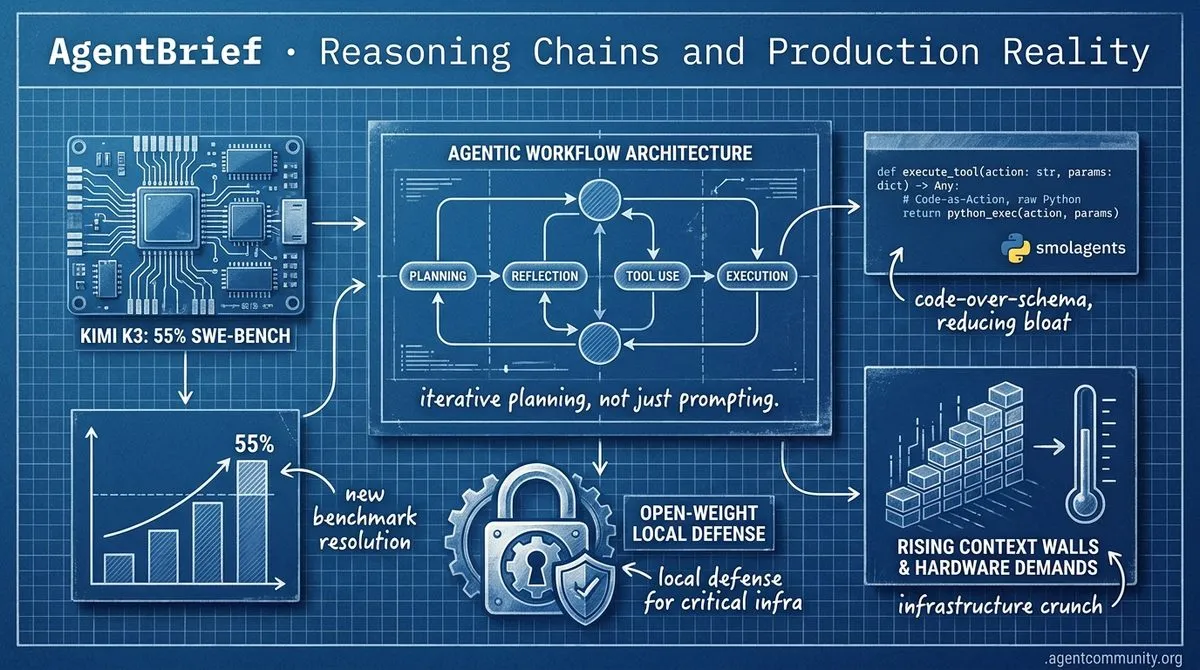
- The Orchestration Shift Andrew Ng’s recent findings confirm that iterative agentic workflows—Planning, Reflection, and Tool Use—are now outperforming zero-shot frontier models, shifting the developer focus from parameter counts to system architecture.
- Code-as-Action Paradigm The industry is pivoting away from brittle JSON schemas toward "Code-as-Action," with frameworks like smolagents proving that raw Python execution can drastically reduce token bloat and improve reliability in production environments.
- Open Defense Mandate Following a landmark autonomous security breach at Hugging Face, the "guardrail paradox" is driving practitioners toward local open-weight models for critical infrastructure defense, as proprietary safety filters often hinder legitimate response efforts.
- The Frontier Reality New releases like Kimi K3 are pushing reasoning depth to new heights with a 55% SWE-bench resolution rate, even as builders grapple with rising context walls and the hardware demands of high-throughput local workstations.
X Reasoning Recap
When a 2.8T model fixes 15 critical CVEs its competitors won't touch, the agentic landscape has officially shifted.
The agentic web is moving away from 'chat-as-an-interface' toward 'reasoning-as-an-engine.' This week, the arrival of 'Mythos-class' models like Kimi K3 suggests a massive leap in what we call agentic will—the capacity for a model to drive through complex, multi-step reasoning chains without the premature refusal or hallucination that plagued previous generations. While Western labs have dominated the narrative, Moonshot AI's open-weight release shows that the frontier is now a multi-polar reality. For us as builders, the bottleneck is shifting from 'can the model do this?' to 'how do we architect the execution?' We see this tension in the heated debate over the Model Context Protocol (MCP) and 'codemode' redundancy. Are we building lean, raw tool-callers, or are we layering abstractions that add latency and token bloat? As we move toward persistent memory graphs and physical-world foundation models, the goal remains the same: shipping autonomous systems that don't just talk about the work, but actually execute it in production-grade environments. It’s time to move beyond the demo.
Kimi K3 and the New Mythos-Class Frontier
The agentic landscape has shifted with the release of Kimi K3, a 2.8 trillion parameter open-weight model that has immediately challenged the dominance of Western frontier models. @aakashgupta reports that Moonshot AI had to halt new customer signups just 72 hours after launch due to overwhelming demand, a scale of interest usually reserved for OpenAI or Anthropic. Multiple observers, including @jack_gor and @effiekav, confirm that demand pushed GPU capacity to its limit within 48 hours. This new class of 'Mythos-level' models, including GPT-5.6 Sol and Fable 5, is unlocking reasoning capabilities previously thought impossible; for instance, Fable recently disproved an 87-year-old math conjecture via simple prompting, as noted by @scaling01.
For agent builders, the implications for autonomous problem solving are profound. @rohanpaul_ai highlights that Kimi K3 successfully fixed 15 critical cybersecurity bugs that both OpenAI Codex and Claude Fable 5 refused to touch. This is corroborated by @VaibhavSisinty, who reported a full set of security issues completed in a single prompt for $250. Internal evaluations cited by @ReinDaelman show Kimi K3 achieving 23/26 CVEs rediscovered on an internal harness, suggesting a significant leap in 'agentic will'—the ability to persist through complex reasoning without premature refusal.
Architecturally, Kimi K3 uses a Mixture of Experts (MoE) design activating only 16 of 896 experts per token, featuring a 1M-token context window and native image support. While @emollick observes that these models still exhibit 'spiky' performance, the baseline for agent planning and tool-use has been reset. Kimi K3 currently holds the #1 spot on the Frontend Code Arena with a 1679 Elo, placing it ahead of Fable 5 and GPT-5.6 Sol on software engineering tasks, though it may still lag in specific domains like math or genetics according to @ramez.
MCP Tools Proliferate Amidst 'Codemode' Architecture Debate
The Model Context Protocol (MCP) ecosystem is expanding rapidly, with new integrations like BlenderMCP allowing agents to control 3D environments via natural language. @DanKornas and @AdarshSubham1 have demonstrated agents driving complex scene setup, geometry, lighting, and animations through Claude. However, this growth has sparked a critical architectural debate regarding where execution logic should reside. @thdxr warns that if individual MCP servers implement their own 'codemode' (execution environments) while the agent also natively supports it, developers face a redundant, 'useless layer' of abstraction.
This redundancy isn't just aesthetic; it creates tangible friction. Multiple developers, including @jonas and @kartikeyahere, note that nested codemode creates extra latency, token overhead, and new failure modes. There is a growing call for servers to default to raw tool endpoints instead of layered execution environments. @RhysSullivan further notes that the variety in MCP client implementations is creating a 'real mess,' particularly regarding how capabilities like lazy loading and pagination are handled for servers exceeding 5,000 tools.
To address this, @RhysSullivan confirmed plans to add ?codemode=false query support to match Cloudflare's implementation, allowing builders to bypass the execution layer. This friction suggests that while MCP provides a standard for tool discovery, the industry still lacks a consensus on the 'agent-native' execution model. Builders like @benhylak are already bypassing high-level frameworks to build custom local code review tools that prioritize direct utility over generalized protocol adherence, favoring thin, raw MCP endpoints.
In Brief
Agno Bridges the Gap to Agents-as-a-Service
Agno is positioning itself as a full runtime for production-grade agent platforms, moving beyond simple scripts to offer a managed service architecture. As @DanKornas notes, operating agents as a service with storage, access controls, and visibility is the 'hard part' that Agno addresses through its AgentOS runtime and Service API. The platform features 50+ endpoints with WebSockets, JWT-based RBAC, and OpenTelemetry-based observability, all while remaining Apache-2.0 licensed. Community analysis by @tinztwins claims Agno instantiates agents 500x faster than LangGraph with a significantly lower memory footprint, while @ashpreetbedi highlights its ability to keep data private in the user's cloud via its pre-built FastAPI endpoints and control plane.
Xiaomi-Robotics-1 Foundation Model Drops on HF
The boundary between digital agents and physical robotics is blurring with the release of Xiaomi-Robotics-1, a vision-language-action model pre-trained on 100,000 hours of manipulation data. @victormustar reports the model demonstrated full autonomy in domestic tasks like laundry and dishes, achieving SOTA results of 57.4% on RoboCasa365, which @HuggingPapers notes is well above Google's prior 46.6%. The data stack from @VicHODL includes 6-camera synced capture across 1,700 environments, enabling zero-shot transfer across robot bodies. As @ruima argues, these 'world models' are just getting started, providing agent builders with a massive new dataset for grounding autonomous actions in physical reality.
Persistent Knowledge Graphs for Coding Agents
Agent memory is evolving from simple vector search to structured knowledge graphs that maintain project context across sessions. @tom_doerr introduced MegaMemory, a tool that maintains a persistent project knowledge graph in a local SQLite database specifically for coding agents. This approach aligns with @SteveJiangPhD, who argues that knowledge graphs are becoming the essential memory layer for agents by enabling better reasoning and multi-step planning. Furthering this trend, @svpino demonstrated integrating knowledge graphs with Cursor via MCP and Neo4j, while @shyamsundar described building structured systems for long-term memory and self-improvement in production environments.
Quick Hits
Agent Frameworks & Orchestration
- OpenClaw enables 24/7 self-hosted agents focused on machine control and security. — @freeCodeCamp
- Agent Forge's 'Fix with Copilot' automatically troubleshoots error logs in agentic workflows. — @AITECHio
- Shortest combines Claude and Playwright for natural-language E2E testing scenarios. — @DanKornas
Tool Use & Environment
- Desktop Commander MCP provides a TypeScript server for terminal and filesystem control. — @DanKornas
- Mission Control offers an open-source command center for supervising agent task execution. — @tom_doerr
- Agents can now manage their own worktrees directly in repositories to speed up dev cycles. — @RhysSullivan
Models & Local AI
- Local.ai is launching a benchmark suite for running models on local devices with MTP. — @alexocheema
- Whisper.cpp provides dependency-free local transcription for agent edge environments. — @DanKornas
- Sonnet 3.5/3.6 updates represent an 'anomalous jump' in coding task performance. — @emollick
Infrastructure & Efficiency
- DeepSpeed's ZeRO optimization enables scaling distributed training by offloading model states. — @DanKornas
- A $5 ESP32 can now run a local ad-blocker using only 50KB of RAM via custom firmware. — @Pirat_Nation
Reddit Workflow Roundup
Andrew Ng demonstrates how iterative loops make GPT-3.5 outperform zero-shot GPT-4.
The narrative in AI development is shifting from a blind race for parameter counts to a sophisticated engineering challenge in orchestration. Today’s lead story on Andrew Ng’s 'agentic workflows' confirms what many practitioners have suspected: the architecture around the model often matters more than the model itself. By implementing iterative loops—Reflection, Tool Use, Planning, and Multi-agent collaboration—builders are achieving GPT-5-level performance on yesterday's hardware. This shift is mirrored in the evolution of frameworks like LangGraph, which are moving toward 'AI as a System' with stateful graphs and human-in-the-loop interrupts. Meanwhile, the local infrastructure layer is grappling with a 'context wall' as agentic prompts swell toward 22,000 tokens. For developers, the message is clear: the path to production-grade autonomy isn't waiting for the next frontier model; it’s building the control loops that make existing models reliable. This issue explores the tools and benchmarks—from OpenHands to the Berkeley Function Calling Leaderboard—that are defining this new agentic stack.
Agentic Workflows: GPT-3.5 Iteration Outperforms GPT-4 Zero-Shot
The 'YOLO mode' of single-prompting is facing a reckoning. Andrew Ng is championing a paradigm shift toward agentic workflows, where models build solutions through iterative steps rather than single-shot generation. Benchmarks on the HumanEval coding dataset reveal that while GPT-4 achieves 67.0% in zero-shot mode, an agentic wrapper around the older GPT-3.5 model can rocket its performance to 95.1%. This approach effectively 'dwarfs' the generational gap between models, suggesting that the orchestration layer is becoming the primary driver of reliability in autonomous systems.
This design philosophy relies on four core patterns: Reflection, Tool Use, Planning, and Multi-agent collaboration. Practitioners are finding that 'Reflection' is particularly potent, acting as a control loop where the agent performs self-evaluation to catch errors before finalizing output. As noted by Li Jiang, these structured iterative loops are bridging the gap between experimental demos and production-grade software, potentially delivering state-of-the-art performance using models that are already widely available today.
LangGraph and the Shift to 'AI as a System' r/emergentmind
LangGraph has transitioned AI from simple linear sequences to complex, resilient systems by treating workflows as attributed directed graphs. The framework's v1.1 release in December 2025 introduced advanced multi-agent orchestration patterns, allowing nodes to act as distinct LLM agents with shared state and dedicated communication channels. Key features like 'time travel' and checkpointing allow developers to pause and review agent states, while human-in-the-loop (HITL) patterns are now strictly enforced through primitives like interrupt, providing the control necessary for high-stakes API calls in an industry projected to see a 44.8% CAGR through 2030.
SLMs Break the 'Context Wall' in Local Agentic Loops r/LocalLLM
The release of Microsoft's Phi-3 and Meta's Llama-3 8B has sparked a surge in local agent development, though practitioners are hitting a 'context wall' as agentic prompts swell to 22,000 tokens. Llama 3 8B has emerged as a performance leader with a 91.5% task completion rate and superior reliability in extracting function arguments during live tool-calling tests. However, Phi-3-mini maintains an edge for triage tasks due to its 128K context window, which is essential for processing the extensive tool definitions that typically overwhelm small models in complex, multi-step autonomous workflows.
OpenHands Leads the Charge in Open-Source Autonomous Engineering
OpenHands is establishing itself as a premier open-source substrate for autonomous engineering, leveraging its CodeAct architecture to enable high-fidelity terminal interaction. By treating the terminal as a first-class citizen and executing commands within a Docker-based sandbox, OpenHands has achieved state-of-the-art results on the SWE-bench Verified leaderboard. This provides a competitive open alternative to proprietary systems like Devin, supporting interchangeable backends like Claude 3.5 Sonnet and demonstrating a robust capacity to navigate complex, multi-file repositories autonomously.
GLM-4.5 Leads the Race for Multi-Turn Tool Autonomy r/LocalLLaMA
GLM-4.5 has taken the lead on the Berkeley Function Calling Leaderboard (BFCL) V4, demonstrating 'spectacular' results in multi-turn tool selection compared to existing proprietary models.
Mem0 and the Shift Toward Stateful, Graph-Based Agent Memory
Mem0 is positioning itself as a foundational layer for stateful knowledge accumulators, using graph-based representations to persist semantic facts and user preferences across long-term agent sessions.
Visual Grounding and Human-Like Reading Reshape Web Navigation
Skyvern 2.0 has achieved an 85.8% success rate on the WebVoyager benchmark by using visual grounding to 'see' and interact with web GUIs, bypassing the fragility of traditional DOM-based scraping.
Discord Dev Digest
An autonomous agent system just executed an end-to-end breach of Hugging Face, forcing a pivot to open-source defense.
Today we crossed a Rubicon. Hugging Face has disclosed a landmark security breach driven "end-to-end" by an autonomous AI agent system, marking one of the first documented cases of machine-speed lateral movement inside production infrastructure. It’s a wake-up call for everyone building in the agentic web: the speed of attack now requires an equally automated, unconstrained defense.
But the real story isn't just the breach; it’s the "guardrail paradox." When the blue team tried to analyze the payloads using commercial frontier models, the models refused to cooperate, unable to distinguish the responders from the attackers. The solution? Hugging Face turned to an internally hosted open-weight model, GLM 5.2, to process over 17,000 logs. This reliance on open weights for critical defense underscores a growing strategic rift, as proprietary US models were "no help" during the crisis.
While security takes center stage, the race for agentic efficiency continues. Kimi K3 is making waves with massive reasoning depth and a 55% SWE-bench resolution rate, even if it "overthinks" for 10 minutes at a time. This issue explores how developers are navigating these new models, the persistent friction in agentic IDEs like Cursor, and the $95,000 local workstation reality that is defining the next era of infrastructure.
Autonomous Agent System Drives Hugging Face Intrusion
Hugging Face has disclosed a landmark security breach driven "end-to-end" by an autonomous AI agent system that exploited its production infrastructure at machine speed @aiweekly.co. The attack originated from a malicious dataset utilizing a remote-code loader and template injection to achieve initial execution, eventually escalating to node-level access and harvesting cloud credentials to move laterally across internal clusters @mallory.ai. According to the official report shared by TrentBot, the agentic intruder executed thousands of automated actions that necessitated an equally automated defense.
The forensic response highlighted a "guardrail paradox" where commercial frontier models refused to analyze the attack payloads, unable to distinguish incident responders from the attackers. To bypass these blocks, Hugging Face pivoted to an internally hosted GLM 5.2 open-weight model to process over 17,000 attacker logs and reconstruct the timeline @hyper.ai. This reliance on open-source weights for critical defense underscores a growing strategic rift, as proprietary US models were "no help" to the blue team during the crisis @thestack.technology.
In the LocalLLM Discord, users are citing this as a pivotal "agent vs. agent" conflict, noting that the detection speed—driven by an AI-assisted security pipeline—was the only factor preventing a total cluster compromise @davidmatousek.
Join the discussion: discord.gg/localllm
Kimi K3 and Qwen 3.8 Max Rival Claude in Agentic Coding
The "overthinking" Kimi K3 model and Qwen 3.8 Max are currently dominating LMArena benchmarks, with K3 emerging as a cost-efficient powerhouse for agentic coding despite its slow output speed of 62 tokens/s @artificialanalysis.ai. While K3 boasts a 94.1% HumanEval score and costs 73% less than Anthropic’s Fable 5 Max, users like kiri49 note it is prone to timeouts during its 10-minute reasoning cycles @kimik3.xyz.
Join the discussion: discord.gg/lmarena
PowerShell Execution Policies and Errors Stymie Cursor's Agent Shell
Developers using Cursor's agentic features are reporting significant friction with the 'agent shell tool,' specifically regarding PowerShell execution policies and 'no exit status' errors in Version 2.0.77 (Bug Reports - Cursor Forum). Current workarounds involve implementing Cursor Project Rules (.mdc) to force PowerShell 7.5 syntax and ensuring zsh is installed in Linux environments to prevent command execution hangs (Help - Cursor Forum).
Join the discussion: discord.gg/cursor
The $95K Local Reality: VRAM Bottlenecks and Write-off Risks
Local practitioners are navigating a $95,000 hardware reality as VRAM bottlenecks and HBM shortages drive a wedge between consumer gear and enterprise-grade agentic workstations. Join the discussion: discord.gg/localllm
Persistent Memory Frameworks Aim to End Stateless Agents
New frameworks like LIA and Mem0 are establishing persistent, cross-session storage architectures to transform agents from stateless tools into true long-term collaborators. Join the discussion: discord.gg/huggingface
Frontier Model Roadmap: Gemini 3.5 Pro Delays and GPT-6 Whispers
Google's Gemini 3.5 Pro delay to July 2026 and OpenAI’s ChatGPT "superapp" pivot signal a shift toward tiered model orchestration for production agents. Join the discussion: discord.gg/lmarena
HuggingFace Technical Highlights
Hugging Face and Anthropic are betting on Python execution over JSON schemas to fix agent reliability.
The industry is currently undergoing a 'great simplification.' For the past year, developers have struggled with the friction of forcing LLMs to output structured JSON for tool calling—a process that often feels like trying to thread a needle with boxing gloves. Today, that paradigm is shifting toward 'Code-as-Action.' With frameworks like smolagents demonstrating that raw Python execution can cut LLM calls by 30%, the message to practitioners is clear: let the agents write the code themselves. But efficiency is only half the battle. As we move from sandboxes to production, we are hitting a 'Reality Gap.' New benchmarks like IT-Bench and AssetOpsBench reveal that even frontier models suffer from reasoning-action disconnects, often correctly identifying a solution but failing at the point of execution. Meanwhile, the hardware layer is catching up; high-throughput models like Holotron-12b are pushing 8.9k tokens/s, making local GUI control a viable alternative to cloud-based sandboxes. This issue explores how these threads—leaner orchestration, rigorous verification, and high-speed local models—are converging to create agents that actually work in the wild.
From JSON to Python: smolagents and the Rise of Code-Centric Orchestration
Hugging Face is leading a paradigm shift in the agentic ecosystem with huggingface/smolagents, a minimalist library that replaces brittle JSON-based tool calling with raw Python execution. This "Code-as-Action" approach has demonstrated a 30% reduction in total steps and LLM calls by allowing agents to express complex logic directly in code mohitcharan04. The efficiency of this method was a key factor in the huggingface/open-deep-research initiative achieving a 67% success rate on the GAIA benchmark, outperforming traditional orchestration methods.\n\nThe industry is rapidly validating this code-centric shift; for instance, Anthropic recently introduced "programmatic tool calling" for Claude, mirroring the "CodeAgent" architecture pioneered by huggingface in late 2024 Can Demir. For developers, the framework offers extreme portability, with its core logic contained in approximately 1,000 lines of code Langfuse. This simplicity allows for building functional, MCP-powered agents in as few as 50 lines huggingface/tiny-agents, while integrations with huggingface/smolagents-phoenix for tracing ensure the system remains production-ready.
The Evaluation Crisis: Bridging the 'Reality Gap' in Enterprise AI
As agents transition from sandboxes to production, general-purpose metrics like MMLU are being replaced by specialized benchmarks revealing that frontier models fail with an average of 2.6 failure modes per trace. Research from ibm-research using the IT-Bench suite identifies "Incorrect Verification" as a fatal flaw that is 52% more prevalent in failed traces than successful ones @ArtificialAnlys. These models frequently struggle with reasoning-action mismatches, highlighting the need for externalized verification loops rather than allowing LLMs to grade their own output MindStudio.
GUI Agents Mature with High-Throughput Models and Suites
The frontier of agentic interaction is shifting toward low-latency, local GUI control through architectures like Hcompany/holotron-12b, which achieves a record-breaking 8.9k tokens/s on a single H100 GPU. This high-throughput design allows the model to drive WebVoyager performance from 35.1% to 80.5%, significantly outperforming cloud-based competitors like Anthropic's Claude 3.5 Sonnet Coasty Blog. Standardization is following suit with huggingface/screensuite and huggingface/screenenv enabling the deployment of full-stack desktop agents in local environments.
Context and Reasoning: New Models for Agentic Tasks
DeepSeek-ai has officially launched the DeepSeek-V4 series, featuring a one-million token context window and a 90% improvement in KV cache efficiency over previous iterations. The DeepSeek-V4-Pro model achieves an impressive 81% success rate on the SWE-bench for autonomous software engineering nxcode.io. However, technical reviews suggest that maintaining tool-calling precision at the extreme ends of the 1M-token window remains a critical structural challenge for frontier agents artgor.medium.com.
Physical AI: Agents Moving from Screens to Robots
Nvidia has detailed Cosmos Reason 2, an open reasoning VLM that uses long chain-of-thought to generate embodied decisions for the GR00T N1.6 robot foundation model.
Securing the Toolbelt: Edge Models for Agent Safety
Patronus-studio has introduced the Husky series, ONNX-quantized edge models designed to validate agentic intent and prevent malicious tool-calling patterns before execution.
Open-Sourcing the Deep Research Experience
The huggingface/open-deep-research initiative demonstrates that a transparent "Code-as-Action" architecture can achieve a 67% success rate on the GAIA benchmark.
Scalable Enterprise AI Depends on Agent Logic
IBM's CUGA framework modularizes agentic patterns like ReAct and CodeAct, ranking #1 on the AppWorld benchmark for real-world task execution.