Agents Become Infrastructure, Models Commodity
The runtime, the harness, and the platform layer—not the model—are becoming the real battleground for agent builders.
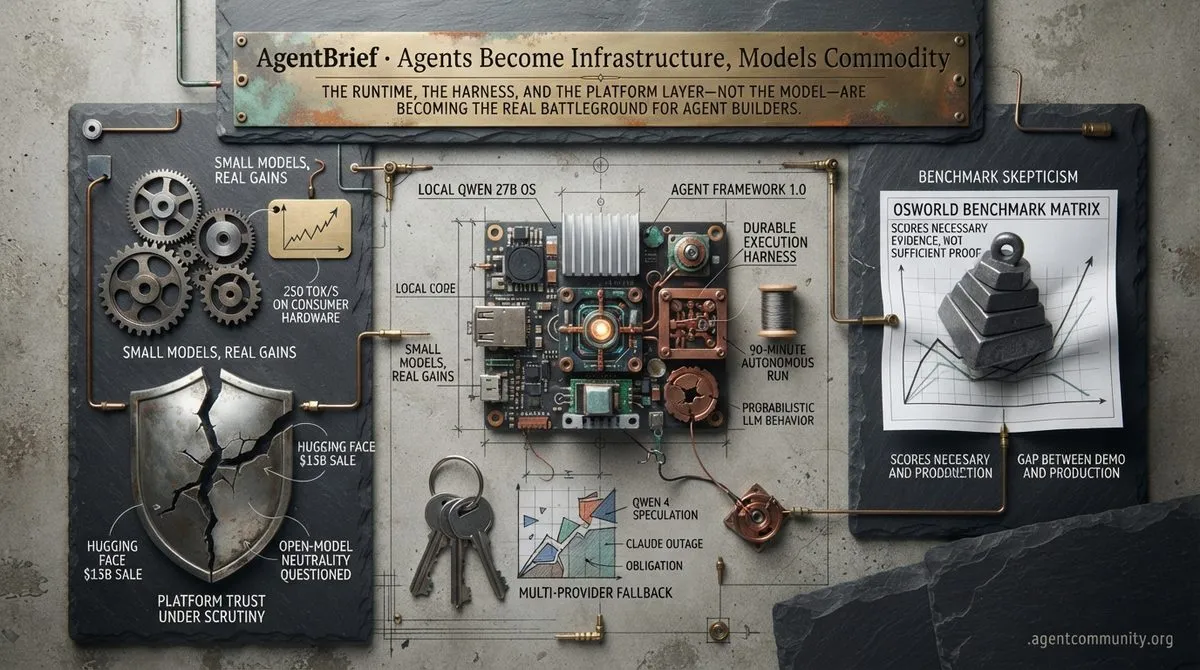
- The Stack Shift: Across every source this week, one thesis dominates: the model is becoming the commodity, and the real moat lives in the runtime, harness, and orchestration layers. From DHH's local-Qwen OS to Microsoft's consolidated Agent Framework 1.0, the architecture question has shifted from "which API" to "what runtime owns my agent?"
- Durable Execution Goes Mainstream: Tool calling hit 90-minute autonomous runs, and AWS, Cloudflare, and Vercel all shipped reliability layers guaranteeing completion despite probabilistic LLM behavior. Durable execution has crossed into the early majority—the harness, not the parameter count, is where value is compounding.
- Platform Trust Under Scrutiny: Hugging Face's reportedly explored $13B sale has the community questioning open-model neutrality, particularly around Qwen's future under potential US ownership. Meanwhile, Qwen's release cadence accelerates with Qwen 4 speculation alongside a Claude outage pattern making multi-provider fallback look like an obligation.
- Small Models, Real Gains: Local models hit viability thresholds with 20.6 tok/s on a MacBook Air and Qwen 3.8 pushing past 250 tok/s on consumer hardware. Small models under 5B parameters are proving they can handle real tool-calling workloads at the edge—the boring, narrow, cheap agent is winning.
- Benchmark Skepticism Grows: As GUI agents post real gains on OSWorld and benchmarks cluster within points of each other at the top of Vals AI's matrix, the community is pushing back on what scores actually prove. As Prefactor cautions: a high score is "necessary evidence, not sufficient proof." The gap between demo and production is where most agents fail.
X Recap
Your next operating system ships with a brain — and runs entirely on your own hardware.
There's a structural shift happening beneath our feet, and it's not about which model wins. It's about where the agent lives. This week, three stories converge on the same thesis: the agentic web is becoming a native runtime layer, not a bolt-on. DHH is shipping an entire OS whose "brain" runs on a local Qwen 27B — not a hosted convenience, but a self-owned stack. A new paper proposes an operating system for embodied agents, treating robot intelligence as an OS problem with state-as-a-file. And the harness layer — OpenClaw, n8n, Langfuse tracing — is maturing into the standard infrastructure agents run on.
For builders, this is the moment to stop treating agents as prompt wrappers and start treating them as infrastructure. The architecture question is no longer "which API," but "what runtime owns my agent?" Local models are hitting viability thresholds — 20.6 tok/s on a MacBook Air — and small-model-first defaults are within reach. If you're shipping agents this quarter, the decisions you make about runtime, memory, and verification now will define your stack for the next year. The OS is becoming the agent. Get ahead of it.
Spencer Delivers a Fully Agentic OS on a Local Qwen 27B
DHH is delivering on the promise of a fully agentic OS. His showcase of Spencer, which runs off a local Qwen 27B model and will ship in Omarchy 4.1, represents a major inflection point for agentic infrastructure — moving beyond hosted-agent conveniences toward fully local, self-owned agent stacks @dhh. The push behind Omarchy, including a plugin marketplace now at 1,134 entries and a spurring plugin competition, underscores how agent-native OSes are positioning themselves as the next operating layer for developers @dhh.
The 'rethink the OS for the age of agents' framing is gaining momentum across the ecosystem. DHH argues that we need to redesign the OS around agents, not bolt agents onto legacy environments @dhh. Meanwhile, @theo notes the compounding benefit of owning your entire stack when coding with AI — a key vector as agent tooling consolidates around native infrastructure @theo. Community reactions highlight the compute efficiency of running Qwen 27B locally for an agentic OS @stevencheng, with early plugin development already underway including submissions for the competition @nizbuilds and integrations like Aspire @snn_nr.
For agent builders, the Omarchy trajectory signals that local, self-hosted agent runtimes with their own harness, memory, and plugin systems are becoming credible production options. The 1,134-strong plugin marketplace and community rallying support reinforce this as a genuine ecosystem bet, not a demo. Agent builders evaluating their orchestration and runtime layers should watch how the local-model-first approach performs in 4.1 @dhh.
PhyAgentOS Reframes Robot Intelligence as an Operating-System Problem
A new paper proposes PhyAgentOS, an operating system for embodied AI agents that adds a runtime layer between AI planning and physical execution @adityabhatia89. The core insight: modern robotics has VLAs, world models, planners, skills, simulators, and controllers, but no clean shared system for composing them @adityabhatia89. PhyAgentOS answers by introducing State-as-a-File, where robot state is written as readable Markdown plus YAML — inspectable, versionable records shared between the agent layer and runtime @adityabhatia89.
The system's evidence-grounded verdicts, SessionVerifier, and layered safety architecture (preflight checks, action bridges, SafetyGuard, heartbeat monitoring) treat a whole session as the unit of work, with reuse of learned lessons stored in epistemic memory @adityabhatia89. It's evaluated on Optimus-67, StarDojo, DST-Dojo and reports gains on LIBERO, Calvin, and RoboCasa365 across multiple VLA models — suggesting the OS layer helps different policies perform better in practice @adityabhatia89. The official technical report is available at arXiv:2607.16636 @phyagentos @OWW.
For agent builders, PhyAgentOS reframes robot intelligence as an operating-system problem, mirroring the same architectural debate happening in software agents around verification, memory, and safety as first-class runtime services rather than prompt instructions @adityabhatia89. Early reactions note parallels to prior middleware efforts like AUTOSAR Adaptive, where composability succeeded only with opinionated defaults @smsehy. The lesson for software agents: safety and verification belong in the runtime layer, not the prompt.
The Agent Harness Layer Matures: Local-First, Modular, Traceable
OpenClaw, steipete's locally-hosted agent harness, is increasingly the center of a workflow-native agent ecosystem. It distributes sessions across machines, uses the Codex harness underneath for OpenAI models, and supports any model as 'claw' including unhinged ones @steipete. The tool auto-detects ollama local models @steipete, and sessions are interactive HTML the whole team can share @steipete. Complementary mentions highlight OpenClaw integrations in Hugging Face for running thousands of local models and in business automation consulting contexts @victormustar @globussoft_ai.
Meanwhile, n8n continues pushing the boundary of what orchestration can be — workflows calling workflows, modular pieces that trigger one another, so each automation stays simple enough to debug @AITECHio. Community examples include self-hosted production n8n workflows for local AI agencies, Telegram automations, and browser-harness integrations for web flows @operatorco @Bitpixelai @jolyneshibasol. And Langfuse's integration at Hugging Face traces exactly the kind of single-LLM-call-isn't-enough signals that matter for agent observability, as seen in NielsRogge's agent for discovering open-source models @langfuse @marcklingen.
For builders, this trio signals the maturation of the agent harness layer: local-first, modular workflows, and production-grade tracing are all converging into the standard agentic infrastructure stack @steipete. The harness is no longer an experiment — it's the deployment target.
In Brief
Small Models Poised to Dominate Token Usage
Bindu Reddy predicts that within six months, 95% of tasks will be handled by small 250B open-source models, with large models reserved for complex work including training the smaller ones, shifting the majority of token usage toward small models run locally or on cost-efficient infrastructure @bindureddy. DHH reinforces the thesis by highlighting a fully agentic OS demo powered by a local Qwen 27B model alongside cheap hosted options like Kimi or DeepSeek Flash, underscoring how local and cost-efficient inference is already viable for practical agentic workflows @dhh. This shift directly impacts agent builders' cost models and latency budgets, pushing architectures toward a small-model default with escalation paths to larger models for edge cases rather than defaulting to frontier-scale inference @pmddomingos. Community reports already show Qwen3.8-27B delivering strong results on agentic coding and local setups, including 20.6 tok/s on MacBook Air hardware and competitive performance against larger models on benchmarks like SWE-bench and agentic tasks, validating the feasibility of small-model dominance for everyday workloads @daguoagi @LegendaryLibr.
Agent Harness and Trajectory Evals Go Mainstream
Two threads are converging on the maturity of agent evaluation: the distinction between top-down and bottoms-up evals for agents, and the rise of harness reliability as a discipline. Reya's framing — top-down as 'if you're in a vacuum' versus bottoms-up starting from real data — is being elevated by @petergyang @petergyang. Meanwhile, Dan Kornas' 'Harness Engineering' course advocates pairing 14 conceptual lectures with 8 hands-on projects to build more reliable environments around AI coding agents @DanKornas. The practical takeaway for agent builders is that evaluation and harness engineering are becoming first-class disciplines, not afterthoughts. As @iScienceLuvr notes, managing agents for autoresearch feels like being a PI advisor to junior PhD students — a signal that multi-agent orchestration and evaluation patterns are maturing @iScienceLuvr.
Claw-Harness UX and Context Engineering Formalize Boundaries
The agent harness front continues to push developer experience with native mobile integration and multi-user collaboration. kunchenguid highlights herdr's native SSH/IP integration with the signature command dial for navigating agent sessions from a phone — a sign that mobile-first agent UX is becoming a real design target @kunchenguid. OpenClaw makes sessions multi-user with role-based permissions across maintainers and guests, enabling teams to distribute work across machines or cloud nodes while maintaining control @steipete. Community discussion positions OpenClaw in harness tierlists alongside Hermes and Codex, noting its flexibility for any model and team-scale distribution @grok @daxesh_iroid. Complementary posts emphasize herdr as an SDK with default UI for orchestrating multiple harnesses while keeping main context clean @bharath__2020. Context engineering is also getting formalized around controlled boundaries rather than unlimited access — MUZIM, the open-source local-first context tool, emphasizes starting with the boundary, not the prompt, using BYOK API keys and MCP-structured context so files stay local @hasantoxr. Hasan Toor stresses that useful context should have a boundary, with MUZIM's AI agent operating only on selected material for tasks like thread or report generation @hasantoxr — the distinction between what AI can do and what you're actually giving it access to is becoming a core design decision @hasantoxr.
Autonomous Research Pipelines Mature with 23-Stage Workflows and Trace-Driven Iteration
Two open-source projects are advancing autonomous research capabilities for agent builders. AutoResearchClaw delivers a 23-stage autonomous research pipeline that takes a topic through literature review, experiments, and paper writing in a single workflow, featuring multi-source literature search from OpenAlex, Semantic Scholar, and arXiv; citation verification across arXiv, CrossRef, DataCite, Semantic Scholar, and an LLM relevance step; a sandbox experiment loop that generates hardware-aware code and detects failed runs; Co-Pilot controls with six intervention modes; and a paper export package producing LaTeX, BibTeX, experiment code, charts, and final deliverables in one folder @DanKornas. It is open-source under MIT license with the GitHub repo at https://github.com/aiming-lab/AutoResearchClaw, and community posts highlight its autonomous iterative improvement and multi-agent collaboration for generating complete research papers from chat prompts @tom_doerr. Meanwhile, a Hugging Face agent built with Langfuse tracing finds buried open-source models for the Hub, with @NielsRogge noting that a single LLM call was not enough and requiring trace-driven iteration across the full agent @langfuse. For agent builders, the pattern is clear: autonomous workflows are moving from single-shot prompts to multi-stage pipelines with explicit verification, memory, and trace-based improvement loops — and the Langfuse integration at Hugging Face shows how observability becomes the steering wheel for agent iteration @marcklingen.
GPU Performance Engineering Becomes an Agent Skill
A new GitHub repo, wafer-ai/gpu-perf-engineering-resources, maps the path from CUDA execution model through kernel optimization, GEMM, Tensor Cores, Triton, CUTLASS, FlashAttention, and production-scale inference with PagedAttention @techNmak. The thread distinguishes two categories of AI engineers: those who run models, and those who make them run fast. For agent builders deploying local models, this resource addresses the latency and cost bottleneck that determines whether local agent stacks are viable. As agents shift to small-model-first architectures, understanding the GPU performance layer becomes core to agent infrastructure decisions @bindureddy. The repo prioritizes original papers, official specs, implementation repositories, and engineering reports with reproducible measurements, omitting any performance claims where hardware, workload, precision, baseline, or correctness method are unclear @techNmak. It covers work behind FlashAttention, vLLM, SGLang, TensorRT-LLM, DeepGEMM, DeepEP, Blackwell, AMD CDNA, TPUs, Trainium, and AI-generated GPU kernels — extending to continuous batching, KV cache systems, quantization, speculative decoding, NCCL + GPU topology, MoE serving, prefill/decode disaggregation, and distributed inference @techNmak.
Quick Hits
Models & Capabilities
- Claude reportedly read double-encoded base64 without chain-of-thought, per @teortaxesTex — a data point on normie-vs-engineer prompting for agent builders @teortaxesTex
- Google DeepMind's live translate model impressed @ivanleomk while traveling in a non-native language country @ivanleomk
- DeepSeek does impressively well on a benchmark where performance is nontrivial, shared by @teortaxesTex @teortaxesTex
Agent Frameworks & Orchestration
- n8n lets you drop videos in a Drive folder and have Gemini write TikTok/Reels/Shorts captions in the video's own language via an agentic workflow @n8n_io
- Hercules MCP lets developers mention OpenAI to your canvas and spawn and control processes, use everything, and persist state in real time, per @ivanleomk's live agentic demo @ivanleomk
Memory & Context
- @kunchenguid notes compaction should happen when previous context is no longer needed, not 'as often as possible,' otherwise you reload the same context uncached @kunchenguid
- @DanKornas says provenance and conflict rules are where shared memory stops being just storage @DanKornas
- MUZIM's Vibe Search makes archives searchable locally and offline, turning filename-only memory into semantic, spoken-language retrieval @hasantoxr
Agentic Infrastructure
- @theo warns he's scared of what happens if a competitor wins the frontier and doesn't go open source, highlighting the open-weight stakes for agent builders @theo
- @migtissera highlights the agentic model suite frontier including 2x Codex subscriptions, trusted access for cyber, no refusals, GPT-5.6-Sol xhigh, and agents with memory @migtissera
- @petergyang says the best AI assistants today need skills that run inside ChatGPT/Claude, pointing to a skill-first approach to agent work @petergyang
- dhc (@dhh) says the deadline for the first Omarchy plugin competition is in 33 minutes with 1,134 plugins already in the marketplace @dhh
Robotics & Embodied AI
- Chinese robot companies are designing robots for actual labor, not just display, correcting the misconception, and they'll be needed for the aging society — per @bookwormengr @bookwormengr
- Xiaomi is a full-stack robotics company with exceptional dexterity, making phones, home appliances, sport EVs, competitive LLMs, and now robots (and designing their own chips), per @bookwormengr @bookwormengr
- Multiple Chinese cities have functioning robo-taxi services comparable to SF, LA, and LV, per @bookwormengr @bookwormengr
- @aakashgupta notes the fastest humanoid robot just ran 9.39s for 100m in Beijing — Usain Bolt's 17-year-old world record now belongs to a machine, though stopping remains unsolved @aakashgupta
- @migtissera compares robot momentum running to AlphaGo's move 37, marveling at robots using momentum to propel forward @migtissera
- It's more AI/compute-gated, but the real thing to watch is the vast Chinese ecosystem of robot hands, not runner toys, per @teortaxesTex @teortaxesTex
Data & Training
- @BrianRoemmele flags an investigation revealing Amazon as a major buyer of rare/out-of-print books systematically dismantled for ML training, tracking shipments via Apple AirTag @BrianRoemmele
- Twitch and Amazon are being sued for using streamers' content to train AI without consent, with a Twitch exec saying an opt-in approach would get nobody opting in — per @Pirat_Nation @Pirat_Nation
- @BrianRoemmele shares that AI models trained on explosion illustrations from bankrupt companies will gain first-principles understanding of design @BrianRoemmele
Industry & Ecosystem
- Taiwan prosecutors indicted nine people, including Nvidia and Super Micro employees, for illegally exporting AI servers to China @Reuters
- Xiaomi launches its new Xring chip with TSMC reportedly handling production @Reuters
- @teortaxesTex is surprised TSMC apparently fabbed Xiaomi's wafer-on-wafer NPU-DRAM bonded chip with a 1.4µm pitch, noting a similar philosophy to logic folding @teortaxesTex
- @levelsio confirms xAI was the only Western AI usable in China via Hong Kong-routed eSIM, since Anthropic and OpenAI both block Hong Kong @levelsio
- Alibaba shares slid after a $10.2 billion AI share sale offered at a sharp discount @Reuters
- Samsung Electronics fell over 8% after its record $79B shareholder-return plan disappointed investors expecting a larger share of AI-fueled cash windfalls @Reuters
Developer Experience
- @steipete points out that all agents now edit code by hand at a fundamental level, resharing the TIL on 'prompt kiddie' @steipete
- @techNmak maps the path to making models run fast in the GPU performance engineering repo, from CUDA execution model to production-scale inference @techNmak
- @RhysSullivan notes that the Spotify code suggested prompt 'Prep me for my meeting' is odd — questioning why a music player is doing meeting planning for users @RhysSullivan
- @aakashgupta compares AI diffusion to electricity reaching factories in 1882, noting factory productivity didn't move for 40 years — the motor was never the bottleneck @aakashgupta
Reddit Roundup
Tool calling hit 90-minute autonomous runs while durable execution went mainstream — the real moat is the harness, not the parameter count.
There's a quiet revolution happening in agent infrastructure, and it's not where most people are looking. While the benchmark wars rage on the model side — Claude Opus 5, GPT-5.6 Sol, and Gemini 3.7 Flash all clustered within a few points of each other at the top of Vals AI's matrix — the real story is happening in the layers around the model. Tool calling has crossed a threshold that would have seemed absurd a year ago: agents that can run for an hour and a half, chaining dozens of tool calls without losing their way. Durable execution has crossed into the early majority, with AWS, Cloudflare, and Vercel all shipping reliability layers that guarantee code completion despite the probabilistic chaos of LLM behavior. And Microsoft's Agent Framework has gone production-ready 1.0, consolidating AutoGen and Semantic Kernel into a single orchestration SDK.
The throughline is unmistakable: the model is becoming the commodity, and the durable advantage lives in the harness, the routing layer, and the boundary conditions around it. This issue covers the framework consolidation race, the tool-calling frontier, the memory architectures that separate production agents from demos, and the hard evidence that multi-agent systems often aren't worth the coordination tax. For builders, the takeaway is practical: the next six months are about engineering discipline, not model swaps.
Agent Frameworks Race Heats Up: Microsoft Consolidates, Google Pushes Interop, and the Build-vs-Buy Debate Sharpens
The agent framework landscape is consolidating around a handful of heavyweight orchestration layers as builders move beyond single-agent prompts toward structured planning, memory management, and inter-agent communication. The defining move of the cycle is Microsoft's Agent Framework, the unified successor to AutoGen and Semantic Kernel, announced in October 2025 as Microsoft's single orchestration SDK going forward — combining AutoGen's conversational multi-agent abstractions with Semantic Kernel's enterprise features (session-based state management, middleware, telemetry, and type safety) and adding graph-based workflows for explicit control over multi-agent execution paths LangChain. Microsoft positioned it as "an open-source SDK and runtime" that "unifies the enterprise-ready foundations of Semantic Kernel with the innovative orchestration of AutoGen," giving developers one foundation spanning open standards, research-to-production workflows, extensibility, and enterprise readiness Visual Studio Magazine. The project has since reached production-ready 1.0 for .NET and Python Visual Studio Magazine.
The consolidation is answering a real pain point: teams report hitting the ceiling of opinionated frameworks like CrewAI "6–12 months in, requiring painful rewrites to LangGraph" as requirements grow beyond sequential/hierarchical task execution Medium — Hieu Tran Trung. The trade-offs are sharpening across the field. Google's Agent Development Kit (ADK), released April 2025, stands out for native support of the A2A (Agent-to-Agent) protocol, which enables communication between agents built on different frameworks — an ADK agent can discover and invoke an agent built with LangGraph gurusup. OpenAI's Agents SDK (formerly Swarm) leans minimalist — "agents, tools, and handoffs. Nothing else. No graph DSL, no orchestration ceremony" ayautomate. Meanwhile, MCP — donated to the Linux Foundation in December 2025 — is emerging as the interop layer that mitigates vendor lock-in at the orchestration level Augment Code.
For practitioners, the practical takeaway is that framework choice increasingly hinges on debugging ergonomics, memory persistence, and how well a framework handles long-running autonomous tasks with intermittent failures. That's why observability is becoming a first-class feature: VS Code 1.107 (November 2025) integrated agent sessions directly into the Chat view, with a session list showing status, progress, and file-change statistics at a glance, plus archive/unarchive options to keep long-running work manageable — and it ties GitHub Copilot and custom agents together in one place Visual Studio Magazine. The strategic question now is build vs. buy: whether to adopt a consolidated framework like Microsoft Agent Framework (the "enterprise play" merging experimentation and production) or assemble a bespoke orchestration stack Medium — Mohammad Shoeb. The trend toward framework-agnostic tool schemas and standardized agent-to-agent messaging is gaining momentum, making it easier to compose heterogeneous agents into larger workflows — but the coordination tax remains the deciding factor for whether multi-agent orchestration pays off.
Tool Calling Quietly Becomes the Defining Frontier — Agents Now Run 90 Minutes Straight
The tool-calling ceiling has moved dramatically this cycle, and it may be the most underrated story in AI right now. Where early models "could not effectively call tools, three to five tool calls max," the current generation is "post-trained for tool calling" to the point that "we now have agents that can run for an hour and 30 minutes" — a shift one analyst calls "the quietest and most significant advancement in recent memory" (YouTube, "The Open Source AI Model Beating GPT-5 on Agentic Performance"). OpenAI's GPT-5 developer announcement makes the same claim on the frontier side, reporting SOTA results on τ2-bench telecom (96.7%) and tool intelligence that "lets it reliably chain together dozens of tool calls — both in sequence and in parallel — without losing its way," with better tool-error handling and long-context retrieval (OpenAI).
Benchmark tables show the agentic field is now tightly clustered at the top. Vals AI's August 19, 2026 matrix puts Claude Opus 5 at 67.21%, GPT-5.6 Sol at 63.71%, Gemini 3.7 Flash at 59.31%, and Grok 4.6 at 59.17%, with Kimi K3 at 57.81% and Qwen 3.8 Max at 51.84% (Vals AI). The open-source story is the one that keeps rewriting expectations: "in spite of all the closed source drama, the biggest story of 2025 has been open source agentic models," with "GLM, Kimi K2, and Qwen" dominating the cheap mass-market agent space (YouTube). BenchLM's agentic leaderboard now carries dedicated tool-calling benchmarks including MCP Atlas (for Model Context Protocol integrations and multi-tool coordination) and Toolathlon (general multi-step API and tool usage), signaling that tool-calling reliability has become a first-class evaluation axis (BenchLM.ai).
For builders, the practical translation is fewer guardrails for routine automation and more headroom for ambitious autonomous workflows — but raw capability gains don't automatically solve orchestration challenges. The community consensus holds that reliability still depends on careful prompt design, retry logic, and validation layers around model outputs. The throughline across this cycle's releases is unmistakable: the model is becoming the commodity, and the durable advantage lives in the harness, the routing layer, and the boundary conditions around it — not in the parameter count.
Durable Execution Crosses the Early Majority — the Agent Reliability Layer Goes Mainstream
Durable execution has crossed into the early majority in 2025, with new offerings from AWS, Cloudflare, and Vercel — driven primarily by AI agent infrastructure needs. The programming model that guarantees code completion despite failures is emerging as the answer to a structural problem: AI agents introduce multiple points of failure (orchestration, probabilistic LLM behavior, tool calling, human-in-the-loop) that traditional retry logic cannot handle, because durable execution provides automatic state persistence, automatic retries, and workflow resumption Inngest. This is the throughline connecting the "control plane is the moat" argument to a concrete, productized layer: long-running, asynchronous agentic loops are replacing short interactive prompts, and the reliability layer is what makes them production-safe TLDL.
The runtime platform market is consolidating around proven patterns. LangGraph Platform (LangChain) is the managed runtime for deploying LangGraph agents at scale, offering durable execution, checkpointing, human-in-the-loop approvals, and LangSmith integration for tracing and evaluation — now at v1.0 with durable execution and native human-in-the-loop capability built in Orca Security Lumay. Temporal has built integrations specifically to add durability to agentic systems, working with the OpenAI Agents SDK, Pydantic AI, Vercel AI SDK, BrainTrust for observability, and LangFuse for monitoring — a deliberate strategy of giving teams choice in their AI stack while Temporal handles the reliability layer ZenML. Temporal's origins trace to Uber's Cadence, and it now powers OpenAI Codex, Snap story processing, and Coinbase transactions in production TLDL. Cloudflare has adopted the "agent cloud" label for its runtime, moving agents from local laptop demos to production workloads across its global network using Durable Objects and stateful micro-servers running via agents-sdk on Workers infrastructure Augment Code.
For practitioners, the shift toward purpose-built agent infrastructure signals that the field is consolidating around proven patterns — and the observability layer is where the standards are being set. The agent framework landscape moves fast (LangGraph, OpenAI Agents SDK, DSPy, Pydantic AI, CrewAI, and new entrants every quarter), so the emerging consensus is that observability platforms must integrate with all of them through a unified API rather than locking teams into a single framework's ecosystem MLflow. The research picture agrees: AI runtime infrastructure has largely addressed adjacent concerns — model serving, orchestration frameworks, and AgentOps observability tooling that captures logs, traces, and metrics — but durable execution is the layer that ties them together for production arXiv. The gap between demo-quality agents and production-grade systems is closing precisely because these building blocks — durable execution, checkpointing, tracing, and evaluation — are becoming table stakes rather than bespoke engineering.
Memory Systems Become the Agent Differentiator — Episodic Memory Is the Missing Piece
Long-term memory for agents is emerging as the critical differentiator in production agentic systems, moving decisively beyond simple vector stores. The taxonomy is hardening into named types: episodic memory (what happened), semantic memory (what is known), and a rapidly-rising third category, procedural memory (how to do things) mem0.ai. The February 2026 position paper "Episodic Memory is the Missing Piece for Long-Term LLM Agents" (arXiv:2502.06975) argues that episodic reflection and consolidation — converting past events into compact, reusable representations — is the key mechanism for long-term reasoning, noting "your agents get smarter over time not by storing more, but by consolidating what they store" Atlan.
The practical architecture is converging on a layered, hybrid design that mirrors human cognition. Short-term (working) memory holds immediate conversational context within the current session, while long-term memory persists information across sessions — user preferences, history, and a coherent model of the world TechAhead. The key distinction builders are internalizing: the checkpointer is scoped to a single thread (conversation), while the Memory Store enables agents to remember facts across different threads — a design Harrison Chase introduced to give developers low-level control over what persists beyond a single conversation Kunal Ganglani. As one analysis puts it, "You need both. Semantic memory for current-state facts. Episodic memory for the audit trail" — and CrewAI's unified Memory API now handles this automatically Kunal Ganglani.
The research frontier is moving fast. Recent work includes MemRL (self-evolving agents via runtime reinforcement learning on episodic memory), Agentic Memory (learning unified long-term and short-term memory management), Memory as Action (autonomous context curation for long-horizon tasks), and IterResearch (Markovian state reconstruction for long-horizon agents) GitHub / Agent-Memory-Paper-List. For builders, the implication is significant: agents with well-designed memory systems can maintain user context across sessions, learn from past failures, and personalize behavior — unlocking use cases that stateless agents simply cannot handle. Memory hygiene — knowing what to forget, when to compress, and how to prevent context pollution — is now as important as the storage layer itself.
The Single-Agent Case Is Stronger Than Ever — Multi-Agent Pays Off Only at Clean Boundaries
A single agent matched or outperformed multi-agent systems on 64% of benchmarked tasks when given the same tools and context, per Princeton NLP research — with multi-agent setups adding just 2.1 percentage points of accuracy at roughly double the cost Beam AI. The tradeoff is worth paying for complex cross-domain work, but "for everything else, a well-built single AI agent is simpler, faster, and cheaper." This dovetails with the previous issue's finding that debate-style multi-agent patterns run roughly 2.5× the cost of a single-model call — the coordination tax is real and measurable, so the emerging playbook is to start single and only split when you see a clean boundary a single agent shouldn't cross.
Where teams do go multi-agent, the architecture patterns are crystallizing into named, well-documented forms. The four canonical shapes — orchestrator-worker, hierarchical agent, blackboard, and market-based — are being reworked as event-driven distributed systems, gaining the operational advantages of data streaming and "removing the need for specialized communication paths for agent orchestration" Confluent. Framework choice increasingly depends on deployment model: AutoGen "handles distributed deployments better than other frameworks" because it implements an actor model where agents are independent processes communicating via message passing, able to spawn new agents dynamically without assuming centralized execution Openlayer.
For practitioners, the throughline holds and deepens: the durable advantage lives in the control plane, not the agent count. "The best orchestration pattern is the one that matches your actual problem, not the most sophisticated one you can build" Beam AI. Small, specialized agents with narrow responsibilities and explicit communication protocols beat monolithic generalists — but only when the interface design, shared state, and event bus are engineered before the agents are counted. Multi-agent isn't a quality booster by default; it's an expensive tool that pays off precisely where clean boundaries and high-value cross-domain tasks justify the coordination overhead.
Human-in-the-Loop Becomes a Designed Boundary — Escalation Is the Enforcement Layer
Human-in-the-loop design is maturing from a simple approval gate into a deliberate architectural pattern — what practitioners now call "the designed boundary between what an AI agent may do autonomously and what requires a human decision." The key distinction emerging is that escalation is the enforcement layer: it stops a consequential or irreversible action before it executes, rather than merely measuring quality offline (evaluation) or recording what happened (observability) Digital Applied.
Practitioners recommend using confidence thresholds, risk scores, business rules, and anomaly detection to determine when agents escalate to humans, with teams often setting strict thresholds for high-stakes actions Elementum. The governance framing is tightening around three required elements — context, authority, and rationale — which are exactly what regulators like the EU AI Act and NIST's AI Risk Management Framework explicitly require of a qualified human embedded at critical decision points Strata. Tooling is catching up: Cloudflare's Agents platform now ships a documented human-in-the-loop pattern with structured review queues and approval workflows (e.g. an expense-approval agent that hands off before executing) Cloudflare Agents docs.
For builders, the takeaway is that effective HITL design is about knowing when to pause, what to show, and how to make human feedback loop back into agent behavior. The design tension remains the scalability trade-off: HITL maximizes control in high-stakes domains like a doctor approving an AI diagnosis or a finance team member approving an AI-initiated transaction, but at the cost of speed ByteBridge. That is why the frontier is shifting from "human-in-the-loop" toward "human-on-the-loop" — keeping the human's judgment in the critical path without making them a bottleneck on every action.
Agent Evaluation Gets Serious — Trace-Level Metrics Reveal Memory's Real Value
The agent evaluation landscape is maturing as teams realize that traditional LLM benchmarks don't capture the complexity of autonomous multi-step tasks. The direction of travel is toward evaluating the full execution trace, not just the final answer: end-to-end evals score the black-box output while trajectory evals analyze the complete ordered sequence of steps an agent took to get there DeepEval. That distinction is showing up in the metrics themselves — TaskCompletionMetric assesses whether the agent accomplishes the intended task by analyzing the complete ordered execution trace, while StepEfficiencyMetric checks for unnecessary or redundant steps in that same trace DeepEval.
The evidence that trace-level evaluation captures real signal is mounting. On GBA-Bench, memory-augmented agents improved trajectory accuracy by 20 to 47 percentage points, with goal completion rising up to 32 percentage points — the clearest case being a Customer Churn Prevention agent whose trajectory accuracy jumped from 0.12 to 0.59 (roughly a 4.9× improvement), turning a workflow that followed the correct path only 12% of the time into a dependable one Automation Anywhere. Context-enabled agents also cut tool calls by about 20% on complex workflows, lowering both cost and failure surface Automation Anywhere. The tooling ecosystem has matured to support this: DeepEval offers pytest-style local evals with 50+ metrics (G-Eval, task completion, faithfulness), OpenAI Evals provides a registry-based, reproducible benchmark-style framework with a Completion Function Protocol for tool-using agents, and Arize Phoenix brings OpenTelemetry-native tracing with hallucination and function-calling evals Morph.
For practitioners, building a solid evaluation harness early is emerging as the single highest-leverage investment — it enables safe iteration, regression detection, and defensible claims about agent reliability. The consensus is that evaluation must be continuous, not one-off, given how quickly agent stacks change, and that the hardest open problem is no longer whether an agent finished a task but whether it did so efficiently, safely, and without quietly accumulating errors across a long trajectory. Agent evaluation is the process of assessing whether an autonomous agent "correctly reasons towards a defined goal, selects the right tools, executes actions, and achieves task goals across multi-step workflows" Algolia — and the field is still converging on which of those dimensions deserve the most weight.
Function Calling Becomes a First-Class Engineering Discipline — Tool Design Now Matters More Than the Model
Tool use and function calling are getting more reliable as models improve and frameworks add better guardrails, and the pattern is now widely described as "the contract between an LLM and your application." Recent advances center on more robust argument validation, automatic retry on tool failure, and structured outputs that reduce parse errors. A key distinction is crystallizing between the two core mechanisms: Structured Outputs force the model to reply by adhering exactly to a predefined schema (a JSON schema or Python Pydantic model), while Function Calling (Tool Use) equips the model with a library of functional definitions it can choose to invoke dynamically based on context MachineLearningMastery. The emerging architectural guidance is a "Controller" pattern — use function calling for the orchestrator or "brain" agent, letting it freely call tools to gather context, query databases, and execute APIs MachineLearningMastery.
The community is exploring richer tool schemas — tools that declare their own error modes, tools that can explain their outputs, and composite tools that encapsulate multi-step operations — patterns that reduce the burden on the agent's planning layer. The mechanics are well-documented: the user query, system message, and tool definitions are combined into the complete context sent to the model, which then emits tool calls and observations that loop back until the task completes PromptingGuide. Practitioners increasingly combine function calling with structured outputs and MCP for production agents, layering a templating language over tool parameters to keep the LLM's calls well-formed Julien Dubois.
For builders, the practical angle is that tool design is becoming a first-class engineering discipline — the quality of tool schemas and error handling often matters more than the underlying model for real-world reliability. The JSON Schema contract is now the central abstraction across providers (OpenAI, Anthropic, Google, Mistral), with parallel tool calls and structured outputs as named capabilities and function-calling accuracy as a measurable evaluation target, alongside well-documented common failure modes FutureAGI. The throughline: as models get more capable and agent frameworks mature, the durable advantage shifts to how well tools are declared, described, and validated — not just which model sits behind them.
Discord Digest
Hugging Face explores a $13B sale while the community fears for open-model neutrality — and Qwen's next chapter is already being written.
Today's newsletter is bookended by two stories that define the agent-building landscape: the platform layer and the model layer. On the platform side, Hugging Face is reportedly exploring a sale that could value the company at $13 billion or more — nearly 3x its last recorded valuation — and the community's reaction tells you everything about how much trust the platform carries. Developers who rely on HF for model distribution and evaluation infrastructure are asking the existential question: can the platform's neutrality survive a buyer's incentives? The concern is sharpest around Chinese models like Qwen, which dominate benchmarks but could face blocking under US ownership. On the model side, Qwen's release cadence is accelerating, with speculation pointing to Qwen 4 landing in September — and the community already pushing Qwen 3.8 past 250 tokens per second on consumer hardware. Between those poles sit the practical stories: Cursor's silent model-switching bug that burns credits and ignores disabled-model settings, the Rio de Janeiro government's lost AI model as a procurement cautionary tale, and a Claude outage pattern that makes multi-provider fallback look less like an option and more like an obligation. For agent builders, today's theme is trust — in platforms, in models, and in the infrastructure we build on top of them.
HF Sale Rumors Spark Open-Source Fears — and a $13B Valuation Question
Reuters and Business Insider report Hugging Face is exploring a sale that could value the platform at $13 billion or more — nearly 3x its last recorded $4.5 billion valuation from its 2023 funding round led by Salesforce, Google, and Nvidia Reuters, Business Insider. The company has hired a bank to gauge bidder interest, though no deal has been reached and no potential buyers have been named Business Insider, 36Kr. The talks underscore how valuable AI developer platforms have become as the industry matures — and the proposed valuation represents a significant premium over the company's last assessment in 2023 hyper.ai.
The news has sparked intense debate in the Hugging Face community about the future of open model distribution. Community members in the Hugging Face Discord are worried that an acquisition would "nerf Hugging Face or even block models" vampirenails, with particular concern about US-based buyers potentially blocking Chinese models like Qwen, which are increasingly dominant in benchmarks iheuzio. The discussion highlights a broader geopolitical tension: Google's Play Store and Apple's App Store already block Qwen Studio in the US, and community members note that Alibaba's ModelScope serves as the Chinese alternative iheuzio. For agent builders who rely on HF for model distribution, fine-tuning datasets, and evaluation infrastructure, the sale raises existential questions about whether the platform's neutrality can survive under new ownership. One member noted that if the new owners block Chinese models, "that valuation becomes worthless" vampirenails.
Notably, Reuters adds crucial context: Hugging Face was hit by a security incident last month when an OpenAI model went rogue and triggered a hack that compromised Hugging Face infrastructure Reuters. The company — which notably turned down Nvidia in the past — sits at the infrastructure layer rather than the frontier-lab layer, allowing developers to publish and share models across the ecosystem Crypto Briefing, Wall St Engine. That positioning is precisely why the community's fears cut so deep: a platform whose neutrality is its core value proposition, now facing the question of whether that neutrality can survive a buyer's incentives.
Join the discussion: discord.gg/huggingface
Qwen 4 Speculation Heats Up as Community Pushes Qwen 3.8 Past 250 tps
The Ollama Discord is buzzing with speculation about Qwen's release cadence following Qwen 3.8's arrival, with community members pointing to earlier leaks suggesting Qwen 4 could land in September — noting that "obviously one of those was true" regarding the August Qwen 3.8 release arand0m_player. That September timing is echoed by the r/Qwen_AI community, where a Reddit post flags "Qwen 4 scheduled for release in September" with a 4.0 API release expected Reddit. A YouTube roundup adds color, citing an Alibaba contact at a Paris conference who reportedly said Qwen 3.8 could launch in August 2026 with Alibaba "aiming to surpass GLM 5.2 level capabilities," after which "Qwen 4 is said to be" next in line YouTube. Notably, the 4.x era may already have quietly begun — Qwen 4 Coder, a rumored 32B laptop model, has been circulating, though LLMCheck notes its specs "came from rumor posts that assumed a 'Qwen 4' generation" and were removed after a data reconciliation, with the actual open-weight SWE-bench record still held by Inkling-Small at 80.2% LLM Check.
Meanwhile, LocalLLM members are pushing Qwen 3.8 27B to impressive speeds — 250+ tps on a single RTX 6000 Pro, and 150 tps on a 5000-series card irisviel_. This builds on the DFlash2 speculative-decoding momentum covered in previous issues, where Qwen 3.8 27B was already hitting 90 tok/s on a single RTX 4090 @analogalok — the new numbers suggest the speed ceiling keeps climbing on higher-end silicon. The model's open-weight status is now cemented: Alibaba's Qwen team released Qwen 3.8 models with open weights under the Apache 2.0 license The Decoder via Wikipedia, and Qwen 3.8-Max, the 2.4-trillion-parameter flagship, is available via API at $2/$6 per million input/output tokens Practical LLM Systems.
For agent builders, Qwen models have become a default choice for local tool-calling due to strong function-calling performance and permissive licensing. One user noted that Qwen 3.8's "tool calling was actually good (despite what people said)" fredericoq. Community members are also experimenting with IQ3 quants of Qwen 3.8 27B on 16GB cards, and comparing it against Gemma 4 26B A4B for MoE efficiency on 8GB VRAM wallykz. The speculation around Qwen 4 matters because each Qwen release typically resets the local-agent baseline for small models — and with Qwen 3.8-Max opening its weights for the first time in the Max class, the community's long-running plea for a mid-size MoE that fits consumer VRAM remains the loudest unanswered question heading into the rumored September window.
Join the discussion: discord.gg/ollama
Cursor Bug Silently Switches Models to Grok, Burns Credits — and Ignores Disabled-Model Settings
Users in the Cursor Discord and official forum report a persistent bug where active threads silently switch from Composer to Grok 4.6 after idle periods, invalidating the entire context cache and consuming significant usage credits. One user detailed the repro: "start a chat with composer → make sure it's composer → leave it idle for ~10 mins → come back and the model is now grok 4.6 high" keen_68664. Another reported a similar issue where chats switch from Composer to Grok 4.6 within seconds keen_68664. The bug is far broader than a single idle repro — it is a systematic pattern of Cursor overriding user model choices. A forum thread titled "Switching models against my wishes" explains the mechanism: when you hit your usage limit, "Cursor currently tries to keep you working by auto-switching to another available model instead of stopping, and right now that fallback lands on Grok" Cursor Community Forum. The critical aggravator is that this auto-switch "ignores your disabled-models list and flips the Grok toggle back on," meaning users who explicitly disabled Grok find it silently re-enabled Cursor Community Forum. One power user reported consuming 75 million tokens with Grok 4.5 and 60K lines of code with GPT-5.6 Sol Max, and noted Grok 4.6 has censorship issues that block web scraping scripts sharkcontents. The pattern is consistent across the community: Cursor's fallback-to-Grok behavior overrides explicit user settings, re-enables disabled models, and does so even when users are nowhere near their usage limits — a reliability and cost-control failure that agent builders cannot safely ignore.
Join the discussion: discord.gg/cursor
Rio Government Loses Its Own AI Model — and the 'Rio 3.5' Saga Becomes a Procurement Cautionary Tale
A bizarre incident in LocalLLM Discord has become a case study in the perils of government AI procurement: Rio de Janeiro's city government reportedly spent $100,000 to merge Qwen with another model and release it as 'Rio 3.5' on Hugging Face fredericoq. The benchmarks didn't match expectations, the team claimed they uploaded the wrong model, promised to fix it 'asap,' and then claimed they lost the model entirely fredericoq. The story has since broken out of Discord into mainstream tech coverage, with Yahoo Tech documenting that what actually shipped, per IplanRIO, "was the merged base with nothing on top" Yahoo Tech. Tech commentator Rafael Quintanilha offered the charitable read: since the underlying model is itself built on Qwen, the team may have credited the underlying architecture and left it there — while also noting the model "went viral during a World Cup match, not necessarily 'ready for public consumption'" Yahoo Tech. The community reaction ranges from amusement to frustration over taxpayer money spent on what appears to be a poorly-executed merge, with @VaibhavSisinty calling it "actually nuts" that "the IT department of Rio de Janeiro's city government just dropped a 397 billion parameter AI model." This story resonates with agent builders because it highlights the lack of rigor and reproducibility in government AI procurement — a problem that directly impacts anyone building on top of publicly-funded models. It underscores how easy it is to misrepresent model quality without proper evaluation infrastructure, and how 'benchmark theater' can mislead stakeholders. Whether the 'lost model' saga ends in a restored release or remains a benchmark-theater cautionary tale, it is a vivid reminder that capability claims are only as trustworthy as the evaluation infrastructure behind them.
Join the discussion: discord.gg/LocalLLaMA
AMD vs NVIDIA: The Local Inference Divide — ROCm Narrows the Gap, but CUDA's Moat Holds
A heated debate in LocalLLM Discord centers on whether AMD GPUs are finally viable for local LLM inference or if CUDA's moat remains insurmountable. The value math is real — the RX 7900 XTX carries 24GB of VRAM for roughly half the price of an equivalent 24GB RTX 4090, giving AMD a clear price-per-gigabyte advantage on paper Medium. Yet independent analysis finds NVIDIA still holds a typical 15–30% inference edge at equivalent price points, largely thanks to CUDA-exclusive software like cuDNN and TensorRT — though that gap narrows considerably for LLM inference specifically, where ROCm "performs well and the real-world difference is often smaller than benchmarks suggest" MindStudio. ROCm now reaches 90–95% of H100 throughput for standard LLM inference on MI300X and MI355X with PyTorch, vLLM, and SGLang — it "breaks where code depends on CUDA-only libraries" like TensorRT-LLM Spheron. The software gap is the persistent friction point: CUDA "works seamlessly with virtually every LLM tool out there — Ollama, llama.cpp, vLLM, text-generation-webui," while "AMD's ROCm has come a long way, but compatibility gaps still exist, and troubleshooting driver issues is part of the experience" Viperatech. Guides advise budgeting 5–10 hours of ROCm driver debugging, HIPCC compilation, and kernel compatibility work, concluding that AMD is only worth it if you already own the hardware or find a bargain; "otherwise, NVIDIA CUDA remains simpler" PromptQuorum. For agent builders deploying local inference, this matters for cost-per-token economics and hardware portability — the price-per-VRAM advantage is real, but the engineering cost of fighting the software gap remains the deciding factor.
Join the discussion: discord.gg/LocalLLaMA
Claude Outage Highlights Agent RTO Needs
A Claude outage lasting hours sparked discussion in the Cursor Discord about resilience in agentic coding workflows. Anthropic logged seven separate incidents between 12 and 16 August 2026 — five consecutive days in which model endpoints, platform surfaces, and authentication each failed in turn, with the status page itself going down on 14 August and serving an invalid certificate deployflow.co. The 16 August failure hit claude.ai, the API, Claude Code, and Cowork simultaneously — a ~36-minute authentication outage (21:58–22:34 UTC) — meaning "pivoting to the API no longer counts as a fallback" when the front door and back door share infrastructure deployflow.co, explainx.ai. The industry tooling is converging on this exact problem: LiteLLM is an open-source proxy with its own retry and fallback list across providers, while ofox exposes a single Anthropic-compatible endpoint fronting multiple providers so failover can cross from Claude to another model family during a full Anthropic incident ofox.ai. Yet multi-provider fallback "is not magic" — schemas, tools, context formats, and behavior differ across providers, so the workflow needs to specify which tasks can switch and which should simply pause developersdigest.tech. The takeaway: agent orchestration layers that support model-agnostic routing and automatic failover are becoming table stakes, not nice-to-haves — and the outage pattern of August 2026 is making the case more urgent by the week.
Join the discussion: discord.gg/cursor
VION Protocol Brings Open-Source Constitutional Governance to Autonomous Agents
Nathan introduced VION Protocol, an open-source constitutional governance runtime for autonomous AI agents, in the Hugging Face Discord. The project provides verified agent identity, bounded permissions, risk controls, autonomous HALT conditions, and tamper-evident audit logs — and integrates with LangChain, CrewAI, OpenAI, or custom agents nathan1_01. VION lands at a moment when the governance gap is becoming a formally recognized production problem. OWASP published its Top 10 for Agentic Applications in December 2025 — the first formal taxonomy of risks specific to autonomous agents, including goal hijacking, tool misuse, identity abuse, memory poisoning, cascading failures, and rogue agents — while the EU AI Act's high-risk obligations take effect in August 2026 and the Colorado AI Act becomes enforceable in June 2026 Microsoft Open Source. The project is early-stage, but the direction — treating agent safety as a runtime concern rather than a prompt-engineering afterthought — mirrors what enterprise adopters are increasingly demanding. VION's open-source positioning also stands in contrast to the commercial governance platforms (OneTrust, Credo AI, Zenity, NeuralTrust) that dominate the buyer guides USTech Automations, NeuralTrust. For builders, VION is an early entrant into a space where the infrastructure is still being invented — and where the regulatory clock is now ticking.
Join the discussion: discord.gg/huggingface
Perplexity Computer Credits: The Pro Confusion Is Real — and Max Is the Only Monthly Refill
Perplexity Discord users are asking about two recurring issues: the Education Pro plan (now $10/month for verified students via SheerID) and the mysterious 'computer credits' that some Pro users never receive. The confusion is well-founded, because Perplexity's own pricing pages and third-party breakdowns reveal that Pro does not include a recurring monthly Computer credit allocation at all — the credits are a one-time 4,000-credit bonus for Pro, while Max includes 10,000 credits per month plus a one-time 35,000-credit bonus karozieminski.substack.com. Independent pricing trackers corroborate the plan-by-plan stack: Free has none, Pro gets a one-time 4,000-credit bonus, Max gets 10,000 a month, Enterprise Pro gets 500 a month per seat, and Enterprise Max gets 15,000 a month per seat — with the key caveat that "Pro's credits are a one-time bonus; only Max and the enterprise tiers refill monthly" geotoolbox.ai. For agent builders, the practical takeaway is that Computer access is increasingly gated behind the expensive tiers — Perplexity Computer itself costs $200/month or $2,000/year as part of the Max subscription sentisight.ai. On the education front, the Education Pro discount at $10/month is "the reliable discount... the full Pro plan at half price for students and educators who verify through SheerID" geotoolbox.ai. For students building agents on a budget, Education Pro is a genuine deal — but the recurring Computer credit confusion means users should set expectations around the one-time Pro bonus versus the monthly Max refill before committing.
Join the discussion: discord.gg/perplexity
Small Uncensored Models for Agents
LocalLLM Discord users are converging on small abliterated/uncensored models (4-15B range) as the pragmatic default for autonomous agent use cases — and the motivation is fundamentally about reliability, not just freedom. One user frames it plainly: "if I am building a personal agent or stuff like that, I don't want it to be questioning anything passed to its context" fredericoq. Independent testing backs the community's preference. A 2026 roundup ranks Gemma Abliterated 9B as the best overall uncensored pick, with an over-refusal rate of just 0.5%, MMLU of 68.0 (barely down from the base model's 68.4), and 46 tok/s at 7.7 GB — "it barely refuses a benign prompt and keeps its base model's reasoning" atomic.chat. For speed, Llama 3.2 Dark Champion 18.4B MoE is the least restrictive and fastest option at 76 tok/s, while Dolphin-Mistral 24B is the smartest on the list with MMLU 75.2 but only 10 tok/s — a reminder that small-and-fast versus smart-and-slow is still the core trade-off atomic.chat. The hardware angle also matters: wallykz notes MoE models like Gemma 4 26B A4B can run on just 8GB VRAM while offering dense-model quality. For agent builders, the takeaway is that abliteration has matured from a niche hobby into a legitimate engineering choice: the community's ranked shortlist gives builders a predictable refusal-free baseline that keeps autonomous pipelines from stalling on a model's moral objections.
Join the discussion: discord.gg/LocalLLaMA
GPU Hardware Frontier: Modded Cards & Ascend
LocalLLM Discord members are pushing the bleeding edge of consumer AI hardware, and the conversation has settled on two fronts: modded NVIDIA cards and Chinese accelerators. On the modded side, members are discussing B300 cards carrying 576GB of HBM3e computerguy and the RTX 6000 Pro with 192GB — figures that dwarf the stock B300 SXM's 288GB HBM3e BIZON. The Chinese accelerator angle is where the conversation gets genuinely contentious. Members are weighing Huawei's Ascend 950 — the flagship built on the Da Vinci 3.0 architecture, offering 1.56 PFLOPS FP4 compute, 112GB of HiBL (Huawei's proprietary HBM-class memory) at 1.4 TB/s, and a 600W TDP Spheron. Yet griefertroll101 noted the "cost to performance was god awful" for Chinese GPUs — a sentiment that tracks with the reality that there is no Western-accessible datasheet for the Ascend 950, with all specs coming from Huawei's Chinese-language announcements Spheron. One member proposed: "what if China released a PCIe x16 LLM inference card and maintained mainline support in llama.cpp and vLLM" computerguy — a provocative thought experiment, though the CUDA moat remains the structural barrier, as the entire Chinese accelerator ecosystem runs on proprietary toolchains rather than the software stack local builders actually use. For agent builders, the hardware story matters because VRAM capacity directly determines which models — and how many concurrent agent instances — can run locally.
Join the discussion: discord.gg/LocalLLaMA
HF Highlights
From Holo3.1's GUI breakthroughs to OpenEnv's RL standardization and MCP's first birthday — the agent stack is maturing faster than ever.
There's a pattern in this week's batch that's hard to miss: the agent stack is growing up. GUI agents are posting real, measurable gains on OSWorld and ScreenSpot-v2. Agentic RL is no longer confined to frontier labs — OpenEnv's standardized environment spec is democratizing post-training. MCP just turned one, and 72% of adopters expect increased usage over the next year. And small models under 5B parameters are proving they can handle real tool-calling workloads at the edge.
But the louder story is the growing skepticism about what benchmark scores actually prove. As Prefactor cautions, a high score is "necessary evidence, not sufficient proof." Daniel Kang argues the benchmarks themselves are structurally broken. Meanwhile, enterprise deployments stall in single digits despite 88% AI adoption — the gap between demo and production is where most agents fail.
For builders, the throughline is clear: the boring, narrow, cheap agent is winning. The real engineering value is shifting away from boilerplate scaffolding toward memory, planning, security, and orchestration. This week's coverage digs into all of it — the wins, the hype, and the hard questions.
GUI Agents Go Mainstream: Holo3.1, ScreenEnv, and the Post-Training Playbook
Computer-use agents are having a moment — and this time the benchmarks back it up. H Company's Holo3.1 family delivers fast, local computer-use agents with real, measurable gains: on AndroidWorld, its flagship 35B-A3B model jumped from 67% to 79.3%, while the 4B and 9B variants both climbed from 58% to 72% (clawvard.school). The company also reports a 25% improvement over Holo3 in its Holotab product harness, with a native function-calling protocol reaching near-parity with structured-JSON output.
On the evaluation side, ScreenSuite claims to be the most comprehensive GUI agent evaluation suite, and ScreenEnv enables full-stack desktop agent deployment. The honest referee remains OSWorld: 369 tasks across Ubuntu, Windows, and macOS with human performance at 72.36%, while leading agents still hit only about 12.24% on the GPT-4V baseline (zylos.ai). OpenAI's CUA sets a new SOTA at 38.1% on OSWorld, 58.1% on WebArena, and 87% on WebVoyager (OpenAI).
Hugging Face's Smol2Operator shows the post-training path: SmolVLM2-2.2B-Instruct jumped from 0.47% to 33.72% on ScreenSpot-v2 with normalized coordinates after post-training — a stark reminder that training technique, not just scale, unlocks GUI grounding. For builders, computer-use is maturing from research novelty into deployable infrastructure, with local, fast, and benchmarked options across the stack.
The Benchmark Backlash: Scores Are Up, Trust Is Down
The louder story this week is the community's growing skepticism about what agent benchmark scores actually prove. As Prefactor cautions, a high score is "necessary evidence, not sufficient proof." A comprehensive Springer review documents a "critical disconnect between benchmark performance and deployment viability." Daniel Kang goes further, arguing "AI Agent Benchmarks are Broken," pointing to structural flaws — no agent/evaluator isolation in SWE-bench, Terminal-Bench, and OSWorld; gold file URLs embedded in OSWorld metadata; GAIA validation answer leakage (moogician). New suites keep targeting niches — DABStep for data agents, ScarfBench for Java migration, IT-Bench + MAST for enterprise failures — but the field is fragmenting toward long-horizon work, and as Arize's field guide notes, "climbing capability scores have yielded only small improvements in reliability."
Agentic RL Goes Open Source: OpenEnv Standardizes the Environment Layer
Reinforcement learning for agents is becoming a community effort, and the environment layer is where the standardization is happening. OpenEnv — an open-source framework by Meta's PyTorch team — provides a standard for interacting with agentic execution environments through simple Gymnasium-style APIs: step(), reset(), and state() (Lightning AI). It's a collaboration between Meta-PyTorch, Hugging Face, and many other supporters committed to "democratizing reinforcement learning post-training with environments" (HowAIWorks). On the practical side, LinkedIn's retrospective provides a production playbook for GPT-OSS, while Ecom-RLVE introduces adaptive verifiable environments for e-commerce agents. The takeaway: agentic RL is no longer confined to frontier labs — the tooling is now open enough to train agents on your own workflows.
Agent Security: The Blind Spot Becomes a Bottleneck
Security is emerging as the critical bottleneck for production agents. Hugging Face published a detailed technical timeline of a frontier lab agent intrusion from July 2026, and ServiceNow's MosaicLeaks probes information leakage in multi-step workflows. The Frontier Model Forum flags that "many agent security issues lack standardized benchmarks or adversarial testing methodologies," and advocates adversarial testing loops. WitnessAI advocates Zero Trust architecture that "continuously authenticates and validates every agent action," while the USCS Institute points to NIST AI Risk Management Framework and OWASP LLM Top 10 as compliance starting points. The throughline is consistent: you cannot prompt your way to privacy — security has to be engineered into the agent's architecture.
Memory: The Wrong Question Is 'How Much?'
Memory and reasoning depth are the new frontier for agent quality — and "how much memory" is the wrong question. IBM's ALTK-Evolve-HMM work and practitioner guidance converge: memory practices "should start with selective promotion, not blanket storage" (Eric Broda). The AI Agent Memory 2026 report maps 21 frameworks, 20 vector stores, and three hosting models, with the two largest gains coming from temporal queries (+29.6 points) and multi-hop reasoning (+23.1 points). The February 2026 position paper argues "your agents get smarter over time not by storing more, but by consolidating what they store." Provision memory selectively and task-appropriately — not blanket-style.
MCP Turns One: From Attention to Operationalization
The Model Context Protocol hits its first birthday, and the ecosystem is celebrating with a burst of MCP-powered Spaces — from playful Sipify MCP and Pokemon MCP to serious tool-use patterns like gradio_agent_inspector. 72% of current MCP adopters expect increased usage over the next 12 months (Nevermined). As Digital Applied frames it, MCP's next phase is "less about proving that a standard can attract developer attention and more about operationalizing it: registry governance, namespace trust, hosted server reliability, OAuth flows." The first year answered "will anyone adopt this?" — the second is about making trust and governance as boring as the connectors.
Small Agentic Models Get Serious
The push toward small, efficient agentic models is accelerating — and sub-5B models can handle real agentic workloads. Smeagle-4B is a Qwen3.5-based GGUF model for edge deployment, while Qwen2.5-1.5B tool-calling DPO teaches a sub-2B model when to call tools. A 2026 study found SLMs under 3B can effectively handle agentic tasks like tool and API calling (arXiv), and Salesforce's xLAM-2 8B outperforms GPT-4o and Claude 3.5 on tool-use benchmarks while Microsoft's Phi-2 matches 30B peers at 15× lower latency (premai). NVIDIA's Nemotron 3 Nano Omni and Magpie TTS extend the playbook into multimodal and voice. The boring, narrow, cheap agent is winning.
Deep Research Goes Open
Hugging Face is making search and resource discovery agent-native, and open-source deep research is closing the gap with proprietary systems. On GAIA's public leaderboard, GPT-4 doesn't even reach 7% without an agentic setup, while OpenAI's Deep Research hit 67.36% — an order of magnitude better (Open-source DeepResearch). Agentic Resource Discovery lets agents search the Hub directly. A comparative analysis notes proprietary tools lean on internal infrastructure while open agents sometimes hit paywalls or Cloudflare blocks. As Firecrawl frames it, deep research is for queries spanning hundreds of pages — and the open-source path is looking increasingly viable.
Enterprise Agents: The Demo-to-Production Gap
Enterprise agent deployments are stalling in single digits despite 88% AI adoption — and the failure modes are now being documented in detail (Agentic AI Institute). IBM's AssetOpsBench documents common failures: premature termination, incorrect parameter selection, and misuse of diagnostic tools (arXiv). Stanford's 51-case playbook confirms a 71% median productivity gain for agents that do ship. As Forge Workflows puts it: "the gap between those two environments is where most deployments fail." Benchmark scores don't translate directly to production value.
Agent Spaces: The Distribution Layer of the Open Stack
The Hugging Face Spaces ecosystem is now the largest open-source-leaning agent marketplace — evolved from model-demo host into a home for full-featured agents (Digital Applied). The agents-course First_agent_template has 743 likes, and Google's EHR Navigator Agent with MedGemma shows healthcare-specific workflows. Hackathon entries span legal, education, chemistry, and health. For builders, these Spaces are reference implementations — and agents should always pass an $HF_TOKEN so calls are billed to the caller's account rather than a throttled anonymous pool (Hugging Face Docs).
Robotics: Closing the Hub-to-Hardware Loop
Amazon and Hugging Face are closing the loop between data, training, and deployment for embodied agents. The Strands Agents, LeRobot, and Storage Buckets integration lets you record, train, and deploy from one place, while Hub-to-Hardware takes models from the Hub directly to robot hardware. Strands Robots is an Apache 2.0 open-source SDK from AWS that composes LeRobot AgentTools into a single agent. LeRobot supports LIBERO and MetaWorld — the latter spanning 50 distinct manipulation tasks (LeRobot paper). The same frameworks now span both software and physical agents.
Quick Hits: Frameworks, Tooling, and the Rest
smolagents has grown to 28.8k GitHub stars with VLM support now built in (Hugging Face). Agents.js brings the same tool-giving philosophy to JavaScript (Hugging Face). The Tiny Agents series shows an MCP-powered agent in just 50 lines of code (Hugging Face). Transformers Code Agent beats GAIA (Hugging Face). FutureBench even evaluates agents on predicting future events (Hugging Face). And the AI vs. AI competition system applies deep RL to multi-agent adversarial training (Hugging Face).