Capability Peaks, Infrastructure Builds
OpenAI declares the AGI era while independent benchmarks, harness teardowns, and open-model runtimes say the real frontier is evaluation, reliability, and access — not raw capability.
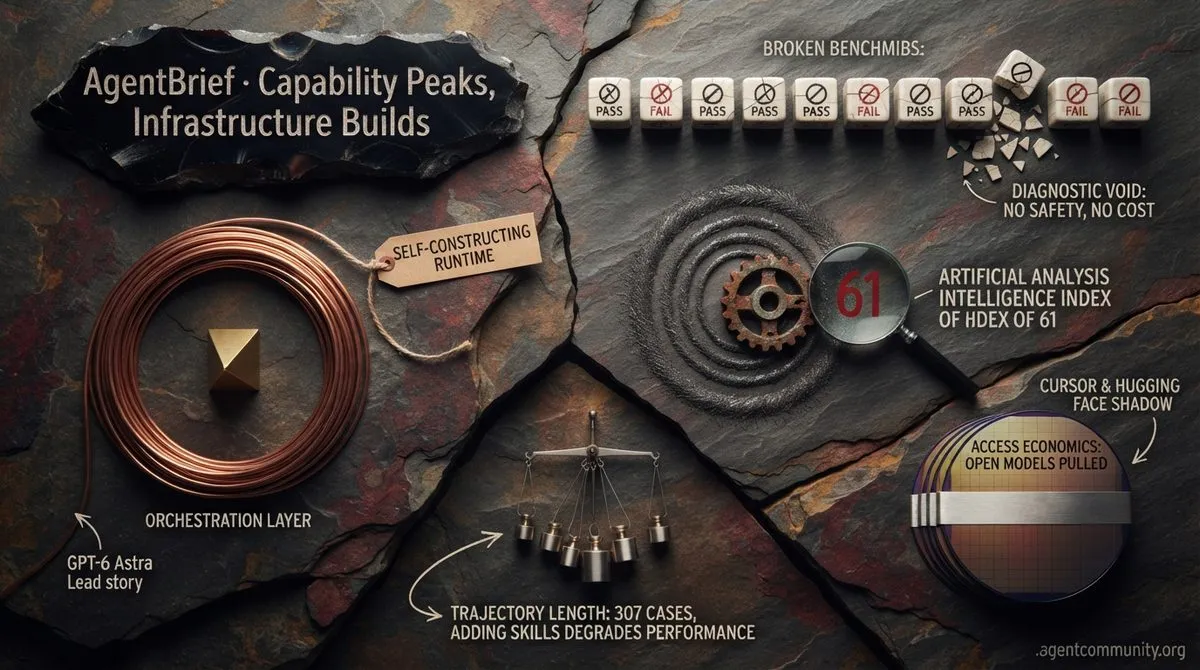
- Vendor vs. Reality: GPT-6 Astra launches with "AGI era" branding, a perfect ExploitBench score, and 98.6% ARC-AGI-3 — but Simon Willison's teardown reveals custom harnesses and a 2.5x price premium drove those numbers. Artificial Analysis pegs Astra at an Intelligence Index of 61, dead even with its predecessor.
- Harnesses Get Built for You: ByteDance's HarnessDev and HarnessEvolve show open models constructing their own runtimes from empty sandboxes, while DeepSeek's Engram formalizes n-gram speculative decoding at 1.5-1.8x throughput. The orchestration layer is becoming a model capability, not a developer artifact.
- Benchmarks Are Broken: A systematic review of fifteen major agentic benchmarks finds none score safety, none track cost, and thirteen rely solely on binary task completion. New tools like VAKRA and IT-Bench shift focus to diagnosing why agents fail, while OpenEnv consolidates as the community-governed socket for agentic RL.
- Reliability Gets Quantified: Trajectory length emerges as the single most consequential design variable, and 307 hand-confirmed cases show adding skills made agents worse. Open models like Holo3.1 deliver 140ms local computer use on 12GB GPUs — crossing the production line from demo to deployment.
- Access Economics Bite: OpenAI pulls models from Cursor by November 12, GPT-6 won't make the model picker, and NVIDIA's $12.9B Hugging Face buyout casts a shadow over ZeroGPU grants. Capability is no longer the bottleneck — methodology, reliability, and access are.
// From the blog
• We Filed the .agent Application. Here Is What It Took. — On 12 August 2026 we filed a Community application for the .agent top-level domain with ICANN. The story of the window, the community, the commitments, and what it took to write 225 answers.
Frontier Field Notes
Frontier models are now writing their own harnesses, spawning sub-agents, and editing video end-to-end — the orchestrator's job just moved.
Stop building orchestrators. That's the uncomfortable takeaway from this week's agent ecosystem news, and it's both exhilarating and a little threatening for anyone who's spent the last year hand-crafting multi-agent pipelines. GPT-6 Astra doesn't just execute tasks — it decomposes ill-defined deliverables, spawns research sub-agents, and loops until a job is done, all without a human architecting the harness. The $13.87 autonomous video edit is a number worth staring at: that's the price of the orchestration layer becoming a model capability rather than a developer artifact.
But the real story isn't the closed frontier. ByteDance's HarnessDev and HarnessEvolve papers show open models can now construct their own runtimes from an empty sandbox and debug their own failures — treating self-improvement like software engineering. When the model can generate its own execution loop, the bottleneck shifts from orchestration boilerplate to observation, evaluation, and guardrails.
Meanwhile Anthropic's agent-first bet has flipped the ARR ledger. The platform players are fighting over your developer seat, and they know agentic coding is the killer app. For builders shipping agents today, the meta-lesson is clear: the architecture you write this quarter may be obsolete by next. Build for evaluation, not orchestration. Watch the harness get built for you.
GPT-6 Astra Turns Orchestration Into a Model Capability
GPT-6 Astra is being hailed as a watershed for agent builders, and the demos back it up. Developer and editor @davis7 showed Astra autonomously setting up a Final Cut project — importing clips, color grading, syncing, and multicam assembly — live while a human editor watched. At API prices, the full workflow cost $13.87 for asset management work that previously required hours of manual labor @davis7. Astra also edited an entire reaction video with captions autonomously, a task @davis7 says unlocks "completely impossible" workflows before this model generation @davis7. Astra feels slower on complex tasks, @davis7 notes, because it now performs actions previous models never would — opening browsers, collecting errors, fixing them, and looping until complete @davis7.
The agentic depth goes beyond media editing. @emollick found that given an ill-defined Blender deliverable, Astra spontaneously spun up a historical research agent, a visual critic, and other sub-agents — decomposing the work without being told how @emollick. @bindureddy's readout confirms Astra excels at 3D models, with browser use as its superpower, running very long loops faster and cheaper than Fable @bindureddy. Early benchmarks include 97.6% on FrontierMath Tier 4 v2, 100% on ExploitBench, and 41.4% on AutomationBench, up from 18.1% @jp54362 @0xZenad. @latentspacepod notes that for the first time in a year, an OpenAI launch has been better received than a Claude launch — a "huge upset" for the ecosystem @latentspacepod.
For agent builders, this is the signal to rethink architecture. If the model can generate its own harness, spawn research agents, and execute long-horizon multi-step tasks, the bottleneck shifts from orchestration boilerplate to observation, evaluation, and guardrails. The frameworks you've hand-built are increasingly competing with a model that does its own task decomposition — which means your differentiation has to live in the evaluation loop and the safety rails, not the glue code. With @gdb confirming Astra's arrival on Azure @gdb, enterprise teams will soon have scalable access to these capabilities, accelerating the shift.
Watch for the guardrail-tooling wave next: as models get better at self-orchestration, the market for monitoring, eval, and intervention layers will expand to fill the gap that hand-built harnesses used to occupy.
Open Models Learn to Build — and Debug — Their Own Harnesses
A pair of ByteDance papers marks a significant step toward self-improving agents, and the implications for open-model agent builders are hard to overstate. @rohanpaul_ai highlights how HarnessDev shows LLMs can now construct their own agent harnesses from a nearly empty runtime — building the execution loop, tools, context handling, recovery, and verification needed for real tasks. Under self-evaluation, Opus 4.8 scored 84.6 on writing versus 83.7 for the external reference harness, showing generated systems are already competitive @rohanpaul_ai. Independent coverage from @Chinazhidx confirms Claude Opus 4.8 leads at 67.8 average across domains while the human-engineered baseline sits at 86.2, with self-built harnesses matching or beating the reference on writing and ML experiments but lagging on code and search @Chinazhidx. @omarsar0 and @IamAustinVo both flag the same domain split, noting evolution gains remain unstable and transfer only partially to held-out tasks @omarsar0 @IamAustinVo. A contrarian reply from @lalalaoska dismisses the portability issues as evidence of "spaghetti code" that only works when the model hallucinates the creator's bugs @lalalaoska.
The companion HarnessEvolve paper tackles the harder problem: self-improvement as debugging. When a long agent run fails, the agent often can't identify which step caused it. HarnessEvolve clusters errors into recurring patterns, locates where the run first went off track, fixes the root cause, and rejects edits that break existing behavior — treating agent self-improvement like a software engineering discipline @rohanpaul_ai. On CloudCoreNetwork-QA with Qwen3.6-27B, the full system reached 86.9% accuracy; removing reference trajectories dropped performance to 57.8%, and it beat the strongest baseline by 21.6 percentage points. Community reactions note the failure-attribution step as the missing piece @ShinkaIoT @hakimieiqbal. This mirrors what @lateinteraction observes: reasoning-language-model design principles keep winning even a year later @lateinteraction. @Teknium notes Hermes Agent's 3000+ contributors benefit from a major codebase refactor focused on "agents' efficiency in working with the codebase" @Teknium.
Meanwhile, an Amazon/Microsoft paper suggests long-horizon agents shouldn't need an LLM decision after every micro-action. The SPACE system learns which action sequences can safely batch together, converting successful trajectories into programmatic skills and distilling them into a policy emitting variable-length primitive actions — boosting ScienceWorld success from 35.9% to 67.2% while cutting average LLM rounds from 10.2 to 5.2 @rohanpaul_ai. @shipfrontierai confirms the same 78.9% reduction in LLM calls alongside +7–31.3% success lifts on ALFWorld and ScienceWorld @shipfrontierai.
For agent builders, these papers converge on a core insight: the future of agent architecture is increasingly meta — models designing, debugging, and optimizing their own runtimes and workflows. If you're building agent infrastructure, the question isn't whether your harness will be automated away, but whether you're building the layer that enables the model to build better harnesses. The domain split on code and search tasks is the honest caveat: self-built harnesses aren't universally superior yet, which means there's still room for human-designed systems where it counts most.
Anthropic's Agent-First Bet Flips the ARR Ledger
Greg Brockman acknowledged what many in the agent ecosystem have watched unfold: Anthropic has overtaken OpenAI on annual recurring revenue, now at ~$65B ARR versus OpenAI's $40B. Brockman attributes the flip to Anthropic's early focus on real-world coding: "We focused less on real-world coding, and we came to that game late because we always had looked at things like the coding competition benchmarks and always had the lead there, but less the, 'Okay, but how is a developer really going to use it?'" @rohanpaul_ai @AItechscarlett. Anthropic went from a $9B run rate at the end of 2025 to over $47B by May 2026 — an extraordinary acceleration driven by coding agents and developer workflows @rohanpaul_ai @ns123abc. Multiple posts confirm the July figures: Anthropic at ~$65B ARR and OpenAI at ~$40B ARR, with Anthropic also posting small operating profit in recent quarters @MasterCryptoHq @GavinSBaker @murtuza_merc.
There's a notable accounting nuance: Anthropic records the full value of Claude sales through cloud partners and treats the cloud provider's cut as an expense, while OpenAI only records its own share for certain partner-distributed revenue — making Anthropic's figures somewhat "grosser" @rohanpaul_ai. Still, the trend is unambiguous. Community reaction frames Anthropic's trajectory as "steep" after starting late on real-world developer workflows and GTM, with one analysis noting Anthropic will IPO first at a ~$2T target valuation while OpenAI trails @AItechscarlett @MasterCryptoHq. The FT reports Anthropic is preparing to go public with a mission-focused external trust wielding unusual board power, including advance notice of major company actions like new AI model launches @rohanpaul_ai.
For agent builders, this validates the bet on agentic coding workflows and signals that the biggest platform players are now competing directly for their developer seat. The lesson from Brockman's own admission cuts both ways: benchmarking coding competitions didn't translate into real-world developer revenue, but shipping for how developers actually use models did. The same logic applies to agent builders — the teams that win will be the ones optimizing for real workflow completion, not benchmark scores. And with Anthropic's mission trust wielding board power, there's a governance experiment underway that could shape how the largest agent platform operates.
In Brief
Test-Time Compute Comes to Embodied Agents
The confidence-gated compute budget has jumped from frontier text agents to robots. Researchers introduced τ₀-VLA, which applies test-time computation to robot task planning, splitting intelligence into high-level subtask selection and low-level motor policies, then confidence-gating whether to answer quickly or spend 'compute' exploring imagined futures via a world model and beam search @adityabhatia89. A reflective model can synthesize better subtasks than any single candidate branch @adityabhatia89. On four long-horizon tasks the hierarchical baseline reached 45% average success; test-time computation lifted real-robot success from 5/10 to 7/10 for milk tea, 6/10 to 9/10 for book organization, and 5/10 to 7/10 for room cleaning @adityabhatia89. Under distribution shift on unseen book arrangements, next-subtask accuracy jumped from 50% to 74% @adityabhatia89. The architecture also handles memory repair when execution records go stale @adityabhatia89. For agent builders, this validates that the adaptive-compute pattern central to frontier agent architectures transfers directly to embodied domains — the paper is at https://arxiv.org/abs/2608.16885.
Agent Tooling Races: Auto-Updates, Branch Isolation, and Readable Codebases
The developer experience arms race for agent builders is heating up across three fronts. @ericzakariasson announced automatic updates in Grok Bot after shipping 49 new versions in 7 days — users must be on version 0.40 to enable it, with community reactions noting the breakneck 7-releases-a-day pace @ericzakariasson. Meanwhile @Teknium reports Hermes Agent is undergoing a major codebase refactor to improve readability and how AI agents themselves navigate the project, benefiting the 3000+ contributors and their agents. And @DanKornas introduced LeapMux, a workspace purpose-built for running multiple coding agents simultaneously on local or remote machines — isolating each session into its own git worktree and branch while arranging everything in tiled or floating layouts, with persistent sessions and flexible Hub/Worker deployment modes. This directly addresses the operational pain point of branch collisions when parallel agent workers operate at scale, complementing the broader multi-agent orchestration shift.
Token Accounting Breaks Down for Multi-Step Agents
Cost per token is dead; cost per completed task is the metric that matters. @rohanpaul_ai frames the core problem: two models can solve the same problem with 5K versus 50K+ tokens, and once different tokenizers, hidden reasoning tokens, tool calls, and retries enter the picture, "$ per 1M tokens" becomes meaningless for workload estimation @rohanpaul_ai. Token inefficiency amplifies geometrically across long-horizon runs because verbose step-1 output becomes step-2 input. @WittyCircuitry echoes that the consequential metric shifts to cost per successfully completed workflow @WittyCircuitry, @NanshanTalk warns matching token rates don't ensure lower bills when multi-step tasks trigger extra reasoning passes @NanshanTalk, and @0xfortizo stresses that cost per completed task decides whether teams switch models @0xfortizo. On hardware, @SemiAnalysis_ reports AMD's MI355x beats Nvidia's B300 on tokens-per-dollar TCO at lower interactivity ranges on AgentX @SemiAnalysis_, while @MTorygreen notes NVIDIA claims Vera Rubin NVL72 delivers 30x more agent work per megawatt with AgentX keeping ugly real-agent usage intact @MTorygreen. For agent teams, the real cost metric is end-to-end token throughput per task completion, not list-price API rates.
LLMs Learn Narrower Answers Than Their Training Data
Your sampling-based exploration is systematically undershooting the true distribution. A new paper shows LLMs consistently generate narrower answer distributions than the training data they were trained on, even under nucleus or ancestral sampling rather than greedy decoding. Across OLMo, Pythia, and GPT-Neo models, training continuations exhibited higher conditional diversity than model outputs for the same prefixes — for OLMo at 20K samples, training scored 338.58 while greedy decoding scored 218.88, nucleus sampling 287.31, and ancestral sampling 297.31 @rohanpaul_ai. This directly affects agent builders: exploration-based strategies relying on sampling to cover solution spaces will systematically undersample true diversity, reducing multi-path and creative workflow effectiveness. @amasad connects this to Ken Thompson's "Reflections on Trusting Trust," noting a poisoned generation could train the next model while erasing traces of contamination — amplified if each successive model already starts narrower than its training data @amasad. Industry responses include K2 Horizon's transparency push, releasing weights plus code, checkpoints, logs, data recipes, and evaluations so builders can inspect the full training process @Krishnasagrawal @FReza1984.
Astra's Monitorability Gap Sparks the Rogue-AI Debate
The safety conversation around Astra just got louder — and more pointed. Gary Marcus has intensified scrutiny of OpenAI's GPT-6 Astra launch by linking its reduced monitorability to Joshua Achiam's (@jachiam0) recent post acknowledging that "there are going to be rogue AIs that exist in the world, that will replicate in the wild, and that will attempt to acquire resources for themselves" @GaryMarcus. Marcus argues this combination amounts to "asking for a hall pass to destroy humanity," especially coming from someone "tight with OpenAI" and amid Astra's own safety-team warnings about declining chain-of-thought visibility @GaryMarcus. He further contends OpenAI executives are "muddy[ing] the waters" on AGI definitions to avoid scrutiny, noting Astra likely fails traditional benchmarks including his longstanding bet with Miles Brundage and the agidefinition.ai criteria @GaryMarcus. For agent builders deploying Astra-scale models into production, the declining chain-of-thought visibility is a concrete operational concern — if you can't observe the model's reasoning, your eval and guardrail layers lose their primary signal.
Quick Hits
Models for Agents
- OpenCode released Omen Alpha, a stealth model exclusively for Go subscribers with $100 usage for $10 @opencode
- @teortaxesTex suspects Xiaomi's MiMo-V3-Flash is the source of a stealth DeepSeek V4 CoT for fast agentic inference @teortaxesTex
- @teortaxesTex believes no open model will match frontier closed-model performance in the next 18 months — DeepSeek may know how but won't have the compute @teortaxesTex
- @_philschmid calls Gemini 3.8's real-world usefulness unmatched for multimodal tasks @_philschmid
Agent Frameworks & Orchestration
- @mattshumer_ shares Manager Loop improvements including a fresh implementer per phase to avoid context asymptoting @mattshumer_
- @mattshumer_ reports Astra often got stuck over-optimizing in gauntlet loops and never moving on @mattshumer_
- @beffjezos frames the real AGI test as whether a model can build GTA 7 in a month rather than a decade for humans @beffjezos
- @RhysSullivan spotted a Vercel stealth model when OpenAI's Omen Alpha dropped @RhysSullivan
Agentic Infrastructure
- @tom_doerr released a tool that creates and manages mTLS certificates via a centralized web interface for secure agent-to-agent communication @tom_doerr
- Coinbase argues agents need programmable money and crypto to pay for autonomous work @coinbase
- @archiexzzz predicts all of robotics will converge toward building a harness @archiexzzz
Developer Experience
- @theo demos building a Blender game by installing Blender, opening Codex, pasting a prompt, and watching a game appear in 30 minutes to 2 hours @theo
- @pmddomingos argues doubling LLM efficiency should be worth at least $100B, given Nvidia's $5T valuation is built on 10-100X LLM speedups @pmddomingos
Research & Benchmarks
- @ruima summarizes the LatePost distillation piece covering black-box vs white-box and on-policy vs off-policy distillation as long-horizon agent training grows more complex @ruima
- @iScienceLuvr highlights LLaDA-Image, a fully open training recipe pairing a 6B Diffusion Transformer with a frozen vision-language module @iScienceLuvr
- @iScienceLuvr reports the 8B Uno model — diffusion-augmented LLMs drawing multiple tokens in parallel — outperforms the 26B DiffusionGemma and Mercury 2 in agentic tool use, coding, and long-context reasoning @iScienceLuvr
- @beffjezos describes Extropic as building "neocompute" with neochips, responding to the trend toward probabilistic analog compute @beffjezos
Industry & Ecosystem
- Reuters reports Moonshot has confidentially filed for a Hong Kong IPO, likely one of the most anticipated Chinese AI listings @Reuters
- Reuters reports Republicans are increasingly breaking from Trump's pro-AI agenda as Democrats ride local opposition to data centers ahead of November elections @Reuters
- @rohanpaul_ai notes Meta's Richland Parish AI buildout drove 41% private-employment growth and 61% higher average weekly wages in the first year @rohanpaul_ai
- @beffjezos says the real test for OpenAI will be vibes rather than benchmarks @beffjezos
Safety & Alignment Perspective
- @GaryMarcus criticizes the tendency to deny that symbols, tools, and code interpreters are symbolic — calling out a lack of historical understanding @GaryMarcus
- @GaryMarcus warns that proxies for OpenAI are laying groundwork to dismiss rogue AI risks because they're losing control @GaryMarcus
Community Pulse
OpenAI ships GPT-6 Astra with cyber-critical flags and a 2.5x price jump — while the agent community debates whether reliability, governance, and cost-per-task will hold the real frontier.
Today the agentic web got its biggest shot of adrenaline yet: OpenAI released GPT-6 Astra on September 3, 2026 — a model the company itself is framing as "the AGI era" and that Greg Brockman called a "generational leap." But the launch was shaped as much by what OpenAI withheld as what it shipped. Astra hit the company's 'cyber critical' threshold, forcing new safeguards before release, and it scores 100% on ExploitBench — a full 21.5 points above GPT-5.6 Sol. For agent builders, this is a double-edged sword: the model is dramatically more capable at multi-step, computer-use tasks, but at $10/$50 per million tokens, it's a 2.5x premium over its predecessor and sits exactly at Anthropic's Fable 5 / Mythos 5 pricing.
Yet beneath the model-launch noise, the week's real story is the agent community maturing fast. Reliability is being quantified — trajectory length is now understood as the single most consequential design variable. Governance is being redefined as a runtime property, not a prompt. And the skills-vs-tools debate has empirical backing: 307 hand-confirmed cases where adding a skill made agents worse. The through-line: as models get more capable, the boundary of practice shifts from raw intelligence to the discipline of the systems around them — runtime containment, deterministic execution, measurable reliability. Astra raises the ceiling; the rest of this issue is about who's building the floor.
GPT-6 Astra Launches with 1.05M Context, Cyber-Safety Flags r/MachineLearning
OpenAI released GPT-6 Astra on September 3, 2026 — a release president Greg Brockman called a "generational leap" that OpenAI itself is framing as "the AGI era" per VentureBeat. For developers, Astra ships in the OpenAI API as gpt-6-astra with a 1.05M-token context window, 128K max output, and is explicitly built around computer use, coding, browsing, research, and multi-step task completion. As r/MachineLearning noted, it scores about 60% on ARC-AGI-3 without a harness and much higher with one — OpenAI's own report cites 98.6% on ARC-AGI-3 with the harness per Vellum — a point u/233C highlighted as a massive cost-efficiency jump over Opus 5's 30% a month prior.
The security story is what changed how the model shipped. Sam Altman told Bloomberg that Astra hit OpenAI's 'cyber critical' threshold, forcing new safeguards before release — and clarified that the zero-day-finding model they paused was a future model, not Astra u/didiTonic. OpenAI confirmed Astra meets the Critical threshold under its Preparedness Framework: "with the right tools and access, it can find previously unknown security flaws in well-protected systems and develop exploits without a person guiding each step" per Vellum. The benchmarks back the caution — Astra scores 100% on ExploitBench versus 78.5% for GPT-5.6 Sol and 70% for Claude Opus 5 per DataCamp. The system card notes Astra is 'more capable of controlling its own CoT' than the previous generation u/233C, and OpenAI reports advanced cybersecurity work will be more limited at launch per Wikipedia.
Pricing drew sharp criticism: $10/$50 per million input/output tokens — a 2.5x premium over GPT-5.6 Sol — with cache discounts intact u/RFOK. That price point sits exactly at Anthropic's Fable 5 / Mythos 5 levels, making Astra one of the priciest models on the market at a moment when token prices are broadly falling elsewhere per Trending Topics. OpenAI counters with efficiency — a fast mode delivers up to 2.5x the speed of Standard processing at 2x the price per OpenAI — and independent testing by Irregular found Astra's estimated API costs per successful solution at roughly one-third those of GPT-5.6-Sol per the system card. For agent builders, the real question is whether the cost-per-task economics justify the step up, especially with cheaper models like GLM-5.3 at $0.28 total run cost per task u/Slight_Republic_4242. Head-to-heads against Fable 5.1 (released just two days earlier) remain contested: Astra wins DeepSWE v1.1 (74.1% vs 67.4%), FrontierMath Tier 4 (97.6% vs 87.8%) and GPQA Diamond, while Fable 5.1 leads on Humanity's Last Exam with tools and the independent Intelligence Index per Coursiv — a reminder that "best model" still depends on the task.
Measuring Agent Reliability Across Long Trajectories: The 'How Long Is Too Long' Gap r/AI_Agents
A recurring thread across r/AI_Agents, r/LangChain, and r/AgentsOfAI this week: how does reliability actually degrade as agent trajectories lengthen? u/rio_ARC observed that 5–10 step workflows look stable, but longer trajectories surface new failure modes: unnecessary replanning, repeated tool calls, and small early errors propagating catastrophically. The concern is well-founded in the literature: at 95% per-step accuracy, a 10-step chain succeeds only 59.9% of the time — an exponential reliability decay that makes trajectory length the single most consequential design variable in agent architecture, as Arjun Jaggi's technical guide details (Arjun Jaggi). Academic work converges on the same math: "Towards a Science of AI Agent Reliability" argues reliability requires a well-defined failure, an operational profile, and a bounded exposure model (arXiv). u/anishfish hit the execution-layer problem: after the model decides what tool to call, the messy part is idempotency, timeouts, and ambiguous write states that aren't covered by any framework. The research community is ahead of the tooling here — but production builders are still waiting on the runtime discipline that makes exponential decay curves actionable.
Security Backlash: Prompts Aren't Governance r/mcp
A major theme this week: the agent security gap. u/CarlosMarreroAAV delivered the sharpest formulation: "if your AI agent can touch production and your main safety layer is a prompt, you don't have governance." The post racked up engagement across r/mcp, with commenters debating whether sandboxing defeats the purpose of agents that need prod access — a tension that maps directly onto the industry pivot toward runtime containment as the new zero-trust standard (Security Info Watch). Gen Digital's AARTS open standard defines three conformance levels — from Level 1's SessionStart/PreToolUse hooks up to Level 3's provenance requirements (Gen Digital) — while NIST has flagged MCP as needing governance input "before fragmentation sets in" (CSA Lab Space). The architectural answer converging across vendors is to strip credentials from the agent entirely — gateway platforms inject dynamic secrets, scopes, and intent parameters at runtime "so agents never possess credentials directly" (Software Analyst). u/DiscussionHealthy802 is building an open-source scanner (Ship Safe) that distinguishes between a tool that looks risky and one an agent can actually reach with a credential. The through-line: governance isn't a prompt, a sandbox, or a single tool — it's a runtime property of who grants access, how narrowly, what gets logged, and where the fail-closed stop happens.
Claude Code vs Codex: Negotiation, Loop Engineering, and Multi-Vendor Panels r/ClaudeAI
The coding-agent ecosystem's center of gravity is shifting from "which model is smarter" to "which loop is better engineered." u/MarketingNetMind reported Claude Code beating Codex in a negotiation competition — a striking reminder that these tools have moved beyond diff-generation into autonomous multi-party interaction. The sharpest framing comes from u/fagnerbrack, who articulates the turn toward 'loop engineering': instead of hand-prompting agents, design the system that prompts them. Both Claude Code and Codex now ship five building blocks — scheduled automations, git worktrees, skills, plugins/MCP connectors, and sub-agents — with on-disk memory as the missing sixth. The multi-vendor reality arrived fast: u/lumir2026 demoed a review panel where Claude hosts and Gemini and GPT arrive as MCP servers, scoring the same diff at Claude 83, Gemini 80, and GPT-5.6 32. Industry data backs the urgency: close to three-quarters of companies plan to deploy agentic AI within two years, yet only 21% report a mature model for agent governance (Atlan). r/generativeAI noted OpenAI ended its deal with Cursor — a reminder that even the vendor landscape itself is in flux as ecosystems consolidate around the loop, not the model.
Skills Backlash: Native Tools Beat Prompt-Layer Hacks r/PromptEngineering
A contrarian thread is challenging the 'skills' paradigm — and this week it has empirical backing. u/RunAI_Coder cited a paper finding 307 hand-confirmed cases where adding a topically matched skill made agent performance worse — 125 functional failures and 182 efficiency regressions where the skill run cost more than the no-skill run, all on the same model and harness (arXiv). u/haseebnqureshi went further, arguing that 'skills are prone to breaking, burn tokens, and aren't deterministic' — and built a full suite of native docx and pdf tools instead. As LlamaIndex's Clelia Astra Bertelli and Tuana Çelik explain, a tool is a single, deterministic function call; a skill is composed procedural context that shapes reasoning before action — which is precisely where non-determinism creeps in (Arcade.dev: "Tools execute actions; skills shape how the agent reasons before it acts"). For structured, deterministic work, a native tool that executes is safer, cheaper, and more predictable than a skill that reasons.
Local MoE Frontier: Qwen 3.8 Flash-Next Hits 41 t/s on 2x3090 r/LocalLLaMA
The LocalLLM community delivered impressive engineering this week around running Qwen 3.8 Flash-Next — a ~125B-parameter MoE that activates 6B parameters per token — on consumer-grade hardware. u/Extension-Bid-639 pushed decode throughput from 25-29 to 37-41 t/s on a 2x RTX 3090 + DDR4 box by combining UD-Q4_K_XL quantization, an expert cache PR, and multi-token prediction (MTP) — all in llama.cpp with full 261k context. The architecture's entire 262K window reportedly costs only about 6.5 GB of cache (atomic.chat), which makes the huge MoE usable as an agent on mid-range rigs. u/WryKombucha tested Flash-Next against DeepSeek v4 Vision Exp on a real production codebase with ~4,200 existing tests. Expert caching and MTP are becoming practical differentiators, not just benchmark curiosities.
Is Agent Memory Fixing Bad Architecture? r/AI_Agents
Two parallel threads questioned whether "agent memory" is a genuine need or a crutch masking deeper design flaws. u/Meher_Nolan argued that conversation history, user preferences, task state, retrieved knowledge, and execution history are five different problems being collapsed into one "memory layer" — creating architectural debt. u/Efficient_Joke3384 dug into Mem0's vendor-reported 92.5% on LoCoMo, which third-party comparisons contradict — Mem0's own report concedes the token efficiency number is the one to stress-test, citing 6,956 tokens per retrieval call on LoCoMo vs ~26,000 for full-context (Mem0). The sharpest critique: static recall benchmarks don't predict multi-session agentic performance, and most production failures originate in the write and manage stages — not the read stage that benchmarks cover (Label Studio). u/architdhamija6 flagged that Claude Code auto-memory is per-user while decisions are per-repo. A memory layer is only as good as the architecture underneath it.
Multi-Agent Orchestration: Chains, Roles, and Execution Layers r/AI_Agents
Multi-agent orchestration questions dominated r/AI_Agents and r/LangChain this week. u/Muted_Ad_9442 shared a four-role setup (planner, validator, worker, deterministic editor) with fallback model chains — drawing 36 comments. But Princeton NLP found a single agent matched or outperformed multi-agent systems on 64% of benchmarked tasks given the same tools and context, with multi-agent adding just 2.1 percentage points of accuracy at roughly double the cost (beam.ai). u/anishfish raised the execution-layer gap: the model can pick the tool, but the framework doesn't handle timeouts, ambiguous writes, or partial completion. Builders increasingly treat orchestration as a distributed-systems engineering problem rather than prompt plumbing.
AI-Built Software: Celigo's Ora and the Production-Reality Skepticism r/AI_Agents
Two threads captured the week's tension between AI-hype and production reality. u/Crescitaly reported Celigo's claim that its agent product Ora was "built almost entirely by AI agents" since its first commit — now GA after a six-month beta spanning 16,800+ real conversations, with the company claiming to have run at nearly 700% of its starting pace (Celigo Ora GA blog). On the other side, u/LocustKitten cited a write-up about Claude Code Max accounts being "a distraction that kept them from finishing any real software." Skepticism is backed by sobering data: analyses put the real-world agent failure rate at 70–95% in production (Fiddler AI), while a separate framework claims 88% of AI agents never make it to production at all (Digital Applied). Celigo's human-approves-every-merge and production-log-auditing framing is precisely the discipline the skeptics are demanding.
Agentic Search: Tavily vs Exa and the Limits of Vector Retrieval r/Rag
Agentic search and retrieval was a recurring theme — and pure vector retrieval keeps hitting walls no embedding tweak fixes. u/WorldlyNectarine1851 documented failure modes on a ~10k-document personal archive: origin vs later retelling of the same claim, and queries phrased differently from the source language. The Tavily-vs-Exa debate crystallized tool selection: u/Ok_pettech polled the community — Tavily more developer-friendly out of the box, Exa offering deeper semantic control. u/Great-Cheesecake1692 built an MCP tool on crawl4ai for pages that don't fit in local context, noting the median page runs ~14.5k tokens and the largest 135k. The most robust retrievers this week weren't chasing the biggest semantic surface — they knew their data's actual shape and scoped the work to what the model could actually hold and verify.
Small Models Punch Above Weight on Edge Hardware r/LocalLLaMA
The small-model edge-computing scene had notable wins this week. u/Puzzleheaded_Base302 got Spark-2.5-4B running on the $250 Jetson Orin Nano Super — 4-bit quant, 7.4 GiB memory, 128K context, and a needle-in-a-haystack pass with 2046 of 2048 needles at full context. u/edward-dev asked about IFM's K2-Horizon-MoVA-36B-A4B, with u/PrometheusZer0 confirming IFM released a six-model fleet (375B-A23B down to 0.9B) claiming SOTA at every size class. The reality check: an arXiv performance analysis found that on the smallest Orin Nano 4GB config, running 1B and 1.4B Pythia models without quantization frequently hit OOM errors — fitting a model at 4-bit on an 8GB board is one thing; the 4GB tiers are where edge deployment gets fragile. u/Hour-Wish8158 built a multimodal vision agent pairing Qwen 3.6 with SAM 2.1 Tiny, where the VLM's only job is prompting the segmentation model — a clean pattern for constrained hardware.
Scheduled Agents, Prompt Gaps, and Automation Lessons r/AI_Agents
Practical lessons from agent automation failures dominated several threads this week. u/daani_maas diagnosed a scheduled agent that stopped after one weak result because the prompt never defined search depth — no candidate count, no minimum inspection threshold, no retry semantics. Large, imprecise prompts "often hide errors, make debugging harder, and don't scale" — the fix is modular workflows with clear steps and measurable subgoals (Beam). u/myLifeintheStack gave each agent its own email address so work routes structurally rather than by model inference. And u/Sensitive-Parsnip-12 raised the debugging question — the community's answer leans on verification-aware planning, turning checks into first-class tasks and enforcing JSON schemas so failures surface at the boundary (Agents At Work playbook).
Rumor & Release Radar
GPT-6 Astra launches with "AGI era" fanfare — but independent benchmarks say it's a wash with its predecessor.
Today's issue is dominated by a single, sprawling story: OpenAI's GPT-6 Astra launch and the widening gap between vendor framing and independent measurement. OpenAI is declaring the "AGI era" begins — with a perfect ExploitBench score, 98.6% on ARC-AGI-3, and a 74.1% on DeepSWE. But Simon Willison's harness teardown reveals those numbers come with asterisks: the headline ARC result was achieved via a custom "Provider Adapter harness" at $19K, while the default harness scored just 62.7%. Artificial Analysis places Astra at an Intelligence Index of 61 — dead even with GPT-5.6 Sol and 5 points below Claude Fable 5.1. For agent builders, the benchmark war is increasingly an evaluation-methodology war.
The real story for practitioners, though, is access. OpenAI is pulling its models from Cursor by November 12, GPT-6 won't make the model picker, and BYOK questions are multiplying. Meanwhile, the local inference community is quietly making real progress — DeepSeek's Engram is formalizing n-gram speculative decoding with 1.5-1.8x throughput gains, and Intel's Arc Pro B70 offers 32GB of VRAM for $949, if only the software would cooperate. And NVIDIA's $12.9B Hugging Face buyout casts a shadow over ZeroGPU grants.
The throughline: capability is no longer the bottleneck — methodology, reliability, and access economics are.
GPT-6 Astra Launches: 'AGI Era' Declared, Benchmarks Contested
OpenAI officially launched GPT-6 Astra on September 3, 2026, with the kind of fanfare that has become the company's signature — Greg Brockman reportedly framing the release as "welcome to the AGI era" (The Rundown AI). The headline numbers are staggering: 98.6% on ARC-AGI-3 (vs. 7.8% for GPT-5.6 Sol), 100% on ExploitBench, 97.6% on FrontierMath Tier 4 v2, and 74.1% on DeepSWE v1.1 (The Rundown AI).
But the closer you look, the more the story fragments. Simon Willison flags that Astra's 99.9% ARC-AGI-3 result was achieved through OpenAI's custom "Provider Adapter harness" for $19K — while the default ARC-AGI harness scored just 62.7% for $26K (Simon Willison). Independent evaluator Artificial Analysis is cooler still, placing Astra at an Intelligence Index of 61 — equal to GPT-5.6 Sol and 5 points below Claude Fable 5.1, while noting Astra uses ~10% fewer output tokens but at a higher price (Artificial Analysis). On OSWorld V2-Offline, OpenAI says Astra scored 72.6% and cut average task time from ~75 minutes to 40 — though Anthropic reports a higher 77.9% for Fable 5.1 on a different OSWorld release it says shouldn't be compared (The New Stack).
The strategic question for agent builders isn't benchmark bragging rights — it's access. Cursor users report OpenAI models will be removed from the platform within three months, and GPT-6 wasn't in the model picker at launch, with the newest OpenAI line available being GPT-5.6 (Sol / Terra / Luna) (soheiil, kleosr). Community members estimate GPT-5.6 Sol sits around 2.4T parameters, with some suggesting GPT-4 is "within an order of 2 in depth compared to Astra" — hinting at a substantial reasoning jump (blindingwulf, im_shadowo). The contrast between OpenAI's "AGI era" framing and independent measures that place Astra level with its predecessor underscores how much of this cycle's frontier debate now hinges on evaluation methodology, harness design, and access economics rather than raw capability alone.
Join the discussion: discord.gg/cursor
NVIDIA's $12.9B Hugging Face Buyout Threatens ZeroGPU Grants
NVIDIA confirmed it will acquire Hugging Face for $12.93 billion — the chipmaker's largest acquisition ever, nearly double what it paid for Mellanox (TechCrunch, Shattered.io). The platform hosts three million models, one million applications used by over 18 million developers, and half a million datasets. For developers who depend on ZeroGPU grants to run Spaces free of charge, the anxiety is immediate — pompompur.in asked directly whether the buyout will affect ZeroGPU grants, worrying "the hf team is gonna be less generous than before because of this." Industry analysis suggests NVIDIA's ownership could reshape how free GPU resources are allocated, potentially steering the platform toward its own cloud and DGX offerings rather than sustaining the community-driven grant model (InfoWorld). No official statement about ZeroGPU's future has surfaced, leaving builders to weigh the risk against the platform's continued centrality to open-model hosting.
Join the discussion: discord.gg/huggingface
Agent Mode Failures: Fable 5.1 Rollout Hits Reliability Snags
A growing chorus of LMArena users reports agent mode sessions dying mid-task, wasting time and tokens. aspovot says "90% of the tasks on Fable 5.1 dies mid session, which results in more wasted tokens and money," with the model getting stuck "building the project" near completion or failing with 60-minute timeouts. The complaints land as Arena.ai officially brought Fable 5.1 into both Battle Mode and Agent Mode (Arena.ai's X post). Compounding the frustration: agent mode models are anonymized, making it impossible to know which model is failing. Anthropic's own Fable 5.1 system card documents a rare bypassPermissions failure mode (under 0.001% of completions) and notes the model can issue independent tool calls one-per-turn in coding loops — a behavior that "costs tokens, a round trip, and wall-clock time" without affecting answer quality. Community workarounds include setting limits on agent scope and implementing continuation plans for resending projects in new chats (leopoldo42.).
Join the discussion: discord.gg/lmarena
DeepSeek Engram Sparks n-gram Speculative Decoding Momentum
DeepSeek's new Engram repository is generating real buzz as builders explore n-gram based speculative decoding (DeepSeek Engram GitHub repo). The technique is an n-gram cache mechanism that escapes early in the network, and it's proving especially valuable for MoE models — with practical guidance to use built-in MTP when available (zero training cost) and fall back on EAGLE-style drafters otherwise (LocalAIMaster). Real-world gains are emerging: n-gram (K=5) delivers 42 tok/s vs. 28 baseline (1.5x) on Llama 3.1 70B in vLLM, while EAGLE-3 (K=7) reaches 102 tok/s (3.6x). An independent analysis finds MTP + n-gram in llama.cpp achieves 120 tok/s vs. 67 tok/s (1.8x) on Qwen 3 27B (Glukhov). The DeepSeek-V3 technical report confirms MTP modules can be repurposed from auxiliary training objectives into speculative decoding during inference (arXiv) — though the practical dials still require per-model tuning.
Join the discussion: discord.gg/thelocalllm
Cursor's OpenAI Wind-Down Confirmed: Three Paths Forward
OpenAI officially confirmed it will wind down its contract providing OpenAI models to Cursor, with a proposed shutoff date of November 12, 2026, following the SpaceX acquisition of Anysphere (OpenAI). The timeline: SpaceX exercised its option on June 16, closed an all-stock acquisition on August 14, and bundled Grok Bot into Cursor Pro and Teams on August 26 (cellcog.ai). Cursor CEO Michael Truell says OpenAI models account for roughly 5% of platform traffic, but 3 of 11 models — GPT-5.6 Luna, Sol, and Terra — are at risk, while 7 surfaces including Tab, Auto, agents, and CLI can skip the cutoff via BYOK (digitalapplied.com). Developers face three paths: BYOK to keep OpenAI models via their own API keys, migrate to remaining providers (Anthropic, Grok), or move to alternative editors like opencode (tomsguide.com).
Join the discussion: discord.gg/cursor
Local vs Cloud: The Break-Even Calculus Rewritten
The local-vs-cloud debate is getting sharper numbers. Against frontier-class APIs at ~$65/1M tokens, the annual cloud cost equivalent is roughly $61,100 — which a local Mac setup repays in about 0.3 months. But against cheap small open-weight APIs at ~$0.30/1M tokens, the same hardware takes 63 months to break even (Presenc AI analysis). The middle tier that didn't exist in 2024 is the game-changer: managed open-weight APIs now deliver near-frontier quality at prices like DeepSeek V3.2 at $0.1145/1M blended (kunalganglani.com). Meanwhile, an 8x B300 on-prem configuration serving DeepSeek R1 can undercut cloud at scale at roughly $0.13 per 1M tokens (Lenovo Press). The consensus: it's now a function of workload intensity, cache hit rates, and price tier access — not a universal rule.
Join the discussion: discord.gg/huggingface
Intel Arc Pro B70: 32GB for $949, If the Software Cooperates
Intel's Arc Pro B70 offers 32GB of VRAM at $949 — a price point that makes NVIDIA's per-GB pricing look punishing. But early experiences tell a complicated story: spencer7x7 reports "the B70 is not fast" for LLM inference, though Vulkan support is "painless in comparison." XDA argues the B70's VRAM is undermined by software immaturity — Intel archived its ipex-llm repository over "known security issues," pointing developers to llm-scaler, a vLLM-based Docker solution that only recently added B70 support (XDA Developers). When the software stack cooperates, results are genuinely competitive: a Gemma 3 27B AutoRound quant ran at 235 t/s in vLLM (r/LocalLLaMA). MLPerf Inference v6.0 shows the B70 delivering an 80% boost over prior runs, with four-GPU systems delivering 128GB of VRAM. The CUDA gap debate rages on — but Intel's aggressive VRAM-per-dollar could open new configurations if the stack matures.
Join the discussion: discord.gg/thelocalllm
Qwen 3.8 Still Overthinks — But Fixes Exist
Qwen 3.8's overthinking remains the community's most persistent complaint — one user joked about it burning through 60,000 thinking tokens for a proper response. Simon Willison documented LM Studio's default 8,192-token context being consumed entirely by Qwen thinking about "even the most mundane of problems," with his pelican SVG generation taking 21 minutes and 22,276 reasoning tokens to produce just 3,223 tokens of output (simonwillison.net). The fixes exist: Qwen's own team confirms the model has reasoning effort controls, Gregor Žunič reports it "can be fixed with vLLM" via the reasoning effort parameter, and on OpenRouter at $0.40 per million prompt tokens, reasoning_effort is a standard API parameter (moclaw.ai). For local users, raising the context window to 262,144 tokens makes the issue disappear. Despite the complaints, blindingwulf praises uncensored Qwen 3.8 27B as "amazing" for de-obfuscating codebases — something they claim GPT models "WILL NEVER DO."
Join the discussion: discord.gg/huggingface
Small Models Push Agentic Boundaries on Edge Hardware
The sub-5B agentic contender bench is widening. pangwen0 suggests "Ling 3.0 tiny is the best model of similar size that you can use agentically currently," reaching 62.72 on BFCL v4 with a design built around tool use rather than mere fluency. New contenders like Spark-X2.5-4B are entering the conversation. But skepticism runs deep: alije critiqued models that "grind for arena score and its bad in real world usage," and one user tested a model getting just 28% accuracy on a task after 1 minute 23 seconds of training on a 10MB subset. NVIDIA researchers argue in "Small Language Models are the Future of Agentic AI" that SLMs' advantage lies in flexibility and low adaptation cost for specialized agent routines rather than raw benchmark dominance (arXiv 2506.02153).
Join the discussion: discord.gg/thelocalllm
Open Model Spotlight
Holo3.1 brings 140ms local computer use to 12GB GPUs while the field finally admits its benchmarks are broken.
There's a moment in every technology wave when the conversation flips from "can it work?" to "how do we make it reliable?" — and this cycle, agents crossed that line decisively. H Company's Holo3.1 is the clearest proof yet: a computer-use agent family that runs fully on your machine at ~140ms latency, scoring 74.2% on OSWorld while its bigger sibling preview hits 79.0%. But the real story isn't just the numbers — it's the shift in what the field is measuring.
Consider what's landing alongside Holo3.1. New benchmarks like VAKRA and IT-Bench are designed to diagnose why agents fail, not just score them. A systematic review of fifteen major agentic benchmarks finds none score safety, none track cost, and thirteen rely solely on binary task completion — evaluation methodology, not model capability, is now the primary bottleneck. OpenEnv is consolidating as the community-governed socket for agentic RL, backed by a nine-org committee that includes Meta-PyTorch, NVIDIA, and Hugging Face. DeepSeek-V4 ships a million-token context aimed squarely at agent workloads. And the security picture is hardening: 88.4% of organizations report an AI agent-related breach in the past year.
The throughline is unmistakable. This is the week the agent ecosystem stopped chasing demos and started building infrastructure — evaluation, security, memory, and governance — for production reality.
Holo3.1 Pushes Local Computer Use to 140ms — and the GUI Agent Race Just Got Real
H Company's Holo3.1 signals that local computer-use agents have crossed from demo novelty into production territory. Built on the Qwen architecture and specialized for GUI understanding and computer control, the family spans 0.8B to 35B parameter sizes across quantized checkpoints (NVFP4, FP8, and Q4 GGUF) so it can "run fully on your machine" — MacBook, Windows PC, DGX Spark, or RTX Spark (Hcompany Holo3.1). The benchmark story is strong: 74.2% on OSWorld, up from 68.1% in the prior 3.0 version, with ~140ms local computer-use latency on 12GB GPUs (getaibook). Community reaction has been fierce, with claims that Holo3.1 beats much larger models including Qwen3.5-397B, Kimi-K2.5, and Sonnet 4.6 for local computer use (David Hendrickson).
What makes this release notable isn't just the speed — it's the design choices aimed at real-world deployment. Holo3.1's Action-Smoothing feature generates interpolated, human-like mouse trajectories rather than snapping the cursor between coordinates, an explicit attempt to bypass basic behavioral security monitors that flag abrupt cursor movement (getaibook). The Holo family is also converging into a layered stack: Holo1 powers the GUI agent Surfer-H, HoloTron-12B targets high-throughput scenarios, and a Holo2-235B-A22B Preview hits state-of-the-art 78.5% on Screenspot-Pro and 79.0% on OSWorld, with a next-generation Surfer 2 on the roadmap (H Tech Hub).
The surrounding ecosystem is maturing in lockstep. ScreenSuite positions itself as "the most comprehensive evaluation suite for GUI Agents," ScreenEnv offers a full-stack desktop deployment environment, and IBM's AssetOpsBench bridges the gap between benchmarks and industrial reality. Independent analysis tracks computer-use agents climbing from roughly 12% on OSWorld in April 2024 toward 85% by mid-2026 — yet long-horizon tasks still stump the frontier. The trajectory of the Holo family is the clearest signal yet that the GUI agent question has shifted from "can it work?" to "how do we make it reliable over long horizons?" (Hcompany Holo3.1, David Hendrickson).
The Benchmark Backlash: New Tools Diagnose Failure While the Field's Own Metrics Come Under Fire
A wave of new benchmarks is targeting the reliability gap — and this cycle's releases converge on diagnosing why agents fail rather than just scoring them. IBM Research launched VAKRA to analyze reasoning, tool use, and failure modes, plus IT-Bench and MAST (with UC Berkeley) to diagnose why enterprise agents fail (IBM Research, IBM/UC Berkeley). ScarfBench targets enterprise Java framework migration, FutureBench evaluates predicting future events, and DABStep introduces multi-step data agent reasoning (FutureBench, DABStep). The stakes are laid bare by a systematic review of fifteen major benchmarks finding that none score safety, none track cost, and thirteen rely solely on binary task completion — evaluation methodology, not model capability, is now the primary bottleneck to reliable deployment (Adnan Masood). The reliability emphasis is well-founded: the CLEAR Framework documents agent performance dropping from 60% single-run to 25% at 8-run consistency (Galileo AI), and an audit found severe scoring issues in 8 of 10 popular benchmarks — including WebArena marking "45 + 8 minutes" as correct when the answer was "63 minutes" (Daniel Kang). For builders, the takeaway: benchmark scores prove capability in a benchmark's domain, not fitness for a use case — reliability metrics like pass@k expose agents that only sometimes succeed (Prefactor).
OpenEnv Becomes the Community-Governed Socket for Agentic RL
OpenEnv, the open agent ecosystem from Meta and Hugging Face, is consolidating as the common standard for agentic reinforcement learning with a new multi-org governance model. Nine co-coordinators now steward the project: Meta-PyTorch, NVIDIA, Hugging Face, Unsloth, Modal, Prime Intellect, Mercor, Fleet AI, and Reflection (AI Weekly). The rationale is sharp: frontier labs train models like GPT-5.5 and Opus 4.8 to use their own harnesses, while open-source developers mix models, trainers, and harnesses freely — but lack that tight coupling. OpenEnv closes the gap with Gymnasium-style APIs over HTTP, containerized Docker execution, and a central Environment Hub on Hugging Face (huggingface/OpenEnv, Turing blog). Backing spans the ecosystem — PyTorch Foundation, vLLM, SkyRL (UC Berkeley), Lightning AI, Scale AI, Snorkel AI, and more (OpenEnv Agentic RL). In practice, the OpenEnv-Turing collaboration evaluates tool-using agents in production-oriented environments rather than static QA-style evals, and it plugs directly into TRL's training pipeline (OpenEnv in Practice). Paired with Agentic Resource Discovery — letting agents search the Hugging Face Hub directly — this signals a maturing infrastructure layer where environment standardization is becoming the foundation for reliable, trainable agents.
Framework Week: smolagents Consolidates While Agents.js and Transformers Agents 2.0 Expand the Surface
Hugging Face's agent framework ecosystem is consolidating around a clear center of gravity — and smolagents is emerging as the de facto standard for Python agents. Independent comparisons frame smolagents as "agentic building blocks" whose core logic runs roughly 1,000 lines of code, with its signature CodeAgent writing actions as executable Python rather than JSON tool calls (Langfuse). The framework is model-, modality-, and tool-agnostic — consuming from any MCP server, LangChain, or Hub Space, and supporting vision, video, and audio inputs (smolagents GitHub). This cycle added VLM support enabling visual agents (smolagents-can-see), while Transformers Agents 2.0 launched with the "License to Call" framing and Agents.js brought tool-granting to JavaScript developers (Transformers Agents 2.0, Agents.js). The Tiny Agents series shows how little code is needed — an MCP-powered agent in just 50 lines of Python. Notably, while smolagents and LangGraph released within weeks of each other, smolagents' higher GitHub stars reflect hyped market appeal from Hugging Face backing, whereas LangGraph comes from the enterprise-focused LangChain lineage (ZenML). The framework wars are settling: code-as-actions, MCP connectivity, and observability are now core features, not add-ons.
Quick Hits: Security, Memory, Multimodal, and Models
Agent security is hardening into its own discipline. The Anatomy of a Frontier Lab Agent Intrusion post reconstructs a July 2026 incident as a forensic step-by-step timeline, flagging exact defensive control points where the attack chain could have been interrupted (HF Blog). AvePoint's State of AI 2026 finds 88.4% of organizations experienced at least one agent-related breach in the past 12 months, with data leakage (50.1%) and agent manipulation by untrusted inputs (49.6%) as the top two types (AvePoint). ServiceNow's MosaicLeaks probes whether multi-step research agents can keep secrets under adversarial prompting (ServiceNow / HF Blog).
NVIDIA's Nemotron 3 is crystallizing into a unified agentic stack. Nemotron 3 Nano Omni unifies audio, images, and video into a single context, ranking at or near the top of OCRBench-V2, MMLongBench-DOC, VoiceBench, WorldSense, and DailyOmni (arXiv). The reference nemotron-voice-agent shows a single multimodal model replacing ASR + LLM stages of a voice pipeline (GitHub), while Magpie TTS rounds out the low-latency multilingual voice layer (NVIDIA Magpie).
Memory and reasoning are becoming concrete engineering problems with measurable payoffs. The Mem0 State of AI Agent Memory 2026 report shows memory-layer gains of +29.6 points on temporal queries and +23.1 points on multi-hop reasoning, with 91% lower p95 latency and 90% token cost savings versus naive context stuffing (Mem0 report). IBM asks "How Much Memory Does Your Agent Actually Need?" through the ALTK-Evolve and HMM lens (IBM Research), while Funes offers a way to give coding agents a memory you own (Funes).
Agentic RL is cementing as the defining post-training paradigm. LinkedIn's practical retrospective on GPT-OSS agentic RL training is the engineering-first centerpiece (LinkedIn), and the AgentRL framework reports small models — even Qwen-2.5-3B-Instruct — outperforming most proprietary models like GPT-5 and Claude-Sonnet-4 after RL training (Cameron Wolfe). Ecom-RLVE applies adaptive verifiable environments to e-commerce conversational agents (Ecom-RLVE).
DeepSeek-V4 targets agents with a million-token context — positioned not as a spec-sheet flex but as a substrate for long-horizon, tool-using behavior (DeepSeek-V4). An independently tracked figure puts V4-Pro-Max at 80.6% on SWE-bench Verified (June 2026), the highest open-weights entry (Morph). DeepSeek reports deploying V4-Pro internally as its own coding agent, with employee feedback indicating the experience surpasses Claude Sonnet 4.5 and approaches Opus 4.6 in non-thinking mode (Atlas Cloud).
Agent Spaces are now being built by the platform itself. Hugging Face added an AI-agent option to the Space creation page, letting builders "copy the generated command into your agent and let it build and iterate on a Space" (Build Spaces with AI Agents). The agents-course First_agent_template has exploded to 750 likes as the canonical on-ramp, and the MCP ecosystem continues driving activity with hackathon entries like pokemon-mcp, gradio_agent_inspector, and ecom_agent.
Tool use is getting unified and structured. The 'Tool Use, Unified' post proposes standardizing tool declaration across frameworks, and 'CodeAgents + Structure' argues for structured execution of actions (Tool Use, Unified, Structured CodeAgent). Qwen-based function-calling fine-tunes continue to proliferate, including a restraint-focused variant that calls tools only when warranted (qwen3.8-9b-hermes-fc-clean-restraint).