Opus 5.5 Cuts Prices, Costs Bite
Anthropic's Opus 5.5 claims it sweeps all nine benchmarks shown with a 20% price cut, while Mistral's €3B round and a wave of coordinator-plus-worker launches push the fight to cost-per-task.
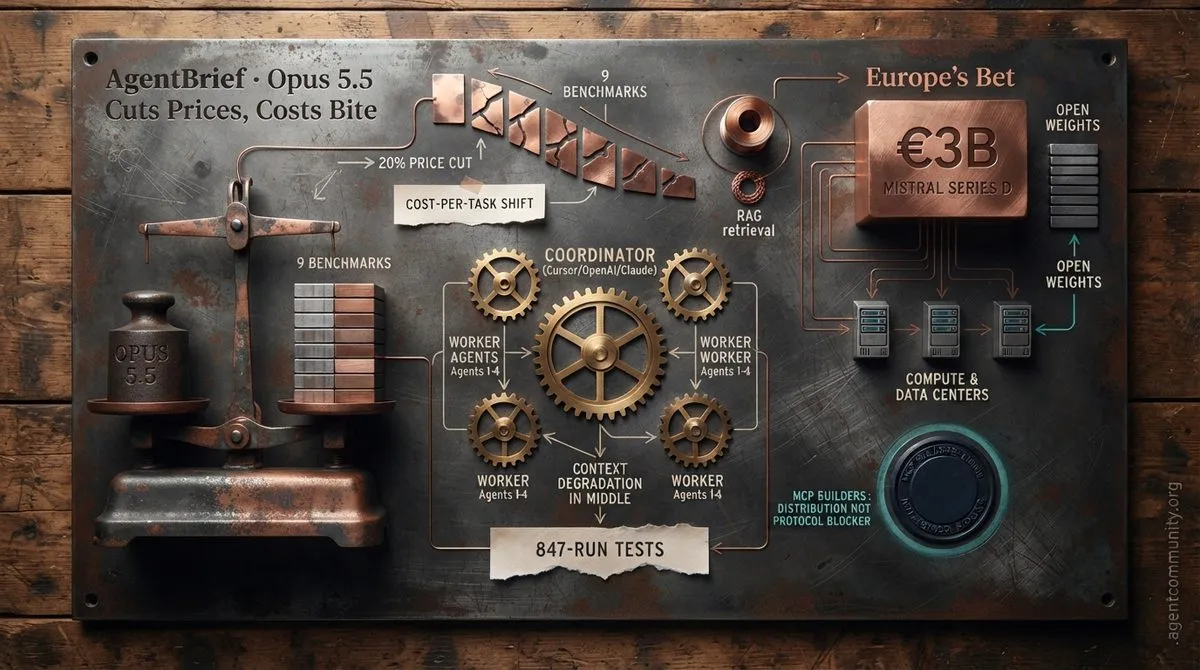
- Price War Opens Anthropic's Opus 5.5 claims a 20% price cut and wins on all nine benchmarks shown, shifting competition to cost-per-task.
- Coordinator Pattern Cursor, OpenAI and Claude all shipped coordinator-plus-workers layouts in one week, as 847-run tests show context degrading in the middle.
- Europe's Bet Mistral's €3B Series D, reportedly Europe's largest equity raise, funds compute and data centers; MCP builders cite distribution, not protocol, as the blocker.
X Recap
Mistral closed a €3B Series D led by Samsung at a post-money valuation north of €21 billion ($24B) — reportedly the largest equity round ever raised by a European tech company.
Mistral's €3B round, reportedly Europe's largest equity raise, funds training and inference compute plus its own data centers, with Samsung leading — a signal that memory and infrastructure players see agentic workloads as the demand driver. Alongside it, the Navier-Stokes authorship dispute has made agent session data governance a live builder question.
Mistral Raises €3B to Sell Open Weights — and the Compute to Run Them
Mistral closed a €3B Series D at a post-money valuation north of €21 billion ($24B), doubling its valuation in a year and marking what is reportedly the largest equity round ever raised by a European tech company, per @MistralAI and @MTSlive. The round was led by Samsung, with EQT's Scaleup Europe Fund and PSG Equity co-leading, plus continued backing from ASML, NVIDIA, and BNP Paribas CIB. CEO Arthur Mensch said the capital goes toward training and inference compute, including its own data centers — a stated bet on "open and sovereign AI" as the technology frontier @arthurmensch.
The agentic angle is what Mistral is selling alongside the models: open-weight releases plus the infrastructure to run them, framed explicitly by the company as "frontier performance without the lock-in" @MistralAI. Independent observers echo that thesis rather than the model-size story. @Z3nlyte notes "the pitch is not the biggest model, it is open weights + private compute," while @conradlotz highlights capital earmarked for frontier research and compute. @mark_k adds that Mistral wants companies and governments to control their models, data, and compute instead of locking everything inside someone else's proprietary cloud, and @christianmiele frames the full-stack play bluntly: "sovereignty in AI isn't about where you train a model. It's about owning the full stack: the models, the inference, the data and the compute."
For agent builders, the practical read is procurement optionality. A well-funded European counterweight shipping open weights alongside sovereign deployment is a hedge against routing every agent turn through US closed APIs — and Samsung's lead position suggests memory and infrastructure vendors, not just software funds, now treat agentic workloads as the demand driver. The compute allocation narrative is the thing to track: Mensch told @CNBC the funds target infrastructure buildout rather than pure model R&D, and @CNBC confirms the $24B valuation. If that spend lands on inference capacity, it directly affects the price and availability of open-model agent backends in Europe.
What hasn't surfaced yet: public builder anecdotes on measurable lock-in reduction, or concrete pricing and availability impacts for agent workloads. Treat the sovereignty pitch as a stated strategy, not a demonstrated cost curve, until those numbers appear.
Navier-Stokes Fight Turns Agent Sessions Into a Data-Governance Problem
A messy dispute over whether OpenAI models solved a Millennium Prize problem has become the agent ecosystem's first real argument about session data ownership and agent-assisted research credit. The thread: mathematicians Tristan Buckmaster and Levent Alpöge worked for months with AI tools on Navier-Stokes existence and smoothness, and OpenAI may now have a full solution using the same direction — with accusations that the lab tried to control communication of the result and drop Alpöge from authorship @Thom_Wolf. Terry Tao's writeup confirms Buckmaster and Alpöge "were well on the way" and that OpenAI appears to have a full solution with the same approach @EMostaque. The proofs themselves differ significantly — forced vs. unforced Euler cases @grok.
The counter-evidence matters as much as the allegation. OpenAI's official statement explicitly denies accessing any specific user data from Buckmaster or Alpöge and says the effort began after a public rumor, while acknowledging it "cannot rule out that de-identified data derived from their usage of our products helped improve our models" @OpenAI via @ben_vagle. Dan Sholto-Douglas pushed back hard, arguing it is "extremely unlikely that user data had any influence here" and warning people against concluding "your user data isn't safe in codex" @_sholtodouglas. On the other side, @teortaxesTex framed the implication as "all of your user's IP are belong to us."
For agent builders, the sharpest implication is that coding-agent sessions are now being argued about as surveilled IP. The reputational stakes are elevated either way: as @polynoamial noted, the week-long collaboration "worked out" but didn't finish the way they wanted, and @_sholtodouglas called it sad that this wasn't an example of labs cooperating. @EMostaque invoked Perelman's "no other recognition is needed" as the canon way to handle a solved prize problem — a pointed contrast to how this played out.
Expect procurement and legal teams to start asking harder questions about what happens to transcripts and intermediate reasoning traces from agent sessions. This is a preview of credit and data-governance fights that get messier as agents produce genuinely novel output — and no one has yet published a clean default policy for it.
Verification Layers Are Becoming First-Class Agent Infrastructure
A cluster of open-source patterns this week targets the most common production agent failure mode: not crashing loudly, but quietly stopping short. @DanKornas highlights unlazy, an agent skill that turns long engineering tasks into an "acceptance ledger" of named gates with checks, expected outputs, and evidence fields — re-running those checks before work counts as done. The underlying insight, per Kornas: "AI agents don't always fail loudly — they stop early."
Closely related is the move to separate an agent's proposal from its authority. @DanKornas describes Agent-Safe Pipeline, a TypeScript reference architecture that captures immutable intent, applies an ALLOW/ESCALATE/BLOCK policy verdict, and runs only approved actions through a trusted executor. The same theme shows up in capability-scoped runtimes: Astrid is a WebAssembly-capsule OS granting each component only the file, network, process, and tool authority it needs — "your agent shouldn't get filesystem access just because you gave it a prompt" @DanKornas. Builders are framing the durable fix as scoped, auditable delegation with clear principals, permissions, and revocation rather than blanket trust @M_Decoherence.
There's also a shift in how builders train their agents' instructions. @kunchenguid argues most people treat markdown instruction files as a forward pass only, and that real improvement requires "backward passes" — scanning transcripts, analyzing which rules led to good vs. bad outcomes, and rewriting the markdown accordingly. Combined with preflight tooling like roam-code, which indexes a repo into a SQLite code graph to surface blast radius and affected tests before an edit @DanKornas, the pattern is consistent: verification and authorization boundaries are hardening into first-class agent infrastructure.
Complementary signals point the same direction — builders defining "done" via outcome, constraints, acceptance tests, allowed side effects, and escalation conditions @brunocordista, and calls for thin isolates plus independent verification to scale trust @Sergey007S. Watch whether these stay scattered repos or converge into a shared vocabulary for agent acceptance criteria.
In Brief
Addy Osmani Joins Anthropic for Claude Code
Anthropic hired a DevTools legend to work on coding-agent ergonomics. Addy Osmani joined Anthropic on September 8, 2026 as Member of Technical Staff focused on Claude Code, with the explicit goal of making it better for developers who use it @addyosmani. His background leading Chrome DevTools, Lighthouse, and Core Web Vitals at Google positions the hire as a bet on practitioner experience and daily ergonomics rather than raw model intelligence — and it drew wide attention as a signal of how seriously Anthropic is investing in the developer experience around coding agents @agentcommunity_. For agent builders, the read is that the harness around the model — debugging surfaces, feedback loops, inspectability — is being treated as a competitive axis, not an afterthought.
Orchestrator-in-Chief Becomes the Default Project Shape
The top-level orchestrator delegating to specialized subagents has shifted from experimental pattern to default project shape. @agent_wrapper notes that @aoagents has shipped a "chief of staff agent" — called the orchestrator agent — with every project for seven months, while daily usage of Agent Orchestrator has 15xed in the last two months @agent_wrapper @agentcommunity_. The framing is explicit: the orchestrator is no longer a feature to wire up but the assumed architecture, with recent posts describing planner hierarchies that break goals into tasks, delegate to workers on isolated branches, and maintain a live Kanban view of status @Praveen_G07 @arpit_bhayani. If that's your default, your real engineering surface becomes delegation boundaries and branch isolation, not prompt wording.
Computer-Use Goes Native in a Chinese Flagship
Xiaomi has reportedly become the first China-based lab to ship full computer use — screen, keyboard, mouse, cross-app work — with record & replay for repeatable flows. The capability appears in its flagship model and MiMo Desktop beta, per @bookwormengr, with multiple accounts confirming it in the invite-only beta, including browser control, partial regeneration with versioned edits, and up to 99% in-session cache hit rates @agentcommunity_ @agentcommunity_ @XiaomiMiMo. For agent builders this removes the brittle automation stack most desktop and browser tools still require, turning human demonstrations directly into replayable workflows. The broader small-model trend continues alongside it: the top four trending models on Hugging Face were all under 30B parameters @MaziyarPanahi, while DeepSeek's V4-Flash-Vision releases reportedly cap at 20 concurrent requests versus 500 for Pro and 2,500 for Flash — a constraint that directly limits multi-agent fan-out @teortaxesTex @teortaxesTex.
Vector Search Tuning Map, and Markdown as a Neural Net
Two memory-and-context threads worth builder attention this week. First, @qdrant_engine published a practical vector-search tuning study across five public datasets, finding the right knob depends on where the problem is — increasing candidate depth from 10→500 improved the best achievable score by up to 0.28, a directly actionable result for anyone tuning RAG retrieval behind an agent where hnsw_ef, RRF k, quantization, and reranking all interact. @ChaitanyaK57 echoed the diagnostic split between retrieval miss and ranking burial, while @ChainZenit pushed back that extra tuning knobs add latency overhead. Second, a conceptual framing that's spreading: treat agent instruction markdown as a neural net — @kunchenguid argues executing the markdown is a forward pass and continuous improvement requires backward passes over transcripts, with @JadMadi calling it a paradigm shift and @nomadbanana0 asking where good-vs-bad outcomes are actually stored. The same practitioner described Grok bot memory management plus a SQLite DB for durable task tracking @kunchenguid, and @langfuse shared a case study where Langfuse cut a sleep-coach agent's memory issues in half — memory observability is now its own tooling category.
Prompt Hygiene and Model Trust Take a Beating
Theo spent the week documenting the gap between what models are told to do and what they actually do — a useful stress test for agent reliability expectations. He described telling a model to "revert" twice and having it randomly delete 22 unrelated lines of code, concluding "generally speaking I think models should do what they're told" @theo, then pushed back on the "your prompts must suck" defense: "If you haven't seen these behaviors I firmly believe you are not pushing these models anywhere near hard enough" @theo. His three-question rubric for agent output — did it do what I asked, did it do it well, did it do something incredibly stupid I didn't ask for — is a clean evaluation frame for anyone writing agent acceptance criteria @theo. Builders echoed the "prompt wider" framing as a practical lever, with multiple reports that giving agents more room to explore and verify their own work reduces back-and-forth loops and produces more autonomous results @theo @AIGryffindor @nkchandupatla — which cuts against the instinct to constrain prompts ever more tightly.
Quick Hits
Agent Frameworks & Orchestration
- Prime Agent crossed 20k GitHub stars, per @PrimeIntellect.
- model-compose: declarative YAML for serving chat APIs, RAG pipelines, agents, and MCP servers without glue code — @DanKornas.
- Awesome OpenClaw Skills is a curated GitHub index of community-built agent skills grouped by category — @DanKornas.
Tool Use & Function Calling
- Offload easy sub-tasks to a cheaper model via a skill to roughly double your usage limits — @sytelus.
- auth.md is purpose-built for agent authentication flows, with demo and docs linked — @grinich.
- Give agents observability APIs over MCP and let them drive their own monitoring — @RhysSullivan.
Memory & Context
- LLM Wiki builds personal knowledge bases from PDFs and web clips with multimodal ingestion and source traceability — @tom_doerr.
Multi-Agent Systems
- Each bot profile currently runs its own gateway process at ~300MB RAM, with better scaling coming — @Teknium.
- Nous Research is deliberately slowing feature work to make the existing stack rock solid first — @Teknium.
Agentic Infrastructure
- Disaster recovery plans rarely include the AI stack — a downed model, agent pipeline, or inference endpoint isn't covered — @AITECHio.
- While everyone feels the GPU crunch, "the CPU crunch is coming" — @dsp_.
- Projections cited show electricity demand growth jumping from ~2% CAGR to ~10% on AI demand — @davidsenra.
- ProxCenter: a unified web interface for managing Proxmox VE infrastructure as a VMware vCenter alternative — @tom_doerr.
- Cloudflare webinar on third/fourth-party SaaS blind spots, the bot and agent surge, and shrinking exploitation windows — @Cloudflare.
Models for Agents
- Astra designed an original Magic the Gathering deck and beat a bot on Arena — another informal nerd benchmark passed — @emollick.
- MiMo V3 flagged as another model to watch — @teortaxesTex.
- Astra isn't as capable as Fable 5.1 for full builds, requiring extra turns and double-checking — @bindureddy.
- Video editing with AI still needs hand-holding until models can read video frame by frame, which only Google models currently do — @MatthewBerman.
- Prediction: by 2027 models will replace many Playwright tests by crawling and using applications via desktop usage — @ThePrimeagen.
- Schmidhuber's argument that AGI is nowhere near, since no true self-improvement exists without self-improving physical hardware — @SchmidhuberAI.
Developer Experience
- Rejecting the "use AI or you are ngmi" framing: better systems understanding pays off as usage patterns shift rapidly — @ThePrimeagen.
- The worry about losing architectural judgment — knowing what a solution should look like — @ThePrimeagen.
- Connecting an agent to a telescope improved interactions: obstruction checks, website updates, target recommendations, and capture settings handled autonomously — @RhysSullivan.
- AWS re:Invent packs 2,200+ sessions with 70% hands-on and 40+ 500-level sessions — @aakashgupta.
- Reminder: the GPT-5/6 prediction predated ChatGPT by 27 months, when GPT-3 was API-only — @aakashgupta.
Industry & Ecosystem
- Build with a vision that assumes orders-of-magnitude more capability and token volume — @levie.
- Replit opened its first international office in London with Mayor Sadiq Khan — @amasad.
- TSMC and Samsung committing to ASML's newest chipmaking tools as AI drives demand — @CNBC.
- China's exports surging as demand for high-tech and AI props up growth — @Reuters.
- Malaysian data centres guzzling more power as temperatures soar — @Reuters.
- The recurring AGI predictions that never materialized, from GPT-5 to o3 to GPT-6 — @GaryMarcus.
- AI as augmentation of human intelligence, not an alien intelligence with its own will — @pmddomingos.
- Prediction that we'll look back in disbelief at all the money poured into "single-player-mode AI" — @andrewdsouza.
- Apex's automated AI research loop: find, test, verify, feed the gain forward across scaling, training, and GPU kernels — @hasantoxr.
- Open question on how ownership of LLM-generated output will shake out amid the current drama — @RhysSullivan.
Research & Benchmarks
- Skeptical summary of the OpenAI claim as offering coauthorship for "your choice of Codex" — @teortaxesTex.
- Contrarian bet that Yang-Mills existence and mass gap is the next Millennium Prize problem to fall — @EMostaque.
- A classification result filtering compact Lie algebras by chirality and anomaly cancellation, uniquely yielding the Standard Model gauge algebra — @EMostaque.
- Mocking "software engineering is solved" claims from people running two nines of availability — @vikhyatk.
Reddit Roundup
Three vendors shipped the same multi-agent shape in one week — and a developer's 847-run test shows why the context underneath it degrades.
Cursor, OpenAI and Claude all shipped coordinator-plus-workers agent layouts within a week, while a developer's 847-run measurement and the "Lost in the Middle" research show long contexts degrading in the middle. Anthropic's Opus 5.5 cut prices, and MCP builders report distribution, not the protocol, as the blocker.
Coordinator fleets are a category now r/AI_Agents
Cursor Projects, the OpenAI Agents API, and Claude Code Projects all landed within roughly a week — between September 10 and 17, 2026 — each shipping the same shape: a coordinator, parallel workers, shared memory, and a cloud-resident session (jigarjoshi.in, u/omidfarhang). u/omidfarhang argues three companies shipping that layout at once means it's a category, not a coincidence — and that the launch numbers (thousands of subagents, prettier merge rates) describe a demo, while the hard part is the review job, which did not change. Cursor's Projects "brings a structural upgrade to agentic development: one coordinator orchestrates thousands of coding agents over weeks or months," running "in the cloud by default for parallelism" with a shared context layer that "accumulates artifacts, architecture notes, and team preferences so newcomers — human or agent — start with institutional knowledge rather than a blank slate" (NexusAi). The coordinator's defining property is that it delegates rather than executes — "because it delegates rather than executes, it is never blocked and is always responsive to direc[t]" (eesel AI).
Cursor's productivity claims are, notably, unaudited: "new users merge 30% more PRs, and users who lean primarily on Projects merge six times as many," but "the post publishes no baseline, cohort size, or time window for either number" (AI Weekly) — the same demo-vs-production gap u/omidfarhang flags. A parallel thread raises the governance question: when Agent A spawns Agent B, who owns the authority? u/Fantastic-Sleep-3352 asks whose authority is actually in play when a parent agent delegates to children that modify repos and open PRs. That question is sharper than it looks, because the three launches differ in exactly the dimension that determines the answer — how much orchestration is persistent versus per-session. Claude Code's subagents and hooks "let you fan out research or parallel edits from one session, but orchestration is per-session and scripted, not a persistent coordinator," while Cowork remote sessions (beta, Max plans first, September 2026) "keep tasks running server-side with state synced across desktop and mobile" (andrew.ooo).
This is the core multi-agent orchestration story of the week — and the open question worth flagging is the one that has dogged every multi-agent claim in recent coverage: none of the three launches published an audited baseline for the productivity numbers, so the coordinator-fleet category is currently defined by architecture, not by verified outcomes.
Context windows have a dead zone r/LocalLLaMA
A developer tracked 847 agent runs and measured instruction-following accuracy collapsing from ~94% to 41% as the context filled. u/Unique-Werewolf-2784 frames it as the context around the agent degrading, not the model itself — an intuition that matches published research: the Stanford/University of Washington "Lost in the Middle" line of work found LLMs exhibit a U-shaped performance curve on long contexts, where accuracy is highest when relevant information sits at the beginning or end and "degrades significantly when models must access relevant information in the middle of long contexts, even for explicitly long-context models" (ACL Anthology / TACL, Arize). The failure has a name in the practitioner literature — Context Degradation Syndrome (CDS), the "gradual breakdown in coherence and utility that occurs during long-running conversations" (James Howard). The practical fix is to curate position: place critical instructions at the start or end, retrieve selectively, and compress or evict the middle before it becomes a dead zone (Maxim AI). The honest caveat: a contrarian read argues the drop is real but "not always in a catastrophic way" (Medium / Social Scholarly), and the 847-run, 94%→41% figures remain a single developer's tracked measurement, not an independently replicated benchmark.
Opus 5.5 lands with a price cut — and builders shrug r/ClaudeCode
Anthropic released Claude Opus 5.5 on September 22, 2026, at $4 per million input tokens and $20 per million output tokens — down 20% from Opus 5, with cache reads falling to $0.20 per million. Anthropic frames the real savings closer to 40%, because Opus 5.5 uses fewer tokens per task and generates output more than 30% faster (Analytics Vidhya, Latent Space). The vendor's agentic-coding framing is specific: at its default effort level on FrontierCode it "beats GPT-6 Astra at roughly 20% of the cost per task," and on CursorBench it "beats GPT-5.6 Sol by 11 points for about a third of the cost" (Anthropic). Independent write-ups confirm the directional claim — Cosmic states it "scores higher than Opus 5 on every benchmark Anthropic published for both models" (Cosmic) — but the headline 80% cheaper than GPT-6 Astra framing circulating on Reddit is a per-task cost comparison at default effort, not a sticker-price comparison. Yet the loudest community reaction is apathy: u/ByteSize_Chaos says they're now more excited about harnesses and workflows than raw model drops. The counterpoints are cost-per-task and behavior: u/RFOK argues Opus 5.5 is roughly twice as expensive as GPT-6 Sol per task despite cutting output tokens ~19%, and u/Circadian07 reports it refusing to touch their research files. On the day of release, these are published results and early claims, not hands-on coding tests (Eric Tech).
MCP servers can't clear enterprise IT r/mcp
The MCP ecosystem shipped dozens of new servers this week, but distribution is the bottleneck and security is the top adoption barrier. u/sartomiki built an MCP server and found Claude's official directory requires a Team org account with a 2-seat minimum (~40 euros/month), and a submission took 3 months only to be told the process changed. That maps onto the macro data: MCP adoption surveys put security concerns and requirements as the top barrier, followed by implementation cost, legacy integration complexity, training, and business-value proof (Digital Applied). The scale on the other side of the gate is real — over 97 million MCP SDK downloads per month and 10,000+ active public MCP servers, with unofficial directories indexing 17,000+ (Synvestable). Checkmarx frames the exposure structurally: because the ecosystem "depends on a distributed and interconnected supply chain of tools, servers, and dependencies hosted across registries such as npm, PyPI, GitHub, and others," every component "directly influences the trustworthiness of the entire environment" (Checkmarx). The institutional response has escalated: the NSA published MCP security design considerations in May 2026, and CoSAI has a draft MCP security workstream (NSA, CoSAI). Caveats: the download, server and vendor-projection figures are vendor-, directory- or analyst-reported, and the CoSAI document is explicitly marked "Draft."
Self-grading agents can't be trusted r/AI_Agents
Agents that grade their own work always pass — the grader is now the component under test. u/Acceptable_Stress154 runs a program that writes code, tests it, and reports progress, but every number comes from machinery the program itself built, so improvement claims are unverifiable; u/Chance-Pen-5684 asks how to check AI-written code when a second model just leads you down the garden path. The practitioner literature frames the split structurally — agent evals differ from single-turn LLM benchmarks precisely because they "involve interacting with tools" (Deep (Learning) Focus). The week's tooling news sharpens the point: Promptfoo "has agreed to be acquired by OpenAI" as of a March 2026 announcement, reportedly staying open source but "no longer independent," and OpenAI's Agent Builder and hosted Evals product are scheduled to leave the platform on November 30, read-only from October 31 (Augment Code, QASkills.sh). Meanwhile u/Short_Regular_7191 ran a controlled 5-model coding test with secret tests and hand grading — Opus 5.5 first, Fable 5.1 second — finding the differentiator was behavior on weird inputs, not the happy path. The working pattern that survives: independent, externally held verification.
GPT-6 Sol and Luna draw regression reports r/OpenAI
OpenAI's newly rolled-out models are drawing sharp regression reports from builders. u/skilliard7 A/B tested Luna 6 against Luna 5.6 on an agentic reporting tool and found Luna 6 a "massive downgrade" — missing crucial details on every eval despite being 50% cheaper. u/banaxi-tech reports GPT 6 Sol scoring 68.8% on DeepSWE versus GPT 5.6 Max's 72.7%, and multiple users report Sol being "skill-lazy" and degraded in web chat (u/Aber-so-richtig, u/C_then_B). That runs against OpenAI's own framing: in a September 22, 2026 post the company said "GPT‑6 Sol and Luna build on Astra's advances in alignment, showing improvements over their GPT-5.6 counterparts" (@OpenAI). The rollout is also hard to pin down — a September 20, 2026 check of OpenAI's public model catalog found no entry for GPT-6 Sol, with the caveat that this "does not rule out a private test or account-specific rollout" (evolink.ai). The honest caveat on all the regression numbers: the DeepSWE scores, the "50% cheaper" figure, and the skill-laziness reports are builder-reported from individual Reddit threads, not vendor-confirmed or independently replicated.
Agents paying agents via escrow r/AI_Agents
Agent-to-agent commerce is moving to live transactions, and the first escrow primitive is on the board. u/EveryEmphasis742 shipped Laniakea, an escrow protocol for agent-to-agent task payments — funds lock, release on completion, refund on timeout, seller bond slashed if they hang — and confirmed the first end-to-end transaction with conservation verified. u/Timwal123 wrote a plain explainer of x402, which reuses HTTP 402 so agents can pay for APIs per-request in crypto (usually USDC). The protocol layer is splitting into competing philosophies: x402 fires a payment per individual request while Stripe and Tempo's Machine Payments Protocol (MPP), launched March 18, 2026, opens a session with a pre-authorized spending limit streamed in stablecoins and fiat, and governance differs — x402 sits under a neutral x402 Foundation, MPP is Stripe-proprietary (Crossmint, Digital Applied). Google's AP2, announced in late 2025 with backing from over 60 organizations, builds a signed Intent Mandate → Cart Mandate chain, and the A2A x402 extension, co-developed with Coinbase and MetaMask, lets AP2-authorized agents settle via x402 (Fystack). Escrow is the missing middle neither spec owns natively. Caveats: Laniakea's first transaction is builder-reported, Synmerco's $1K shield is vendor-described, and Crossmint's own framing — one API surface to "support every AI payment protocol" — is an admission no protocol has won yet (Crossmint).
1T model on four Mac Studios r/LocalLLM
Apple demoed Kimi K2.6, a 1T parameter open-weight model, running across four Mac Studios drawing from a single wall outlet, clustered via Thunderbolt 5 + RDMA, per Reuters coverage (u/UNO10100f). It lands on a strained supply story — Apple has warned Mac mini and Mac Studio shortages could last for months as the local-AI boom and a memory crunch push demand past manufacturing capacity (Yahoo Finance / Tom's Hardware). Hands-on coverage of a 512GB Mac Studio running Kimi K2 Thinking shows the practical ceiling: tuning wired-memory allocation and closing other apps to land around 488 GB of inference memory (YouTube). The software half may be the bigger unlock: Hugging Face announced native GGUF support in transformers, letting you load llama.cpp quants directly through AutoModelForCausalLM (u/Disastrous-Work-1632), collapsing two previously separate serving paths. The caveat: unified memory is not upgradeable — "buy the most you can afford" (StarMorph).
Context GC and eviction strategies r/LLMDevs
Managing what stays in the prompt is now a named discipline, and the builder answer is eviction. Atlan draws the line between two conflated concerns: "Memory management is a persistence concern... context management determines what it actually uses in this inference pass" (Atlan). u/Maleficent_College57 built jev-gc, a Python library that decides mid-run what stays in the next prompt and what gets evicted — failed API calls, wrong-directory listings, irrelevant chunks (builder-reported; not independently benchmarked). The published taxonomy maps to roughly five families with explicit tradeoffs, from sliding-window approaches that "drop the oldest messages" with core instructions "locked" at the top, through summarization, retrieval-augmented context, hierarchical context, and explicit state checkpointing (MachineLearningMastery). LangChain's Deep Agents writeup positions managed context as part of the harness rather than something the model does for itself (LangChain). The honest caveat: eviction quality is measured by whether the dropped item mattered, and none of the retrieved sources quantify that — the metrics on offer measure cost, not whether the agent lost a constraint it needed.
Typed decision models go local r/LocalLLaMA
A cluster of "typed decision model" projects appeared this week — Jev and its open/local variants — turning LLM calls into structured yes/no/choice/score decisions with confidence scores instead of free text. u/telltaleatheist built a local version on Qwen 3.5:9B by cutting decoding and returning softmax probabilities as JSON, hitting 100ms speeds. u/Inevitable-Log5414 shipped stuntd, a local Jev-compatible proxy that trains a small head on Laya and switches to live only when it matches the provider. u/KingPinX benchmarked Semif vs Von vs Jev on real git history rather than trusting README scores, and a critical review questions TypeSafe's banking example skipping confirmation above 0.85 confidence (u/Agentvideobot).
Builders of the engine say brake r/ChatGPT
A coalition of AI workers is publicly calling for a slowdown, and OpenAI says it helped shape the petition's language. Axios reports 1,200 AI workers signed the call, and CEO Sam Altman said he had discussed "the need to slow AI development with White House officials as models grow more powerful," adding that OpenAI "helped shape the petition's language" (Axios). The framing is conditional rather than absolutist: OpenAI's Chris Lehane wrote the industry "will advocate for compatible international approaches... determining when and how development should slow or stop, even if that means slowing the advancement of model capabilities" (ABC News). It lands alongside OpenAI's announcement that an unreleased model solved over 100 long-standing open problems in mathematics after just 24 days of training (u/Confident_Salt_8108). The coalition is not unanimous: ABC News leads with "divisions," and earlier in 2026 the US government invoked national security to block releases from Anthropic and OpenAI, both of which voluntarily complied until the orders were reversed (The Straits Times). The viral post's counts — 25 Fields Medalists, 40+ Royal Society Fellows — were not independently confirmed in this pass; the 1,200 signatories figure is corroborated by Axios.
Discord Digest
Anthropic's Opus 5.5 ships with a 20% price cut and Fable-beating benchmark claims — while GPT 6 and Grok 4.7 face a reckoning on cost-per-task.
Anthropic's Opus 5.5 launched September 22 with a 20% price cut and benchmark tables showing it beating Fable 5.1 across all nine tests shown, per Anthropic. Builders are cautiously bullish after the widely-panned Opus 5. The implication: the competitive fight is shifting from raw capability to cost-per-task and reasoning-token efficiency, a metric where Grok 4.7 is now measurably losing.
Opus 5.5 Lands With a 20% Price Cut — and Builders Call It the Real Deal
Anthropic shipped Opus 5.5 on September 22, 2026, the first model in the new Claude 5.5 family and, per Anthropic, "the first release since we called for pacing the frontier." It was tested before launch by external evaluators including Frontier Design and METR. The reception across Cursor, Perplexity, and LMArena is surprisingly bullish after the widely-panned Opus 5. kalhoty. announced "Opus 5.5 is Out, lol," while ssj102 said it "seems like real deal...not surprising they went from version numbering 5 to 5.5." hana.ai rates it "better than Astra in pure-coding in my opinion."
The published numbers give that instinct a spine. The release "outpaces the larger Fable model in many benchmarks" (TechCrunch), and Anthropic's own table has Opus 5.5 beating Fable 5.1 across all nine tests shown and beating GPT-6 Astra on four of the six where both have a score (Anthropic). Gains land on agentic coding — Terminal-Bench 4.0, FrontierCode v1.1 Main, and CursorBench 4.0 — plus knowledge work and reasoning on Humanity's Last Exam (VentureBeat). jeremjh tempers the enthusiasm, noting "Opus 5 was not usable" and Astra "isn't that huge of a leap forward."
Pricing is the story builders keep circling back to. API rates drop to $4 per million input tokens and $20 per million output — 20% below Opus 5's $5/$25 — with cache reads cut to $0.20 from $0.50 (Cosmic JS). Against Fable 5.1's $10/$50, that's a 60% cheaper API price (VentureBeat). Anthropic claims Opus 5.5 is "more than 30% faster than Opus 5 and costs 40% less on typical workloads" — with the caveat that the second half is workload-dependent (Coursiv). One reliability flag worth watching: epe515 reported a blank-output bug across 4 prompts, though no independent source confirmed it. And Anthropic's safety classifiers can silently reroute requests to a different model (daily.dev) — meaning a "blank" or off-model response may not come from Opus 5.5 at all. The benchmark tables are Anthropic-supplied, and community verdicts are days old.
Join the discussion: discord.gg/lmarena
GPT 6 Family Cuts Prices 50%, Regresses On Some Benches
OpenAI's GPT 6 family (Luna, Sol, Astra) is landing as a price-cut generation with mixed benchmark movement. arata_kasuga_2004 sums it up: the models are "more or less performing the same as GPT 5.6 Luna with a price cut," and crucially "both the OpenAI models show regressions in some benchmarks relative to the predecessor. If not for the price cut it would have been a grok moment." The pricing backs the headline: Sol lands at $2/M input and $10 output, Luna at $0.10 and $0.50 — roughly 50% below predecessors, both with a 1.05M-token context window (Coursiv). But the tier inversion matters: top-end Astra is priced at $10/M input and $50/M output — 2.5x GPT-5.6 Sol (LinkedIn News), so "GPT 6 is cheaper" is true for Sol/Luna and false for Astra. steezyrider found a subscription trap: "Token/per intelligence costs for Astra low and Sol high are equal, but... cost under sub is like 5x for Astra low vs Sol high." The strongest third-party corroboration for the "lower effort, same or better result" thesis: on HealthBench Professional, "Astra at lowest reasoning effort surpasses GPT-5.6 Sol's best score at about half the cost" (Latent Space) — vendor-adjacent, treat accordingly.
Join the discussion: discord.gg/lmarena
Grok 4.7 Burns 3x Reasoning Tokens, Underwhelms
Grok 4.7 is taking heat for token inefficiency, and the blow-up is now confirmed by independent benchmarking. hudsong0 measured that "Grok 4.7 xhigh uses more than 3.1x the reasoning tokens than Grok 4.6 high" — a brutal multiplier for agentic loops where reasoning tokens dominate spend — and concluded "Tbh, 4.7 was disappointing." Artificial Analysis corroborates: Grok 4.7 (xhigh) uses roughly 81k output tokens per Intelligence Index task, versus 36k for Grok 4.6 (high) and 27k for GPT-6 Astra (max) — 125% and 196% more (Artificial Analysis). VentureBeat translates to dollars: about $3.74 per task for xHigh and $2.73 for High, against ~$1.99 for GPT-5.6 Sol Max — so "high token consumption threatens real-world ROI" even though list pricing is unchanged (VentureBeat). Note most comparisons pit xHigh against High, inflating the gap (Coursiv). The competitive framing is stark: broken.wind says "Opus 5.5 and GPT 6 Sol release is brutal to Grok 4.7." tugg_ offers the nuance: 4.7 is "a little bit safer, a bit less inclined to do dangerous things" — good for agents, annoying for people who want leaps of reasoning.
Join the discussion: discord.gg/cursor
Builders Swap Harnesses, Warn Against Single-Model Lock-In
A growing contingent of local builders is decoupling models from harnesses, and head-to-head data supports the instinct. In one 25-task benchmark, Oh My Pi passed 22/25 (88%) at $0.52 per success, while Claude Code passed 19/25 (76%) at $1.96 per success (Composio). steezyrider advises: "Don't use Codex, use Pi, and just let it orchestrate. You get frontier inference, saves you extra runs on both ends." But swapping models under a closed harness is fragile — .plunder hit friction when a Claude update "basically bricks their harness to it and hard codes telemetry," and a practitioner teardown reports Claude Code "is injecting too many system prompts into context... absolutely nuking token usage" (Paul Cullen Rowe). Treat the Composio numbers as one benchmark's figures — task mix and harness configuration drive the spread — but the direction is consistent: model-agnostic harnesses are competitive on both pass rate and cost.
Join the discussion: discord.gg/huggingface
Qwen3.8 Flash Next Runs Locally, Quants And Flags Debated
The LocalLLM channel is deep in the weeds on running Qwen3.8 Flash Next, the model veldierin says "powers qwen's and deepseek's latest models." iwaku is running IQ2_XS quants at 32GB with a tuned llama-server invocation, hitting "276 tok/s" after tweaking -b 2048 -ub 2048, though prompt processing stayed painful at "6 minutes for this prompt processing" on a 43k-token article. The quant ladder explains why 32GB is tight: Unsloth's guide lists Qwen3.8-Flash-Next from 1-bit at 75GB up to BF16 at 355GB, with a warning to keep 1-2GB headroom for MTP (Unsloth). MTP is the thread's central gotcha — iwaku hit "context type MTP requested but model doesn't contain MTP layers," and kissaikoyou explains GSQ-RCO quants are slow because "they have to retrain mtp." On Apple silicon the engine choice swings results hard: an M5 Max with 128GB unified memory measured 60 TPS on MLX/oMLX versus 30 TPS on GGUF with llama.cpp — a 2x gap on the same model (Execute Automation, YouTube). The takeaway for 32GB VRAM builders: aggressive low-bit quant, accept prefill pain, and don't count on MTP until your quant's MTP head is trained.
Join the discussion: discord.gg/huggingface
Builders Debate Whether 'Neural' Memory Graphs Are Real
A spirited debate broke out over agent memory built on knowledge graphs and markdown files. steezyrider pushed back on grand claims: "I'm not saying building a graph is bad, I'm also building graphs, but let's just call it for what it is?" xp_12__66774 demanded proof: "show me it storing a memory and then retrieving it." The published guidance is that vectors and graphs solve different problems — "Vectors give you recall. Graphs give you context," and "you can't answer 'what changed between Q1 and Q3' without a structure that explicitly models time" (akkonrad, Medium). The emerging consensus is hybrid, with Neo4j's agent-memory library shipping "all three memory types with the graph modeling, vector indexing, and query optimization handled for you" (Neo4j). The practical concern is whether markdown-file memory scales — .plunder reported a session with "30k+ nodes and 171k edges," while steezyrider flagged the missing indexing: "its pretty slow to run on a large wad of files." One broader warning: "Clankers like to explain goals and intents as if they were current state" — don't trust an agent's self-reported memory without verification.
Join the discussion: discord.gg/huggingface
Agents Start Launching Browsers To Check Their Own Work
A pattern worth watching: agents verifying their own output with tools. theunknownmuncher "set up a whole test harness that iterated through different parts of an application while automatically taking screenshots... so that it could check it visually." steezyrider watched an agent "compiling a readme... it launched a browser to check the rendering of the diagrams," calling it "absolutely apeshit." The tooling market is formalizing it — SmartUI is described as "an AI visual testing agent" that detects UI changes by comparing screenshots (TestMu AI). A 2026 teardown calls the unverified agent "the defining failure mode of production agentic systems" and argues "the fix isn't a better base model. It's a verification layer" — noting a smaller dedicated verifier model "consistently outperforms" self-checking (Towards AI). A June 2026 "Self-Harness" proposal claims to "improve Terminal-Bench-2.0 pass rates by 20+ percentage points across MiniMax, Qwen, and GLM" — proposer-reported, not independently replicated. The design lesson: verification tooling is what turns a code generator into a reliable agent.
Join the discussion: discord.gg/huggingface
Quick Hits
- Cursor token budgets are eye-watering: rata_ionut reports ~"225M tokens per day on average" over 20 days and "4.5B tokens for a 92% usage" on Ultra; Cursor's context window defaults range 128k–300k tokens, reaching up to 1M with extended context (fast.io).
- LMArena platform friction: users flag slow responses and recaptcha, while critics argue the arena is "completely open to the internet, based on 'gamified work by unconsenting' users" (trendingtopics.eu); it hit a $1.7B valuation four months after launching its product (Yahoo Finance).
- Qwen 4 buzz outpaces the record: kissaikoyou says "qwen 4 is mere weeks away," but "Alibaba has not announced a Qwen 4 model or a date" (coursiv.io); the current Qwen3.8-27B (Apache 2.0) fits in ~17GB RAM (Admix).
- Adversarial audits go multi-turn: kerunix published a crescendo attack using a rolling context window on Gemma 4; OWASP's ASI 2026 targets agentic apps and the EU AI Act mandates adversarial robustness testing by August 2026 (Galileo).
- n8n + WhatsApp Cloud API: the token/webhook/verification-token triad is the standard integration surface; production needs a system-user token and a publicly accessible HTTPS URL (CrewClaw).