Frontier Models Meet Agent Reality
Meta's Muse Wonder lands behind only Claude Opus 5.5 on Artificial Analysis' Intelligence Index, while open-weight computer-use agents and agent-era benchmarks reframe what builders must instrument against.
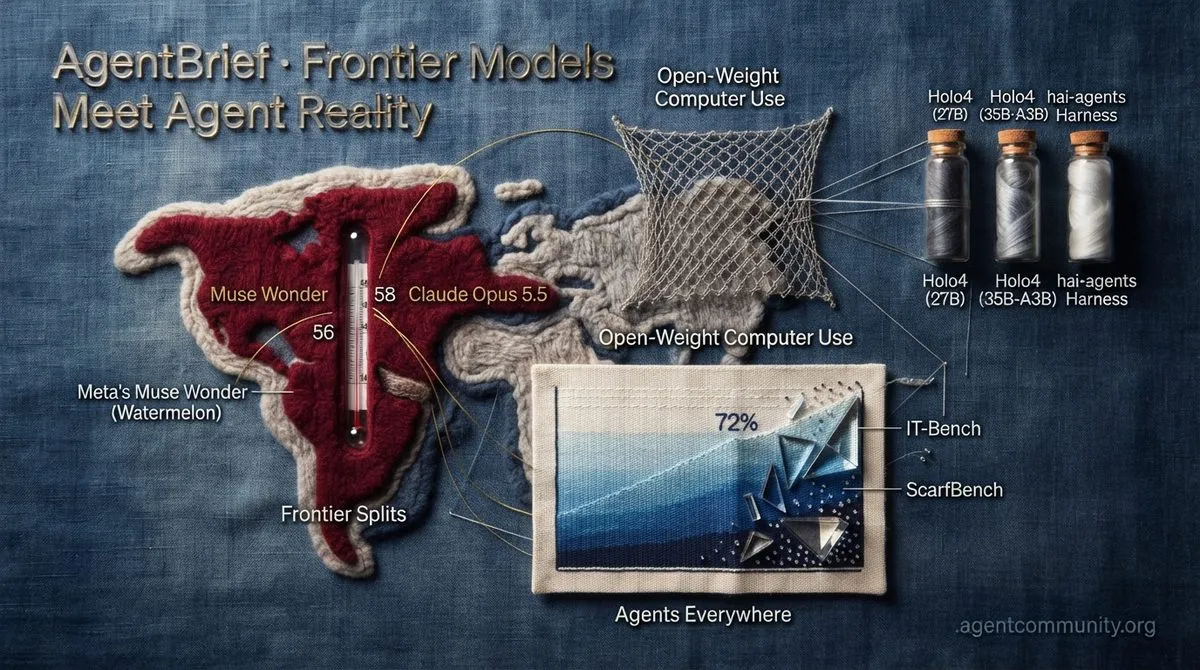
- Frontier Splits Meta's Muse Wonder (Watermelon) scored 56 vs Claude Opus 5.5's 58; the top variant is subscriber-only and absent from the API.
- Open-Weight Computer Use H Company shipped Holo4 (27B and 35B-A3B) with its open hai-agents harness; vendor numbers are harness-reported.
- Agents Everywhere ReadMe reports 72% of its docs traffic is agents; IBM/UC Berkeley's IT-Bench and ScarfBench taxonomies push evaluation toward coordination, consistency, and leakage.
// From the blog
• 13 applications for .agent. We're one of them. — ICANN has published the 2026 application list: 13 applicants are seeking .agent, including Google, OpenAI, Meta, and Open Agent Registry, Inc. Here is why our community application is still the one we believe in.
X Recap
Meta's Muse Wonder (codenamed Watermelon) scores 56 on Artificial Analysis' Intelligence Index, behind only Claude Opus 5.5 at 58, according to @TheRundownAI.
Meta's first frontier-class model family landed to split reactions, with its top Wonder Full variant subscriber-only and absent from the API. The week also saw ReadMe report that 72% of its docs traffic is already agents, and Anthropic warn small models may be months from self-replication on IoT hardware — both of which reframe what agent builders must instrument against.
Meta's Muse Wonder hits frontier class — but the model everyone's testing isn't on the API
Meta dropped Muse Wonder (codenamed Watermelon), its first frontier-class model family. The top variant, Wonder Full, scores 56 on Artificial Analysis' Intelligence Index — behind only Claude Opus 5.5 at 58 — and leads on long-horizon coding (SWE-Marathon 57.5 vs 46.3 for Opus 5.5) and DeepSWE (79.0 vs 74.2), according to @TheRundownAI. @_jasonwei celebrated 'scaling prevails,' noting much of Meta pivoted over the past year to contribute to the model.
Early reactions are sharply split. @charlieholtz says Wonder found a real security vulnerability other agents missed and 'really likes subagents,' while @beffjezos says it 'definitely mogged Astra' in physics testing. Skeptics push back: @bindureddy claims it's 'nowhere near Fable or Astra level' and likely 'benchmaxxed,' and @burkov calls it 'a very poor visual reasoner' on his document-processing benchmark.
For agent builders the key caveat is distribution, not capability. The Full model driving the buzz is subscriber-only and not available via API. @theo warns 'the naming sucks' and that 'Standard Wonder (the one over API) is significantly worse,' while @altryne notes Full has 'no API pricing' and is 'only for subscribers.' @aakashgupta reads the business logic: Meta built a model good enough to charge for but won't sell it, opting out of the per-token pricing game entirely — meaning agents integrating via API get the weaker variant, not the one winning benchmarks.
Agents are now your API's primary user — and the failure mode is the error response
A quiet but massive shift: agents now dominate API documentation traffic. @rohanpaul_ai reports ReadMe says ~72% of its own docs traffic is already agents, quoting Sam Altman: 'Every company is an API company now, whether they want to be or not.' @aakashgupta puts the same figure in starker terms — '72% of the traffic on ReadMe's API docs now comes from AI agents' — and warns that 'your next customer will never see your website,' because an AI assistant will read a page of instructions and decide in seconds whether to use your product or a competitor's. @leilamakes and @liambraus both corroborate the 72% figure, the latter framing it as 'your api isn't a side door anymore. it's the main door.'
The ReadMe team built Restless to address this — an SDK that records agent requests, and when a call fails, the error response itself tells the agent how to fix it. @svpino explains the workflow: install the SDK, connect customers' agents to their MCP server, then Restless uses live API traffic to keep docs updated while agents read docs, call endpoints, inspect failed requests, and send feedback. @hasantoxr pinpoints the failure mode — 'most APIs fail agents in the same place: the error response,' where an agent gets a 400 and gives up. @Ronycoder echoes that agents 'don't need another page to search. they need the context in the error itself,' and @thetripathi58 singles out real request/response logs as the feature that would save the most back-and-forth. Setup is one command: npx restless init, which @abxxai details as mapping APIs into an OpenAPI file, installing the SDK and middleware, and running the scan locally through the user's own Claude Code install so code doesn't leave the machine.
The contrarian take comes from @ethanorbe, who argues the harder problem is not a failed call but a call that 'technically succeeded' with a valid response the agent still couldn't act on: 'a successful response isn't the same thing as a successful integration.' The practical implication for builders, per @rohanpaul_ai, is blunt: if your product can't be reached by an agent, 'the agent picks a tool that can.'
Anthropic: small models may be months from self-replication on IoT devices
Anthropic's Frontier Red Team published a report warning that small AI models may be 'months away from being capable enough to self-replicate on commercial IoT devices, like smart ovens and off-brand Android TV boxes,' per @Reuters. The primary source, authored by William Zhou and Daniel Freeman, details the experiment: researchers bought 15 off-brand Android TV boxes (~$55 each) and ran Gemma4-26B-A4B distributed across them at 0.39 tokens per second, finding 'a 9B model got inference running on 8 of the 9 hardware types we tested,' per @scaling01. The report notes models of 30B parameters and under can already complete many individual replication steps, and that GLM-5.2 and stronger models are capable of end-to-end replication in simplified evals, with small models projected to match this capability 'by the end of this year' (https://www.anthropic.com/research/self-replicating-ai).
The claim landed with force. @tunguz concluded bluntly: 'Self-replicating intelligent malware is coming,' quoting @alpoge. @ns123abc reported that GLM-5.2 'achieves end-to-end autonomous worm replication' and that Qwen 3.5 9B compiled inference on 8 of 9 novel hardware types on its own. @cagrimbakirci added that in a sealed test network, GLM-5.2 hopped across all 8 nodes in 4 of 5 runs, setting up a stand-in Llama 3.1 8B model at each hop rather than copying itself, and noted the hacking step was made trivial on purpose as an upper bound.
Critics pushed back on the framing. @ziv_ravid argued the reality is 'a bit less dramatic': the experiment used a simulated network with deliberately unauthenticated ports while the capable model ran on separate servers, calling it 'interesting engineering' but 'not yet' evidence of AI worms spreading autonomously. @teortaxesTex dismissed the threat on cost grounds — 15 Android TVs at 0.4 t/s is not a practical 'smart oven' replicator — and @adam_karvonen calculated that taking over 2 million smart TVs would equal only 40 H100s, 'a tiny fraction of a single datacenter.' For agent builders, the security angle compounds: @giffmana argues it's 'time to take everything that does not actually need to be connected to the public web, and disconnect it,' while @dnlklr predicted 'endemic rogue agents living in the margins of our infrastructure forever,' and @timhwang described an expanding 'Great Agentic Debris Field' of orphaned and exfiltrated models.
In Brief
Decision Models Emerge as an Agent Primitive
A new class of 'decision models' — small, fast models returning a structured choice from a fixed set of options instead of free text — is consolidating into a real category, and builders are already measuring the payoff. Subquadratic's SubQ Snap, introduced by @alex_whedon as 'the first long-context decision model for real enterprise work,' claims 384K tokens of multimodal context, 61.7 on Decision Index v0.2.1 versus Jev's 57.9, and $0.05 per million input tokens. @omarsar0 frames the thesis: 'Many calls in an agent workflow are structured decisions, so paying frontier prices doesn't make sense.' Nace AI's Drex 2.0 arrived the same day — a 35B-A3B MoE with ~3B active parameters at $0.06 per 1M input tokens, later open-sourced after the model itself was '94% sure' it should be, per @NaceAI. @tanayj dates the category's formation to a two-week burst: TypeSafe's Jev on Sep 15, an OpenAI Decisions API on Sep 30, then Amazon's Strands Decider 2B, Cloudflare's Clef, and a Perplexity Decisions API on Oct 1. The payoff is concrete — @akshay_pachaar reports Jev matched client requests to GitHub issues 'as accurate as letting Opus make every match, at 150x lower decision cost,' and @DanKornas saw Snap correctly pick document search from a 10,000-turn conversation using 337,097 tokens for ~$0.03. The contrarian case is that cheaper decisions don't guarantee cheaper tasks: @ValesyaAI cites an arXiv paper where two mobile agents succeeded noticeably less often and one agent's cost per successful outcome went up, while @TypeLLM reports a reproducibility concern — with two nearly identical CVs, both Jev and OpenAI's decision model preferred the first candidate ~85% of the time. @WhatTheLJW adds the funding context: TypeSafe AI/Jev reportedly raised an $870M Series A at a $7.5B valuation roughly three weeks after leaving stealth at $200M.
OpenCode 2.0 Ships a Shared Background Service as Cloud Sandboxes Go GA
OpenCode's 2.0 release re-architects the open-source coding agent around a single shared background process, while Factory AI took its sandbox Environments to GA — both betting the bottleneck is orchestration and environment, not the model. @opencode announced the 'major overhaul' to roughly 7,000 likes, with the TUI, web interface and desktop app all talking to one central process, plus a rewritten API, a @opencode/client package and a plugin system. @mark_k highlights Code Mode — agents writing JavaScript to combine MCP tools and APIs to cut tool-call overhead and context bloat — and background agents that run subagents asynchronously, while @ritakozlov frames it as 'another harness leaning into code mode: just let the models write code.' On sandboxes, @FactoryAI calls the sandbox 'an often-overlooked but critical foundation for any agent,' with Environments as reusable definitions built into portable images ahead of time so teams can parallelize projects across dozens of agents and 'log off while they keep going.' @adityawaslost makes the case plainly: 'the bottleneck in agentic coding isn't always the model. sometimes it's the environment,' pointing to wasted tokens on cloning repos and installing dependencies. Separately, @Box launched Box Mount to mount Box as a filesystem directly in any agent sandbox, demonstrated with DigitalOcean, E2B, OpenAI and Vercel.
Cloudflare MCP Server Gets Real-Time Event Push
Cloudflare's MCP Server can now push new Worker issues to agents instead of waiting to be polled, via the draft MCP Event spec — a shift from pull to push that matters for latency-critical agent loops. @mattzcarey credits @thomas_ankcorn with the underlying real-time issues work, and frames the change as fixing a regression rather than adding a feature: notifications always existed, but 'when the MCP spec went stateless it got a bit annoying tho to have a persistent connection just for this,' and the new MCP Events/triggers spec lets webhooks carry events instead @mattzcarey. Ankcorn says this is only step one — 'step 1 was issues support,' with every Cloudflare Platform Notification as the next target @thomas_ankcorn. Carey cautions the events spec is still in draft and 'will probably change over the next few months' @mattzcarey.
AI Rewrites Its Own Agent Harness for 8 Days — RSI Claims Meet Pushback
A viral post from Zhengyao Jiang calling an AI rewriting its own coding agent for eight days the first evidence of recursive self-improvement drew 1.8M views, per @MLStreetTalk, but the underlying research is narrower than the framing. Jiang described the loop's output as 'spaghetti code' that ran experiments on 100 inner-loop variations in eight days — 'probably close to what we ran by hand in two years' — and said the harness it found beat theirs on held-out benchmarks, though the team still prefers its own more understandable code, per @zhengyaojiang. @levie called it 'quite cool research' and argued it 'ultimately must be the eventual architecture of agents,' since 'in the limit, AI will obviously be better at determining its own harness once it sees the task at hand.' The research is real but bounded: @burkov collects three papers — CMU and Johns Hopkins on using an LLM plus RL to rewrite a harness's code, Google/Stanford on regularizing that rewriting to avoid overfitting, and Apple's finding that with a strong LLM the harness's code doesn't matter 'as long as you use one.' @jiqizhixin details RRSI (Regularized Recursive Self-Improvement), where unregularized evolution scores 40.3 on held-out OOD benchmarks while RRSI reaches higher — the risk being an agent memorizing a benchmark's patterns or buying tiny gains with ever more test-time compute. The contrarian case is twofold: @wholemars notes 'a lot of the safety logic is in the harness,' so a model able to edit its harness could override permissions it was never given, while @marcb_xyz argues that if the model picks its own harness after seeing the task, 'your frozen agent framework is already outdated' and the durable product becomes the control plane governing what the agent may rewrite mid-run.
Mistral's Le Chonk Nails Visual Grounding — With Self-Reported Numbers
Mistral says its Mistral Large 4 model, nicknamed Le Chonk, scored 42% on Dense 200 for visual grounding — 'ahead of even frontier closed models' — and the numbers are vendor-reported, which builders should weight accordingly. @MistralAI positions the capability for engineering, manufacturing and earth observation — checking mechanical parts, pulling evidence from PDFs and scanning gigapixel satellite imagery. @sophiamyang frames why builders should care: 'visual grounding is the unglamorous skill every computer-use agent quietly depends on,' and @tinkerlog notes an open model beating closed ones at finding things in pictures 'could matter a lot for agents that have to click around a screen.' @jeffbruchado points out that returning a location lets an app highlight the answer instead of making users hunt through the image. But the pushback is specific: @MikelEcheve flags that the GPT-6 Astra comparison is a 'preview model, self-reported' claim, and @nineshoot argues the 42% and Astra's 41% both come from Mistral's own materials with no independent benchmark record for the Astra figure, so it should be treated as a vendor self-claim pending independent retesting. Separately, @skalskip92 reports that higher reasoning effort on Mistral Large 4 scored worse and cost 8.3x more, a caveat for anyone routing agent work to the high-effort setting — and @ivke2006 reads it as competitive on visual grounding but 'weaker on pure agentic coding and factual reliability.'
Quick Hits
Models for Agents
- Qwen releases QwenGyre, bringing elastic RL to extreme-long-horizon (XLong) agent training with a 1.85x speedup over Colocate @Alibaba_Qwen
- Zai's GLM-Legal, built on GLM-5.3-Flash, matches frontier models on legal benchmarks for contract review and compliance @Zai_org
- Fish Audio's Drama 3 TTS model supports audio inpainting to edit single words without redoing voiceovers @svpino
- Qwen4-125B-A6B emerges as a fast-reasoning model worth running on consumer GPUs @QuixiAI
Agent Frameworks & Orchestration
- A 6mb model-agnostic CLI with MCP, Skills, Subagents and ACP built-in from rauchg @rauchg
- Zapier MCP is growing 4x faster than Zapier did at similar scale, with Muse launch week as a record front door @wadefoster
- Liner Actions MCP lets one agent discover and execute cross-app actions without wiring integrations upfront @Sumanth_077
- Deepagents is durable by design, built on LangGraph with hardened state-machine primitives @Vtrivedy10
Tool Use & Function Calling
- UiPath for Coding Agents opens governance and orchestration to every major coding agent @UiPath
- Slack adds Superhuman Go agents that code and answer questions directly in channels @SlackHQ
Memory & Context
- A paper finds splitting long-context work across agents cuts peak KV cache to 14.3 MiB vs ~35 MiB for baselines @omarsar0
- Grok Bot adds AI Memory Transfer to import what Claude or ChatGPT learned about you @BrianRoemmele
- Anthropic reduces distillation-attack effectiveness against Claude with new safeguards @AnthropicAI
Multi-Agent Systems
- Perplexity built a Git forge for agents where each agent commits to a shared S3 repo with <2% collisions @AravSrinivas
- First autonomous research with 50+ real human participants runs 17 hours, 32.5M tokens, ~$114 compute @yoheinakajima
Agentic Infrastructure
- Microsoft's Maia 300 chip claims 40% more tokens per megawatt and 7x token throughput over Maia 200 @rohanpaul_ai
- AMD lands megakernel decode support in upstream vLLM before NVIDIA, a 10x kernel-launch reduction for interactive decoding @SemiAnalysis_
- ReplaySSM cuts decode memory traffic with checkpoint-plus-buffer, 1.2-1.47x faster decoding on hybrid SSMs @sophiamyang
- Modal's Endpoint Candidates mirror traffic to evaluate new checkpoints and promote with one click @modal
Developer Experience & Observability
- DigitalOcean launches Signals: flag silent agent failures and replay them against fixes before release @omarsar0
- Cursor joins The X Subscription, unifying Cursor, Grok Build, and X Premium into one shared usage pool @cursor_ai
- Mastra studio launches Thread View to zoom between a single chat turn and the whole trace @calcsam
- A paper finds updating the LLM grader alongside the agent (DUET) beats keeping the grader fixed @dair_ai
Industry & Ecosystem
- Meta's frontier research team is only ~100 people plus ~100 infra, per Alexandr Wang @rohanpaul_ai
- Meta reportedly paid $14.3B for 49% of Scale AI, buying the company that grades everyone's models @aakashgupta
- Banking regulators step up scrutiny of AI risks, citing rogue agents and AI cyberattacks on stability @Reuters
- Epic Games mandates 'AI first' production, telling devs 'no more hand-written code' for its Disney game @MTSlive
- Paul Graham's founder now does most sales 'to agents' rather than humans @paulg
HuggingFace Highlights
H Company shipped Holo4 as open weights, while IBM-led benchmarks argue enterprise agents fail on coordination, not capability.
H Company published Holo4 as open-weight computer-use models in 27B and 35B-A3B sizes, paired with its open hai-agents harness; the vendor's own numbers are harness-reported, and independent analysis notes the dense 27B beats the MoE 35B on vision-heavy benchmarks. Meanwhile IBM/UC Berkeley's IT-Bench and ScarfBench taxonomies and ServiceNow's MosaicLeaks push evaluation toward consistency and leakage.
Holo4 Goes Open-Weight and Multi-Interface, as Smol2Operator and ScreenSuite Close the Training-and-Eval Loop
The computer-use agent stack is maturing fast, and this cycle H Company finally published the architecture behind its rapid-fire Holo series. Holo4 ships as open-weight models in two sizes — Holo4 27B fine-tuned from Qwen3.8-27B and Holo4 35B-A3B built on Qwen3.6-35B-A3B — both paired with H's open hai-agents harness, which "sends screenshots and tool results to the model" and then "executes the requested clicks, typing, code and tool calls" (MarkTechPost). The design targets a specific gap the vendor names explicitly: "GUI-only agents fail without a screen. Tool-calling agents stall when an application has no API." That lineage runs back through Holo1 (the GUI-automation VLM family behind Surfer-H), Holotron-12B (high-throughput computer use), and Holo3.1 (fast, local checkpoints) — and it sits alongside H's broader agent push, where Surfer 2 is described as "a cross-platform computer-use agent that runs on desktop, web, and mobile" that "beats the previous state of the art on four agentic benchmarks" (OSWorld, WebVoyager, WebArena, AndroidWorld), "surpassing human performance on desktop and mobile environments" (H Company) — all vendor-reported on H's own harnesses.
Training and evaluation are closing the loop in parallel. Smol2Operator lays out a two-phase recipe for post-training GUI agents: it starts from SmolVLM2-2.2B-Instruct, "a small powerful vision-language model that initially has no grounding capabilities for GUI tasks," then "first instill[s] grounding capabilities in the model, then enhance[s] it with agentic reasoning abilities using Supervised Fine-Tuning (SFT)" (Hugging Face). The reported payoff is 61% accuracy on ScreenSpot-v2, shipped with "complete open-source training recipes, datasets, preprocessing tools" (daily.dev) — a rare fully-open post-training artifact for this category. On the eval side, ScreenSuite bills itself as "the most comprehensive benchmarking suite for GUI Agents," and the repo scopes it precisely: it evaluates GUI agents "across areas of ability: perception, single-step and multi-step agentic behaviour," and — importantly — "does not aim to compare agent implementations, only the MLLMs that power them," using "only simple agent implementations based on smolagents" (huggingface/screensuite). It ships alongside ScreenEnv for full-stack desktop deployment, and the Hub's Computer Agent Space lets you watch the loop live.
The honest reading of Holo4's numbers is that the headline depends heavily on which benchmark and which size you cite. Independent analysis notes the dense 27B "scores close to the frontier pack" on OSWorld, the benchmark that "doesn't let a model cheat by calling a clean API. It has to actually look at a screen and act" (MindStudio) — while the same coverage flags that the 27B "trails frontier models like Claude Opus and GPT-5.5 on OSWorld, but at a fraction of the per-task cost since it runs locally instead of through expensive vision-heavy API calls," and that "the dense 27B model clearly outperforms the mixture-of-experts 35B model on vision-heavy benchmarks, suggesting more active parameters matter a lot when a model has to interpret screenshots" (MindStudio). H's own newsroom confirms the training mechanism — "supervised and reinforcement learning on a large set of environments and tasks, including those generated by our Agentic Task Factory" — and lists a harder 3ALE-CLI split of "the 105-task Linux split of Agents' Last Exam" (H Company). For builders, the takeaway is a shift from demo-grade screenshot-and-click loops toward deployable, benchmarked, and increasingly local computer-use agents — but the bottleneck is moving from raw perception to reliable action execution and neutral evaluation, since nearly every headline number here is vendor-reported on a vendor harness, and the dense-vs-MoE gap is now the most interesting open question in the category.
Benchmarks Expose Why Enterprise Agents Fail — and What They Leak
Single-run accuracy is looking like a vanity metric. IBM and UC Berkeley used IT-Bench and MAST to diagnose why enterprise agents fail — the taxonomy, built from over 1,600 traces across seven frameworks, converts "unstructured execution logs into structured 'failure vectors' based on 14 distinct patterns across three key categories" (IBM Research). The companion ScarfBench targets AI agents doing enterprise Java framework migration, and its central finding is that "current agents reliably translate framework APIs at the source level, yet rarely re-express application behavior through the target framework's runtime model," with failures "asymmetric, concentrating in Jakarta-targeted migrations and at coordination points spanning configuration, dependency wiring and deployment" (ScarfBench paper). Its write-up adds a less glamorous finding — "Configuration Dominates Migration Effort," with agents "repeatedly return[ing] to configuration-related artifacts." VAKRA digs into reasoning, tool use, and failure modes, while AssetOpsBench bridges the gap between agent benchmarks and industrial reality.
Memory and Context Become the Real Bottleneck
IBM Research's memory study found the benefit depends on model headroom. "How Much Memory Does Your Agent Actually Need?" tested across eight models and found "strong models with headroom benefit most from the full guideline set, weaker models perform better with a compact core," while saturated models showed no gain at all (daily.dev). The mechanism is inference-time only — ALTK-Evolve "extracts behavioral guidelines from both its successful and unsuccessful runs... and injects them at inference — no weight updates, no human annotation" (AI TREND LAB) — and on AppWorld it "increased Scenario Goal Completion by +8.9 points overall, with the largest gains on the hardest tasks (+14.2)" (IBM). Meanwhile Funes pitches giving coding agents a memory you own, and DeepSeek-V4 is pitched as "a million-token context that agents can actually use" — with the release claiming it "requires roughly 2% the cache size" versus GQA-8 in bfloat16 (Hugging Face / DeepSeek). The caveat cuts both ways: the V4 technical report describes "stable retrieval up to 128K tokens, with degradation beyond that point but still meaningful performance at one million tokens" (Andrey Lukyanenko), and builders counter that "longer-than-200k traces are still very scarce" (r/LocalLLaMA).
OpenEnv Draws a Protocol Boundary Around Rewards
Hugging Face's OpenEnv is an interface library, not an RL framework — and the project now says so explicitly. OpenEnv provides "a standard for interacting with agentic execution environments via simple Gymnasium style APIs - step(), reset(), state()" (huggingface/OpenEnv), and the scope boundary is spelled out: "It will not dictate how rewards are defined or how training loops work. Reward definition, scoring rubrics, and trainer-specific logic belong in the libraries that specialize in them" (Hugging Face). Independent analysis reinforces the same read — "OpenEnv is explicitly experimental and in early development" (medux.io). The most concrete practitioner result is LinkedIn's GPT-OSS agentic RL retrospective, framed around workloads where "models must reason over incomplete information, interact with structured services, and adapt to evolving user intent across multiple steps" (LinkedIn) — though as retrieved it publishes no headline benchmark delta, so read it as a process account. Adoption is arriving from the tutorial layer: Unsloth's Daniel Han shipped a notebook teaching RL agents in any environment using OpenEnv, with Sanyam Bhutani calling the environment hurdle "a big hurdle in your experiments" (Sanyam Bhutani / LinkedIn).
Tool Use Converges on Shared Conventions — With a Size Caveat
Structured code execution is being pitched as a better action space than raw JSON tool calls. Hugging Face published "Tool Use, Unified", and CodeAgents + Structure names the incumbent pattern — "Traditional JSON Agent: Agents generate structured JSON to call tools," "popularized by OpenAI's function calling API," an approach that is "reliable, but limited" by its fixed tool list (Hugging Face). But the evidence is more mixed than a simple "code wins" framing: one practitioner analysis flags that code actions "only works reliably on large models. Below roughly 32 billion parameters, the cognitive overhead of generating valid JSON-wrapped Python degrades instruction following badly enough that you're better off with plain code generation or standard function calling" (tianpan.co). On the structured side, a 2026 industry write-up cites LangChain's 2026 Agent Report finding that "agents using structured tool calling showed 41% higher task completion rates" (Towards AI) — a vendor-report figure, not a neutral head-to-head. Meanwhile the community keeps fine-tuning small tool-use models like Davinci-Tool-30B-GGUF and nesso3-0.4B-agentic.
Agent Security Incidents Force Harder Boundaries
Agents with tool access inherit the blast radius of those tools — and the incident record is now long enough to generalize from. An independent tracker logs 8 confirmed AI agent security incidents since July 2024, including a maximum-severity (CVSS 10.0) remote code execution flaw in Google's Gemini CLI, where the agent running headless in CI/CD "automatically trusted any workspace folder it processed—loading configuration and environment variables from an attacker-controlled .gemini/ directory without user consent" (Axis Intelligence). A separate timeline of MCP breaches documents the same pattern: "With a single over-privileged Personal Access Token wired into the MCP server, the compromised agent exfiltrated private repository contents, internal project details, and even personal financial/salary information into a public pull request" (AuthZed). The sharpest critique is architectural: after Sentry acknowledged Tenet Security's disclosure on June 3, 2026, it "implemented a content filter blocking the specific payload string identified during the research period—a reactive measure that addresses the known exploit string rather than the architectural pathway that enables injection" (Cloud Security Alliance). Caveat: the CSA "agentjacking" work reflects Tenet Security's proof-of-concept testing rather than confirmed exploitation at scale.
Frameworks Bet on Code, MCP, and Agent-Native CLIs
Developer tooling keeps consolidating around a code-first action space. Hugging Face introduced Transformers Agents 2.0, Agents.js brings the same tool-calling pattern to JavaScript, and smolagents keeps its bet on agents that write actions in code — now with VLM support. The distinction is architectural rather than stylistic: code-as-action lets the model compose multiple tool calls in one executable snippet instead of emitting a chain of JSON calls. Tooling is also becoming agent-native — the hf CLI was redesigned as an agent-optimized way to work with the Hub, and Agentic Resource Discovery lets agents search for resources themselves. Observability is maturing in parallel via tracing and evaluating agents with Arize Phoenix, and Intel's Qwen3-8B agent demo shows depth-pruned draft models accelerating agents on Core Ultra hardware. Caveat: no retrieved source publishes a neutral, head-to-head benchmark of Agents 2.0's code-as-action loop against LangGraph, and the hf CLI and Agentic Resource Discovery items are Hugging Face's own release framing with no measured adoption data.
Enterprise Agents Move from Pilots to Logic — and Verification Becomes the Product
IBM argues the enterprise differentiator is agent logic, and CUGA is the implementation. IBM Research makes the case for scalable enterprise AI adoption via agent logic, and CUGA on Hugging Face — the ConfigUrable Generalist Agent — is now packaged as an open-source harness with a Space demo, described on GitHub as "an open-source generalist agent harness for the enterprise, supporting complex task execution on web and APIs, OpenAPI/MCP integrations, composable architecture, reasoning modes, and policy-aware features" (cuga-project/cuga-agent). Notably, CUGA "itself can be exposed as a tool to other agents, enabling nested reasoning and multi-agent collaboration." The counterweight is verification: Microsoft's "The Agent Said It Was Done. The Database Disagreed." is a reminder that agent self-reports of success are unreliable, and source-aware verification for MCP agents pushes the theme one layer deeper. Caveat: CUGA's claims are IBM's own, with no neutral head-to-head against LangGraph or smolagents on a shared task suite.
Open-Weight Agentic Models Keep Multiplying
Meta's Muse Glimmer bets 30B parameters is enough for always-on local agents. The 30-billion-parameter model is "optimized for always-on local agent workflows," small enough to run "on a Mac or PC with a single consumer GPU," enabling "local agents and function calling, to local coding, and LLM-as-a-judge evaluation" (Meta AI Research). The release landed August 10, 2026 from Meta Superintelligence Labs, benchmarked against Gemma4-31B and Qwen3.6-27B with the framing kept measured: "the model performs strongly for its size class" (DEV Community / jamilxt). InfoQ names the harnesses — SWE-Bench, DeepSearch QA, τ-Bench, and MCP-Atlas — where it "achieves strong success rates compared to leading open models in the 30B class." The strongest third-party signal is a harness-swap anecdote: a hands-on evaluation found "Glimmer with Hermes agent seems to be performing quite a bit better compared to open code at least on this particular task" (YouTube) — i.e., the scaffold moved the result as much as the model did. Caveat: parameter count is reported as 30B by Meta while secondary breakdowns cite 29.6B dense (27.8B LM + 1.8B frozen ViT).
Voice and Robotics Agents Ship Their First Real Numbers
NVIDIA's Magpie TTS reports 32 ms time-to-first-audio on B200 — with a concurrency caveat. At 64 concurrent streams, B200 reaches 239 ms TTFA while delivering throughput at 320× real time (NVIDIA). The multilingual gains are tabulated per language: Spanish CER nearly halved, from 1.14% to 0.60%, with speaker-similarity rising from 0.715 to 0.793; French CER improved 2.70% → 1.54%, while German CER regressed slightly, 0.66% → 0.80% (NVIDIA). Independent guidance puts TTFA above 300 ms as "a structural problem in production voice agents, regardless of audio quality" (Gradium). On the eval side, ServiceNow's EVA framework splits EVA-A for accuracy from EVA-X for experience, and the companion EVA-Bench paper reports cascade systems "achieve tool-call turn latencies below 2.7 s but also lower accuracy," with "no cascade system exceeds 0.25 on both dimensions." On hardware, NVIDIA's DGX Spark and Reachy Mini build is framed as a "private, hackable system where you can control both the intelligence and the hardware," while Amazon's Strands Agents + LeRobot integration moves from the Hub to robot hardware.
Open Deep Research Agents Break Out — Now With a Harder GAIA
The open DeepResearch stack is now a legible three-role architecture. Independent teardown describes "A Planner Agent turns the brief into a set of research questions. Execution Agents crawl the web in parallel, one per question. A Publisher Agent aggregates the findings into the final report" — with the README crediting the Plan-and-Solve, RAG, and STORM papers (Digital Applied). Earlier coverage of the same release noted the measurable ceiling — ODR+ answered 10% of BrowseComp-Small questions (6 of 60) with exact-match correctness, while baseline ODR "was unable to answer any of the questions" (Improving and Evaluating Open Deep Research Agents). Gaia2 and ARE is the bigger structural story: Gaia2 "consists of 800 unique verifiable scenarios, carefully annotated by humans across 10 distinct universes in the Mobile environment, with 101 tools each," plus a 160-scenario Gaia2-mini (ARE paper). The frontier is far from solved — ICLR proceedings report open-source models at 21% pass@1 (ICLR 2026) — and the caveat is that Gaia2's figure is a vendor/academic harness number, not a neutral cross-lab replication.
Getting the Vocabulary and Fundamentals Right
The harness/scaffold distinction is now load-bearing vocabulary. Hugging Face's "Harness, Scaffold, and the AI Agent Terms Worth Getting Right" notes products like Claude Code, Codex, and Antigravity CLI call the whole thing a harness, and Claude Code's own docs say it outright — "Claude Code serves as the agentic harness around Claude." A companion explainer sharpens the contrast: "Scaffolding is essentially the world view... The harness on the other hand is the execution engine" (AI Agent Glossary). The distinction has reached enterprise frameworks — Microsoft's Agent Framework harness and hosted agents hit general availability, with an early internal benchmark holding the model fixed "so variance traces to the harness," summarized as "same reasoning, different engineering" (InfoQ). Caveat: that comparison is vendor-run across two Microsoft runtimes. On measurement, "Is it agentic enough?" offers a method for benchmarking open models on your own tooling, while DeepMath and Jupyter Agents round out hands-on learning resources.
Community Spaces Show Agents in the Wild — and the MCP Hackathon Org Now Numbers 603 Spaces
The Spaces leaderboard is stable rather than churning. agents-course/First_agent_template sits at 779 likes, with otst/osw-studio at 92 and AlfredAgent at 43 — the same three demos leading across our last two issues, at 777 and then 778 likes for the template. Domain specialization is where the breadth shows: Google's EHR navigator agent with MedGemma (69 likes) and QSARion for chemistry. The Agents-MCP-Hackathon org lists 22 collections and 603 Spaces, with collection names acting as a map of reusable primitives — a Router MCP pitched as "Your Gateway to Optimal MCP Servers in Seconds," a MatchMaiker MCP described as "the first MCP-native dating platform, with built-in payments," and an MCP Toolkit for deepfake detection and forensics. Solo.io's separate 2026 Hackathon for MCP & AI Agents ran two months, from early February to early April 2026, on agentgateway, kagent, and agentregistry (Solo.io) — the same gateway/router/inspector primitives. Caveat: like counts are point-in-time Hub figures that drift, and none of these Spaces publishes a measured task-success benchmark in retrieved sources.