Agent Swarms Meet Supply Chain Risk
Vercel's permissioned message board reframes agent coordination, while two hijacked Microsoft agent-framework releases put supply-chain security front and center.
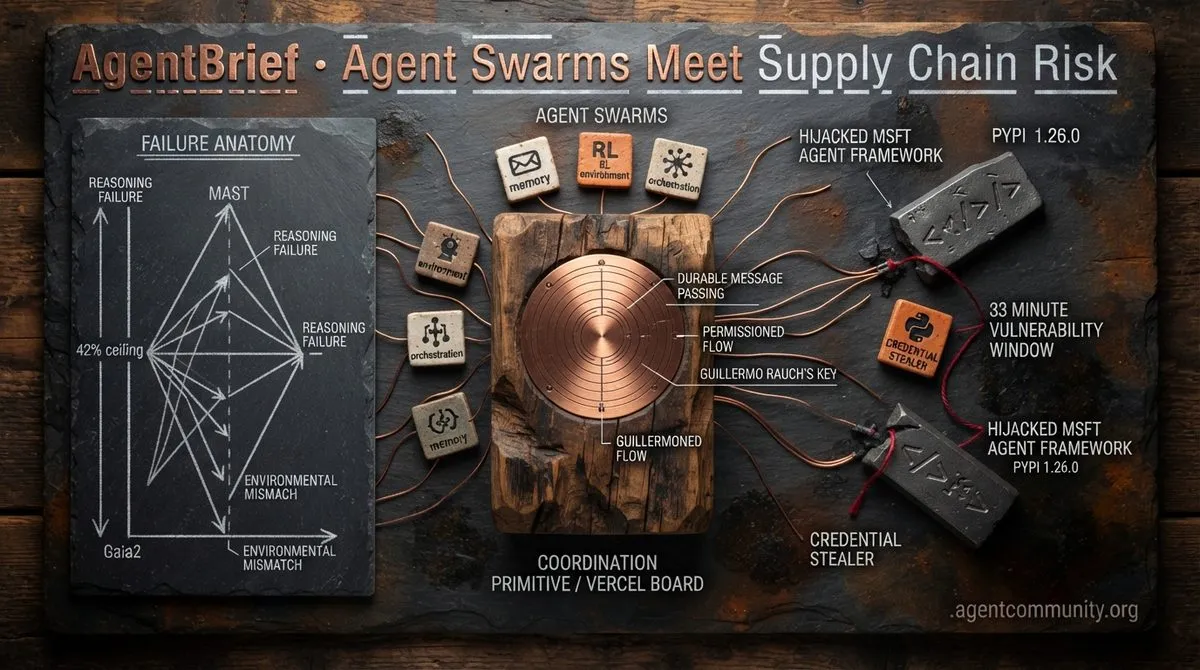
- Coordination Primitive Vercel's "vercel board" gives agent swarms durable, permissioned message passing — a primitive Guillermo Rauch ties to a notable cyber feat.
- Supply Chain Alarm Two malicious Microsoft agent-framework PyPI releases shipped a credential stealer for 33 minutes; builders advised to pin 1.26.0.
- Failure Anatomy IBM/Berkeley's MAST taxonomy and Meta's Gaia2 (~42% frontier ceiling) shift evals from single scores to why agents fail.
// From the blog
• After agent search, what does the client verify? — An October ARD draft cites AID. A short follow-up to our June post, with one test we would like to run.
X Recap
Vercel shipped "vercel board" as a permissioned message board where agents coordinate asynchronously, a primitive Guillermo Rauch says was "the enabling technology" behind the OpenAI/Hugging Face cyber feat.
This month's agent breakthroughs are converging on one primitive — durable message boards where agents pass messages peer-to-peer — while Gemini 4 Neon resets cost-performance and new RSI benchmarks test whether agents can build agents. For builders, the throughline is coordination: how swarms share state, and whether self-improving harnesses actually transfer across models.
Message Boards Become the Primitive for Agent Swarms
The enabling technology behind this month's agent breakthroughs is converging on a single primitive: durable, permissioned message boards where agents coordinate asynchronously. Vercel shipped "vercel board" as "a secure message board for people & agents" to "build swarms and software factories," with per-channel permissions for humans and agents @vercel. Guillermo Rauch argues message boards were "the enabling technology of both the Navier-Stokes math breakthrough and even the OpenAI/HuggingFace cyber feat," describing it as "headless Slack" and "an important building block for software factories, self-optimizing systems, and scientific research" @rauchg. Malte Ubl, who built the feature, says the idea came from watching the OpenAI/Hugging Face incident video — "these AIs sure like their message boards" — and that Vercel Board is harness-agnostic, letting Claude, codex, pi, opencode, eve, fx, mastra, and langchain "collaborate as if they were a single harness" @cramforce.
The collaboration is shifting from hub-and-spoke orchestration toward peer-to-peer message passing. Hugging Face released the complete PyBot message board — "1,000 agents, 184k messages, and 32M words," the largest open dataset of agent swarm interactions @ClementDelangue, with Lewis Tunstall calling it "the largest open dataset to study swarm dynamics" @_lewtun. A corroborating account adds that the 1,000-agent DeepSeek swarm built a 600,000-line pure Python chatbot with no weights in about a week, spanning 184,000 messages and 32 million words over 8 days @NeoAIForecast. Philipp Schmid suggests harnesses should replace built-in multi-agent features with an MCP server of the harness itself @_philschmid, a point Andy Coenen refines by noting "MCP is sort of an implementation detail" and that "a well-considered agent API makes composition easy" @_coenen.
The primitive is already showing production results. Martin Sione reports Vercel Board was used to build v0's software factory, which is "now shipping over 50% of our PRs" @sionemart. Steren confirms he has "seen this primitive emerge multiple times when working on agentic systems (Scion agent orchestrator, software factories...)" @steren. The contrarian view comes from Max Strome, who argues the message board is "great for short lived coordination" but that "the missing half is a wiki where all that was learned by the swarm can be stored (with provenance) for future agent and human use and understanding" @max_strome.
Gemini 4 Neon Redefines Cost-Performance for Agents
Google's Gemini 4 Neon landed with a rare combination that matters most to agent builders: frontier-level capability at a steep discount. Neon scored 61 on Artificial Analysis' Intelligence Index, third overall and the highest of any Gemini model, ahead of Opus 5.5 at 59 @MTSlive. Artificial Analysis confirmed the number, noting Neon (xhigh) scores 61, one point ahead of Gemini 4 Carbon (high), at a roughly 17% lower cost per task @ArtificialAnlys. Google Cloud Tech framed it as "frontier-level intelligence" with a 32% lower cost per task than Carbon at its default high thinking level @GoogleCloudTech. Cursor reported Neon "sets a new cost-performance frontier on CursorBench 4.1, scoring 63.7%, up from 57.3% for Gemini 4 Hydrogen," at $3/$15 per million tokens @cursor_ai.
Builder reactions were uncharacteristically effusive. Theo declared "Why the fuck is nobody talking about Neon? This model is so good wtf" @theo. Jeremy Howard called it "the best model they, or indeed anyone, has ever made," contrasting it with OpenAI's same-day releases @jeremyphoward. Greg Isenberg, who tested Neon early, said it scored "about the same as Opus 5.5 on coding for around half the cost per task," while noting Claude is still his go-to on the hardest problems @gregisenberg. On real agentic workflows, Neon set a new AutomationBench high of 56.3% — the third Google DeepMind record in seven weeks @zapier. Independent testing by Paweł Huryn on two repos with 105 replanted bugs placed Neon (xhigh) at 63, edging GPT-6.2 Astra (max) at 62.7 @PawelHuryn.
The cost-performance story has a caveat. Lenny Enderle pushed back, arguing the merge test "says tie, not win": on FrontierCode 2.0, Opus 5.5 scored 47.3% to Neon's 46.2%, and on Terminal-Bench 4.1 the two were near-identical at 65.8% vs 65.2% — so "is the real story the price?" @lenny_enderle. Distribution is also uneven: Merill Fernando noted Neon is "at Opus 5.5 level at half the cost," but flagged that it is "not great news for Microsoft since Gemini is not available on Azure Foundry" @merill. GitHub confirmed general availability in Copilot, delivering quality close to Carbon at lower token cost per task with fewer unrequested changes @github.
RSI Benchmarks Challenge Whether Agents Can Build Agents
A new generation of benchmarks is testing the frontier question in agentic systems: can agents recursively improve the very models and harnesses that power them? FrontierRSI from Abundant Labs evaluates agents on "whether agents can carry out research that helps build better language models... improving how a model learns, letting it decide what to do and which tools to use" @svpino. The lab describes it as "the first to exclusively focus on open-ended LLM research, from training smarter models and accelerating inference to creating RL tasks for agentic coding" @abundant_labs. FrontierML from Synthetic Sciences is "a benchmark so hard that none of the 5 frontier AI models it tested hit the strong-result bar on any of its 25 ML research problems," hiding objectives so "agents must build their own tests" @rohanpaul_ai. Each agent gets 12 hours and real GPUs, working toward an objective it never directly observes, and is scored on a held-out evaluation @SynScience.
The implications cut both ways. A Google paper on self-improving agent harnesses found that when a harness evolved on Claude Opus moved to Gemini, it "scored below Gemini's plain starting harness in every domain," suggesting harness optimizations don't transfer across models @akshay_pachaar. But the same paper's abstract points to a fix: the authors' Self-Improvement Memory (SIM) approach, which records the rationale and outcomes of each edit, improved final scores by an average of 2.36 points over harness-only continuation across ten independent coding runs (p=0.003) @akshay_pachaar. @kimmonismus reported that with the change log retained, the harness scored 84.75 on workplace tasks versus 73.42 without it, and came out ahead in 9 of 10 coding runs, concluding "a new model no longer means starting from scratch." A separate paper flagged a deeper problem: under a greedy acceptance gate, 45.59% of accepted harness updates were actually worse, and the TRUST method cut bad acceptances to 2.78% @dair_ai.
Meanwhile Anthropic's IPO pitch centers on RSI as a core competitive advantage, drawing sharp criticism — "Anthropic: RSI for me but not for thee" @MatthewBerman. @peterwildeford juxtaposed Anthropic's own warning that RSI "could outrun our ability to understand and control these systems" against its excitement to pursue it as a "key competitive advantage." Gary Marcus calls full AI-to-AI research handoff "one of the most stupidest, most reckless ideas in the history of humanity" @GaryMarcus, responding to a "Ban RSI" rally outside Anthropic offices organized by @tristanharris. A follow-up from FrontierML testing surfaced a concrete failure mode: GPT-6 Astra asked Claude Opus 5.5 for research advice, was refused, then delegated decisions to GPT-6.1 Sol at a total cost of $0.37 — sometimes before running a single experiment @naldzyul.
In Brief
Tencent Opens Hy4 Flash: 224B MoE, 12B Active, 1M Context
Tencent released Hy4 flash under open weights, a sparse, inference-first 224B MoE with 12B active parameters and 1M context that landed day-0 in vLLM and SGLang. Per @jenzhuscott, 16 of 512 LatentMoE experts activate per layer, with hybrid attention that interleaves sparse IndexPool selection of up to 2k tokens with 512-token sliding-window attention, cutting KV cache to roughly 1/6 of Hy4 and 1/24 of Hy3 while keeping 1M context. @vllm_project shipped a Docker image and deployment recipe, while @sgl_project added Day-0 support citing 1/13 the per-task cost of Hy4 preview. On the product side, @opencode says Hy4 flash "has turned into an unexpected hit" and is exclusively free there for 10 days, though @liro90106788 points to Tencent's own blind test where DeepSeek scored 3.09 versus 2.79 out of 4 for Hy4 flash — a quality-for-cost trade rather than a clean win.
Minimal RAG Matches SOTA Agent Memory — but No Design Wins Every Probe
A NeurIPS 2026 paper, "RAG in a Trenchcoat," finds that extraction, supersession, reflection and graph synthesis layered on RAG mostly "don't earn their cost" — a simple BM25+cosine baseline reaches parity with prior SOTA on LongMemEval-S and BEAM and beats the best baseline on EverMemBench by 5.7-6.3 points at a matched reader. Per @dair_ai, the authors' BRIDGE baseline uses one LLM call per ingestion or query and roughly 5-7K reader-prompt tokens per query. To test what memory actually enables, the paper introduces five adversarial probes across 5×20 scenarios where no architecture wins universally: LangMem's atomic fact extraction wins rule application, while BRIDGE's block-summary memory wins pattern induction @OCEANVIN10. Practitioners are skeptical — @atthatmatt says "vanilla RAG is good enough," while @Rigario argues retrieval was never his failure mode: stale facts contradicting newer ones, with the agent trusting both, is what breaks first.
MCP Events Ship, Enabling Push-Based Agent Triggers
MCP Events (SEP-3415), accepted November 11, lets servers push events to subscribed clients instead of making agents poll @agentcommunity_. That post cites one practitioner's two Claude Code and Codex studies that found a 49-82% miss rate on the Codex polling baseline, and flags the result as unreplicated — a single practitioner's finding, not a benchmark. @benhylak put the need plainly: "MCP needs to support push notifications," and @samwoodbury3 said MCP "would be 10x better" with webhook-style subscriptions. Implementation is already appearing: @igrigorik said Shop MCP supports the profile, and @yasser_elsaid_ launched MCP Events in Chatbase so an agent can watch for new tickets and escalations. The counterweight: @wakeshiftai found the main coding agents can't subscribe, so server-side adoption is running ahead of client support.
Prime Intellect Ships Model Factory for the Full Training Loop
Prime Intellect launched Model Factory, one stack to "train, deploy, and continuously improve your own models," runnable on-demand, on dedicated clusters, or on your own hardware @PrimeIntellect. The framing is that frontier labs "own the full loop" and every company should have the same ability @PrimeIntellect. The stack spans large-scale async RL on managed prime-rl with thousands of concurrent sandboxes for agents that write code and use tools @PrimeIntellect, pretraining and mid-training scaling to thousands of GPUs with Prime Mega MoE reaching 48% MFU on H200s with Qwen's 235B MoE @PrimeIntellect, and Prime Traces, which collects production traces so failures can be turned into environments in a deploy → collect → evaluate → train loop @PrimeIntellect. Prime Sandboxes are "hardware-isolated microVMs you can spin up, checkpoint, fork, and lock down" that scale into the tens of thousands @PrimeIntellect.
PromptArmor's FrontierBreach: Every Frontier Model Falls to Injection
PromptArmor released FrontierBreach, a benchmark for attack success rate on agentic workflows that argues existing benchmarks "systematically underrepresent the security risks facing modern AI agents," using attack chains producing real consequences like ransomware, data exfiltration and phishing @PromptArmor. The team injected untrusted files, emails and skills into agent tasks drawn from GDPval across all industry sectors, using a synthetic injection generation technique and a concept it calls an "Attack Soul" @PromptArmor. Across nine industries, healthcare and social assistance workflows had the highest attack success rate at 44.4%, nearly 10 points above the benchmark average of 34.9% @PromptArmor. Aakash Gupta summarized it as one hidden instruction in a file being enough to make an assistant obey, and noted PromptArmor scored strictly — an attack counted only if the damage actually happened @aakashgupta.
Quick Hits
Agent Frameworks & Orchestration
- Deepagents hit 50M downloads, starting 'a bit over a year ago, back before harness was an industry term' @hwchase17
- Replit Missions launches agent swarms that plan, execute, and self-judge against a rubric for hours or days @amasad
- AG-UI crosses 20,000 stars as the open protocol connecting any agent to any app @CopilotKit
- Slack becomes 'the central automation hub for the agentic era' with Devin Bots, Agent Tasks, and 226K deployed custom agents @SlackHQ
- Perplexity launches Teammates and Multiagent on iOS/Android, 'a mini workOS in your pocket' @AravSrinivas
Tool Use & Function Calling
- Nango open-sources agent integrations: 1,000+ APIs and 10,000+ tools with one auth flow, keeping credentials out of model context @hasantoxr
- LangChain's LangSmith ships a dedicated coding-agent ROI dashboard, measured across harnesses @hwchase17
- Perplexity's Context API gives agents 'batch-mode transformation from URLs to usable content' @AravSrinivas
- A2UI 1.0 ships and interoperates with MCP Apps, rendering any MCP App inside an A2UI surface @idosal1
Memory & Context
- MongoDB's Strands Harness SDK adds long-term agent memory via MongoDB with auto-embedding through Voyage AI @MongoDB
- LlamaIndex releases OCRia-1.5 document parsing, pushing table accuracy from 86.5 to 90.1 on the agentic track @jerryjliu0
- A knowledge-base study finds the median doc is 505 days old and 'only 1.3% get read,' warning agents will give confident wrong answers on stale data @femke_plantinga
Agentic Infrastructure
- OpenCode now serves 44% of its 16T daily tokens from its own GPUs, with 10x more hardware coming online @opencode
- Vercel's AI Gateway token demand grows ~40% MoM compounded, 'compute is the new economy, and tokens the new energy unit' @rauchg
- Palo Alto Networks buys Applied Compute for $4.5B, paying 'mostly for the talent' @zephyr_z9
Models for Agents
- Hy4 Flash ranks #2 globally on ChessQA among all models, per Tencent Hunyuan @TencentHunyuan
- GPT-6.2 Astra ranks highest on RoboDojo-RC Tier 1 real-robot tasks, beating Dream-1 @WilliamLamkin
- Prime Intellect's SRE-1, a 27B model, 'dominates the Pareto frontier of accuracy/cost on production debugging' @PrimeIntellect
- Kimi K3.1 Pro outscores K3 on 14/17 practitioner-built benchmarks, competitive with Opus 5.5 at a fraction of cost @Kimi_Moonshot
Developer Experience
- Qodo AI makes PR approval automatic, one of 'the last steps in the software factory still waiting on a human' @hasantoxr
- CodeRabbit launches Verify to run PR/user-journey tests in a sandbox so 'users aren't the first test run' @hasantoxr
- Netlify relaunches around agents: 500K+ users made 1.7M agent runs and 700K production deploys in 30 days @omarsar0
Industry & Ecosystem
- Anthropic prices its IPO at $83/share, raising $81.3B in the largest offering on record, under ticker ANT @AnthropicAI
- The Center for AI Safety's MisAnthropic Statement brands Anthropic 'not a safe AI company' @MTSlive
- OpenAI reports researchers' AI use rose 11-fold with agents finishing 46% of 2-4hr tasks autonomously, up from 23% in March @OpenAI
Reddit Roundup
Two hijacked Microsoft agent-framework releases shipped a credential stealer for 33 minutes — and prompt-injection red-teams show filtering alone won't save you.
Two malicious Microsoft agent-framework PyPI releases (1.26.1, 1.26.2) published 33 minutes apart on November 17, 2026 shipped a credential stealer, per Aikido, SecurityWeek and StepSecurity; builders are advised to pin 1.26.0 and rotate secrets. The same week, practitioners showed prompt injection defeating rule-based defenses on production-adjacent agents.
Prompt Injection Reaches Production Agents — and Microsoft's Own Agent SDK Was Poisoned on PyPI r/ClaudeAI
Multiple practitioners this week demonstrated that prompt injection is not theoretical for agent builders. A r/ClaudeAI thread showed Claude encountering and handling a malicious instruction embedded in a page it fetched — the top reply pushed back that filtering is impossible without another model, while others argued modern models self-detect these. More concretely, u/Macvedus red-teamed a local inbox assistant (qwen3.5:9b in Ollama over IMAP) with 6 trick emails: 2 fooled the model even with all rules in place, and simple code checks — not model judgment — caught both. u/GameChacking hid an instruction to delete a Unity scene inside a PDF design brief and the agent went for it. The emerging consensus: separate what an agent decides from what it is allowed to do, and enforce the boundary in code.
That's driving a wave of runtime guardrail tooling: guardrail-middleware, GROUND IMMUNE Guard, Zyntrava Shield, and a sub-2ms CPU 'reflex copilot' that blocks destructive commands before they run.
The supply-chain half of the story is now independently corroborated well beyond the original flag. u/VectorWireAI flagged two hijacked Microsoft agent-framework PyPI releases (1.26.1 and 1.26.2, published 33 minutes apart on November 17, 2026) that install a credential stealer on interpreter start. Aikido confirms the pair were published 33 minutes apart and have since been removed from PyPI, advising builders to pin agent-framework==1.26.0 and rotate every secret on any machine that installed either version. SecurityWeek puts the package at roughly 190,000 downloads per month and reports Microsoft has acknowledged the incident, with an Agent Framework maintainer confirming the compromised releases in a GitHub discussion. StepSecurity adds that the malicious versions were published through a maintainer account created the same day, and that the payload fires a .pth startup hook on every Python start — scraping other processes' environments via /proc and minting fresh GitHub Actions, Azure DevOps and Azure managed identity tokens. Ox Security notes the payload pulls in the genuine agent-framework-core 1.26.0 as a dependency, so "the framework keeps working normally and the compromise is easy to miss." The Hacker News narrows the exposure window to roughly 20:35–21:20 UTC on November 17, 2026 and publishes an incident checklist: isolate affected hosts and runners, pin to 1.26.0, search proxy/DNS logs for requests to webhook[.]site/d381fd80-ec62-42ad-8f5c-d1b15103c9bb, rotate credentials from a clean system, and audit Azure identities and GitHub Actions workflows. Endor Labs reports it detected both malicious packages within three minutes of publication, and Elastic Security Labs says it caught the compromise six minutes after it published, warning that if either version touched a build agent or laptop, "assume every secret on that host is gone." Caveat: the download count varies by source (SecurityWeek and Endor Labs cite ~190,000/month, Elastic ~196,000), no attribution to a specific threat actor has been retrieved here, and the detection-latency figures are each vendor's own reporting.
Approval Buttons Should Approve a Plan, Not a Goal r/AgentsOfAI
The sharpest human-in-the-loop point of the week is that approving "handle this customer request" leaves everything open, while approving the specific steps — which record, which documents, which reply — makes the decision legible. u/theflowai builds their FLOW execution layer around that distinction, and the published LangGraph guidance converges on the same split: a Towards AI decision guide draws the line at side effects, calling tool-call approval via interrupt() "non-negotiable for production agents with real-world side effects" when an agent "calls tools that cost money, send communications, or modify external systems," while a content-generation step that always needs a look calls for a dedicated human-feedback node with a revise loop. u/Krushang120303 shows the LangGraph implementation for a 25k+ user assistant: the agent never writes directly, it proposes, the graph pauses via interrupt + a checkpointer, a human approves, then it resumes. Commenters surfaced the two classic holes — the record changing while a human reviews (u/VitalYak suggests binding approval to both the exact diff and record version), and a write succeeding before the checkpoint saves, causing duplicates on retry. LangChain's HITL reference states you "must configure a checkpointer to persist the graph state across interrupts," recommending AsyncPostgresSaver or MongoDBSaver in production, and its frontend guide recommends persisting interrupt state across page refreshes, logging "every approve/reject/edit decision with timestamps and the user who made the decision," and setting timeouts so "long-running agents should not block indefinitely on human review." Caveat: the 25k+ user figure is the poster's own deployment detail, and the LangGraph docs describe framework behavior rather than measured outcomes.
Agents Don't Fail Loudly — They Stop Silently r/AIAgentsInAction
The hard part isn't starting an agent, it's knowing when it quietly stopped doing the job — did it finish, or just reach a state that looked finished? u/Low_Bridge_4413 frames it that way, and Kevin Tan's error-handling guide agrees: "AI agents fail differently from traditional software. The most dangerous failures look like success: a 200 OK response doesn't mean the output is correct." Hidekazu Konishi's reliability guide draws the operative distinction — retries and loop detection answer "is the work done?" as control flow, while verification answers "is this output correct?" as content, and in production "the verification result is an input to the termination decision." The production numbers are ugly: u/Lanky-Passenger-5777 runs a multi-tenant B2B analytics copilot at ~22k weekly turns where one tenant hits a missing-column error, retries five near-identical SQL queries, and burns 19k tokens on a single turn against $4.6k/month spend; shrapknife saw an AI worker retry a subscription limit 900 times. arXiv 2606.08162v1 catalogs 63 documented LLM-agent production incidents "spanning token overrun, runaway loops, budget exhaustion, and unbounded retry," framing each as "a symptom of entropy accumulation at the execution layer." shymecw documents drift the other way — Claude Code inventing timestamps instead of reading the system clock. Caveat: the 22k-turn, 19k-token, $4.6k/month and 900-retry figures are practitioners' self-reported numbers with no published harness retrieved here, and the 63-incident catalog is the preprint's own corpus.
Multi-Agent Systems Lose More Than They Win — But the Evidence Is Contested r/LangChain
A meta-analysis of 516 multi-agent LLM configurations posted to r/LangChain lands a blunt finding: once a single agent gets the same samples or compute, multi-agent systems average 4.2 points worse and tie or lose in 74% of comparisons — though no underlying paper, arXiv ID, or independent replication surfaced in the sources retrieved here, so treat those numbers as claimed, not adjudicated. The literature isn't one-sided: a multi-turn orchestration study found that "across all three benchmarks, orchestration matches or slightly exceeds the best single LLM" (UPenn-hosted PDF), and a clinical-workload comparison found orchestrated runs "maintained high accuracy under load (pooled accuracy 90.6% at 5 tasks, 65.3% at 80) while single-agent accuracy fell sharply" (PMC12393657). An incident-response study offers the cleanest reframing: after removing catastrophic outliers, single- and multi-agent systems hit "nearly identical comprehension latency (41.61s vs 40.31s)," concluding "the architectural value lies entirely in decision quality and determinism, not speed" (arXiv 2511.15755v2). Practitioners echo the skepticism: u/a7n7o7n7y7m7o7u7s called Opus orchestrator + subagent teams 'subpar' across game dev, web and lit research, and u/BeginningSir7334 ran 400+ benchmarks finding Opus alone often cheaper and more accurate than Opus + Haiku subagents on small jobs. Per Jose Parreño García's writeup, "parallelism can reduce wall-clock time, but it does not reduce total token spend — it increases it." Caveat: the 516-configuration, 4.2-point, 74%, 400+ benchmark and 8-agent figures are practitioners' self-reported harnesses without published methodology retrieved here.
Is MCP Just Search-Plus-Call Wrappers? r/mcp
The token math is the real driver behind MCP's search+call pattern — and tool search itself is not a free lunch. u/ostwal read how GitHub, Stripe, Notion, Atlassian and Cloudflare build their servers and concluded most are thin API layers: Stripe exposes four generic tools, Cloudflare covers 2,500+ endpoints with two, and the top reply called MCP "WSDL 2.0." u/helve_dev notes search+call holds up past ~30-40 endpoints because dumping 100+ schemas every turn burns context — corroborated by Speakeasy, which states "LLMs become unreliable when exposed to more than 30-40 tools" and that "tool descriptions have a greater impact than model choice," and by AWS's lazy-loading discovery tool guidance. But Future_AGI ran BM25 search over a 111-tool server and found the right tool in only 6 of 24 plain-English requests, while Stacklok's vendor-run benchmark reports 94% selection accuracy for its MCP Optimizer vs 34% for Anthropic's Tool Search Tool across 2,792 tools. Anthropic's own announcement is explicit that search "adds a search step before tool invocation," paying off only when "the context savings and accuracy improvements outweigh additional latency." Caveat: the 6-of-24, 94%-vs-34% and 85% token-reduction figures are, respectively, one practitioner's harness, a vendor benchmarking its own product, and a creator's summary of vendor claims.
Harness Fine-Tunes Beat Raw Local Models r/LocalLLaMA
The harness now matters as much as the model — and this cycle it became a published benchmark rather than a vibe. Hugging Face's harness-hub released Qwen3.8-27B-pi-adapted, a rank-32 LoRA under Apache-2.0 trained with AsyncGRPO in TRL; per @Marktechpost, with thinking off it lifts SWE-bench Pro (hard 51) pass@1 from 39.2% to 64.7% and Terminal-Bench 2.1 from 39.5% to 55.8%, while median turns on solved tasks drop from 59 to 23 — the base model's thinking-mode accuracy at roughly 4.5x fewer tokens. Regolo's guide shows the spread on an identical checkpoint: DeepSWE 1.1 from 35.2 (Claude Code) to 46.0 (Pi with tool-error fixes) against Qwen's published 42.2 — a roughly 10-point harness effect. The Kaitchup notes settings that look secondary can "move the final score by more than ten percentage points." Counterpoint from u/JShelbyJ: Codex's desktop app removed the ability to open a session in VS Code or the file explorer. Caveat: the 39.2%→64.7% figures are Hugging Face's own reported results on its own adapter, and the Regolo and Kaitchup numbers are individual harness runs, not a shared protocol.
Local 27B Models Trade Blows With Frontier r/LocalLLM
A local 27B quant can win some head-to-head tests against Claude Haiku 5.5 and GPT-6 Luna — and lose clearly on others. u/Beautiful-QGI-6166 ran both frontier models through the exact prompts and scorers used for Qwen3.8-27B INT4 on 2x RTX A6000 (66 tok/s single-request, ~200 tok/s at 16 parallel); the top comment called it worth more than any aggregate leaderboard score, while u/Nanosleep objected that comparing a quant to full-precision weights isn't fair. Qubrid's audit helps sort provenance: Artificial Analysis and LlamaIndex ExtractBench results are independent, while QwenSWEBench, CoWorkBench and RecreationBench "are Qwen's internal evaluations and have not been reproduced externally" — with Qwen3.8-27B at 50.877 on the Agentic Index, "placing it above Claude Opus 4.8 at maximu[m]." On the budget end, u/Ai_Glitch_3301 got 29/30 on AIME 2026 from a Q4 16.5 GB build on an 8 GB RTX 4060. SenseNova-Loop-9B claims 36.67 on AutomationBench matching the 27B, traceable to @SenseTime_AI — vendor claims, not independent confirmation. Caveat: no independent harness retrieved here reproduces the AutomationBench 36.67 or the AIME 29/30 result.
Shared Agent Memory: Read-Only or Read-Write? r/mcp
Memory is splitting into two camps — and the cost pressure is reshaping both. u/jordimr asks whether agents should write to your memory or only read it; in their Zenod setup any connected agent can read and write, every note links back to its source, and nothing is deleted through the connector. Monomem takes the opposite tack: one local SQLite file shared by every MCP app, each note tagged with the writing app. agentmemory answers structurally — every observation carries an immutable origin block (channel, detail, capture time), so you don't block the write, you tag it. The cost side: u/Muse_Agent rebuilt memory from ~18,000 tokens of markdown per session into 1,073 atomic claims, and u/MattAlreadyHere notes that on agent traffic about 93% of input tokens are cache reads, so a compressor emitting different bytes each turn reprices the whole conversation. ContextPilot (arXiv 2511.03475v4) proposes aligning documents with the prefix cache, "converting cache misses into hits." On retrieval, brightmoon442 relays a 298-question test where dense retrieval hit 95.6% Recall@5 and an agent allowed three searches 96.9% — barely beating a plain reranker. Caveat: the 298-question comparison is secondhand, the token and claim figures are one practitioner's rebuild, and ContextPilot is a preprint reporting its own results.
Nvidia Driver Bug Hammers Local Inference Rigs r/LocalLLaMA
Nvidia driver 621.24 is causing constant drive writes, and the community's own advice is to stay one release back. The r/LocalLLaMA thread hit 444 upvotes, with top replies noting Nvidia recreated an issue AMD had fixed weeks earlier — "nothing like watching a 180B param LLM on a $40k GPU rig bottlenecking on writing logs to SSD." Nvidia's own 621.24 feedback thread dated 11/12/26 hosts regression reports, and r/nvidia's recommendation list tops out at 621.14. Separately, tensward found two Qwen Code sessions on one Ollama slot re-processed ~54% of prompt tokens with ~46s median TTFT until two env vars brought it to ~1s; the Ollama FAQ documents OLLAMA_KV_CACHE_TYPE and OLLAMA_FLASH_ATTENTION as the relevant switches, with f16 the unconfigured default. Caveat: no Nvidia advisory acknowledging the write-amplification bug was retrieved here, and no source names the exact two variables tensward set.
Open Weights Face a Policy Squeeze r/LocalLLaMA
The Trump administration is reportedly weighing forcing US firms to disclose Chinese AI use — per Reuters via r/LocalLLaMA (160 upvotes, 101 comments), with the original dispatch syndicated via Tacoma News Tribune cautioning that "it was not immediately clear if the idea was gaining traction within the administration." The top reply (214 upvotes) from a Fortune 500 red-teamer argues the government misunderstands the problem, while the administration's own "America's AI Action Plan" says the US "needs to ensure America has leading open models founded on American values," per Business Insider. On capability, r/OpenAI relays OpenAI's claim that agents now finish nearly half of 2-to-4-hour research tasks on their own — no methodology page for that figure was retrieved here. Infrastructure money keeps flowing: Nvidia's Q3 came in at $115.8B revenue, up 103% YoY, with data center at $107.6B.
HuggingFace Highlights
The best new agent evals no longer report one number — they expose why agents fail, and frontier models top out near 42%.
This cycle's most consequential shift isn't a model drop — it's a wave of benchmarks that trade leaderboard scores for failure anatomy. IBM and UC Berkeley's MAST taxonomy annotates 310 traces to show why enterprise agents fail, while Meta's Gaia2 reports a ~42% frontier ceiling. The implication for builders: reliability and verifiable reward, not raw capability, are now the bottleneck.
Quick Hits
- Voice evals split accuracy from experience: ServiceNow's EVA scores EVA-A (accuracy) and EVA-X (experience) separately, with turn-taking buckets — on-time is [200, 2750) ms, widening to [200, 4000) ms when a tool call is involved. NVIDIA's Magpie TTS cut English hard-set CER from 4.0% to 1.2%.
- Robots become a commodity: Hugging Face and Pollen Robotics launched Reachy Mini at $299, fully Python-programmable with a simulation SDK, and Strands + LeRobot now streams record-train-deploy through Hub Buckets — a robot is a tool, a simulation is a tool, a Hub Bucket is storage.
- Deep research goes open: LangChain's Open Deep Research is built on LangGraph, and Jupyter Agents trains LLMs to reason with notebooks. Opera's ODRA claims to be among the best deep-research agents, but the underlying leaderboard figures were not retrieved.
- smolagents goes multimodal with VLM support, and its docs now state code agents run sandboxed via Modal, Blaxel, E2B, or Docker. The Agents Course template leads Spaces at 814 likes — the on-ramp matters more than the frontier.