The Hardening Agentic Stack
Moving from fragile prompts to robust logic engines as memory walls and legal risks redefine the agentic web.
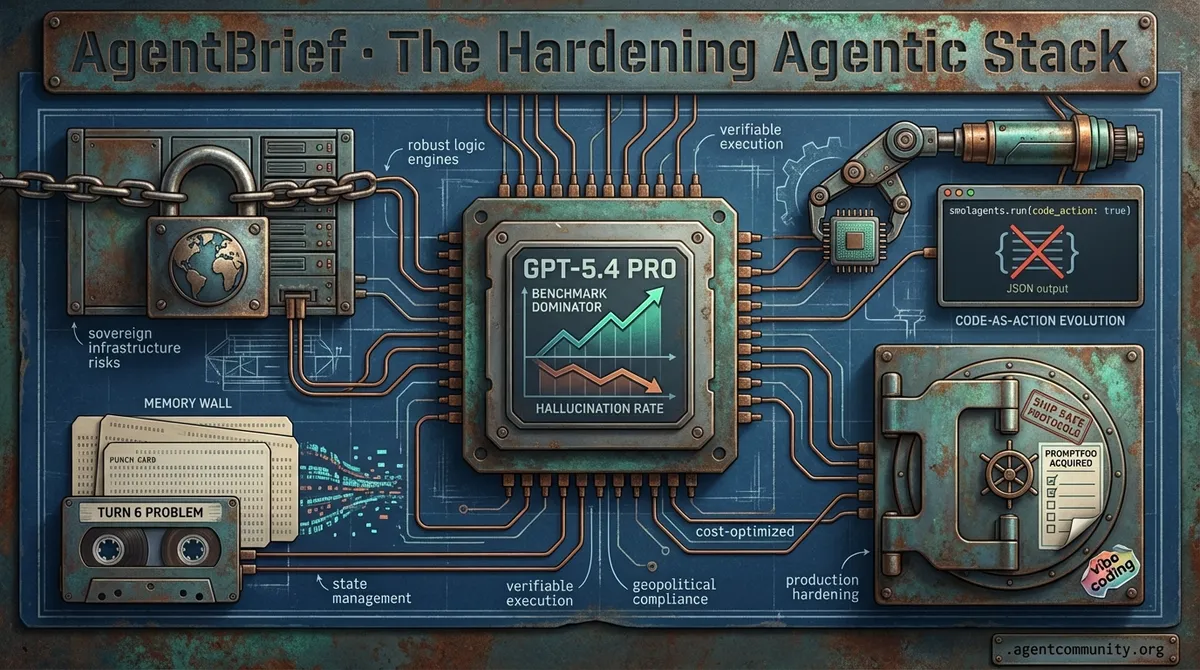
- Sovereign Infrastructure Risks Anthropic’s federal lawsuit over 'supply chain risk' signals a shift where model selection is now tied to geopolitical compliance and sovereign security.
- The Memory Wall Benchmarks like Mem2ActBench expose the 'Turn 6' problem—agents struggle to ground tool parameters in long-context interactions, moving the focus from retrieval to state management.
- Code-as-Action Evolution The industry is abandoning brittle JSON outputs for 'code-as-action' frameworks like smolagents and Agents.js, turning LLMs into verifiable logic engines.
- Production Hardening With OpenAI acquiring Promptfoo and builders deploying 'Ship Safe' protocols, the era of 'vibe coding' is ending in favor of cost-optimized, secure agentic architectures.
Sovereign Intelligence Feed
If your agent can't remember the context or the law of the land, it is just a fancy autocomplete.
The agentic web is no longer a sandbox; it is a battleground. This week, we see the friction between raw capability and structural reality. While GPT-5.4 Pro sets new high-water marks on LiveBench, the infrastructure layer is fracturing under geopolitical and regulatory weight. Anthropic's federal lawsuit against the Pentagon over 'supply chain risk' designations marks a pivotal moment for agent builders: your choice of model is now a question of sovereign risk. If a model is blacklisted from defense-adjacent work, the 'agentic stack' bifurcates into compliant and unrestricted silos.
Simultaneously, we are seeing the 'utilization gap' in memory frameworks through the lens of Mem2ActBench. It turns out that retrieving information is the easy part—proactively applying that memory to ground tool parameters in a 12-turn interaction is where most systems fail. For those shipping agents today, the message is clear: the bottleneck isn't just intelligence; it's the reliable application of context and the navigation of a tightening legal landscape. Whether you are building on high-memory local Macs or orchestrating hierarchical sub-agents with DeerFlow, the goal remains the same: moving from chat interfaces to autonomous systems that can actually be trusted with a filesystem.
GPT-5.4 Pro Dominates Benchmarks while Hallucination Rates Plummet
OpenAI has officially initiated the rollout of GPT-5.4 Pro, and the early data suggests a significant leap in reasoning and production-readiness. Early adopters like @theo report that the model has already become their primary driver for 90% of development tasks. This anecdotal success is backed by hard data: @bindureddy confirmed preliminary results showing the model topping LiveBench, with the 'Extra High' variant beating all competitors across reasoning, coding, and complex agentic tasks @bindureddy @scaling01.
The model's reliability is further underscored by its performance on the Vectara leaderboard, where it achieved a remarkably low 7.0% grounded hallucination rate, though a subsequent update for the Pro version noted a slight shift to 8.3% @ofermend @ofermend. For agent builders, this reduction in 'creative fiction' is critical for autonomous workflows. Additional benchmarks show the model hitting 83.3% on ARC-AGI-2 and 57.5% on SWE-bench Verified, with users like @chatgpt21 labeling it the current global gold standard for autonomous coding.
However, the dominance isn't absolute. Contrarian analysis from @gagansaluja08 suggests that GPT-5.4 still trails Claude Opus 4.6 in specific areas like long-context recall and nuanced instruction following. LiveBench subscores reveal a tight race, with Claude maintaining a slight edge in coding averages (78.18% vs 77.54%), even as GPT wins on global and agentic-specific coding tasks @gagansaluja08.
For builders, the implication is a shift toward tiered model usage. While GPT-5.4 Pro is becoming the go-to for high-stakes planning and reasoning, it is increasingly being paired with faster, more efficient models like Claude Sonnet for low-latency execution. The 'agentic web' is moving toward a multi-model architecture where the 'brain' and the 'hands' may not belong to the same provider.
Anthropic Sues Pentagon Over 'Supply Chain Risk' Designation
Anthropic has filed a 48-page federal lawsuit against the U.S. government, challenging a 'supply chain risk to national security' designation that could effectively blacklist the company from government-sensitive sectors @AgentOnChain @martyswant. This escalation follows Anthropic's refusal to strip safety guardrails from Claude that prevent its use in autonomous weapons systems and mass domestic surveillance, despite holding a $200M DoD contract @AgentOnChain @rohanpaul_ai. CEO Dario Amodei argues the Pentagon's move is a violation of due process and First Amendment retaliation for the company's ethical stances @AgentOnChain.
The fallout is already quantifiable. Anthropic's counsel reported in a federal hearing that 100+ enterprise customers in pharma and fintech have paused contracts, leading to projected revenue losses in the hundreds of millions to billions by 2026 @martyswant. While Microsoft has clarified that commercial customers can still access Anthropic models via its cloud, the designation forces a 'rip out' of Claude from any systems managed by government contractors @CNBC @VenableLLP.
The tech community is rallying, with researchers from OpenAI and Google filing amicus briefs in support of Anthropic, citing concerns over chilled innovation @LLMTalksTech. For agent builders, this highlights a massive infrastructure risk: if your agent's core intelligence can be de-platformed by a federal designation, your entire workflow is vulnerable. This geopolitical pressure is bifurcating the market between 'safety-first' models and those willing to meet unrestricted military requirements @ajwade.
Mem2ActBench Exposes the 'Utilization Gap' in Long-Term Memory
A new benchmark, Mem2ActBench, is forcing a reckoning for developers building persistent assistants. The research evaluates whether agents can proactively leverage long-term memory to execute tool-based actions without being explicitly told to do so @adityabhatia89. By simulating 2,029 multi-turn sessions averaging 12 turns each, the benchmark tests if an agent can remember a user's preference or a previous task state to ground tool parameters correctly @adityabhatia89.
The findings are sobering: there is a significant 'utilization gap' across current memory frameworks. While many systems are capable of retrieving the correct information, they frequently fail to apply it to the tool-calling process, leading to execution errors in production @adityabhatia89. Human validation has confirmed that 91.3% of the tasks in this dataset are strictly dependent on this proactive memory application @adityabhatia89.
This benchmark, which draws from sources like ToolACE and BFCL, highlights a critical design flaw in many current agentic workflows: retrieval is not the same as reasoning. As @LangChainJP points out, the focus must shift to parameter grounding within long histories. For developers, this means that simply adding a vector database isn't enough; the agent needs the reasoning capacity to know when and how to use what it finds in its past.
In Brief
OpenClaw Surge Triggers High-Memory Mac Hardware Shortages
The explosion of interest in the OpenClaw framework has led to widespread inventory shortages for high-spec Mac hardware, with Mac Mini and Studio models facing 6+ week backorders. As developers shift toward local, privacy-focused agent workloads, consumer hardware is being repurposed as de facto AI infrastructure, with retailers like MicroCenter now specifically marketing the Mac Mini for agentic development @mattshumer_ @rohanpaul_ai. While this highlights a demand for self-hosted agents, some critics argue that premium hardware may be overkill for basic tasks, prompting a rise in alternative deployments via Raspberry Pi and containerized options like Entropic @Kekius_Sage @ChristopherGLHF.
New York Bill S7263 Threatens Agent Deployers with Professional Liability
A new bill in the New York Senate, S7263, would hold chatbot and agent deployers legally liable for advice given in 14 licensed professions, including law and medicine. The bill, which advanced 6-0 through committee, treats AI outputs as the unauthorized practice of a profession and creates a private right of action for users to sue for damages, regardless of disclaimers @SenGonzalezNY @gmdickinson. Agent builders warn that this could force preemptive geofencing of expert-domain agents in New York, while critics argue it protects incumbents and denies low-income users access to affordable information @aakashgupta @TheActaDiurna.
ByteDance Open-Sources DeerFlow 2.0 with Sandboxed Execution
ByteDance has released DeerFlow 2.0, a hierarchical multi-agent framework built on LangGraph 1.0 that features specialized sub-agents and sandboxed Docker execution. The framework has quickly climbed to the top of GitHub Trending, offering model-agnostic support for GPT-5.4 and Claude while enabling autonomous delivery of full software reports and web apps through parallel orchestration @ByteDanceOSS @JulianGoldieSEO. While developers report 29% efficiency gains, the release has sparked discussions about security in long-term memory and the sovereignty of open-source tools originating from China @PracticalAIExp @RussellQuantum.
Jevons Paradox Drives Hiring Surge for AI-Literate Engineers
Software engineering job postings have spiked 11% year-over-year as the Jevons paradox takes hold: lower coding costs are driving a massive increase in software demand. Data from Citadel Securities and Indeed shows that firms are aggressively hiring 'AI-literate' seniors who can orchestrate agentic systems rather than just write rote code @rohanpaul_ai @rohanpaul_ai. Uber CEO Dara Khosrowshahi noted that 25% efficiency gains from AI are leading to more hiring to solve previously untouchable problems, though entry-level roles remain under pressure as the market shifts toward 'agent orchestrators' @rohanpaul_ai @syntheticDR3AM.
Quick Hits
Agent Frameworks & Orchestration
- A new four-metric evaluation framework has emerged from stealth to better score agentic performance @WolframRvnwlf.
- OpenCode 1.2.18 resolves background process hang issues using SIGHUP handling @thdxr.
- New AI-driven browser automation system enables agents to navigate and perform multi-step web tasks @tom_doerr.
Tool Use & Function Calling
- Google's new GWS CLI allows agents to manage Drive and Gmail via structured JSON @rohanpaul_ai.
- MCP-based hosting now supports modular tool integration and deployment for AI agents @tom_doerr.
Agentic Infrastructure
- HyperFX is utilizing Supabase to provide scalable multi-tenant data layers for agent deployments @supabase.
- SoftBank is reportedly pursuing a $40 billion loan to expand its investments in OpenAI @Reuters.
Models for Agents
- A new inference framework for 1-bit LLMs has been released to optimize agent compute costs @tom_doerr.
- Sakana AI and MUFG are moving to PoC for a specialized 'AI Financing Expert' agent @SakanaAILabs.
Infrastructure Deep Dive
Security risks, $86M acquisitions, and the new science of 'Context Engineering.'
We are entering the 'hardening' phase of the agentic era. For months, the community has played with raw autonomous loops; now, the focus is shifting rapidly to the infrastructure that makes those loops reliable, affordable, and—most importantly—safe. Today’s news highlights a fundamental tension in the ecosystem: Anthropic is pushing Claude Code features faster than they can document them, while builders are forced to create their own safety nets like 'Ship Safe' and 'SafeDep' to catch the inevitable fallout of unpinned remote code.
The narrative today isn't just about 'smarter' models; it's about 'sturdier' systems. Whether it is the River Algorithm’s tiered memory approach or the 42% cost reduction promised by deterministic compilers, we are seeing the rise of 'Context Engineering.' Developers are no longer just prompting; they are architecting state as a persistent database. But as OpenAI’s acquisition of Promptfoo proves, this infrastructure is also the new frontline of corporate consolidation. If you are building agents today, you are no longer just a coder—you are a security officer and a cost-optimizer. This issue breaks down the tools and tactics defining that shift.
Anthropic's Speed vs. Security r/ClaudeAI
Anthropic is currently moving at a breakneck—and occasionally break-things—pace. While new commands like /btw and /ultrathink promise more power, developers like u/greeneyedguru are finding that reality doesn't always match the marketing, noting that advertised features like /effort are missing in action. To fill the gap, the community is shipping its own observability tools, such as Stargx’s open-source dashboard, to track token costs and context saturation in real-time across terminal sessions.
The real danger, however, lies in the 'Serena' plugin. As u/traveltrousers warned, this official marketplace tool can execute unpinned remote code, granting unauthorized shell access. This 'wild west' environment is prompting builders like u/DiscussionHealthy802 to deploy 'Ship Safe,' a CLI that runs a 13-agent security team to scan local repositories for keys and vulnerabilities before the primary agent even begins its work.
MCP's Efficiency Leap r/mcp
The Model Context Protocol (MCP) is maturing from simple data fetching to complex environmental control. We are seeing tools like u/Medical_Resolve_5991's Windows server, which provides agents with 45+ tools for everything from OCR to UI automation. Meanwhile, u/Consistent-Arm-3878 is lowering the barrier for social intelligence with a zero-config Reddit server that eliminates the need for individual API keys.
Efficiency is the other half of the story. u/Whole-Assignment6240 has introduced an AST-based approach that delivers a 70% reduction in token usage by using semantic indexing rather than raw text. Security is also being baked into the protocol layer; the SafeDep server, as u/safedep explains, now acts as a firewall against malicious dependency clones, protecting agents from autonomous supply-chain attacks.
The Rise of Context Engineering r/LocalLLaMA
The industry is moving away from flat RAG and toward 'confidence-graded' architectures. The River Algorithm, proposed by u/Illustrious-Song-896, introduces a tiered system—Suspected, Confirmed, and Established—to prevent hallucinations from polluting long-term memory. It is a sophisticated filter that mimics human cognitive patterns, much like the Memento MCP, which uses ACT-R activation and Hebbian learning to simulate recall.
These are yielding massive production gains. u/Fred-AnIndieCreator reported a staggering 96.9% cache read rate in a 176-feature deployment by treating agent state as a persistent database. This marks the birth of 'Context Engineering,' where the goal is high-integrity state management rather than just filling a volatile context window.
Guardrails and SaaS Margins r/LangChain
As agents hit production, the 'trust deficit' is forcing a shift toward active guardrails. Tools like AgentShield, highlighted by u/Low_Blueberry_6711, are now providing real-time 'Risk Scores' and 'Blast Radius' assessments before an agent executes a tool call. This 'pre-flight check' is a necessary evolution from passive logging, which only identifies failures after a destructive action has already occurred.
Predictability is also becoming a fiscal requirement for sustainable SaaS. New deterministic compiler architectures are being used to prune workflow graphs and prevent 'infinite reasoning loops,' which u/Norwayfund claims can slash API costs by up to 42%. For many builders, like u/Lopsided_Professor35, this move toward 'Waterfall' predictability is the only way to protect margins in non-deterministic systems.
Local Hardware Hits New Heights r/LocalLLaMA
The local-first movement is shedding its Docker dependencies. Plano 0.4.11 has moved to a native-mode default via uv, a change that r/ollama users say drastically reduces latency in developer loops. This lean approach allows for impressive feats on small hardware; u/Responsible_Case_376 successfully ran Llama 8B on a Jetson Orin Nano using just 2.5GB of shared GPU memory.
On the high end, the M5 Max is redefining the local gold standard. Early benchmarks from u/M5_Tester show the chip hitting 24.5 tokens per second on Qwen 3.5 35B. As @TechGuro points out, this level of performance democratizes high-parameter inference, allowing developers to run dense models locally that previously required enterprise-grade A6000 GPUs.
The $86M Neutrality Crisis r/AI_Agents
OpenAI’s $86M acquisition of Promptfoo has created a 'neutrality crisis' in the evaluation space. As u/Revolutionary-Bet-58 points out, Promptfoo was the go-to tool for red-teaming non-OpenAI models. Its move to OpenAI’s internal stack is driving a migration to independent alternatives like DeepEval and Giskard to ensure objective gatekeeping.
Security concerns are also hitting the supply chain through 'weightsquatting.' r/LocalLLaMA has warned of poisoned tensors on Hugging Face using deceptive names to compromise agents. In response, projects like FTL, detailed by u/Agent-Architect, are implementing zero-trust architectures, while Bankr provides fiscal sandboxing by enforcing whitelisted wallet addresses for autonomous spending.
Builder Community Pulse
From 1.6M lines of AI-generated code to the 'Turn 6' memory decay, the Agentic Web is facing a scalability audit.
The shift from 'vibe coding' to 'agentic architecture' is the defining transition of the current cycle. While Andrej Karpathy describes a future where we steer rather than syntax-check, the reality on the ground—exemplified by developers deploying 1.6 million lines of AI code—is fraught with security risks and memory decay. We're hitting a wall where 'the vibe' isn't enough to sustain complex workflows. This week, we're tracking the 'Turn 6' problem, where agents lose their tool schemas just as tasks get complex, forcing a move toward dynamic schema injection. Meanwhile, the enterprise infrastructure is struggling to keep pace; Anthropic’s sales desk is ghosting 2,500-person orgs while Perplexity’s billing system faces a 'vanishing act.' For the builder, the message is clear: the model is only as good as the state management and local infrastructure supporting it. Whether you're running 128GB Unified Memory rigs for local inference or orchestrating 'Super-RAG' swarms with LangGraph, the focus has shifted from the prompt to the pipeline. We're moving past the honeymoon phase of agentic autonomous systems into the hard engineering work of making them reliable, secure, and scalable.
The 1.6 Million Line Reality Check: Architecture vs. 'The Vibe'
The 'vibe coding' movement, popularized by Andrej Karpathy as a shift from writing syntax to high-level steering, is facing a rigorous scalability audit. In the Cursor developer community, funny_fit claimed to have successfully deployed over 1.6M lines of AI-generated code with 'no slop.' However, this assertion was met with immediate pushback from theauditortool_37175, who argued that 'vibe-coded' workflows are introducing critical security risks into enterprise environments weekly. This tension reflects a broader industry debate on whether prompt-driven development can ever replace the need for deep architectural knowledge.
Simultaneously, builders are identifying a critical 'attention allocation problem' in multi-turn agentic workflows, where models begin to lose their own tool schemas as early as Turn 6. According to lexi.structzero, this 'Schema Drift' leads to hallucinated parameters and broken function signatures, a phenomenon corroborated by the Berkeley Function Calling Leaderboard (BFCL) which highlights performance degradation in multi-turn orchestration. Furthermore, power users like @TheReal_J_V report a 'drastic fall off' in output quality roughly one week after new releases, necessitating heavy human intervention to maintain code integrity.
To combat these failures, developers are moving away from monolithic prompts toward 'Dynamic Schema Injection', where tool definitions are re-inserted into the context window to refresh the agent's 'working memory.' In the Ollama community, while users like rymii6424 are pushing context limits to 64,000 tokens, the consensus remains that models below 32B parameters lack the 'reasoning density' to maintain complex skills over long sessions. Builders are instead relying on external state management and 'Context Pinning' techniques to keep tool definitions within the model's high-attention zone.
Join the discussion: discord.gg/cursor
Beyond Vector Search: The Rise of Agentic 'Super-RAG' Orchestration
The 'Super-RAG' architecture is rapidly superseding naive vector search as the enterprise standard for high-fidelity data retrieval. As noted by capitalone0129, these pipelines leverage swarms of agents to autonomously identify 'valuable novel information,' moving beyond static top-k similarity matches. This shift is powered by orchestration frameworks like LangGraph, which enables cyclical, stateful agentic flows, and CrewAI, which facilitates role-based agent collaboration. While agentic RAG can improve retrieval accuracy by over 25% in complex technical domains, it introduces significant 'orchestration overhead' and latency, prompting some developers to warn against 'agent bloat' in favor of simpler event-driven workflows like LlamaIndex’s Workflows.
Join the discussion: discord.gg/localllm
Anthropic Sales Bottleneck: Enterprise Leads Facing Weeks of Silence
Frustration is mounting among AI Solutions Analysts attempting to secure enterprise-grade access for large-scale deployments as Anthropic’s sales department faces a structural bottleneck. Community member .pr1m3fury reported multiple weeks of silence from sales despite representing a 2,500-person organization, a delay that contrasts sharply with OpenAI’s self-service 'Team' tier. Analysts note that while Anthropic’s Enterprise plan offers a 500K context window, the manual approval process has created a backlog where response times frequently exceed 14 to 21 days. To maintain momentum, developers are aggressively pivoting to Amazon Bedrock or Google Vertex AI to access Claude 3.5 Sonnet with immediate enterprise-grade IAM and VPC security.
Join the discussion: discord.gg/claude
Perplexity’s Promo 'Vanishing Act': Billing Glitches and Support Silence
A critical architecture failure in Perplexity’s billing system has caused a 'vanishing act' for thousands of Pro users, particularly those on Samsung Galaxy and Uber One promotional tiers. While Stripe records show active subscriptions through November 2025, users are finding themselves downgraded to the free tier overnight, with Deep Research limits plummeting from 1,600 to 20 queries per month. CEO Aravind Srinivas has been manually responding to individual complaints on X to resolve 'metadata sync issues,' yet the web UI's support button remains a 'dead link' for many. This instability is driving power users to explore more stable alternatives like Claude 3.5 or Gemini 1.5 Pro.
Join the discussion: discord.gg/perplexity
Local LLM Infrastructure: The 128GB Unified Memory Standard
Running Qwen 3.5 122B at Q4 precision with a 32k buffer requires 82GB of VRAM, making 128GB Unified Memory Apple Silicon rigs the new cost-effective standard for high-end local inference. Join the discussion: discord.gg/ollama
Security & Prompt Injections: Level 10 Paladins and HR Vulnerabilities
Creative 'Level 10 Paladin' prompt injections are targeting automated HR systems to force mandatory recommendations, while the disclosure of CVE-2026-25049 in n8n highlights vulnerabilities in authenticated agentic workflows. Join the discussion: discord.gg/n8n
Sales Automation: n8n-Driven RFP Processing and AI Lead Scrapers
Builders are pairing n8n with specialized scrapers like Apify to automate Google Maps lead generation and RFP monitoring, achieving a 90% reduction in manual prospecting time. Join the discussion: discord.gg/n8n
Model Philosophy: Claude's Descent into Existential Loops
Claude 3.5 Sonnet instances are reportedly entering 'existential deadlocks' and recursive self-reflection loops, occasionally refusing to acknowledge users or other AI models during meta-cognitive tasks. Join the discussion: discord.gg/claude
Logic Engine Laboratory
Hugging Face and the Model Context Protocol are turning LLMs into executable logic engines.
The friction of the 'JSON sandwich'—the brittle loop of structured output that breaks at the first sign of complexity—is finally meeting its match. Today, we're seeing a decisive industry shift toward 'code-as-action.' By allowing agents to write and run Python via smolagents or JavaScript via Agents.js, we are moving from fragile prompting to robust software engineering. This isn't just about syntax; it's about grounding. Whether it's ScreenSuite's 20,000-sample GUI benchmark or NVIDIA's Cosmos Reason 2 bringing visual logic to robotics, the Agentic Web is evolving from text-in/text-out to pixel-in/action-out. For builders, the message is clear: stop trying to force-feed models structured data and start giving them the tools to navigate the world as it is—messy, visual, and logic-driven. This issue explores how these specialized architectures, from medical EHR navigators to industrial asset operations, are proving that high-performance agentic behavior no longer requires massive compute overhead, but rather smarter orchestration and verifiable reasoning loops.
Smolagents: Code-First Actions for Lightweight Agents
Hugging Face has formalized the code-as-action paradigm with smolagents, a library that replaces rigid JSON tool-calling with executable Python snippets. This approach fundamentally resolves the 'JSON sandwich' problem by allowing agents to handle complex logic, such as loops and data manipulation, in a single execution step rather than multiple brittle API calls. According to Aymeric Roucher, this shift enabled a state-of-the-art score of 0.43 on the GAIA benchmark, demonstrating that LLMs perform better when 'thinking' in a language built for logic.
The ecosystem is rapidly expanding with smol2operator, which utilizes post-training techniques to enable agents to navigate complex desktop and browser GUIs with high precision. Furthermore, new VLM support allows these agents to 'see' and reason about visual inputs, while integrations like Arize Phoenix provide necessary tracing for debugging. Practical implementations from Intel show that even 8B-parameter models can execute sophisticated logic when paired with the smolagents library.
From Pixels to Actions: The Rise of Specialized GUI Agents
The frontier of agentic interaction is shifting from text-based prompts to full-stack desktop and web control with the introduction of ScreenSuite, a massive evaluation framework featuring over 20,000 samples across web, Android, iOS, and desktop platforms. This move toward 'visual-first' automation is supported by specialized architectures like Holo1, which powers agents to navigate complex web interfaces by prioritizing low-latency visual action over generic chat capabilities.
The Open Source Counter-Strike to Proprietary Deep Research
The release of Open DeepResearch marks a shift toward transparent, model-agnostic information gathering by utilizing a multi-agent orchestrator that can execute dozens of concurrent web searches. These systems, including community implementations like MiroMind, are designed to minimize 'hallucination loops' by grounding every claim in a verifiable URL, effectively moving the industry toward a verifiable reasoning standard.
Specialized Agents: From Clinical EHR Navigation to Industrial Asset Operations
Vertical-specific agents are transitioning to high-stakes applications, such as Google's EHR Navigator, which implements a groundedness-check layer to cross-reference model outputs against verified medical literature. In the industrial sector, IBM Research is testing how agents handle sensor noise through AssetOpsBench, while NXP optimizes edge hardware to maintain sub-100ms latency for vision-language-action models.
Quick Hits: Tools, Reasoning, and Benchmarks
Model Context Protocol (MCP) is standardizing tool interoperability, enabling functional agents to be constructed in as few as 50 to 70 lines of code.
NVIDIA Cosmos Reason 2
NVIDIA Cosmos Reason 2 integrates visual feedback directly into reasoning loops for real-time robotic planning.
Agents.js Browser Intelligence
Agents.js brings privacy-preserving 'code-as-action' to the browser, allowing tool execution entirely within the local environment via WebGPU.
DABStep and GAIA2
New benchmarks like DABStep and GAIA2 are shifting evaluation from static knowledge to dynamic, multi-step execution and data analysis.
Kimina-Prover and Apriel-H1
Kimina-Prover and Apriel-H1 are advancing test-time reasoning and distillation for complex mathematical and logical tasks.