The Era of Execution Agents
From browser-crushing benchmarks to hardware-level optimization, the agentic stack is moving from conversation to deterministic execution.
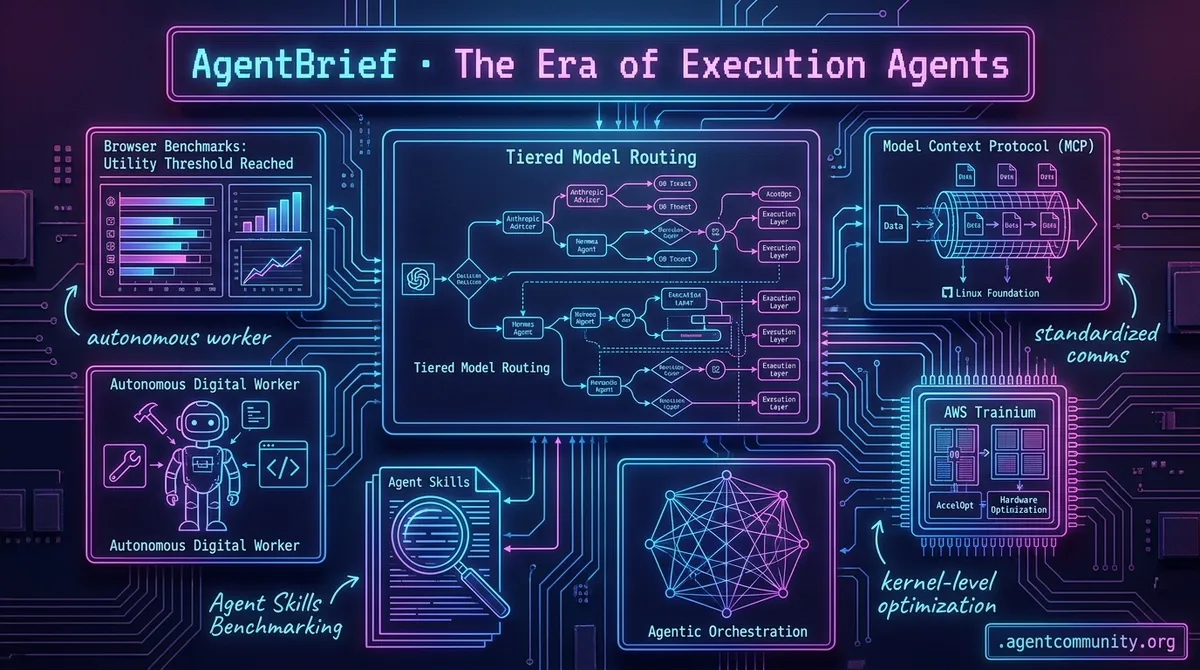
- Utility Threshold Reached OpenAI’s Operator and browser-navigation benchmarks signal a definitive shift from conversational AI to autonomous digital labor.
- Standardizing Agent Infrastructure The Model Context Protocol (MCP) transition to the Linux Foundation provides the structured environment needed to prevent "Agent Retry Storms."
- Rise of Hierarchical Routing Tiered orchestration is becoming the industry standard, utilizing Anthropic’s "advisor" pattern and Hermes Agent for cost-effective reasoning.
- Hardware and Kernel Optimization Systems like AccelOpt are now optimizing their own execution environments on AWS Trainium, moving agents deeper into the infrastructure stack.
X Intel
Why pay for frontier reasoning when you can route for it?
The agentic web is rapidly shifting from monolithic prompting to sophisticated hierarchical orchestration. As builders, we've long known that brute-forcing frontier models is a cost-sink; today's news confirms that the industry is finally formalizing the 'advisor' pattern. Anthropic's new beta isn't just a tool—it's a validation of tiered reasoning where small, fast executors handle the grunt work and only pull in the heavy hitters for strategic turns. This is the architectural shift we need to break the agent cost wall. Meanwhile, the open-source community is moving at a breakneck pace. The explosive growth of Hermes Agent proves that developers are hungry for agent-centric architectures that prioritize long-term memory and self-improvement over simple directory indexing. We are moving toward a world where agents aren't just tools we use, but systems that manage themselves, their costs, and their own skill acquisition. For those of us shipping agents today, the message is clear: focus on the orchestration layer and the memory stack. The models are becoming primitives; the logic is in the routing.
Tiered Model Routing Cuts Costs and Boosts Accuracy
Anthropic has launched its advisor tool in public beta, a move that formalizes tiered reasoning as a core primitive for agentic workflows. By utilizing the anthropic-beta: advisor-tool-2026-03-01 header, developers can now allow executor models like Claude 3.5 Sonnet or Haiku to consult Opus mid-task for high-level strategic guidance without producing user-facing output @claudeai. This advisor pattern typically generates 400-700 tokens of guidance per consultation, focusing the expensive model's reasoning on critical decision points rather than the entire execution loop @claudeai @akshay_pachaar.
The performance gains for this hierarchical approach are significant. Benchmarks show that a Sonnet + Opus advisor configuration scored 74.8% on SWE-bench Multilingual, representing a +2.7pp increase over Sonnet alone, while simultaneously reducing costs by 11.9% per task ($0.96 vs $1.09) @claudeai. Even more striking is the Haiku + Opus combo, which reached 41.2% on BrowseComp—up from Haiku's solo score of 19.7%—at an 85% lower cost than running Sonnet solo @akshay_pachaar @aakashgupta.
Community leaders like @aakashgupta suggest this pattern effectively solves the 'agent cost wall' by reserving frontier reasoning for the hardest turns in a workflow. However, scaling remains a concern; early adopters such as @saneord have flagged current usage limits as a potential bottleneck for production deployments. Researchers @AlexGDimakis and @DimitrisPapail have also noted that this approach validates years of research into model cascades and advisor training.
Hermes Agent Hits 100K Stars as Open-Source Challenger
The Hermes Agent from Nous Research has achieved a staggering 100,000 GitHub stars in only 53 days, a growth rate that dwarf's previous ecosystem milestones @0x_kaize. Architecturally, Hermes differentiates itself by being 'agent-centric,' prioritizing a persona and a 3-layer memory architecture (curated facts, session search, and procedural skills) over the 'workspace-centric' approach seen in tools like Claude Code @MinionLabAI. This allows the agent to self-improve by writing its own skills based on experience @0x_kaize.
Performance metrics are backing the hype, with WolfBench data showing Hermes outperforming both Claude Code and OpenClaw across 89 real-world tasks @WolfBenchAI via @Wayland_Six. Builders are particularly impressed by its local efficiency; while Claude Code has been cited for demanding heavy RAM sessions, Hermes operates within a lean 3,575-character memory budget utilizing smart compression @RihardJarc. The project is further lowered the barrier to entry with Ollama 0.21 now supporting a simple ollama launch hermes command @ollama.
For agent builders, the appeal lies in the project's self-building nature—the agentic loop uses daily compute to refine its own coding and workspace skills @Teknium. With its latest v0.10 release boasting 118 native skills and zero CVEs, compared to nine in OpenClaw, Hermes is positioning itself as the high-security, luxury standard for open-source agents @siliconcarnesf @petergyang.
In Brief
The Universal Skill Marketplace Goes Massive
A surge in modular agent interfaces is transforming developer workflows as libraries for OpenClaw and Claude Code reach critical mass. @tom_doerr has curated over 5,200 skills for OpenClaw, while Shopify has released an AI Toolkit that gives agents direct write access to 5.6 million store backends via MCP @aakashgupta. Builders like @samruddhi_mokal are leveraging this to build specialized business advisors, though security advocates like @MervinPraison warn that the lack of marketplace vetting remains a significant risk for production systems.
Tencent Open-Sources Edge-Ready Embodied Foundation Models
Tencent's new HY-Embodied-0.5 family introduces a Mixture-of-Transformers (MoT) architecture designed for efficient robotics deployment on consumer hardware. The open-sourced 2B model utilizes only 2.2B active parameters during inference, allowing it to run on 16GB VRAM GPUs while outperforming SOTA systems like Qwen3-VL 4B on 16 of 22 benchmarks @TencentHunyuan @AIBuddyRomano. This release, which includes scores of 89.2 on CV-Bench and 92.3 on DA-2K, lowers the barrier for builders creating physical agents without cloud dependency @HuggingPapers @_akhaliq.
MCP Evolves to Standardize Universal Skill Delivery
A new proposal to serve agent skills within MCP resources aims to bridge the compatibility gap between clients like Claude and Cursor. Rhys Sullivan @RhysSullivan proposed a 'skills://' URI pattern with a load_resources tool fallback, a move supported by MCP co-creator David Soria Parra @dsp_. This pattern provides a secure way to inject tool guidance without the prompt injection risks associated with traditional system prompts, according to Darren Shepherd @ibuildthecloud, positioning MCP as the primary infrastructure for portable agent capabilities.
Quick Hits
Models for Agents
- GPT-5.4 Pro's deep planning is driving high inference compute usage for complex agent tasks @Vtrivedy10.
- Gemini 3.2 Pro Preview Experimental has been spotted in active testing @willccbb.
- GLM-5.1 brings open-weight frontier performance to the Droid agent ecosystem @FactoryAI.
Agent Frameworks
- PydanticAI released a master guide on multi-agent orchestration including subagent fanouts @Vtrivedy10.
- Jido agents in Elixir can scale to thousands of instances on 4GB RAM via 2mb heap spaces @mikehostetler.
- AgentCraft emerged as a dominant framework highlight at AI Engineer Europe @idosal1.
Agentic Infrastructure
- Amazon's Trainium2 chip was co-designed with Anthropic for RL-heavy reasoning models @aakashgupta.
- A new anti-detection browser server launched to help agents bypass scraping bot-detection @tom_doerr.
Industry
- Claude Code is now estimated to generate 4% of all public GitHub commits @rauchg.
- xAI is suing Colorado over SB24-205, citing First Amendment protections against AI output regulation @rohanpaul_ai.
Reddit Dispatch
OpenAI and Anthropic push autonomous systems past the utility threshold as MCP standardizes the agentic stack.
We have officially entered the era of the 'Action Agent.' This week’s launch of OpenAI’s Operator marks a definitive pivot from models that merely talk to systems that execute. While conversational AI dominated the last two years, the focus has shifted to the 'utility threshold'—the point where an agent becomes more helpful than the overhead required to manage it. For practitioners, the data reveals a stark reality: we are winning on the web but still fighting for the desktop. OpenAI’s 87% success rate on WebVoyager contrasts sharply with its 38.1% performance on full OS environments. This reliability gap is driving the rapid adoption of the Model Context Protocol (MCP), which recently moved to the Linux Foundation to provide the structured environment agents desperately need to avoid the 'Agent Retry Storm.' In this issue, we dive into the battle for orchestration between LangGraph and CrewAI, the rise of self-correcting RAG architectures, and why Llama 3.2 is making on-device agents a viable privacy-first alternative. The infrastructure for the Agentic Web is being standardized in real-time.
OpenAI Operator Shifts Action Agents from Theory to 87% Success Rates r/OpenAI
OpenAI has officially transitioned from conversational models to action-oriented agents with the launch of Operator, currently available in research preview for Pro Tier users. Designed for multi-step execution across web and desktop environments, Operator allows users to run simultaneous tasks—such as restocking groceries or managing e-commerce orders—by creating multiple concurrent conversations. This release solidifies an 'action-first' pivot, placing OpenAI in direct competition with Anthropic’s computer-use features by offering a consumer-facing interface for legacy web software.
Technically, the system demonstrates a significant performance gap between web-based and OS-level automation. While Operator achieves a high 87% success rate on the WebVoyager benchmark, its performance on full computer-use tasks (OSWorld) sits at a more modest 38.1%. These metrics underscore the 'reliability frontier' where autonomous loops still struggle with the non-deterministic nature of desktop environments. To mitigate these hurdles, OpenAI has introduced features to 'save prompts' for repeated tasks, aiming to bypass reasoning failures in frequently used workflows.
Claude Computer Use Crosses 'Utility Threshold' Amid Reliability Struggles r/Anthropic
Claude 3.5 Sonnet has reached a critical 72.5% success rate on OSWorld benchmarks, crossing the 60% 'utility threshold' for digital intern tasks, even as production developers report a decline in reliability due to increased task abandonment and tool-call hallucinations. To combat these bottlenecks, practitioners are increasingly moving away from raw coordinate-based instructions toward the Model Context Protocol (MCP) to provide agents with structured environmental context.
Model Context Protocol Standardizes Under Linux Foundation r/mcp
The Model Context Protocol (MCP) has transitioned to the Linux Foundation's Agentic AI Foundation, backed by a powerhouse coalition including OpenAI, Google, Microsoft, and AWS to solve the 'n-to-n' integration crisis. Beyond early adoption by Cursor and Replit, the protocol is industrializing rapidly with Shopify routing its AI Toolkit through MCP and the ecosystem now tracking 440 servers with over 930,000 GitHub stars.
LangGraph vs. CrewAI: The Battle for Agentic State r/LangChain
LangGraph is redefining reliability in autonomous systems by introducing 'Time Travel' and persistent checkpointers to handle the 40% failure rate of complex multi-agent loops.
Beyond Retrieval: The Rise of Self-Correcting RAG r/LlamaIndex
Agentic RAG is driving 30% improvements in retrieval accuracy by replacing one-shot vector lookups with iterative 'self-reflection' loops that evaluate document relevance in real-time.
Llama 3.2 and MLX Solidify the On-Device Agent Stack r/LocalLLaMA
Llama 3.2-3B is becoming the standard for private, on-device tool calling via Apple's MLX and Ollama, effectively solving data sovereignty for sensitive file-system interactions.
Discord Chatter
OpenAI’s new autonomous agent more than doubles previous browser-navigation records as the industry pivots to execution.
The 'Agentic Web' is no longer a theoretical roadmap; it is a benchmark-shattering reality. Today's news centers on a fundamental shift from models that simply talk to models that actually do. OpenAI’s 'Operator' has set a massive new precedent, effectively doubling previous browser-automation benchmarks and signaling that the browser is now the primary execution environment for digital labor. But as we move toward autonomous execution, the infrastructure supporting it is bifurcating. We see a growing divide between the 'agent-as-a-service' simplicity of PydanticAI and the complex, stateful orchestration of LangGraph. Meanwhile, the Model Context Protocol (MCP) is rapidly becoming the industry's 'USB port,' though not without significant security warnings from experts regarding autonomous identity exploits. For builders, the message is clear: the stack is hardening. Whether you’re deploying Llama 3.2 at the edge or building complex multi-step loops in the cloud, the focus has shifted from 'can it reason?' to 'can it execute reliably and securely?' Today’s issue breaks down the frameworks, protocols, and observability tools making this shift possible.
OpenAI Operator and the Rise of Browser-Native Agents
The industry is pivoting from conversational chat to action-oriented execution, with OpenAI's 'Operator' setting a new performance ceiling for autonomous web navigation. Achieving a 32.6% score on the OSWorld benchmark, Operator more than doubles the 14.9% previously set by Anthropic's Claude 3.5 Sonnet @helicone. While Anthropic maintains a lead in complex coding tasks, Operator is purpose-built for browser-native logic, with early access testers reporting 85% success rates on multi-step travel and research workflows Discord Dev Digest.
This shift is redefining the automation landscape as developers move beyond brittle DOM-parsing toward robust visual grounding. Frameworks like Browser Use Cloud are already demonstrating high reliability, scoring 78% on a suite of 100 difficult browser tasks @browser-use. As OpenAI introduces the BrowseComp benchmark to evaluate browsing agents @openai, the ecosystem is transitioning from simple navigation to complex, state-managed digital labor, effectively turning the browser into a standardized execution environment for AI workers.
PydanticAI Hardens Agent Logic with Type-Safe Orchestration
PydanticAI is gaining significant traction for its focus on production rigor, achieving a 40% reduction in runtime validation errors compared to manual parsing. While LangGraph models agent workflows as state machines, PydanticAI treats agents as high-level constructs defined by data schemas, providing 100% type safety across backends @TowardsAI @pydantic. Developers report a 15% improvement in velocity when integrating with existing FastAPI or SQLModel stacks, signaling a shift toward 'agent-as-a-service' deployments where stability and developer experience are prioritized Discord Engineering Sync.
MCP Protocol Gains Ecosystem Momentum Amid Rising Security Scrutiny
The Model Context Protocol (MCP) has solidified its position as the 'USB port' for AI agents, though experts warn that its role as a centralized gateway makes it a primary target for identity exploits. Ecosystem partners like Replit and Sourcegraph are targeting a 10x reduction in integration time for new tools, yet security researchers note that rapid adoption is currently outpacing the development of robust security practices Anthropic Silverfort. The urgency for hardening is underscored by the OWASP Top 10 for Agentic Applications, which now labels 'Insecure Agentic Delegation' a critical risk for 2026 OWASP.
LangGraph Hardens Cyclic Orchestration with Multi-Tiered Persistence
LangGraph has solidified its position as the de-facto framework for cyclic agentic workflows, moving beyond linear chains to support complex error-correction loops. A key differentiator is its refined state management architecture which utilizes the BaseStore interface to distinguish between short-term episodic and long-term semantic memory MahendraMedapati27. While practitioners note that managing state consistency in distributed environments remains a hurdle, the framework’s 'time-travel' debugging primitives enable critical manual interrupts for high-stakes tasks Scalable Path.
Beyond the Trace: The Rise of Quality-Centric Agent Observability
Standard LLM monitoring is no longer sufficient; teams are now prioritizing tool call monitoring with agent attribution and quality-centric metrics to reduce debugging time by up to 60% AgentOps.
Small Language Models Powering Local Edge Agents
Meta's Llama 3.2 3B model is matching 8B models for common agentic tasks when utilizing 8-bit quantization to prevent tool-calling degradation on mobile hardware Ollama.
HF Technicals
From autonomous hardware optimization to 0.8B reasoning engines, the agentic stack is moving from chat to execution.
Today’s issue marks a pivotal transition in the agentic web: the move from general-purpose reasoning to deep, verticalized execution. We are seeing agents climb down the stack to optimize low-level hardware kernels while simultaneously climbing up into highly regulated domains like clinical healthcare.
The headline development is AccelOpt, a system that doesn't just write code, but optimizes its own execution environment on AWS Trainium chips. This self-improving loop at the infrastructure layer is a critical step for developers struggling with the efficiency-performance trade-off. Meanwhile, the distillation trend is proving that high-parameter counts aren't always a prerequisite for logic; new 0.8B Claude-distilled models offer a glimpse into a future of ubiquitous, edge-compatible sub-agents.
What connects these stories is a new obsession with verification. Whether it is Salesforce’s xLAM dominating function-calling benchmarks through triple-verified datasets or Google’s MedGemma enforcing strict FHIR-schema guardrails, the industry is moving away from probabilistic chat toward deterministic action. For practitioners, the message is clear: the most valuable agents in 2025 won't just be the smartest—they will be the most reliable and the most specialized.
AccelOpt: The First Self-Improving Agent for AI Accelerator Kernel Optimization
Researchers have unveiled AccelOpt: A Self-Improving LLM Agentic System for AI Accelerator Kernel Optimization, the first self-improving agentic system designed to autonomously optimize kernels for emerging AI accelerators like AWS Trainium. Unlike traditional methods that require deep manual tuning, AccelOpt utilizes beam search to explore the kernel optimization space and an "optimization memory" to store insights from previous iterations to iteratively improve performance.
This architecture allows the agent to effectively automate the infrastructure layer of AI development by learning from slow kernels. The system is benchmarked using NKIBench, a new evaluation suite containing challenging optimization tasks sourced from real-world LLM workloads. This development signifies a shift toward autonomous performance tuning, where agents move beyond high-level code generation to handle low-level hardware efficiency.
By bridging the gap between general-purpose reasoning and specialized hardware constraints, zhang677/AccelOpt enables developers to focus on architectural innovation while the agent maintains peak execution efficiency. This marks a significant milestone in the "agents-building-agents" narrative, specifically targeting the hardware bottlenecks of the modern LLM stack.
Claude Opus Reasoning Distilled: The 0.8B Edge-Agent Engine
The drive toward efficient, edge-compatible reasoning has reached a new milestone with mradermacher/Qwen3.5-0.8B-SFT-Claude-Opus-Reasoning-i1-GGUF. This model leverages supervised fine-tuning based on reasoning distillation from Claude Opus, packing high-level logical capabilities into a tiny 0.8B parameter footprint with a massive 262,144 token context window. Performance benchmarks from Artificial Analysis indicate this family represents a generational leap, providing a low-latency 'sub-agent' capable of complex planning on consumer-grade hardware.
Verticalized Agents and the xLAM Revolution
A wave of specialized models is refining the 'agent-as-a-tool' paradigm, led by the xLAM family securing the 1st position on the Berkeley Function Calling Leaderboard (BFCL). Models like Bharambe-NL/mimir-qwen3-4b-lora-v2 are fine-tuned on the Salesforce/xlam-function-calling-60k dataset, which utilizes a three-stage hierarchical verification process. This shift toward high-precision vertical tasks, supported by the APIGen pipeline, demonstrates that smaller, specialized architectures can outperform much larger general-purpose frontier models in autonomous action tasks.
MedGemma Powers EHR Navigation Agents
Google’s EHR Navigator Agent signals a critical shift toward verticalized agentic architectures in high-stakes medicine. Powered by MedGemma, the system maintains a 10-14% accuracy lead over GPT-4 in clinical tasks by navigating FHIR-formatted patient data. Experts like Sailesh Conjeti highlight that rigid, schema-aware guardrails are essential to prevent 'drift,' with the system forcing agents to surface uncertainty rather than producing confident-sounding hallucinations.
Quick Hits: Education, Research, and SQL Benchmarks
Hugging Face launched its AI Agents Course featuring smolagents and a partnership with Thomas Wolf at DeepLearning.AI. The MiroMind Open-Source Deep Research Space provides a transparent multi-step reasoning loop for event prediction, securing Top-1 positions on 5+ benchmarks. New research into DySQL-Bench suggests that static Text-to-SQL evaluation is insufficient, pushing for dynamic, multi-turn benchmarks to capture real-world agent complexity.