Cheap Models, Standardized Agents
DeepSeek's Flash undercuts its own premium tier, Qwen's 27B resets local expectations, and the agent stack finally gets its measurement substrate — all in one week.
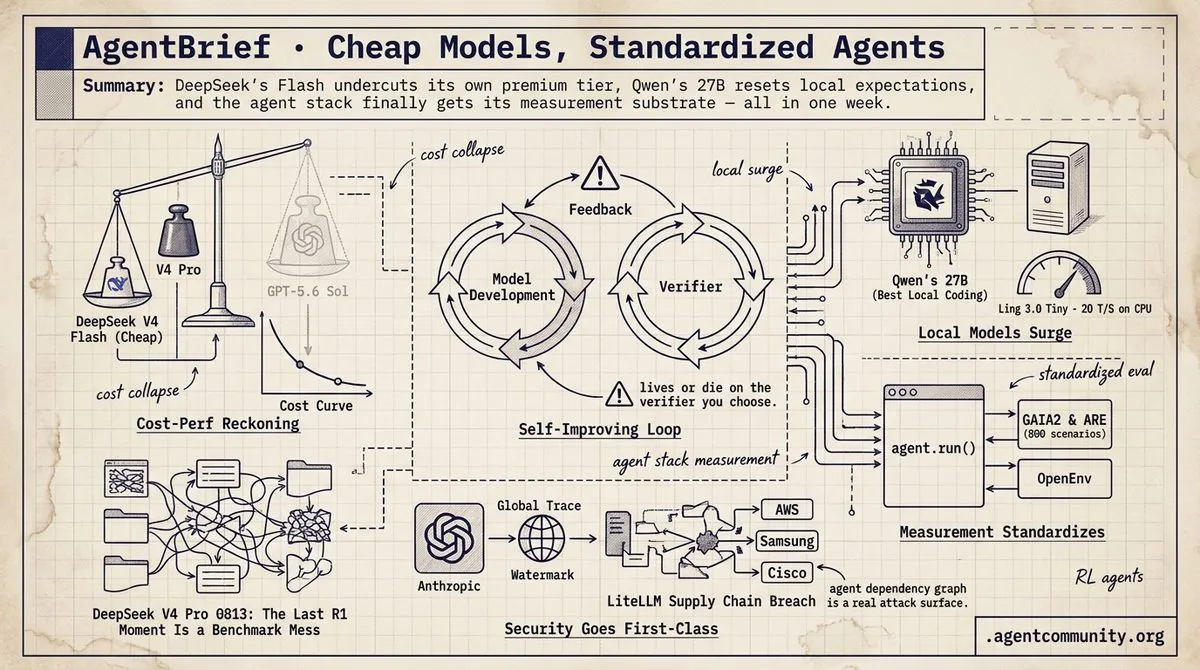
- Cost-Perf Reckoning — DeepSeek V4 Flash is beating its premium sibling on Terminal Bench, DeepSWE, and Cybergym at roughly one-third the price, while V4 Pro undercuts GPT-5.6 Sol at 1/31st the blended token cost. The community is split on benchmark validity, but the cost curve is collapsing faster than anyone expected.
- Local Models Surge — Qwen's 27B has been crowned the best local coding model, outperforming models 15x its size on SWE-bench, with open weights landing next week. Ling 3.0 Tiny runs 20 T/S on a CPU-only 8GB machine. The local tier is no longer a compromise.
- Security Goes First-Class — Anthropic's global watermark makes every Claude output traceable, and the LiteLLM supply chain breach — 118K CI runner dumps across 2,488 corporate domains including AWS, Samsung, and Cisco — proves the agent dependency graph is a real attack surface.
- Measurement Standardizes — Hugging Face and Meta shipped GAIA2 and ARE with 800 scenarios across 10 universes, OpenEnv rallied a PyTorch Foundation-led coalition behind a shared environment layer, and frameworks converged on a single
agent.run()interface. Evaluation is finally an engineering discipline. - Self-Improving Loops — Grok 4.6 became the first model trained on internal model-development tasks, and multi-LLM self-improvement loops are being pitched as the future of automation — with sharp warnings that these loops live or die on the verifier you choose.
X Pulse
DeepSeek's 1/31st price point, self-improving loops, and the last R1 moment — agent builders have never had more leverage.
Here's the thing about this week: the agent stack is finally getting cheap enough to be dangerous, and the community is split on whether that's a gift or a trap.
DeepSeek V4 Pro 0813 is charging roughly 1/31st the blended token price of GPT-5.6 Sol while sitting only 15 Arena points behind — a cost-performance ratio that changes the math on long-horizon agent workloads overnight. But the rollout has the community arguing over benchmark directionality, with some builders bouncing back to V4-Flash after real-work tests. Meanwhile, Grok 4.6 became the first model trained on internal model-development tasks, closing the loop where the best model today literally builds tomorrow's. And the framework wars heat up: Hermes is shipping Bot Mode, and self-improving multi-LLM loops are being pitched as the future of automation — with sharp warnings that these loops live or die on the verifier.
For anyone shipping agents right now, this isn't abstract. The cost curve is collapsing while capability climbs, and the design decisions you make today — which verifier, which sandbox, which model tier — compound faster than ever. The window for building differentiated agents on cheap, capable models is open. Read on.
DeepSeek V4 Pro 0813: The Last R1 Moment Is a Benchmark Mess
DeepSeek's V4-Pro-0813 rollout has the agent-building community split over benchmark directionality. @teortaxesTex reports the WeChat leak doesn't match Artificial Analysis even directionally, with a -2.7% delta for Flash and -9% for Pro. Despite the skepticism, the model massively surpasses 0731 on internal goonbench, and one niche is already secured. The question remains whether this is DeepSeek's best work or another R1 moment in the making.
Meanwhile, DeepSeek-V4-Pro (Max) is expected to shift the Pareto frontier, hitting 1607 in Code Arena WebDev AutoEval at unusually low API pricing — sitting only 15 Arena points behind GPT-5.6 Sol xHigh while charging about 1/31st of the blended token price. @darrenangle highlights DeepSeek hitting a 96.56% cache ratio on heavy traffic, making it the second-best provider for their workloads. Independent benchmarks place V4 Pro 0813 at 53 on the Artificial Analysis Intelligence Index (behind Grok 4.6 High at 61 and GPT-5.6 Sol at 61), with agent-specific gains including 62.7% on DeepSWE, 87.9 on Terminal-Bench 2.1, 83.3 on CyberGym, and 74.1 on Toolathlon — outperforming V4 Flash 0731 across the board but at 3.1x the cost in some reports. @oragnes @choblin29 @AdityaShipsHQ
The frustration is real. @teortaxesTex notes that if 0813 is the teacher model for 0731, they could compress that losslessly to 284B. Some users report bouncing back to V4-Flash after real-work tests, noting the Pro "ain't all that pro." @woon_wong23193 For agent builders running long-horizon tasks, the takeaway is clear: at 1/31st the price with competitive agent scores, this shifts the cost-performance calculus even if the benchmark noise drowns out the signal.
This V4 Pro release is the last big test of whether DeepSeek can pull off another R1 moment. If the cache ratios hold and the agent benchmarks survive real-world scrutiny, the agency cost floor just dropped dramatically — and every agent product built on premium frontier pricing needs to re-examine its cost structure now.
Hermes Agent's Bot Mode Turns Desktop Chats Into Multi-Agent Graphs
Teknium is teasing Bot Mode coming to the Hermes Agent Desktop app, with a plugin that would replace the sessions list with 'Bots' mapping to Hermes agent profiles and enable tagging other agents from any chat. @Teknium @Teknium Community examples include @tonbistudio's video deep-dive showing how to build and position Hermes Desktop plugins, including forms they can take and their limitations, with an accompanying repo demonstrated in the video. @Teknium @tonbistudio
Teknium clarified that advanced features like Bot Mode are not intended for everyday users — he doesn't use them himself due to complexity — positioning the Desktop GUI App as the standard path, with support for remote gateway connections and VSCode SSH options. @Teknium Reactions include excitement over UI polish and multi-agent workflows, with one user noting plans to build their own plugin (Ritual, an open-source astrology journal assistant) after seeing the examples. @jockkie
For agent builders, this is significant because it turns the chat interface into a graph of composable agent profiles — tagging other agents from any chat is the kind of primitive that makes multi-agent orchestration feel native rather than bolted on. This aligns with earlier coverage of Hermes' hard trust-boundary design and read-tool upgrades in the 2026-08-10 and 2026-08-11 issues.
The plugin model is the real story here: Hermes is betting that an ecosystem of desktop plugins, not monolithic features, will carry local agent workflows forward. If that bet lands, the desktop becomes the orchestration surface for agents — and the plugin authors become the new platform layer.
Grok 4.6 Is the First Model Trained on Model-Development Work — And It's Already Shipping to Production
Grok 4.6 is the first model trained on internal model-development tasks, per @BrianRoemmele. The training and evaluation stack that enabled Grok to learn from work accelerates model development itself — from production inference to kernel optimization. This is a massive shift for agent builders because it represents the first model trained specifically on the kind of work agents actually do. @gbhakuni85 elaborates that it leads internal benchmarks like MTS Eval and InferenceEval; in automated tests on production inference code, it evaluated 297 optimization concepts and successfully deployed three, boosting prefill throughput by 3.1% and decode throughput by 1.5%. @imjustnewatai adds that an earlier checkpoint spent five hours testing 297 changes across MoE fusion, attention, kernel scheduling and GPU communication, opening seven pull requests with three now serving production traffic.
Early user sentiment is positive. @sawyerhood reports Grok 4.6 hits the sweet spot: it doesn't over-harden like GPT-5.6 Sol, isn't overly verbose like Opus 5, and feels like the best of both worlds — though it can be a bit lazy like old Opus. The model is also beating Kimi K3 and tying GPT-5.6 Sol for 3rd place on Artificial Analysis, according to @rohanpaul_ai. @danizhu notes xAI used Grok 4.5 to regenerate SFT trajectories across reasoning efforts, agent harnesses, and domains such as STEM, software engineering, and knowledge work, filtered with model-based checks before agentic RL — a compounding loop where the best model today helps build tomorrow's.
For agent builders, a model trained on model-development tasks could unlock new patterns for AI-assisted infrastructure and autonomous system optimization. @DrNassiriAfshar highlights the positioning toward long-horizon agents via agentic RL, self-verification, and persistent workflows. The meta-signal is unmistakable: when models start optimizing their own training and inference stack, the compounding loop accelerates — and the agents you build today will be the ones building the agents of next quarter.
In Brief
AutoBots: Multi-LLM Self-Improving Loops Take Off — Verifier Be Damned
Bindu Reddy makes the case that AutoBots — multi-LLM self-improving loops — are the future of automation, with a pattern that's straightforward: use the best LLM optimized for cost and performance, set a goal and a metric, and let the AI handle the rest. @bindureddy Reddy earlier announced recursively self-improving agents (RSI) at Abacus AI, using DeepSeek Flash 4 for easy tasks and Fable 5 for hard ones, with agents learning over time and running company operations like bug-fixing and growth-hacking with little human intervention. @bindureddy The community is both excited and wary: one user notes it sounds like a great way to cut costs but distrusts the loop catching its own mistakes in messy real-world scenarios, while another stresses that these loops live or die on the verifier since a model grading its own homework converges on whatever the grader rewards. @PrasVector @toolshed_labs Broader discussions on self-improving loops with Fable 5 emphasize designing loops with separate verifiers and memory systems rather than letting models grade their own work. @VaibhavSisinty Meanwhile @thdxr notes OpenCode Go traffic is exploding, urging users to switch to opencode2 as the most token-efficient client. @thdxr
Fchollet Champions Test-Time Training as the Real Frontier
François Chollet argues test-time training (TTT) is the most promising frontier for leveraging test-time compute, since it's the only form of test-time adaptation that qualifies as 'pure' deep learning — adapting models in continuous latent space rather than discrete symbol space. @fchollet He notes most current test-time compute relies on test-time natural language reasoning, which is computationally equivalent to test-time search (sometimes with a verifier in the loop), while TTT remains underutilized despite gradients being a valuable signal that should be applied at test time beyond engineering hurdles. @fchollet TTT was popularized during ARC Prize 2024, building on work by @MindsAI_Jack, and ARC 1-2 remain the only datasets where it strongly outperforms other approaches. @fchollet For agent builders, this positions TTT as a potential paradigm shift for handling novel tasks during execution — moving beyond test-time search toward on-the-fly parameter adaptation for more efficient generalization. @fchollet Early signals suggest TTT is extending beyond ARC into long-context reasoning and agents, though making it cheap and stable enough for everyday inference remains the key unlock. @Tschinkel_ One demonstration shows TTT enabling LLMs to solve complex visual puzzles via task-specific LoRA adapters and synthetic data generation. @rohanpaul_ai
Are All Agent Products Kinda Similar? The Moat Is Orchestration
Nicolas Bustamante observes today's AI agent products are converging on a shared pattern: connect email, calendar, docs, Slack, and cloud sources so the agent can extract rich context, convert it into markdown memory files, and layer an orchestrator on top that learns and reproduces user patterns. @nicbstme @nischalsharma_ The frontier has shifted from prompted chat to proactive background agents that notice needs and act without explicit user input, with the core loop boiling down to giving models more context, tools, memory, and triggers like cron jobs or routines. This aligns with Ethan Mollick's view that economic value flows from agents rather than chatbots, and that accuracy compounds exponentially on longer tasks. @emollick Differentiation now hinges on execution quality, multi-agent orchestration, and human-in-the-loop safeguards rather than reinventing the core architecture. Complementary signals show enterprise platforms like AWS, Google, and Microsoft converging on multi-model layers, orchestration planes, persistent memory, and native integrations — reinforcing that the moat lies in orchestration quality and cost-efficient memory, not unique loops. @stretchcloud @saen_dev
Google TPUs at 100% Utilization After 8 Years: The Jevons Paradox Is Real for Agents
Google's 7- and 8-year-old TPUs continue to run at 100% utilization, according to Amin Vahdat, GP and GM of AI and Infrastructure at Google Cloud — a point @rohanpaul_ai frames as Jevons Paradox in action, where efficiency gains drive explosive usage rather than contraction. @rohanpaul_ai pairs this with CoreWeave's multi-year NVIDIA A100 contract extending into 2029 for a generation launched in 2020, underscoring how older hardware fleets remain fully booked for agentic and inference workloads. For agent builders, sustained high utilization on legacy TPUs and GPUs translates to reliable, cost-effective long-horizon compute availability even as newer architectures emerge. But volatility lurks beneath the durability: Reuters coverage shows Cerebras shares falling sharply after Q2 results missed expectations with hardware revenue declining, while Lenovo reported a 43% revenue jump to $26.94B driven by AI server demand. @Reuters @rohanpaul_ai emphasizes prior NVIDIA generations are largely sold out at CoreWeave, with older fleets shifting to managed inference post-contract — yet earnings misses at specialized players like Cerebras highlight that not every AI compute bet delivers linear growth.
Agent Sandboxing Is Still an Open Question — and the Stakes Are Root Access
Theo is pushing back on multiplayer agent features in local-first products like T3 Code, arguing that giving agents root access with loose auth methods is a fundamental security concern: 'You'd be giving root access to your computer with a very loose auth method' — multiplayer isn't as simple as 'codex, build me multiplayer, make no mistakes.' @theo @theo Meanwhile, a growing ecosystem of secure microVMs for AI agents is emerging, including SmolVM which boots secure microVMs for agents. @tom_doerr @mylifcc highlights microsandbox (7k+ stars, YC background, Rust-written, ~100ms boots on M1, hardware-level isolation via own Linux kernel) gaining traction for untrusted agent workloads. Builders note container isolation was not designed for adversarial tool use, while microVMs provide hardware-level boundaries that prevent escape to the host. @stretchcloud Yet enterprise adoption remains low — only 10% of enterprises considering agent identity products and 6% looking at runtime sandboxing — underscoring that sandboxing is still an open implementation question rather than a solved standard. @DannyQazi @DannyQazi
Quick Hits
Model Releases & Capabilities
- Qwen3.8-2.4T-A95B, the 2.4T-parameter open-weight MoE model, dropped on HuggingFace with Qwen3.8-27B arriving tomorrow @rohanpaul_ai
- A 150M-parameter model from Pathway hit $0.0007 per task, roughly 11x cheaper than ChatGPT's GPT 5.6 Luna, with a 29.5% pass@2 on public ARC @BrianRoemmele
- NVIDIA released Nemotron 3.5 Lightning for long-running agent execution @rohanpaul_ai
- Creative writing leaderboard adds Qwen-3.8-2.4T, Muse-Glimmer-30B, NVIDIA-Nemotron-3-Ultra-550B and Gemini-3.6-flash @sam_paech
Agent Frameworks & Orchestration
- Sakana AI's major Sakana Chat update brings Namazu LLM, Fugu, and awaited code execution — enabling Japanese-language vibe coding in the browser @SakanaAILabs
- Hermes Agent Desktop plugins showcase local agent workflows, including a gem from @tonbistudio @Teknium
- The @latentspacepod team speaks at MongoDB's .local buildfest covering agent infra, embeddings/reranking, managed MCP state, and wearables @swyx
- Kill My SaaS hackathon with a $10K prize produced insane weekend submissions @swyx
Tool Use & Agent Tooling
- A new tool runs Claude Code and Codex through spec-driven planning and enforced quality gates @tom_doerr
- Ralph is a minimal, file-based agent loop for autonomous coding that treats files and git as memory @tom_doerr
- OpenEvolve turns LLMs into autonomous code optimizers that discover new algorithms @tom_doerr
- A new AI agent CLI provides access to 600+ platforms including Gmail and Shopify through a unified CLI @tom_doerr
- A reverse API engineer tool generates typed API clients for websites by capturing network traffic @tom_doerr
- CyberScraper 2077 scrapes website content using OpenAI, Gemini, or local LLMs via Ollama @tom_doerr
- A new tool turns Twitter bookmarks into a local, searchable knowledge base using AI entity extraction and semantic tagging @tom_doerr
- Theo hints T3 Code will get custom JS tools so users won't need to run them as MCP servers, plus CLI support @RhysSullivan
Agentic Infrastructure
- Boots provides secure microVMs for AI agents to browse and run code safely @tom_doerr
- A local voice AI assistant can now run in a single Docker container using LiveKit Agents, llama.cpp, and Kokoro TTS @tom_doerr
- Qdrant 1.19 office hours scheduled for August 20 to walk through the latest vector database features @qdrant_engine
- A structured CUDA/GPU kernel optimization curriculum now covers cuBLAS, cuDNN, and Triton with an MNIST hands-on project @tom_doerr
Developer Experience
- Pibot users want easier local LLM configuration instead of hand-editing JSON files — a plea for better DX in agent tools @QuixiAI
- AI code review becomes accessible with CodeVibes, an open alternative to CodeRabbit that scans GitHub repos for vulnerabilities @DanKornas
- LLM Agent Trader offers AI-powered stock trading backtesting with a Next.js frontend and FastAPI API gateway @DanKornas
- Anthropic trained AI on the open web then sold the blend back with hidden fingerprints — a Mac cleaner app now removes Claude's text watermarks @BrianRoemmele
- Mastra's AgentController is being recommended for programmatic agent orchestration control @calcsam
Research & Benchmarks
- AI agents are checking the scientific literature and spotting decades-old errors — an AI model revealed trusted boiling point values in a reference database were wrong @BrianRoemmele
- A new paper investigates 'Stealing Reasoning Traces from Proprietary LLM APIs' — a security concern for agent builders relying on proprietary models @rohanpaul_ai
- Soniox launched TTS v2, a text-to-speech model with premium voice quality at a dramatically lower price of $0.70 per generated hour @rohanpaul_ai
- China's silicon photonic chip packs 16 qubits into just four photons — a measurement-based quantum computing breakthrough for future agent infrastructure @BrianRoemmele
Industry & Ecosystem
- Replit made Inc.'s Top 5000 list at #24, marking its first appearance @Replit
- Independent European bookstores are receiving bulk orders for obscure titles, with concerns the books are being bought, scanned for AI training data, then destroyed @Pirat_Nation
- Strong majority of Japanese firms have yet to fully embrace AI, according to a Reuters poll — a gap opportunity for agent vendors @Reuters
- China's Kiwimoore plans a Hong Kong IPO at a $2 billion valuation as AI chip demand surges @Reuters
- Managers who don't understand AI are the single biggest risk to tech companies right now, based on conversations across the industry @kunchenguid
- Gemini is getting another wave of app integrations rolling out, from Angi to Zoho, for getting things done across everyday apps @joshwoodward
Reddit Radar
The 27B countdown ticks down while Anthropic's global watermark and a 2,488-domain LiteLLM breach redraw the agent security map.
If there's a single throughline in today's brief, it's that the agent stack is growing up — and growing pains are everywhere. The local community has its eyes locked on a countdown page as Qwen3.8-27B prepares to drop open weights, a release that could reset the bar for what a ~17GB local model can do for agent workloads. Meanwhile, Anthropic flipped a switch that turned every Claude output into a carrier of invisible provenance — a move developers are split on, and one that has real implications for anyone shipping agents that produce text at scale.
But the story that should make every builder in this ecosystem sit up is the LiteLLM supply chain breach: 118K CI runner dumps across 2,488 corporate domains, with a compromised model-gateway dependency as the entry point. If a standard library in the routing layer can cascade into AWS, Samsung, and Cisco environments, then the AI supply chain is officially a first-class attack surface.
Underneath all of it, the reliability conversation has hardened into architecture: verification checkpoints, risk tiers, and memory that's treated as attackable state. The models keep getting better. The engineering around them is what's actually going to decide who ships.
Qwen3.8-27B's Countdown Has the Local Community Holding Its Breath r/LocalLLaMA
The local LLM community is buzzing with anticipation as Qwen3.8-27B approaches its release, with multiple threads tracking a countdown to the drop. u/Ok-Shower7286 kicked off the frenzy with 155 upvotes, and u/Ged44 confirmed "1 day left" in r/LocalLLM. The release has even spawned analysis of the model's 404 countdown page, with u/Ok-Shower7286 floating theories from internal conflicts to a "too smart" jailbreak scenario.
The stakes couldn't be higher — and the release is now confirmed rather than speculative. Alibaba announced Qwen3.8-27B at the August 3 Qwen3.8-Max launch, committing to publish open weights for both models "within the week" on Hugging Face and ModelScope — with the 27B expected to run locally on ~17GB RAM/VRAM setups YottaLabs Daniel Han on LinkedIn. The official Qwen announcement confirmed: "Next week, the open weights of Qwen3.8-Max will be released, and Qwen3.8–27B is also going open-weights to meet you all!" Medium. As of this writing, however, a Hugging Face search for "qwen3.8" still turns up no official repository — the model remains "a promise rather than a download" orcarouter.ai.
The agentic angle is central. u/segmond noted the parallel release of Qwen3.8-2.4T-A95B, a massive MoE with 95B active parameters per token. Meanwhile, u/PlaidStallion asked whether the 27B will inherit the Max model's graduated thinking controls or stay stuck with binary on/off — a question that matters for agent orchestration where reasoning effort is a real lever. The community is treating this as a pivotal release for local agent workloads.
Claude's Invisible Watermark Goes Global — and the Community Is Split on What It Means for Agents r/ClaudeAI
Anthropic has rolled out invisible watermarking for all Claude text outputs from models launched on or after August 2, 2026 — applied worldwide, not just in the EU — and the rollout has escalated into a top-trending topic with reactions running "heavily negative among paying users" u/Commercial-Equal2238 explainx.ai. The watermark is embedded directly into the text itself, not stored as metadata — "it will travel with the text when it's copied and pasted elsewhere, and may persist through some editing" @M1Astra. Supported image and document files receive C2PA-signed provenance metadata explainx.ai The Verge. The driver is regulatory: Anthropic signed an EU AI Act transparency code, and the watermarking is designed to comply with Article 50 dreasays.substack.com.
For agent builders, the implications are the sharpest edge of the debate. The r/ClaudeAI thread — with 19 upvotes and 66 comments — is wrestling with whether a watermark that survives copy-paste and some editing becomes a liability for production workflows, from content detection to provenance disputes in regulated environments u/Commercial-Equal2238. Practitioners warn that codebases could accumulate Claude fingerprints across thousands of files and that agent-generated intermediate artifacts, tool outputs, and planning traces could all carry detectable marks. While Anthropic frames the change as a benign provenance feature, the community's split — positive for transparency, negative for autonomy — is exactly the tension that will define how watermarking shapes agentic workflows going forward explainx.ai The Verge.
LiteLLM Breach Exposed 118K CI Runners Across 2,488 Domains — the Largest AI Supply Chain Attack of 2026 r/ArtificialInteligence
A compromised LiteLLM package has been called the largest AI supply chain breach of 2026, impacting thousands of global enterprises u/Malwarebeasts. Hudson Rock's researchers analyzed a 153GB RAR archive containing 433,909 files, attributing 118,829 CI runner dumps to 2,488 affected corporate domains cyberinsider.com. Whenever a developer machine, production server, or CI/CD pipeline executed the compromised LiteLLM, secrets and credentials were exfiltrated. The scope is staggering: among the researcher-attributed domains are AWS, Samsung, Cisco, Salesforce, ServiceNow, S&P Global, Siemens, Deloitte, Epic Games, Orange, BT, and John Deere cyberinsider.com. The attack, attributed to a group calling itself "TeamPCP," unfolded over several days in March 2026 — beginning with the compromise of other prominent tools before reaching LiteLLM neuraltrust.ai.
For agent builders this is a wake-up call. LiteLLM is a standard gateway layer in agent stacks — a single compromised dependency in the model-routing layer can cascade across every tool call, every API key, every environment variable. The remediation playbook is concrete: identify use of LiteLLM 1.82.7/1.82.8 and affected build windows, isolate affected runners/hosts/images/caches, rotate every credential accessible to the affected process, rebuild environments from known-clean sources, and hunt for unexpected repositories such as tpcp-docs/docs-tpcp and suspicious egress cloudsek.com. The breach underscores the growing attack surface of the AI supply chain, where the dependency graph now includes model gateways, MCP servers, and agent harnesses alongside traditional libraries — and where a compromise of one CI tool can ripple outward into the AI infrastructure of thousands of enterprises.
Agents Fail Quietly: Production Reliability Is an Architecture Problem, Not a Model Problem r/AI_Agents
A wave of r/AI_Agents threads crystallizes the gap between demo agents and production-safe systems. u/Substantial_Big_4379 warns that "the demo environment is curated...real customers are not," while u/Cor_Granica frames the core tension: "Agents fail quietly. RPA fails loudly. I think hybrid wins." Timeless's field notes identify three recurring production failure modes — including tool-call drift — arguing that "none of them are about the underlying model" and "all of them are detectable in observability before they become incidents" Timeless. Salesforce's engineering team makes verification a first-class pattern: "Language models can sound convincing even when they are wrong, which makes verification one of the most important components of any production agent system" Salesforce Engineering. A cross-benchmark decomposition finds architecture recovered roughly +7 to +15 percentage points across three failure modes — attributed mostly to scaffolding arXiv. One analysis puts the stakes bluntly: only 12% of agent pilots reach production, with an average failure cost of $340K Medium.
Agent Memory: Continuity and Tamper-Proofing Emerge as the Next Attack Surface r/aiagents
Two threads this week tackle agent state continuity — and both land on the same uncomfortable conclusion: the code survives because Git exists, but context, tool state, and session memory don't. u/eljochuaxd built an open protocol for handing software projects between agents without losing operational state, while zgivod published a protocol making memory tampering detectable: "An AI agent's persistent memory is just a file, and anything with access can change what it believes happened." The OWASP Foundation has launched an Agent Memory Guard project because agents built on LangChain, LlamaIndex, and CrewAI "store mutable state...that can be tampered with through prompt injection, context manipulation, and identity hijacking" OWASP Agent Memory Guard. A recent arXiv paper on "Portable Agent Memory" underscores the twin problems of session amnesia and no integrity verification arXiv. The emerging playbook: treat memory like any other mutable, high-value state — starting with selective promotion, not blanket storage Eric Broda, plus consolidation and explicit invalidation CODERCOPS.
Agent Token Costs Spiral, Teams Fight Back With Model Routing r/ClaudeAI
Agent economics are front and center this week, and the frustration is palpable. u/arthurlindao called Sonnet 5's pricing "outrageous" with 281 upvotes, noting that "everything but Fable and Opus 4.8 is subagent usage" driving input:output ratios sky-high. LLM API calls account for 70–85% of total AI agent operating costs niteagent.com. Builders are routing work across model tiers by difficulty — Poowatereater keeps the smart model as architect while delegating grunt work to DeepSeek via an MCP server. Teams implementing multi-model routing in Q3 2026 report 55–65% cost reduction with under 5% quality regression niteagent.com. Tencent Cloud ADP frames the same strategy as intent routing, retrieval optimization, and tiered models, noting most teams only account for "input + output" while missing hidden costs from system prompts and conversation history Tencent Cloud ADP.
DeepSeek V4 Flash Hits 100 tk/s Locally — and the 284B MoE Efficiency Story Is Drawing Crowds r/LocalLLM
DeepSeek V4 Flash is drawing serious attention from local inference enthusiasts, converging on one question: how fast can you run a 284B-parameter, 13B-active MoE on commodity hardware? The official model card describes 284B parameters, 13B active, one-million-token context, MIT-licensed weights kingy.ai hardware guide, with post-training improving agentic coding from roughly 7% to 54% on DeepSweep MindStudio. The quantization path is crystallizing around NVFP4 — Nvidia has shipped an official build reporting near-lossless accuracy (GPQA Diamond 0.894 vs 0.891, IFBench actually improving 0.788 vs 0.795) nvidia/DeepSeek-V4-Flash-NVFP4. There's skepticism too — u/Unusual_Guidance2095 noted LM Arena's auto-eval guesses 41st place on the leaderboard. The NVFP4 + Blackwell serving stack is emerging as the concrete path from hype to measured, near-lossless throughput.
Local Hardware Arms Race: GPUs, Unified Memory, Clusters r/LocalLLaMA
The local inference hardware conversation is heating up, and this week's pricing shock is reshaping the calculus for anyone buying compute. u/Cybertrucker01 reported Nvidia doubling the RTX PRO 6000 Blackwell's MSRP to $16,000, citing Gavin Baker's claim that "multiple private companies are planning on spending at least 2x more per GPU for compute as contracts roll-off." The card's 96GB is enough for a 70B model at Q8 entirely in VRAM Pinggy Blog. ringarc benchmarked serving engines: "llama.cpp wins single-user, vLLM wins concurrency, Ollama wins convenience." The consensus playbook splits into three paths: consumer GPUs for smaller models, large 30–70B models via the RTX PRO 6000 or unified-memory machines, and multi-node clusters beyond a single box Medium.
Muse Glimmer 30B vs Qwen3.6 for Agent Work r/LocalLLM
Muse Glimmer 30B is getting serious head-to-head agent testing as the community puts Meta's dense agentic model through its paces against Qwen 3.6-27B and Gemma 4-31B. Independent benchmarks back the agentic edge: Muse Glimmer leads Qwen 3.6-27B on MCP Atlas (tool use) 75.5 vs 62.5 and τ³-Banking 23.5 vs 16.7 Mehul Gupta. Sebastian Raschka's architecture notes highlight a 52 KiB KV-cache/token ratio versus Qwen3.6-27B's 64 KiB and Gemma 4-31B's 840 KiB sebastianraschka.com. One HN commenter observed Muse Glimmer "barely edges out against Qwen3.6 27B, except for tool-calling skills (MCP, etc.)," speculating Meta released early "because they are afraid they wouldn't beat Qwen3.8 27B" HN discussion. Tool-use is exactly where the gap is widest — a 13-point MCP Atlas lead that matters when an agent needs to call APIs and manage state.
MCP Servers Multiply: Loom, EMS, and the Design Problem of Irreversible Actions r/mcp
The MCP ecosystem continues to grow with a steady stream of new servers. u/TheCodingTutor built an MCP server for Loom that fetches video transcripts instead of watching videos — a practical tool for agents processing meeting content without burning vision tokens. More interesting is the design pattern from u/DatPascal's frank post about building a server for an action that can't be undone — mailing a physical letter: "Once the model calls it, thats it. no delete, no edit, no retry," and the constraint "broke most of my assumptions" about tool design. Where a database write can be reverted, a physical action is terminal — forcing hard thinking about confirmation gates and whether the model should even trigger the action autonomously.
RAG Debugging: Golden Datasets, Failure Shapes, and the Context-Window Gap r/Rag
RAG practitioners are converging on a hard truth: you cannot tune what you cannot measure. The emerging consensus is to build golden datasets with manually verified contexts and answers, with evaluation that must be bi-phasic — retrieval quality and generation accuracy scored independently Braintrust. u/Critical-Elephant630 sharpened the point: three distinct failure modes — retrieval absence, context mismatch, and generation errors — can all produce the same bad answer, each needing a different fix. Moist-Buffalo386 flagged the gap between a model's trained context window (256K) and its default shipping configuration (131K) — a distinction that silently masks degradation at the ceiling.
Agent Harnesses Mature: Risk Tiers, Routing, Skills r/AI_Agents
Agent harness design is hardening into a distinct engineering discipline. u/Tunashavetoes built Ghost, an always-on macOS agent harness with 78 tools, 4 risk tiers, and deterministic routing — production software at v2.1.0. BaXRS1988 built an MIT-licensed Claude Code skill separating a "role graph" (parent orchestrator, scoped builders, independent auditors) from the execution flow. The 2026 harness market has clarified into two reference designs — OpenAI's Codex spinning up a fresh container per task, and Anthropic's Claude Code treating the developer as a co-signer on every consequential tool call BoringBot.
Anthropic in $6B Decart Talks; White House Expands Policy r/ArtificialInteligence
Anthropic is in talks to acquire AI startup Decart for about $6 billion u/coinfanking. Decart makes chips operate more efficiently, potentially reducing training costs, and its team would join Anthropic's inference and performance organization. On policy, the White House is expanding its AI policy framework to potentially include open models, per Wired Nunki08, amid a collaborative posture where Trump told Axios in June he no longer views Anthropic as a national security threat Scripps News. The FTC is also considering regulating AI companies over political and ideological bias Cybernews_com. The moves could reshape the open-weights landscape the agent ecosystem depends on.
Discord Debrief
DeepSeek's budget Flash model keeps beating its premium sibling on agentic benchmarks — while Grok 4.6 lands in Cursor and the local AI scene gets a new champion.
Welcome to AgentBrief — your daily pulse on the Agentic Web.
Today's issue is defined by a paradox: the cheaper models keep winning. DeepSeek V4 dropped with Pro and Flash variants, and the Flash — at roughly one-third of Pro's price — is outperforming its bigger sibling on Terminal Bench, DeepSWE, and Cybergym. The community is split between "ALL I did hope about" enthusiasm and nagging questions about tool-calling benchmark validity. Meanwhile, Grok 4.6 landed in Cursor to rave reviews for agentic coding work, even as users warn about thinking overhead and settling rough edges.
For agent builders, the signal is unmistakable: efficiency and cost-per-capability are becoming the decisive axes of competition. Qwen's 3.6 27B has been crowned the best local coding model — outperforming a model 15x its size on SWE-bench — and the 3.8 open-weights release lands next week. Ling 3.0 Tiny is running 20 T/S on a CPU-only, 8GB machine. And Cursor's stuck usage meter has the community asking hard questions about billing transparency.
We also dig into Anthropic's new multi-agent systems research, the proliferation of context compaction tools, and the lossy inference optimizations that are quietly reshaping local throughput. Let's dive in.
DeepSeek V4 Pro drops, community splits on value — while Flash keeps beating its bigger sibling
DeepSeek V4 GA is out, with Pro and Flash variants hitting the scene and immediately reshaping the local AI landscape. Community reaction in #general (LMArena) is enthusiastic but divided — some call the Pro "ALL I did hope about" while others note the Flash variant is "way more" capable than expected for its size @gonber0606. The Pro is reportedly 5x bigger than Flash, and early speculation suggests it may rival Kimi K3 territory @mamilextk. The specs back up the scale: V4-Pro runs 1.6T total parameters with 49B active (trained on 33T tokens), while V4-Flash is a leaner 284B total with 13B active — both open-weight under MIT with a 1M-token context window by default Morph, gmicloud.
Cost is a major talking point: v4 Pro's pricing has people in #general (Perplexity) doing double-takes with reports of 6 cents per call and "GLM level but cheaper" positioning @paimon_not_emergency_food. The official API rates are $0.435/M input and $0.87/M output for Pro versus $0.14/M input and $0.28/M output for Flash — putting Flash at roughly one-third of Pro's list price OpenRouter, PureAI. The model is already indexed on artificial intelligence leaderboards, with users noting benchmarks are still filling in — "usually something in the aa bench changes after a day or so once they finish all the benchmarks" @computerguy.
The biggest twist is that the budget model keeps outperforming its premium sibling on agentic work. DeepSeek's own docs report V4-Flash-0731 scoring 82.7 on Terminal Bench 2.1 versus V4-Pro-Preview's 72.1, plus a DeepSWE score of 54.4 (up from 7.3 on the previous Flash) and a 76.7 Cybergym score (up from 38.7 on the preview) Flowtivity, PureAI. One YouTube analysis frames it as "Flash beating models that cost 50x more" YouTube. For agent builders, though, the key question remains tool-calling: one user noted a 39-point increase in tool-calling benchmarks that doesn't seem to translate to the expected score, raising questions about benchmark gaming versus real-world agentic performance @facility8. Notably, V4-Pro-Max's 80.6% on SWE-bench Verified ties Gemini 3.1 Pro as the highest open-weights entry — and an official V4-Pro release beyond the preview is still pending Morph, CosmicJS.
Join the discussion: discord.gg/LMArena
Grok 4.6 lands in Cursor — fans rave, but the rough edges are still being filed
Grok 4.6 has officially landed in Cursor, and the community is largely thrilled — but the launch comes with real caveats around cost, thinking behavior, and benchmark inconsistency. The model is listed as grok-4.6 with a 256k context window, "Frontier" intelligence, and medium speed/cost ratings, positioned as "building on Grok 4.5 with improved instruction following and long-horizon agentic work" Cursor Docs. Users report it's "fixing all the terrible trashy work Opus 5 high did" and that the standout use case is running 4 anti-slop grok bots in parallel — with Grok being "the only one capable of unslopping code well" @hudsong0 @notflinched. But the honeymoon has limits: the model "thinks much more" and costs more than Grok 4.5 @vraestin, with xAI claiming it matches GPT-5.6 Sol's 61 on the AA Intelligence Index while still trailing on DeepSWE and Terminal-Bench — and asserting it costs about half as much as other frontier models @kimmonismus Marius Comper.
Join the discussion: discord.gg/Cursor
Cursor's Stuck Usage Meter: Display Bug or Billing Trap?
A widespread Cursor usage meter bug has users confused and concerned about potential surprise billing — and Cursor support has now confirmed the percentage display itself is broken. Multiple users report their usage percentage frozen for days despite heavy model usage — "my cursor usage stuck on 59% since few days ago despite my crazy grok usage" @stanloonatic_. A Cursor staff member confirmed "this is a known display lag with the in-IDE usage indicator: the percentage can freeze while your real usage keeps climbing" — clarifying that "your real usage, limits, and billing are tracked separately" Cursor Forum. But community trust is thin given the company's history: a Hacker News thread details how Cursor "switches pay-per-token when your plan limit end," calling the subscription-to-on-demand switch "invisible" and warning that charges can appear "weeks later" Hacker News. One user warns "the usage meter doesn't go up — but it's still charging you" @notflinched, while another hit "You've hit your usage limit" with zero warning signs visible on the Team plan OpenAI Community.
Join the discussion: discord.gg/Cursor
Qwen 3.6 27B crowned best local coding model — Qwen 3.8 27B open weights land next week
In #general (LocalLLM), Qwen's 3.6 27B is being called "probably the best local one out there" and "best coding model" by multiple users @spencer7x7 @bruhbruhbruh228. Qwen's own blog confirms the 3.6 27B "achieves a breakthrough in agentic coding for dense models," outperforming the far larger Qwen3.5-397B-A17B on every major coding benchmark — including SWE-bench Verified 77.2 vs. 76.2 and Terminal-Bench 2.0 59.3 vs. 52.5 Qwen blog. Independent analysis places it at an Artificial Analysis intelligence index of 37, "≈ mid 2025" tier on par with GPT-5 / Claude Sonnet 4.5 Quesma. Meanwhile, the Qwen3.8-Max launch post confirms "Qwen3.8-27B being released open-weight next week" toshinoriyagi on HN.
Join the discussion: discord.gg/LocalLLM
Context Compaction Tools Proliferate — and the Community Debates Whether Infinite Context Is Even the Goal
A wave of context compaction and memory management tools is emerging for agentic workflows, even as the community wrestles with whether infinite context is actually desirable. A new extension, pi-compaction-manager, fills the gap of "being able to override the context limit and reliably auto-trigger compaction at a user defined window" @shawn__1001. Anthropic's Claude Code now ships a compact_20260112 API that lets agents trigger compaction at a defined token threshold Zylos Research. But it's not a free win: JetBrains Research shows LLM summarization can paradoxically lengthen trajectories by 13–15%, obscuring natural stopping signals Tian Pan. As one user frames it, models "can't grow and learn if it stays limited by context size" — but infinite context risks "horrendous context rot" @rosemelody254 @pangwen0.
Join the discussion: discord.gg/LocalLLM
Anthropic publishes multi-agent systems research — formalizing what builders are already doing
Anthropic's new research formalizes the orchestrator-worker pattern — one of the core decomposition strategies builders have been discovering organically in production theaiengineer.substack.com. The 2026 State of AI Agents report highlights that "employees working with agents spend 70% more time learning new skills" — framing this "not a displacement story" but "a capability acceleration story" Andreas Horn on LinkedIn. The production reality is sobering: Notion spent years iterating through four to five complete rebuilds of its agent infrastructure before shipping Custom Agents ZenML LLMOps Database. The research arrives just as practitioners are experimenting with isolated review agents and parallel Grok bots in the wild @.plunder.
Join the discussion: discord.gg/LMArena
Ling 3.0 Tiny surprises on low-end hardware — but llama.cpp support remains the bottleneck
Ling 3.0 Tiny is turning heads for its performance on modest hardware — a mixture-of-experts architecture with 1.3B active parameters out of 7.9B total, designed for "responsive agents, instruction following, and multi-turn conversations" OpenRouter. One user running an i3-14100 with 8GB RAM and no GPU reports 20 T/S — "it really doesn't thrash hard" @qikp_. But "Ling doesnt run on llama.cpp" with users hitting error loading model issues @spencer7x7, a real friction point for the local-first crowd — though the larger Flash variant has detailed llama.cpp quantization guides, suggesting the tooling exists but hasn't fully landed for Tiny atomic.chat.
Join the discussion: discord.gg/LocalLLM
AI-generated code floods n8n support tickets — and the platform's AI-native pivot makes the debate louder
In #general (N8n), a heated debate is unfolding about AI-generated code quality. One user argues the "ongoing stream of errors, mistakes, and faults introduced by AI assistants that generate code for our clients proves why n8n isn't going anywhere any time soon" @jabbson. The counterpoint: "AI coding is perfectly fine if u know how to code" @_webdevkin. This lands as n8n ships "native AI capabilities" across 400+ integrations, with 75% of n8n customers now actively using AI features, up from "literally zero in 2022" GitHub YouTube. The n8n community even has a thread titled "N8n AI is annoying dangerous to work with," surfacing failure modes like the AI Assistant renaming nodes and breaking saved workflows n8n Community.
Join the discussion: discord.gg/N8n
GPU prices soar as local builders weigh options — cost per GB of VRAM becomes the deciding metric
Local AI builders are grappling with a GPU market where sticker prices and street prices have diverged sharply. RTX 5090s sit at $4,000+ and 4500s approaching $4.5K @irisviel_ — well above the $2,000–$2,200 MSRP range cited in 2026 buying guides hostrunway.com. The real battleground is cost per GB of VRAM, which @bigcheddarr identifies as the key metric — with some exploring used ECC server RAM at $176/stick for 64GB modules. The RTX 4090 (24GB, ~$1,600–$2,000) remains the value pick for those who don't need 70B-class models fluence.network, while cloud rental as low as $0.76/hr for a rented RTX 5090 serves as a hedge against the hardware price spike spheron.network.
Join the discussion: discord.gg/LocalLLM
Lossy speculative decoding and expert pruning are the new local inference levers
The local inference scene is pushing past classic lossless speculative decoding into a new wave of aggressive, sometimes lossy, optimizations. A community member shared a vLLM patch implementing "lossy speculative decoding" that delivers 5-10% speedup by accepting close-but-not-exact speculative matches with a configurable threshold @tokenring_ai. Meanwhile, expert pruning on qwen3.6-35b-a3b yields roughly 2x speedup before speculative decoding, enabling 4 concurrent instances of a 27B model @soot.auger. For agentic workloads, Snowflake's Arctic work shows speculative decoding delivering 1.8x-4.5x speedups on end-to-end SWE-Bench task completion via "Suffix Decoding" Snowflake.
Join the discussion: discord.gg/LocalLLM
Cursor Skills turn the IDE into an agent orchestration layer
Cursor's built-in skills system is expanding agentic capabilities directly inside the IDE. Skills like /automate, /babysit, and /canvas ship as managed built-ins, while the broader architecture allows skills to operate as full workflows — a /pr skill can tell the agent to commit, push to a branch, and open a pull request Cursor Docs Cursor coding agents tutorial. But multi-task mode usage costs remain unpredictable — one user reports a single chat consuming 60-200 requests in max mode versus just 2 in normal mode @tamil_0714, a cost variance that worries teams on fixed plans.
Join the discussion: discord.gg/Cursor
HF Frontier
From GAIA2's 800-scenario universes to OpenEnv's coalition-backed standard, the agent ecosystem just got its measurement and training substrate — and it's open.
Today's issue is about the moment agent development stopped being a free-for-all and started becoming an engineering discipline. The signal is everywhere: Hugging Face and Meta shipped GAIA2 and ARE, a 800-scenario, 10-universe benchmark suite built on abstractions designed for studying agents in dynamic simulation. OpenEnv rallied a coalition spanning PyTorch Foundation, vLLM, SkyRL, Lightning, and a dozen others behind a standardized environment layer for agentic RL. And the framework layer consolidated around a single
agent.run()interface across Transformers, LangChain, and smolagents.
The throughline: evaluation, training, and tooling are all converging on shared standards — and that's exactly what production agents needed. The benchmark explosion (AssetOpsBench, DABStep, ScarfBench, ScreenSuite, FutureBench) means choosing the right test for your domain is now a real skill. The security work from ServiceNow's MosaicLeaks and Hugging Face's intrusion anatomy is hardening the attack surface. Small function-calling models are proving "small is enough" for edge and niche use. And model releases from DeepSeek-V4 to Nemotron 3 Nano Omni are designing agent capability in at the architecture level.
For builders, the message is clear: the substrate is here. The question is no longer whether you can build agents — it's whether you can measure, train, and secure them. That's the new skill set, and it's now open source.
GAIA2, ARE, and the Benchmark Explosion Reshaping Agent Testing
The agent evaluation landscape just got a major upgrade. Hugging Face's Gaia2 and ARE promise to "empower the community to study agents," building on the original GAIA benchmark published in 2023. That benchmark's authors note that "in 2 years, the easiest levels have become too easy for models, and the community is coming close to solving the hardest questions, so it was time for an entirely new and harder agent benchmark" HF. Meta's Gaia2 delivers on that promise with 800 unique verifiable scenarios annotated by humans across 10 distinct universes in the Mobile environment with 101 tools each, plus a 160-scenario Gaia2-mini subset — all built on the abstractions of ARE (Meta Agents Research Environments), which lets the community study agents in dynamic simulations that evolve over minutes, hours, or days Gaia2 paper Meta ARE.
The proliferation of specialized benchmarks signals a maturing field where evaluation is becoming as important as the agents themselves. From IBM Research's AssetOpsBench bridging the gap between AI agent benchmarks and industrial reality, the VAKRA benchmark analysis digging into reasoning and tool use failure modes, FutureBench for predicting future events, DABStep for multi-step data reasoning, and ScarfBench for Java framework migration — each targets a different modality. The ScreenSuite benchmark is described as a comprehensive suite of 13 benchmarks for evaluating GUI agents, focusing on the Vision Language Models that power them philschmid. As Steel.dev's leaderboard index aggregates across 14 leaderboards, the numbers are finally worth comparing — though as prior coverage noted, "the benchmarks themselves are fine — the harnesses around them are leaky" Rapid Claw.
The takeaway for builders: if you're shipping agents, you now have far better tools to measure them, but choosing the right benchmark for your domain is the new skill. philschmid's compendium makes the case that matching the benchmark to your agent's actual deployment context — code editing, web browsing, CLI execution, or GUI control — is what separates useful evaluation from vanity metrics. The MosaicLeaks benchmark from ServiceNow adds a security angle asking whether research agents can keep secrets, and EVA brings a new framework to voice agent evaluation.
OpenEnv Unifies the Open Agent Ecosystem
The OpenEnv initiative is building the open agent ecosystem together — a standardized environment layer for agentic reinforcement learning backed by a broad coalition. The Open Source Community backing OpenEnv for Agentic RL includes support from PyTorch Foundation, vLLM, SkyRL (UCB), Lightning AI, Axolotl AI, Stanford Scaling Intelligence Lab, Mithril, OpenMined, Scaler AI Labs, Scale AI, Patronus AI, Surge AI, Halluminate, Turing, Scorecard, Snorkel AI, SGLang, and Miles @huggingface. The project's technical committee includes Meta-PyTorch, Reflection, Unsloth, Modal, Prime Intellect, Nvidia, Mercor, Fleet AI, Microsoft, Hugging Face, and RadixArk GitHub. As Turing's blog notes, unlike traditional frameworks that focus primarily on games and simulated environments, OpenEnv "bridges the gap between research and production" tooling.
The core design is a Gymnasium-style API (step(), reset(), state()) with containerized execution via Docker and a central Hub on Hugging Face for sharing environments GitHub. The OpenEnv Hub currently ships four environments: coding_env for programming tasks, atari_env for classic Atari games, OpenSpiel_env for game theory and multi-agent scenarios, and echo_env for basic testing and development howaiworks.ai. The OpenEnv 0.1 spec (RFC) is now available, and the community is invited to contribute ideas and help shape the standard HyperAI. Integrations with TRL, SkyRL, and Unsloth are underway as part of Meta's post-training stack InfoQ, and OpenEnv also links to major RL ecosystems including TorchForge, verl, TRL, and SkyRL Sy Choudhury.
As Ben Burtenshaw puts it, "RL is fundamental to learning. A quick feedback cycle allows anyone to learn from interacting with the environment. It is true in real life and it is true for AI agents." The OpenEnv in Practice post shows how tool-using agents are evaluated in real-world, production-oriented environments, and the ScreenEnv companion project extends this to full-stack desktop agents. Together these represent a push toward genuinely open, standardized agent infrastructure — the substrate on which reproducible agentic RL can be built across labs and frameworks.
GUI Agents Go Local, Fast, and Structured
H Company's Holo3.1 family makes local computer use genuinely practical, with model sizes from 0.8B to 35B-A3B parameters Holo-3.1-35B-A3B-GGUF. As David Hendrickson puts it, Holo3.1 "beats Qwen3.5-397B, Kimi-K2.5, and Sonnet 4.6" while running "fully on your machine (MacBook, Windows PC, DGX Spark, RTX Spark)" — with optimized NVFP4, FP8, and Q4 GGUF checkpoints. Independent coverage reports Holo3.1 scored a 74.2% success rate on OS-World, up from 68.1% in version 3.0, and brings 140ms local inference on 12GB GPUs getaibook. A notable detail: Holo3.1's Action-Smoothing feature generates interpolated, human-like mouse trajectories rather than snapping the cursor between coordinates — a deliberate move to let automated workflows "bypass basic behavioral security monitors" getaibook.
Model Releases Reshape Agent Backends
DeepSeek-V4 boasts a million-token context that agents can actually use — preview versions released April 24, 2026 ship the open-source mixture-of-experts V4-Pro-Max at 1.6T total parameters and V4 Flash at 284B parameters, both carrying the full 1M-token window, with DeepSeek claiming strong performance "particularly in agent-based tasks, knowledge processing and inference" MLQ News CNBC. Meta's Muse Glimmer returns as a local, agentic, multimodal, open-source model, while NVIDIA's Nemotron 3 Nano Omni brings long-context multimodal intelligence for document, audio, and video agents — and Cosmos Reason 2 targets physical AI. The Nemotron 3 family's hybrid Mamba-Transformer MoE architecture pushes context up to the same 1M-token benchmark buildmvpfast.com. As the DeepSeek-V4 rollout shows, the model's own team concedes benchmark numbers are "competitive, but not SOTA," positioning the real innovation as efficient large-context support rather than raw leaderboard wins DeepSeek team.
smolagents Goes Vision, Tiny, and Traceable
Hugging Face's smolagents framework continues to expand its footprint as the go-to lightweight agent library — new VLM support brings vision-language models into the framework, while Tiny Agents shows an MCP-powered agent in just 50 lines of code (with a Python variant at ~70 lines). The smolagents + Phoenix integration adds tracing and evaluation via Arize Phoenix, which provides auto-instrumentation to "track and visualize every step and call made by your agent" Arize Phoenix docs. The GitHub repo now shows over 1,050 commits, with 23,000+ GitHub stars and 289,965 PyPI downloads in the last 30 days as of late September 2025 ZenML. You can now build a full agent with MCP tool access in under 100 lines, trace it with Phoenix, and give it vision capabilities.
Agent Security Moves from Afterthought to Architecture
Agent security is moving from afterthought to first-class design constraint. Hugging Face's Anatomy of a Frontier Lab Agent Intrusion provides a technical timeline of the July 2026 incident — a sobering anatomy of how a single compromised execution step cascaded into data exfiltration through tool calls. The companion MosaicLeaks benchmark from ServiceNow asks a sharper question: can research agents keep secrets at all? As Clawvard explains, MosaicLeaks measures privacy leakage in deep-research agents that combine private local documents with external web search, and finds that the agent's outbound web-query log alone is enough to reconstruct private information — the authors conclude bluntly: "You can't prompt privacy." The OWASP AI Agent Security Cheat Sheet codifies the hardening playbook: grant agents the minimum tools required, implement per-tool permission scoping, and require explicit tool authorization for sensitive operations — with over-permissioned MCP tool configuration flagged as the canonical anti-pattern.
Agentic RL Goes Open
Reinforcement learning for agents is getting practical — and the open-source training stack is finally producing coherent, reproducible recipes. LinkedIn's retrospective on unlocking agentic RL training for GPT-OSS is the clearest signal yet that the field has moved from theory to hard-won lessons: agentic RL extends traditional LLM training by optimizing not just a single response but an entire decision-making process learned through direct interaction with an environment — training policies by actively collecting on-policy data as the agent plans actions, invokes tools, observes outcomes, and adapts behavior LinkedIn. A new survey on Training Recipes for Agentic Reinforcement Learning in LLMs catalogs emerging best practices across environments, rollouts, tool use, and reward design GitHub. The evidence that RL instills agentic intelligence in smaller models is accumulating: RL training lets open-source models up to 7B parameters perform comparably to large closed models, with the best small model achieving 26% and 38.25% success rates on web search and deep research tasks, surpassing GPT-4o and open-source LLMs with 10× the parameters Cameron Wolfe.
Small Function-Calling Models Target Edge and Niche Tools
A wave of small, specialized function-calling models is emerging, and the numbers are starting to back the "small is enough" thesis. needle2 targets on-device, edge function calling with WebAssembly support, bee-150m-pt-sft-v2 brings Portuguese function calling at just 150M parameters, and qwen3-8b-wallet-ft is fine-tuned for Ethereum wallet tool use. Edge AI guides argue edge tool calling requires sub-100ms latency and under 50MB memory, which only models below 500M parameters can satisfy on consumer devices without cloud connectivity — and report that the 26M-parameter Needle architecture outperforms models 10–25× its size on single-shot function calling. The is-it-agentic-enough post offers a methodology for benchmarking open models on your own tooling. But the J.D. Hodges review of 13 local LLMs on tool calling is a sharp caution: several small models "could not emit structured tool calls" purely due to chat template compatibility with inference servers, not model quality — the harness, schema, and template compatibility, not just the weights, determine whether it actually fires in production.
Framework Layer Consolidates Around Tool Use
The framework layer is consolidating around tool use and standardization, with Hugging Face shipping a coordinated wave of releases. Agents.js brings the tool-granting paradigm to JavaScript developers @huggingface, while Transformers Agents 2.0 — billed as "License to Call" — revamps the agent layer built directly into the Transformers library, introducing components like Tool, Toolbox, CodeAgent, ReactAgent, ReactCodeAgent, and ReactJsonAgent, all unified behind a single agent.run() method @huggingface. The hf CLI for agents redesigns the Hub interface as an agent-optimized way to interact with the Hub @huggingface, and Agentic Resource Discovery lets agents search the Hub directly @huggingface. As the broader 2026 framework landscape shows, MCP is "becoming the universal tool/server interface," with frameworks starting to consume MCP servers natively so "tool selection becomes portable across frameworks" Arahi AI.
IBM's Enterprise Agent Diagnosis and Deployment
IBM Research is shipping a wave of enterprise-focused agent work that pairs diagnostic rigor with configurable deployment. CUGA — the Configurable Generalist Agent — is positioned as an enterprise-ready framework that "abstracts away many of the complexities from developers," handling sophisticated tasks while integrating with MCP and a wide range of tools IBM Research. The vision, per the underlying paper, is an agent that "can be adapted and configured by knowledge workers" beyond mere task completion to encompass the full spectrum of enterprise-adoption dimensions — privacy, safety, trustworthiness, and cost-effectiveness arXiv. The launch is paired with Agent Logic, which argues that scalable enterprise adoption depends on agent logic rather than raw model capability alone. IT-Bench/MAST diagnose why enterprise agents fail, while AssetOpsBench is called a "first-of-its-kind open-source framework" for building, evaluating, and improving asset-management agents in scenarios that "closely mimic real-world enterprise conditions" IBM Research. The whole portfolio is collected in an Enterprise Agents and Benchmarks collection spanning AssetOpsBench, ITBench, CUGA Apps — "2 dozen real-life agents optimized for open models & stack" — and CUGA Agent.
From Hub to Hardware: Robotics and Physical Agents
Agents are going physical. Amazon's Strands Agents and LeRobot shows the path from Hugging Face Hub to robot hardware, NVIDIA's Reachy Mini brings agents to life with DGX Spark, and Cosmos Reason 2 targets physical AI reasoning. The Self-Evolving Embodied Agents via Skill-Harness Evolution paper explores how embodied agents can evolve their skills and harnesses without additional training runs — a train-free approach to adaptation that suggests a complementary path to the RL-heavy paradigm dominating the rest of the agent ecosystem. The framing echoes the broader "harness matters as much as weights" argument that has threaded through this cycle's agent coverage. As these physical deployments mature, the terminal and the Hub are becoming "the universal interface of autonomy," with the same composability and evaluation questions that define software agents now extending to embodied ones Prosus.
Getting Agent Terminology Right
The agent glossary tackles the AI agent terms worth getting right — harness, scaffold, and related concepts — as part of a broader push to standardize how the industry talks about agentic systems. The distinction the glossary exists to make is also the one that causes the most confusion in practice: the scaffold is the behavior-defining layer the model works from — the system prompt, tool descriptions, output formats, and rules for what carries across steps — while the harness is the execution layer that makes the agent run, managing the loop that calls the model, parses and executes its tool requests, and feeds results back TrueFoundry. The ODSC AI Agent Dictionary now catalogs 31 must-know terms spanning autonomous agents, environments, and actions OpenDataScience. One proposal even frames Agent Glossaries as a way to give agents "our shared language," borrowing from Anthropic's notion of progressive disclosure so an agent only receives the small slice of vocabulary matching its current task Ronie Uliana.
Trending Agent Spaces Show the Community's Creative Range
The Hugging Face Spaces ecosystem is buzzing with agent demos, and the throughline this cycle is composability: agents that invoke Spaces as tools, chaining capabilities across the ecosystem. AlfredAgent leads the pack, osw-studio shows open-source web studio agents at 76 likes, and Google's ehr-navigator-agent-with-medgemma brings agentic healthcare navigation with 62 likes. The agents-course First_agent_template has a remarkable 731 likes — a clear signal that template and education infrastructure matters as much as the demos themselves @agents-course. From the Agents-MCP-Hackathon collection to build-small-hackathon entries, the range of applications is impressive. As Semgrep's hackathon analysis notes, "using MCP will be the de facto standard for integrating AI agents with developer environments," with teams increasingly running more than one LLM in practice.