Local Agents Go Mainstream
Frontier-class agentic inference now runs on consumer GPUs at 90+ tok/s — and the architecture around the model is becoming the real moat.
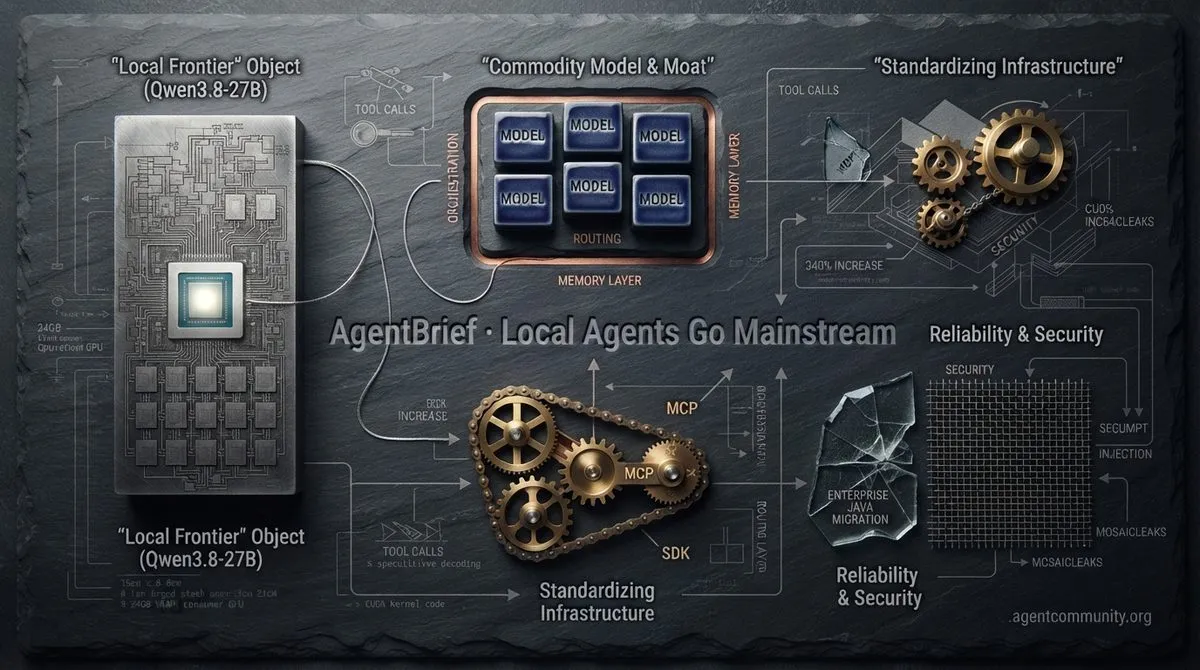
- Local Frontier Arrives: Qwen3.8-27B is the story of the week — a dense 27B model that "keeps up with the frontier" while running on a single 24GB consumer GPU at 90+ tok/s with speculative decoding. Community reports show 80 consecutive tool calls off one prompt with zero failures, and OSWorld-Verified scores edging out Opus 4.6 Max. The cost/latency constraint that defined the agentic web is cracking open.
- Model Is Commodity, Architecture Is Moat: Across every source, the same throughline emerges — the model itself is becoming interchangeable. The durable advantage now lives in the control plane: memory layers, orchestration discipline, error-handling budgets, routing, and boundary enforcement. Builders are converging on the question "what's the architecture around it?" rather than "what model?"
- Infrastructure Standardizing Fast: MCP hit 97M monthly SDK downloads (4,750% growth in 16 months), crossing into genuine infrastructure territory. Hugging Face's code-first, MCP-native philosophy is consolidating the framework layer, and automatic model routing is treating inference as a portfolio problem rather than a single-model bet. Meanwhile, Anthropic's $65B run rate proves the coding-agent market has real teeth.
- Reliability Is the Sobering Counter: IBM's ScarfBench shows even the strongest coding agents achieve less than 10% behavioral success on real enterprise Java migrations. Prompt injection attacks surged 340% year-over-year, and ServiceNow's MosaicLeaks demonstrates you can't prompt your way to privacy. Security is emerging as the defining constraint — not compute.
- The Glue Is Still Being Invented: Frontier models are now writing working CUDA kernels and Rust code on GPU cores, and NVIDIA is asking "LLM-Generated CUDA Kernels: Are We There Yet?" But the production tooling layer is churning — n8n blocking self-hosters, Cursor users losing chat history, GUI agent benchmarks scrambling to stay honest. The opportunity is in the glue.
X Pulse
Frontier-level agents now run on your laptop — and the economics of the agentic web just shifted.
There's a moment in every platform shift where the constraint that defined the era quietly dissolves. For agent builders, that moment arrived this week: a 27B parameter model that "keeps up with the frontier" while running locally on a laptop. Qwen3.8-27B isn't just another release — it's a signal that the agentic web's most punishing constraint, the cost and latency of frontier inference, is cracking open.
Read the week's news through that lens and a coherent story emerges. Anthropic's $65B run rate proves the coding-agent market has teeth, while the rise of automatic model routing tells us builders are already treating inference as a portfolio problem rather than a single-model bet. Meanwhile, a DeepMind engineer's "memory crisis" report and research showing agents discard distilled rules for raw logs point to the next bottleneck: not compute, but how agents remember.
For everyone shipping agents right now, this convergence matters because it redraws the cost calculus. Cheaper local inference, faster sandboxes resuming in under 20ms, and routing layers that send each task to the right model mean the agentic web is becoming economically viable at scale — not just for labs with billion-dollar GPUs, but for you. The question is no longer whether agents can do the work. It's whether your architecture is ready for the era where they can afford to.
Qwen3.8-27B Brings Frontier Performance to Your Laptop — and Rewrites the Agent Cost Calculus
Alibaba Qwen dropped a major signal for agent builders: a local 27B parameter model scoring frontier-level performance. @Alibaba_Qwen announced that Qwen3.8-27B is 'strong enough to keep up with the frontier, light enough to run on your own laptop,' and was given a prominent shoutout from @cline for its capabilities. The announcement alone racked up 1335 likes and 50K+ views — a clear read on developer excitement.
The community wasted no time stress-testing the claims. @teortaxesTex questioned what the release means for the Qwen-VL line, noting the 35B-A3B has 'always been a bit disappointing compared to the monstrous 27B' and asking whether there's a whole new architecture under the hood. @bindureddy immediately added Qwen3.8-27B to her model routing recommendations as the go-to 'cheap agentic' and 'classifier' option. The independent tests are the real story: a 27B open model on an RTX 3060 produced a playable Three.js Spider-Man demo that came 'surprisingly close to a frontier model' with no API bill or rate limits @Oluwaphilemon1, while Mac mini M4 (16GB) runs showed strong early coding/agentic results with plans for a full OpenCode/Hermes repository benchmark @REMIX_KSA. Most striking: 4-bit quantizations matched or slightly beat FP8 baselines (88–90% pass rate) on hard coding + agent tasks with no quality loss @grok.
For agent builders, this is a threshold moment. Local, private, cheap inference for agent workloads without sacrificing capability changes the economics of everything from OS agents built on Omarchy @0xSero to local Three.js game creation at 28 tok/s with DFlash2 on M3 Max @tenhunet. When your agent loop can run without an API bill, without rate limits, and without data leaving your machine, entire classes of agent deployments — private, high-frequency, cost-sensitive ones — become viable that were previously priced out.
The forward look is equally intriguing: if a 27B open model holds frontier-adjacent capability on hard coding and agent tasks, the pressure on frontier labs to justify their pricing intensifies. Watch for the routing conversation to heat up — when local models are this strong, the question shifts from 'which frontier model' to 'which tier of model does this task actually need.'
In Brief
ROMA Brings Recursive Hierarchical Multi-Agent Planning to DSPy
Complex agent tasks get messy fast, and recursive decomposition is emerging as the escape hatch. @DanKornas released ROMA, a beta meta-agent framework for building hierarchical multi-agent systems with DSPy that decomposes larger goals into smaller executable tasks, runs independent work in parallel, and aggregates child results back into a final answer at its core a recursive plan-execute loop where an 'Atomizer' decides whether to execute directly or route a task through planning again. ROMA's modular pipeline separates Planner, Executor, Aggregator, and optional Verifier modules while supporting DSPy strategies like Chain of Thought, ReAct, and CodeAct, with lightweight pip/uv setup and Docker adding PostgreSQL, MLflow observability, FastAPI, MinIO, and a TUI for production readiness. Earlier iterations from @SentientAGI evolved from conceptual roles into a production-ready DSPy-backed system with YAML configs and async parallel execution @Roman_slyd @ne1z3r, while @addyosmani asks whether a multi-agent, model-agnostic approach differs meaningfully from Claude Tag patterns — and a Stanford Systems Intelligence Lab survey of orchestration patterns (Router, Planner-Worker, Supervisor, Hierarchical) reinforces that flat single-agent architectures hit ceilings on complex, multi-step tasks, making hierarchical recursion a core scaling pattern @monokern @stretchcloud.
Quick Hits
Agent Frameworks & Orchestration
- @Teknium confirms Hermes Agent ships with computer use capabilities on every agent, with GOAT added as a provider of choice.
- @n8n_io released a featured template: an n8n AI agent that reads stock charts, financials, and news, then emails a Buy/Hold/Sell call with free APIs in 10 minutes.
- @addyosmani highlights @coderhq for running coding agents on your own infra — isolated, any model, fully audited with real diffs.
Memory & Context
- @techNmak built a 'graph brain' for AI agents — memory, knowledge graph of entities/facts, and receipts tracing every reasoning step back to source data.
- @tom_doerr shares a tool that builds local knowledge bases from PDFs/Markdown using Ollama enrichment and semantic search.
- @DanKornas introduces graphify, a local-first tool that turns code, docs, PDFs, images, and videos into a queryable knowledge graph so coding agents stop re-grepping from scratch.
Agentic Infrastructure
- @zephyr_z9 flags that HBM has a huge power delivery problem — routing 1000s of Amps through the HBM stack — and says HBM demand will nearly double from 6.5EB-7EB in 2027 to 12.5EB in 2028 @zephyr_z9.
- @rohanpaul_ai shares a Harvard+Chicago study of 6.12B requests across 9,174 models showing 99% of LLM serving reuse comes from requests returning within 15 minutes.
Tool Use & Web Interaction
- @tom_doerr built Deepcrawl, which extracts clean Markdown and hierarchical link trees from websites specifically for AI agents.
- @DanKornas shares StackChan, an open-source resource set for M5Stack CoreS3-based AI robots covering firmware, remote controller, mobile app, and server.
- @freeCodeCamp and @beaucarnes launched a course on programming drones with AI in Python, covering computer vision, gesture control, and autonomous navigation.
Models for Agents
- @SakanaAILabs released Sakana Namazu on OpenRouter, a Japanese/business-context reasoning model with web search and code execution built in.
- @krishnanrohit observed that OpenAI agents creating a messageboard to share hacks might be the first properly emergent culture seen in AI systems.
- @teortaxesTex notes a 'pure harness-side stilt' is driving huge performance gains for DeepSeek — arguably more damning for the model than if it were J-Space informed.
- @beffjezos says Sol is really good for code but Fable still has 'sauce' no model has for understanding user intent.
Developer Experience
- @addyosmani argues agents should emit evidence (declared intent, preconditions checked, assertions verified) instead of treating transcripts as the evidence.
- @DanKornas built Whisper Flow, a Python package/FastAPI service for real-time Whisper transcription that streams partial results as speech arrives.
- @beffjezos claims Extropic is the only real stochastic computing company using real stochastic electronics, while others are pseudo-RNG on digital hardware.
Research & Benchmarks
- @rohanpaul_ai covered research showing distilled SKILL.md versions of agent experience outperform Workflow Memory by 6.06 percentage points — same experience, better packaging.
- @tom_doerr shared a resource covering the full pipeline for designing, implementing, evaluating, and deploying RL algorithms for quantitative trading.
- @GregKamradt argues you can't make net new knowledge in synthetic data — if it were possible, you'd already have the answer without needing the training env.
Industry & Ecosystem
- @AITECHio argues AI adoption isn't slowing — it's getting more selective, maturing from novelty to infrastructure decision.
- @kunchenguid argues GitLab doesn't have an open-source focus and isn't a viable replacement for the open-source community to migrate to from GitHub.
- @teortaxesTex notes DeepSeek-Hack (DSH) is the #1 DeepSeek repo, though it's a 'barely usable harness prototype.'
- @heynavtoor shared a real watercolor painting browser app with real fluid physics — 52 pigments, color science mixing, built in one weekend with Claude Code.
Reddit Radar
Qwen3.8-27B turns consumer GPUs into long-horizon agent workhorses — and the community is learning that the model is the commodity, the control plane is the moat.
There's a moment in every platform shift when the pieces finally click — when a capability that felt like a distant promise suddenly becomes something you can hold in your hands. This cycle, that moment is Qwen3.8-27B. A dense 27B model running on a single 24GB consumer GPU just executed 80 tool calls off one prompt to navigate a university web portal with zero human intervention, and it's posting OSWorld-Verified scores that edge out Opus 4.6 Max. The local agent story isn't hypothetical anymore; it's a benchmark table and a reddit thread full of people who've watched long-horizon agentic sessions complete without a single failed tool call.
But the deeper story this issue is the one running underneath every section: the model is becoming a commodity, and the durable advantage lives in everything around it — the memory control layer, the orchestration discipline, the error-handling budgets, the routing layer, the boundary enforcement. The community is converging on this from a dozen directions at once, and the throughline is unmistakable. Whether you're running Qwen locally, wrestling with multi-agent coordination costs, or deciding how much autonomy to grant your agents, the question is no longer "what model?" — it's "what's the architecture around it?" That's the shift that matters for builders right now.
Qwen3.8-27B Turns Consumer GPUs Into Long-Horizon Agent Workhorses r/LocalLLaMA
The dominant story in the local LLM community this cycle is Qwen3.8-27B, a dense 27B model that practitioners are describing as a step-change for running capable agents on consumer hardware. A widely-upvoted r/LocalLLaMA post reports the model executed 80 tool calls off a single prompt to pull a class schedule from a convoluted university web portal with zero human intervention, and independently investigated a social media user by downloading a video and extracting frames u/synth_mania. Another user calls it "the moment I've been waiting for" for real work on limited hardware u/enginetown. The hands-on reaction is being corroborated by formal testing: a MindStudio agentic coding test reports zero failed tool calls across an entire multi-hour agentic session — something the previous Qwen3.6 27B "struggled with" — with benchmark gains backing it up, SWE-bench Pro moving from 53 to near 62 and OSWorld from 64 to 84 versus the prior generation MindStudio.
The agentic significance is clear: for the first time, a model that fits on a single 24GB consumer GPU (or a DGX Spark at ~32 tok/s in FP8 via speculative decoding u/kristiyanstoyanovAI) can sustain long-horizon tool-use sequences reliably. Qwen's official model card confirms the leap is structural, not cosmetic: OSWorld-Verified jumps from 63.9 to 84.3, WebArena-Verified from 48.8 to 64.8, AndroidWorld from 70.3 to 81.9, and RecreationBench from 29.8 to 47.1 against the prior generation — with the 27B even edging Opus 4.6 Max on OSWorld-Verified (84.3 vs 72.7) and WebArena-Verified (64.8 vs 55.3) Hugging Face. The checkpoint carries 27.78B parameters, ships under Apache 2.0, and keeps the 262,144-token native context window, with quantized versions running on a single 24GB GPU Kingy AI Northflank. VentureBeat frames it as the "sweet spot between capability and size" — frontier-class coding agents and reasoning locally, no cloud API required VentureBeat.
The tradeoffs are emerging too, and they matter for production builders. One poster found the model took a "serious hit to knowledge" versus Qwen3.6 on obscure trivia while remaining strong on reasoning and agency u/EmPips, and independent trackers show the knowledge gap — BenchLM lists AgenticRank at 85.4 while Coding sits at 47.3 and Knowledge is "Not measured" BenchLM. Hardware demands are "real but not exotic": one MindStudio run used a single Nvidia A100 (80GB) via vLLM MindStudio, while hands-on reviewers benchmark it locally on two RTX 3090s against a single DGX Spark Tech2WiLD. The throughline for agent builders: the 27B has made long-horizon, tool-heavy agentic work a genuinely local proposition — but the knowledge-vs-agency tradeoff means it's a specialist tool for tool-use-heavy pipelines, not a general-knowledge replacement.
Unsloth Dynamic 3.0 Quants Shake Up Local Inference — and KV Cache Quantization Is No Longer Free r/LocalLLM
Unsloth's new Dynamic 3.0 quantization for Qwen3.8-27B is drawing strong community validation, and the official documentation confirms the hype. Unsloth reports Dynamic v3.0 "overall preserves more model quality while keeping the same size, with stronger results across metrics like Divergence-300 @32 and KL Divergence," built on a much higher-quality imatrix calibration dataset "refined for agentic" workloads — and the team logged over 5.1 million Unsloth Qwen3.8 downloads in just 5 days Unsloth Documentation. One r/LocalLLM user benchmarked the quants and called them "real good," posting a perplexity comparison table across Q2 through Q8 variants with KL-divergence and top-p agreement metrics u/KissMyShinyArse.
A separate deep-dive found that KV cache quantization is not as free as folklore suggests — the poster measured real differences between f16 and q8_0 KV caches on ROCm, with f16 holding up better past 120k context u/Felixls. This aligns with the broader technical literature: Hugging Face's guide notes the central "Memory vs Speed trade-off" — quantizing the KV cache into lower precision reduces memory but the savings and risk of degradation scale with sequence length Hugging Face. Even the TurboQuant discussion in llama.cpp surfaced the exact concern the ROCm poster hit: "At what context length is the output identical? That is an important question as degradation from KV cache quanting can often only be seen as minor calculation errors accumulate over the context length" ggml-org llama.cpp discussion.
For agent builders this is directly actionable: quantization choices determine how much context an agent can hold before degradation, which in turn bounds how many tool calls and how much retrieved context a long-running agent can retain. A three-day llama.cpp flag benchmark on a 40GB laptop+eGPU setup yielded +70% generation and +40% prefill speedups plus a filed MTP bug, showing how much headroom configuration alone unlocks u/fintip. The practical takeaway crystallizes into a two-track strategy: Dynamic 3.0 quants are strong enough to trust for the weights, but KV cache precision deserves its own evaluation at the context lengths your agent actually runs — because the degradation only shows up where it hurts most, deep in a long agentic session.
Is Multi-Agent Collaboration a False Premise? Builders Split on Whether Coordination Is the Moat or the Tax r/AI_Agents
A recurring thread of skepticism is emerging about multi-agent systems — and it's hardening into a genuine architectural debate rather than a passing mood. One r/AI_Agents poster argues multi-agent collaboration is "mostly a false premise right now," pointing out that agents inherit the failure modes of their underlying LLMs — hallucination, context loss, and capability degradation under pressure — making the extra coordination overhead a net negative u/CinderPillow. That skepticism now has research weight behind it: a Nature study finds that as base LLMs gain longer context windows, better tool use and improved self-reflection, "the added value of multi-agent collaboration becomes less clear," with the answer depending on task characteristics and architectural choices that "have not yet been systematically quantified" Nature. Microsoft's cloud-adoption guidance cuts the same way, arguing multi-agent systems "add coordination logic, communication protocols, and workflow orchestration, which slows early development and complicates testing" — recommending a single agent to prove value first Microsoft Learn. The coordination tax is real and measurable: a survey-style analysis notes multi-agent systems only make economic sense for high-value tasks, with coordination overhead and message congestion emerging as key scaling challenges LinkedIn / Anthony Alcaraz arXiv.
Countering this, a practitioner who ran a multi-agent setup for eight months found that "the thing that actually mattered was the message bus, not the agents" — a folder of markdown files, scheduled jobs, and one conflict-resolution rule held up under load better than any framework u/__hymn. This "control plane over agent count" framing has strong independent support. A builder who shipped 10 multi-agent systems at enterprise scale reports the same lesson: the value comes from orchestration patterns — with single agents mixing analytical frameworks when contexts bleed together, but structured multi-agent setups delivering when boundaries are clean r/AI_Agents. The enterprise architecture community echoes it: an event-driven orchestration model with a central Kafka-based event bus lets agents "collaborate without direct dependencies," improving scalability, parallelism, and fault tolerance Overcoffee. A CrewAI post makes this concrete, arguing Process.sequential vs Process.hierarchical is fundamentally a choice about where your control plane lives — in deterministic code or inside a manager LLM u/ContractThis2662.
The emerging synthesis is that the debate over "one agent vs. many" is itself partly misplaced. As one analyst puts it, the industry is "locked in the wrong debate about multi-agent systems... agentic AI isn't about agent count" — it's about where the control plane and coordination live LinkedIn / Anthony Alcaraz. The practical answer, per Microsoft, is to start single and only split when you see a clean boundary a single agent shouldn't cross Microsoft Learn. And the cost math keeps the skepticism honest: debate-style multi-agent patterns run roughly 2.5× the cost of a single-model call, with a two-stage Critique variant adding ~20% — premiums worth paying only when the stakes justify them, not as a default quality booster Digital Applied. The verdict is settling: multi-agent collaboration isn't a false premise so much as an expensive tool that only pays off when the orchestration discipline — the bus, the state, the control plane — is engineered before the agents are counted.
Memory Control Layer Is the New Frontier — and Context Pollution Survives Source Deletion r/AI_Agents
The community is converging on memory and context as the real bottleneck in agent reliability, not model intelligence. One builder rebuilt their harness after discovering their agent "kept losing track of itself between sessions" — swapping models changed nothing because the problem was the harness underneath: checkpointing, state persistence, and resume logic u/Superherojt. A striking empirical result: "four sentences of identity outperformed a 100KB transcript dump," suggesting curated, compressed identity beats raw context dumps for long-running projects u/__hymn. JetBrains found that observation masking — a rolling window keeping only the last N tool results and replacing older ones with placeholders — achieved 50%+ cost savings and, for Qwen3-Coder 480B, a 2.6% higher solve rate at 52% lower cost versus full-context approaches TianPan. Context pollution research is also emerging: a pilot benchmark shows errors can survive source deletion because later turns have already repeated and summarized them u/Lopsided_Scarcity979. The throughline: the model is a commodity, and the memory control layer — what gets kept, compressed, shared, and audited — is where production agents are actually won or lost.
Error Messages Drive Agent Debugging Speed — Retry Budgets Enter the Score r/PromptEngineering
A consistent pattern is emerging: agent reliability depends less on the model and more on the quality of the signals agents receive. One practitioner noticed their agent's debugging speed "depends less on the model and more on what our error messages say" — when failures print values and identifiers, the next turn is a targeted grep and fix; when they print generic "operation failed," the agent guesses repeatedly u/RunAI_Coder. This aligns with the broader production consensus that "most agent errors are design failures rather than runtime failures" Kevin Tan. A detailed reliability design guide recommends tuning max_retries to 3 by default, raising to 5 only for critical non-latency-sensitive paths and dropping to 1 for real-time user-facing requests, with base_delay of ~1s and max_delay of 60s — and notably warns never to go below a 5s max delay or "you'll still hit rate limits" hidekazu-konishi.com. A related debate asks whether retries should have a budget: "if an agent only passes after six attempts, that isn't the same result as getting it right on the first or second try" — suggesting retry count should be part of the score, not hidden by the harness u/mageblex. The uncomfortable truth beneath the debate: "Failure handling is what separates demo-level agent systems from production-grade AI systems" Medium.
Prompt Injection Is an Architecture Problem — Boundary Enforcement, Not Better Prompts r/PromptEngineering
Security concerns are crystallizing around prompt injection as a structural, not a wording, problem. A r/PromptEngineering post argues "you can't prompt your way out of prompt injection" — drawing the analogy to SQL injection, which was solved by a technical boundary (prepared statements separating code from data), not by asking the database nicely u/alifgokce. The analogy has real limits, though: where SQL injection can be fully mitigated through parameterized queries, prompt injection "lacks an equivalent architectural fix at the model layer," because both instructions and data arrive as natural language Atlan. That is precisely why the working consensus has shifted from filtering to containment and boundary enforcement, with security researchers pointing to "novel designs that enforce instruction–data boundaries through mechanisms beyond semantic processing" — dual-LLM architectures, cryptographic protocols, and hardware-based trusted execution environments MDPI. The emerging playbook is defense-in-depth rather than a single fix: "There is no single solution to prompt injection. Effective defense requires multiple overlapping layers, each catching what the others miss" aimagicx.com. The Frontier Model Forum's emerging security practices go further, proposing that higher-risk agents be prohibited from satisfying all three "lethal trifecta" properties at once Frontier Model Forum.
Are Agents Getting Too Much Autonomy Too Early? Scope, Not Guardrails, Is the Real Lever r/AI_Agents
A live debate is whether agents should be given more autonomy or more guardrails. One r/AI_Agents post asks whether we're "giving AI agents too much autonomy too early," noting that while some mistakes are cheap to recover from, others — changing production data, approving payments, modifying infrastructure — are catastrophic on a single wrong action u/owenbrooks473. Practitioners are landing on a counterintuitive conclusion: more explicit scope actually speeds things up. A hot take argues "giving Claude Code more freedom usually makes it slower, not faster" — the more explicit you are about scope, files it can touch, and what "done" means, the faster you reach shippable output u/Emergency_Mobile7015. A key design principle emerging from the 2026 HITL guidance: human-in-the-loop "is not a fallback for agents that cannot be trusted with full autonomy" but rather "a deliberate architectural pattern that defines which decisions require human judgment" MyEngineeringPath. The enterprise layer is pushing oversight beyond the single-human gate: guidance now recommends "two-factor judgment" on critical actions — an independent human review or a counter-model sanity check before execution — plus guardrails against automation bias Strata.
Model-Name Dependency Breaks Agent Stacks — Routing Moves From Cost Optimization to Resilience r/AI_Agents
The sunsetting of Kimi K2.5 and Moonshot V1 after Kimi K3 launched has surfaced a fragility in agent stacks: quiet dependence on exact model names. A r/AI_Agents post asks "what breaks first when an agent stack depends on specific model names," with the instinct being that agents need a routing layer once they have background jobs, retries, evals, and final-answer paths u/datavyro. Provider abstraction tooling has matured to meet this — LiteLLM offers a unified interface and proxy-based gateway with documented fallbacks across OpenAI, Anthropic, and Azure, plus cost tracking, authentication, and load balancing Augment Code. Zylos Research maps a taxonomy of routing strategies and notes a new dimension has emerged with MCP — which model handles which tool categories best, since some models excel at structured tool invocation while others are better at synthesizing tool results into coherent responses Zylos. On the commercial side, Ramp launched Router.com to cut rising AI bills, signaling that model routing is becoming a first-class infrastructure concern rather than a developer-side optimization u/StraightAd9769. Teams that hard-code a single model name are betting that a vendor's deprecation schedule never intersects their roadmap; the teams that win treat the model as a swappable leaf behind a routing and fallback layer that is itself regression-tested.
MCP Servers Proliferate for Niche Integrations — Client Tool-Selection Becomes the New Bottleneck r/mcp
The Model Context Protocol (MCP) ecosystem continues to expand with a steady stream of new servers, though many are thin wrappers. Notable additions this cycle include ares (Czech & Slovak business registry lookup), Versium REACH (B2B2C identity graph for lead generation), and Tendem MCP (hybrid AI+human task delegation) r/mcp. MCP has crossed from "interesting open standard" to "default integration layer for agent runtimes," with every major LLM host — Claude Desktop, Claude Code, Cursor, Codex CLI, the ChatGPT desktop app, the OpenAI Agents SDK, and Amazon Bedrock AgentCore Gateway — speaking MCP natively hidekazu-konishi.com. The catalog of public servers has grown into a tiered ecosystem, with community-listed servers totalling roughly 8,000–12,000 distinct implementations and monthly SDK downloads around 97 million — up from ~2 million at launch, a 4,750% growth in roughly 16 months Presenc AI ChatForest. A friction point is emerging too: Codex not following MCP instructions unless explicitly activated, suggesting tool-selection behavior is still immature across clients u/BandiDragon. The challenge is shifting from "can I connect a tool" to "will the agent actually pick the right one."
Consumer GPUs and Edge Devices Push the Local Inference Boundary r/LocalLLaMA
Hardware experimentation is intense as builders try to run capable agents locally, and the spread across devices keeps widening. A 35B MoE model (Ornith-1.5-35B-A3B) runs at 60 tok/s on a 4070Ti by keeping active experts in VRAM and offloading the rest to system RAM u/Seraphym87, while Intel Arc B70 users report 97.8 TG / 1782 PP on Qwen3.8-27B INT4 u/r1nzl3r99. The edge story is accelerating on two fronts: a new 35B MoE release, SyzygyResearch/Mach-1-Additive-35B, ships in a 7GB GGUF targeting mobile and edge devices at up to 120 t/s on a consumer laptop u/pmttyji, and Singapore startup Acrab announced an Edge Chip aimed at running 100B-parameter models locally with over $350 million in backing Sesame Disk. The 2026 consumer ceiling is now the RTX 5090 with 32GB GDDR7, which provides "enough headroom to run quantized 70B models with comfortable context lengths" SitePoint. The boundary between "runs on my desk" and "needs a datacenter" is still the single biggest determinant of whether a self-hosted agentic stack is a hobby or a production architecture.
Discord Dispatch
Qwen 3.8 27B with DFlash2 pushes frontier-class agentic inference past 90 tok/s on a single 4090, while Opus 4.6 writes working GPU kernels.
There's a quiet revolution happening in agent infrastructure, and it's not in the cloud — it's on consumer GPUs. This issue's lead story is the convergence of two forces: Qwen 3.8 27B has emerged as the definitive local workhorse for agentic workloads, and Z-lab's DFlash2 speculative decoding is pushing it to speeds that were unthinkable on consumer hardware just months ago. Ninety tokens per second on a single RTX 4090 isn't just a benchmark flex — it's the latency argument against local agentic inference crumbling in real time.
But the speed story is only half of it. The same week, we're seeing frontier models write working CUDA kernels, OpenCL compressors, and Rust code that touches individual GPU cores. Stanford's KernelBench and the CUDA-LLM paper are no longer academic curiosities — NVIDIA is running a GTC 2026 session asking whether "LLM-Generated CUDA Kernels: Are We There Yet?" The answer is increasingly yes, with caveats.
Meanwhile, the tooling layer is churning. n8n's AI Assistant is blocking self-hosters behind sandbox requirements and alias allowlists. Cursor users are losing chat history and demanding Composer 3. DeepSeek v4 Flash 0731 is the new default on Ollama Cloud. LMArena's Agent Mode is crowdsourcing a blind agent leaderboard. The throughline: agents are getting faster, cheaper, and more capable — but the glue holding production workflows together is still being invented. That's where the opportunity is.
Qwen 3.8 27B + DFlash2: The Local Agent Crown Is Decided
The LocalLLM community has converged: Qwen 3.8 27B is the local workhorse for agentic workloads, and the numbers are finally making the case on their own. The model passed 3 million Hugging Face downloads in its first three days, with quantized versions flooding local inference tools and a dedicated release megathread on r/LocalLLaMA consolidating benchmarks and config advice. Users consistently report it outperforming Gemma 4 26B and LFM 2.5 for tool calling and task completion. As soot.auger put it: "all business — you give it a job, no fussing, it just goes to work and reports back when done." Independent testing backs the hype — one reviewer noted that in Terminal Bench, "no tool calling, the terminal operations just worked every single time."
The DFlash2 story is where it gets genuinely disruptive. Z-lab's speculative decoding patch for llama.cpp (PR #27342) is delivering dramatic speedups on consumer hardware. @analogalok is running Qwen 3.8 27B Q4_K_M at 90 tokens/sec on a single RTX 4090 with DFlash2, up from 60 tps with MTP — and separately confirmed 65 tok/s decode with native MTP on a 260,000-token context window, declaring "the API cartel should be terrified. We are officially running frontier tier agentic AI." A live YouTube benchmark found DFlash2 roughly doubling throughput from 28.9 to 59.1 tok/s, with a long draft-model run hitting 72 tok/s. On a 5090, short bursts hit ~200 tk/s on long code generation blocks, though thinking-heavy turns drop to ~80-90 tok/s and DFlash2 is "quite memory hungry," forcing a drop from 220k context. Simon Willison also confirmed the MTP boost, finding the --spec-type draft-mtp server outperformed the LM Studio default GGUF by around 72%.
The remaining friction is real but shrinking. DFlash2 isn't yet in upstream llama.cpp generally, and the model's chronic overthinking persists — mister_spoogles notes Q4_K_M "sort of reasons its way to the correct answer with bad precision." But KGP Talkie's speed-testing guide found a single llama.cpp flag bumping decode from 74 to 134 tok/s after 45 configurations, and users report running 256K context in F16 with Q8_K_XL quantizations on consumer hardware. The consensus for builders: 27B-class models with strong tool calling are now viable for production agent harnesses. The latency argument against local agentic inference is crumbling — and that changes the cost calculus for everyone building on top of APIs.
Join the discussion: discord.gg/LocalLLaMA
Opus 4.6 Writes Working CUDA Kernels — and the Low-Level Ceiling Is Being Tested
The most quietly significant story this week isn't a model release — it's what models are now capable of writing. lasimeri reported that "Opus 4.6 made the majority of the compressor code" for AMDcompressor, an OpenCL-based zstd compressor that chunks work across up to 8 GPUs for roughly a 6x speed boost. The same model wrote Rust code that used a single CUDA core for compression. This isn't just hobbyist curiosity anymore — Stanford's KernelBench project benchmarks exactly whether LLMs can write GPU kernels, with a fully LLM-generated custom CUDA C++ operator (JIT-compiled via load_inline()) delivering >12x speedup over torch and torch.compile(). The CUDA-LLM paper (arXiv 2506.09092) documents LLMs generating efficient kernels that pass correctness checks across consumer GPUs like the GTX 1660 SUPER and RTX 3090 Ti. And NVIDIA is now running a GTC 2026 session titled "LLM-Generated CUDA Kernels: Are We There Yet?" — the question has moved from hobbyist territory to mainstream infrastructure concern.
The counter-take is worth hearing. computerguy pushed back with deep SIMT architecture knowledge, noting the generated code could be "way faster if you knew how it worked under the hood" — branches in GPU code cause serialization, and stream processors execute the same code simultaneously. "Working" and "optimal" are still different things. But the capability trajectory is unmistakable: models can now decompile asset files, create new interpreters, and JIT-compile custom CUDA kernels that run an order of magnitude faster than stock torch. For agent builders, this means autonomous systems that can self-optimize their own compute infrastructure are no longer hypothetical. The ceiling isn't model competence anymore — it's the human knowledge required to know what's being left on the table.
Join the discussion: discord.gg/LocalLLaMA
DeepSeek v4 Flash 0731 Is the New Ollama Cloud Default — and It's Fast
DeepSeek v4 Flash 0731 is now fully rolled out as the default for deepseek-v4-flash on Ollama's cloud. @ollama confirmed: "Fast: 120+ output tps on Ollama's cloud. Private: zero data retention hosting in US & Europe. Efficient: generous usage on Ollama's Pro and Max plans." The model is a Mixture-of-Experts architecture with 284B total parameters and 13B activated, built for a 1M-token context window. Users report flash often running over 200 TPS, and the older build remains accessible under deepseek-v4-flash:preview-cloud. The economics matter here: yage.ai analysis found that once DeepSeek's 75% API discount expires May 31, 2026, monthly cost jumps from $18 to $73 for a lightweight agent scenario — making Ollama Cloud Pro ($20/month) a stable-cost alternative. Ollama also hosts DeepSeek V4 Pro as a free-tier coding model with a 1M context window.
n8n Assistant Alias Check Blocks Self-Hosters — Docker-Only Is Coming
n8n's new AI Assistant is creating real friction for self-hosters. basilalikhan_ reported API keys working fine in AI Agent nodes but failing in the Assistant's model connector — the community diagnosed it as a fixed alias allowlist that "validates against a fixed alias list before it ever sends the request." The root cause traces to missing N8N_INSTANCE_AI_MODEL_API_KEY and N8N_INSTANCE_AI_MODEL env vars, plus the sandbox requirement — which n8n's official docs explain is because the Assistant runs code in "an isolated, disposable environment... kept fully separate from your n8n instance and your data." A separate thread documents users pulling the latest image with N8N_GENAI_ENABLED=true only to find the Assistant interface missing entirely. Adding to the friction: n8n's v30 breaking changes require Docker-based deployment, ending npm-based installs — .joff noted "Don't forget docker will be the only option very soon." Meanwhile a GitHub issue titled "AI Agent Node Validation & Error Handling is Unreliable" flags that production reliability is at risk.
Join the discussion: discord.gg/N8n
Cursor Users Lose Chats, Demand Composer 3
Cursor users are dealing with a documented data loss issue spanning Discord and the official forum. funnylollypop reported all chats and repositories vanishing after re-authentication — chats live in ~/.cursor/projects/*/agent-transcripts with no server-side restore. A SQL migration failure on state.vscdb leaves chats stuck on infinite "Loading Chat" screens, and an open-source tool, cursor-chat-recovery, now exists to recover lost history. One user pushed back on Cursor's claim that losses are "usually caused by low disk space": "I have 32GB free on my disk and still lost all but the most recent composer/chat history." Meanwhile, demand for Composer 3 is building — kleosr confirmed "no date on composer 3. they announce the next model when it ships." A critical memory leak bug report traces listener counts exploding from 180 to 459 listeners in under seven minutes before the extension host crashed.
Join the discussion: discord.gg/Cursor
LMArena Agent Mode Uses Random Orchestrators — and Runs Without Humans
LMArena's Agent Mode picks a single orchestrator model at random per session, lm_mod_5 confirmed — a deliberate design choice for crowdsourcing a blind agent leaderboard. The platform's announcement frames it as answering "the urgent question of how frontier models perform in agentic, real-world contexts." The notable finding: novmrunner confirmed the Agent feature can "complete tasks on the virtual machine even if no real human is connected." Users are requesting an Arena API and MCP support, which pineapple.___. acknowledged as known requests. Third-party snapshots show a crowded top tier with Claude Opus 4.7 variants leading around 1567 Elo.
Join the discussion: discord.gg/LMArena
HF Community Hunts for Apache-2.0 SFX Models
The Hugging Face community is hunting for open-source, locally-hostable sound effects models that can ship in commercial products without license friction. [gobblecrow](https://discord.com/channels/Hugging Face/general) asked for Apache-2.0 SFX recommendations — a real gap, since AudioLDM2 models ship under cc-by-nc-sa-4.0, meaning "you can't use it for commercial projects." Meanwhile, the speech-to-speech repo carries Apache-2.0 with 12.6k stars, and SarasFlow launched as a beta open-source pipeline turning prompts into finished educational videos.
Join the discussion: discord.gg/HuggingFace
HF Focus
MCP crossed 97M monthly downloads, the agent stack is standardizing on code-as-action, and security is becoming the defining constraint — here's what builders need to know.
If you squint at this week's news, one story dominates everything else: the agent stack is finally standardizing. MCP hit 97 million monthly SDK downloads — a 4,750% growth rate in 16 months that has it crossing into genuine infrastructure territory. That single number reshapes how we read everything else in this issue.
The framework layer is consolidating around Hugging Face's code-first, MCP-native philosophy. smolagents keeps the core under a thousand lines while Agents.js brings the same philosophy to JavaScript, and tiny-agent templates show you can build a working agent in ~50 lines. Meanwhile, the GUI agent arms race is heating up — H Company's Holotron-12B jumped from 35.1% to 80.5% on WebVoyager, and the benchmark ecosystem (ScreenSuite, WindowsWorld, WorldGUI) is scrambling to keep evaluation honest.
But the sobering counter-narrative is reliability. IBM's ScarfBench shows even the strongest coding agents achieve less than 10% behavioral success on real enterprise Java migrations. Security is emerging as the defining constraint — prompt injection attacks surged 340% year-over-year, and ServiceNow's MosaicLeaks demonstrates you can't prompt your way to privacy.
OpenEnv is standardizing agentic RL infrastructure, Qwen3.8 and friends are shipping tiny function-calling models, and Hugging Face's Pollen Robotics acquisition pushes agents into the physical world. The throughline: the boring, narrow, cheap agent is winning — and the tooling to build it just got a lot more boring (in the best way).
MCP Crosses Into Infrastructure Territory — and the Agent Stack Standardizes
The numbers are in, and they're hard to argue with: MCP hit 97 million monthly SDK downloads in March 2026, up from ~2 million at launch in November 2024 — a 4,750% growth rate in 16 months that mirrors the adoption curves of foundational infrastructure protocols (Digital Applied). With 10,000+ published MCP servers and adoption by OpenAI, Microsoft, and dozens of other platforms, MCP's governance is now being donated to the community-driven Agentic AI Foundation (Agnost AI). This isn't a trend anymore; it's the tool layer of the agent stack.
Hugging Face is doubling down on the code-first philosophy that pairs with it. The smolagents framework keeps abstractions to a minimum — the core library stays around a thousand lines of code — with agents writing actions directly in code rather than JSON, a pattern that has proven more reliable for complex tool orchestration (GitHub). The framework now supports VLMs via smolagents-can-see, and can consume tools from any MCP server, from LangChain, or even a Hub Space as a tool. As Sam Witteveen frames it, smolagents is "a game-changer, especially with its support for small LLM models."
The entry point for the next wave of builders is the tiny agent template. An MCP-powered agent in ~50 lines and a ~70 line Python variant show how little code is needed to get started — ideal for practitioners evaluating whether they need a full framework at all. The positioning battle is sharpening too: the ZenML comparison contrasts smolagents' minimal approach against LangGraph's low-level graph-based orchestration for stateful multi-agent systems — a useful frame for developers weighing simplicity against control. The throughline: code-as-action, MCP as the tool layer, and frameworks that stay out of the way.
H Company's Holotron-12B Jumps 45 Points on WebVoyager — But the Reliability Gap Persists
The GUI agent arms race just got a serious challenger. H Company released Holo1, a family of GUI automation VLMs powering their Surfer-H agent, alongside Holotron-12B, a high-throughput computer-use agent, and Holo3.1 for fast, local workloads. Holotron-12B's WebVoyager performance jumped from 35.1% to 80.5% over its Nemotron base, exceeding Holo2-8B's showing on the benchmark (Hcompany). As David Hendrickson frames it, Holo3.1 "beats Qwen3.5-397B, Kimi-K2.5, and Sonnet 4.6" and "runs fully on your machine (MacBook, Windows PC, DGX Spark, RTX Spark)," shipping optimized NVFP4, FP8 and Q4 GGUF checkpoints from 0.8B to 35B sizes. Independent analysis highlights 3x higher throughput than 70B-class models on real-world tasks like "Find the invoice in Gmail and upload it to QuickBooks" (n1n.ai). Yet as Zylos Research documents, even as frameworks like Mobile-use claim 100% on AndroidWorld, production-grade reliability across OSWorld-class environments remains the open challenge — and the benchmark ecosystem (ScreenSuite, WindowsWorld, WorldGUI) is what will close it.
ScarfBench: Even the Best Coding Agents Fail 90% of Real Enterprise Migrations
IBM Research's ScarfBench delivers the sobering reality check the agent hype needs. The benchmark evaluates AI agents on enterprise Java framework migration across 204 directed migration tasks spanning Spring, Jakarta EE, and Quarkus — roughly 151,000 lines of code — and even the strongest AI coding agents achieve less than 10% behavioral success (Omid Erfanmanesh). Critically, ScarfBench finds that configuration dominates migration effort — agents repeatedly return to configuration-related artifacts while resolving framework differences and dependency issues (ScarfBench). IBM's VAKRA analysis digs into why agents break, finding failures arise not only during tool invocation but also in language-mediated reasoning between tools — entity disambiguation and cross-source grounding (IBM). The broader landscape — IT-Bench and MAST, AssetOpsBench, FutureBench, DABStep — is converging on the same theme: reliability, not leaderboard bragging rights. As Paul Simmering documents, treat every leaderboard number as a starting point, not a promise.
OpenEnv Standardizes Agentic RL — and the Community Is Backing It
Reinforcement learning for agents is moving from closed labs to open infrastructure. The OpenEnv initiative aims to build an open agent ecosystem for agentic RL, supported by PyTorch Foundation, vLLM, SkyRL (UCB), Lightning AI, Stanford Scaling Intelligence Lab, Scale AI, SGLang, and more (OpenEnv Agentic RL). A Linux/PyTorch Foundation workshop with Meta, Hugging Face, and Unsloth walked builders through "from zero to hero with agentic reinforcement learning" (Workshop). LinkedIn published a retrospective on agentic RL training for GPT-OSS documenting how a FlashAttention v3 fix produced "substantially faster convergence." On the research frontier, Co-RL shows unsupervised reasoning emerging from diverse cohorts, AI-MO's Kimina-Prover applies test-time RL search to formal reasoning, and Cameron Wolfe's survey frames the shift from post-training toward incorporating agent trajectories directly into pretraining or midtraining.
Quick Hits
BFCL v3 leaderboard tightens: Top score is 76.7% (GLM 4.5), with Claude Opus 4.7 at 76.6% and Gemini 3.1 Flash Lite at 76.5% across 23 models (pricepertoken).
Hugging Face acquires Pollen Robotics: The company's first move into hardware and embodied AI brings open-source robots directly to market, timed after NVIDIA chose HF as preferred platform for GR00T N1 humanoid foundation models (The Robot Report).
Prompt injection attacks surged 340% YoY: The OWASP 2026 LLM Security Report calls it the fastest-growing category of cyberattack globally, as agents trusted to act across MCP-connected systems expand the attack surface (AIMagicX).
NVIDIA's Magpie TTS hits sub-second latency: The Nemotron Voice Agent Blueprint posts sub-second end-to-end latency across up to 64 parallel streams on a 4xH100 setup, with TTFA positioned as the metric that matters (NVIDIA Magpie TTS).
Agent memory gets practical: The AI Agent Memory 2026 report maps 21 frameworks, 20 vector stores, and three hosting models, noting "engineers building an agent now can wire in persistent memory in a single afternoon" (Mem0).
The smolagents Spaces ecosystem is exploding: First_agent_template racked up 737 likes — getting-started infrastructure matters as much as any single demo.
IBM's AlTK-Evolve asks "How Much Memory Does Your Agent Actually Need?" — and practitioners answer that memory practices "should start with selective promotion, not blanket storage" (Eric Broda).
ScarfBench reveals configuration dominates migration effort — agents repeatedly return to configuration artifacts while resolving framework differences (ScarfBench).