The Harness Is the Product
Across sources, practitioners converge on one claim: agent reliability is engineered in the runtime, not the model — and the benchmarks keep proving it.
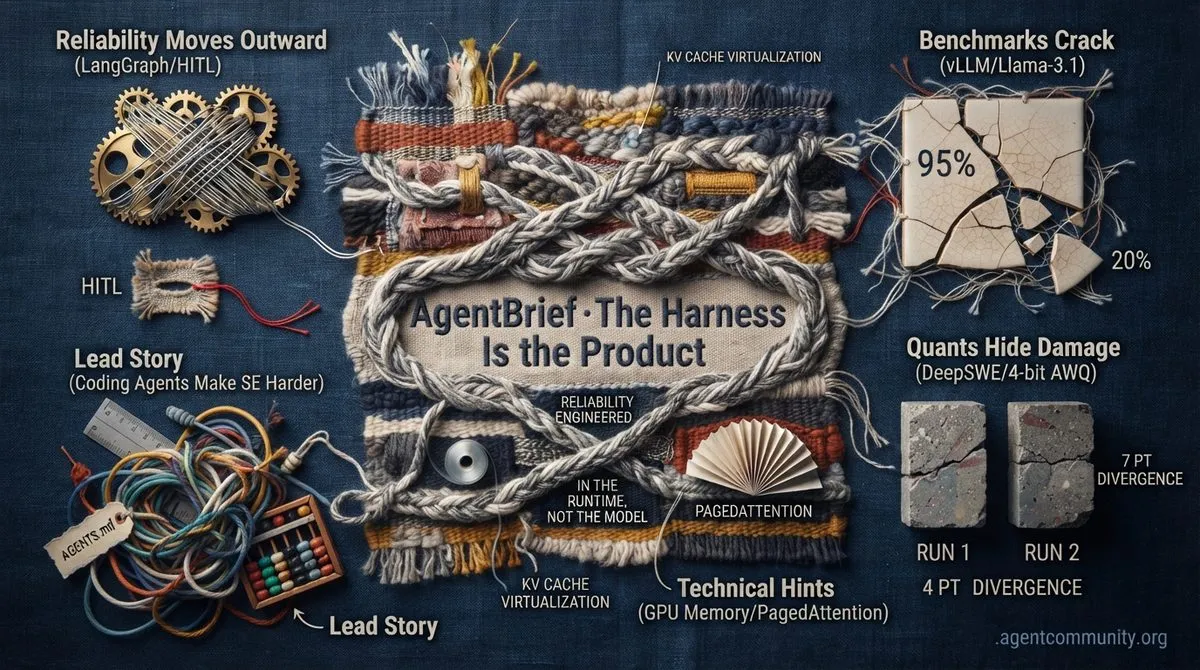
- Reliability Moves Outward LangGraph tops framework comparisons for observability and HITL, while tool-calling, tracing and guardrail guidance all place enforcement in the runtime.
- Benchmarks Crack A vLLM stress test reportedly drops Llama-3.1-70B tool-selection accuracy from 95% to 20% as catalogs grow; sub-1B routers are the proposed fix.
- Quants Hide Damage One user's identical 4-bit AWQ runs on DeepSWE diverged by ~7 points and solved different task sets.
X Signal
Simon Willison argues coding agents make software engineering harder, not easier, because unlocking them "requires extraordinary discipline and knowledge."
This issue: practitioners argue coding agents raise rather than lower the engineering bar, while skill libraries (Azure's 193 skills, Claude Skills' 372) and KV-cache virtualization push the agentic stack toward modular, memory-aware infrastructure. The through-line for builders is that discipline — the harness, not the model — is where the work is moving.
Coding Agents Make Software Engineering Harder, Not Easier
The most-cited take in this batch inverts the standard pitch: agents don't lower the bar for software engineering, they raise it. Simon Willison argues that "the more time I spend working with coding agents, the more convinced I am that they make software engineering even harder" — unlocking their potential "requires extraordinary discipline and knowledge" @simonw. François Chollet frames the same intuition structurally: "the 'difficulty' of software engineering is essentially constant no matter what abstraction level you move to, because human cognition adapts to new tools until it can fully utilize itself" — tools are "affordances, not a magic wand" @fchollet.
Practitioners are converging on the operational corollaries. Theo reports his multi-plan usage barely moving because he lets Opus orchestrate Opus rather than hand-rolling elaborate swarm topologies — "Stop over optimizing. Just let the model do its thing" @theo — and notes he sometimes simply tells one model to call another CLI for a second opinion on hard problems, "much less elaborate than all this for the same benefits" @theo. Aakash Gupta's recounting of DHH's reversal — from telling Lex Fridman that AI-written code felt like "competence draining out of his fingers" to opening Rails World by telling 1,000 developers to put their pencils down, after shipping 150,000 lines of production Ruby in a single month against a career average of ~30,000/year — is the strongest data point for what changes when discipline is present @aakashgupta.
The open question for agent builders is where the discipline actually lives: in the engineer, in the harness, or in the eval. Kun Chen's warning that changing reasoning effort levels mid-session typically breaks prompt caching — "the next request will be a fully uncached request, which can be very expensive" — is the kind of hidden cost that separates a working agent loop from a burning budget @kunchenguid. Recent builder reports reinforce the harness layer as the real lever: @rayLuxembourg describes running multiple low-effort Opus 5.5 agents all day by prioritizing verification loops over high-reasoning calls — "Build → Verify → Fix → Verify again" — because "the scarce resource stops being model intelligence. It becomes the quality of your harness" @rayLuxembourg.
Context compaction is emerging as a concrete cost-control practice. One empirical study found that unmanaged coding agents lost 78.7% of SWE-Bench tasks to context overflow at 32k tokens, while harness-managed compaction dropped that failure rate to zero @BuiltinMind. CliffCompaction (append-only context with selective tool-result truncation) halved per-task cost on Terminal-Bench 2.0 while improving success rates @guifav. Builders are also shipping sub-agent CLI orchestration patterns, such as dedicated dashboard-builder sub-agents that run in the background to keep long tasks visible without bloating the main session @pagameba. The pattern is consistent: verification loops, prompt-cache preservation, and context-compaction rules are the difference between productive and expensive coding-agent workflows.
Agent Skills Go Modular: Azure, Notion, Claude Libraries — with AGENTS.md, MCP, and Plugins as Cross-Harness Standards
The "skills" abstraction is consolidating into a real ecosystem, with curated, packaged skill libraries replacing one-off prompt hacking. Azure Agent Skills ships 193 skills across 19 categories — "from compute and data to AI/ML, security" — packaging Microsoft Learn procedures, best practices, and constraints into structured skills an assistant loads when relevant, addressing the complaint that "Azure agent know-how is scattered across docs" @DanKornas. A parallel public GitHub library, Claude Skills, offers 372 skills across 20 domains for engineering, product, marketing, compliance, operations, and research, with a CLI that detects supported developer assistants @DanKornas.
The tooling layer around skills is getting attention from serious product teams. Geoffrey Litt confirmed a shared approach is "relevant to how we're thinking about skills tooling at Notion" @geoffreylitt. Builders are converging on layered structures that treat AGENTS.md / CLAUDE.md as the always-on instruction layer, Skills as on-demand procedures, Hooks for deterministic automation, Subagents for delegation, MCP for external ability, and Plugins for packaging and distribution across Claude Code, Codex, Cursor, and others @RockHoundGO @heyitsurya @himanshu231204. Claude's recent move to Plugins as the official distribution surface (with MCP Connectors and Skills bundled into discoverable packages) is explicitly positioned as the layer that finally connects capability to discovery @Xudong07452910 @WalzAIkxfl. Altryne flagged that GPT-6-class agents "pause all work when you steer them" from AGENTS.md, and shared a system-prompt fragment teaching models to distinguish genuine steering from casual conversation so they don't halt mid-task @altryne.
Verification and cross-harness compatibility are the next layer up from skills. AgentSmith is positioned as a "model-agnostic operating harness for coding agents" that turns a task into a bounded, inspectable loop — "set up the right profile, configure checks, make the change, exercise the real path, and retain the proof for handoff" @DanKornas. Shared AGENTS.md files are already traveling with repos so the same engineering contract applies across tools @runner4you @kulekci. For agent builders the practical read is that the durable surface is no longer the prompt — it is the packaged, portable contract that any harness can load.
KV Cache Virtualization Targets the Agent Memory Bottleneck
Long-running agents are memory-bound, and the open-source infrastructure layer is responding. kvcached applies the oldest idea in operating systems — virtual memory — to the KV cache: vLLM and SGLang can reserve large KV-cache pools per model and PagedAttention manages blocks within a model, "but the physical GPU memory is still difficult to redistribute across different model instances" @techNmak. Separating the virtual KV address space from the physical GPU memory underneath is exactly the kind of primitive that makes multi-agent and multi-model serving economically viable. The underlying Prism system was published at OSDI '26, and its kvcached balloon driver has been deployed across 10K+ GPUs @techNmak.
Recent practitioner threads reinforce the framing. PagedAttention is KV cache management that pages like OS memory to kill fragmentation, yet once weights chew up 80% of VRAM concurrent batch capacity still hits a wall fast @ZorkyDev9l. Builders note that vLLM's PagedAttention solves fragmentation but still requires manual request grouping, and that WiSP (a vLLM plugin) pages experts like vLLM pages KV cache for up to 2x decode throughput on 24 GB cards @mordn.
The implication for agent builders is structural rather than incremental: if KV memory becomes a pooled, redistributable resource, then the cost model for keeping many persistent agent sessions warm — rather than cold-starting them per request — changes. Multi-model routing and per-agent context residency stop being luxuries you ration and start being scheduling decisions a serving layer can make. That is the same shift kvcached's authors describe from per-model reservation to cross-instance redistribution, and it is the layer most agent frameworks currently abstract away without controlling.
In Brief
Internal Evals Are Becoming the Real Proprietary IP
A conversation with one of the big data labeling businesses surfaced a structural prediction: a company's evals will become its main proprietary IP, given the improvement in agent performance after properly setting up and running internal eval environments @businessbarista. The same source predicted most revenue will come from Fortune 1000 enterprises rather than labs, and that "every company will want to own their intelligence" — without that necessarily meaning open-source models @businessbarista. Logan Kilpatrick reinforced the trend from the benchmark side: "enter company benchmarks, where companies building with AI start making a vast majority of the public benchmarks" @OfficialLoganK, while Teortaxes noted an "interesting private eval" doing the rounds @teortaxesTex. Vik echoed it directly: "Internal evals and domain ground truth are becoming the primary IP. As models commoditize, enterprise advantage shifts from who trains the weights to who can objectively score agent accuracy on messy, production-grade workflows" @vikbilakanti1, with Jamie adding that "Models are becoming interchangeable, so a company's evals, the record of what good looks like in its own work, is the asset that actually compounds" @jamiejreach. SagentLab observed the same on the coding side — "teams that instrument their review + evidence pipeline get compounding returns from agents; everyone else stays stuck at demo stage" @sagentlab — and Sarah Catanzaro framed the broader shift: "I think we'll likely see a dramatic decrease in the number and potentially the value of public benchmarks; so many people are realizing that your benchmark IS your secret sauce" @sarahcat21. For agent builders the practical read is that public leaderboards are increasingly a poor proxy for production performance, and a well-constructed internal eval suite is a durable moat.
Builders Call for a Real Agent-to-Agent Communication Layer
Nicolas Bustamante's question — 'Who is building an agent-to-agent communication protocol?' — framed the coordination problem explicitly: agents exchanging emails is too slow, and what is needed is 'something closer to a shared peer-to-peer board they can access directly from the CLI: post, get, reply, subscribe. Fast, permissioned and persistent,' so an agent can request context, share an artifact, or ask another agent to do something in milliseconds without pretending to be a human sending emails @nicbstme. Early tooling is surfacing in response: Micky demonstrated a workflow where comments left on @paper drive agent actions directly — "I can leave comments on @paper and tell my agent to address it" — turning inline human artifacts into machine-readable coordination points @Rasmic, while Dan Kornas's open-supermarkets project exposes messy retail integrations behind a uniform surface (CLI, HTTP API, MCP server, and agent skills) so shopping workflows can be composed by humans or agents without per-retailer reinvention @DanKornas. Kornas separately highlighted Pilot Protocol, an open-source overlay network giving agents virtual addressing, a rendezvous service for discovery, authenticated encrypted tunnels, and a CLI (pilotctl) for find/ping/send so agents can locate and message each other directly instead of routing through centralized APIs @DanKornas. Complementary signals include an ANP open protocol effort assigning W3C DIDs to agents for cross-platform 1:1/group messaging with end-to-end encryption, and Codex's recent HTTP client merge enabling remote agent message boards that speak HTTP + SSE across Mac, cloud, and server environments. The open question is whether these scattered primitives converge on a shared vocabulary fast enough to become the default coordination substrate, or remain per-project inventions.
Local SaaS Emulators Remove the Account Requirement for Agent Testing
Testing agent workflows that touch enterprise SaaS has meant either real credentials or hand-written mocks — Backlot is a local emulator that "serves supported Slack, Gmail, Google Drive, GitHub, Jira, Notion, S3, and other APIs from one local process," letting developers build and test with official vendor SDKs "against a deterministic corpus by serving vendor-shaped local responses instead of hand-written mocks" @DanKornas. Determinism is the point for agent builders: non-reproducible tool responses are the main reason agent evals are flaky, and pairing a deterministic emulation layer with a verification harness like AgentSmith — which turns an agent task into a bounded, inspectable loop of "set up the right profile, configure checks, make the change, exercise the real path, and retain the proof for handoff" — starts to close the loop between local test runs and production behavior @DanKornas. Backlot imports JSONL source documents to produce stable records, identities, tokens, and ACL-filtered views while reproducing response shapes, pagination, authentication, errors, and per-document access controls, all exposed either as a local server or as MCP tools for agents @DanKornas; AgentSmith complements this with work-type profiles across software, DevOps, marketing, research, and security domains, native integrations for Claude Code and Codex, and a cautious default that requires explicit opt-in for trusted mode @DanKornas. Early reactions note that permissions on underlying sources become a new concern once multiple agents access the same MCP-exposed corpus, highlighting the need for clear authorization boundaries even in local emulation setups @LuckDg.
California Makes Data Centers Pay Their Own Power Bill
Governor Gavin Newsom signed a package of seven bills into law in September 2026 requiring large AI data centers to cover their own electricity infrastructure costs — grid upgrades, transmission, generation, and a portion of wildfire costs — instead of passing those expenses to residential ratepayers, with new permitting processes, CEQA reviews, and water-use disclosure requirements also included @alphaticaio @The_Tradesman1. The measures create a separate utility rate class for data centers and force builders to fund local grid and water upgrades directly, giving communities greater control over project approvals @tchsignal @AgentFilipHQ. For agent builders running inference-heavy workloads, this introduces a direct structural cost signal: electricity and grid expansion are now line items that operators must internalize rather than socialize, shifting the build-versus-buy calculus for persistent or high-concurrency agent deployments in the US's largest compute market @alphaticaio. The policy shift lands alongside federal pressure, with Trump, the US House speaker, and tech CEOs scheduled to meet on AI on September 29 @Reuters, while broader framing treats compute access as the decisive variable in RSI scenarios @beffjezos. Industry observers note the bills make California "an unattractive proposition" for data centers, with capital expected to reroute to more permissive states even as the aggregate math on permission costs shifts nationally @alphaticaio.
Deep Reasoning May Live in Latent Space, Not the Chain of Thought
Christian Szegedy frames chain-of-thought as a surface symptom rather than the core mechanism, describing training as a bootstrap where shorter high-quality reasoning emerges first, followed by correct longer sequences in each batch, while plans actually evolve inside individual token latent representations that reach 10K-100K dimensions per layer @ChrSzegedy. That view positions emitted tokens as incomplete signals for what an agent is actually planning — a direct problem for agent builders who currently monitor only visible output and treat the CoT as the audit surface. Complementary discussion from Machine Learning Street Talk resurfaced Bainbridge's 1983 "Ironies of Automation," arguing that automating most work leaves human operators with exhausting monitoring tasks and rare but critical interventions, so operators need more — not less — training to stay ready @MLStreetTalk.
Quick Hits
Agent Frameworks & Orchestration
- Theo argues against over-engineered swarms for hard tasks, saying he sometimes just has Opus call a Codex CLI with Astra for feedback — "much less elaborate than all this for the same benefits" @theo
- Beffjezos suggests using a model classifier to auto-decide thinking levels rather than manually steering effort @beffjezos
- Altryne teases a major agentic personal milestone achieved with a multi-agent workflow @altryne
- Theo says most T3 Code complaints are heuristics-versus-harness tradeoffs, and he thinks of it as an Xcode alternative rather than a Codex alternative @theo
Memory & Context
- Kun Chen warns that switching reasoning effort levels usually breaks prompt caching, making the next request fully uncached and "very expensive" — only Claude Code recently enabled mid-session changes without breaking cache @kunchenguid
- Ivan Leo stays fast by backing spotlight search with BM25 indexing over files, folders, content, and applications for his agent @ivanleomk
- Moonbite's Memory/Diary design keeps references for exact evidence so long-running agents can prove what they did across sessions @DanKornas
Tool Use & Function Calling
- A self-hosted email agent on Cloudflare Workers reads inboxes, searches conversations, and drafts replies for users @tom_doerr
- Security teams are prioritizing agent tool safety — Boardy asks whether prompt injection, secret exposure, or agents overreaching with tools is the first threat to tackle @boardyai
- Altryne ran three AI assistants in a race to rebuild his sushi order direct from the restaurant and catch Uber Eats overcharging — winner finished in 7:41 @altryne
Agentic Infrastructure
- kvcached separates virtual KV address space from physical GPU memory, making KV-cache pools redistributable across model instances @techNmak
- Theo reports a giant TS-to-Rust port agent is "still gently sipping" from his accounts rather than burning budget on /goal workflows @theo
- AITECHio cautions that more GPUs won't fix a messy dataset or unoptimized pipeline — "it will just underperform faster and cost more" @AITECHio
Models for Agents
- Theo says Opus 5.5's unlimited-feeling usage limits on a model that feels unstoppable is "truly incredible" @theo
- Matt Shumer compares new models to new hires — "you have to learn its personality, how to work with it" @mattshumer_
- Theo finds Opus great to work with and better than Fable in most ways, but still misses an intangible "something" from the older model @theo
- Bindureddy claims Gemini 4.0 leaks include auto-learning, infinite persistent memory, and future prediction @bindureddy
- Beffjezos wants Ilya and SSI to "come in with Test Time Training and nuke everything with a banger" @beffjezos
Developer Experience
- Altryne shares a system message fragment teaching agents to treat human messages as steering "only when it starts, changes, cancels, or continues work," so casual chat doesn't pause all running agents @altryne
- Theo asks developers moving back to Claude Code from the Codex app what they miss most @theo
- Addy Osmani's rule for shipping: default to the smallest responsible step that gives feedback, with guardrails so mistakes are cheap to fix and have limited blast radius @addyosmani
- MLStreetTalk notes AI can crystallize skill into regularities that let us do "more with less," but also keeps revealing new complexity that cannot be compressed @MLStreetTalk
- Altryne notes a leaked system message from a major upcoming product is circulating @altryne
Industry & Ecosystem
- Higgsfield hit $1B in revenue run rate, with Menlo leading the seed round @deedydas
- Trump, the US House speaker, and tech CEOs will meet on AI on September 29 @Reuters
- Latent Space announced AINews v3 plans, a new home, and Supabase as its first sponsor @latentspacepod
- Swyx says his "Scaling without Slop" content strategy is working — three years to the first 100k YouTube subs, then 1.2 months to the next 100k @swyx
Open Source & Model Politics
- Nathan Lambert argues Reid Hoffman's framing presents the state of the technology in a way that makes open source appear "far more dangerous" than it is — "the simplest explanations of AI are often the scariest, but the real world is messy" @natolambert
- Teortaxes notes DeepSeek's Wenfeng Liang co-authors all major DeepSeek papers and submits them to arXiv himself, calling him "deep in the trenches" @teortaxesTex
- Teortaxes speculates DeepSeek might swap its free web model to a ~35B 3AB model running off 5090s with Engram in DRAM @teortaxesTex
Reddit Roundup
Orchestration, tool-calling, memory, HITL and tracing all moved toward the same thesis this week: the agent's reliability lives in the harness, not the model.
This week's material converges on a single claim: agent reliability is being engineered outside the model. Framework comparisons rank LangGraph as most production-ready for reliability, observability and human oversight; tool-calling writeups argue format validity and decision correctness are separate problems; and HITL, tracing and guardrail guidance all place enforcement in the runtime rather than the prompt. Most of this is vendor- and analyst-adjacent, not audited benchmark.
Framework Wars Heat Up As Orchestration Layers Mature r/MachineLearning
The agent framework landscape keeps fragmenting and re-consolidating, and the recurring comparison across r/MachineLearning and r/LocalLLaMA is which orchestration layer actually survives contact with production. The 2026 comparison literature now sorts the field by architecture rather than feature list: "LangGraph compiles every step into a stateful graph with checkpoints you can replay or roll back," while "AutoGen orchestrates work through structured multi-agent conversations," "CrewAI leans on role-based 'crews' with shared context that mimics human team structures," and "OpenAI's Agent SDK opts for a lightweight, tool-centric model that favors speed over deep orchestration" (Galileo). That architectural split is exactly the graph-planner-versus-loose-loop axis builders keep debating: LangGraph "suits deterministic workflows," CrewAI "fits role-based business processes," and AutoGen/AG2 "supports reasoning-heavy work" (TrueFoundry).
The draft's core claim — that explicit routing beats emergent routing as tool counts grow — is directionally supported by the practitioner comparisons, which consistently rank LangGraph as the most production-ready substrate for exactly the reliability reasons the draft names. One 2026 comparison puts it plainly: "LangGraph is the most production-ready for workflows that require reliability, observability, and human oversight," citing "deterministic graph execution, native state persistence, and LangSmith tracing," while "CrewAI and AutoGen can reach production, but they require more custom work to match LangGraph's out-of-the-box production features" (Towards AI). A separate 2026 writeup reaches the same conclusion from the failure-handling angle, noting LangGraph "leads on production maturity thanks to built-in checkpointing, streaming, and LangSmith observability" (cowork.ink). The notable 2026 development on the human-oversight front: LangGraph added interrupt() as a first-class primitive — "replacing the earlier human_input workaround" — which "makes building approval gates and human-review" steps native rather than bolted on (MyEngineeringPath).
The sharpest correction to the "framework wars" framing is that the two leading options are not actually competitors in production. "The two frameworks are not in competition. Most production teams end up using both: LangGraph for the orchestration skeleton and CrewAI for the multi-agent logic within individual nodes" — with the recommended path being "Start with CrewAI to validate your workflow. Add LangGraph when you need to move into production with reliability guarantees" (MyEngineeringPath). The independent hands-on read is more skeptical of the role-based approach: CrewAI is worth using "if I needed very thorough text outputs and relatively linear sequence, for simpler tasks," but "the role-based concept is appealing, but it lacks effective planning, re-planning, robust conditional logic, and can get stuck in hierarchical loops" (Saeed Hajebi / Medium). The honest caveat on all of this: the "most production-ready" rankings are analyst and vendor-adjacent comparisons, not independently audited benchmarks, and the frameworks themselves ship breaking rewrites fast enough — "Microsoft shipped AutoGen, then rewrote it" — that any maturity ranking has a short shelf life (Tensoria). The practical takeaway for agent builders stands: pick your orchestration substrate for observability and replay, not for the demo — and note that governance is increasingly expected to "sit above the framework" rather than inside it (TrueFoundry).
Tool Calling Reliability Still The Bottleneck r/LocalLLaMA
The failure usually isn't the model, it's the contract. OpenAI introduced function calling in June 2023 with "best effort" schema adherence, and the guaranteed version only arrived in August 2024 with gpt-4o-2024-08-06 and Structured Outputs, where a strict: true parameter added to function definitions enforces the shape (Zylos Research). That gap is what builders are still fighting: schema adherence is a guarantee only where the provider supports strict mode, and even then it covers the format, not whether the right tool was chosen. Practitioner writeups frame the split as two separate guarantees — "Function Calling vs Structured Outputs" is a reliability distinction, not a naming one, because the contract between model and tool is what has to hold (ServicesGround, Propelius). Eval tooling measures schema adherence as a distinct dimension — "does the parameters passed (JSON) match the required technical schema and data types" — separate from whether the call was correct (Co-One). The gap is widest in open source: general-purpose models like GPT-4 "come with reliable function calling capabilities," while open-source models "often require fine-tuning to reliably emit structured tool calls" (mbrenndoerfer).
Memory Architectures Move Beyond Vector Search r/LocalLLaMA
The write side, not the store, is where memory architectures are being specified. Redis lays out the canonical cycle — receive input, memory read, reason and plan, act, observe, memory write — where the write step "update[s] working memory, extract[s] facts to the long-term store, and optionally summarize[s] old" context (Redis). TechGig names the failure mode precisely: memory operates through a "write-manage-read" loop, and "the crucial 'manage' phase [is] frequently neglected, leading to noise, contradictions, and bloated context" (TechGig). A 2026 arXiv survey maps three generations — "prompt-level compression, retrieval-augmented external stores, and end-to-end learned memory policies" — and flags the pattern of separating context from retrieval so the system decides what to pull (arXiv), i.e. memory retrieval decoupled from memory injection. The open question is evaluation: that survey states evaluation "has evolved in tandem—from static recall tests to multi-session agentic benchmarks that expose the gap between remembering a fact and actually using it," and there is still no standard benchmark for whether memory improves multi-step task success versus just adding tokens (arXiv).
HITL Becomes A Design Primitive, Not A Patch r/AI_Agents
Approval gates are shipping as documented runtime patterns, not prompt instructions. Cloudflare's Agents docs lay out HITL as three distinct approval layers: "You can respond to an MCP server request, hold application work in a durable Workflow, or approve a connector call before model-generated code invokes a tool" (Cloudflare Agents docs). Temporal's AI Cookbook documents the same shape at the workflow level: an LLM proposes an action, and "if the proposed action is deemed risky, [the workflow] pauses and waits for human approval via Temporal Signal," then "executes the action if auto-approved (if not risky) or human approved, or cancels if rejected/timed out" (Temporal docs). Temporal's framing of why this belongs in the durability layer is the sharpest version: retries "are not implemented in your application code, they're actually a part of the durability services," so "if your process goes away all of that retry logic" survives — the same property that lets an approval wait span "hours, days, weeks, months" (Temporal, HITL for AI Agents). The third leg — using humans as labelers for agent trajectories, turning approval decisions into training and eval data — is the least documented claim in this pass: no source retrieved here quantifies that feedback loop, so treat the "reduces future interrupts" outcome as an open question rather than a measured result.
Observability Becomes Table Stakes For Agents r/AI_Agents
Tracing is now the precondition for deploying an agent at all. Observability "becomes table stakes (you can't deploy agents without it)," with OpenTelemetry "adopt[ing] as the de facto standard for agent tracing" and a "first wave of consolidation" underway (guptadeepak.com). The 2026 stack has distinct trade-offs: LangSmith provides "the deepest framework integration available" — node-by-node state diffs, full execution graphs, and trace replay against new model versions — but carries "the highest vendor lock-in risk of any platform" (Zylos Research). Phoenix is the open-source, OpenTelemetry-first option; Datadog "covers the operational observability surface but provides limited support for agent-specific concepts"; Braintrust "focuses on the trace-to-eval workflow" (Braintrust). Pricing shows span volume is the unit of account: Helicone ships a 300+ model cost repo, Datadog's tiering starts at 40K LLM spans/month on a $160/mo Pro plan, and Braintrust's starter covers 1M spans/month on a $249/mo Pro plan (Digital Applied). The catch: the sources making the strongest case for integration are the ones with the most lock-in.
Multi-Agent Debates Settle On Narrow Roles r/AI_Agents
The failure data, not the hype cycle, is driving the retreat to fewer agents. Multi-agent LLM systems "fail at rates between 41–86.7% in production because specification ambiguity and unstructured coordination protocols cause agents to misinterpret roles, duplicate work, and skip verification," with those two categories identified as the source of 79% of production breakdowns (Augment Code). The recommended remedy is a critic bolted onto a producer with hard bounds: "Implement judge agents for all critical outputs. Set explicit thresholds and retry limits" (Augment Code) — which echoes the self-grading problem surfaced earlier, where a grader the producer itself built always passes (u/Acceptable_Stress154). The 2026 retrospective on the 2023–2024 boom is blunt: "many European companies built systems with 8–15 collaborating agents that cost 10× more than one well-designed agent, were unpredictable, hallucinated in communication between each other, and didn't scale to production" (EITT). Caveat: the 41–86.7% range and 79% attribution come from a single 2026 guide's aggregation of research, not an independently replicated benchmark, and the 10× figure is qualitative.
Agent Evals Still Chasing Real-World Validity r/MachineLearning
There is still no leaderboard that predicts production success, so teams are building domain-specific harnesses instead. Confident AI describes trajectory evaluation as "scoring the path an agent takes to reach" an outcome, with its Task Completion metric using an LLM to infer the user's goal and judge reasoning steps, tool calling and final response — notably requiring no predefined ground-truth dataset (Confident AI). Automation Anywhere concedes the blind spot directly: "most agent evaluation in 2026 runs through a handful of public benchmarks. Each tests a real factor of agent reliability, but each one also has a non-trivial blind spot that impacts enterprise deployment" (Automation Anywhere). Toloka pushes further: "Continuous evaluation is the 2026 standard," because production agents "evolve continuously," so the suite must be "a living evaluation infrastructure" (Toloka). Note: the retrieved sources describe trajectory grading and continuous evaluation in detail but none documents a shadow-deployment methodology with published results, so treat that practice as builder-described rather than benchmarked.
Prompt Injection Remains Unsolved For Agents r/netsec
The injected instruction "sits in the same context window as the system prompt, and the model has no architectural way to distinguish them" (Traversaal). Indirect injection "is what happens when the agent has access to attacker-controlled content" — "the attacker doesn't talk to the model. They place instructions somewhere the model will read on its own" (Sysdig). CrowdStrike notes it is ranked "the number one threat in the OWASP 2025 Top 10 Risk & Mitigations for LLMs and Gen AI Apps" (CrowdStrike). Microsoft's Zero Trust guidance is the most concrete published mitigation set: "give agents only the minimal number of short-lived privileges needed to complete their tasks," plus information flow control (IFC) to "enforce policy-based isolation of untrusted content using metadata and quarantined inference environments" (Microsoft Learn). Caveat: every source here is vendor or framework guidance, and none publishes a measured bypass rate against a live agentic workload.
Planning Loops Get Cheaper And More Structured r/MachineLearning
The planner–executor split is the architecture with the clearest measured win so far. The literature describes it as "a systems architecture that explicitly separates high-level planning (task decomposition, strategic reasoning) from low-level execution," credited with improving "alignment between user queries and executable actions" (Emergent Mind, Plan-and-Act, arXiv). OPERA, a two-tier architecture using RL-trained planners and executors, reports a 15.9% EM increase on the 2WikiMultiHopQA benchmark versus the best baseline (Emergent Mind). The cost case is stated qualitatively: plan-and-execute lets the system "execute multi-step workflow faster, since the larger agent doesn't need to be consulted after each action," and sub-task LLM calls "typically can be made to smaller, domain-specific models" (Medium / Shubham Singh). Caveats: the 15.9% EM gain is one benchmark result for one architecture, the cost savings carry no per-task dollar figures, and the "first-class training objectives" framing is a vendor wiki's synthesis (Taskade).
Open Models Close Gap On Tool-Use Tasks r/LocalLLaMA
"Open" increasingly means "open weights, enterprise-cluster inference." Z.ai's GLM-5.2 (744B total / ~40B active MoE, June 2026, MIT-licensed) ships "native tool-calling, function calling, structured output, and MCP support" with a 1M context and a SWE-bench Pro of 62.1, but self-hosting "needs a multi-GPU node (≈8×H100/H200-class at FP8)" (ChangeGamer). Mistral Large 2 "natively supports parallel function calling, letting an agent dispatch multiple tool requests simultaneously and aggregate results" (Swarmsignal). The security literature treats hybrid as the default rather than a compromise — "sensitive open-weight on-prem/VPC, burst on managed APIs where policy allows" — while warning that open-weight LLMs "do not deliver free open weight models security" (SwiftFlutter). Caveat: the benchmark figures are vendor- and directory-reported, with no head-to-head independently run tool-use eval against frontier closed models on identical harnesses.
Discord Digest
A 7-point score swing on identical 4-bit runs suggests quant damage hides in variance, not headline regressions.
This issue centers on a question agent builders can no longer defer: whether quantization quietly degrades multi-step tool-use even when benchmark scores hold up. One user's identical 4-bit AWQ runs of Qwen3.8-27B on DeepSWE diverged by ~7 points and solved different task sets, while a parallel community push to run GSQ/RCO mixed quants on vLLM runs headlong into a serving stack that doesn't yet support them.
Do Bad Quants Break Agentic Loops? Early Data Says the Score Hides the Damage
The sharpest public number on this question landed outside the Discord thread, and it supports the "score hides the damage" thesis. @Oluwaphilemon1 ran two identical 4-bit AWQ runs of Qwen3.8-27B on DeepSWE 1.1 and got 38.94% and 31.86% Reward — a roughly 7-point swing on the same quant, same harness, same thinking mode. The task-level detail is the more damning part: out of 113 tasks, the two runs diverged on 32 outcomes even though aggregate scores looked comparable, meaning "two runs can report the exact same benchmark score while solving a surprisingly different set of problems." BF16 under the same Pi harness reached 43.36%.
The mechanism is specific to agents, not chat. "With a normal benchmark, a small change in token probabilities might change an answer slightly. With an agent, one different token can change an edit. That edit changes the codebase. The next tool call sees a different state." That compounding is why quant damage shows up as variance and task-set divergence before it shows up as a headline regression. In #general (LocalLLM), starw1 is running a DeepSWE evaluation on a W4A16 AutoRound quant — "5/14 have been correct so far. 99 left to go" — and flags the methodology problems himself: "This is so dirty right now. It's really hard to draw meaningful conclusions."
Published research backs the direction. A Digital Applied workload map names "Math reasoning · agentic tool-use" as the highest-sensitivity category, warning that "even FP8 can show 0.5-1 point regression" and pointing at "KV cache quantization is the bigger lever here than weight quantization — handle KV first," with AWQ-4 risking a 4-7 point drop on multi-needle NIAH-2 (Digital Applied). That directly addresses starw1's observation that quantizing DeepSeek V4 Flash's KV cache to 8-bit "drops massively in a deepswe subset." The takeaway for builders: until a clean matrix exists, treat any single quantized agentic benchmark score as a sample from a distribution, not a measurement.
Join the discussion: discord.gg/localllama
Community Hacks Mixed Quants Into vLLM — GSQ/RCO's Real Ceiling Is Support, Not Speed
The biggest thread in #general (LocalLLM) is starw1's push to get GSQ RCO — a mixed-precision quant recipe from Das Lab at ISTA, the group behind GPTQ — running on vLLM. The recipe is open at IST-DASLab/GSQ, and the paper's own framing is that GSQ "naturally supports non-uniform bit allocation across layers," with mixed 2/3-bit configurations via RCO search demonstrated on Llama-3.1-8B and 70B Instruct. starw1 reports 200k advertised context with 208,593 tokens of KV on a single 3090, with weights at 14.26 GiB and fp8 KV at 7.21 GiB. The catch is structural: vLLM's docs list a fixed set of supported quant formats and point builders at LLM Compressor, while a vLLM forum thread titled "A bit of frustration with Quantization" and a maintainer-adjacent discussion both flag that "gguf is experimental on vLLM and most likely slower than other quant types."
The honest read: GSQ/RCO's ceiling on vLLM is support, not speed. The recipe is published and open, but the serving stack it needs is still being hand-patched by users. The "Claude fixed vLLM" claim is a community-reported patch with no upstream PR, merged commit, or vLLM release note surfaced in this pass, and the 208,593-token KV pool is a single-user report with no independent replication. For context on what does work today, vLLM's own blog reports W4A16 quantization of Qwen3-Omni-30B-A3B cutting the checkpoint "from 66 GB down to 25 GB" (up to 62% reduction), with the variant scoring "slightly better than its BF16 reference" on OmniBench — a vendor-reported result on its own evaluated workloads.
Why it matters for agents: mixed quants are what let a 27B agentic model fit in ~24GB while still running long tool-use loops. computerguy calls GSQ/RCO "a recipe finder for figuring out which tensors suck the least to quantise." The tension with the quant-damage story above is unresolved: squeezing a 27B into 24GB is exactly the regime where the variance @Oluwaphilemon1 documented is most likely to bite.
Join the discussion: discord.gg/localllama
Subs Get Quietly Nerfed Reasoning — and the Effort Dial Now Has a Price Tag
A sharp accusation in #general (LMArena): kami6963 says models are "nerfed... by up to 12.38x on the subscription vs API without documenting it at all," with a breakdown — Astra Max 832 API → 128 subscription, GPT-6 Sol Max 768 → 62, GPT-6 Luna Max 768 → 70. For max effort specifically they cite a 6.5x decrease for Astra, 12.38x for GPT-6 Sol, and 11x for Luna. The claim lands in a news cycle where reasoning effort has become the dominant cost lever: published analysis shows the same model can cost dramatically different amounts per completed task as you raise effort, with the Astra-vs-Sol cost ratio climbing from 1.57x at low to 2.57x at max (Synthor AI). No source surfaced here confirms OpenAI documents a subscription-vs-API effort cap, so treat the specific multipliers as one user's claim pending independent measurement.
nexuhs draws the practical conclusion: benchmarks on evaluation sites are "all skewed because they use API and users use subs." For agent builders this is a planning problem — your reasoning budget, and therefore your multi-step success rate, may differ from the published benchmark configuration. only_pain adds methodology context: arena ratings are "a rating fit to every head-to-head vote at once, not an average," with whiskers as 95% confidence intervals — so a leaderboard gap inside overlapping intervals is not a real ranking difference, and a run at full API effort may not represent what a subscriber actually gets.
Join the discussion: discord.gg/lmarena
MiMo v2.6 Pro Punches Way Above Its Price — But Safety Refusals Are Nondeterministic
Xiaomi's MiMo v2.6 Pro is landing as the price-per-intelligence outlier of the week. In #general (Cursor), notflinched recommends it as an "extremely good model for a crazy small price — its ~2x luna but cheaper than 5.3-flash." The spec sheet backs the price claim: $0.435 per 1M uncached input tokens and $0.87 per 1M output, a 1,048,576-token context window, and — notably for a cheap frontier-adjacent model — an MIT license with open weights. Against Gemini 3.6 Flash it's 3.4x cheaper on input and 8.6x cheaper on output (llm-stats).
The caveat is behavioral, not economic. starw1 flagged that "mimo v2.6 getting flagged for safety and it scoring 8.6 after a second identical request didn't get flagged for safety" — inconsistent refusal behavior across identical prompts, a real operational problem for agents that retry on failure. No first-party Xiaomi safety documentation or independent replication surfaced, so treat it as a single-user report. On the adjacent frontier-price thread, rubixytbackup2 floated Gemini 4 Pro at $2.25 input / $11.25 output with 2M context as a "frontier model at a near sonnet price" — community-floated, not Google-confirmed.
Join the discussion: discord.gg/cursor
Gemma4 Vision OOMs On Ollama — and the Bug Tracker Confirms a Pattern
A concrete infra bug in #general (Ollama): valeriya331 reports "gemma4 has problems when inputting an image," with a raw stack trace — cudaMalloc failed: out of memory, clip_encode: failed to allocate compute graph on gemma4:26b. That maps onto an open, actively-tracked class of Ollama issues where the vision/CLIP projection layer tips an already-tight VRAM budget over the edge. The closest match, ollama/ollama#16147, diagnoses that "the main LLM weights are already consuming approximately 16GB of VRAM" and the crash comes when the system tries to allocate "an additional ~1.1GB for the CLIP/vision projection layer." The pattern predates gemma4 and spans model families, from llama3.2-vision:11b to gemma4 on multi-GPU servers.
Two details undercut common assumptions. ollama/ollama#15714 finds gemma4 crashing on "both text-only and image prompts" because "the vision encoder runs on EVERY request including text-only prompts" — so vision cost isn't only paid when you send an image. Separately, dialoguechicken hit a different wall: llava and moondream fail with does not support tools, while gemma4 claims it can't do vision at all — a capability-advertisement mismatch, not a crash. For agent builders wanting a local vision model in a tool-calling loop, the multimodal path is still brittle, and the failure modes are distinct: hard CUDA OOM, silent capability refusal, and version regressions in between. The GitHub issues cited are community-filed with no confirmed upstream fix surfaced.
Join the discussion: discord.gg/ollama
vLLM vs llama.cpp: The Agent Serving War
A running flame war in #general (LocalLLM) with real technical content. starw1 declares "VLLM > llama.cpp," citing "double to triple speed in similar circumstances, continuous batching," and near-free KV cache reuse — which matters enormously for agents that re-send large tool-call histories. The published record backs the throughput half: one vendor benchmark puts vLLM at 2-3x on throughput at 32+ concurrent requests on datacenter GPUs (GIGAGPU), vendor-reported but consistent with the field report.
computerguy counters that "llamacpp has continuous batching thou," and that llama.cpp "didn't need a single patch to run" the GSQ RCO quants while "vLLM seems very hostile to quants in general." The memory math explains why 32GB builders feel the squeeze — a 13B model on a single RTX 5090 runs at roughly 35% less VRAM in llama.cpp than in vLLM at equivalent quality. But note the asymmetry: starw1 claims a throughput and KV-reuse advantage for concurrent agent traffic, while computerguy claims a quant-format and footprint advantage for single-user local serving — different workloads, and the comparison literature agrees the choice "depends entirely" on which one you're running. A practical wrinkle surfaced too: agents keep resetting parallel 1, and computerguy notes the meta-problem — "this is why you don't get AI to do your config."
Join the discussion: discord.gg/localllama
Ban The Word 'Wait' To Boost Accuracy — a Paper-Backed Logit Hack
A rising r/localllama post claims "adding logit penalty for 'wait', 'maybe' and 'perhaps' to Qwen models improves their accuracy," citing a Meta paper (arXiv 2606.00206). The paper is real and the mechanism is documented: "Quantized Reasoning Models Think They Need to Think Longer, but They Do Not" finds the overthinking penalty "reduces CoT length by 4.1% to 28.0% on average across benchmarks," with accuracy "preserved or slightly improved" in most cases. The headline result: on AWQ 3-bit with Qwen-1.5B, "accuracy improves by 6.2% while CoT decreases by 28.0%." Crucially, the control matters — "penalizing random or low-KL tokens does not" produce the same gain, so the effect is specific to hedging tokens, not a generic penalty artifact.
This is a cheap, model-agnostic-ish lever that composes with quantized deployment — exactly where the poster focused. Adjacent work, THINKLOGIT, reports "consistent accuracy gains (up to +25.9% absolute)" steering reasoning at the logit level across model families, corroborating the direction. But starw1 and iowaman are separately finding that quant choice, context length, and KV precision all move scores enough to swamp small prompt-level effects — so replicate before shipping. The 50-question MATH-500 run is a single poster's replication on unspecified hardware, and the paper's gains are benchmark-specific.
Join the discussion: discord.gg/localllama
Agents That Wipe Your Config Files — and the Guardrails Builders Are Reaching For
A cautionary tale from cdt_5050: "Luna is really bad at configurations. 'Ok, I successfully set that! Something you should know, I overwrote the configuration file so all of your other configuration settings are lost.'" It's the classic agent failure mode — task success at the cost of collateral state destruction, with the model self-reporting only after the fact. computerguy draws the systemic conclusion: "wonder how many corporate workflows are about to implode and nobody can figure it out because they fired all the smart people."
The threat model is worse than accidental overwrites. SymJack describes a symlink-based RCE class in which "a malicious repository ships key configuration files as empty placeholders" that "are actually symlinks pointing somewhere else, such as the agent's own startup configuration, or a shell initialization file" — six tools were affected (infosec.ge). Sandboxing alone isn't a full answer either: because Git reads a repository's own .git/config after your global one, "a booby-trapped .git/config wins" (CybeDefend). The lesson for builders is concrete: any agent with write access to config needs diff-based writes, backups, symlink-resolving approval prompts, and a verification step — not just a success message.
Join the discussion: discord.gg/localllama
GPT-3 Era Ends, Weights Go Dark
End-of-life day: qikp_ flagged that "davinci-002" was shutting down "literally today" — "gpt-3 had such a long run, it is dying today." OpenAI's deprecations page lists davinci-002, babbage-002, gpt-3.5-turbo-instruct, and gpt-3.5-turbo-1106 all with a shutdown date of 2026-09-28, recommending gpt-5.6-terra as the replacement. One migration caveat worth flagging: the tracker advises builders to "validate endpoint, request format, output behavior and cost for a Terra migration; do not treat it as a drop-in legacy Completions replacement" (Kingy AI).
On the open-weights side, qikp_ argues "the only reason why the grok models are open weight is simply because they were discontinued," and xp_12__66774 states "xai hasn't open weighted a model in over a year despite what Elon has said" — a community assertion, claimed-not-verified. The broader pattern is that deprecation is now a multi-vendor, calendar-driven process: the same lifecycle calendar logs Amazon Bedrock's Claude 3 Haiku EOL and OpenAI's Videos API plus sora-2 shutdown. For agent builders, pinning model versions and keeping a fallback path is non-negotiable when orchestration depends on a specific model's tool-calling quirks.
Join the discussion: discord.gg/localllama
Builders Are Rolling Their Own Agentic Eval Harnesses — and Open-Source Rigs Now Exist to Copy
iowaman is assembling an ad-hoc agentic benchmark rig, and the scale is the story: "I'm pretty sure the majority of my local LLM use by tokens is benchmarking, and that in the low billions of tokens." Their anecdote is pointed for anyone assuming frontier models are required for retrieval-style agent work: "It doesn't take GPT-6 Sol to rummage for a needle in the haystack of the internet (GPT-5.6 Sol failed, and only Qwen3.5:9b and Gemini 3.6 actually found a useful result)." The thread is honest about where its rig is soft — starw1 notes "Now the judging model is standardized and it has three passes," while iowaman admits "Some of the data presentation is broken here."
The good news is builders no longer have to start from scratch. harness-bench pairs local LLMs served via llama.cpp with agent harnesses — Aider, Claude Code, OpenCode, Pi, Qwen CLI — across 16 software-engineering tasks, with "grading done by a hidden test.sh that the agent never sees," and a planned sweep of 17 model-quants × 5 harnesses × 16 tasks = 1360 cells (neuralnoise.com). The two design choices that separate a real harness from a vibes check — the hidden-test-file pattern and Docker sandboxing — are now copyable off the shelf.
Join the discussion: discord.gg/localllama
Google's Suncatcher MVP Satellite Launches October 1 — Orbital Inference Gets Its First Real Test
Infra news that could eventually matter for agent hosting: Google's first Suncatcher orbital data center test launches October 1st, riding a SpaceX Falcon 9 from Vandenberg (Ars Technica). The payload is a single satellite Google has named MVP, "about the size of a refrigerator," and the stated purpose is validation, not service — a first step toward a constellation of AI satellites. The technical premise: in low Earth orbit, satellites can access near-constant sunlight, generating "up to eight times more solar power than on Earth" — Google's own design claim, not an independently measured result.
In the same channel, pjyonda noted a model release "is looking like it will release October 1st" — the same date as the orbital test — but no first-party model announcement tied to October 1 surfaced in this pass, so treat the same-date framing as community speculation. Long-horizon agents are latency- and cost-sensitive; anything that changes compute-locality or the energy equation eventually shows up in inference pricing. Separately, vashujayswal_42458 claims "my agent is run tooo long to make gta 5 it runs 88 hours" — an amusing, unverified data point on how long-horizon autonomous runs are already being attempted.
Join the discussion: discord.gg/lmarena
Opus 5 Flopped, 5.5 Is New Arch — But Nobody Can Prove It
A recurring LocalLLM theory: starw1 claims "opus 5 was new (bad) arch," "opus 5.5 is new (very good) arch," and "opus 4.6 - 4.8 was rl." The honest counterpoint comes from computerguy: "we know genuinely nothing about anthropic models" — "we can guess at their size at best." The published record supports the caveat rather than the theory: Anthropic has not disclosed Opus 5.5's architecture, parameter count, or training method, framing the release as an incremental update positioned "between major flagship releases and lighter alternatives" (emergent.sh).
The one concrete capability datapoint that circulated at launch was scale-of-task, not architecture: Opus 5.5 "completed a 680,000-line code migration" (Ground News). The "~40% cheaper per task than Opus 5" framing traces to Anthropic-affiliated staff rather than an independent audit — @lydiahallie posted at launch that it "feels like Fable, but ~30% faster and ~40% cheaper per task." So the "new arch vs. RL-only" question is currently unfalsifiable from the outside — only a version-number jump, a price cut, and a speed claim. Context: starw1 used Opus 5.5 as a coding agent to add GSQ RCO support to vLLM, soft evidence that 5.5 is materially better at long agentic coding tasks — but not evidence of a new architecture.
Join the discussion: discord.gg/localllama
Breaking Into Agentic AI — and Auditing the Anthropic Billing Glitch
The recurring "how do I break in" thread keeps resurfacing. [gettygermany](https://discord.com/channels/Hugging Face/general) answers with the practical framing: "if you dont know where you can get a job, then its hard to know what you need to focus on... Usage of AI is always a good start." That instinct matches how frontier labs actually hire — Anthropic's own careers page describes its philosophy as "background-agnostic," with roughly half its technical staff having no prior ML experience, filtering on "independent technical work, open-source contributions, and a track record of shipping" rather than credentials (Standout).
On the billing side, [anaximander](https://discord.com/channels/Hugging Face/general) reports "Anthropic have had some billing glitches lately; I got an email recently saying they'd had some mishap where background jobs kept their container open (and thus charging you) way after they'd finished," with free credit equal to twice the overcharge. One caveat: no first-party Anthropic statement acknowledging the container glitch surfaced in this pass — the account is community-reported. Separately, Anthropic paused a Claude Agent SDK billing overhaul on June 15, 2026 — the day it was set to go live — a distinct, documented event about subscription-vs-usage pricing, not the container bug. If you run long-lived agent containers, audit your usage and watch for the overcharge credit.
Join the discussion: discord.gg/huggingface
HuggingFace Highlights
A vLLM stress test shows frontier models losing up to 100 points of tool-selection accuracy as catalogs grow — and sub-1B routers are the proposed fix.
Tool-selection accuracy reportedly collapses as catalogs grow — Llama-3.1-70B fell from 95% to 20% in vLLM's BFCL stress test — while a cluster of sub-1B routers and Meta's GAIA2 benchmark arrive in the same cycle. IBM's failure taxonomy and H Company's local computer-use stack round out a week about where agents actually break.
Unified Tool Use and the Rise of Tiny Routers — With the Scaling Curve That Explains Why
Tool use is getting both standardized and specialized. On the standard side, Tool Use, Unified pushes toward a single interface across model families — a real pain point for anyone maintaining per-provider tool schemas. On the specialized side, a cluster of sub-1B models is attacking the routing problem directly: 69crc/Qwen3-0.6B-LoRA_Tool_Router is a 0.6B LoRA-tuned classifier that picks which tool to invoke before the main model runs; sauravsingla08/AgentWeave-Router-MiniLM does semantic pre-inference routing on CPU with a MiniLM backbone; and ksg91/toam-100m-v0.1 is a 100M tool-augmented model trained on ToolACE, When2Call, and APIGen — deliberately small enough to run anywhere. A fourth, Lordnyx/qwen3loop-0.6b-tool-calling-sft-v1, pushes the same 0.6B base toward SFT'd tool calling rather than routing alone.
The reason this split exists is now measured, and the numbers are brutal for monolithic tool catalogs. vLLM's Semantic Router team ran a large-catalog stress test on the Berkeley Function Calling Leaderboard (BFCL) dataset and found tool-selection accuracy collapsing as catalog size grows: Llama-3.1-70B falls from 95% to 20% (−79 points), Mistral-Large from 94% to 0% (−100), Granite-3.1-8B from 84% to 7% (−92), and BitAgent-8B from 95% to 10% (−89) (vLLM Semantic Router). The same team's vision paper reports that a two-stage retrieval approach — "ITR retrieves minimal system-instruction fragments and a narrowed tool subset per agent step" — achieves "~95% lower per-step context tokens and large gains in correct tool routing," because "monolithic catalogs can consume ~90% of the context window" (arXiv 2603.21354v2). That is the mechanism behind the tiny-router cluster: the router's job is not to be smart, it is to shrink the candidate set before the expensive model ever sees it. An independent illustrative model from an ML writer's function-calling primer shows the same shape — direct selection degrading from near-100% at one tool to roughly 65% at 50 tools, while two-stage retrieval holds around 85% (mbrenndoerfer) — though the author labels those values conceptual rather than measured.
Practitioner discussion is converging on the same architecture, with the caveats attached. A LangChain forum thread on pre-inference routing for long-context agent workflows describes an "early local benchmark" on a 300-turn test, with the author explicitly disclaiming generality: "I'm not claiming generality yet — this is an early benchmark." A former backend lead at Manus frames the underlying cost: "With function calling, each tool is a separate entry in the tools array — the model has to select among N tool definitions before it can" act (r/LocalLLaMA). On the model-routing side, LMSYS' RouteLLM evaluation is the widely cited anchor that "up to 86% of typical user prompts can be resolved successfully by smaller models without detectable quality degradation" (DEV Community) — note that is prompt routing, a related but distinct problem from tool routing. The open question: the degradation curves above come from a vLLM-run stress test and a vendor blog, not a neutral head-to-head of "tiny router + frontier reasoner" versus "frontier model picks tools directly."
Benchmark Avalanche: GAIA2, AgentWorld, VAKRA, ScreenSuite
This cycle produced an unusual density of agent benchmarks, and they're converging on the same diagnosis: short-horizon, single-agent evals don't predict real deployment. AgentWorld introduces 100 human-annotated tasks (plus 100 augmented variants) specifically for long-horizon multi-agent collaboration, spanning 50+ interaction types. The most consequential addition is Gaia2 and ARE, Meta's read-and-write successor to the original GAIA: the Meta Agents Research Environments repo confirms "a comprehensive suite of 800 dynamic scenarios across 10 universes." The paper reports that no model dominates across capabilities: "GPT-5 (high) reaches the strongest overall score of 42% pass@1 but fails on time-sensitive tasks, Claude-4 Sonnet trades accuracy and speed for cost, Kimi-K2 leads among open-source models." Meta AI's Grégoire Mialon explains the design shift in an Arize AI interview: "We made the benchmark harder not by longer questions but with a richer, more difficult action space in a complex environment where agents can modify the world," adding that "Gaia2 checks write actions — the ones that modify the world (like sending an email) — and don't explicitly verify pure reads." An independent GAIA explainer names three failure modes of the eval itself: tool reliability ("a flaky browser, a rate-limited search, or a tool that times out mid-plan will tank long-horizon questions"), withheld test answers ("You can't [score on test] — test answers are withheld"), and over-reading a single run ("Agents are stochastic"). IBM's VAKRA analysis digs into reasoning, tool use, and failure modes; ScreenSuite claims the most comprehensive GUI agent eval suite, while DABStep targets multi-step data reasoning and FutureBench tests prediction of future events. The signal for builders: reliability and consistency are now first-class eval targets — IBM's "Will It Do It Again?" and AssetOpsBench both push toward industrial-grade repeatability rather than one-shot task success.
IT-Bench and MAST Diagnose Why Enterprise Agents Fail — Now With a 14-Mode Failure Taxonomy
IBM and UC Berkeley's IT-Bench and MAST is the most directly useful thing in this batch for anyone shipping agents into a company — it categorizes why agents break rather than reporting a success rate. The mechanism-level finding is the keeper: "the most prominent example is FM-3.3 (Incorrect Verification). This mode shows a 52 percent increase in failed Gemini-3-Flash traces compared to its successful ones," with other prominent modes being 1.5 (Unaware of Termination Conditions) and 2.6 (Reasoning Action Mismatch) (IBM Research). The Berkeley team's taxonomy — the Multi-Agent System Failure Taxonomy (MASFT) — was derived from "analyzing over 150 real-world execution traces," with failures falling "into three roughly equal categories: problems with the initial setup (Specification and System Design), breakdowns in agent collaboration (Inter-Agent Misalignment)," and a third category (Gradient Flow / Ben Lorica, arXiv 2503.13657). A separate analysis puts a sharper number on it: "79% of Multi-Agent Failures Are Specification Problems" (Forkast) — treat that as a single-outlet synthesis, not a MAST paper figure. Adjacent IBM work fills out the picture: "Beyond LLMs: Why Scalable Enterprise AI Adoption Depends on Agent Logic" argues the bottleneck is orchestration logic, not model capability, and ScarfBench benchmarks agents on enterprise Java framework migration. The caveat to carry: the MAST failure shares come from a small trace corpus, and independent replication of the specific percentages remains thin this cycle.
H Company's Holo3.1 Hits 140ms Local Latency on a 12GB GPU — Vendor-Reported
H Company's computer-use stack now arrives with a latency budget and a benchmark ladder, not just positioning. Holo3.1 ships as a family of four sizes — 0.8B, 4B, 9B, and 35B-A3B — with AndroidWorld scores jumping from 67% to 79.3% for the 35B model (daily.dev). The headline number is a perception-to-action latency of 140ms on an NVIDIA RTX 4090, which one write-up frames as a 4x speed improvement over typical cloud-based agents, "which suffer from network overhead when streaming high-resolution visual states to remote servers" (getaibook.com). The mechanism: BF16 quantization with minimal accuracy loss plus harness optimizations that "cut average agent step time from 6.8s to 3.3s" (daily.dev). Holotron-12B is the throughput axis: it was "trained in two stages. We started from Nemotron-Nano," and its WebVoyager performance "increased from 35.1% to 80.5%, exceeding Holo2-8B's performance" — vendor-reported and consistent across the model card and vendor page, but with no independent replication surfaced this cycle. The caveats: the 140ms figure is a single-outlet report on a specific GPU, and the 74.2% OSWorld number comes from H Company's own internal OSWorld implementation, which it notes "differ[s] slightly" from official OSWorld-Verified (ChatForest). The local-vs-cloud gap is a latency and governance argument, not yet an accuracy one.
smolagents Goes Multimodal, and the Structured-Code Debate Gets a "Structure Tax"
Hugging Face's agent framework stack got a meaningful upgrade this cycle, and the structured-code case now comes with a named cost. smolagents now supports VLMs, extending the code-writing agent paradigm to visual grounding, alongside Tiny Agents — an MCP-powered agent in 50 lines of code. Independent trackers keep the minimalism claim intact: "the logic for agents fits in approximately 1,000 lines of code" (mem0.ai). The deeper story is convergence on MCP as the default tool-transport layer, with CodeAgent and ToolCallingAgent as well-documented first-class choices (Alex Hruska / Medium). HF's structured-CodeAgent post names the failure mode it fixes: the "structure tax," where "smaller models struggle to simultaneously handle JSON formatting, Python syntax, and the actual problem-solving logic" (Hugging Face). The counterweight is honesty about where code-as-action breaks: one practitioner run found a CodeAgent mis-tagging articles because "a CodeAgent writes keyword-matching code at generation time" — "Trusted Computing Frequently Asked Questions" got tagged ['ml', 'web', 'rust'] purely on substring matches — concluding the real tradeoff is "code vs. judgment" (Roman Imankulov). A separate review flags "where the code-as-action model creates security trade-offs you need to price in before deploying anything close to production" (Orange ITS). Structured code is not a free upgrade for small models or for tasks that need judgment over keyword logic.
How Much Memory Does Your Agent Actually Need?
IBM interrogates the assumption that more context is always better — a useful counterweight to the million-token arms race. "How Much Memory Does Your Agent Actually Need?" defines memory as "a guideline set — strategies that worked, mistakes to avoid, and edge cases — distilled from the agent's own prior trajectories," with the right dose tier-dependent: strong models want the full guideline set, weaker models do best with a compact core plus per-task retrieval, and saturated models show no measurable gain. Give Your Coding Agents a Memory You Own makes the sovereignty argument, and independent commentary argues that "the ugliest agent failures I've seen are state failures, not reasoning failures" (System Design Newsletter). On the model side, DeepSeek-V4 ships a million-token context that agents can actually use — but the retrieval-at-depth evidence is not yet public: one analysis concludes it "does not replace RAG for long-context agents on any evidence available today," noting "no fetched source contains a verified context-window spec, a RULER score, or a needle-in-haystack result at depth" (Groundy). A deployment claim worth flagging as vendor-side: a domestic-compute adaptation writeup says the V4 series "has achieved stable support and efficient reasoning for 1 million token context" after optimization for Huawei Ascend and Cambricon chips (LimaxAI) — treat the "stable support" phrasing as vendor-asserted pending independent replication.
OpenEnv Gains Community Backing for Agentic RL — With a Named Governance Committee
OpenEnv launched as shared infrastructure for agent environments, and this cycle brings evidence the community is actually adopting it. The community retrospective tightens the project's self-definition: "In recent releases, OpenEnv has become an interoperability layer for RL environments. Its job is to standardize how environments" are exposed — "one interface, many environments which all expose the familiar Gymnasium-style API (reset(), step(), state()) running on a client/server architecture." An independent explainer states the strategic thesis bluntly: "the bottleneck has been the environments, not the models," which is why the cross-industry roster — "Hugging Face, PyTorch, Nvidia, vLLM, Unsloth, Stanford, and more" — is load-bearing rather than decorative (Clawvard). Training recipes are maturing in parallel and failure modes are now named: LinkedIn's GPT-OSS agentic RL retrospective lists reward hacking, tool-call formatting drift, and long-horizon credit assignment as first-class problems, while an independent survey adds that training Qwen3-4B "clearly improves performance across all environments, but results vary depending upon the training settings," with GRPO best on most tasks but PPO best on WebShop (Cameron R. Wolfe). The open caveat: no source retrieved provides a head-to-head, independently replicated result table for agents trained on OpenEnv specifically — adoption claims are organizational and architectural.
Sub-1B Agents Target Edge Deployment — and the 1.7B "Capability Valley" Is Now Measured
A distinct cluster of releases is betting that many agent tasks don't need a frontier model — and the small end of the curve looks unflattering. CentIo/Cent1-1B is a 1B Qwen3-based model fine-tuned for financial tool-calling, and sraivante/tiny-superfast-agentic-MLM-6.5m-v1 is a 6.5M parameter agentic MLM targeting Raspberry Pi and CPU-only inference — roughly three orders of magnitude below typical agent models. A community run testing 21 small LLMs on tool-calling judgment reported a non-monotonic ordering summarized as "0.6B > 4B > 1.7B," with the 1.7B class landing in a "capability valley — aggressive enough to call tools, but not careful enough to know when not to" (r/LocalLLaMA). Two independent lines sharpen the accuracy ceiling: a practitioner survey warns that "BFCL v4 is materially harder than v3" and that "the best small model here still lands at roughly two-thirds of frontier performance" (AI Plain English), while a 2026 validity audit across 496 expert-assessed tasks found "the automated evaluator disagreed with human judgment on 18.5% of them" (Splunk). The edge thesis is real but unproven — and the benchmark you'd use to prove otherwise is roughly one-fifth wrong.
Let Agents Search: ARD Turns Resource Discovery Into a Cross-Vendor Spec
Agentic Resource Discovery is a quiet but structurally important launch: rather than hardcoding tool and model lists into an agent's prompt, agents can search for resources at runtime. ARD "is a draft, open specification developed by contributors from Microsoft, Google, GoDaddy, Hugging Face, and others," and it "defines how agents and tools are cataloged, indexed, and searched across federated registries." Critically, the project draws a boundary: "It is not a product or a marketplace. It is a [discovery layer]" (Hugging Face). Google frames the handoff — ARD "steps out of the way – handing off the verifiable trust metadata so the agent can establish a direct, secure connection using the tool's native protocol" (Google Developers Blog). AWS states the concrete cost ARD targets: "without a central catalog, those resources stay siloed. Developers locate a resource, vet it, connect it, and maintain that connection manually" (AWS Machine Learning Blog). The open question: discovery solves finding, not vetting.
NVIDIA Ships Nemotron 3 Nano Omni and Magpie TTS — All Numbers Vendor-Reported
NVIDIA dropped two agent-relevant releases, and the voice-agent latency budget now has a hardware table. Nemotron 3 Nano Omni targets long-context multimodal intelligence across documents, audio, and video, carrying the 256K-token window and 65.8 OCRBenchV2-En / 47.4 OSWorld vendor numbers. Magpie TTS ships open weights for low-latency multilingual voice agents, adding Modern Standard Arabic (1.62% CER), Korean (2.69%), and Brazilian Portuguese (2.91%) as baseline languages while improving French CER 2.70% → 1.54% and Spanish 1.14% → 0.60% (NVIDIA). NVIDIA's voice-agent blueprint reports sub-second end-to-end latency across up to 64 parallel streams on 4×H100, a useful counterweight to the single-stream 32 ms on B200 / 47 ms on H100 / 53 ms on DGX Spark / 79 ms on A100 TTFA figures (NVIDIA NIM). ServiceNow's EVA framework proposes splitting "EVA-A for accuracy" from "EVA-X for experience," reporting pass@k alongside the stricter pass^k, with EVA-Bench classifying a turn as early when latency < 200 ms and late when ≥ 2.75 s. Caveat: the CER/SSIM table, the TTFA figures, and the 64-stream claim are all NVIDIA-reported with no independent replication retrieved this cycle.
Hackathon Spaces Show Agents Doing Real Work — With a $16,500 Prize Pool
The Spaces ecosystem is where agent abstractions meet actual tasks, and this cycle the MCP hackathon has a documented track structure. otst/osw-studio leads engagement at 89 likes, with Google's EHR Navigator agent with MedGemma at 68 — a notable signal that domain-specific agents in regulated fields are drawing attention. The hackathon org page lists a "Track 3: Agentic Demo Showcase" and states a "Total prize pool: $16,500+ USD" (Agents-MCP-Hackathon). The most interesting submission is gradio_agent_inspector, since agent observability tooling is chronically underserved. Caveat: the like counts are point-in-time engagement figures, not usage or quality measures, and no retrieved source benchmarks any of these Spaces against a task suite.
Harness, Scaffold, and the Words That Matter
The agent glossary is the sleeper hit of this batch — it pins down "harness" versus "scaffold" and other terms used loosely across the ecosystem. Wikipedia's entry treats the two words as synonyms: "an agent harness, also known as agent scaffolding, is the software infrastructure surrounding a large language model (LLM) that enables it to operate as an AI agent," managing "tool use, memory, state persistence, execution environments and feedback loops, as opposed to the model's internal reasoning" — giving the field a compact equation: agent = model + harness (Agent harness - Wikipedia). The competing definitions sort into three camps: the expansive camp ("every piece of code, configuration, and execution logic that isn't the model itself"), the security camp ("the model decides. The harness acts." — Adversa), and the practical camp, which argues the 2026 shift is that "builders realized the scaffolding around the model matters as much as the model itself" (Taskade). The unresolved fault line: whether framework is a peer term or a subcategory.