Orchestration Rises as Costs Plummet
From DeepSeek's pricing floor to Apple's legal offensive, the infrastructure for autonomous agents is rapidly maturing.
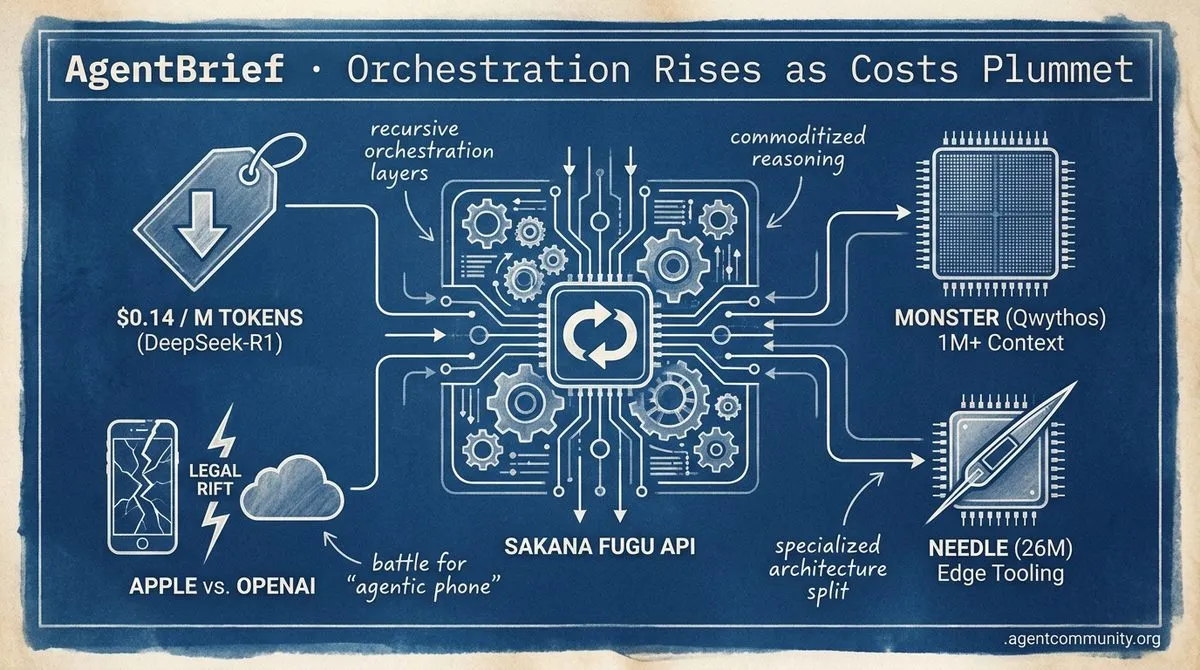
- The Reasoning Floor Drops DeepSeek-R1 has effectively commoditized frontier reasoning at $0.14 per million tokens, forcing a shift from "can it work" to "how cheap can we scale."
- Orchestration Over Models With Sakana’s Fugu and Microsoft’s governance tools, the industry is moving away from monolithic LLM interfaces toward specialized, recursive orchestration layers.
- Legal and Hardware Rifts The Apple-OpenAI partnership implosion and subsequent trade secret lawsuit signal a volatile battle for the "Agentic Phone" and local execution dominance.
- Bifurcated Model Architectures We are seeing a split between million-token context "monsters" like Qwythos and hyper-fast 26M-parameter "Needle" specialists for edge-based tool calling.
// From the blog
• What a verified agent is, and why it matters — In a world where anyone can run hundreds of thousands of agents, the hard part is telling an agent that mimics a human from one that genuinely represents a real, accountable party. Here is what a verified agent is, and why that difference will matter.
X Intel & Cloud Trends
Stop building wrappers; the infrastructure for 100x agentic scale is landing now.
The era of the 'monolithic model' as the primary interface is beginning to crack. For those of us building agents, the bottleneck has never been raw intelligence—it has been the brittle glue code required to make models behave in complex environments. This week, we are seeing the first real abstractions for 'orchestration as a service' with Sakana's Fugu, which treats a pool of expert models as a single recursive API. It is a signal that the 'agentic web' isn't just about better prompts; it is about a learned coordination layer that handles delegation and verification autonomously.
Simultaneously, the infrastructure layer is hardening. When agents start hitting APIs at 100x the frequency of humans, traditional enterprise guardrails fail. The shift toward agent-specific gateways, 'Headless APIs' from players like Workato, and Microsoft’s zero-trust governance toolkit marks the transition from experimental toys to production-grade swarms. We are finally moving away from overloading single agents with hundreds of tasks, opting instead for specialized agents collaborating in shared workspaces. For builders, this means the 'Cloud for Agents' is no longer a concept—it is a deployment target.
Sakana Fugu: Multi-Agent Orchestration as a Single API
Sakana AI has introduced Sakana Fugu, a multi-agent orchestration system that functions as a single model API designed to dynamically manage model selection, delegation, and verification. Unlike monolithic models that attempt to solve everything internally, Fugu acts as a learned coordinator trained to call various LLMs in an agent pool recursively @SakanaAILabs @SakanaAILabs. The technical architecture utilizes a fast router (Fugu) and a deep multi-agent conductor (Fugu Ultra) trained with SFT, evolutionary strategies, and GRPO to compose query-specific workflows using models like GPT-5.5 and Claude 4.8 @askalphaxiv.
Early performance data suggests this orchestration-first approach is highly competitive. The 'Fugu Ultra' variant is matching or exceeding frontier models like Fable and Mythos across engineering and reasoning benchmarks, specifically scoring 73.7 on SWE-Bench Pro compared to Claude Opus at 69.2 @TheRundownAI @neocell_ai. The community has already responded with open-source replications like 'openfugu,' which claims an 88.0% score across six benchmark suites while exposing the underlying routing decisions and costs @aashwindev.
For agent builders, this moves the 'messy work' of multi-step synthesis and recursive task handling into the model layer itself. While single-prompt tasks might still favor direct model access, Fugu's strength lies in workflows where agents must act as project managers for other agents @ChrissGPT. This abstraction allows developers to stop hard-coding logic for when to switch from a fast model to a reasoning model, letting the learned coordinator optimize for both performance and cost.
Hardening the Enterprise Cloud for Autonomous Swarms
Enterprise platforms are being fundamentally redesigned as agents begin to use software at scales 100x greater than human users. Aaron Levie and Guy Grinich are leading the call for a 'cloud for agents' that treats autonomous systems as a distinct class of users requiring specialized guardrails, authoritative data sources, and robust logging to prevent data leakage @levie @grinich. This shift is moving away from monolithic agents toward massive swarms of specialized agents interacting in shared workspaces that resemble collaborative platforms like Discord more than traditional hosting @RhysSullivan.
Practical implementation of this infrastructure is already shipping. Workato recently expanded its Agent Studio with a 'Headless API' for embedding genies with native governance and 'Agent Guardrails' covering auditability and compliance @Workato. Meanwhile, WorkOS is rolling out an API Gateway and Widgets API designed specifically to handle agent traffic with full audit trails and schema-as-documentation @grinich. Microsoft has also entered the fray by open-sourcing an Agent Governance Toolkit that provides deterministic interception and zero-trust identity to cover OWASP agentic risks @_vmlops.
This hardening is yielding measurable results in complex domains. Box AI evaluations on GPT-5.6 family models have demonstrated significant gains for agentic document tasks: Financial Services accuracy rose to 76% (from 71%), and Healthcare tasks saw a jump to 58% (from 46%) @levie. For builders, these tools solve the 'trust' gap, providing the Merkle audit logs and YAML policies necessary to move agents out of the sandbox and into the core of the enterprise workflow.
In Brief
Standardizing Agent Reliability in Claude Code
The developer community is standardizing a 'plan-verify' workflow for Claude Code to maximize agentic reliability in production environments. Key best practices include utilizing 'plan mode' to force the agent to verify its own steps before execution and implementing custom briefing files (CLAUDE.md) to ensure consistent context across every session @techNmak. Advanced setups are now pairing these patterns with Git Worktrees for parallel agent sessions and specialized slash commands for deployment, moving the developer experience closer to a collaborative multi-agent IDE @Krishnasagrawal.
Executor and Mem0 Tackle Persistent Identity and Memory
The agentic tooling stack is maturing with the release of Executor v1.5.16 and self-hosted Mem0, both of which reduce external dependencies for production agents. Executor now supports native Microsoft Graph integration with persistent OAuth connections, allowing agents to use an emit() function to output attachments directly to chat interfaces without repeated re-authentication @RhysSullivan @agentcommunity_. Simultaneously, Mem0's new self-hosting capability allows builders to run their long-term memory layer inside a private VPC, addressing enterprise privacy concerns while maintaining hybrid fact extraction and recall @Teknium @stretchcloud.
The 'Final Boss' of Agent Reasoning: World Models and Skill Decay
Recent research highlights a significant barrier in agentic development: the inability of LLM agents to build stable internal world models in complex environments with hidden rules. Evidence from 'Agentic Automata Learning' (arXiv:2606.16576) shows that agents frequently re-derive state from context rather than consolidating durable long-term representations, a limitation of next-token prediction @rohanpaul_ai @agentcommunity_. This reliance on agentic assistance may also carry human costs, as a Nature-published study found that expert detection rates in specialized fields dropped from 28.4% to 22.4% after AI integration, suggesting that reducing cognitive friction can inadvertently erode expert-level debugging and reasoning skills @rohanpaul_ai @Vanarchain.
Quick Hits
Agent Frameworks & Orchestration
- RushDB offers a database layer that transforms JSON into graph relationships and semantic search for agent memory @DanKornas.
- OpenClaw emphasizes its non-profit status and quality-focused development over VC-funded competitors @steipete.
Models for Agents
- DeepSeek has finalized post-training for its V4 Pro model on the CloudMatrix 384 supernode @teortaxesTex.
- Anthropic’s 30-day data retention policy is drawing scrutiny compared to OpenAI's zero-retention options for sensitive agent workloads @steipete.
Industry & Ecosystem
- Steam games disclosing AI use receive 53% fewer reviews, signaling a persistent 'AI stigma' among gamers @Pirat_Nation.
- SK hynix is dropping degree requirements for new hires to prioritize AI-centric skills in a shifting labor market @Pirat_Nation.
Reddit Reasoning Roundup
DeepSeek-R1 shatters the pricing floor for frontier reasoning while browser agents race for desktop dominance.
The agentic landscape is shifting from 'can it work?' to 'how cheap can it run?' Today's lead story on DeepSeek-R1 represents a watershed moment: high-tier reasoning is no longer a luxury of the Silicon Valley elite. At $0.14 per million tokens, the barrier to complex, multi-step agentic loops has effectively vanished. This democratization of 'brain power' is being met on the other side by a hardening of the 'body'—the execution environments where these agents live. From OpenAI's Operator leading the browser wars to the mandatory adoption of microVM sandboxes like E2B, we are seeing the infrastructure for autonomous systems mature in real-time. For developers, the message is clear: the tools are ready, the costs are down, and the focus must now turn to reliability and safety. We are moving past the 'happy-path' prototypes into the era of deterministic, stateful graphs and edge-optimized reasoning that can run locally on consumer hardware.
DeepSeek-R1 Challenges Frontier Reasoning at 1/10th the Cost r/MachineLearning
The release of DeepSeek-R1 has disrupted the agentic ecosystem by offering open-weights reasoning that rivals proprietary models like OpenAI o1-mini. For agent builders, the primary draw is a massive shift in the cost-to-intelligence ratio; R1 is priced at approximately $0.14 per 1M input tokens, a fraction of the cost of its closed-source rivals. This efficiency is rooted in R1's training process, which achieved state-of-the-art results using an estimated 60,000 GPUs—orders of magnitude fewer than the 500,000+ required by industry leaders.
Technical benchmarks confirm R1's capability as a high-level agentic 'brain.' On the AIME 2024 math benchmark, R1 scored 79.8%, placing it in direct competition with o1-mini, while hitting a near-perfect 97.3% on MATH-500. In specialized agentic workflows, such as complex ophthalmology reasoning, R1 demonstrated superior accuracy (0.808) compared to o1's 0.723. Developers on r/MachineLearning are increasingly adopting the model for long-context reasoning tasks where multi-step problem decomposition is required.
The democratization of this reasoning power is further visible in the distillation series. The DeepSeek-R1-Distill-Qwen-32B model reportedly outperforms o1-mini across several benchmarks, allowing for sophisticated local deployments of autonomous systems that were previously restricted by API latency and high token overhead. By leveraging these distilled models, agentic workflows can maintain self-correction cycles and complex planning without the 'metering transition' friction found in premium tiers.
OpenAI Operator vs. Anthropic: The Battle for the Browser Desktop
OpenAI's dedicated 'Computer-Using Agent' (CUA) has established a significant lead in browser-specific benchmarks, scoring 87% on WebVoyager compared to the 56% achieved by Anthropic's Computer Use. While Anthropic remains superior in coding and software development tasks, OpenAI's Operator benefits from a specialized perception model that offers lower latency per step than general-purpose vision models. Despite these gains, the industry is seeing a shift toward non-vision alternatives like the 'Terminator' library, which u/mediar-ai claims is 100x faster and cheaper by using OS-level APIs instead of processing raw pixels.
LangGraph Hardens the Agentic Web via Checkpointing and Circuit Breakers
As developers move beyond linear chains, LangGraph is becoming the standard for stateful multi-agent systems, though it introduces three canonical failure modes: task duplication, contradictory outputs, and convergence failure. To combat 'infinite loops' where agents delegate back and forth without progress, engineers are implementing 'circuit breaker' patterns—explicitly setting a retry_count or max iteration limit to force a terminal state rather than looping indefinitely. This transition highlights a shift toward 'controllability' over 'pure autonomy,' ensuring agents remain within bounded execution paths via persistence and Human-in-the-loop (HITL) interrupt boundaries.
MicroVM Sandboxing Becomes Mandatory for Autonomous Agents r/NetSec
As agents transition from chat interfaces to autonomous systems capable of local code execution, sandboxing has evolved from a developer convenience to a critical production requirement. Security practitioners on r/NetSec warn that indirect prompt injection can weaponize agent scripts if not isolated within 'disposable' environments, leading to the dominance of platforms like E2B, which utilizes gVisor-based microVM isolation. Developers like u/IndyDevDan are already deploying nine parallel agent sandboxes simultaneously to solve complex engineering tasks without risking host infrastructure.
Berkeley Function Calling Leaderboard Updates Standards r/MachineLearning
The BFCL v2 update shows Llama 3.1 405B Instruct leading in function-calling accuracy, proving open-weights models have reached parity with frontier systems like Claude Opus 4.8.
Phi-4 Redefines the Edge with 14B Reasoning Power r/LocalLLaMA
Microsoft's Phi-4 14B has been identified as superior to Llama 3.1 70B across reasoning benchmarks, while the Phi-4 Mini (3.8B) runs 2x faster on just 3GB of VRAM.
Discord Dev Debrief
A massive trade secret lawsuit and agent reliability issues signal a volatile week for the Agentic Web.
The partnership between Apple and OpenAI has effectively imploded, replaced by a high-stakes legal battle in Northern California that could reshape the consumer hardware landscape. Apple’s lawsuit, alleging a systematic trade secret theft scheme involving Jony Ive’s former collaborators at io Products, signals more than just a corporate rift—it’s a declaration that the battle for the 'Agentic Phone' will be fought in court as much as in code. As Apple pivots to Google’s Gemini, OpenAI faces a 'discovery nightmare' that could expose its most guarded architectural secrets.
Meanwhile, the technical reality for agent developers is one of high-speed instability. We’re seeing Cursor’s much-vaunted Auto Agent stumble over context windows, leading to database wipes and runaway API costs. Grok 4.5, despite its massive 500K context window and 'reasoning dial,' is reportedly getting stuck in infinite loops. The takeaway for practitioners is clear: raw model capability is hitting a ceiling of reliability. The path forward isn't just bigger context; it’s better orchestration through standards like the Model Context Protocol (MCP) and specialized, low-latency architectures like the new Tiny-MoE. Today, we dive into the fallout and the tools trying to fix the mess.
Apple Sues OpenAI Over Systematic Trade Secret Theft
In a major industry shift, Apple filed a lawsuit in Northern California on July 10, 2026, alleging OpenAI orchestrated a trade secret theft scheme "at every level" of the organization. The filing specifically claims OpenAI misappropriated intellectual property to accelerate its entry into the consumer hardware market, targeting Apple’s dominance in personal devices through the acquisition of io Products—the AI hardware startup founded by former Apple employee Tan and Jony Ive.
The suit names Tan as a central figure, alleging he methodically emailed himself confidential summaries and supplier information prior to his departure. This escalation follows a period of mounting tension where OpenAI reportedly weighed its own breach-of-contract lawsuit against Apple earlier this year. Practitioners on TrentBot suggest the legal battle could trigger a "discovery nightmare" for OpenAI, potentially exposing the architectural secrets of its most guarded frontier models.
The rift appears permanent as Apple pivots toward integrating Google’s Gemini for Siri. Analysts warn that a potential injunction could effectively terminate ChatGPT’s presence on Apple devices, marking a total collapse of the high-profile partnership. For developers, this signals a future where the platform-layer for agents is increasingly fractured and legally volatile.
Join the discussion: discord.gg/localllm
Cursor Auto Agent Faces Significant Performance Degradation
Power users of Cursor's 'Auto Agent' mode are reporting a sharp decline in reliability following the release of Fable 5. As funny_fit and others on the Cursor Forum noted, workflows utilizing graph memory are losing context after just 4 messages, leading to failures like database wipes and API costs exceeding $500. This instability is exacerbated by an architectural flaw where Cursor auto-switches to Composer 2.5 when API limits are reached; because Composer 2.5 has a significantly smaller context window, the session view collapses and summarizes earlier turns, leading to immediate context loss and hallucinations.
Join the discussion: discord.gg/cursor
Grok 4.5 Loops and the Dial for Agentic Harnessing
Early testing of Grok 4.5 in agentic workflows has revealed a tendency for the model to get stuck in 'infinite retry loops.' digilog2501 observed that the model often retries failing tasks repeatedly without investigating the root cause, despite its new 500K-token context window and a specialized 'reasoning-effort' dial designed to configure tool-calling depth. While Grok 4.5 shows strong token efficiency on benchmarks like SWE-bench Pro, practitioners like kleosr find that raw speed does not yet equate to autonomous error correction, highlighting a critical need for external monitors and global constrained optimization as formalized in the DeepPlanning benchmark.
Join the discussion: discord.gg/cursor
MCP Bridges the Gap for Agentic Image Editing
The Model Context Protocol (MCP) is emerging as the standardized 'USB-C port' for AI applications, enabling agents to move beyond one-shot generation. Developers have already launched GIMP-MCP, a server that exposes GIMP’s professional suite to agents like Claude with features like get_state_snapshot for live visual feedback. Beyond single-tool wrappers, the ecosystem is shifting toward 'multi-agent image editing stacks' like Agent Banana, which utilizes the MCP specification to facilitate high-fidelity editing through an iterative think-act loop across a team of up to six distinct tools.
Join the discussion: discord.gg/eurekalabs
Tiny-MoE: 200M Parameter Mixture of Experts Built from Scratch
Abdelrhman Ebied has released Tiny-MoE, a 200M parameter Mixture of Experts model trained on 8 billion tokens using Multi-head Latent Attention (MLA) on consumer-grade hardware.
The 304GB VRAM Barrier: Blackwell WS vs. the $800/Month Cloud Tax
The local inference debate is intensifying as developers like computerguy target 304GB VRAM rigs to bypass the $800/month cloud tax associated with frontier 70B+ models. Join the discussion: discord.gg/localllm
GPT Image 2 API Speedups and Nerfing Rumors
OpenAI's GPT Image 2 API has received significant speed boosts and 4K support, though kiri49 and others report 'nerfed' quality on low-cost $0.008 presets. Join the discussion: discord.gg/lmarena
HuggingFace Model Insights
From 26M-parameter edge specialists to 1M-token context windows, the agentic stack is specializing for speed and scale.
Today we are witnessing a fascinating bifurcation in the agentic web. Google’s Gemma 4 (31B) and the 1,000,000-token Qwythos-9B are pushing the ceiling of reasoning and 'working memory,' enabling agents to hold entire clinical histories or massive codebases in context without relying on brittle RAG setups. Conversely, the minimalist movement is proving that for specific agentic loops, efficiency is king. The 'Needle' architecture—a tiny 26M-parameter model—is now hitting 1,200 tokens/second on edge hardware like Raspberry Pi, specializing in the essential 'retrieve-and-emit' tool-calling loop. This shift suggests that the next generation of autonomous systems won't be powered by single general-purpose models, but by tiered architectures: heavy-duty reasoning at the core and hyper-fast specialists at the edge. For builders, this means the focus is moving from prompt engineering to architectural orchestration—balancing latency, context, and cost to create truly responsive agents. Whether navigating medical records or automating deep research, the tools for specialized agency are finally hitting production readiness.
Gemma 4 and AlfredAgent: The New Frontier of Visual Reasoning
Google DeepMind has officially launched Gemma 4, a family of open-weight models built on Gemini 3 research to maximize 'intelligence-per-parameter.' The flagship 31B model has already set a high bar, scoring a 39 on the Intelligence Index according to @ArtificialAnlys and achieving a 100% survival rate with a +1,144% median ROI in community-driven agentic benchmarks Reddit/LocalLLaMA.
These models feature native support for function calling and enhanced multimodal understanding, enabling agents to plan, navigate apps, and complete tasks with high spatio-temporal precision. On the community side, the gemma-4-E4B-Agentic-Opus-Reasoning fine-tune has surfaced, leveraging these new capabilities to fuse 'Opus-level' reasoning with autonomous tool-calling. This trend is mirrored in the AlfredAgent Space, which has garnered 42 likes for its focus on visual agent simulations.
26M-Parameter Specialists: The Rise of Needle and On-Device Agentic Workflows
The 'Needle' architecture is redefining the lower bound of agentic hardware requirements. Originally a 26M-parameter model distilled from Gemini 3.1 by Cactus, Needle is a specialist optimized for the 'retrieve-arguments-and-emit-JSON' loop required for tool use NYU Shanghai. Implementations by theabbie and gixnu have brought this capability to Raspberry Pi and Android, achieving performance of 1,200 tokens/second decode on edge hardware, which is critical for real-time robotics where milliseconds matter Aaron's AI Feeds.
One Million Tokens for Agentic Context
The open-source landscape for long-context reasoning is shifting as empero-ai releases Qwythos-9B, supporting a 1,000,000-token context window. Optimized for agentic workflows, the model acts as a high-velocity 'working memory' that allows developers to skip intensive RAG tuning for datasets under 100K tokens, addressing the 'lost in the middle' problem and providing the runway for agents to execute multi-step plans without losing initial objectives @o96a.
MiroMind Debuts Open Deep Research Space with MiroThinker Series
The miromind-ai/MiroMind-Open-Source-Deep-Research Space has emerged as a high-performance open-source alternative to proprietary agents. Utilizing Claude 3.7 Sonnet as its primary reasoning engine, the system achieves a 74.5% pass@1 on research benchmarks, following the industry trend toward 'agentic search' where the LLM actively investigates a topic until a goal is met rather than just retrieving links Miro ODR: Reddit.
Google Navigates EHR Data with Gemma 3-Powered MedGemma
Google's MedGemma leverage a 128k context window and native FHIR standard understanding to intelligently fetch and interpret patient data from complex medical records.
Hugging Face Formalizes Agent Training
The Hugging Face Agents Course now includes a multi-framework curriculum covering smolagents, LangChain, and LlamaIndex to standardize education for autonomous system builders.