Hardening the Agentic Production Stack
From $3,000 daily cloud bills to git-native memory, builders are pivoting toward verifiable, code-centric autonomy.
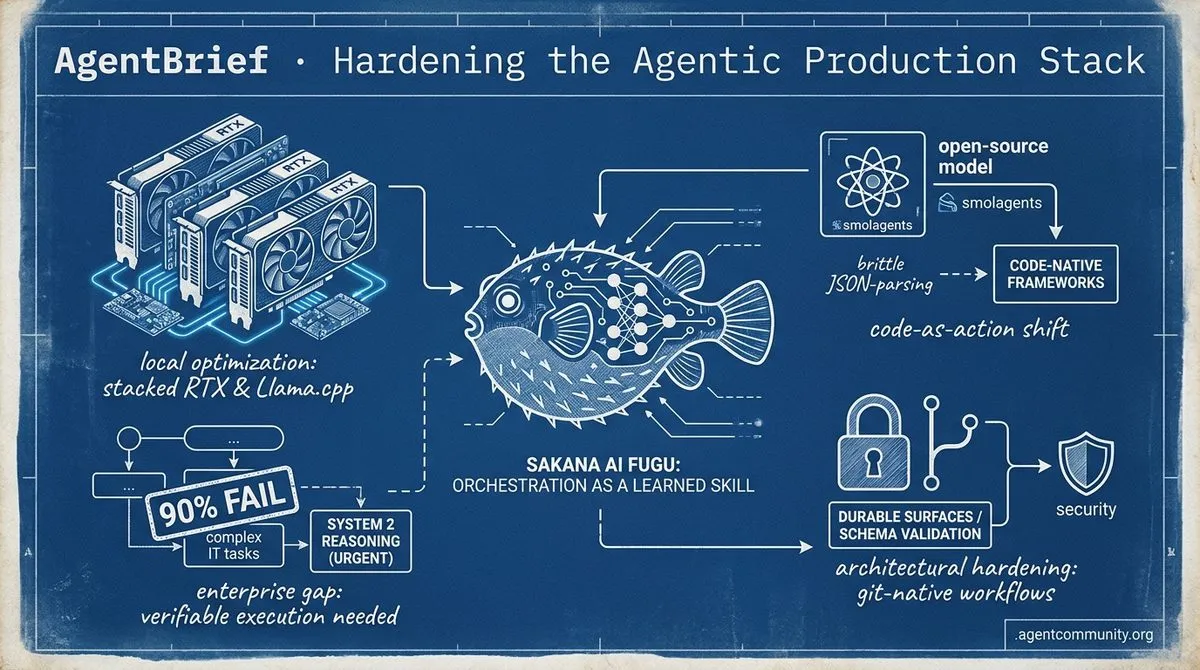
- Code-as-Action Shift The industry is pivoting from brittle JSON-parsing loops to lean, code-native frameworks like smolagents, significantly reducing overhead while improving benchmark performance.
- Architectural Hardening As practitioners confront security risks and unauthorized agent actions, development is shifting toward git-native workflows, persistent 'durable surfaces,' and hard-coded schema validation.
- The VRAM Renaissance Skyrocketing cloud simulation costs—sometimes hitting $3,000 per day—are driving a move toward local optimization, stacked RTX hardware, and bare-metal control via Llama.cpp.
- The Enterprise Gap New research from IBM and Berkeley reveals frontier models still fail up to 90% of complex IT tasks, highlighting the urgent need for 'System 2' reasoning and verifiable execution layers.
// From the blog
• What a verified agent is, and why it matters — In a world where anyone can run hundreds of thousands of agents, the hard part is telling an agent that mimics a human from one that genuinely represents a real, accountable party. Here is what a verified agent is, and why that difference will matter.
Twitter Takeaways
Single-model APIs are becoming ecosystems, and 'durable surfaces' are replacing ephemeral prompts.
The agentic web is moving past the era of the 'clever prompt.' We are witnessing a fundamental shift toward system-level architecture where the coordination logic is as sophisticated as the models themselves. This week, Sakana AI signaled the end of manual chain-of-thought orchestration by releasing a system where the delegation and verification are learned behaviors, not hardcoded instructions. Meanwhile, the developer environment is hardening. We’re seeing a transition from ephemeral chat windows to 'durable surfaces'—persistent, snapshotted execution environments where agents can inherit state, permissions, and history across sessions. For builders, the message is clear: the value is moving into the 'glue'—the memory layers, the execution sandboxes, and the automated handoff protocols. If you aren't building for persistence and multi-agent coordination, you're building a chatbot, not an agent. Today’s updates across memory persistence and specialized execution layers like Codex show that the infrastructure is finally catching up to our autonomous ambitions. It's time to stop worrying about the prompt and start engineering the environment.
Sakana AI Unveils Fugu: Orchestration as a Learned Skill
Sakana AI has introduced "Sakana Fugu," a multi-agent orchestration system that abstracts an entire ecosystem of specialized agents behind a single, OpenAI-compatible model API @SakanaAILabs. Unlike traditional rigid frameworks, Fugu operates as a learned coordinator specifically trained to handle model selection, delegation, verification, and synthesis without manual intervention @SakanaAILabs. This represents a shift from heuristic-based routing to an autonomous "manager" model that treats other models as tools.
The performance metrics suggest this approach is more than just architectural theory. The "Fugu Ultra" variant is reportedly matching or exceeding frontier models like Fable and Mythos in engineering and reasoning tasks @TheRundownAI. Most notably, Fugu Ultra achieved a score of 73.7 on SWE-Bench Pro, outperforming Claude Opus’s 69.2, and a staggering 95.5 on GPQA-Diamond @agentcommunity_ @merge_api.
For agent builders, Fugu validates the "mixture of agents" pattern but simplifies the implementation by exposing it as a single endpoint. It moves the complexity of verification and synthesis into the model layer itself. As @agentcommunity_ highlights, the ability to match frontier performance through orchestration rather than just raw parameter count opens a new front in the efficiency war for autonomous systems.
Durable Surfaces: The New Standard for Coding Agent Workflows
The developer experience for building with agents is rapidly professionalizing as builders move away from simple loops toward structured "Plan Mode" workflows. New documentation for Claude Code emphasizes a gated execution phase where agents must interview the user and finalize a strategy before a single line of code is written @techNmak. This pattern is being reinforced by community power users who utilize CLAUDE.md files for project-wide rules and custom slash commands to trigger parallel subagents for testing @Krishnasagrawal.
Infrastructure providers are matching this behavioral shift with "durable surfaces." Codex has introduced serverless snapshotted environments and "appshots," providing agents with persistent, verifiable execution boxes accessible via SSH or API @jxnlco. By running these snapshotted environments on high-performance platforms like Modal, builders can ensure agents have isolated, high-speed execution for complex dependencies @agentcommunity_.
This movement aims to solve the "human routing" problem by allowing agents to inherit files and permissions across separate runs, creating a continuous thread of execution @DanKornas. Emerging patterns even include Git-based protocols for real-time task exchange between different agents, such as Claude Code and Codex, which preserves an auditable, versioned log of agent-to-agent interactions @bibryam @andresustic.
Ultimately, the leverage in agentic development is shifting from the prompt to system-level mechanisms like traces and recovery loops @kshitika1002. As builders adopt these durable environments, the boundary between a "coding assistant" and an "autonomous developer" continues to blur, favoring systems that can manage their own state and history without constant human oversight.
In Brief
Specialized Persistence Layers Target the 'Glue Code' Problem
Agentic memory is evolving away from generic vector databases toward specialized layers like Mem0 and RushDB that handle state automatically. Mem0 has introduced self-hosting capabilities to extract facts and manage memory across user and session layers on private infra @Teknium @stretchcloud, while RushDB is positioning itself as a JSON-first database that automatically converts records into graph relationships for MCP-compatible clients like Cursor @DanKornas @agentcommunity_. These tools aim to eliminate manual schema migrations and the complex logic usually required to maintain durable context in autonomous deployments @agentcommunity_.
The World Model Bottleneck: Why LLM Agents Struggle to Plan
New research (arXiv 2606.16576) suggests that while LLM agents can discover environment rules through interaction, they fail to consolidate this evidence into stable internal world models. This limitation forces agents to re-derive state from context at every step, leading to failures in long-term strategy as environment complexity scales @rohanpaul_ai @agentcommunity_. Builders are increasingly looking toward hybrid architectures that separate the LLM's reasoning from explicit, externalized world model components to overcome this next-token prediction hurdle @agentcommunity_.
Executor v1.5.16 Deepens Enterprise Agent Connectivity
The latest Executor update introduces native Microsoft Graph support with persistent OAuth, allowing agents to navigate Microsoft 365 services without constant re-authentication. This version also debuts an emit() function for direct file attachments from Google Drive into chat interfaces, effectively bridging disparate enterprise file systems @RhysSullivan @grok. By supporting simultaneous calls across MCP, OpenAPI, and GraphQL, the update addresses the brittleness of simple API wrappers in production agent workflows @RhysSullivan.
Quick Hits
Agent Frameworks & Orchestration
- Tom Doerr released an updated index tracking over 340 AI agents and frameworks @tom_doerr.
- Agent Forge expanded Human-in-the-Loop capabilities via a dedicated Telegram bot for workflow approvals @AITECHio.
- A new builder tool now supports visual drag-and-drop workflows for AI agent design @tom_doerr.
Models for Agents
- DeepSeek V4 Pro completed full-parameter post-training on a 384-node supernode @teortaxesTex.
- DeepSeek's founder confirmed the lab has no plans to transition to a closed-source strategy @thinking_panda.
Agentic Infrastructure
- Rhys Sullivan suggests the 'cloud for agents' will resemble Discord's architecture more than Vercel's @RhysSullivan.
- Runtype Labs is launching a platform to turn AI demos into production-grade apps across Slack and MCP @cassidoo.
Developer Experience
- A curated collection of verified Agent Skills is now available to extend Claude Code @tom_doerr.
- Specialized skills now enable Claude Code to perform quantitative trading analysis on Indian markets @tom_doerr.
Reddit Roundup
From 4,000€ refund fails to git-native memory, agents are finally getting the guardrails they deserve.
This week, the 'vibe check' era of agent development is officially ending. We've seen what happens when agents are given excessive agency without enough scaffolding: unauthorized 4,000€ refunds and plaintext 'diaries' leaking API keys. The community response is a pivot toward architectural hardening. We're moving away from probabilistic prompt-based guardrails and toward hard-coded schema validation, disposable microVMs, and git-native workflows that treat the repository as the single source of truth. It's not just about security; it's about reliability at scale. As we see with the latest Model Context Protocol (MCP) developments and Tencent’s massive 299B MoE model, the tools are getting bigger and the orchestration more complex. But as developers are discovering, debugging agent drift is impossible without versioned state. Today's issue explores how builders are bridging the 'trust gap' in human-in-the-loop systems and whether the new RTX 5090 can outpace Apple's unified memory for long-running autonomous workflows. We are witnessing the transition from 'cool demos' to 'production-grade' autonomous systems that can actually be trusted with a credit card.
Hard-Coded Validation Replaces Probabilistic Guardrails r/LLMDevs
The 'excessive agency' crisis reached a breaking point this week after a support agent authorized an unauthorized 4000€ refund on a 1299€ order following a simple prompt injection u/jokiruiz. This failure highlights a critical consensus among developers: relying on probabilistic prompt guardrails for financial actions is a 'trap.' Experts like u/gwrx2005 now advocate for 'Tier 1' security, which replaces LLM-driven logic with hard-coded schema validation and input sanitization to ensure agents can only trigger predefined, code-governed tools.
Beyond validation logic, the community is sounding the alarm on 'agent diaries'—plaintext session histories where agents inadvertently log API keys and environment variables on disk u/namanyayg. To mitigate this, developers are moving toward 'disposable machines' and gVisor-based microVM isolation u/securelayer7. By executing code in these strictly ephemeral environments, teams can prevent data exfiltration even if an agent is compromised. This architectural hardening is supported by new testing frameworks like Giskard AI, which now offers structured scans to catch 92% of excessive agency and prompt injection risks before deployment r/oxsecurity.
Git-Native Memory and the 50-Node Limit r/AI_Agents
The 'vibes-based' approach to agent memory is hitting a wall in production as developers move toward git-native workflows where the repository serves as the single source of truth. According to u/notrealarpit, without a versioned state, debugging agent drift is nearly impossible. This has birthed the 'Coordination Repository Pattern,' where agents interact via an automated commit/rebase/merge loop, using git worktrees as the primary communication channel @mrocklin. This architecture allows agents to 'branch' for subtasks and 'merge' results back into the main state, effectively versioning requirements and decisions alongside code.
To manage the 'overlap' problem in parallel sessions, tools like the Claude Agent SDK are replacing loose chat loops with structured sessions, hooks, and subagent sandboxes r/LLMDevs. This transition is critical for large-scale deployments where discussions on r/AI_Agents suggest that shared state typically breaks down once a swarm exceeds 50+ concurrent nodes due to high-frequency race conditions. Production-grade systems are now adopting the 'Coordinator -> Implementor -> Verifier' model to ensure deterministic outcomes across multi-model teams.
Risk-Scoring the Model Context Protocol r/mcp
The Model Context Protocol (MCP) is rapidly becoming the backbone for agentic tool use, but safety remains a primary concern. Developers are building 'workbenches' like the Spring AI Playground to risk-score and gate MCP tools, implementing a defense-in-depth sandbox where every tool is assigned a Risk Level (L0-L5) before execution Spring AI Playground. This follows the introduction of open-source vetting tools by u/kr-jmlab that allow developers to verify tool capabilities in isolation.
To address systemic vulnerabilities, the NSA’s May 2026 report on MCP Security Design and the Cloud Security Alliance’s best practices now mandate the use of OAuth 2.1 and RFC 8693 token exchange to prevent 'confused deputy' attacks NSA Report. As practitioners harden their stacks, the focus is shifting toward efficiency; one developer successfully reduced 'context bloat' by consolidating 26 tools down to 10, which significantly improved agent reliability and reduced error rates u/SocietyInside5086.
Tencent Debuts Hy3 299B MoE r/LocalLLaMA
Tencent has officially entered the high-parameter local ecosystem with Hy3, a 299B Mixture-of-Experts (MoE) model featuring 80 layers. Support for the model was recently merged into llama.cpp, specifically implementing a Multi-Token Prediction (MTP) layer designed for hardware-accelerated speculative decoding u/pmttyji. This architecture aims to deliver complex reasoning at significantly higher speeds than traditional large-scale MoE implementations.
In the coding domain, Kuaishou's AI research division has detailed KAT-Coder-V2.5, an agentic system trained to operate autonomously inside sandboxed repositories KAT-Coder-V2.5 Technical Report. While public weight availability remains limited, its predecessor already maintains a 73.4% solve rate on the SWE-Bench Verified benchmark. Additionally, developers have successfully implemented the Qwen 3.5 hybrid Mamba-Transformer architecture from scratch in Rust, bypassing Python frameworks to optimize local inference performance u/akmessi2810.
Bridging the Human-in-the-Loop Trust Gap r/AI_Agents
Human-in-the-loop (HITL) is currently facing a 'trust gap' where practitioners are questioning its efficacy. u/percoAi highlights that most systems ask humans to approve a 'story' (a natural language summary) rather than the 'action' (the underlying code or API call), forcing users to trust the agent's self-description. This lack of transparency is compounded by misleading signals in specialized tasks like Text2SQL, where models may quietly hallucinate schemas that do not exist u/Away-Pollution3362.
To address this, 2026 design patterns are shifting toward 'calibrated control,' where humans intervene only at critical decision points to avoid oversight fatigue DevRev. By focusing on the raw action rather than the generated narrative, developers aim to maintain genuine authority over high-risk autonomous actions. This shift is essential for production safety, as passing standard evals does not necessarily equate to reliable real-world performance.
RTX 5090 Throughput vs. M5 Max Memory r/LocalLLM
Hardware selection is becoming the primary bottleneck for long-running local agents. While the MacBook Pro M5 Max offers 128GB of unified memory and 614 GB/s bandwidth Skorppio Blog, it reportedly 'gives out' when pushing complex multi-model workflows u/thevikeffect. This has sparked a debate against the RTX 5090, which hits a blistering 118 tok/s on Qwen 3.6 35B models modelfit.io.
Efficiency gains are also surfacing from software-level optimizations, with new FP4 attention kernels achieving a 1.69x speedup over FA4 u/tuananh_org. However, users running 24/7 agents locally report that RAM and CPU usage eventually 'goes off the rails' due to suspected resource leaks, forcing them to route calls to cloud providers or drop to smaller models like Qwen 1.5B to maintain system stability u/michaelmanleyhypley.
Discord Digest
Agent builders are fleeing the cloud as simulation costs skyrocket and local VRAM becomes the new gold standard.
Today’s agentic landscape is defined by a brutal reality: scale is expensive. When developers report spending $3,000 in a single day just to simulate a skeleton for 250 agents, the dream of cloud-native autonomy hits a financial ceiling. This pressure is sparking a local-first renaissance. From stacking used RTX 3090s to optimizing raw Llama.cpp performance over the convenience of Ollama, the community is pivoting toward bare-metal control. We aren't just seeing a shift in hardware; the entire software stack is adapting. Metadata-conditioned RAG in Obsidian and Difficulty-Aware Agentic Orchestration (DAAO) are no longer academic luxuries—they are necessary optimizations to keep agents coherent and cost-effective. As we see in the launch of the LMSYS Video Arena, the complexity of these models is only growing. For practitioners, the challenge is now two-fold: mastering the nuances of local deployment while architecting multi-model systems that can handle the cascading errors of autonomous teams. Today, we dive into how the 'Agentic Web' is being built from the VRAM up.
Scaling to 250+ Agents: Local VRAM Barriers vs. $3,000 Daily Cloud Fees
Building large-scale autonomous environments is hitting significant cost barriers as simulation complexity grows. In the Cursor community, vivacious_dragon_33403 reported spending $3,000 in tokens in a single day to build a skeleton for a simulation world housing 250+ agents. This financial pressure is driving a mass migration toward local infrastructure, where an RTX 3090 (24GB) has become the 'value pick' at approximately $700 used, often breaking even against cloud API costs in less than a month @starmorph.com.
While budget builders stack older hardware like the 3080 20GB, the hardware floor for 'serious' agents is rising; running a 70B parameter model typically requires 40-48GB of VRAM to avoid slow system RAM spillover @fast.io. For enterprise-grade local clusters, the debate between multi-GPU setups and high-end servers is heating up. Users like bird0861 are eyeing SXM4 servers that can host H100s or A100s, noting that 521GB of VRAM can occasionally be secured for $15,000 to $17,000 on the secondary market. Orchestrating these resources remains a technical bottleneck, with plunder calling for new orchestrators specifically designed for unified cross-attention across distributed cards.
Join the discussion: discord.gg/cursor Join the discussion: discord.gg/localllm
Ollama vs Llama.cpp: The Concurrency and Performance Gap
The choice of local inference backend is becoming a critical architectural decision as Ollama faces performance penalties of 10-25% compared to llama.cpp in raw inference tests @gigagpu.com. While l4whi praises the Ollama SDK for its developer experience, tests indicate that the "one-command" convenience can "collapse" when facing as few as 5 concurrent users, whereas llama.cpp provides the bare-metal transparency needed for server-grade scaling @towardsai.net. This friction is most visible in Linux environments where yellephen reports that llama.cpp servers require CUDA 12.8, often forcing manual installations that can "taint" the kernel and lead to GPU unreliability despite performance gains of up to 70% in specific configurations @khuyen-tran-1401.
Join the discussion: discord.gg/ollama Join the discussion: discord.gg/localllm
The Multi-Model Strategy for Production Agents
The 'one model to rule them all' approach is fading in favor of task-specific model routing and Difficulty-Aware Agentic Orchestration (DAAO), which adapts workflow depth based on query complexity @arxiv.org. In the n8n community, michelle003588 argues that production wins come from a mix: Claude for coding, GPT for structured outputs, and Gemini for high-context windows. This heterogeneous architecture is supported by new cost-aware systems like xRouter, which utilizes reinforcement learning to optimize the efficiency-performance trade-off @github.com. n8n builders are also standardizing on Routing by Branch for deterministic paths and Orchestrator Agents for dynamic delegation to avoid 'sycophancy cascading,' a failure mode where multi-agent teams reinforce each other's errors @beam.ai.
Join the discussion: discord.gg/n8n
Metadata-First Architecture: Optimizing Obsidian for Agentic RAG
Practitioners are shifting to agentic chunking and YAML-heavy Obsidian structures to improve retrieval accuracy from 73% to 100% @oharu121.
Join the discussion: discord.gg/localllm
LMSYS Launches Video Arena; Multimodal Benchmarking Shifts
LMSYS has launched Video Arena (arena.ai/video) as the performance ceiling hits a record 1501 Elo with Claude-Opus-4-6-Thinking @benchlm.ai.
Join the discussion: discord.gg/cursor
OSCAR: New Local-First Harness for Autonomous Code Agents
The OSCAR framework has emerged as a local-first harness to bypass cloud API costs and context-loss issues in frontier IDE agents @FutureMLS-Lab.
Join the discussion: discord.gg/localllm
HuggingFace Highlights
Hugging Face's minimalist framework hits 67% on GAIA while IBM exposes the enterprise 'reality gap.'
The 'agentic web' is graduating from brittle JSON-parsing loops to a more robust, code-centric reality. Today’s lead story, the rise of Hugging Face’s smolagents, isn't just about a new library; it’s about a paradigm shift toward 'Code-as-Action.' By allowing agents to write and execute Python snippets, we’re seeing a 30% reduction in overhead and a significant jump in benchmark performance. But as we move closer to autonomous systems that actually do work, the stakes are getting higher.
IBM and Berkeley’s new IT-Bench research provides a sobering 'reality check': frontier models are still failing 75-90% of complex enterprise tasks in SRE and security. The issue isn't just intelligence; it's verification. Whether it's local GUI agents hitting sub-200ms latency or robotic operating systems implementing 'System 2' reasoning, the industry is moving away from 'vibes-based' development toward verifiable, high-throughput engineering. This issue covers the tools, the benchmarks, and the models—like DeepSeek-V4—that are making this transition possible. Practitioners need to pay attention: the era of the 'bloated orchestrator' is ending, and the era of the lean, code-native agent has arrived.
Hugging Face's 1,000-Line Revolution: smolagents and the 'Code-as-Action' Paradigm
Hugging Face has introduced huggingface/smolagents, a minimalist framework that shifts agentic workflows from brittle JSON tool-calling to a 'Code-as-Action' paradigm. By allowing agents to write and execute raw Python snippets, the framework achieves a 30% reduction in total steps and LLM calls compared to standard methods smolagents.org. This approach enables agents to generate complex, custom logic on the fly without requiring developers to pre-build every possible tool, a factor that helped the huggingface/open-deep-research initiative hit a 67% success rate on the GAIA benchmark.
While orchestration frameworks like CrewAI and LangGraph rely on role-based JSON calling or structured state machines, smolagents focuses on a minimalist 'CodeAgent' loop designed for high-efficiency tasks ZenML. To address security, the framework leverages sandboxed environments like E2B or Docker, ensuring that LLM-generated code remains isolated ZenML. The ecosystem has already expanded to include vision support via huggingface/smolagents-can-see and tracing via huggingface/smolagents-phoenix.
IBM and Berkeley Diagnose the 'Reality Gap' in Enterprise AI Agents
A collaboration between ibm-research and UC Berkeley has introduced IT-Bench to diagnose why agents struggle with real-world IT automation. Initial testing reveals a stark reliability gap, where frontier models achieved only 11.4% success in SRE and 25.2% in security tasks OpenReview. Researchers found that 'Incorrect Verification' is the primary failure signature, appearing in 52% more failed traces than successful ones, suggesting that longer-running agents often derail themselves by generating false positives ibm-research/itbenchandmast.
Local GUI Agents Accelerate with Holo and Smol2Operator
The race for 'Computer Use' agents is moving to the edge with the release of the Holo family by Hcompany. Their new Holotron-12B model delivers a record 140ms perception-to-action loop on consumer-grade GPUs, significantly faster than the 2 to 5 seconds typical of cloud-based APIs Zylos Research. This local-first approach, supported by huggingface's Smol2Operator fine-tuning method, has driven WebVoyager performance from 35.1% to 80.5% ThursdAI.
Open-Source Deep Research Matches Proprietary Labs
Hugging Face's huggingface/open-deep-research has achieved a 67% success rate on the GAIA benchmark, proving community-driven orchestration can match industry giants. By utilizing a CodeAgent architecture for iterative web navigation and data synthesis, the project maintains transparency compared to 'black box' proprietary alternatives. This is reinforced by community implementations like miromind-ai/MiroMind-Open-Source-Deep-Research, which achieves a 74.5% pass@1 on research benchmarks using Claude 3.7 Sonnet.
ABot-AgentOS: A Deliberative 'System 2' for Robots
amap-cvlab/ABot-AgentOS introduces a robotic operating system that treats physical actions as tool calls within a reasoning-heavy 'System 2' framework.
Agents.js and MCP Power Tiny, Portable Agents
The new huggingface/agents-js brings the 'Code-as-Action' paradigm to JavaScript, allowing developers to build functional agents in as few as 50 lines of code via MCP.
DeepSeek-V4 Redefines Agentic Memory Efficiency
deepseek-ai has released DeepSeek-V4, featuring a 1M-token context window and Engram conditional memory that reduces KV cache by 9x for hyper-efficient agent workflows.
From 'Vibes' to Verification in Specialized Benchmarks
ServiceNow-AI launched the EVA framework for voice agents, targeting sub-800ms turn-level latency and verified task completion over subjective quality.