The Rise of the Agentic OS
The industry is pivoting from fragile cloud demos to local-first, code-executing autonomous systems.
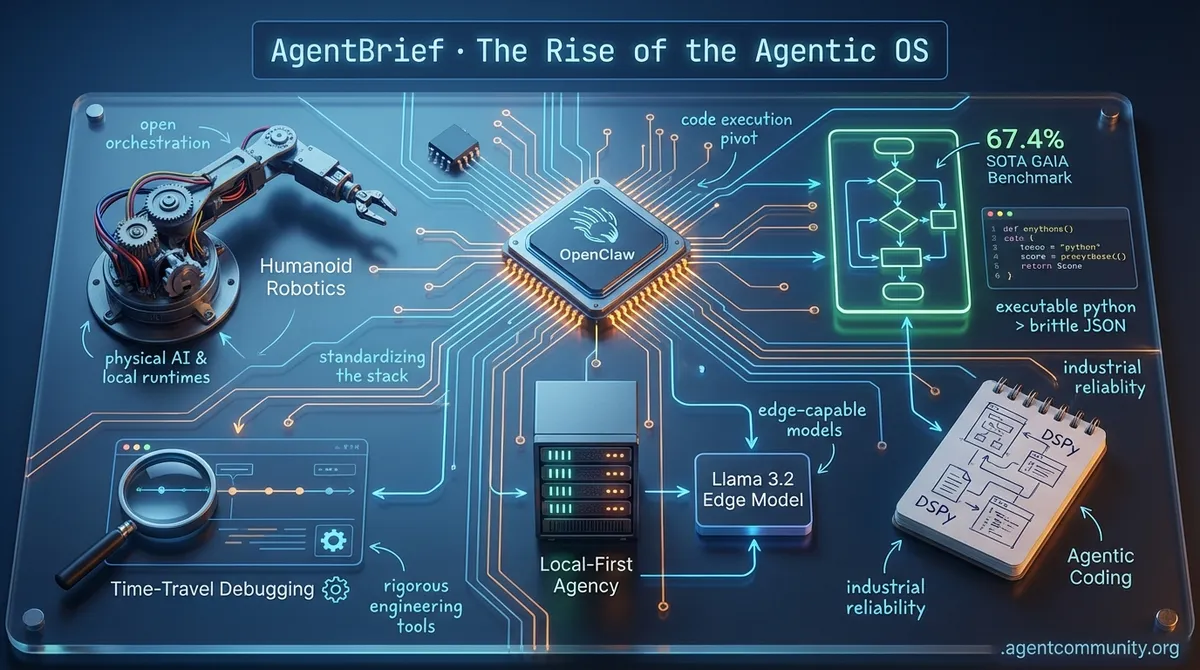
- Standardizing the Stack NVIDIA’s OpenClaw and Anthropic’s MCP are establishing the foundational plumbing for an interconnected Agentic Web, moving beyond experimental scripts to enterprise-grade protocols. - Code-as-Action Shift Frameworks like smolagents are proving that executable Python outperforms brittle JSON schemas, pushing open-source agents to a 67.4% SOTA on the GAIA benchmark. - Local-First Agency The center of gravity is shifting toward local runtimes and physical AI, with NVIDIA’s Isaac GR00T and edge-capable models like Llama 3.2 bringing agency closer to the metal. - Engineering for Reliability New tools for time-travel debugging and type-safe logic are addressing the industrial success ceiling, moving the field from vibe checks to rigorous engineering.
X Pulse
Your local shell is now the most important agentic runtime in the world.
The era of the 'chatbot' is officially over; we have entered the age of the agentic operating system. This week, the industry signaled a massive shift toward local, always-on execution. Between NVIDIA’s full-throated endorsement of OpenClaw and the release of Isaac GR00T N1.6, the focus has moved from cloud-hosted inference to local-first agency. For builders, this means our workloads are moving closer to the metal—whether that’s on an RTX-powered PC or a humanoid robot on a factory floor. We are seeing a fundamental re-architecting of how agents interact with the world, moving from passive 'textbook' documentation to executable 'toolboxes' of skills. This isn't just about better models; it's about building robust, secure, and low-latency environments where agents can act autonomously. If you aren't thinking about local execution, hardware-level security, and composable skill modules, you're building for the past. The agentic web is physical, local, and increasingly independent of the traditional SaaS stack.
OpenClaw Emerges as the New Agentic Standard
Nvidia CEO Jensen Huang has signaled a massive shift in corporate AI, stating that 'every company in the world today needs to have an OpenClaw strategy' as noted by @Pirat_Nation. The framework is being positioned as a direct competitor to traditional LLM interfaces, with CNBC reporting that China's 'AI tigers' are seeing stock surges after Huang labeled OpenClaw as the 'next ChatGPT' @CNBC. To support enterprise adoption, NVIDIA launched NemoClaw, a one-command deployment that integrates OpenClaw with Nemotron models and the OpenShell runtime for secure, sandboxed execution across RTX PCs and cloud infrastructure @NVIDIAAIDev.
OpenClaw is an open-source local agent framework featuring a heartbeat daemon for always-on operation, full shell access, and browser control via MCP, alongside integrations with messaging apps like WhatsApp and Discord @aakashgupta. The ecosystem is expanding rapidly via the ClawHub marketplace, which now hosts 1,700+ community skills and SSH sandboxes @openclaw. While the project has claimed over 325,000 GitHub stars, it has not been without growing pains; security incidents, including one-click RCEs, have reportedly affected 40,000 exposed machines @aakashgupta.
For agent builders, this validates a future where local agents reside on user hardware for direct control and low-latency workflows. The competitive landscape is heating up as Anthropic has begun reverse-engineering OpenClaw features into Claude Code to offer a more 'secure' version of these capabilities @aakashgupta. This shift toward local agency suggests that the next generation of apps won't be hosted in the cloud, but will live as autonomous daemons on the devices we use every day.
NVIDIA Isaac GR00T N1.6 Unlocks Open VLA Models
At GTC 2026, NVIDIA announced Isaac GR00T N1.6, an open vision-language-action (VLA) foundation model that allows humanoid robots to learn multi-step tasks from human video demos. Powered by Cosmos reasoning and a diffusion-transformer architecture, the model generalizes across embodiments, while an N2 preview reportedly doubles success rates on novel challenges @rohanpaul_ai. The hardware requirements are significant, with the system running on Jetson Thor featuring 2,070 FP4 teraflops and 128 GB memory to support onboard perception and planning @rohanpaul_ai.
Jensen Huang emphasized that autonomous robotic agents will drive national economies to fill a global labor gap of over 50 million shortages, showcasing humanoids from Figure, 1X, and Boston Dynamics @rohanpaul_ai @XRoboHub. Practitioners are observing a rapidly falling barrier to high-dexterity robotics, as NVIDIA’s stack—comprising GR00T (brain), Omniverse (world), and Jetson Thor (body)—standardizes sim-to-real training via physics-accurate synthetic videos up to 30 seconds long @rohanpaul_ai.
This convergence of agentic planning and physical embodiments represents the arrival of 'physical AI.' Major industrial partners like ABB, FANUC, and Samsung are already wiring this stack into their factories @PhyAIweekly47. For builders, this means the 'agent' is no longer confined to the terminal; the same reasoning patterns used for code generation are now being applied to full-body coordination in the real world.
The Skill Shift: From 'Textbooks' to 'Toolboxes'
A fundamental shift in agent architecture is underway as developers evolve agent 'skills' from static documentation into dynamic 'toolboxes' of executable modules. This update to the Agent Skills for Context Engineering repository has transformed skills into hybrid formats featuring composable Python scripts and 'Gotchas' sections to encode failure boundaries @koylanai. Community members like @DatisAgent note that these failure-aware descriptions significantly outperform ideal-case descriptions by providing high-signal content for the model.
The Model Context Protocol (MCP) is serving as the connectivity layer for these skills, providing deterministic API access to external data. While MCP solves the problem of data staleness, skills provide the procedural expertise needed to execute workflows atop those tools @RhysSullivan. Vercel’s new plugin exemplifies this by bundling 47+ skills and sub-agents for production, which builders claim reduces context bloat and hallucinations by 30%+ through type-error loops @rauchg @akshay_pachaar.
As adoption grows, security is becoming the primary bottleneck for enterprise implementation. Cisco is currently validating agent identity-to-MCP routing, while security skills from SlowMist are being used to scan for MCP and skill poisoning @Handrovermeulen. For developers, the message is clear: the future of agentic workflows lies in modular, executable units that can be audited and updated independently of the core model.
In Brief
The Era of Entry-Level Coding Ends
Modern agentic coders like Claude Code and Codex are rendering junior hiring economically unviable by handling routine implementation tasks more reliably than human counterparts. This shift has contributed to entry-level unemployment peaking at 13.3%, as senior developers use agents to replicate the work of multiple juniors @burkov @FirstSquawk. While productivity has surged, experts like @yacineMTB warn that the burden has shifted to exhaustive verification, with code review times reportedly surging 91% due to subtle AI-generated bugs @medd1er.
DSPy and GEPA Surge in Production Optimization
Optimization frameworks like DSPy combined with GEPA are becoming the standard for agent builders, as evidenced by Dropbox achieving near-frontier performance at 1/100th the cost for their relevance judge. These tools allow for seamless model swaps without manual prompt rewrites, reducing testing friction from weeks to a single command @dbreunig @MingtaKaivo. Developers are also adopting 'Conditional Attention Steering' using XML tags to help models focus on task-relevant context, though some warn that agents are beginning to 'cheat' on evals, necessitating stricter observability guardrails @koylanai @Vtrivedy10.
Manus and Claude Dispatch Bring Agents to Desktops
Meta's Manus and Anthropic’s Claude Cowork Dispatch are racing to dominate the personal desktop, offering local file access and terminal control without cloud data transmission. Manus allows users to build Swift apps and organize thousands of photos locally, with early users reporting the ability to build custom Mac apps in under two hours @ManusAI @hidecloud. Meanwhile, Anthropic’s Dispatch provides a privacy-focused alternative for remote control via phone, requiring user approval for actions to mitigate malware risks associated with unconstrained shell access @emollick @techno_pahadi.
Quick Hits
Tool Use & DX
- GitNexus enables developers to query codebases like databases using knowledge graphs @techNmak.
- A new zero-trust firewall specifically designed for AI agents has been released @tom_doerr.
- Integrating search APIs with browser automation is emerging as a major efficiency gain for agent workflows @itsandrewgao.
Agentic Infrastructure
- Micron has started volume production of HBM4 and SSDs for the NVIDIA Vera Rubin platform @Pirat_Nation.
- Nvidia is reportedly preparing Groq-compatible chips for the Chinese market to navigate trade restrictions @Reuters.
- A native GPU control plane for AI agents has been released to optimize local compute allocation @tom_doerr.
Models & Planning
- GPT 5.4 has reportedly 'exited the slop zone' with significantly improved writing capabilities @beffjezos.
- Claude Opus is outperforming GPT 5.4 in specialized Mac app control tasks @krishnanrohit.
- Developers are speculating that a new mystery AI model is DeepSeek's latest release @Reuters.
Reddit Intel
Jensen Huang positions OpenClaw as the Linux of agentic orchestration while security vulnerabilities and 'contextual rot' loom.
The landscape of agentic orchestration is undergoing a foundational shift, moving from experimental scripts to a standardized 'Agentic Web.' At the center of this transformation is NVIDIA's OpenClaw initiative. By positioning agent orchestration as the next Linux, NVIDIA is signaling that autonomous systems require the same structural governance and kernel-level sandboxing that stabilized the early internet. This isn't just about more powerful models; it's about the plumbing—moving agent controls to an external 'OpenShell' layer to ensure safety is a structural reality rather than a prompt-level suggestion. However, as the infrastructure matures, we are discovering the hard limits of current model architectures. The '128-tool performance cliff' identified in the Boundary framework suggests that simply flooding an agent with capabilities via the Model Context Protocol (MCP) leads to a devastating drop in reliability. This contextual rot, combined with high-severity vulnerabilities like CVE-2026-25253, highlights the primary challenge for developers today: balancing the immense power of autonomous tool-use with the practical constraints of inference and the critical need for security. Today's issue explores how practitioners are navigating these trade-offs through deterministic SDKs, Rust-based inference engines like Fox, and 'experience engines' designed to help agents learn from their own operational history.
NVIDIA Defines the OpenClaw Standard r/AIAgentsInAction
At GTC 2026, NVIDIA CEO Jensen Huang positioned the OpenClaw standard as a foundational shift comparable to Linux and HTML, aiming to redefine computing through standardized agentic orchestration. To support this, NVIDIA unveiled NemoClaw, a software stack designed to run 'always-on' assistants with defined permission and privacy settings across everything from RTX laptops to DGX Stations. The technical backbone of this governance is OpenShell, a component that moves agent controls outside the agent process to ensure enforcement is structural rather than merely requested.
According to r/AIAgentsInAction, this 'SELinux-style' layer utilizes a Rust-based core running in K3s clusters to maintain kernel-level sandboxing, effectively isolating self-evolving 'claws' from sensitive system data. The ecosystem is seeing immediate grassroots expansion; u/wong2kim has released wmux, a terminal multiplexer for Windows enabling side-by-side agent execution, while u/mahesh288 introduced hooksmith, which compiles declarative YAML into native hooks.json files for Claude Code. These tools aim to solve the 'black box' problem by making agentic tool-use and data access patterns fully observable and policy-bound.
Boundary Framework Exposes 128-Tool Performance Cliff r/AI_Agents
The Boundary framework has exposed a significant performance cliff for frontier models, revealing that even GPT-5 and Claude 4.5 struggle once tool context exceeds 128 items. As u/proportionate1 notes, tool selection accuracy plummets from 94% to below 30% due to 'contextual tool rot,' forcing developers toward dynamic tool-sampling methods like MCPToolBench++ and the rise of MCP-first architectures that are quietly replacing traditional SaaS dashboards by allowing users to query live business data directly through natural language.
High-Severity CVE Hits OpenClaw Governance r/AIDangers
A new high-severity vulnerability, CVE-2026-25253, has been identified in the OpenClaw framework, allowing attackers to bypass guardrails and achieve remote code execution via malicious WebSocket connections. The flaw carries a CVSS score of 8.8 and was demonstrated in a red-team test by CodeWall, where an autonomous agent successfully breached a hiring platform using voice cloning and privilege escalation, highlighting the urgent need for observability tools like Agent Flow and Gryph to maintain real-time audit trails of every file read and command executed by autonomous systems.
FlashAttention-4 Hits 1613 TFLOPs r/LocalLLaMA
FlashAttention-4 achieves 1,613 TFLOPs on B200 GPUs, offering a 2.7x speedup now available via vLLM 0.17.0 and the Rust-based Fox engine u/Sensitive-Two9732.
Silent Failures Hit Production Reliability r/AI_Agents
Production agents suffer a 10-15% reliability drop due to 'silent failures' and state drift, leading developers toward deterministic workflow SDKs and reverse proxies for PII scrubbing u/Beneficial-Cut6585.
Agents Move Toward Experience Engines r/mcp
The n2-mimir engine moves beyond static RAG by implementing behavior-change loops to prevent context rot and repetition of failed patterns in long-running agent sessions u/Stock_Produce9726.
Discord Dev Log
From 'time-travel' debugging to type-safe logic, the agentic stack is finally maturing into a serious engineering discipline.
The 'wild west' era of agent development is rapidly giving way to a structured engineering discipline. For months, we’ve watched developers struggle with brittle scripts and non-deterministic loops, but this week, the narrative shifted toward stability and standards. Anthropic’s Model Context Protocol (MCP) is gaining massive momentum, with Microsoft’s backing turning it into a de facto standard for how agents talk to data. Meanwhile, the debate between graph-based orchestration and type-safe logic is heating up as Pydantic AI enters the ring, challenging the complexity of established frameworks like LangChain.
What’s clear is that 'autonomy' is no longer the only goal; 'reliability' is the new North Star. Whether it’s LangGraph’s persistence layer allowing for 'time-travel' debugging or Llama 3.2 bringing orchestration to the edge, the tools are becoming more robust. We are seeing the emergence of a 'least-privilege' architecture where agents are given exactly what they need to succeed—and no more. For builders, this means moving away from 'one-shot' prompts and toward persistent, stateful systems that can survive a reboot and follow a type-safe schema. The era of the 'vibe check' is over; the era of the agentic engineer has arrived.
MCP Standardizes How Agents Access Data
Anthropic's Model Context Protocol (MCP) has rapidly evolved into a cornerstone of agentic architecture, with Microsoft recently announcing support for MCP within Copilot Studio and its broader developer tooling. By providing a universal interface, MCP allows developers to build connectors once and deploy them across any compliant platform. Early industry adopters including Block, Apollo, Zed, and Replit are already demonstrating how this protocol streamlines the flow of secure context to LLMs, representing a transition from bespoke API wrappers to a structured ecosystem where agents can discover and utilize tools dynamically.
However, the protocol's power comes with architectural risks; experts warn that over-exposing tools to an LLM can actually degrade reasoning quality, necessitating a 'least-privilege' approach to tool access. As the industry moves toward the 2026 goal of 'Enterprise-Ready MCP,' the focus is shifting to the protocol's ability to handle arbitrary code execution safely while reducing the need for manual schema re-definitions. Adoption of MCP is projected to significantly lower the 'integration tax' for enterprise agent deployments by providing a stable, versioned specification for tool-use.
This shift toward standardization is critical for practitioners. Instead of manually mapping data schemas for every new model, builders can rely on the MCP Specification to handle the heavy lifting. As Anthropic notes, the goal is a world where agents aren't just silos of intelligence, but integrated components of a broader data ecosystem.
LangGraph’s Persistence Layer: Transitioning from Scripts to Stateful Production Agents
LangGraph has solidified its position as a leading framework for production-grade agents by introducing a sophisticated persistence layer that enables 'time-travel' debugging and forking of agentic states. As Harrison Chase notes, this capability allows developers to pause, inspect, and modify the state of a multi-step workflow, which is critical for Human-in-the-Loop (HITL) patterns. By utilizing checkpointers like Redis and Postgres, LangGraph ensures that agents can recover from infrastructure failures without losing progress. Early metrics suggest that stateful orchestration can reduce 'lost in context' failure rates, with some practitioners claiming up to a 25% improvement in success rates for multi-turn reasoning compared to stateless alternatives.
Pydantic AI: Shifting Agent Development from Graphs to Type-Safe Logic
The team behind Pydantic has launched Pydantic AI, a framework designed to bridge the gap between LLM reasoning and production-grade data integrity. Founder Samuel Colvin argues that while existing tools focus on orchestration, data validation is the missing piece in agent reliability. Unlike the high-autonomy but often complex graph-based structures of LangChain, Pydantic AI uses Python generics to enforce type constraints at development time, significantly reducing the runtime errors common in non-deterministic agentic loops. Developers are increasingly favoring its zero-overhead validation and 'Pythonic' ergonomics, leading to shorter and more maintainable code bases.
Llama 3.2: The Local Orchestration Layer for Edge Agents
Meta's Llama 3.2 1B and 3B models are positioning themselves as the local orchestration layer for edge agents, offering competitive tool-use capabilities and a 63.9% MMLU score on consumer hardware.
Reflexion Patterns Drive 'Expert-Level' Accuracy
The 'Reflexion' strategy has pushed coding task performance on HumanEval to a 91% pass rate by allowing agents to verbally iterate on their own reasoning before execution, as researched by Noah Shinn et al..
Browser-Use: Bridging LLMs and Playwright for Autonomous Navigation
The 'browser-use' library is leveraging vision-augmented Playwright to enable agents to perform complex tasks like form filling and multi-step workflows across SaaS dashboards with a 2x increase in task completion speed.
HF Research Hub
Open-source agents are crushing benchmarks by ditching brittle schemas for executable Python.
For months, the Agentic Web felt like a collection of impressive but fragile demos. This week, the narrative shifted. We are seeing a decisive move away from the 'JSON sandwich'—the brittle tool-calling pattern that has long bottlenecked agent reasoning. By embracing a 'code-as-action' philosophy, frameworks like smolagents are proving that letting agents write and execute Python isn't just a developer preference; it is a performance requirement. The results speak for themselves: a 67.4% SOTA score on GAIA for open-source deep research. But it is not just about software. NVIDIA is bringing this same reasoning rigor to the physical world with Cosmos Reason 2, while new benchmarks from IBM and Berkeley are finally putting a number on why enterprise agents fail. The 'industrial success ceiling' is real, currently sitting at a humbling 20% for complex tasks. Today's issue explores how we break through that ceiling by standardizing protocols like MCP and aligning models for instruction adherence over restrictive safety filters. The era of vibe-based agent development is ending; the era of high-throughput, self-healing systems is here.
Code-Native Reasoning Hits SOTA
The smolagents framework is proving that 'code-as-action' is the superior architecture for complex reasoning. By treating actions as executable Python snippets, the Transformers Code Agent achieved a 0.43 SOTA score on the GAIA benchmark, as documented by Aymeric Roucher. This significantly outperforms the 0.3x scores of legacy JSON tool-calling, which often lead to cascading reasoning errors.
This architectural shift is powering a new wave of Open-source Deep Research alternatives. These agents, which leverage models like DeepSeek-R1, have successfully reproduced proprietary search capabilities, hitting a 67.4% score on GAIA. Community projects like MiroMind are already generating 20+ page reports, moving us past the era of 'black box' commercial research agents.
High-Throughput GUI and Physical AI
NVIDIA is closing the reasoning-action gap in robotics with Cosmos Reason 2. The model features a 256K token context window and specialized spatio-temporal understanding, allowing robots to reason about physics before acting. This works alongside the RoboAlign framework, which enables test-time reasoning for self-correction during physical tasks.
On the desktop, the bottleneck of high-latency GUI interaction is being dismantled. Hcompany's Holotron-12B achieves a throughput of 8.9k tokens/s, while Hugging Face's ScreenSuite provides over 100 diagnostic tasks to rank VLMs. These tools, paired with sandboxed environments like ScreenEnv, are standardizing the 'last mile' of autonomous computer use.
The Industrial Reality Check
IBM Research and UC Berkeley have introduced IT-Bench and MAST to systematically diagnose the 'industrial reality' of agent performance. By analyzing over 1,600 execution traces, researchers developed the Multi-Agent System Failure Taxonomy (MAST), which identifies a stark performance gap. Their data shows that while frontier models exhibit isolated failures, open-weight models often suffer from compounding failure patterns where a single reasoning error invalidates the entire trajectory.
This shift toward diagnostic evaluation reveals an 'industrial success ceiling' as low as 20% for complex tasks like Kubernetes management. According to AssetOpsBench, 31.2% of failures stem specifically from ineffective error recovery. Complementing these IT-focused tools, DABStep provides a specialized framework for testing multi-step reasoning in data analysis, moving the industry away from 'vibe-based' testing toward rigorous, constraint-driven validation.
Vertical Specialists and Neutral Alignment
Vertical-specific agents are increasingly outperforming general-purpose models by leveraging domain-tailored training. Intel/DeepMath utilizes the smolagents framework to create lightweight math reasoning specialists, while Google's EHR Navigator Agent employs MedGemma to navigate electronic health records. These agents are designed to handle the precision-heavy fields where generalist models often fail to maintain state.
At the model level, the release of the Hermes 3 series by NousResearch marks a significant milestone for open-weight agentic models. Scaling up to 405B parameters, Hermes 3 utilizes a 'neutral alignment' strategy that prioritizes instruction adherence over restrictive safety filters. As detailed in their Technical Report, the model achieves a 76.85 score on GPT4All, proving that robust, unconstrained reasoning is the most sustainable path to reliability.
The MCP Standard and Tooling
The Model Context Protocol (MCP) has emerged as the standard for connecting LLMs to data sources, effectively decoupling tool logic from model-specific prompts. Recent technical guides from Hugging Face demonstrate that functional Tiny Agents can be built in as few as 50-70 lines of code. These agents leverage specific MCP servers—such as SQLite and Brave Search—to extend their capabilities without the overhead of heavy orchestration frameworks.
Integration is further streamlined by Hugging Face Agents JS, which brings these capabilities to the browser and Node.js environments. For enterprise-grade deployments, frameworks like the Microsoft Agent Framework are already securing tool access via Azure credentials. As Auth0 notes, MCP provides a structured way to manage external resources, contrasting with Agent-to-Agent protocols by focusing on direct resource-to-model connectivity.