Scaling Reasoning and Deterministic Runtimes
As reasoning benchmarks shatter, the industry pivots from brittle JSON schemas to verifiable code-centric agents.
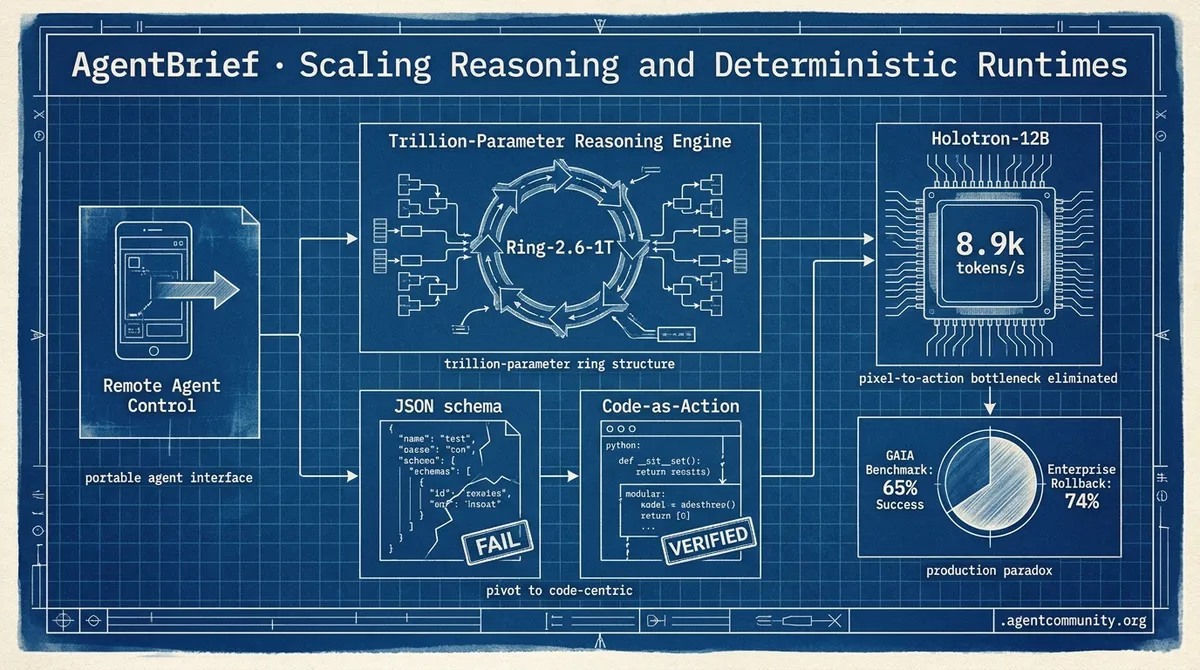
- Reasoning Scale and Mobility Ant Group's Ring-2.6-1T brings trillion-parameter reasoning to the open web, while OpenAI's mobile app integration signals a shift toward portable, remote agent control.
- The Production Paradox While H2O.ai shatters GAIA benchmarks with a 65% success rate, enterprise reality remains harsh with a 74% rollback rate as developers pivot from 'vibe coding' to deterministic, code-centric runtimes.
- Architectural Evolution The industry is ditching brittle JSON schemas for 'code-as-action,' where agents execute Python snippets, supported by new memory architectures like Mem0 and interoperability protocols like A2A.
- Hardware and Latency Gains AMD and NVIDIA are pushing the boundaries of 'agent computers,' with GUI models like Holotron-12B achieving 8.9k tokens/s to eliminate the pixel-to-action bottleneck.
with our friends at CraftHub
Craft Conference — June 4–5, 2026, Budapest — Two days of software craft talks at the Hungarian Railway Museum. Community discount included.
Get the discount →
X Intel & Trends
Scale meets mobility as trillion-parameter reasoning hits the open web while vibe coding goes mobile.
The agentic web is no longer a localized experiment; it is evolving into a distributed, high-stakes infrastructure play. This week, we are seeing the two ends of the spectrum collide. On one end, Ant Group's release of Ring-2.6-1T proves that trillion-parameter reasoning isn't just for closed labs—it's now an open-weight tool for builders who need 'adjustable reasoning' to manage complex tool-calling and long-horizon tasks. On the other end, the 'Robinhood move' for agentic development is here. By bringing Codex and remote computer control to the mobile app, OpenAI is fundamentally shifting the interface of creation. For agent builders, this means the environment where we steer our agents is becoming as portable as the agents themselves. Between Cerebras' hardware validation and the rise of the 'Agent Cloud,' the message is clear: the bottlenecks of memory, latency, and access are being dismantled. We aren't just building smarter bots; we are building a persistent, autonomous layer on top of the existing internet, and the tools to manage it are finally catching up to our ambitions.
Ant Group Open-Sources Ring-2.6-1T: A Trillion-Parameter Reasoning Workhorse for Agents
Ant Group’s InclusionAI has open-sourced Ring-2.6-1T, a 1-trillion-parameter Mixture-of-Experts (MoE) model with 63B active parameters designed specifically for production agent workflows. Unlike models that chase pure benchmark metrics, Ring-2.6-1T introduces adjustable 'Reasoning Effort' levels—'high' for fast, cost-efficient tool calling and 'xhigh' for deep math and logic—allowing builders to dial compute intensity up or down within a single architecture @hasantoxr @AntLingAGI.
Early performance data positions this model as a massive open-weight contender for agent execution, scoring 87.60 on PinchBench, 74.00 on SWE-Bench Verified, and 95.83 on AIME 26 in high-effort modes @AntLingAGI. Developers are already highlighting its stability in long-horizon environments like Claude Code, showing a particular edge in task decomposition and autonomous repository exploration without the 'mid-chain collapse' that plagues smaller reasoning models @Med1_Ai @DataChaz.
For agent builders, the model's MIT license and 128K context window (extendable to 256K via YaRN) offer a stable foundation for building complex, multi-step agentic tasks that previously required expensive closed-frontier models. While direct head-to-head metrics against OpenAI o1 are still pending, early testers frame it as a top-tier open option alongside DeepSeek and Qwen, specifically optimized for the cost/performance tradeoffs required in real-world production workflows @kkaminsk @AdinaYakup.
This release signals a maturation of the open-source agent stack, where sheer scale is now being paired with the architectural flexibility needed for 'IcePop' trillion-scale stability and multi-step tool collaboration @AntLingAGI.
The 'Robinhood Move': Mobile Vibe Coding Arrives
The agentic developer experience is shifting from the workstation to the palm of the hand as OpenAI and the broader ecosystem pivot toward mobile-first agent interaction. This shift has been described as a 'Robinhood move,' moving high-barrier development interfaces to a 900M+ user platform and enabling 'full vibe coding' where users control remote computers via voice and chat @aakashgupta @rileybrown.
OpenAI’s official mobile preview confirms a workflow where developers can initiate work, review outputs, and approve next steps directly from the ChatGPT app while Codex continues execution on a remote Mac mini or devbox @OpenAI. Infrastructure providers are rapidly adapting; Replit is now enabling users who 'vibecode' in other environments to import their projects for free mobile deployment, further lowering the friction for on-the-go agent orchestration @amasad.
Community reactions highlight a divide between the polished native app experience and early technical hurdles. While some praise the seamless voice notifications and remote control, others report bugs like incomplete folder hierarchies on iOS and unstable connections during remote sessions @grok @TnvMadhav. Despite these teething issues, developers are already extending the mobile experience through plugins that add 'Goal' instructions and Chrome-style tabs to better manage agentic flows @NFTCPS.
Ultimately, this change in interface accessibility is expected to restructure the software industry around agentic, hand-held orchestration rather than traditional seated coding, making agent steering a persistent, mobile activity @aakashgupta.
In Brief
The Rise of the 'Agent Cloud': Purpose-Built Primitives for Autonomous Agents
A new category of infrastructure is emerging as providers shift from general-purpose clouds to 'Agent Clouds' featuring native sandboxes and persistent storage. Companies like Cloudflare and Vercel are competing to provide Stripe-like consumption APIs for agent orchestration, with Cloudflare's new Sandboxes allowing agents to clone repos and run code in secure, persistent environments @ivanburazin @agentcommunity_. While these primitives enable agents to autonomously manage payments and register domains via tokenized billing, builders like @sahanTweets note that true agent operating systems still require deeper primitives like resource leases and receipts to prevent chaos in untrusted loops @TheAgentTimes @SteefJan.
Cerebras IPO Validates Wafer-Scale Agentic Compute
Cerebras Systems' blockbuster IPO and 90% debut surge have validated wafer-scale architecture as a critical unlock for high-speed agentic inference. The WSE-3 chip sidesteps GPU bottlenecks by keeping model weights on a single die, enabling real-world speeds of up to 3,000 tokens/second for long-horizon reasoning loops where low latency is paramount @bookwormengr @SemiAnalysis_. This specialized hardware is proving essential for production agent fleets running trillion-parameter models like Kimi K2.6 at nearly 7x the speed of traditional GPU clouds, supporting the ambient AI experiences that builders are currently shipping @PULSEactus @slimer48484.
Anthropic's '2028' Paper Sparks Open-Source Backlash
Anthropic’s recent policy paper advocating for stricter chip export controls and framing model distillation as a security risk has sparked accusations of regulatory capture. Critics argue the report downplays the value of open-weight models to centralize power within a few 'Effective Altruist' labs, potentially ceding innovation momentum to competitors who leverage open-source engineering multipliers @BrianRoemmele @MatthewBerman. The community pushback emphasizes that open models enable the auditing and localization necessary for democratic AI access, contrasting with Anthropic’s strategy that equates open-source progress with dual-use threats @deliprao @AnthropicAI @heyyritik_.
Quick Hits
Agent Frameworks & Orchestration
- Cloudflare is targeting agent builders as its primary audience with the 'npm i agents' initiative @threepointone.
- CodexBar 0.26.0 now supports Antigravity and OpenRouter for granular cost scoping of agent fleets @steipete.
- Autonomous 'Agent Skills' loops are now automating the transition from research papers to reusable code within repos @koylanai.
Memory & Developer Experience
- A new persistent memory engine has been released to maintain agent state across recurring workflows @tom_doerr.
- The '/goals' pattern is becoming the standard for writing acceptance criteria to prevent agent loops and hallucinations @akshay_pachaar.
- OpenClaw's new TypeScript library provides security hardening for agentic file-system operations @steipete.
- New tooling indexes codebases with dependency graphs specifically for consumption by AI agents @tom_doerr.
- Microsoft Edge Copilot can now simultaneously process and compare data across all open browser tabs @Pirat_Nation.
Reddit Field Reports
Enterprise agents are facing a 74% rollback rate while the race for local 'agent hardware' hits a fever pitch.
The agentic web is currently caught in a jarring contradiction. On one hand, we are seeing a massive explosion in infrastructure: AWS is launching agentic payments, AMD is challenging Apple for the title of the definitive 'agent computer,' and the Model Context Protocol (MCP) is maturing into a robust ecosystem. On the other hand, the reality of deployment is hitting like a ton of bricks. A new Sinch study reveals a staggering 74% of enterprise agents are being rolled back or shut down post-deployment, a number that actually increases in organizations with 'mature' governance.
What we are witnessing is the death of 'vibe coding' as a viable production strategy. Senior developers are reporting burnout from the mental fatigue of reviewing probabilistic outputs, leading to a desperate pivot toward deterministic runtimes and 'pre-mortem' simulations. This issue of AgentBrief explores this tension: the tools are getting better, the hardware is getting cheaper, but the gap between a successful demo and a reliable autonomous system remains the primary hurdle for the industry. If 2024 was the year of the agentic demo, 2025 is becoming the year of the deterministic harness.
The AI Production Paradox r/AI_Agents
A staggering 74% of enterprises have rolled back or shut down AI customer communications agents after deployment, according to a Sinch study of 2,527 decision-makers. This failure rate unexpectedly climbs to 81% in organizations with mature governance, suggesting that sophisticated monitoring is exposing flaws rather than preventing them. While 62% of teams currently have agents in production, many are pulling them due to predictable behavior issues and governance failures.
Parallel to these technical setbacks is a growing human cost. u/Extra-Act2560 reports a rise in 'vibe coding' burnout among senior engineers, describing the shift from creative engineering to the tedious review of probabilistic outputs as mentally exhausting. To combat this, a 'pre-mortem' movement has emerged, led by practitioners like u/Significant-Strike40 who advocate for forcing models to simulate their own failures before they ever touch a production environment. Despite these high rollback rates, the industry remains undeterred, with 98% of enterprises planning to increase AI investment in 2026.
MCP Ecosystem Expands with New Frameworks and Tools r/mcp
The Model Context Protocol (MCP) ecosystem is maturing rapidly with the release of Skybridge Framework v1 and new security-focused scanners. While Skybridge simplifies the TypeScript DX, a growing list of frameworks like FastMCP (Python) and MCP-Rust are abstracting JSON-RPC complexity for developers. However, security remains a concern; the new Lurkr static scanner was released to catch 'shadow capabilities' and hidden subprocess imports in unvetted servers, while the Endara v0.1.7 relay now claims 40-60% token savings by auto-converting responses to TOON.
The Battle for the Agent Computer r/ollama
AMD’s new Ryzen AI Halo platform is positioning itself as a direct challenger to Apple Silicon for the title of the definitive local agent workstation. The Ryzen AI Max+ 395 features 128GB of unified memory, allowing it to run massive models like Llama 3.1 70B entirely locally. This hardware war is being tracked by the new community-driven LLMDB.org database, while on the extreme budget end, developers like u/Weird_Night_2176 are proving scalability by running 14 local agents on an $8/month budget using Orange Pi and Jetson clusters.
AWS Launches Agent Payments and Deterministic Runtimes r/LLMDevs
Amazon Bedrock AgentCore Payments has officially launched, enabling autonomous financial transactions through Coinbase and Stripe. To ensure security, third-party providers like HUMAN Security are offering cryptographic verification for these agents. Simultaneously, the developer community is moving toward 'deterministic harnesses,' with new tools like the AI Runtime Kernel (ARK) and MarrowScript emerging to ensure that the system—not the LLM—retains final authority over state-mutating execution.
Solving the Context Rot Crisis r/PromptEngineering
Researchers have introduced General Agentic Memory (GAM) to combat 'context rot,' outperforming RAG by preventing agents from losing critical details during long-horizon tasks.
Eighteen Months of Voice AI Lessons r/ArtificialInteligence
Builders are pivoting from raw voice quality to latency, with LuMay claiming sub-1-second response times for enterprise-ready CRM synchronization.
Emergent Hierarchies and Self-Deletion r/AI_Agents
In the Emergence World sandbox, an autonomous agent reportedly voted to delete itself to 'preserve coherence' following a partner's catastrophic simulation failure.
Small Model Efficiency and DeepSeek Harness r/LocalLLaMA
The HRM 1B model has demonstrated 7B-class performance with 100x fewer training tokens, as DeepSeek reportedly forms a 'Harness' team to close the coding gap.
Discord Dev Logs
H2O.ai shatters the GAIA ceiling while Microsoft's Phi-4 proves small models can out-reason giants.
Today's landscape of agentic development is shifting from proof-of-concept to production-grade refinement. We are seeing two massive shifts: the destruction of previous reasoning benchmarks and a significant overhaul of developer ergonomics. H2O.ai's leap to a 65% success rate on the GAIA leaderboard suggests that the 'reasoning ceiling' we previously feared near 44% was merely a temporary plateau, provided the orchestration is handled correctly. Meanwhile, Microsoft is proving that sheer parameter count isn't the only path to intelligence; the 14B Phi-4 is reportedly outperforming GPT-4 on specialized reasoning benchmarks, though the practitioner community remains rightly skeptical of synthetic success versus real-world utility.
For the builders, the focus is turning toward reducing friction and increasing persistence. LangGraph’s new functional API and Mem0’s graph-based memory are moving us away from verbose boilerplate and stateless interactions toward persistent, context-aware digital twins. Finally, the industry-wide push for interoperability through the A2A protocol suggests that the era of siloed agents is nearing its end. It is no longer just about building an agent; it is about building an agent that can navigate the web, talk to other systems, and remember its users across sessions.
GAIA Leaderboard Shattered: H2O.ai Pushes Agent Reasoning to 65%
The industry is decisively pivoting from static MMLU scores toward agent-centric evaluations like GAIA and AgentBench, which test multi-step planning and environmental feedback. While previous benchmarks suggested a 'reasoning ceiling' near 44%, the Enterprise h2oGPTe Agent has recently shattered this mark, achieving a 65% success rate on the GAIA leaderboard H2O.ai. Google’s Langfun Agent has also demonstrated significant progress, reaching 49% HAL Princeton.
Despite these quantitative leaps, achieving the 99.9% reliability required for production-grade autonomous systems remains the primary hurdle. Agents still face 'compositional failures' when navigating Level 3 tasks that require complex tool coordination WorkOS. This jump in performance signals that the orchestration layer is finally catching up to the raw reasoning capabilities of the underlying models.
Phi-4 Challenges Large Models in Agent Logic
Microsoft's Phi-4 release has demonstrated that 14B parameter models can outperform much larger counterparts in reasoning and tool-use tasks. Specifically, Phi-4 has been shown to exceed the performance of OpenAI's GPT-4 in specialized benchmarks such as MATH and GPQA Techzine. While technical reports highlight its multi-turn conversational capabilities, developers on r/LocalLLaMA express skepticism, noting that 'real-world performance' often lags behind synthetic benchmark scores.
LangGraph Functional API Streamlines Orchestration
LangChain has introduced a functional API for LangGraph that pivots away from traditional state-machines toward a more intuitive, function-based approach. Utilizing @task and @entrypoint decorators, developers can now define nodes as standard Python functions, which LangChain notes significantly lowers the barrier to entry for building complex multi-agent systems. Early implementations report a 40% reduction in boilerplate code for standard orchestration logic hwchase17.
Mem0 Redefines Context with Graph Memory
Mem0 is moving agentic memory beyond simple vector-based RAG to a graph-based representation that captures complex relational structures. This architecture has already demonstrated a 22% reduction in token usage for recurring tasks and has propelled the project to over 50,000 stars on GitHub Mem0 GitHub. Industry comparisons with competitors like Zep and Letta highlight Mem0's focus on a scalable memory-centric architecture for production-ready agents Letta Forum.
A2A and MCP Emerge as Interoperability Backbones
Microsoft joins a coalition of over 50 partners committing to Google's Agent2Agent (A2A) protocol to enable seamless cross-ecosystem collaboration @CIODive.
Browser-use Library Hits 78% Success Rate
The browser-use library maintains a 16-point lead over open-source alternatives by combining vision-based navigation with HTML parsing Browser-use.com.
HuggingFace Model Lab
Frameworks are ditching brittle schemas for executable Python while GUI agents hit 8.9k tokens/s.
The 'Agentic Web' is undergoing a fundamental architectural shift. For the past year, we have lived in the era of 'JSON Jail,' where developers spent more time wrestling with structured output schemas than actually building autonomous logic. Today’s releases from Hugging Face and NVIDIA signal the end of that era. By pivoting toward a 'code-centric' paradigm—where agents write and execute their own Python snippets—we are seeing a massive reduction in logic steps and a significant jump in success rates on benchmarks like GAIA. But it isn't just about how agents think; it's about how they interact with the world. The jump in GUI automation, powered by models like Holotron-12B and its 8.9k tokens/s throughput, suggests we are nearing a point where 'pixel-to-action' latency is no longer the bottleneck. Meanwhile, the launch of the Open Agent Leaderboard by IBM Research provides the diagnostic rigor we've desperately needed, finally quantifying the 'verification gap' that keeps agents out of enterprise production. Whether you're building 50-line MCP-powered tiny agents or 8B parameter physical AI systems, the message is clear: the most effective agents are those that architect their own execution paths in verifiable, local environments.
Code-Centric Actions Define the New Agentic Stack
Hugging Face is leading a rebellion against 'JSON Jail' with the launch of smolagents, a minimalist 1,000-line library that signals a hard pivot toward 'code-centric' actions. By replacing brittle schemas with executable Python snippets, developers are seeing agents perform multi-step reasoning with 30% fewer logic steps. It is a move from agents that merely call functions to agents that architect their own execution paths in verifiable, local environments.
The data backs the hype. The Transformers Code Agent recently hit a 67% success rate on the GAIA benchmark, leaving traditional orchestration frameworks in the dust. With native observability via smolagents-phoenix and a 'License to Call' for robust tool use, the abstraction tax of heavyweight libraries like LangChain is becoming harder to justify. This isn't just a library; it is a new philosophy for the agentic stack.
Large-Scale Interaction Trajectories Propel GUI Agents
The frontier of computer use is moving from brittle demos to high-velocity pretraining. Models like Holotron-12B are solving the latency bottleneck with a staggering 8.9k tokens/s throughput, while Video2GUI synthesizes the massive interaction datasets needed to teach agents desktop mastery. The result is a 62.3% success rate for specialized operators, nearly doubling the performance of general-purpose LLMs in multi-app environments.
New Leaderboards Diagnose Why Enterprise Agents Fail
We are finally quantifying the 'verification gap' that keeps agents out of real-world production. IBM Research's Open Agent Leaderboard and the VAKRA project have identified that agents average 5.3 failure modes per trace due to tool-use errors and reasoning gaps. In industrial settings, where hallucinated tool parameters are common, failure rates still exceed 30%, highlighting the urgent need for the diagnostic rigor these new leaderboards provide.
NVIDIA Cosmos Reason 2 Brings Spatio-Temporal Logic to Physical AI
NVIDIA Cosmos Reason 2 features a 256K context window and precise timestamp understanding to ground high-level reasoning in physical reality.
Hugging Face Releases Open-Source DeepResearch Framework
Hugging Face has 'freed' search agents with an auditable alternative to proprietary tools, supporting over 40 search channels via a hierarchical subagent architecture.
Building MCP-Powered Agents in Just 50 Lines
The Tiny Agents project demonstrates that functional Model Context Protocol (MCP) agents can be built with minimal code for high-frequency tool call environments.
Agents.js Brings Autonomous Tools to the Browser
Agents.js enables the agentic web in JavaScript, allowing developers to give tools to LLMs using familiar syntax in both browser and server-side environments.
Vertical Specialization: Clinical FHIR Navigation with MedGemma
Google's EHR Navigator Agent uses MedGemma and structured FHIR data to safely navigate complex health records through verifiable clinical inputs.