Hardening the Agentic Infrastructure
The agentic web is moving from vibe-based demos to a deterministic harness powered by standardized protocols and persistent clouds.
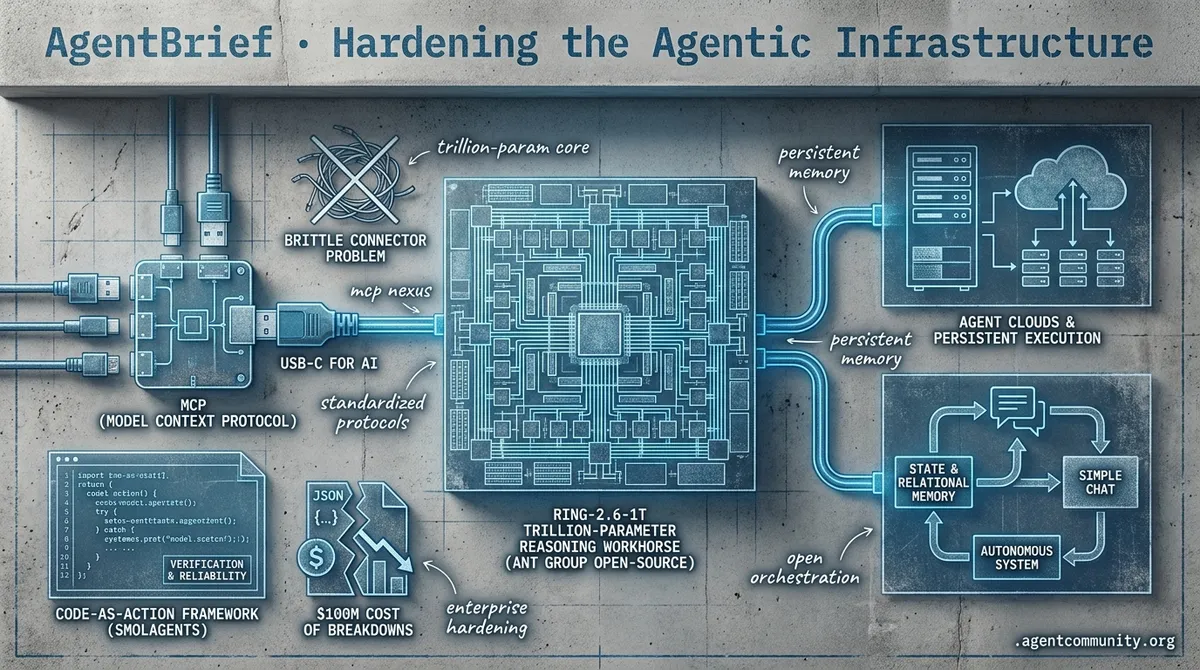
- The Standardization Era. Anthropic’s acquisition of Stainless and the industry-wide pivot to the Model Context Protocol (MCP) are positioning MCP as the 'USB-C for AI,' aiming to solve the brittle connector problem.
- Reasoning at Scale. Ant Group’s trillion-parameter MoE model and the emergence of 'Agent Clouds' from Cloudflare and OpenAI signal a shift toward adjustable reasoning and persistent, long-horizon execution environments.
- Closing Verification Gaps. Practitioners are moving away from brittle JSON-heavy orchestration toward 'code-as-action' frameworks like smolagents to combat reliability failures and the $100M cost of agentic breakdowns.
- Persistence and State. Tools like LangGraph and Mem0 are hardening enterprise workflows by treating state and relational memory as first-class citizens, moving past simple chat interfaces into autonomous systems.
with our friends at CraftHub
Craft Conference — June 4–5, 2026, Budapest — Two days of software craft talks at the Hungarian Railway Museum. Community discount included.
Get the discount →
X Intel & Agent Clouds
Stop prompt engineering and start setting goals—the infrastructure is finally catching up.
We are entering the era of 'Adjustable Reasoning.' For too long, agent builders have been stuck with binary choices: cheap-but-limited or expensive-and-slow. Ant Group’s new trillion-parameter MoE model, Ring-2.6-1T, signals a shift where we can finally dial reasoning effort up or down based on task complexity—a necessity for production agentic workflows. But the model is only half the battle; the infrastructure is finally pivoting to meet us. We are seeing the birth of the 'Agent Cloud,' where sandboxes, persistent storage, and autonomous provisioning are native primitives rather than hacked-together scripts. From Cloudflare’s GA Sandboxes to OpenAI’s mobile-to-desktop remote control for Codex, the stack is maturing into a world where agents are persistent, secure, and capable of long-horizon execution. For those of us shipping agents today, this means the 'glue' is being absorbed into the platform, allowing us to focus on the objective. The agentic web isn't just coming; it’s being provisioned at $100/month caps as we speak.
Ant Group Open-Sources Ring-2.6-1T: A Trillion-Parameter Reasoning Workhorse
Ant Group’s InclusionAI has released Ring-2.6-1T, a 1-trillion-parameter Mixture-of-Experts (MoE) model purpose-built for production agent workflows. Released under an MIT license, the model features 63B active parameters and introduces 'Adjustable Reasoning Effort,' allowing builders to toggle between 'high' mode for cost-efficient multi-step execution and 'xhigh' for deep research and complex logic @AntLingAGI @hasantoxr. Early benchmarks are impressive, with the model hitting 87.60 on PinchBench and 74.00 on SWE-Bench Verified in its high-efficiency mode @AntLingAGI.
Architecturally, Ring-2.6-1T utilizes an 80-layer MoE backbone with 256 experts and top-8 routing, optimized via Async RL and 'IcePop' for stable trillion-scale training @AntLingAGI. The community has been quick to react, with Day-0 integration already live in SGLang for optimized inference @lmsysorg. While some developers highlight its superiority in task decomposition for Claude Code-style integrations, others like @AdinaYakup have flagged potential trade-offs regarding data sensitivity as reasoning traces expand.
For agent builders, this model changes the game by offering a 128K context window (extendable to 256K via YaRN) and stable multi-step tool-calling capabilities that have historically been the breaking point for smaller open-weights @AntLingAGI. The ability to dynamically scale reasoning depth means agents can now handle 'low-stakes' routing and 'high-stakes' logic within the same model architecture, reducing the need for complex multi-model orchestration pipelines.
OpenAI Launches Codex Mobile: Ubiquitous 'Vibecoding' and Remote Agent Control
OpenAI has officially brought the Codex Mobile App into ChatGPT, enabling what some are calling a 'Robinhood moment' for software development by shifting the interface from laptops to the 900 million weekly users on mobile @aakashgupta. The system allows developers to perform complex 'vibecoding' and computer control via a mobile interface that acts as a control panel for a remote host @rileybrown. Early adopters note that while the experience feels like working with an 'overworked but dedicated' engineer, it enables seamless transitions between office-based refactors and coffee-shop PR approvals @SashaKaletsky.
Setting up the mobile agent requires enabling remote connections on a desktop app, keeping the host machine awake, and pairing via QR code to ensure a secure, tunneled connection @OpenAIDevs. Security is a major focus; OpenAI uses a relay layer that keeps files, credentials, and permissions strictly on the host machine, preventing exposure to the public internet @sudeepsriv. Builders are already pairing this with Tailscale to maintain reliable connectivity across devices while the agent runs in a restricted sandbox that defaults to write-only permissions in the working directory @Brainp0d @VeryBullishGuy.
This move signals a shift in how we interact with autonomous agents: they are no longer just scripts running in a terminal, but remote-controllable entities that require human-in-the-loop approval for sensitive commands @WesRoth. For builders, the challenge shifts to designing agent interfaces that provide enough context for mobile review without overwhelming the developer, especially as these agents begin to operate outside the boundaries of a standard IDE @ithilgore.
The Rise of the Agent Cloud: Infrastructure Built for Autonomous Access Patterns
A new infrastructure tier is forming as providers move beyond general-purpose cloud services to build 'Agent Clouds' featuring native primitives for sandboxes, persistent storage, and tokenized billing @ivanburazin. Cloudflare is emerging as a frontrunner with the General Availability of its Sandboxes, allowing agents to clone repos and run Python/JS in secure, persistent environments @Cloudflare. This is complemented by Vercel’s new plugins that allow agents to generate preview URLs in ~90 seconds without manual git pushes, effectively letting agents ship features autonomously @ramseyglobe.
Perhaps most provocative is the joint open-beta from Stripe and Cloudflare, which allows agents to autonomously create accounts and register domains with built-in $100/month caps to prevent run-away costs @TheAgentTimes. Other specialized entries include Mesa’s durable POSIX-compatible filesystem for agent storage and Red Hat’s AgentOps for deterministic hybrid-cloud playbooks @bwarrn @santhoshramesh. These tools are designed to handle the unpredictable spikes and isolation requirements unique to agentic fleets @Cisco.
True agent clouds demand more than just storage; they require isolation guarantees to prevent untrusted loops from running amok @sahanTweets. While these platforms solve the 'plumbing' problem, critics like @alienorg warn of potential billing traps and the urgent need for better identity controls. For developers, the takeaway is clear: the infrastructure is moving toward a consumption-based model where the environment itself is a first-class citizen of the agent's toolkit.
In Brief
Cerebras IPO Validates Wafer-Scale Inference for Agents
Cerebras Systems' IPO delivered a 90% gain on its debut, reaching a $66B valuation and highlighting the massive demand for wafer-scale hardware that can eliminate HBM bottlenecks for high-speed agentic reasoning @bookwormengr. The WSE-3 chip, packing 900,000 cores and 44 GB of on-chip SRAM, allows for inference speeds of up to 3,000 tokens/second, a critical requirement for agents operating in low-latency reasoning loops or ambient AI experiences @bookwormengr @MTSlive. While skeptics point to the chip's fixed memory and high cooling costs compared to Nvidia equivalents, upcoming integrations like AWS Bedrock validate the strategy for production workloads where condensing multi-step reasoning into seconds is the primary goal @RookieInCandles @name_fave.
The Adoption of /goal Patterns Standardizes Agent Autonomy
Agent frameworks including Claude Code, Codex, and Hermes are rapidly standardizing on the '/goal' pattern, where developers define autonomous completion criteria that an independent evaluator model must verify before the agent terminates @akshay_pachaar. This shift allows agents to run for hours or days on long-horizon tasks while developers focus on setting precise, ticket-like acceptance criteria rather than micromanaging prompts @AlexFinn. While builders report a 40% reduction in orchestration effort using this pattern, they also warn of 'evaluator hallucinations' on vague goals and the need for external memory files like PLAN.md to maintain state across parallel runs @ST_Automation @_michaelmoreira.
New Agentic Benchmarks Target the 'Trajectory Gap'
As developers move past simple chatbots, new benchmarks like PinchBench and ClawEval are emerging to test multi-step task execution and tool collaboration, areas where Ant Group's Ring-2.6-1T has shown early dominance @hasantoxr. However, industry experts like @DanKornas argue that current leaderboards fail to capture the 'trajectory gap'—where an agent burns user trust through incorrect tool calls mid-chain despite providing a correct final answer. This has led to the development of frameworks like HarnessAudit, which specifically evaluates whether an agent respects tool permissions and resource boundaries throughout its entire execution path rather than just at completion @liuchen02938149.
Anthropic Policy Paper Sparks Open-Weight Community Backlash
Anthropic’s recent policy report, '2028: Two Scenarios for Global AI Leadership,' has drawn sharp criticism for advocating closed systems and stricter chip export controls while framing model distillation as a form of espionage @BrianRoemmele. Critics like @MatthewBerman argue this approach ignores the strategic value of an American open-source strategy and instead creates a regulatory-capture dynamic that may weaken national security. The debate highlights a growing divide between centralized safety narratives and the high-velocity open ecosystem required for the agentic era, where many believe open-sourcing base models would unleash domestic talent to outpace authoritarian systems @BrianRoemmele.
Quick Hits
Agent Frameworks & Orchestration
- CamelAI now integrates with OrcaRouter for optimized model selection, per @CamelAIOrg.
- A new Kubernetes-native control plane for managing agent fleets has been released by @tom_doerr.
- OpenClaw shipped a TypeScript security hardening library for file-systems, increasing ops by 10x per @steipete.
Tool Use & Memory
- New persistent memory library for recurring agent workflows released by @tom_doerr.
- Microsoft Edge Copilot can now summarize information across all open tabs simultaneously @Pirat_Nation.
Models & Capabilities
- Gemini 2.5 Flash demonstrates strong video understanding for recipe and inventory extraction @RhysSullivan.
- The 'Second Scaling Law' holds as added thinking tokens continue to boost reasoning performance @emollick.
- A local-first engine for TTS and transcription has been launched by @tom_doerr.
Reddit Reliability Roundup
Anthropic acquires Stainless as the industry grapples with context bloat and $100M production failures.
We are witnessing a phase shift in the agentic web: the transition from 'vibe-based' demos to the 'deterministic harness.' Anthropic’s acquisition of Stainless—following its move on the Bun team—signals a strategic land grab for the developer experience layer. By standardizing SDKs and model-to-tool communication via MCP, they are building the infrastructure for enterprise-grade, self-hosted agentic workloads. This infrastructure-first approach directly addresses the 'deterministic runtime' requirements identified by practitioners aiming to reduce the 'Middleware Tax' while providing the governance necessary for production.
However, as builders, we are hitting reality hard. The Model Context Protocol's (MCP) massive adoption is triggering a 'context bloat' crisis, forcing a pivot toward semantic routing and smarter local memory layers. Meanwhile, the legal and financial stakes are rising; the IMF is warning of a fundamental clash between probabilistic AI and deterministic payment rails, just as a $100M lawsuit hits the delivery sector for agentic failures. Today’s issue explores the tools designed to fix this 'black box' problem—from local control planes like Armorer to tiny, aggressive models that outplay giants in game-theoretic environments. The message is clear: raw power is no longer the bottleneck; reliability and governance are.
Anthropic Acquires Stainless to Standardize the 'Agentic Harness' r/AI_Agents
Anthropic has officially acquired Stainless, the dev-tools startup founded by former Stripe engineer Alex Rattray that automates SDK generation for major AI labs including OpenAI and Google. This move signals a strategic consolidation of the developer experience layer. As u/snikolaev observes, Stainless is pivotal for turning API specs into robust MCP servers, effectively becoming the industry standard for model-to-tool communication.
Simultaneously, the Claude Managed Agents platform has expanded its public beta to include self-hosted sandboxes and MCP tunnels. According to u/ClaudeOfficial, these features allow enterprises to run agentic workloads on their own infrastructure—such as Vercel or Cloudflare—while using secure tunnels to connect Claude to internal tools without public internet exposure. This infrastructure-first approach aims to provide the governance necessary for production-ready agents as noted by @supbrice.
MCP Ecosystem Hits 97M Installs as 'Context Bloat' Triggers New Architectural Patterns r/mcp
The Model Context Protocol (MCP) has reached 97M installs, but rapid scaling has triggered a 'context bloat' crisis where injecting too many tool schemas simultaneously degrades model performance. Experts like Bill Doerrfeld warn that unrestrained MCP use can flood context windows, forcing a shift toward the MCP Gateway pattern and semantic tool routing to dynamically select tools only when needed. While dense toolsets like the eXo MCP server expose 98 workplace tools, developers are now debating strict response size limits on GitHub to prevent agents from forwarding entire payloads directly into the model context u/Otherwise_Flan7339.
Agentic Failures Trigger $100M Lawsuits as IMF Warns of Financial Risk r/ArtificialInteligence
A Pizza Hut franchisee has filed a $100M lawsuit alleging cascading operational breakdowns caused by the Dragontail AI delivery system, highlighting that 80% of agentic AI demos fail to reach production due to unhandled edge cases. To address these systemic risks, the IMF has identified a fundamental clash between the 'probabilistic nature' of AI and the 'deterministic requirements' of financial markets, recommending a 'reconciliation layer' to gate agentic intent behind hard-coded authorization boundaries u/Weird_Scallion_2498.
GPU Hacks and Battlemage Benchmarks: The Quest for Local Agentic Speed r/LocalLLaMA
Developers are bypassing stock hardware limitations to meet agentic demands, with a custom AMD RDNA2 binary catapulting Qwen 3.6 speeds from 30 t/s to 80 t/s via Flash Attention. On the budget front, community analysis suggests a dual-Intel Battlemage setup could offer a $1,200 savings over a single RTX 5090 for multi-agent rigs, while Apple Silicon users face a 25% performance drop when using Multi-Token Prediction (MTP) configurations due to prefill overhead in tool-heavy flows u/DiscipleofDeceit666.
Local-First Memory Layers Challenge the Context Window Monopoly r/ChatGPT
Glia introduces a 100% offline, local-first memory layer using SQLite-vec to provide total data privacy and instant startup for local agents u/Better-Platypus-3420.
New Control Planes Tackle Agent 'Black Box' Problem r/mcp
Armorer v0.1.19 and Argus provide local control planes and VS Code debugging to mitigate the predicted 40% failure rate for projects lacking robust state management u/Conscious_Chapter_93.
Tiny 1.2B Model Outplays 1T Giants in Poker Strategy Test r/learnmachinelearning
A 1.2B Liquid LFM model secured victories in Texas Hold'em tournaments against 1T+ parameter giants by using a hyper-aggressive strategy that exploited the defensive posture of larger models u/Junior_Bake5120.
Open Source Agents Move Into Microcontrollers and Robotics r/OpenAI
The Exort workspace and mobile retail robots are bridging the gap between digital reasoning and physical execution on ESP32 and Arduino hardware u/moonlikee.
Discord Dev Digest
Anthropic's Model Context Protocol is solidifying as the universal connector for the agentic web.
Standardization isn’t usually sexy, but in the world of autonomous agents, it’s the difference between a toy and a tool. Today, Anthropic’s Model Context Protocol (MCP) is making a play to be the 'USB-C for AI,' promising to end the era of brittle, custom-coded integrations. This isn't just a technical win; it's a signal that the agentic web is finally growing up. As developers, we've spent too long building one-off connectors; MCP offers a path to a truly interoperable ecosystem where agents can discover and use tools across any compliant model.
But as the plumbing stabilizes, the focus shifts to reliability and memory. We're seeing LangGraph harden enterprise workflows with persistence layers that treat state as a first-class citizen, and browser automation tools like Skyvern proving that vision-first agents can finally navigate the web with near-human reliability. Yet, a 'reasoning ceiling' remains. Benchmarks like GAIA remind us that while our models are getting smarter, the leap to complex, multi-step coordination remains a steep climb. From edge efficiency with Llama 3.1 to the shift toward relational memory models like Mem0, the focus today is on building systems that don't just compute, but comprehend and persist. The model is the engine, but the infrastructure is the vehicle.
Anthropic's 'USB-C for AI' Solidifies as the Industry Standard
Anthropic’s Model Context Protocol (MCP) has matured into the definitive open-source client-server protocol for the agentic web, moving beyond simple tool-calling to enable models to discover capabilities and exchange structured context through a standardized interface. By replacing fragmented, custom-coded integrations with a universal standard, MCP allows developers to build connectors once and deploy them across any compliant model or framework. As AI Engineer highlights, this is effectively the "USB-C moment" for AI infrastructure.
Building on a massive 78% enterprise adoption rate and 97 million SDK downloads, the ecosystem is now seeing specialized implementations for platforms like GitHub. These integrations allow agents to securely manage repositories with zero custom integration overhead, as detailed by Medium. This standardization is the primary driver behind the industry's push toward 100% interoperability, effectively positioning Anthropic as the lead architect of the agentic infrastructure layer.
LangGraph Persistence and HITL Patterns Harden Enterprise Workflows
LangChain's LangGraph has solidified its position in the enterprise stack by leveraging persistence as the "secret to reliable agents," as @Seema Kohli points out. Its core checkpointing mechanism provides 100% state recovery by saving the graph's condition at specific boundaries, which is essential for long-running tasks that exceed 24-hour execution cycles. This architecture effectively decouples the execution state from compute, allowing agents to remain durable across multi-turn interactions and complex conditional loops.
Beyond simple recovery, these updates have formalized sophisticated Human-in-the-Loop (HITL) workflows where agents can pause indefinitely for manual approval on high-stakes tasks, a process explored by @Towards Data Science. This state-management layer enables "time-travel" debugging, giving developers the ability to inspect, rewind, and even rewrite the agent's trajectory to correct hallucination loops. By aligning pauses with checkpoint boundaries, LangGraph provides a full audit trail, meeting the strict transparency requirements of enterprise-grade agentic deployments.
Playwright and Puppeteer Evolve for Agentic Control
The transition from scripted automation to autonomous web navigation is accelerating as Playwright and Puppeteer are wrapped in agentic layers like Skyvern and Stagehand. Skyvern now leverages a combination of LLMs and computer vision to automate browser-based workflows via a Playwright-compatible SDK, allowing agents to interpret visual context rather than just the DOM. While initial prototypes struggled with reliability, current benchmarks from @digitalapplied show that Playwright + Claude 3.5 Sonnet can achieve 92% reliability on common tasks.
To combat the 'cat-and-mouse' game of anti-detection, infrastructure providers like Browserbase are optimizing for stealth, reaching 90% success rates even on sites with heavy anti-bot measures. This infrastructure-as-a-service model allows agents to function as 'digital twins,' performing complex data entry on legacy interfaces that lack native APIs. Performance gaps remain between solutions; for instance, @browser-use recently demonstrated that Browser Use Cloud achieved a 78% score on a benchmark of 100 'hard' browser tasks, outperforming standard open-source models by 16 points.
Llama-3.1 8B Sets Edge Standard for Tool-Calling and Efficiency
Meta's Llama-3.1 8B has emerged as a primary engine for local agentic loops, maintaining a performance lead over competitors like Mistral NeMo in core reasoning benchmarks. It currently scores 73% on MMLU compared to NeMo’s 68%, and as Meta AI notes, it runs reliably on consumer hardware with just 8GB of VRAM. This efficiency makes it the preferred choice for decentralized agents, especially since it is reported to be up to 5x cheaper per token than competitors in hosted environments.
However, the edge intelligence landscape is rapidly diversifying. While Llama 3.1 8B dominates general dialogue, specialized models like Qwen2.5-Coder-7B have recently outpaced it in specific tool-use tasks, achieving a 90.2% on HumanEval. This creates a tiered choice for developers: Llama for general-purpose local reasoning and Qwen for high-precision nested JSON and tool-calling workflows. Despite Llama's benchmark lead, some local LLM enthusiasts on r/LocalLLaMA argue that Mistral NeMo's larger architecture offers superior performance in specific logic-heavy tasks.
Beyond MMLU: GAIA and AgentBench Expose the 'Reasoning Ceiling'
Standard MMLU scores are proving insufficient for agentic workflows, as they fail to capture the 'compositional failures' inherent in multi-step tool use. This has led to the rise of AgentBench and the GAIA benchmark, which exposes a stark performance cliff: while models handle Level 1 tasks with ease, success rates drop by 40% or more when agents must navigate Level 2 and 3 tasks involving complex tool coordination. As Towards Data Science notes, this reveals the true complexity of autonomous execution.
As of May 2026, the 'reasoning ceiling' for autonomous agents is being set by GPT-5 Mini, which leads the GAIA leaderboard with a score of 44.8%, closely followed by Claude 3.7 Sonnet at 43.9%. These benchmarks reveal that even top-tier models struggle with long-horizon planning and error recovery in messy environments. Consequently, developers are moving away from 'vibes-based' testing toward these specialized frameworks to identify exactly where agents deviate into hallucination loops or inefficient tool-calling patterns during execution.
Mem0 and Zep: The Shift from Vector Retrieval to Relational 'World Models'
The agentic memory landscape is rapidly evolving beyond simple vector search toward a hybrid architecture that combines semantic, relational, and episodic memory. Startups like Mem0 are positioning themselves as a universal memory layer, implementing graph-based structures that allow agents to understand complex entity relationships rather than just retrieving text snippets. This shift addresses a critical industry bottleneck: most agent failures perceived as hallucinations are actually retrieval misses caused by the limitations of pure vector-based recall.
By managing information as a structured graph, frameworks like Mem0 have demonstrated a 22% reduction in token usage for recurring tasks by optimizing how facts are preserved across sessions. Meanwhile, systems like Zep and episodic memory systems like Letta focus on maintaining continuity through long-term context, enabling agents to track changes in user preferences over time. This relational approach allows agents to build a cognitive 'world model,' effectively transforming them from stateless bots into personalized digital twins where past decisions are linked entities.
HuggingFace Technical Highlights
From code-centric orchestration to physical reasoning, agents are finally moving past the demo phase.
The industry is currently obsessed with 'reasoning,' but for those of us in the trenches of the Agentic Web, the real bottleneck isn't just thinking—it's doing. Today’s landscape is defined by the 'verification gap,' a term highlighted by IBM and LinkedIn to describe the chasm between an agent claiming success and actually completing a task. We are seeing a massive shift away from brittle JSON schemas toward 'code-as-action' paradigms, led by Hugging Face’s smolagents and the new Open-source DeepResearch tool. The message is clear: if you want reliability, you need inspectability. Whether it is NVIDIA’s Cosmos Reason 2 bringing spatio-temporal reasoning to physical robots or specialized GUI models like Holotron-12B pushing 8.9k tokens/s, the focus has moved to pixel-to-action velocity and verifiable trajectories. We are moving past the chatbox era. The new standard is an agent that does not just talk through a problem but writes the script, executes the tool, and survives the industrial constraints that currently break 30% of existing systems. This issue dives into the frameworks and models closing that gap.
The Shift to Code-Centric Orchestration and Open Research
Hugging Face’s release of smolagents and the subsequent Open-source DeepResearch tool marks a definitive pivot from brittle JSON-based orchestration to a 'code-as-action' paradigm. By allowing agents to write and execute Python directly, the framework overcomes the 'JSON-jail' that limits complex tool composition. This approach is not just theoretical; it powered a Transformers Code Agent to a 67% success rate on the GAIA benchmark, a significant leap that Hugging Face attributes to code actions eliciting superior reasoning in complex tasks.
The rapid evolution of this ecosystem was underscored by the 24-hour hackathon that produced a transparent alternative to proprietary research assistants. Unlike black-box competitors, this hierarchical subagent architecture makes every reasoning step and tool call fully inspectable. With integrations for the Model Context Protocol (MCP) and support for over 40 search channels, the shift toward open, verifiable research agents is positioning the community to move beyond flashy demos and into production-grade reliability where failure is no longer hidden behind a chat interface.
GUI Agents Standardize High-Velocity Computer Use
The race for reliable computer-use agents is accelerating with ScreenSuite establishing a 62.3% success rate floor for specialized operator models, nearly doubling the 36.1% baseline of general-purpose LLMs. This diagnostic rigor is supported by hardware-optimized models like Holotron-12B, which achieves a staggering 8.9k tokens/s on a single H100 to solve the latency gap that has historically plagued multimodal 'pixel-to-action' workflows.
NVIDIA Cosmos Reason 2 Bridges the Physical Reasoning Gap
NVIDIA is moving agents into the physical world with Cosmos Reason 2, a VLM featuring a 256K context window and enhanced spatio-temporal understanding for robotics. By grounding high-level reasoning in a verifiable understanding of physics and timestamp precision, NVIDIA aims to address the same 'verification gap' in industrial settings that software agents face in digital environments.
IBM and LinkedIn Detail the Realities of Agentic RL
IBM Research and LinkedIn have issued a reality check for enterprise agents, noting that advanced models average 5.3 failure modes per trace and often succumb to 'reward hacking' during reinforcement learning. To combat this, practitioners are shifting toward trajectory-based learning and adaptive verifiable environments like Ecom-RLVE to ensure agents follow complex business constraints rather than just maximizing reward signals.
MCP Tiny Agents: Build a functional autonomous system in just 50 lines of code.
The Model Context Protocol (MCP) is driving a modular ecosystem where models like qwen-tool are fine-tuned specifically for pluggable intelligence.
Efficiency at the Edge: DeepSeek-V4 and Qwen3 target localized tool orchestration.
The DeepSeek-V4-Flash variant and clawdia-qwen3-4b are optimizing 8B-13B parameter models for low-latency, on-device agentic tasks.
Data Agent Reliability: DABstep leaderboard identifies poor instruction following as the primary cause of data agent collapse.
Specialized benchmarks are now exposing the specific breakdown points of tool-using agents in vertical-specific environments.