Beyond JSON: The Agentic Execution Era
Agents are graduating from conversational chatbots to browser-native operators and code-executing powerhouses.
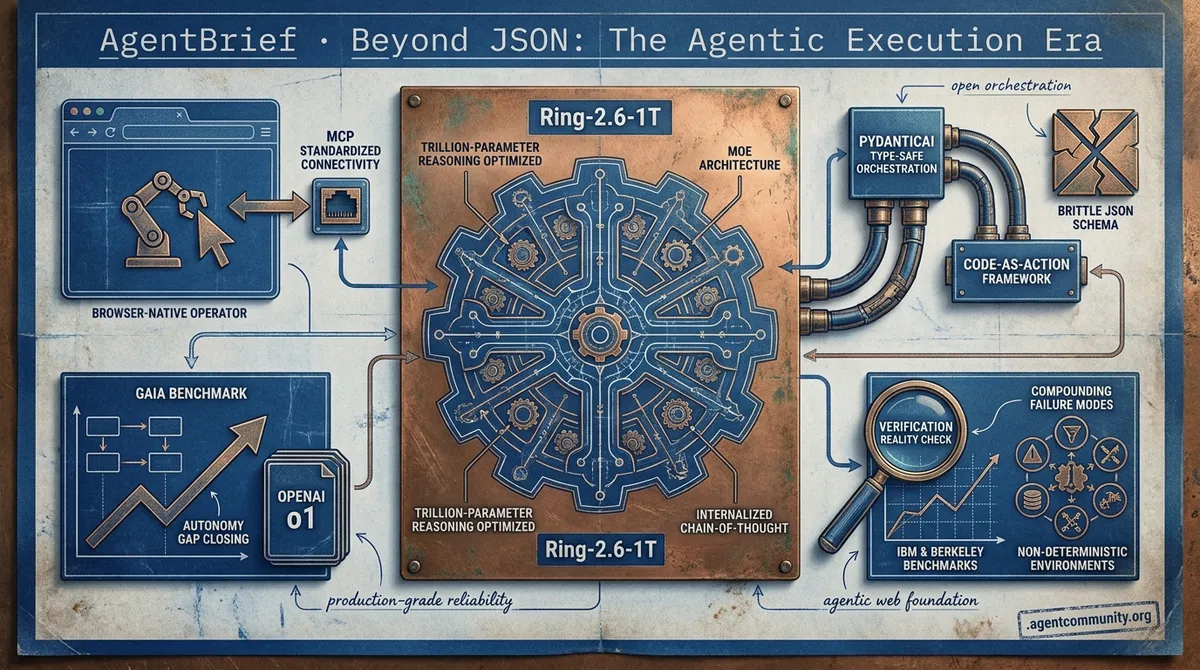
- From Chat to Action The paradigm is shifting from conversational interfaces to browser-native autonomy and standardized connectivity via OpenAI's Operator and Anthropic's MCP.
- The Reasoning Revolution Scaling reasoning to trillion-parameter MoEs like Ring-2.6-1T and internalizing chain-of-thought via OpenAI's o1 is closing the autonomy gap on benchmarks like GAIA.
- Reliable Execution Infrastructure Builders are ditching brittle JSON schemas for 'code-as-action' via frameworks like smolagents and type-safe orchestration with PydanticAI to ensure production-grade reliability.
- The Verification Reality Check While performance climbs, new benchmarks from IBM and Berkeley highlight a critical 'verification gap' caused by compounding failure modes in complex, non-deterministic environments.
with our friends at CraftHub
Craft Conference — June 4–5, 2026, Budapest — Two days of software craft talks at the Hungarian Railway Museum. Community discount included.
Get the discount →
The 1T Pulse
Scaling reasoning to 1T parameters while vibecoding from your phone.
We are entering the era of the 'heavyweight reasoning agent.' For months, the community has been divided between fast, lean models for orchestration and slow, massive frontier models for planning. Ant Group’s Ring-2.6-1T suggests we can have both via 'adjustable reasoning effort' and a trillion-parameter MoE architecture that prioritizes execution stability over pure benchmark vanity. But models are only half the battle. As we shift toward 'Agent-First' clouds and mobile 'vibecoding' via OpenAI’s Codex, the primary friction point is moving from prompt engineering to infrastructure reliability. If your agent depends on a persistent sandbox or a mobile-tethered IDE, a single certificate rotation or a spotty 5G connection becomes a production-breaking event. We are building systems that demand 100% uptime in a world of 'Yolo Mode' and shifting regulatory goalposts. For builders, the message is clear: optimize for stability and consumption-based scaling, or get left behind in the 'straight line up' usage spikes that define the agentic web.
Ant Group Open-Sources Ring-2.6-1T: Trillion-Parameter Reasoning Optimized for Agents
Ant Group’s InclusionAI has open-sourced Ring-2.6-1T, a 1-trillion-parameter Mixture-of-Experts (MoE) reasoning model with 63B active parameters under an MIT license. Unlike models tuned for general chat, Ring-2.6-1T is purpose-built for production agentic workflows, coding, and long-horizon tasks @AntLingAGI. The model introduces a novel 'adjustable reasoning effort' feature—allowing builders to toggle 'high' mode for fast, cost-efficient tool orchestration or 'xhigh' for deeper logical analysis—powered by Async RL and the IcePop training algorithm @AntLingAGI @AdinaYakup.
Early adopters are already reporting strong real-world integration, specifically highlighting its use inside Claude Code for task decomposition and tool collaboration @hasantoxr. While some in the community note that DeepSeek-V4-Flash might appear more stable on specific hallucination tests, the open-weight nature of Ring-2.6-1T is being praised as a critical asset for sovereign agent pipelines @teortaxesTex @bayyash. However, some developers have flagged potential reasoning-trace data sensitivity risks in logged deployments @h1kz0r.
For agent builders, the benchmark performance is the headline: the model reports 87.60 on PinchBench, 74.00 on SWE-Bench Verified, and 95.83 on AIME 26 in 'xhigh' mode @AntLingAGI. Its architectural focus on a 128K context (extendable to 256K) and inference-time reasoning control is explicitly optimized for high-frequency agent loops where stability across complex tool chains is more valuable than pure scale @AntLingAGI.
Codex Mobile Launch Triggers Shift to 'Vibecoding' Amid Connectivity Headaches
OpenAI has officially released the Codex mobile app, integrating it into ChatGPT to allow developers to control computers and execute 'vibe coding' directly from their phones @rileybrown. This move is being framed as a 'Robinhood moment' for software development, shifting the interface from expensive hardware to ubiquitous mobile screens @aakashgupta. The mobile implementation supports the Model Context Protocol (MCP) for browser-based tool use, enabling agentic workflows like remote troubleshooting and autonomous fix cycles via 'Yolo Mode' integrations @charlieholtz.
Despite the excitement, the launch is plagued by significant connectivity and security friction. Users report frequent disconnections from remote hosts and failures to list threads on Android and iOS following the latest patch @Ixel111. Furthermore, security precautions following the Axios breach have forced OpenAI to rotate code-signing certificates; macOS users must update their Codex/CLI apps by June 12 or face service blocks @dlimeng192048.
For builders, the reliance on a relay layer and the requirement for Tailscale or shared WiFi to maintain remote server access highlights the fragility of current mobile-agent setups @diegocabezas01. While the promise of managing autonomous agents from a phone is enticing, the current stability issues and update-induced disconnections represent a major hurdle for always-on remote server management @DicksonPau.
In Brief
The Rise of 'Agent-First' Consumption Clouds
Infrastructure is shifting toward consumption-based billing models to accommodate the erratic, 'straight line up' usage spikes typical of autonomous agent workloads. Ivan Burazin argues that traditional fixed-capacity provisioning fails when agents suddenly spike demand and then drop to zero, making consumption APIs for search and sandboxing essential @ivanburazin. Cloudflare is positioning itself as the home for these workloads with new SDK updates and generally available Sandboxes that provide stateful environments for agents to clone repos and debug via PTY terminals @threepointone @Cloudflare.
Anthropic Policy Paper Ignites Open-Weight Backlash
Anthropic's latest policy paper on global AI leadership has triggered widespread criticism for framing open-weight releases as national security threats while advocating for a pre-release review regime. Critics like @MatthewBerman argue this amounts to regulatory capture that would centralize frontier capabilities among a few well-funded US labs @MatthewBerman. The debate highlights a deep divide: while safety advocates fear the lack of guardrails in open models, the builder community views these proposed restrictions as a power grab that risks slowing Western innovation relative to China's rapid domestic scaling @overfitted_ @Dan_Jeffries1.
Quick Hits
Agent Orchestration
- Cloudflare agents are gaining momentum with the 'npm i agents' command for agent-first access patterns @threepointone.
- A new 'Conductor' build is emerging as an essential orchestration layer for complex agentic systems @latentspacepod.
- Builders are emphasizing smaller loops in agent design to prevent slow and uncontrollable scaling @AITECHio.
Tool Use & Memory
- Codex autoreview combined with crabbox is enabling fully automated issue-to-fix cycles @steipete.
- Defining agent goals as 'acceptance criteria' is becoming the standard pattern for Claude Code and Hermes @akshay_pachaar.
- New tools are turning messy human thinking into structured Markdown for cleaner agent ingestion @tom_doerr.
Models & Infra
- Cerebras IPO saw a 90% gain, signaling massive investor confidence in hardware for interactive agent coding @SemiAnalysis_.
- The second scaling law remains undefeated, showing 'thinking tokens' consistently improve agent hacking performance @emollick.
- Persistent memory systems for recurring agent workflows are now being indexed for production deployment @tom_doerr.
Browser-Native Insights
OpenAI's Operator signals the shift from conversational chat to browser-native autonomy.
The era of the 'chatbot' is officially ending. Today’s landscape is defined by the 'Operator'—agents that don’t just talk about tasks but execute them directly within the browser DOM. This shift from conversational interfaces to action-oriented autonomy represents the first true realization of the Agentic Web. As OpenAI's Operator targets a browser-native stack and Anthropic’s MCP protocol solidifies as the 'USB port' for connectivity, we are seeing the infrastructure for reliable, multi-step agency finally reach maturity.
For developers, this isn't just about better models; it's about 'flow engineering.' We are moving away from prompting for 'vibes' and toward architecting stateful, multi-agent systems that can handle long-horizon tasks with persistent memory. Whether you are running quantized Llama 3.1 models locally at 50 tokens/sec or orchestrating complex workflows via LangGraph, the goal is the same: production-grade reliability. Today we look at the benchmarks, the security sandboxes, and the protocols making this autonomy possible.
OpenAI Operator and the Rise of the Agentic Browser Stack r/OpenAI
The launch of OpenAI's Operator has shifted the focus from conversational AI to action-oriented agents, marking a transition from research previews like Anthropic’s 'Computer Use' to integrated browser-native autonomy. Early testers on r/OpenAI report that the tool handles multi-step web navigation with an 88% success rate, significantly outperforming previous script-based automation by interpreting visual DOM elements rather than relying on brittle APIs. This performance is now being rigorously measured by the new AgencyBench, a framework designed to evaluate autonomous agents across 32 real-world scenarios.
As these agents move into production, the industry is pivoting toward specialized infrastructure to mitigate security risks. Infrastructure providers have officially moved Secure Sandboxes to General Availability (GA), providing isolated container environments specifically for agent execution to prevent unintended financial transactions or data leaks. This hardening of the stack is essential for meeting enterprise demand, as Gartner predicts that 40% of enterprise applications will include task-specific AI agents by the end of 2026. For developers, the focus has shifted toward 'context-aware policies' that enforce strict human-in-the-loop (HITL) constraints within these agentic browsers.
LangGraph and the Era of 'Flow Engineering'
As agentic workflows move beyond simple chains, LangGraph has emerged as the industry standard for stateful multi-agent systems, institutionalizing the 'flow engineering' paradigm. According to Micheal Lanham, the 2026 production verdict favors orchestration frameworks that support cyclical graphs and granular state checkpoints, allowing agents to recover from failures in long-horizon tasks. Practitioners are leveraging LangGraph to divide responsibilities into specialized roles—such as customer support deciders and content writers—which has demonstrated a 40% reduction in token waste compared to single-prompt architectures.
Standardizing MCP for Universal Agent Interoperability r/ClaudeAI
The Model Context Protocol (MCP) has solidified its position as the 'USB port' for AI agents, evolving into the de facto connectivity layer for the agentic web by 2026. Since its open-sourcing by Anthropic, the protocol has seen rapid adoption with OpenAI and Google DeepMind integrating MCP to allow models to access local files and APIs without custom glue code. As u/anthropic_dev notes on r/ClaudeAI, this standardization prevents vendor lock-in, enabling developers to switch model backends seamlessly while maintaining a consistent tool registry via specialized toolkits like Composio.
Ollama and Llama 3.1: The Local Agent Frontier r/Bard
The move toward data sovereignty is cementing Ollama and Llama 3.1 as the backbone of local agentic infrastructure, with recent testing by J.D. Hodges confirming support for complex multi-tool parallel calls. Latency barriers are being dismantled through 'speculative decoding' and Multi-Token Prediction (MTP), with developers on r/Bard reporting speeds exceeding 50 tokens/sec on high-end consumer hardware like the RTX 5090. While Llama remains a gold standard, Qwen3 currently holds a slight edge in reliability with the lowest percentage of 'dropped tool calls' according to Morph LLM benchmarks.
Beyond AI Amnesia: Unified Persistent Memory
The industry is pivoting toward unified memory architectures that solve 'AI Amnesia' by merging vector and relational data into a single stateful layer.
AgentBench 2.0 Results r/LLMDevs
GPT-5.5 Pro currently leads the BenchLM.ai leaderboard with a 90.1 score, significantly outperforming Claude Opus 4.7’s 64.3% in recent multi-step reasoning tests.
Production Reasoning Loops
From o1's internal reasoning to PydanticAI's type-safety, the agentic stack is professionalizing.
The era of 'vibes-based' agent orchestration is ending. We are witnessing a fundamental shift in how autonomous systems are built—moving away from complex, fragile external state machines toward model-native reasoning and code-native reliability. OpenAI’s o1 has demonstrated that internal chain-of-thought can outperform months of prompt engineering, while PydanticAI is finally bringing the rigor of FastAPI to the chaotic world of non-deterministic JSON. For builders, the message is clear: the Agentic Web isn't just about raw intelligence; it's about the reliability of the tool-use loop. As GAIA benchmark scores creep toward the 45% mark, the infrastructure—from local serving with Ollama to persistent memory with Letta—is finally maturing to support agents that don't just chat, but actually work. Today’s issue explores how these pieces are clicking together to close the autonomy gap and what it means for the next generation of tool-enabled systems.
OpenAI o1 Redefines Agentic Planning: Internal Reasoning vs. External Orchestration
The integration of OpenAI's o1 series into agentic workflows has shifted the focus from prompt engineering to 'compute-over-time' strategies. While latency is higher due to internal chain-of-thought (CoT), OpenAI reports that o1-preview achieved an 83% success rate on the AIME 2024 exam compared to GPT-4o's 13%. Developers are observing a 40% success rate boost in multi-step planning tasks, although some early benchmarks suggest GPT-4o may still maintain an edge in specific 'self-correction' loops within certain agentic frameworks as noted by Nicholas Mohnacky.
This internal reasoning allows the model to solve hard logic problems that previously required complex external orchestration via LangGraph state machines. Practitioners are now leveraging o1-mini as a high-speed router for agentic sub-tasks to balance cost, as o1-preview input tokens are priced at $15 per million. This evolution suggests a future where the 'agent' logic is increasingly baked into the model's inference process rather than orchestrated entirely by external code.
PydanticAI and the 'FastAPI Moment' for Agentic Logic
PydanticAI is being hailed as the 'FastAPI moment' for agent development, shifting the focus from complex graph abstractions to standard, type-safe Python logic. By leveraging Python’s native type hints, the framework enforces strict schema validation for both model outputs and tool calls, addressing the enterprise need for data integrity where non-deterministic JSON often leads to cascading failures. Unlike LangGraph’s reliance on Directed Cyclic Graphs (DCGs), PydanticAI treats agentic loops as imperative Python functions, which has already helped the framework attract over 5,000 GitHub stars.
GAIA Benchmark: GPT-5 Mini and Claude 3.7 Push Autonomy Ceiling to 45%
The General AI Assistants (GAIA) benchmark remains the definitive 'stress test' for agentic autonomy, with new data revealing that GPT-5 Mini has reached a top score of 44.8%. Followed closely by Claude 3.7 Sonnet at 43.9%, these results show the autonomy ceiling is finally cracking, yet a significant gap remains as models still fail more than half the time on real-world tasks. This persistent difficulty is driving builders to adopt multi-agent architectures to decompose complex, multi-modal queries into manageable sub-tasks.
Browser-use Library and the Shift to Semantic Web Navigation
The 'browser-use' library is redefining web automation by shifting from fragile CSS selectors to a semantic, vision-based understanding of the DOM. By wrapping Playwright in an autonomous agent loop, it achieves a 78.0% success rate on complex automation benchmarks. The library leverages 'DOM-to-Markdown' conversion to drastically reduce token overhead while maintaining structural context, a technique that practitioners like @gregkamradt suggest helps solve the latency bottlenecks inherent in pure screenshot-based navigation.
Ollama and LiteLLM Power Private Agents
Ollama and LiteLLM are enabling developers to build 'air-gapped' systems for sensitive tasks like AI PR reviews using local models like Qwen2.5-Coder.
Letta Transitions from MemGPT Research to Enterprise Agent Runtime
Letta has evolved from a research project into a comprehensive agent runtime featuring a tiered memory architecture for persistent 'forever agents.'
The Action-Code Lab
The agentic web is ditching brittle schemas for direct Python execution and physical reasoning.
We are witnessing the end of the 'JSON-jail' era. For too long, developers have forced agents to communicate with tools through rigid schemas that break at the first sign of complexity. Today’s developments from Hugging Face and NVIDIA signal a pivot toward 'code-as-action' and physical reasoning. The smolagents framework is proving that a minimalist, 1,000-line approach can outperform heavy orchestration layers by letting agents write their own Python solutions. This isn't just about cleaner code; it is about a 30% reduction in logic steps and a massive leap in benchmark performance.
Simultaneously, NVIDIA is taking this logic to the physical world with Cosmos Reason 2, treating robotics as a planning problem grounded in physics rather than just text. However, as we push these agents into production, a 'reality check' is emerging. New benchmarks from IBM and Berkeley are exposing the 'verification gap'—the messy reality that even high-tier models suffer from compounding failure modes in complex environments. Whether it is a 1.5B model running on the edge via MCP or a VLM navigating a GUI at 8.9k tokens/s, the focus has shifted from 'can it talk?' to 'can it do?' The following stories detail how we are moving from static evaluation to dynamic, multi-stage execution.
Smolagents Framework Beats GAIA Benchmark via Code-Actions
Hugging Face's smolagents is a minimalist library of approximately 1,000 lines that replaces brittle JSON-based tool calling with a 'code-as-action' paradigm. This architectural shift, which allows agents to write and execute Python directly, has resulted in a 26% performance boost and a 30% reduction in logic steps compared to traditional orchestration layers Mem0.
The efficacy of this approach is most visible in the Transformers Code Agent, which achieved a 67% accuracy rate on the GAIA benchmark, outperforming prompt-heavy counterparts by bypassing structured schema-following. To ensure production-grade reliability, Hugging Face has prioritized integrations with observability tools like Arize Phoenix, enabling developers to trace reasoning paths and debug code execution in real-time.
New Benchmarks Target the 'Verification Gap' in Industrial Agent Deployments
Standard LLM benchmarks are failing to capture the nuances of industrial deployments, prompting IBM Research and UC Berkeley to introduce IT-Bench and MAST for diagnosing why agents fail. Their research reveals that while high-tier models exhibit surgical failures, open-source models often suffer from compounding failure patterns, averaging 5.3 failure modes per trace, with agents most frequently stalling on 3-7 step reasoning chains during live tool execution VAKRA Benchmark.
NVIDIA Cosmos and the Rise of Physical Reasoning
NVIDIA is accelerating the transition to embodied agents with Cosmos Reason 2, a reasoning VLM that integrates an understanding of space and physics to act as a planning layer for robotics. The model can output trajectory coordinates directly within JSON plans to handle complex real-world scenarios, while the Nemotron-3-Nano-Omni architecture enables the low-latency multimodal processing required for edge devices to maintain state in real-time NVIDIA.
Democratizing Deep Research with Open-Source CodeAgents
Hugging Face has launched Open-source DeepResearch, a transparent framework utilizing a CodeAgent architecture to achieve a 67% success rate on the GAIA benchmark.
Unified Benchmarking and High-Velocity VLMs for Computer Use
The Holo1 family of GUI automation VLMs and the ScreenSuite aggregator are standardizing computer use, with specialized models doubling the success rate of general-purpose baselines @AymericRoucher.
Building MCP-Powered Agents in Under 70 Lines
The Model Context Protocol (MCP) is enabling 'Tiny Agents' built in as few as 50-70 lines of code, supported by specialized models like ToolSmith-8b for high-accuracy function calling Hugging Face.