The Era of Autonomous Execution
The industry is ditching chat bubbles for deterministic browser execution and code-native logic.
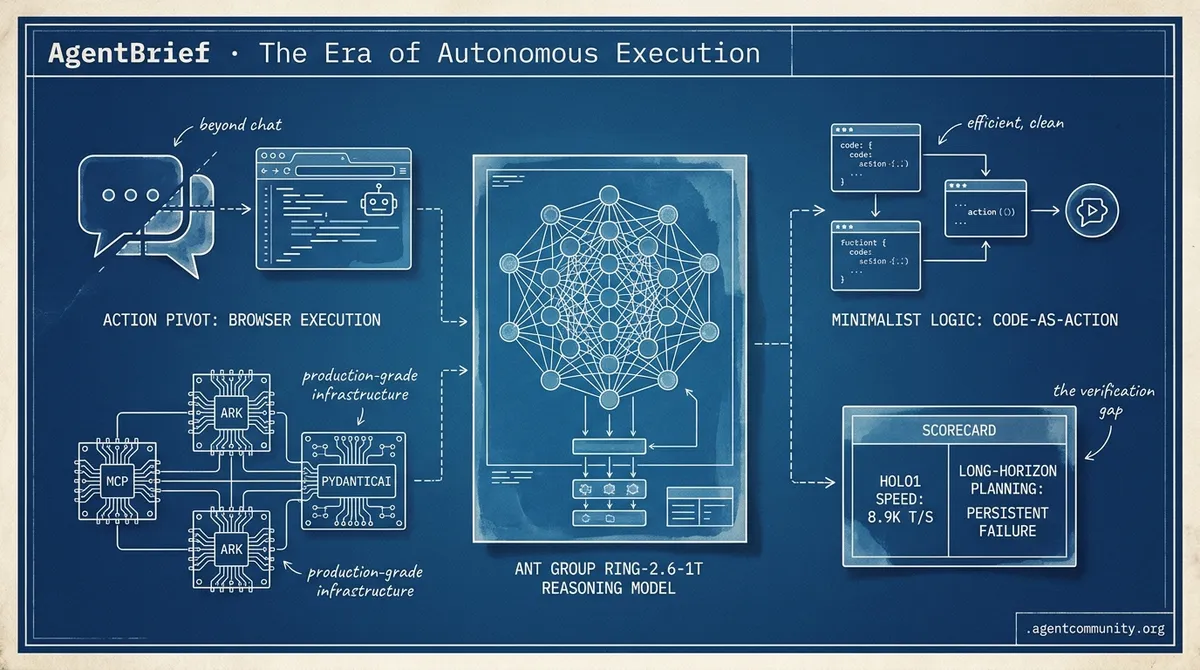
- The Action Pivot OpenAI's Operator and Google's I/O 2026 showcase a shift from conversational models to autonomous browser and OS execution, fundamentally moving the agentic web beyond search into execution.
- Production-Grade Infrastructure The emergence of the Model Context Protocol (MCP), AI Runtime Kernels (ARK), and type-safe frameworks like PydanticAI are replacing 'vibe coding' with hardened engineering and deterministic control.
- Minimalist Logic Wins Hugging Face’s smolagents and the rise of code-as-action are outperforming bloated orchestration layers on benchmarks like GAIA by reducing the 'abstraction tax' and logic overhead.
- The Verification Gap While hardware like Holo1 pushes raw speed at 8.9k tokens per second, diagnostic research highlights a persistent failure rate in long-horizon planning that remains a critical hurdle for practitioners.
with our friends at CraftHub
Craft Conference — June 4–5, 2026, Budapest — Two days of software craft talks at the Hungarian Railway Museum. Community discount included.
Get the discount →
X Intel & Trends
Stop benchmarking and start shipping: the tools for autonomous production are here.
The agentic web is shifting from experimental 'vibe coding' to hardened production engineering. We are seeing a pincer movement in the stack: at the foundation layer, models like Ant Group’s Ring-2.6-1T are abandoning 'benchmark theater' in favor of raw reasoning and tool-collaboration depth. Simultaneously, the interface is moving from the desk to the pocket with OpenAI’s Codex Mobile, effectively turning 900 million devices into potential command centers for autonomous systems. But for those of us actually shipping, the real news lies in the plumbing. The emergence of 'Agent Cloud' primitives from Cloudflare and security-first libraries like OpenClaw’s fs-safe suggests that we are finally moving past reinventing the wheel for every sandbox and filesystem check. Today’s issue is about the transition from agents that talk to agents that do—securely, at scale, and from anywhere. If you aren't thinking about your agent's persistent environment and its ability to handle long-horizon reasoning, you're already behind the curve.
Ant Group Open-Sources Ring-2.6-1T: A Trillion-Parameter Workhorse for Reasoning
Ant Group has officially entered the heavyweight arena with the release of Ring-2.6-1T, a 1-trillion parameter model specifically optimized for agentic and coding workflows. Unlike previous models designed for generic benchmarks, Ring-2.6-1T features 63B active parameters tuned for multi-step task execution and tool collaboration without losing coherence mid-chain @hasantoxr. The model is built for production, offering developers adjustable reasoning depths—'high' for cost-efficient speed or 'xhigh' for complex decision-making @hasantoxr.
Early developer feedback is promising, particularly for those integrating the model into Claude Code-style engineering setups. Testers report that it excels at task decomposition and collaborative engineering without collapsing under heavy production loads @Med1_Ai @Rixhabh__. The performance metrics back this up: Ring-2.6-1T clocked an 87.60 on PinchBench and 74.00 on SWE-Bench Verified, establishing it as a top-tier open-source foundation for stable, long-horizon pipelines @AntLingAGI.
For agent builders, this represents a shift toward models that prioritize the 'middle' of the chain—the messy part where agents must collaborate with tools and maintain logic across thousands of tokens. By providing a SOTA open-source alternative for agent-specific tasks, Ant Group is lowering the barrier for developers who need deep reasoning without the proprietary lock-in of closed-source giants @agentcommunity_.
OpenAI Launches Codex Mobile: Direct Computer Control for the Pocket
OpenAI has officially launched the Codex Mobile App, a move analysts are calling a 'Robinhood moment' for software development by bringing computer control, voice mode, and plugin support to a potential base of 900M weekly users @rileybrown @aakashgupta. Early adopters are already leveraging the app for 'vibe coding' on the go, using the mobile agent to fix remote server access via Wireguard or refactor UIs while away from their desks @itsclivetime @alightinastorm.
However, the rollout has not been without significant friction. User reports highlight critical limitations, including the fact that mobile remote control is currently restricted to Mac hosts, leaving Windows users calling for compatibility @Elena_xiaoyuan. Others have encountered unstable connections, incomplete response threads, and 403 errors when attempting to re-enroll devices after state failures @NeuSatz1sw @xd_easton. Some developers even described the current mobile integration as 'buggy' despite the core app's high quality @dh1yaan.
Despite these teething issues, the implications for agent builders are profound. The ability to deploy features via Docker or manage home infrastructure from a phone transforms the developer's role from a static coder to a mobile orchestrator @bobtabor. As reliability improves and git integration matures, the mobile agent could become the primary interface for managing autonomous workflows during downtime @theo @shivamhwp.
In Brief
The Emergence of 'Agent Cloud' Infrastructure
A new category of cloud infrastructure is pivoting toward agent-specific primitives like sandboxes and persistent storage to handle the bursty demand of autonomous systems. Moving away from traditional AWS-style general compute, platforms like Cloudflare are offering Sandboxes with terminal access and secure credentials that wake on demand, while a new Stripe integration allows agents to autonomously manage accounts with built-in $100/month spending caps @ivanburazin @threepointone @TheAgentTimes.
OpenClaw Hardens Agent Filesystems with TS Library
OpenClaw has released fs-safe, a TypeScript security library that delivers a 10x speedup for agent-driven filesystem operations while preventing symlink and TOCTOU escapes. This production-ready tool replaces ad-hoc checks with a canonicalized path system and default-deny write permissions, a move praised by builders for extracting reusable security primitives that stop every project from reinventing path hardening @steipete @sahanTweets @Alek_Mitch.
Autonomous Research Loops for Skill Generation
Developers are building autonomous loops that transform engineering papers into reusable agent skills, creating a self-updating repository for context engineering. Inspired by AlphaEvolve, Muratcan Koylan's system uses agents to score sources and draft PR-ready skill updates, though community members have raised questions regarding how to manage potential skill conflicts and validation boundaries as these automated libraries scale @koylanai @agentpilled_xyz @borancakir.
Quick Hits
Agent Frameworks & Orchestration
- @conductor_build is emerging as a top choice for building complex orchestration systems @latentspacepod.
- @CamelAIOrg has added support for OrcaRouter to streamline model routing efficiency @CamelAIOrg.
Tool Use & Function Calling
- A new autonomous web agent has been released using multi-LLM vision and semantic trees @tom_doerr.
- AI agents are now playing Pokémon through headless emulation and API-driven tool use @tom_doerr.
Benchmarks & Evaluation
- PinchBench and ClawEval are now key benchmarks for testing assistant capabilites and general agent reasoning @hasantoxr.
- OBLIQ-Bench is recommended for builders testing the robustness of agentic reasoning @lateinteraction.
Developer Experience
- The /goals pattern is becoming a standard UI convention across Codex, Claude Code, and Hermes @akshay_pachaar.
- Grok Build's interface is generating early buzz as a potential competitor to OpenAI's Codex @beffjezos.
The Reddit Pulse
From swarm-built operating systems to deterministic guardrails, the agentic web is moving from 'vibes' to production kernels.
We are witnessing the death of the search engine as we know it. Google’s I/O 2026 wasn't about finding information; it was about executing it. When a swarm of 96 agents can spin up a functional OS in 12 hours for under $1,000, the conversation shifts from 'can they do it?' to 'how do we manage the overhead?' This issue dives into that shift. We are seeing a massive push for deterministic control—from AI Runtime Kernels (ARK) that sandbox agent code to Model Context Protocol (MCP) trust layers. Meanwhile, the 'local-first' crowd is hitting a performance ceiling where Multi-Token Prediction (MTP) offers speed but at a significant 'single-card penalty' and reported quality costs. The agentic web isn't just about smarter models; it's about the infrastructure—the context engines, the guardrails, and the specialized hardware—that keeps them from hallucinating our budgets away. Practitioners are moving beyond simple RAG toward 'Context Architecture,' acknowledging that agents make orders of magnitude more data requests than humans. It is a high-stakes transition from chat interfaces to execution layers.
Google Pivot: From Search Engine to Execution Engine r/ArtificialInteligence
Google’s I/O 2026 conference marked a hard pivot from search to an 'Agentic Enterprise' execution engine. The headline technical achievement was 'Antigravity 2.0,' an experimental framework that reportedly utilized a swarm of 96 agents to build a functional operating system from scratch in just 12 hours. The project demonstrated massive efficiency, completing the task for under $1,000 in total token costs according to u/Jenna_AI.
This shift toward 'Agentic Commerce' signals Google’s intent to become the primary execution layer where AI agents, rather than humans, are the core transactional users. The new Gemini 3.5 Flash model claims to outperform the previous 3.1 Pro, though developers like u/mpuchala report it is 3x more expensive per token. To address this, Google introduced a $99.99/month 'AI Ultra' subscription, justifying the premium with 5x higher usage limits and exclusive priority access to the 'Antigravity' agent-first coding platform.
Infrastructure support for this ecosystem includes Gemini Spark—a personal agent designed for autonomous 24/7 operation—and the multimodal Gemini Omni system. As u/Pie-2561 notes, the move suggests that Google is preparing for a future where AI agents act as the primary interface for the web's execution layer.
MTP Integration Hits Mainstream: 100+ tok/s Local Speeds vs. 'Single-Card Penalty' r/LocalLLaMA
Speculative decoding via Multi-Token Prediction (MTP) has hit the local LLM mainstream with LM Studio 0.4.14, but benchmarks suggest it is not a 'free lunch.' While early benchmarks for Qwen 3.6 35B show local speeds reaching 100-107 tok/s on a single RTX 3090, technical audits from thc1006 reveal a 'single-card penalty' where unoptimized configurations can suffer a 44.6% net loss in throughput compared to baseline greedy decoding. Furthermore, users like u/Fit_Split_9933 are flagging a 'perceptible decrease in output quality,' suggesting that the speed-to-accuracy trade-off may only be viable for deterministic rather than creative tasks.
Auditing MCP: The Rise of the 'Trust Layer' as Security Gaps Multiply r/aiagents
As the Model Context Protocol (MCP) hits the enterprise wall, security is transitioning from an afterthought to a primary bottleneck. A recent audit of 20 popular MCP servers revealed a critical lack of standardized trust, with the docker-mcp server scoring only 18/100 due to rampant credential exposure, according to u/Recent_Sample_2056. To mitigate risks of 'tool poisoning' and unauthorized command execution, developers are pivoting toward 'guardrail middleware' like QueryShield, which employs AST-based validation to ensure agents cannot execute dangerous SQL commands while maintaining natural language flexibility.
The Hidden Costs of Agentic Workflows: Cache Re-warming and the Efficiency Paradox r/LLMDevs
The Token Price Index now tracks frontier API costs at $1.90/M tokens—a 61.6% YoY increase—forcing a new focus on prompt caching and model selection efficiency. Developers are battling 'cache re-warming' costs where session inactivity leads to significant write expenses, though Zylos Research notes that just 1.4–2 cache hits are enough to slash long-term expenses by up to 90%. Interestingly, a 'efficiency paradox' has emerged: one test showed a ReAct agent using Llama-8B consumed 7.4x more tokens than Llama-70B for the same query because the smaller model required significantly more tool calls to achieve the result.
Guardrails Boost 8B Model Success to 99% r/LocalLLaMA
New research in an ACM CAIS '26 preprint reveals that applying structured guardrails and runtime kernels like ARK can skyrocket an 8B model's success rate on complex tasks from 53% to 99%.
Beyond Vector DBs: The Rise of Context Engines r/AI_Agents
Systems like Redis Iris are replacing standard RAG with 'Context Architecture,' integrating memory and semantic caching to handle the massive data request volume of production agents.
DeepMind’s Co-Scientist and ‘Tournament-of-Ideas’ Architectures r/aiagents
Google DeepMind has unveiled 'Co-Scientist,' a multi-agent system that uses a 'tournament-of-ideas' protocol and test-time compute scaling to automate scientific hypothesis generation.
Blackwell GSP Timeouts Plague Production Pass-through r/LocalLLaMA
Developers using NVIDIA Blackwell RTX Pro cards report spontaneous GSP firmware heartbeat timeouts and 'GPU is lost' errors on Linux KVM hypervisors, requiring specific driver downgrades to maintain stability.
Discord Dev Dispatch
OpenAI shifts from chat to browser-based execution as agentic standards like MCP and PydanticAI solidify.
Today marks a definitive shift from conversational AI to autonomous execution. OpenAI's launch of 'Operator' signals that the industry is no longer content with models that merely talk; they must now do. This move into the browser-agent space directly challenges the traditional RPA market, aiming to replace rigid scripts with vision-language models capable of navigating the messy, dynamic web. For builders, this transition is accompanied by a maturing infrastructure layer. Anthropic’s Model Context Protocol (MCP) is emerging as a 'USB-C' for tool integration, while frameworks like PydanticAI are bringing production-grade type safety to agent logic. We are moving away from the 'wild west' of prompt engineering toward a structured 'agentic engineering' discipline. Whether it's local models like Llama 3.1 8B handling edge tasks or Mem0 providing persistent cross-session memory, the stack for autonomous systems is rapidly hardening. This issue explores how these pieces—execution, standardization, and type-safe architecture—are coming together to define the next phase of the Agentic Web.
OpenAI Operator and the Rise of Action-Oriented Browser Agents
OpenAI has officially transitioned from conversational AI to autonomous execution with the launch of Operator, a research preview now available to ChatGPT Pro users in the U.S. OpenAI. Unlike traditional LLMs, Operator utilizes its own browser instance to perform multi-step tasks such as booking travel, ordering groceries, and filling complex forms, marking a strategic pivot toward 'action-oriented' agents Campus Technology.
This development is set to disrupt the $20B RPA market by replacing rigid, script-based automation with vision-language models capable of navigating dynamic web interfaces Reddit. For agent builders, this shift necessitates a heightened focus on session management and DOM-parsing reliability, especially as the system aims for a 90% success rate on procurement tasks to surpass its current 87% benchmark on WebVoyager OpenAI.
Early community reactions on Reddit highlight both excitement for the 'action-oriented' shift and skepticism regarding reliability in production environments, given the gap between current benchmarks and the target success rate.
MCP Standardizes Agentic Tool Discovery and Use
Anthropic's Model Context Protocol (MCP) has solidified its role as the 'USB-C for AI,' providing a universal standard that replaces fragmented integrations with a single protocol Anthropic. The ecosystem now supports major frameworks like Composio and OpenAgents, facilitating over 25 official connectors—such as Google Drive and Slack—enabling agents to discover and use tools dynamically GetKnit. While practitioners report a 40% reduction in boilerplate code for tool-calling Deepak Gupta, the industry is shifting focus toward security, with the Cloud Security Alliance now tracking 'MCP Top 10 Security Risks' to address vulnerabilities in token management Merge.dev.
PydanticAI Challenges LangGraph with Type-Safe Rigor
The launch of PydanticAI marks a shift toward 'production-grade' agentic development, prioritizing strict type safety over the flexible but complex graph structures of LangGraph emasterlabs.com. By leveraging native Python type hints, the framework ensures that agent outputs are validated before execution, which early adopters say results in a 65% decrease in runtime parsing errors javascript.plainenglish.io. While LangGraph maintains its lead in scalability due to hardened persistence layers xpay.sh, developers transitioning to PydanticAI describe it as a 'lighter and more intuitive' approach for building agents with well-defined outputs community.latenode.com.
LangGraph Functional API Streamlines Multi-Agent Orchestration
LangGraph’s new functional API uses @task decorators to reduce boilerplate, contributing to a 30% increase in new graph-based projects on GitHub this month LangChain.
Llama 3.1 8B Solidifies Edge Supremacy with Native Tool-Calling
Llama 3.1 8B has emerged as the definitive engine for edge-based agents, offering native tool-calling support on hardware with as little as 8GB of VRAM Meta AI.
Mem0 Scales Agentic Memory with Hybrid Architecture
Mem0 has surpassed 50,000 stars on GitHub with its hybrid graph-vector architecture that scales persistent, context-aware memory for AI agents MemU.
HuggingFace Open Insights
Hugging Face's 1,000-line framework hits SOTA as the industry ditches the 'abstraction tax'.
We are witnessing a fundamental pivot in how agents are built. For the past year, developers have been trapped in 'JSON-jail,' struggling with heavy orchestration layers that often add more friction than function. Today, the momentum has shifted decisively toward 'code-as-action.' Hugging Face’s smolagents is the standard-bearer for this movement, proving that a minimalist, code-native approach can outperform bloated frameworks on the GAIA benchmark while using 30% fewer logic steps. This isn't just an optimization; it's a rebellion against the abstraction tax.
However, this shift toward high-velocity execution comes with a reality check. New diagnostic frameworks from IBM and UC Berkeley reveal a persistent 'verification gap,' with agents averaging over five failure modes per trace during long-horizon planning. As we push toward autonomous desktop operators like Holo1—capable of processing 8.9k tokens per second—the industry is forced to reconcile raw speed with reliability. From open-source deep research challenging proprietary search models to DeepSeek-V4's massive million-token context windows, the goal for 2026 is clear: building agents that don't just 'think' in a vacuum but execute with verifiable precision in the real world.
Hugging Face smolagents Challenges Heavyweight Frameworks
The era of bloated agent orchestration may be ending. Hugging Face has launched smolagents, a minimalist library of approximately 1,000 lines that prioritizes 'code-as-action' over traditional JSON-based logic. By allowing agents to write and execute Python snippets directly, the framework achieved a 67% success rate on the GAIA benchmark Hugging Face, outperforming larger systems while requiring 30% fewer logic steps Hugging Face. Unlike comprehensive platforms like LangChain or AutoGen, smolagents is viewed by Mem0 as a high-speed 'building block' library that excels in tasks requiring dynamic, on-the-fly logic.
This shift toward code-native architectures allows developers to build functional autonomous systems in as few as 50 lines of code Hugging Face, significantly lowering the barrier to entry while maintaining high-velocity execution. Recent updates have expanded its capabilities to include native support for Vision Language Models (VLMs) and integration with observability tools like Arize Phoenix. As Saeed Hajebi notes, the framework is a specialized tool for developers who need to bypass the latency of complex abstractions in favor of direct execution through the Model Context Protocol (MCP).
Open Source Deep Research Challenges Proprietary Search
Hugging Face and the community have released Open-source DeepResearch, a framework that achieves a 67% success rate on the GAIA benchmark by leveraging code-native agents to bypass traditional 'JSON-jail'. This movement directly challenges proprietary models like OpenAI’s Deep Research by offering transparent, inspectable reasoning chains and local execution capabilities. Systems like MiroMind further extend this by supporting over 40 search channels, while Together AI has introduced workflows specifically optimized for multi-hop reasoning, ensuring synthesis is grounded in verifiable data rather than model hallucinations.
Real-World Reliability: The 5.3 Failure Mode Problem
The industry is pivoting from generic LLM benchmarks toward agent-specific evaluations like IBM Research's Open Agent Leaderboard and DABStep, which prioritize 'verifiable environments' over text output. Despite the excitement around new frameworks, diagnostic frameworks from IBM Research and UC Berkeley reveal a sobering reality: even advanced agents average 5.3 failure modes per trace during long-horizon planning. These tools are bridging the gap between lab settings and industrial reality, with environments like the AssetOpsBench playground testing agent resilience in scenarios where failure rates often exceed 30%.
Desktop Agents Move Toward High-Throughput Action VLMs
The 'Computer Use' frontier is shifting toward specialized architectures like the Holo1 family of Action VLMs, which prioritize deep UI understanding to solve the 'pixel-to-action' latency gap. Powering the Surfer-H agent, these models utilize a specialized localization approach to navigate complex, dynamic web interfaces with human-like precision Hcompany. The Holotron-12B variant achieves a throughput of 8.9k tokens/s on a single H100, enabling the rapid feedback loops necessary for autonomous desktop workflows that general-purpose models like Claude 3.5 often struggle to match in specific throughput optimizations.
Quick Hits: Million-Token Contexts and Vertical Autonomy
DeepSeek-V4 launches with a 1,000,000-token context window and a 90% reduction in KV cache costs to enable massive agentic state histories DeepSeek-V4. Developers are building MCP-powered 'Tiny Agents' in as few as 50 lines of Python, decoupling logic from tool definitions huggingface/tiny-agents. Google's EHRNavigator targets clinical question-answering using MedGemma and synthetic patient data to bridge the trust gap in healthcare google-health. Specialized fine-tunes like Ornstein3.6-27B are prioritizing verifiable tool execution over general chat to close the 'verification gap' in function calling McG-221.