From Chatbots to Remote Operators
The transition from conversational AI to autonomous execution is live, moving from brittle JSON wrappers to code-native action and OS-level control.
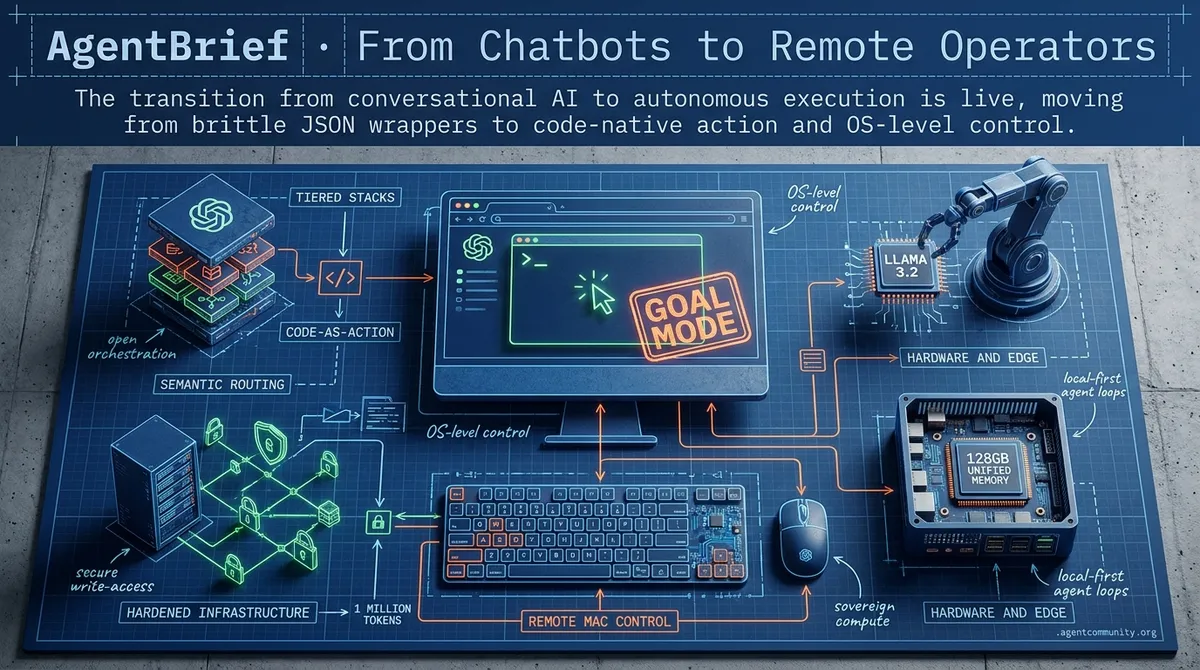
- The Operator Shift OpenAI’s 'Goal Mode' and 'Operator' signify a pivot from chat interfaces to direct OS and browser control, effectively turning the desktop into a remote-controlled environment for autonomous agents.
- Dismantling the Monolith Builders are moving away from single-model dependencies toward tiered stacks, utilizing semantic routing to slash costs and specialized 'smol' frameworks that favor code-as-action over brittle JSON outputs.
- Hardened Infrastructure As DeepSeek scales context to a million tokens and MCP expands to 9,400 servers, the focus has shifted to production-grade reliability, state management, and securing 'write-access' agents against infrastructure breaches.
- Hardware and Edge The rise of 128GB unified memory mini-PCs and edge models like Llama 3.2 is enabling local-first agent loops, offering a sovereign, low-latency alternative to proprietary cloud APIs.
with our friends at CraftHub
Craft Conference — June 4–5, 2026, Budapest — Two days of software craft talks at the Hungarian Railway Museum. Community discount included.
Get the discount →
X Intel
OpenAI just turned your Mac into a remote-controlled agent puppet while you sleep.
The era of the 'chatbot' is officially over; we have entered the era of the 'remote operator.' OpenAI’s release of Goal Mode for Codex isn't just another feature update—it’s a land grab for the user's desktop. When an agent can control a locked Mac through a secure relay, we’ve moved past simple tool-use into true OS-level agency. But this autonomy comes with a cost: vertical integration. We’re seeing a massive debate erupt over 'harnesses'—the proprietary wrappers labs build to make their models perform. If a first-party harness provides a 1.7x performance boost over open-source alternatives, builders face a hard choice between performance and platform lock-in. Meanwhile, the stakes for these 'write-access' agents are becoming painfully clear following the Composio breach. As builders, our job is shifting from prompt engineering to infrastructure security and state management. We’re no longer just building apps; we’re building autonomous employees that need to remember their mistakes without burning down the house.
OpenAI Unveils Persistent 'Goal Mode' with Remote Mac Control
OpenAI has significantly expanded the Codex ecosystem with 'Goal Mode,' a feature allowing agents to work autonomously toward high-level objectives for hours or even days @OpenAI. The most striking breakthrough is the ability to securely control Mac applications from a mobile device, even when the computer is locked and the screen is off @OpenAI. This signals a transition where, as Greg Brockman puts it, 'the model alone is no longer the product' @gdb.
The community response highlights both the technical audacity and the early-stage friction of this OS-level agency. While some joke that OpenAI now employs more macOS engineers than Apple @theo, early adopters are reporting connection bugs and enrollment issues @masa_okamura108. However, for those who get it working, the ability to approve repo-level changes via phone while the machine stays locked is a massive step for shipping continuity @adriwtm.
For agent builders, the move to 'Appshots'—providing direct screen context—and kernel-gated control via Apple's team ID changes the game @OpenAI. We are no longer limited by what an API exposes; the agent can see and interact with the UI as a human would. This unlocks workflows that were previously impossible due to lack of API coverage, though it requires a new level of trust in the relay security @SIGKITTEN.
Looking forward, watch how enterprises react to the compliance nightmare of agents accessing sensitive data on locked devices. As @laobaishare notes, the security implications of this level of remote control are profound, likely requiring new frameworks for agentic auditing and permissioning @TeksCreate.
The Battle Between Models and Proprietary Harnesses
A fierce debate is brewing over the 'harness'—the product wrapper and orchestration layer that sits on top of the model. While Greg Brockman argues for a symbiotic relationship between model and harness @gdb, some builders fear that labs building their own CLI tools, like Claude Code, are stifling the 3rd-party ecosystem @kunchenguid. This isn't just about competition; it's about labs potentially over-fitting models to their proprietary tools @kunchenguid.
The performance data suggests the 'harness' might be the most critical component of the agentic stack. Recent benchmarks show a 1.7× performance delta when running the same model through different harnesses, with some third-party wrappers actually outperforming lab-built tools like Claude Code in specific speed tests @GitMaxd. On Terminal-Bench 2.0, the pre.dev harness achieved a 56.2% pass rate, beating Claude Code’s 53.9% despite using a lower-tier model @predotdev.
This shift means 'the product' is now the entire stack: models, harnesses, and evals @Vtrivedy10. For builders, the choice of orchestration framework is becoming as high-stakes as the LLM itself. While first-party tools offer deep integration and better real-world reliability in blind reviews, open alternatives like Goose or custom setups provide the flexibility needed to avoid vendor lock-in @Garabed96 @YasssineKh.
In Brief
Gemini 3.5 Flash Hits Frontier Benchmarks
Google’s Gemini 3.5 Flash is emerging as a top-tier agentic engine, hitting 1656 on GDPval and demonstrating 289 tokens per second execution speeds @praveenkoka @302aiofficial. Logan Kilpatrick confirmed tripled quotas to keep builders in a 'flow state,' though some users report UI bugs like broken text copying and cursor issues in chat sessions @OfficialLoganK @leo1400257721.
Google Research Releases 'ReasoningBank' for Agent Memory
Google Research is tackling 'agent amnesia' with ReasoningBank, an open-source framework that distills successful reasoning trajectories into reusable strategies @GoogleResearch. The system reportedly boosts success rates by 8.3% on WebArena and improves SWE-Bench resolve rates to 57.4% by retrieving past lessons via embedding search, allowing agents to continuously learn from failures @yaelkroy @AlphaSignalAI.
Composio Security Incident Exposes Write-Access Risks
A major security breach at Composio highlights the 'write-access' danger zone for agents after an attacker compromised internal tools and escalated privileges to access GitHub tokens @KaranVaidya6. Founder Karan Vaidya confirmed the 8-hour breach led to a platform-wide token revocation, serving as a stark reminder that giving agents control over production infrastructure requires extreme sandboxing and rigorous security auditing @KaranVaidya6.
Quick Hits
Agent Frameworks & Orchestration
- ManusAI launched a comprehensive course on building autonomous agents that handle research and deployment via API @freeCodeCamp.
- Async Code Agent allows developers to run multiple AI coding agents in parallel to compare outputs faster @DanKornas.
- A new 'bossman supervisor' pattern is outperforming self-reflection in multi-agent orchestration @Vtrivedy10.
Tool Use & Developer Experience
- BrowserAct is a free CLI giving agents human-like browser control and CAPTCHA solving @hasantoxr.
- OpsKat offers a natural-language agent for managing remote infrastructure across SSH and Kafka @DanKornas.
- DeepLearningAI released a free course on Generative UI for agents to assemble interactive components @akshay_pachaar.
Agentic Infrastructure & Models
- NVIDIA's next-gen Vera Rubin system is seeing a 485% increase in memory costs, critical for agentic HBM needs @Pirat_Nation.
- Llama.cpp now includes a WebGPU backend, enabling high-performance LLM execution in the browser @ggerganov.
- The gap between standard and Pro models is widening as OpenAI reportedly cuts intelligence on non-Pro search @zephyr_z9.
Reddit Field Reports
From $200 bills dropping to $40 to local 128GB silicon, the era of 'just hit the API' is over.
The honeymoon phase of 'agentic vibes' is officially over, replaced by the cold, hard reality of production engineering. Today's theme is the dismantling of the monolithic model approach. Developers are no longer content throwing Opus or GPT-4 at every problem; the market is moving toward a tiered architectural stack. We are seeing a surge in Semantic Routing to slash costs by 80%, the rise of 'Agent Memory' to filter out persistent noise, and a massive expansion of the Model Context Protocol (MCP) to 9,400 servers.
What matters for practitioners right now is 'Context Architecture.' Whether it is managing the 'babysitting' problem in RAG pipelines or the execution gap in high-speed models like Gemini 3.5 Flash, the focus has shifted from raw intelligence to deterministic control. Even the hardware is catching up, with AMD’s new 128GB unified memory mini-PCs promising a future where these complex agent loops run locally, independent of cloud API volatility. The stories below outline the blueprint for this transition: cheaper, more specialized, and locally sovereign.
Routing Boring Subtasks to Slash Agent Overhead by 80% r/AI_Agents
Developers are moving away from monolithic model usage, finding that running top-tier models for every step of an agentic loop is a massive waste of capital. u/breadislifeee reported cutting their weekly bill from $200 to $40 by routing 'boring' subtasks—such as file reading and tool formatting—to cheaper models. This pattern is evolving into Semantic Routing, which uses embedding-based similarity to classify intent before an LLM is even invoked, preventing 'routing error cascades' that otherwise multiply costs in multi-agent systems.
The financial stakes are high as long-horizon workflows for research and deck generation often consume 2M to 3M tokens per run. u/BookwormSarah1 shared a success story of reducing daily costs from $300 to $63 by implementing a complexity-aware routing layer. Beyond routing, practitioners are leveraging Prompt Caching to stabilize costs; community discussions highlight that caching tool schemas and system instructions is essential for making 24/7 autonomous agents economically viable.
The Problem of Noise with Persistence r/aiagents
Practitioners are reporting a significant architectural bottleneck where AI memory systems excel at data accumulation but fail at 'forgetting.' As agents run for months, old preferences and corrected facts are stored as literal truth, often winning retrieval over newer information, a phenomenon u/knothinggoess describes as 'babysitting' a system rather than running one. To solve this, Cloudflare introduced Agent Memory, a three-tier system (User, Session, and Agent scopes), while researchers advocate for hybrid memory stores that combine vector search with graph-based logic to prevent 'context rot.'
Gemini 3.5 Flash: Frontier Speed vs. The Execution Gap r/AgentsOfAI
Gemini 3.5 Flash entered GA on May 19, 2026, sparking a debate over its 'speed vs. execution' gap in agentic workflows. Priced at $1.50 per 1M input tokens, the model boasts a 76.2% on Terminal-Bench 2.1, yet real-world testing from builders like u/BullBullGo suggests it frequently stalls during browser automation and complex planning. While it runs 4x faster than other frontier models, it currently sits as a top-tier routing model rather than a primary executor, requiring rigid prompting to overcome execution failures reported by the community.
MCP Ecosystem Hits 9,400 Servers as 'Data-Shaping' Becomes the New Standard r/mcp
The Model Context Protocol (MCP) ecosystem has expanded 7.8x year-over-year, reaching over 9,400 servers by April 2026. This growth is marked by a shift toward specialized harnesses like the AgentOps MCP for observability and octen-mcp for extracting structured URLs to combat 'context bloat.' To manage this scale, the official roadmap now includes 'MCP Server Cards' for structured metadata discovery, moving the protocol from simple tool access to a sophisticated data-shaping standard for autonomous agents.
Hard Constraints for Autonomous Shells r/AgentsOfAI
A near-miss $5,000 refund hallucination reported by u/SpeedRare6173 has accelerated the move toward shell-level control layers and 'Instructional Hierarchy' protocols.
The $4K Ryzen AI Halo PC r/LocalLLM
AMD's new 1-liter chassis features 128GB of LPDDR5x-8000 memory, enabling 70B+ parameter models to run locally with 215 GB/s bandwidth, delivering up to 12x the LLM performance of Intel's Lunar Lake.
Babysitting Broken Retrieval Pipelines r/LangChain
The shift from RAG to 'Context Architecture' is underway as u/SilverConsistent9222 notes that production RAG is mostly babysitting retrieval; teams are now adopting the Lerim context compiler to manage data flow.
Claude Code's Context Struggle r/ClaudeAI
Anthropic has introduced 'Routines' and 'Checkpoints' to help Claude Code overcome its 60-minute 'teaching phase' and allow for more proactive, persistent repository audits.
Discord Dev Logs
OpenAI's Operator launch signals a definitive shift from chat boxes to autonomous browser execution.
The transition from conversational AI to autonomous action is no longer a theoretical roadmap—it is live in production. OpenAI's Operator launch marks the official start of the 'Action-Oriented' era, where agents move beyond the chat box to navigate the web as human users do. However, as the latest benchmarks from OSWorld and WebVoyager suggest, we are hitting a 'reasoning ceiling' where execution reliability often lags behind intent. For developers, the focus is rapidly shifting from raw model power to the infrastructure that makes these agents viable: standardizing tool communication with Anthropic’s Model Context Protocol (MCP), hardening logic with type-safe frameworks like PydanticAI, and managing complex state with LangGraph. We are also seeing a significant push toward the edge, where models like Llama 3.2 and Phi-4 are slashing latency for function-calling tasks. Today’s issue explores this tension between high-latency proprietary 'operators' and the high-efficiency, open-source orchestration layers that are actually winning the battle for developer mindshare. Whether you are building browser agents or local-first digital twins, the tooling is maturing to favor reliability and engineering rigor over 'vibes.'
OpenAI Operator and the Shift to Action-Oriented Browser Agents
OpenAI has officially transitioned from conversational AI to autonomous execution with the launch of Operator, a research preview now available to ChatGPT Pro users in the U.S. OpenAI. Unlike traditional LLMs, Operator utilizes its own browser instance to perform multi-step tasks such as booking travel and filling complex forms, signaling a definitive shift toward 'action-oriented' agents.
While the system aims for a 90% success rate on procurement tasks to surpass its current 87% benchmark on WebVoyager OpenAI, it currently holds a 38.1% success rate on the more rigorous OSWorld benchmark, highlighting the remaining 'reasoning ceiling' for full computer autonomy Coasty. This release marks a milestone in the agentic web, where models are no longer confined to chat boxes but can navigate the internet like human users, provided developers can solve for DOM-parsing reliability and session management.
Despite its perceived edge in applicability over Anthropic’s Computer Use LinkedIn, latency and operational costs remain significant barriers. Early developer feedback highlights a demand for more efficient vision-and-action loops, with some practitioners already turning to third-party optimizations that claim to be 100x faster and cheaper than native implementations by optimizing how the AI interacts with the OS OpenAI Community.
Browser-use Scales Web Automation with 78% Success Rate
The browser-use Python library has solidified its position as a dominant orchestration layer for LLMs, recently surpassing 12,000 stars on GitHub. By automating DOM-to-text conversion and action-looping, it eliminates the need for extensive custom code, with the Cloud (bu-ultra) version achieving a 78% success rate on hard browser tasks—maintaining a 16-point lead over standalone open-source models browser-use.com. While vision-based navigation is narrowing the performance gap, practitioners are warned that visual interaction can consume 45x more tokens than API-based architectures Baytech Consulting.
Anthropic’s MCP Evolves into the 'USB-C for AI'
Anthropic’s Model Context Protocol (MCP) has solidified its position as a universal interface that decouples tool logic from the underlying model, leading to a 40% reduction in boilerplate code for developers. The ecosystem has rapidly expanded to include over 50 community-built servers for data sources like Postgres and Slack GitHub, with AWS recently detailing implementation strategies for cloud-native environments AWS. As the protocol matures, industry focus is shifting toward production-grade observability and managing emerging risks in tool-call payloads Synvestable.
LangGraph Hardens Enterprise Workflows with Persistence
LangGraph has emerged as the definitive framework for managing persistent state in complex, cyclical agentic systems. By treating agentic loops as directed graphs, it enables long-running executions that survive system restarts, a feature critical for automating complex business processes Appri AI. With 75% of enterprise pilots exploring graph-based orchestration, the focus has shifted toward building multi-agent systems where coordination and shared memory are the primary architectural requirements DataNorth.
PydanticAI Hardens Agent Logic with Type Safety
PydanticAI is accelerating the shift to agentic engineering by enforcing strict type-hinting and validation, resulting in a reported 65% decrease in runtime parsing errors @Nirupam S D.
Llama 3.2 and Phi-4 Shatter Latency Barriers at the Edge
Llama 3.2 3B-Instruct has achieved 88.23% accuracy on function-calling benchmarks Gorilla LLM, while Microsoft's Phi-4 (14B) is outperforming GPT-4 on reasoning tasks like MATH (71.1%) Microsoft HF.
HuggingFace Lab Notes
Hugging Face escapes 'JSON jail' while DeepSeek scales agentic context to one million tokens.
We are witnessing a Great Simplification in the agentic stack. For the last year, developers have been wrestling with 'JSON jail'—the brittle, high-latency process of forcing LLMs to output structured data just to trigger a function. Hugging Face’s release of smolagents marks a pivot toward 'code-as-action,' where agents write Python directly. It’s cleaner, faster, and, as the GAIA benchmarks show, significantly more effective. But as the frameworks get smaller, the context windows are getting gargantuan. DeepSeek-V4’s million-token window isn't just a flex; it’s a bid for long-horizon autonomy where an agent can 'remember' an entire multi-day research project. However, more memory brings more noise, as evidenced by the retrieval nuances in their latest benchmarks. The common thread today is the move toward production-grade reliability. Whether it’s IBM’s new leaderboard exposing the 'verification gap' or NVIDIA and H-Company slashing latency for computer-use agents, the industry is moving past the demo phase. We aren't just building bots that talk; we're building systems that act, reason, and—crucially—fail in predictable, fixable ways. This shift from chat-centric wrappers to code-native autonomous systems is exactly what practitioners need to scale.
Smol Is the New Big for Agents: Escaping 'JSON Jail'
Hugging Face has launched smolagents, a minimalist 1,000-line library that signals a definitive shift from brittle JSON-based orchestration to a 'code-as-action' paradigm. By allowing agents to write and execute Python directly, the framework overcomes the 'JSON-jail' that limits complex tool composition. This modularity is further emphasized by the emergence of MCP-powered systems; Hugging Face has demonstrated that a functional 'Tiny Agent' leveraging the Model Context Protocol can be implemented in just 50 lines of code.\n\nThe efficiency gains are measurable: the Transformers Code Agent powered by this framework achieved a 67% success rate on the GAIA benchmark, requiring 30% fewer logic steps than traditional heavyweight frameworks. By stripping away the 'abstraction tax' found in platforms like LangChain, smolagents functions as a high-speed building block for developers who prioritize inspectability. This trajectory suggests a broader industry move toward lightweight, code-centric patterns that are easier to debug and deploy in production than their more complex predecessors.
Action-Optimized VLMs Break the Pixel-to-Action Latency Barrier
The frontier of agentic capabilities is moving from text boxes to full desktop environments, led by specialized architectures that prioritize execution speed. H-Company recently released Holotron-12B, a high-throughput computer use agent developed with NVIDIA that achieves 8.9k tokens/s on a single H100. Diagnostic tools like ScreenSuite have established a 62.3% success rate floor for these specialized operators—nearly doubling the 36.1% baseline of general-purpose LLMs, while platforms like OpenEnv provide the necessary full-stack environments for reproducible deployment.
Quantifying the Verification Gap: VAKRA and the Open Agent Leaderboard
As agentic frameworks explode, IBM Research has launched the Open Agent Leaderboard to provide transparent, system-level evaluation. Diagnostic data from the VAKRA benchmark reveals a sobering reality: agents average 5.3 failure modes per trace, with bottlenecks often being systemic—such as API orchestration and multi-hop reasoning gaps—rather than model-specific. These tools, alongside ServiceNow-AI's EVA framework for voice agents, are helping developers move toward production-grade reliability where industrial constraints currently break up to 30% of existing systems.
Quick Hits: DeepSeek, MedGemma, and Local Execution
DeepSeek-V4 introduces a 1,000,000-token context window for long-horizon planning, with the Pro-Max variant achieving a 0.59 MMR on retrieval tests.
Medical AI Agents Expand Support
Google's EHR Navigator, powered by MedGemma 1.5, uses synthetic patient data to navigate structured medical FHIR records safely.
Hardware-Specific Agent Acceleration
Intel has accelerated Qwen3-8B agents on Core Ultra processors using depth-pruned draft models to reduce tool-calling trajectory overhead.
Standardizing the Agentic Stack
The new Unified Tool Use pattern in the transformers library allows portable code across Mistral, Cohere, and Llama models via automatic schema conversion.