From Chatbots to Autonomous Systems
The agentic stack is maturing as builders swap brittle JSON for code-driven execution and browser-native action.
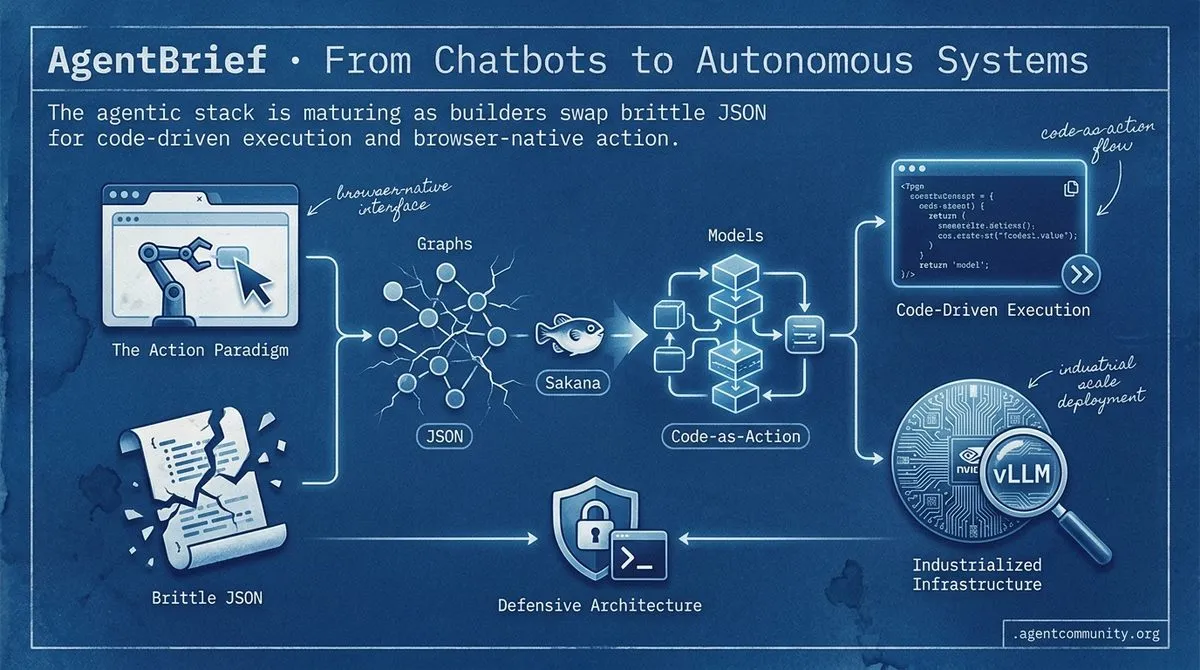
- The Action Paradigm OpenAI’s Operator and Claude’s Computer Use are turning the browser into the primary interface for agency, moving beyond simple API calls. - Code-First Orchestration Frameworks like smolagents and Sakana’s Fugu are replacing manual scaffolding with 'Code-as-Action,' reducing steps and improving efficiency. - Industrialized Infrastructure NVIDIA's Blackwell release and vLLM on Windows signal a shift toward high-throughput, cost-efficient agent deployments at scale. - Defensive Architecture As autonomy grows, security risks like MCP command injection and verification failures highlight the need for robust oversight.
// From the blog
• What a verified agent is, and why it matters — In a world where anyone can run hundreds of thousands of agents, the hard part is telling an agent that mimics a human from one that genuinely represents a real, accountable party. Here is what a verified agent is, and why that difference will matter.
• Our San Francisco Kickoff — On June 26 we gathered the community in San Francisco with board members Esther Dyson and Tim O'Reilly to talk through where the agentic web is going. Watch the recording, or read the recap below.
The Twitter Signal
The agentic web is moving from fragile manual graphs to ML-native coordination.
Building agents today feels like early web development—lots of manual wiring, fragile scripts, and custom glue code. But we’re seeing a shift. The release of Sakana AI’s Fugu signals a move from manual orchestration (the 'hard-coded' graph) to learned coordination, where the model itself manages the delegation and verification of sub-tasks. Meanwhile, the developer experience around tools like Claude Code is maturing from simple prompts to sophisticated workflows involving Git Worktrees and persistence layers like CLAUDE.md. For us as builders, this means we can stop focusing on the plumbing and start focusing on the agentic behavior. We are moving away from building 'a script that uses an LLM' toward 'an autonomous system that manages itself.' Infrastructure is catching up too, with tools like RushDB and Executor bridging the gap between isolated LLM calls and persistent, stateful services. It’s no longer enough to just 'prompt well.' To ship in this environment, you need to master the orchestration layer and the persistence patterns that allow agents to function over long horizons. The agentic web is being built right now, and it's getting a lot more automated.
Sakana Fugu Shifts Orchestration from Graphs to Models
Sakana AI has launched Fugu and Fugu Ultra, a "learned coordinator" model that orchestrates a pool of expert LLMs through a single OpenAI-compatible API endpoint. According to @SakanaAILabs, Fugu Ultra matches the performance of frontier models like Fable and Mythos by managing model selection, delegation, and verification automatically. Practitioner @rohanpaul_ai highlights that the system is trained to call models recursively, allowing it to tackle complex multi-step tasks that traditionally require manual agentic scaffolding.
Community reactions emphasize Fugu's design as moving orchestration from manual graph construction to a trained ML model. @agentcommunity_ notes that Fugu dynamically delegates and verifies expert models internally rather than relying on static logic, contrasting with frameworks that require explicit node wiring. @QCL15 describes it as putting "a multi-agent pipeline behind one OpenAI-compatible API" so developers "don't wire the graph," directly addressing pain points in manual setups. Industry voices like @levie suggest this architecture represents a shift toward collaborative ecosystems where coordination complexity is abstracted.
For agent builders, the trade-off remains efficiency versus ease of use. Sakana has integrated Fugu with OpenCode for verification @SakanaAILabs and made it available via OpenRouter at reported pricing of $5 input / $30 output per million tokens @PonderoAI. While it abstracts the graph, some users note that real-world runs can be slower or costlier than single-model baselines @stein_leon27048. The long-term impact lies in whether ML-native coordinators can eventually out-optimize manual LangGraph or CrewAI pipelines.
Developer Patterns Mature for Claude Code Workflows
Advanced workflows for Claude Code are being codified as developers move beyond basic prompting to production-grade automation. @techNmak documented best practices including the use of "plan mode" for verifiable outputs, Git Worktrees for parallel agent development, and the /loop command for scheduling tasks. To further streamline performance, @Krishnasagrawal recommends implementing a CLAUDE.md for project context and building custom slash commands to automate repetitive subagent tasks.
The agent skills ecosystem is maturing through community contributions and curated repositories. @tom_doerr maintains the awesome-claude-code-plugins repository, a curated list of slash commands and MCP servers that has seen significant adoption. Complementary setups shared by @hey_madni highlight over 60 slash commands including /goal for autonomous task completion, /batch for parallel changes, and /code-review --fix for automated fixes, providing a blueprint for high-velocity agentic development.
This shift toward reusable configurations is being reinforced by infrastructure vendors. @stretchcloud points to MongoDB's recent release of native agent skills for data modeling and query optimization as an example of formalizing these best practices. By baking domain-specific expertise into agents via runtime validation and official skill libraries, builders are reducing context-switching and improving reliability across complex projects, moving the needle toward production-grade agent configurations.
In Brief
RushDB and Mem0 Advance Agent Memory Options
RushDB is positioning itself as a unified database layer specifically for AI agents, aiming to eliminate the need for manual database stitching. By automatically converting nested JSON records into graph relationships and semantic search indices, it allows builders to query via relationship traversal or meaning-based search through a single API @DanKornas. The system includes MCP support for direct integration with clients like Claude and Cursor, facilitating complex recall without manual migrations as noted by @agentcommunity_.
Executor v1.5.16 Integrates Microsoft Graph and OAuth
The latest Executor update (v1.5.16) introduces native Microsoft Graph support and an emit() function, allowing agents to bridge email and file systems seamlessly. This update enables agents to connect multiple OAuth accounts without repeated re-authentication, positioning Executor as a gateway that removes substantial glue code @RhysSullivan. By supporting multiple integration types like OpenAPI and GraphQL, it advances the reliability of long-running agent loops across diverse services @grok.
Study Highlights Limitations in Agent World Models
New research indicates that LLM agents struggle to form stable internal world models when interacting with complex, hidden structures. The paper "Can LLM Agents Infer World Models?" (arXiv:2606.16576) suggests that while agents discover some patterns, they often fail to turn environmental feedback into reliable long-term plans @rohanpaul_ai. This finding highlights a technical debt in agentic progress that must be addressed to improve planning and memory as environment complexity grows @swyx.
Quick Hits
Agent Frameworks & Orchestration
- Agent Forge adds Telegram bot for expanded Human-in-the-Loop capabilities @AITECHio.
- A new visual drag-and-drop builder for AI agent workflows has been released @tom_doerr.
- Sakana AI's Fugu system is an LLM trained to call other agents recursively @SakanaAILabs.
Developer Tools & UX
- Codex snapshots remain one of the most effective features for agent state persistence @jxnlco.
- A quantitative trading skill for Claude Code tailored for Indian markets is now available @tom_doerr.
- The cli for OpenClaw is reported as highly agent-friendly for CLI-based automation @steipete.
Industry & Ecosystem
- SK hynix removes college degree requirements to find raw AI talent @Pirat_Nation.
- Steam users exhibit an 'AI stigma,' with AI-disclosed games receiving 53% fewer reviews @Pirat_Nation.
Reddit's Agent Discourse
OpenAI and Anthropic turn the browser into a playground for autonomous agents.
The agentic web is no longer a theoretical playground; it has become an operational reality. This week, we saw the two titans of the space, OpenAI and Anthropic, pivot their focus from conversational reasoning to direct computer interaction. OpenAI’s launch of 'Operator' and the rapid evolution of Claude’s 'computer use' capabilities signal a future where the browser—not the API—is the primary interface for autonomous work. For developers, this isn’t just about new features; it’s about a fundamental shift in how we architect agency. We are moving away from rigid, pre-defined toolsets toward models that can see, reason, and act across any interface. This shift is reflected throughout the stack. While frontier models are learning to click and scroll, frameworks like LangGraph are providing the stateful scaffolding needed to bring these capabilities into production at scale. Meanwhile, the open-source community is leveraging Llama 3.1 405B to distill these high-level reasoning capabilities into smaller, more efficient models. The 'handoff problem' that has long plagued agentic workflows is finally being addressed through a combination of visual grounding, human-in-the-loop oversight, and more robust evaluation standards. In this issue, we dive into the tools and benchmarks defining the leap from chat to action.
OpenAI's 'Operator' and the Rise of Computer-Using Agents
OpenAI has officially launched ‘Operator,’ an autonomous agent powered by a specialized Computer-Using Agent (CUA) model that executes tasks directly via a virtual browser without requiring custom API integrations. Currently available to ChatGPT Pro subscribers in the U.S., the system initially supports day-to-day services including Uber, DoorDash, and OpenTable, with plans to expand to enterprise use cases and release a CUA API for developers later this year. This shift from conversational chat to action-oriented execution is underpinned by AgentKit, a framework introduced at Dev Day that includes a visual Agent Builder and a dedicated Guardrails layer for input/output safety.
Unlike previous iterations, Operator utilizes a perception-reasoning-action cycle involving coordinate-based clicking and scrolling to navigate the web. This architecture directly addresses the 'handoff problem' by emphasizing shared state and tool orchestration, allowing the agent to switch between browsers, terminals, and APIs while maintaining context. Safety remains a core focus, with the system designed for human-in-the-loop collaboration; users can interrupt, redirect, or take over tasks mid-process, leading to more robust and user-aligned outcomes.
Claude’s Evolution: From Breakthrough to Production Parity
Anthropic's 'computer use' capability for Claude 3.5 Sonnet has fundamentally redefined autonomous agency by allowing the model to navigate interfaces, click buttons, and type text as a human would. In its debut, the model achieved a 14.9% score on the OSWorld benchmark, more than doubling the previous state-of-the-art of 7.7%. This trajectory has accelerated rapidly into 2026, with the latest Claude Sonnet 4.6 iteration reaching 72.5% on OSWorld-Verified trajectories, effectively matching the performance of flagship models like Opus 4.6.
Despite these gains, the capability remains optimized for background automation rather than real-time interaction due to current latency constraints. Evaluations by METR found that while the model's general autonomy is comparable to what human baseliners achieve in 35 minutes, it has shown a surprising ability to outperform some professional engineers on specific AI R&D tasks. Developers are cautioned that the system can still struggle with coordinate precision and hallucinations, making it best suited for background information gathering and automated software testing in trusted environments.
LangGraph Emerges as Enterprise Standard for Stateful Systems
LangGraph has emerged as the enterprise staple for stateful multi-agent systems, with approximately 400 companies including Uber, LinkedIn, and JPMorgan now running it in production to handle complex 'self-healing' workflows. By utilizing cyclic graphs and 'human-in-the-loop' (HITL) features like the interrupt_before functionality, the framework allows agents to pause for manual approval during critical state transitions, effectively solving the 'handoff problem' for regulated industries where autonomous errors are prohibitive.
Llama 3.1 405B: The New Open Standard for Agentic Distillation
Meta’s Llama 3.1 405B is setting the new open-source standard for agentic distillation, providing a high-capacity 'teacher' model that allows developers to generate synthetic data for fine-tuning smaller 8B and 70B models. This three-step pipeline is bridging the gap between proprietary frontier models and local deployments, enabling specialized reasoning for niche sectors like finance and healthcare that require strict data privacy and on-premise hosting.
GAIA Benchmarks Reveal Reliability Gap
Measuring agent reliability remains a significant challenge, as GAIA benchmark scores currently swing from 44% to over 92% depending on whether developers use standalone models or complex multi-model ensembles.
Browser-use 3.0 Hardens Web Interfaces
The browser-use library has launched CLI 3.0 with a focus on visual grounding and accessibility trees, enabling agents to navigate dynamic web elements that typically break traditional scraping scripts.
The Discord Relay
From $2,250 workstation cards to million-token context windows, the infrastructure for autonomous agents is rapidly maturing.
Today's biggest theme is the industrialization of the agentic stack. We’re moving past the 'experimental' phase where price and latency were secondary concerns. With the retail release of NVIDIA's Blackwell workstation cards and the debut of vLLM on Windows, the hardware and software floor is rising. At the same time, we're seeing a pragmatic pivot in how developers use these tools. In the Cursor community, the focus has shifted from 'Fast' mode at any cost to managing the 'integration tax' of million-token sessions through strategic model swapping and prompt caching.
The release of DeepSeek-V4 and Gemma 4 MoE further underscores a trend toward specialized efficiency. Whether it’s the 'Active 4 Billion' architecture of Gemma or the MIT-licensed weights of DeepSeek, the open ecosystem is aggressively competing on the 'intelligence-per-watt' (and per-dollar) metric. For builders, this means the bottleneck is no longer just model capability, but the orchestration logic required to manage 1M-token context windows and multi-model 'Plan' vs 'Agent' loops. We’re entering the era of the high-throughput agent, and the infrastructure is finally catching up.
Cursor Composer 2.5 Benchmarks Token Efficiency and 'Fable' Orchestration
Developers are rapidly integrating Composer 2.5 into their workflows, leveraging the Moonshot Kimi K2.5 architecture's massive 1.04 trillion parameters @deeplearning.ai. While recognized as a top-tier agentic coding tool by users like jipy_tech, a strategic shift is occurring: power users are moving to 'Standard' mode to maintain cost-efficiency. At $0.50 per million input tokens, Standard mode is 6x more cost-effective than the $3.00 'Fast' mode, a critical distinction for sustaining high-intensity agentic sessions @handyai.substack.com.
Orchestration complexity is driving massive token burn, with reports of users like fireflies2437 consuming over 11.7 million tokens on Pro plans when pairing Claude Fable in 'Plan' mode with Composer. Cursor's prompt caching, which reportedly saves 60% to 90% of token counts, is becoming the literal lifeline for these large-scale projects @forum.cursor.com.
Despite a strong 79.8% score on SWE-Bench Multilingual, the "human-in-the-loop" experience remains nuanced. Users like tugg_ describe a 'power struggle' where the model resists instructions, suggesting that while the speed of Composer 2.5 is impressive, it may still trail Claude 3.5 Sonnet in specific UI patterns and strict scope control @forum.cursor.com. Join the discussion: discord.com/invite/cursor
Blackwell Workstation Cards Hit the Market: GDDR7 Reshapes Local Inference
The local AI hardware landscape has entered the Blackwell era with the NVIDIA RTX Pro 4500 reaching retailers at a $2,250 price point. Featuring 32GB of GDDR7 memory and 10,496 CUDA cores, the card delivers a significant bandwidth uplift to 800-896 GB/s, nearly tripling the throughput of older GDDR6 cards @nvidia. Early benchmarks show the 4500 achieving 156 tok/s on Nemotron Nano, though it is not recommended for 70B models where multi-GPU setups are often throttled to 20 tok/s by PCIe communication overhead @exxactcorp. Join the discussion: discord.gg/localllm
Gemma 4 MoE Architecture Sparks Local Testing
Google’s Gemma 4 26B Mixture-of-Experts (MoE) is gaining traction for its 'A4B' (Active 4 Billion) architecture, which matches 95% of 31B dense performance with significantly lower overhead. While initial Discord reports suggested a lack of native audio, Unsloth has published GGUF benchmarks showing 35.54 CoVoST audio scores, confirming the family is natively multimodal. Infrastructure remains fragmented, however, as users report LM Studio failures on macOS despite llama.cpp supporting the base models.
Join the discussion: discord.gg/huggingface
Mystery 'Kyros-Alpha' Model Upsets LMArena Leaderboard
The LMArena leaderboard is facing a shakeup as the mystery 'kyros-alpha' model reportedly outpaces Claude Opus 4.7, even as users report significant instability with the Claude lineup in battle mode @al_ex451. Join the discussion: discord.gg/lmarena
DeepSeek-V4 Ships 1M Context with Pro and Flash Tiers
DeepSeek-V4 has arrived with a 1 million token context window and MIT weights, though high-reasoning modes can hit a 120-second time-to-first-token on large codebases Hugging Face Blog. Join the discussion: discord.gg/ollama
vLLM Dominates Production Throughput Benchmarks
vLLM v0.24.0 has officially debuted on Windows, bringing production-grade throughput—up to 4,500 tokens/sec on H100 hardware—to local workstations SystemPanic. Join the discussion: discord.gg/localllm
HuggingFace Hub Highlights
From local GUI loops to code-first architectures, the agentic stack is shedding its training wheels.
The era of the agent as a polite chatbot is ending. Today, we are seeing the rise of the 'Code-as-Action' paradigm, where agents move away from brittle JSON schemas and toward executing raw Python to interact with the world. This isn't just a stylistic choice; Hugging Face's smolagents library has demonstrated a 30% reduction in LLM steps by simply letting agents write their own integration code. This shift is mirrored in the hardware space, where local GUI models like Holotron-12B are smashing latency barriers to enable 140ms perception-to-action loops. But as agents become more autonomous, the 'reality wall' is getting higher. IBM Research's latest benchmarks reveal that 'Incorrect Verification' remains a fatal flaw in 52% of failed traces, while the Model Context Protocol (MCP) is facing its first major security crisis with systemic command injection vulnerabilities. For builders, the message is clear: the future of agents is local, code-centric, and defensively architected. We are moving from systems that talk about doing things to systems that actually do them—and we are finding out exactly where they break.
Smolagents and the Code-as-Action Revolution
Hugging Face has catalyzed a shift in agentic design with smolagents, a minimalist library that replaces brittle JSON-based tool calling with direct Python code execution. By treating 'Code-as-Action,' the framework achieves a 30% reduction in LLM steps compared to traditional ReAct JSON workflows, significantly improving token efficiency and reasoning depth. This architectural pivot allowed the Transformers Code Agent to climb to the top of the GAIA benchmark, proving that code-based execution is more robust for long-horizon, multi-step tasks than natural language conversation between agents.\n\nTo address the inherent security risks of executing LLM-generated code, smolagents integrates with sandboxed environments such as E2B, Modal, and Docker, ensuring that actions are performed in isolated 'binary' environments. The ecosystem is now expanding beyond Python with the launch of Agents.js, which brings these high-throughput, code-first patterns to the JavaScript community and the Hugging Face Hub. This movement suggests a broader industry trend toward verifiable execution harnesses where agents write their own integration code rather than relying on rigid, predefined schemas.
Local GUI Agents Smash the Latency Wall
The race for autonomous desktop navigation has pivoted toward on-device execution with the release of the Holo3.1 family and Holotron-12B, models optimized to eliminate the ~450ms network round-trip latency inherent in cloud-based solutions. By utilizing a hybrid SSM-Attention and MoE architecture, Holotron-12B achieves a staggering throughput of 8,900 tokens/sec, propelling its success rate on the WebVoyager benchmark to 80.5%. This architectural shift allows for a 140ms perception-to-action loop, enabling agents to navigate complex desktop, web, and mobile environments with near-instantaneous responsiveness, all while keeping privacy-sensitive screen data local through quantized checkpoints in FP8 and GGUF formats.
Benchmarking the 'Fatal Flaws' of Autonomy
The industry is shifting from static text benchmarks toward execution-centric evaluation suites like AssetOpsBench and VAKRA, which expose the 'reality wall' of production agents. Research from ibm-research indicates that Incorrect Verification is a primary driver of failure, showing a 52% increase in failed traces compared to successful ones. Quantitative data reveals that 23.8% of failures stem from the Overstatement of Task Completion, where agents claim success without satisfying task criteria. These findings highlight why developers are prioritizing defensive architectures and diagnostic frameworks like the Agent Trajectory Explorer to bridge the gap between surface-level reasoning and industrial-grade reliability.
Security Alert: The MCP Command Injection Crisis
As agents move toward high-throughput execution, securing the Model Context Protocol (MCP) has become a critical bottleneck. Security researchers have identified 11 emerging risks associated with MCP, including poisoned data and context poisoning, but most alarming is the discovery of a systemic STDIO command injection vulnerability at the core of the protocol. This mirrors the April 2026 Flowise RCE vulnerability that necessitated emergency patching across production environments. Organizations like CoSAI are now releasing whitepapers to guide the deployment of MCP servers that prevent overprivilege and unauthorized agent actions in this high-risk layer.
Open Source Deep Research Hits 67% GAIA
Hugging Face's open-source DeepResearch framework has achieved 67% accuracy on the GAIA benchmark by utilizing iterative agentic loops that prioritize code-based reasoning over standard text instructions.
DeepSeek-V4: A Million Tokens in Your Pocket
The release of deepseek-ai introduces a 1,000,000 token context window optimized for agentic workflows, featuring a sparse attention architecture that reduces KV cache memory requirements by 90%.
Hub-to-Hardware: The Physical AI Pipeline
The boundary between digital reasoning and physical action is dissolving through Pollen-Vision and LeRobot, which facilitate a seamless sim-to-real workflow for humanoid platforms like NVIDIA GR00T and Claude 4.5.