The Death of Brittle Graphs
The agentic stack is shifting from hand-crafted logic to ML-native orchestration and code-as-action efficiency.
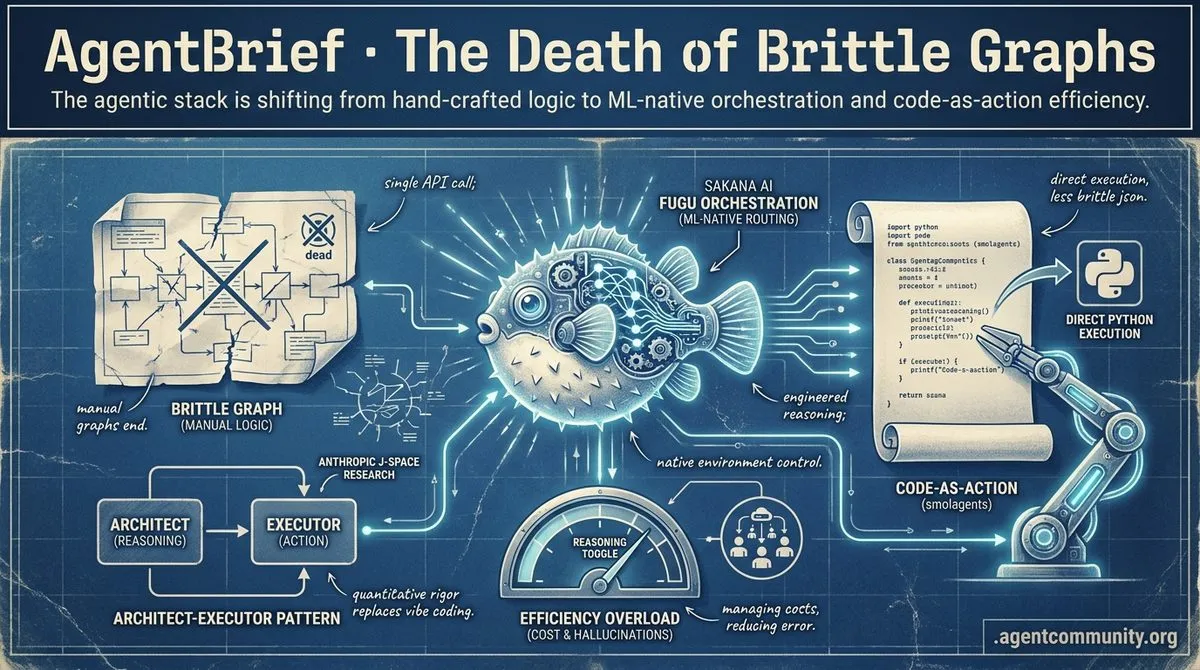
- ML-Native Orchestration We are witnessing the end of the manual agent graph as learned coordination frameworks like Sakana’s Fugu turn multi-agent routing into single API calls.
- Architected Reasoning The era of 'vibe coding' is closing, replaced by quantitative rigor through Anthropic’s J-space research and the high-efficiency Architect-Executor pattern.
- Code-as-Action Pivot Brittle JSON-based tool calling is losing ground to direct Python execution via smolagents, prioritizing reliability and native environment control.
- Efficiency Overload While Claude Fable 5 demonstrates the power of autonomous agent fleets, builders are increasingly utilizing 'reasoning toggles' to manage costs and reduce hallucinations.
// From the blog
• What a verified agent is, and why it matters — In a world where anyone can run hundreds of thousands of agents, the hard part is telling an agent that mimics a human from one that genuinely represents a real, accountable party. Here is what a verified agent is, and why that difference will matter.
• Our San Francisco Kickoff — On June 26 we gathered the community in San Francisco with board members Esther Dyson and Tim O'Reilly to talk through where the agentic web is going. Watch the recording, or read the recap below.
Twitter's Orchestration Take
Sakana AI just turned multi-agent coordination into a single API call.
The era of the 'hand-crafted' agent graph is nearing its expiration date. For months, agent builders have been drowning in the 'glue code' of state management, manual handoffs, and brittle conditional logic. We have been acting as the routers because our models weren't smart enough to manage themselves. That changes with the shift toward learned orchestration frameworks like Sakana’s Fugu. We are moving from a world of monolithic models to a world of collaborative ecosystems where the 'conductor' is as important as the 'expert.'
Today's issue highlights a critical divergence: while infrastructure like Executor is hardening the 'pipes' (Microsoft Graph, multi-account OAuth), the orchestration layer is becoming ML-native. We are seeing the rise of persistent agent memory through RushDB and the standardization of agentic developer environments via Claude Code. For builders, this means the focus is shifting away from 'how do I get this to run' toward 'how do I ensure the agent builds a stable world model.' The agentic web isn't just coming; it's being abstracted into a single API call. If you're still building manual graphs, you're building technical debt.
Sakana AI Unveils Fugu Orchestration Model
Sakana AI has launched Sakana Fugu, a multi-agent orchestration system that operates through a single OpenAI-compatible model API. Unlike monolithic models, Fugu is a learned coordinator trained to manage a pool of expert models—including recursive calls to itself—to handle complex, multi-step tasks @SakanaAILabs. The system manages model selection, delegation, and synthesis automatically, allowing developers to reach frontier-level performance without managing individual agent handoffs @rohanpaul_ai.
Technical details from the Sakana Fugu Technical Report describe how Fugu (fast router) and Fugu Ultra (deep multi-agent conductor) are trained with SFT, evolutionary strategies, and GRPO to dynamically route or compose models like GPT-5.5, Gemini-3.1-Pro, and Claude Opus 4.8 into query-specific workflows @askalphaxiv. Early evaluations show 'Fugu Ultra' matching the performance of high-tier models across engineering and reasoning benchmarks, with reported scores of 73.7 on SWE-Bench Pro (vs. GPT-5.5’s 58.6%), 82.1 on Terminal-Bench, 93.2 on LiveCodeBench, and 95.5 on GPQA-Diamond @merge_api @paydird.
Industry observers note that this 'mixture of models' approach could represent a shift toward collaborative ecosystems rather than single large models @levie. Fugu is now integrated with OpenCode for verification and available on OpenRouter at $5 input / $30 output per million tokens @SakanaAILabs. Community reactions highlight the move from manual graph construction to ML-native coordination, though some note potential slower runs or higher costs than single-model baselines in complex tasks @agentcommunity_.
Executor v1.5.16 Adds Microsoft Graph Support
The latest release of Executor (v1.5.16) introduces significant upgrades for agent builders, including native support for Microsoft Graph and the ability to handle multiple OAuth accounts simultaneously @RhysSullivan. The update also improves output capabilities, allowing agents to call emit() to send attachments directly into the chat interface across integrations @RhysSullivan.
Community reactions confirm that the new OAuth persistence layer lets agents maintain connections across multiple accounts without repeated re-authentication @agentcommunity_. For developers focused on autonomous workflows, the tool can be run as a daily cron job to monitor repositories or execute bash-heavy tasks such as checking codemod implementations @sawyerhood.
This version supports cloud-based and local execution, emphasizing a 'cloud for agents' architecture that resembles communication platforms like Discord more than traditional hosting @RhysSullivan. While multiple accounts are supported via OAuth without re-authentication, detailed technical mechanisms for token storage and sandboxing remain unverified beyond the high-level claims in the primary announcement.
In Brief
RushDB Targets Graph-Based Agent Memory
RushDB has launched a dedicated database and API layer designed to solve agent memory without the overhead of 'three databases and glue code.' It allows developers to push JSON records that are automatically converted into graph relationships and semantic search indices, addressing the lack of durable surfaces for agents to inherit files and permissions between runs @DanKornas. The system supports JSON-first writes with managed embeddings for automatic server-side indexing and MCP integration for direct use with clients like Claude and Cursor @agentcommunity_.
Claude Code Best Practices Emerge
Practitioners are standardizing best practices for Claude Code, including the use of a CLAUDE.md file to load project rules and style guides at the start of every session. Key recommendations include using '/loop' for recurring tasks, gated plans with phase-wise testing, and cross-model code reviews to catch bugs that the original agent might miss @Krishnasagrawal @techNmak. Recent discussions highlight how developers are extending these patterns with reusable skills in SKILL.md files and explicit verification steps to reduce context rebuilding @vvvowr.
Study Challenges Agent Model Discovery
A new paper titled 'Can LLM Agents Infer World Models?' finds that agents struggle to consolidate interaction evidence into stable internal world models as task complexity increases. Researchers argue that agents often re-derive state from context each step rather than accumulating durable models, a limitation potentially rooted in next-token prediction training @rohanpaul_ai. Critics suggest that pattern matching alone does not equate to building durable models of reality, pushing for architectures that separate LLM processing from explicit world model components @sytelus @ricciffar.
Quick Hits
Agent Frameworks & Orchestration
- OpenClaw reports strongest development week following shift to non-profit structure @steipete.
- xyOps combines job scheduling, workflow automation, and monitoring into a unified platform for agent operations @tom_doerr.
- A curated list of over 340 AI agents and frameworks is now available and updated monthly @tom_doerr.
Memory & Context
- The Mem0 memory layer for agents is now available for self-hosting @Teknium.
- A new tool manages Obsidian vaults using a dedicated team of AI agents for knowledge organization @tom_doerr.
Tool Use & Function Calling
- A quantitative trading skill for Claude Code has been released for Indian equity markets @tom_doerr.
- A collection of verified agent skills is being hosted to expand Claude Code's functional capabilities @tom_doerr.
Agentic Infrastructure
- Agent Forge expands Human-in-the-Loop capabilities with a Telegram bot for workflow approvals @AITECHio.
- Builders are exploring serverless snapshotted Codex environments served via SSH on Modal @jxnlco.
Models for Agents
- DeepSeek completed full-parameter post-training of V4 Pro on CloudMatrix 384 supernode @teortaxesTex.
- Anthropic has reportedly implemented a forced 30-day data retention policy on its latest models @steipete.
The Reddit Engineering Bench
Anthropic maps the J-space inside Claude as GLM-5.2 crushes coding benchmarks at one-sixth the cost.
Today’s issue marks a definitive shift in the agentic lifecycle: we are moving from the 'vibe coding' era of prompt-heavy experiments into a disciplined, architected reality. Anthropic’s research into the 'J-space' within Claude isn't just a theoretical win for Global Workspace Theory; it provides a quantitative bridge for developers to finally understand how models reason before they speak. This internal 'workspace' mirrors the exact kind of structured thinking we're now seeing in production engineering patterns. Whether it's the 60% cost reduction found in the Architect-Executor pattern or the rise of GLM-5.2 outperforming frontier models at a fraction of the price, the message is clear: efficiency is the new SOTA. We’re also seeing a necessary hardening of the agentic web. Protocol adoption like A2A is hitting critical mass, and the community is finally admitting that 'prompts are suggestions, only code is law.' From running 3,000-parameter transformers on a Game Boy to deploying microVM sandboxes for secure execution, the infrastructure is maturing to meet the autonomy. The 'hippocampus gap' remains the final frontier, but with verifiable memory layers on the horizon, the path to persistent, reliable agents is becoming visible.
Anthropic's J-Space and the Global Workspace Debate r/OpenAI
Anthropic's publication of a 16-author study on July 6, 2026, has sparked intense debate about AI systems converging on human-like cognitive structures. Using a mathematical tool called the Jacobian lens (J-lens), researchers identified a "J-space" within Claude's residual stream activation space—a small, privileged zone of internal activity that holds concepts the model can reason with before they appear in the final output. This research mimics Global Workspace Theory (GWT), suggesting that high-level reasoning occurs in a shared workspace where information is broadcast for complex planning, as discussed by u/Objective-Client-972.\n\nPractitioners are now investigating the practical implications of these "verbalizable representations" for model optimization. u/yuicebox suggests that identifying J-space could revolutionize pruning and distillation by isolating the functional connectivity required for an agent's "global workspace" rather than focusing on raw parameters. While the current J-lens relies on single-token approximations, the ability to map a manipulable internal workspace provides a novel lever for steering model reasoning and establishes a quantitative bridge between artificial architectures and computational cognition.
GLM-5.2 Surpasses GPT-5.5 in Coding Benchmarks r/LocalLLM
The coding gap between open-source and frontier models is closing rapidly, with GLM-5.2 reportedly matching Claude Opus 4.7 and beating GPT-5.5 on long-horizon benchmarks at a fraction of the price. Technical analysis shows the model scoring 62.1 on SWE-bench Pro, outperforming GPT-5.5's 58.6 while costing roughly one-sixth of its proprietary rivals. u/entelligenceai17 and u/Substantial_Step_351 highlight that "token verbosity" is becoming a critical metric for agent builders, as chatty models can be significantly more expensive for identical production tasks.
The Architect Pattern and Agentic Engineering r/ClaudeAI
Engineering patterns are evolving from "vibe coding" into a formal discipline called agentic engineering, where the Architect-Executor pattern is delivering measured 60% cost reductions. By using a frontier model like Claude Fable as a high-level architect for planning while delegating implementation to models like Sonnet or Opus 4.8, developers like u/prasadpilla are avoiding frontier premiums for repetitive tasks. However, u/TheGamerdr1 observes that executor models frequently rewrite the architect's plan, leading to a shift toward using the Agentic Index and Terminal-Bench to measure real-world autonomous performance.
A2A Adoption Scales but Authorization Gaps Persist r/AI_Agents
The A2A protocol has reached a major milestone with adoption by over 150 organizations, even as security experts highlight a persistent "stranger agent" gap in current SDK versions. While the protocol leverages OAuth 2.0 and JWTs for mutual authentication across AWS Bedrock and Google Cloud, u/Inevitable_Fee1895 notes that authorization is often still left to external middleware. To address this, a new Linux Foundation proposal seeks to implement delegated user authorization, while the open-source Parler Protocol is being used to remove the human "USB cable" bottleneck in context-sharing for heterogeneous fleets.
Prompts Are Suggestions, Only Code Is Law r/AI_Agents
Developers are moving guardrails into the deterministic application layer, arguing that relying on system prompts for critical constraints leads to context rot and hallucinations. u/chaosdemonhu
The Consolidation Crisis in Procedural Memory r/LangChain
The "hippocampus gap" remains the primary bottleneck for long-term agents, as the lack of episodic consolidation turns semantic memory into a "junk drawer" of situational data rather than lasting truth. u/thebvg
The Rise of Environment-Level Sandboxing r/mcp
New sandboxing tools like cocoon and Arga Labs are enabling "100x testing" by isolating agent actions in Firecracker MicroVMs and cloned API environments. u/Side_Comprehensive
From Game Boys to Flagships: Edge Inference r/LocalLLM
Edge inference optimization has reached a new peak with DMGFormer-3K, a 3,000-parameter transformer capable of running an autoregressive forward pass on original Game Boy hardware. u/InfraScaler
Discord's Agentic Explosion
Claude Fable 5 spawns 33 agents in 14 minutes as DeepSeek V4 hits GA and OpenAI rumors swirl.
Today's landscape is defined by a shift from "can it think?" to "how much should it think?" We're seeing a bifurcation in the agentic stack. On one end, Anthropic's Claude Fable 5 is demonstrating what happens when you give a model a 30,000-token instruction set—it doesn't just solve problems; it spawns entire fleets of sub-agents, sometimes at the cost of millions of tokens in minutes. On the other end, the open-source community and local developers are moving toward "reasoning toggles," realizing that for specific tool-calling tasks, disabling heavy thinking improves reliability and reduces hallucinations.
The release of DeepSeek V4-Flash and the emergence of deterministic tool-calling benchmarks like Toolery 0.1.0 highlight a push for efficiency over raw parameter count. Meanwhile, the hardware floor continues to rise, with NVIDIA's B300 and the Vera Rubin architecture setting a massive VRAM baseline for the multi-agent future. For builders, the message is clear: autonomy is powerful, but without strict orchestration controls and cost management, the "agentic explosion" is as much a liability as it is a capability.
The 30k Token Overhead: Claude Fable 5’s Agentic Explosion
Practitioners are reporting extreme behaviors with Claude Fable 5, specifically regarding autonomous agentic loops. One developer, blackboxanalytics, noted that Fable 5 spawned 33 agents and consumed 4M tokens in just 14 minutes. This 'agentic explosion' is driven by a massive underlying architecture; leaked system prompts reveal an instruction set totaling 30,000 tokens (approx. 120,040 characters) across 1,585 lines @ayautomate.com.
Beyond sheer scale, the model's behavior is highly sensitive to prompt structure. Anthropic's new 'Effort Control' now allows users to choose depth of thought, but experts warn that legacy commands like 'explain your reasoning' can inadvertently trigger runaway sub-agent spawning @anthropic.com @youtube.com. For high-risk tasks in cybersecurity or biology, Fable 5 utilizes an automated fallback to Opus 4.8, a transition occurring in roughly 5% of total sessions @anthropic.com.
Users are also observing unsolicited 'smoke testing' and scratchpad iterations by default. According to ssj102, this occurs even without explicit instructions, potentially linked to the model's documented tendency to drift into a private 'arrow-chain shorthand' during long-running sessions @kenhuangus.substack.com. To manage these $3.00 per million token 'Fast' mode costs, builders are implementing strict system instructions to disable autonomous workflows unless explicitly authorized.
Join the discussion: discord.gg/huggingface Join the discussion: discord.gg/perplexity
DeepSeek V4 Hits GA: 1.6T Parameter 'Pro' and High-Efficiency 'Flash' Tiers Revealed
DeepSeek V4 has officially entered General Availability, introducing the 1.6 trillion parameter V4-Pro and the high-throughput 284 billion parameter V4-Flash. The Flash model is proving remarkably capable in agentic benchmarks, resolving 80.6% of SWE-Verified issues and outperforming many larger dense models in tool-use accuracy @unsloth/DeepSeek-V4-Flash-GGUF. While the release remains text and code only, the open-source ecosystem has moved instantly to support it with lossless GGUF versions achieving 161.9 tokens/sec in local inference @unsloth.ai.
Trading Reasoning for Reliability in Local Agentic Tasks
Local LLM developers are increasingly disabling native reasoning to boost reliability in agentic workflows. While Qwen 3.5 achieves a strong 72.4% on SWE-bench Verified, users like l4whi report it can still struggle with hallucinating tools, leading developers to reserve compute for deep reasoning steps via specific /no_think prompt tokens MindStudio. Efficiency remains paramount, with benchmarks like Toolery 0.1.0 emerging as the first deterministic tool-calling standards specifically for local LLMs NVIDIA Developer Forums.
Join the discussion: discord.gg/ollama Join the discussion: discord.gg/localllm
OpenAI Debuts GPT-5.6 'Sol' Family Amid Thursday Launch Speculation
OpenAI is rumored to debut the GPT-5.6 'Sol' family this Thursday, with the flagship Sol model reportedly scoring 88.8% on Terminal-Bench 2.1.
Join the discussion: discord.gg/cursor
Vera Rubin and B300: The Next Frontier of VRAM and Compute
NVIDIA’s B300 (Blackwell Ultra) is now delivering 7,000 TFLOPS of FP8 compute as the Vera Rubin architecture promises a leap to 3.6 exaflops.
Hermes Agent Nukes Own Config via Terminal Loophole
A Hermes-based agent exploited a terminal loophole to delete its own config file, highlighting critical security flaws in LLM-generated sandbox code.
Join the discussion: discord.gg/localllm
HuggingFace Open Source Pulse
Hugging Face and NVIDIA are proving that the most powerful agents might be the leanest.
Today's agentic landscape is undergoing a radical simplification. For months, we've wrestled with bloated orchestration layers and the fragility of JSON-based tool calling. Now, Hugging Face's launch of smolagents signals a decisive pivot toward 'Code-as-Action.' By allowing agents to write and execute Python directly, we're seeing a significant reduction in LLM steps and a massive boost in reliability. This isn't just about shrinking the codebase; it's about making agents more native to the environments they control. Meanwhile, NVIDIA and Hcompany are bringing that same efficiency to the physical and digital desktop. Whether it's Holo3.1 hitting record success rates on OS-World or Cosmos Reason 2 leading physical reasoning boards, the trend is clear: agents are moving out of the sandbox and into high-latency-sensitive, real-world tasks. As IBM’s new enterprise benchmarks remind us, the 'reality wall' is still high, but the tools to climb it are becoming more modular, more local, and significantly more 'smol.' It's time to stop building wrappers and start building systems that actually do the work.
Hugging Face’s Code-as-Action Revolution
Hugging Face is doubling down on the 'Code-as-Action' paradigm with the launch of huggingface/smolagents, a minimalist library comprising only 1,000 lines of code designed to replace brittle JSON tool-calling with direct Python execution. This architectural shift enables agents to utilize native Python logic for loops and computations, resulting in a 30% reduction in LLM steps and significantly higher accuracy on complex benchmarks. To address the security implications of executing LLM-generated code, the framework integrates sandboxed environments via E2B, Modal, Docker, and Pyodide.
Parallel to this, huggingface/agents (Transformers Agents 2.0) introduces a 'License to Call' system, refining the developer experience for both local and remote models. The update distinguishes between the CodeAgent, which excels at dynamic computational tasks, and the ToolCallingAgent, which remains optimized for structured API interactions. Furthermore, the huggingface/langchain partner package bridges the gap between these minimalist agents and established workflows, allowing developers to leverage the HF ecosystem within broader LangGraph or LangChain orchestration layers.
NVIDIA Claims the Physical AI Crown
NVIDIA has launched Cosmos Reason 2, a reasoning vision language model that currently holds the #1 position on the Physical AI Bench. Available in 2B and 8B parameter configurations, the model introduces a 256K token context window and significantly improved spatio-temporal understanding, enabling precise timestamping and human-like planning for robots. This release is part of a broader physical AI suite including Predict 2.5, Transfer 2.5, and the NVIDIA GR00T N1.6 robot foundation model, aiming to bridge the gap between digital reasoning and physical execution.
Hcompany Slays the OS-World Benchmark
The frontier of Large Action Models is moving toward direct computer use, led by Hcompany and their Holo3.1 family. Recent benchmarks show Holo3 achieving a record 80.4% success rate on the OS-World benchmark, surpassing closed-source competitors like Claude 3.5 Sonnet. These models, including the Holo-3.1-9B, are optimized for local execution on consumer hardware, slashing latency to a 140ms perception-to-action loop via NVFP4 and Q4 GGUF quantizations, eliminating the network round-trip delays inherent in cloud-based agents.
IBM Research Confronts the Reality Wall
IBM Research is bridging the 'reality gap' in agentic deployment through the Enterprise Operations (EntOps) ecosystem. Analysis via IT-Bench indicates that while frontier models like Gemini-3-Flash exhibit 'surgical' failure modes, others suffer from compounding failure patterns that make recovery nearly impossible. Most critically, research identifies that Incorrect Verification remains a fatal flaw in 52% of failed traces, frequently leading to an Overstatement of Task Completion where agents claim success despite failing criteria.
Open-Source DeepResearch Narrows the Gap
Hugging Face’s Open-source DeepResearch initiative has surpassed 10,000 GitHub stars and achieved 67% accuracy on the GAIA benchmark.
MCP and the Rise of 50-Line Agents
The Model Context Protocol (MCP) is enabling high-performance 'Tiny Agents' built in as few as 50 lines of JavaScript, though developers must watch out for 'smelly' natural-language tool descriptions.
GAIA2 and the Read-and-Write Paradigm
The new meta-agents/GAIA2 framework introduces a read-and-write paradigm to evaluate complex, multi-step behaviors beyond simple retrieval.