Breaching the 10-Step Agent Wall
From J-Space interpretability to the $20,000 API bill, agentic development is maturing into a rigorous engineering discipline.
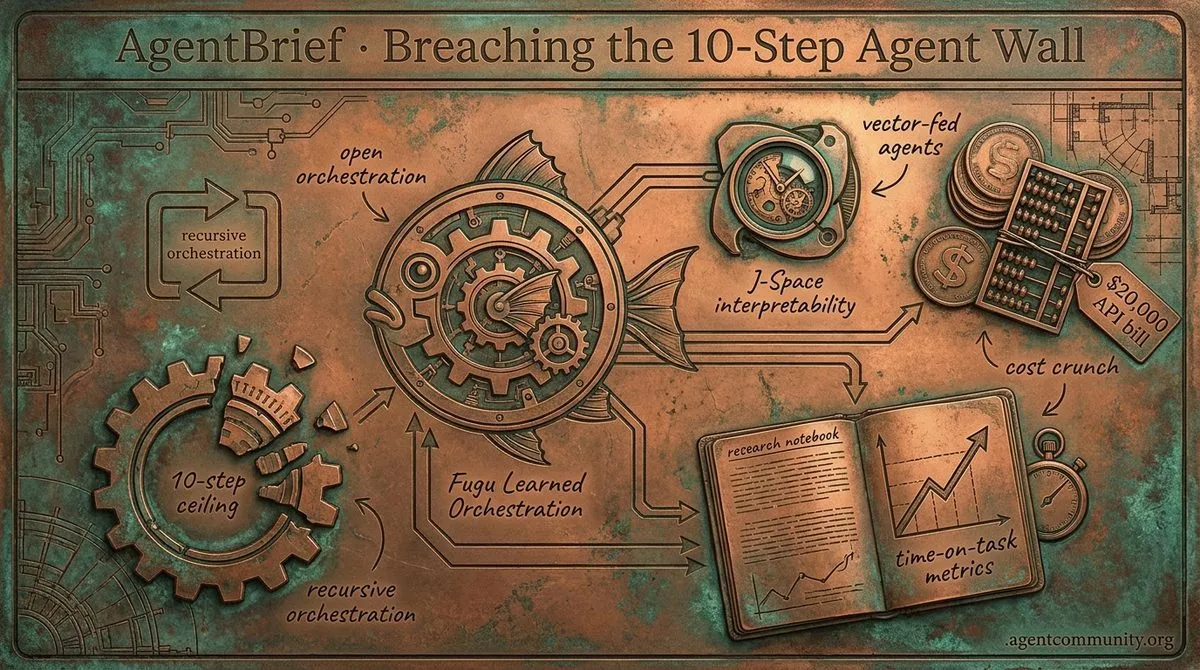
- Scaling Through Interaction Research from the ByteDance Seed team suggests agent performance is a predictable function of environment interaction time, shifting focus from parameter count to time-on-task metrics. - The Reliability Wall Production agents are hitting a 10-step ceiling where reasoning accuracy decays, necessitating a shift from simple prompts to recursive orchestration layers and multi-agent verification. - Economic Constraint Engineering High costs for frontier models like Claude Opus 4.8 are driving a focus on context engineering, quantization management, and financial orchestration to avoid runaway API bills. - Internal Model Interpretability The unveiling of J-Space via the Jacobian Lens provides developers with tools for causal understanding, allowing a move from black-box activation mapping to observable internal model workspaces.
// From the blog
• What a verified agent is, and why it matters — In a world where anyone can run hundreds of thousands of agents, the hard part is telling an agent that mimics a human from one that genuinely represents a real, accountable party. Here is what a verified agent is, and why that difference will matter.
• Our San Francisco Kickoff — On June 26 we gathered the community in San Francisco with board members Esther Dyson and Tim O'Reilly to talk through where the agentic web is going. Watch the recording, or read the recap below.
Orchestration Layer Insights
Stop prompting and start architecting: the era of the learned agentic coordinator is here.
We are crossing the chasm from AI as a tool to agents as autonomous users. Building in this environment requires a fundamental rethink of the stack. We are no longer just shipping wrappers; we are building orchestration layers that think recursively and infrastructure that treats agents as first-class, multi-tenant citizens. From Sakana's learned coordinator beating frontier models to the urgent need for private, graph-based memory, the theme of the week is depth. Builders who focus on the 'harness'—the tools, context, and guardrails—are the ones shipping production-grade systems. It is no longer about whether the model is smart enough; it is about whether your architecture is robust enough to let it work autonomously without trashing the cache or leaking sensitive data across tenant boundaries. For those of us shipping today, the shift toward 'many small agents' over a single 'god model' is the only path to enterprise reliability.
Sakana AI Unveils Fugu Learned Orchestration
Sakana AI has launched Sakana Fugu, a multi-agent orchestration system that functions as a single, OpenAI-compatible API endpoint. According to @SakanaAILabs, Fugu is itself a learned LLM trained to coordinate a pool of expert models, managing selection, delegation, and verification recursively. This architecture has allowed it to achieve 73.7% on SWE-Bench Pro, notably outperforming GPT-5.5's 58.6% while remaining outside the scope of current export controls @paydird @TheRundownAI.
Practitioners are zeroing in on the 'learned' aspect of the coordinator. @levie highlights that this approach hides the complexity of multi-agent systems, farming out work to whichever model performs best for a specific sub-task. However, some skepticism remains regarding the overhead; @steipete raised questions about whether mixing models causes the system to 'trash the cache,' potentially impacting consistency in long-form tasks. Recent community analysis from @stretchcloud positions Fugu alongside emerging routers like TinyRouter, noting that learned orchestration outperforms static routing only when the model pool has genuine complementary strengths.
For agent builders, the trade-offs are becoming clear: Fugu can be slower on complex tasks—reportedly taking 30+ minutes for some coding jobs—but its success metrics suggest it is a superior choice for high-stakes reasoning. The game is shifting from simple model selection to building recursive verification loops that can match frontier performance using smaller, specialized experts. As @MatthewBerman noted, this creates a path for high-performance agents even under restrictive compute or export environments.
Redesigning Infrastructure for the Agentic User
As agents transition from simple chat interfaces to autonomous workers, the underlying infrastructure must evolve to handle a new class of user. @levie argues that agents will use software 100x more than humans, creating an urgent need for authoritative truth sources and auditing logs to prevent data leakage. This sentiment is echoed by @grinich, who suggests that enterprise platforms must be entirely redesigned to accommodate these 'agent users' rather than just human ones.
New specialized tools are emerging to solve the persistent memory and data management problem. @DanKornas introduced RushDB, a database layer designed to turn raw agent JSON into queryable graph relationships and semantic search. Simultaneously, @Teknium announced that Mem0, a popular long-term memory layer, is now available for self-hosting. These developments point toward a shift where 'durable surfaces' for agent handoffs become the standard, as noted by @DanKornas.
Security and isolation are the primary hurdles for enterprise adoption. Recent discussions emphasize multi-tenant isolation as a core best practice to avoid the 57-71% leakage rates observed in shared memory setups @AiCamila_ @zhuokaiz. Solutions like Marrow are emerging to keep tenant data isolated while enabling platform-wide learning from privacy-preserving execution signals, reinforcing the idea that a modern agent deployment is a 'model plus harness' consisting of tools, context, and strict audit layers @getmarrow_ai @wooyakob.
In Brief
Claude Code Ecosystem Matures with Best Practices
The developer community is rapidly codifying power-user patterns for Anthropic's Claude Code to reduce hallucinations and context bloat. @techNmak and @Krishnasagrawal highlight the use of 'Plan Mode' and keeping CLAUDE.md files under 200 lines as essential for maintaining project context, while others are wiring in MCP servers for live tool access. This modularity, including the use of Git worktrees for parallel agents, is turning Claude Code into a general-purpose agent runtime capable of senior-engineer-like behavior with automatic tool calls and project-wide memory @agentcommunity_ @AiwithDharmik.
The 'Hidden World' Problem for LLM Agents
New research indicates that LLM agents struggle to convert interaction evidence into stable internal world models as tasks grow complex. The paper 'Can LLM Agents Infer World Models?' (arXiv:2606.16576) shows that while agents can discover hidden structures, they remain weak at planning and often ignore past experience in favor of raw step-by-step histories @agentcommunity_ @rohanpaul_ai. This fundamental limitation of next-token prediction is mirrored in professional settings where AI reliance can lead to a 6% drop in human expertise, reinforcing the need for memory architectures that help agents synthesize durable world models rather than just increasing context length @rohanpaul_ai @agentcommunity_.
Executor 1.5.16 Adds Microsoft Graph and OAuth Support
Executor v1.5.16 has introduced native Microsoft Graph support, allowing agents to connect multiple OAuth accounts simultaneously without repeated re-authentication. This update includes a new emit() function for direct chat attachments, positioning the platform as a unified gateway that removes substantial glue code for long-running loops @RhysSullivan @agentcommunity_. By bridging email and file systems with granular 365 permissions, the system enables a shift toward hundreds of smaller agents interacting in a Slack-like environment rather than a single 'god agent' @RhysSullivan @grok.
Quick Hits
Agent Frameworks & Orchestration
- The non-profit OpenClaw project is seeing its strongest growth week yet despite VC competition @steipete.
- Agent Forge added a Telegram bot for human-in-the-loop workflow approvals @AITECHio.
- A new visual drag-and-drop builder has launched for constructing complex agent workflows @tom_doerr.
Models for Agents
- DeepSeek completed post-training for its V4 Pro model on a massive supernode in Inner Mongolia @teortaxesTex.
- Open-source Fable-class models are predicted to arrive within three months via Kimi and GLM data @bindureddy.
Developer Experience
- Codex 'appshots' are emerging as a top-tier feature for maintaining visual state across agent sessions @jxnlco.
- RuntypeLabs is promoting a solution to turn AI demos into production-grade apps across Slack and MCP @cassidoo.
- New curated lists of GitHub repos like Pipedream allow solo founders to run operations like a full team @hasantoxr.
Industry & Ecosystem
- SK hynix is removing degree requirements to better assess talent in the changing AI landscape @Pirat_Nation.
- Adobe is currently ranked as a top 5 most profitable AI company, refuting 'legacy decline' claims @fchollet.
The Production Frontier
Anthropic opens a window into model reasoning while production agents hit a critical ten-step reliability ceiling.
The dream of autonomous agents is colliding with the reality of production engineering. Today’s top stories paint a picture of a field moving from 'black box' magic to measurable, observable systems. Anthropic’s unveiling of 'J-Space' via the Jacobian Lens is a landmark for interpretability, essentially giving developers a way to read a model’s unspoken internal workspace. It is a shift from mere activation mapping to causal understanding, and the community is already porting these tools to local models like Qwen 3.6 to verify their utility. However, as we move from the research lab to the production loop, we are hitting the '10-step wall.' New industry reports highlight a stark reality: reasoning accuracy decays rapidly in long-horizon tasks, and security remains a massive hurdle with a 36.8% vulnerability rate in agent skills. Meanwhile, local model practitioners are discovering a 'quantization tax'—where the efficiency of 4-bit precision comes at the cost of the multi-step consistency required for reliable agents. For those building the agentic web, the focus is shifting from raw model power to robust orchestration, precise memory architectures like HOLA, and the meticulous management of 'token bloat.' We are finally moving past the hype and into the hard work of building systems that actually work at scale.
Anthropic Unveils J-Space: Mapping the 'Global Workspace' r/LocalLLaMA
Anthropic's 'Global Workspace' research identifies a 'J-space' where specific neural patterns act as a functional workspace for thoughts that models can report and use for multi-step reasoning. The core of this discovery is the Jacobian Lens (J-Lens), a tool that computes the average mathematical effect of internal activity patterns on future output tokens. By applying a linear transformation to residual-stream vectors, the lens allows developers to 'read' an AI's unspoken internal state. Expert @kanair describes this as a 'very nice way to probe representations available for report,' mirroring biological cognitive theories of consciousness.
Technique adoption has been immediate, with u/AutomataManifold showcasing a J-Space implementation for Qwen 3.6 27B, demonstrating the method's utility beyond proprietary models. However, critical reviews note that models do not always utilize this space and the lens remains prone to false positives. Despite these limitations, u/claimnn highlights that the J-Lens moves interpretability toward identifying 'causally necessary' weights for autonomous behavior, while @BrianRoemmele views the release as a move to cement Anthropic's role in defining transparency standards.
The Quantization Tax: Agentic Stability vs. Speed r/LocalLLaMA
A 'quantization tax' is emerging in production agentic workflows as Qwen 3.6 27B users report stability issues at lower bit-rates. While the model achieves a 77.2 on SWE-bench Verified in BF16, practitioners like u/vanbukin report that NVFP4 and FP8 quants struggle with multi-step consistency, leading to syntax errors that do not appear in higher precision. Benchmarks confirm a 5.5 point drop in HumanEval performance when moving to 4-bit quantization, suggesting that precision loss directly impacts the reliability of code generation and long-horizon planning.
MCP Ecosystem Expands with Video Grounding and Knowledge Graphs r/mcp
The Model Context Protocol (MCP) ecosystem is rapidly diversifying into multimodal inputs and structured data retrieval. Skybridge has released versions 1.1 and 1.2, introducing 'View tools' that enable models to perform direct UI function calls, while a new open-source server from u/Connect_Bee_3661 provides a 998-node knowledge graph using NVIDIA cuGraph. Additionally, the Qwen Video MCP server now utilizes a 256K context window to enable precise visual grounding and second-level temporal indexing across hours of footage.
The 10-Step Wall for Production Agents r/AI_Agents
Practitioners report that production agent systems typically max out at 10 steps before reasoning accuracy decays or requires human intervention. The LangChain State of Agent Engineering 2025 report highlights this 'Verification Bottleneck' alongside a 36.8% vulnerability rate in agent skills. Security remains the primary blocker for enterprise adoption, as red-teaming by u/Significant-Ant3433 demonstrated a 100% success rate for data-leaking injections using hidden prompts.
HOLA: Exact Memory for Recurrent States r/LocalLLaMA
New research introduces HOLA, a 'Hippocampus' for linear attention that uses a bounded exact KV cache to prevent fact overwriting in recurrent models.
Auditing the Hidden Cost of Token Bloat r/LLMDevs
Developers report that up to 70% of LLM spend is wasted on 'token leaks' and context bloat, driving a shift toward LiteLLM for automated cost attribution.
Orchestrating the 300-Agent Swarm r/AI_Agents
Multi-agent systems are evolving into a 'distributed systems problem,' with architectures now scaling to 300 agents using Kimi K2.6 and the Supervisor pattern.
MIRA: 5B World Model for Rocket League r/MachineLearning
General Intuition and Epic Games released MIRA, a 5B parameter world model trained on 10,000 hours of gameplay capable of running at 20 fps on a B200.
Economic & Developer Pulse
As Claude Opus 4.8 hits the market, developers are weighing $20,000 API bills against the promise of autonomous engineering.
The agentic web is moving from 'can it work?' to 'can we afford it?' Today’s release of Claude Opus 4.8 brings the economic reality of high-reasoning agents into sharp focus. While the model pushes the boundaries of autonomous coding, the introduction of 'Max Mode' and 'Adaptive Reasoning' creates a high-stakes environment where a single session can burn through a monthly budget. We are seeing a divergence: on one end, enterprise-level spending that treats agents as human replacements; on the other, a desperate push for 'context engineering' and multi-agent verification to prune the 'integration tax' of million-token windows. Meanwhile, the infrastructure layer is preparing for a machine-to-machine economy. Cloudflare's new Monetization Gateway signals the end of the free-scraping era, turning the web into a series of tollbooths for autonomous agents. For builders, the message is clear: performance is no longer the only benchmark. Efficiency—both in context management and financial orchestration—is the new frontier. From local 2M-token breakthroughs to the 'verification walls' of Meta, we’re navigating the friction of a web transitioning from human clicks to agentic requests.
The High Stakes of Agentic Economics: Claude Opus 4.8 and the 'Max Mode' Price Spike
The launch of Claude Opus 4.8 has ignited a firestorm over the economic viability of autonomous coding. With pricing confirmed at $5.00 per 1M input and $25.00 per 1M output tokens, Anthropic is holding the line on rates, but the new 'Adaptive Reasoning' tiers and user-facing 'effort levels' are significantly complicating the task-per-dollar equation. Developers in the Cursor community report that 'Max mode' is increasingly required for complex agentic workflows, routing requests through premium tiers that can lead to massive unmonitored spending during long-context sessions.
User sentiment remains sharply divided between sticker shock and pragmatic ROI. While ffmad claims the high costs render the model 'useless' for high-volume tasks, go_pr0 argues that a $20,000/month API bill is a bargain if the agent replaces ten engineers. For those requiring extreme low latency, a specialized 'Fast Mode' is also available at a 2.5x speed premium ($10 input / $50 output), further tiered for high-performance requirements.
This financial pressure is driving a shift toward strategic orchestration, where developers 'dual wield' Claude with cheaper models or leverage Cursor's 'Standard' mode—which remains 6x more cost-effective at $0.50 per million input tokens—to manage the 'integration tax' of million-token context windows.
Join the discussion: discord.gg/cursor
Multi-Agent Verification Overcomes Long Context Congestion
To survive the 'context congestion' of 1M+ token windows, developers are moving toward multi-agent verification architectures that use deliberation and disagreement to catch hallucinations. As wow_gold_mission points out, this pattern avoids performance degradation by deploying separate agents for retrieval, validation, and policy compliance. This shift toward 'Post-hoc Verification' allows agents to assess intermediate decisions before commitment, mitigating the 'blast radius' of model confabulation in long-horizon tasks.
Join the discussion: discord.gg/cursor
Deixis & Context Engineering: Solving the 'Identity Crisis' in Long-Horizon Agents
The emerging field of 'Context Engineering' is targeting 'Deixis'—the linguistic phenomenon of 'pointing'—as a critical factor in agent performance. tugg_ claims that explicitly prompting for deictic clarity can result in a 20% improvement in AI narrative consistency, addressing failure modes where agents lose track of their own identity during long-horizon tasks. While 2M-token windows are more accessible, builders are using 'autonomous context pruning' to combat attentional dilution and the 'lost in the middle' effect.
Join the discussion: discord.gg/cursor
Cloudflare’s Monetization Gateway: The 'Pay-per-Request' Tollbooth for AI Agents
Cloudflare is pivoting from blocking AI bots to monetizing them through the newly announced Monetization Gateway and the x402 protocol. Built in collaboration with Coinbase, the gateway allows site owners to charge agents for access via micropayments as low as $0.001 settled in 'NET Dollar' stablecoins. This infrastructure shift treats agents as 'new web users' rather than intruders, creating a standardized payment handshake at the edge for autonomous scrapers and MCP tools.
Join the discussion: discord.gg/localllm
2M Context Breakthroughs and Gemma 4 MoE Efficiency
The 'MrMaie Code' project claims a 2M token context breakthrough on consumer hardware using less than 8GB VRAM, while Google’s Gemma 4 26B has been confirmed as a highly efficient 'A4B' Mixture-of-Experts model. Join the discussion: discord.gg/lmsys
Orchestration Hurdles: The Meta Verification Wall for n8n
Developers using n8n for agentic workflows are hitting a 'verification wall' with Meta, where anti-spam measures frequently block personal accounts unless they complete full Business Verification for WhatsApp-based agents. Join the discussion: discord.gg/n8n
Research Scaling Trends
New research suggests agent performance is a predictable function of time-on-task, not just parameter count.
We are witnessing the birth of a genuine science of agentic scaling. For years, we’ve obsessed over parameter counts, but the ByteDance Seed team’s EdgeBench results suggest we’ve been looking at the wrong axis. Their discovery of a log-sigmoid scaling law—with a staggering R-squared of 0.998—proves that agentic capability is a predictable function of environment interaction time. This isn't just academic; it gives developers a mathematical framework to calculate the "unlock time" for specific tasks. While we see this macro-predictability, the local level remains "jagged," defined by sudden leaps in capability after long plateaus. This duality is mirrored in the week's other big moves: the massive 1M context window of Qwythos-9B and the surprising efficiency of sub-1B models. We are moving from a world of "bigger is better" to one of "smarter interaction." Whether it's Google’s EHR Navigator navigating clinical records or sparse MoE architectures hitting high marks on Terminal-Bench, the focus has shifted to verifiable, tool-integrated execution. The Agentic Web is no longer a collection of clever prompts; it is an engineering discipline governed by predictable laws of interaction and coordination.
The Log-Sigmoid Law of Agentic Learning
The ByteDance Seed team has introduced EdgeBench, a benchmark of 134 real-world tasks that provides the first empirical evidence of a log-sigmoid scaling law for agentic learning @ByteDance-Seed. By analyzing over 38,000 hours of agent interaction, researchers found that performance follows interaction time ($t$) with a precision of $R^2 = 0.998$. This suggests that agentic capability is governed by a predictable curve where performance is a function of environment interaction rather than just raw model size.
The research identifies a critical "jagged" performance profile where individual tasks are characterized by long plateaus and sudden jumps, yet they smooth into a predictable sigmoid curve when averaged across the population @EdgeBench. This macro-predictability allows developers to calculate the "unlock time" ($t_{mid}$) required for an agent to reach 50% of its potential, offering a new metric for evaluating the ROI of autonomous agent compute @ainvest.
However, Google Research warns of a "tool-coordination trade-off" in Towards a Science of Scaling Agent Systems. Their data shows performance plateaus near 0.39 messages per turn, after which coordination overhead can reach 515% for only marginal success gains. Currently, Claude Opus 4.8 leads the 12-hour interaction window on EdgeBench with a score of 43.6, highlighting the current ceiling for sustained problem-solving.
Qwythos-9B: Local Reasoning at a 1M Token Scale
The release of Qwythos-9B-Claude-Mythos-5-1M-MTP marks a significant step for long-horizon agent tasks. Built on Qwen 3.5 and utilizing YaRN rope-scaling, the model achieves a massive 1,048,576-token context window featherless.ai. It was post-trained on over 500 million synthetic reasoning traces, resulting in performance leaps of +34 MMLU points over its base model @AlphaSignalAI.
Beyond raw capacity, Qwythos-9B features native function calling that scored a perfect 7 of 7 on tool-use tests, enabling complex multi-document research. While the 1M window is architecturally supported, experts at digitalapplied.com note that production reliability still depends on performance stability across the full 'haystack.' For developers, this provides a high-throughput local alternative for ingesting entire codebases in a single pass.
Small Language Models Shatter the '11% Reality Wall'
The barrier to entry for local, high-throughput agents is collapsing as sub-1B models demonstrate specialized tool-calling proficiency. A fine-tuned SLM at the 350M scale can achieve a 77.55% pass rate on ToolBench, significantly outperforming ChatGPT-CoT's 26.00% Small Language Models for Efficient Agentic Tool Calling. Models like the 270M FunctionGemma and 1B MiniCPM5 are proving that specialized fine-tuning allows small models to outperform frontier models in niche domains.
This trend is powered by datasets like Salesforce/xlam-function-calling-60k, which helps models like the xLAM-2-8b-fc-r achieve competitive scores of 46.56 on the Berkeley Function Calling Leaderboard. By prioritizing 'agentic-at-the-edge' architectures, developers are achieving 80.00% accuracy on benchmarks like ACEBench with models as small as 4B parameters, bypassing the latency and cost of cloud-dependent agents.
Specialized Architectures and the Orchestration Ecosystem
Domain-specific agents are moving into high-stakes environments, exemplified by Google's EHR Navigator. Utilizing the MedGemma collection, this agent navigates electronic health records and performs longitudinal analysis of clinical data google/medgemma. Simultaneously, open-source projects like MiroMind and ScholarAgent are automating technical literature synthesis by interfacing with external search APIs like Tavily and Jina Reader.
Efficiency is also hitting the multimodal space with the Qwopuagent-35B, a sparse Mixture-of-Experts model that activates only 3B parameters per pass. It recently achieved a score of 51.5 on Terminal-Bench 2.0, proving that sparse designs can deliver reasoning depth comparable to dense models on consumer hardware. This maturation of the ecosystem is supported by tools like osw-studio and frameworks like LangGraph, which are defining the next generation of stateful, multi-agent orchestration.