The Rise of Verifiable Orchestration
Manual agent graphs are giving way to learned orchestration, zero-trust security, and python-driven verification.
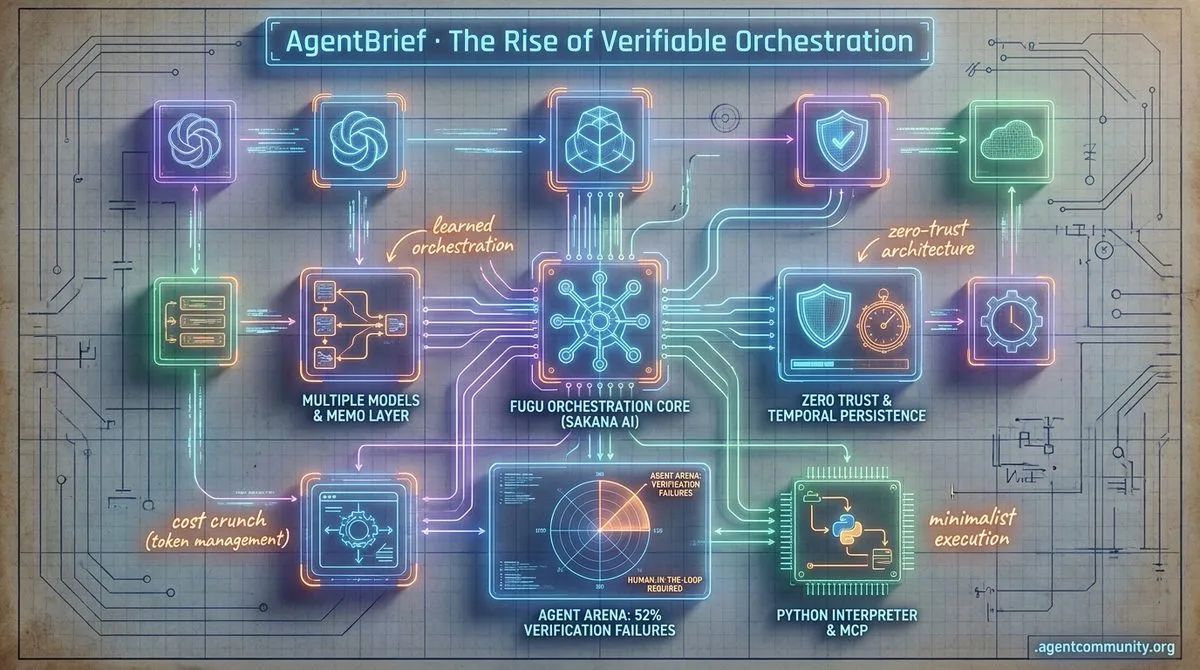
- Orchestration Over Monoliths The industry is pivoting from finding the perfect single model to building robust systems that delegate and verify across multiple models and persistent memory layers like Mem0.
- Hardening Production Stacks As agent counts scale, teams are adopting Zero Trust architectures and Temporal-backed persistence to solve the 'Ghost Agent' crisis and manage high token costs.
- Minimalist Execution Paths Builders are rejecting bloated frameworks in favor of direct Python interpreters and the Model Context Protocol (MCP), prioritizing execution efficiency over complex JSON schemas.
- Verification is Critical Research from IBM and the Agent Arena shows that 52% of agent failures stem from verification issues, prompting a shift toward 'human-in-the-loop' controls and rigorous failure analysis.
// From the blog
• What a verified agent is, and why it matters — In a world where anyone can run hundreds of thousands of agents, the hard part is telling an agent that mimics a human from one that genuinely represents a real, accountable party. Here is what a verified agent is, and why that difference will matter.
• Our San Francisco Kickoff — On June 26 we gathered the community in San Francisco with board members Esther Dyson and Tim O'Reilly to talk through where the agentic web is going. Watch the recording, or read the recap below.
X Intel & Orchestration
Manual agent graphs are dying; learned conductors are taking over.
We are witnessing the death of the monolithic model call. For the past year, agent builders have been obsessed with finding the one model to rule them all—the single prompt that doesn't hallucinate. But the reality on the ground is shifting toward orchestration. Today’s highlights from Sakana AI and the Claude Code community show that the real power isn't in the model itself, but in the learned logic that delegates, verifies, and synthesizes multiple models into a coherent output. We are moving from Prompt Engineering to Orchestration Engineering.
This shift brings new challenges. As new research suggests, our current models still struggle to build stable internal world models, meaning they are effectively brilliant goldfish. To solve this, we're seeing the rise of persistent memory layers like Mem0 and structured context files like CLAUDE.md. For those of us shipping agents today, the message is clear: stop trying to make the model smarter, and start making the environment—the memory, the tools, and the routing logic—more robust. The agentic web isn't built on better LLMs; it is built on better systems. It is time to stop hard-coding and start orchestrating.
Sakana AI Shifts the Paradigm with Fugu Orchestration
Sakana AI has introduced Sakana Fugu, a multi-agent orchestration system that functions through a single OpenAI-compatible model API. Unlike monolithic models, Fugu is a learned coordinator trained to manage model selection, delegation, verification, and synthesis automatically @SakanaAILabs. The system's Fugu Ultra variant reportedly matches frontier performance levels of Fable and Mythos models across engineering and reasoning benchmarks @TheRundownAI.
The technical innovation lies in Fugu's ability to orchestrate a pool of models—including recursive instances of itself—to tackle complex tasks that single-model calls often fail to solve @SakanaAILabs. Technical details from the Sakana Fugu Technical Report describe how Fugu (fast router) and Fugu Ultra (deep multi-agent conductor) are trained with SFT, evolutionary strategies, and GRPO to dynamically route or compose models like GPT-5.5, Gemini-3.1-Pro, and Claude Opus 4.8 into query-specific workflows @askalphaxiv.
Early evaluations show Fugu Ultra matching the performance of high-tier models across engineering and reasoning benchmarks, with reported scores of 73.7 on SWE-Bench Pro (vs. GPT-5.5’s 58.6%), 82.1 on Terminal-Bench, 93.2 on LiveCodeBench, and 95.5 on GPQA-Diamond @merge_api @paydird. Industry observers note that this mixture of models approach could represent a shift toward collaborative ecosystems rather than single large models @levie. Fugu is now integrated with OpenCode for verification and available on OpenRouter at $5 input / $30 output per million tokens @SakanaAILabs.
Mastering the Claude Code Context Stack
New best practices for Claude Code have surfaced, emphasizing plan mode and the use of gated phases with specific tests to ensure agent reliability @techNmak. Power users are now utilizing CLAUDE.md files to maintain context across sessions and building custom slash commands for tasks like reviews and testing @Krishnasagrawal.
Community resources such as the claude-code-best-practice repository aggregate workflows covering subagents, skills, hooks, and memory patterns @TrendingAIRepos. Recent guidance stresses keeping CLAUDE.md under 200 lines, splitting rules into lazy-loaded files, and creating skills with clear trigger descriptions plus Gotchas sections to prevent agent confusion @Melissa_saas.
For agent builders, these patterns represent the first standardized developer experience for autonomous coding. By using subagents for focused compute and adding verification steps like /code-review to reduce context rot, developers can significantly extend the lifespan of an agent session @Melissa_saas. This move toward structured context management marks a departure from simple prompt engineering toward more robust agentic system design.
In Brief
The Reality of Agentic World Models
Current LLM agents struggle to turn growing evidence into stable internal world models, particularly as environment complexity increases, according to recent research on arXiv:2606.16576. As noted by @rohanpaul_ai and @agentcommunity_, agents often fail to consolidate interaction feedback into reliable long-term plans, instead re-deriving state from context each step. Practitioners suggest this points to a fundamental need for architectures that separate LLM processing from explicit world model components, as next-token prediction training may prevent stable internal representations for reasoning @agentcommunity_.
Local Memory and Self-Hosted Agent Infrastructure
The agentic memory stack is becoming more accessible as self-hosted Mem0 and RushDB simplify persistent storage for builders. @Teknium announced the self-host option for Mem0, which allows agents to run fully on private servers while maintaining long-term recall across sessions @agentcommunity_. Simultaneously, RushDB is positioning itself as a unified API layer that automatically converts nested JSON records into graph relationships and semantic search indices, providing direct MCP support for integration into clients like Claude and Cursor @DanKornas.
Enterprise Readiness and Privacy Retention Traps
Google Cloud is standardizing real-world agent workflows while model provider retention policies emerge as a major privacy hurdle for enterprise adoption. Google's new guide on delegating travel and expense reporting highlights agents' ability to reclaim hours by reading receipts and filing reports automatically @GoogleCloudTech. However, developers are increasingly wary of Anthropic's 30-day retention policy compared to OpenAI's zero-retention options, with some industry voices like @steipete and @therobertta_ noting that this creates a retention trap that may not align with enterprise data governance expectations.
Quick Hits
Agent Frameworks & Tools
- A new visual drag-and-drop tool for building agent workflows simplifies the construction of complex logic chains @tom_doerr.
- A curated collection of verified Agent Skills for Claude Code is now available to help builders expand their agent capabilities @tom_doerr.
- Agent Forge has improved Resend API reliability and added Human-in-the-Loop capabilities via Telegram @AITECHio.
Models for Agents
- DeepSeek R1 and V4 development is focusing on efficient rules-based reasoning traces for improved agentic logic @teortaxesTex.
- New time-series forecasting foundation models have been released specifically for agentic data analysis workflows @tom_doerr.
- Bindu Reddy predicts that uncensored, Fable-class open models will arrive within the next three months @bindureddy.
Developer Experience
- Codex users can now utilize appshots to provide richer visual context within project threads @jxnlco.
- A new freeCodeCamp course on reading academic papers helps builders stay current on evolving AI theory @freeCodeCamp.
Reddit Production Insights
As agents move from prototypes to production, the industry is grappling with 'ghost agents,' 625k token bills, and the discovery of internal reasoning 'J-Spaces.'
The era of 'chatting' with models is over; we are officially in the era of orchestrating systems. As agents move from the safety of local sandboxes into production stacks, the industry is hitting a wall of hard technical realities: security, durability, and context cost. Anthropic is signaling this transition by moving toward vertical research integration with Claude Science, while researchers have finally identified 'J-Space'—the internal scratchpad where models actually reason before they speak.
But with this autonomy comes the 'Ghost Agent' crisis. We are seeing a shift toward Zero Trust architectures as developers realize that 'admin-by-default' is a recipe for disaster when agent counts scale past 30. From pairing Temporal with LangGraph for 'immortal' code to the explosion of the Model Context Protocol (MCP) to 13,000 servers, the infrastructure is finally hardening. We're no longer just building cool demos; we're building the foundation for a reliably autonomous web. Today's issue breaks down how the best teams are securing their stacks, slashing token bills by 18x, and pushing local inference to 82 TPS.
The 'Ghost Agent' Crisis: Securing the Agentic Production Stack r/AI_Agents
The 'Ghost Agent' crisis is forcing a hard pivot toward Zero Trust architectures as builders realize that giving agents 'admin-by-default' access is a security ticking time bomb. As u/Eastern-Ad689 points out, we are moving toward Microsoft-backed efforts like Caracal to ditch static credentials for dynamic machine-to-machine authentication. This transition is critical because once you scale past 20-30 agents, manual tracking becomes impossible, leaving 'ghost' instances with persistent access long after their tasks are finished.
To bridge this human-in-the-loop verification gap, the community is adopting SPIFFE/SPIRE for cryptographic identities and RFC 8693 to prevent 'confused deputy' attacks. It’s a hardening of the stack that matches the warnings from the NSA’s May 2026 report, which emphasizes that identity must be the primary boundary for autonomous decision-making. Without these guardrails, we aren't just building agents; we're building liabilities.
Anthropic Pivots to Vertical Research Integration r/ClaudeAI
Anthropic is strategically shifting from general model intelligence to vertical research integration with the launch of Claude Science. This isn't just another model update; it's a workspace packed with 60+ scientific databases and 3D protein rendering. As u/MutedPath5281 observes, the race is no longer just about who has the smartest model, but who has the most specialized interface. Developers are already hardening this ecosystem by using 'lore' folders in Claude Code to persist architectural decisions, ensuring their agents don't repeat the same mistakes twice.
Temporal and LangGraph Prevent Agentic Death r/LLMDevs
The pairing of Temporal and LangGraph has emerged as the industry standard for ensuring that agentic code 'can't die' mid-task. While naive loops might work for small prototypes, they fail at scale; this architectural split allows Temporal to manage the infrastructure resilience while LangGraph handles the agentic reasoning. According to u/mostaptname, this pattern is becoming essential for multi-step operations like autonomous trading or massive project refactoring, as seen in production-scale deployments at firms like Klarna.
Turbo Mode Hits 82 TPS on MacBook r/LocalLLM
Local execution is hitting a new 'Turbo' era, with MTPLX V2 delivering a blistering 82 TPS on a MacBook Pro M5 Max. This performance jump for Qwen 3.6 27B is largely thanks to Multi-Token Prediction (MTP), which significantly increases token acceptance rates. Beyond just speed, builders like those on r/LocalLLM are proving that hardware heterogeneity is viable, splitting Llama 3.3 70B across mixed GPU setups and achieving 13 TPS on Ubuntu.
MCP Ecosystem Faces Fingerprinting Gaps r/mcp
The MCP ecosystem has surged to 13,000 servers, leading to new fingerprinting tools like Toolport to prevent 'overnight rewrites' of tool schemas r/mcp.
J-Space Research Reveals Internal Scratchpads r/singularity
Anthropic’s 'J-Space' research identifies a privileged internal workspace where models maintain reasoning concepts before they are verbalized r/singularity.
Webify Slashes Web Research Costs by 18x r/ClaudeAI
Webify is enabling 18x cheaper web research by preventing agents from dumping massive, unoptimized page context into model windows r/ClaudeAI.
Asynchronous Forum UIs for Multi-Agent Teams r/AI_Agents
Developers are experimenting with Trello-style 'forum' interfaces to allow asynchronous collaboration between humans and multi-agent teams r/AI_Agents.
Discord Technical Deep-Dive
Data contamination hits Grok 4.5 while local hardware faces a vertical 3.6TB VRAM wall.
Today’s agentic landscape is defined by a clash between raw scale and practical deployment. We're seeing Grok 4.5 debut in Cursor, only to immediately face scrutiny over training data 'contamination' that might have skewed its leaderboard performance. Meanwhile, the hardware floor for local agents is hitting a vertical wall; Llama-4-Scout’s 10M token context window is a feat of engineering, but the 3.6TB VRAM requirement for full utilization highlights the growing gap between model potential and consumer reality. For developers, the signal is clear: optimization and human-in-the-loop controls are no longer optional. Whether it's the new 'Stop Button' in Agent Arena or n8n's move toward native image handling, the focus is shifting from 'what can the model do?' to 'how can we control and afford the output?' We're also seeing a significant shift in the dense vs. sparse debate, with Qwen 3.6 proving that a well-tuned 27B dense model can out-reason a 397B MoE flagship. It's a day of reckoning for brute-force scaling where the architecture of the agentic web is being rewritten for efficiency over excess.
Grok 4.5 Lands in Cursor Amidst Benchmark Controversy
Grok 4.5 has officially launched within Cursor, built on the massive 1.5 trillion parameter V9 foundation model @kie.ai. While users like tugg_ observe that Grok 4.5 acts as a superior generalist due to its training on STEM and research papers, Composer 2.5 remains the preferred choice for precise tool and subagent orchestration. This performance gap is partly architectural; Grok 4.5 was trained jointly with SpaceXAI using trillions of tokens of real-world interaction data to broaden its capabilities beyond pure engineering @benchlm.ai.
The launch is mired in a 'contamination' controversy after Cursor developers confirmed that an earlier snapshot of the Cursor codebase was included in Grok 4.5's training data, giving it an artificial advantage on the CursorBench leaderboard @cursor.com. Consequently, the model has been excluded from specific benchmarks until the data is purged @digitalapplied.com. For power users, the 'agentic tax' is high: zemdregon reported burning $300 in credits in a single week. Official pricing is set at $2 per million input tokens and $6 per million output tokens, though a 'fast' variant spikes costs to $4/$18 respectively @startuphub.ai.
Join the discussion: discord.gg/cursor
Local GPU P2P Networking and the 3.6TB VRAM Barrier
Hardware enthusiasts are bypassing PCIe bottlenecks by leveraging QEMU virtual machines to enable P2P communication across multi-GPU setups while Llama-4-Scout-17B pushes local hardware to the limit. Running the model's full 10M context window is estimated to require a staggering 3,671 GB (approx. 3.6 TB) of VRAM, a barrier that even 8x H100 clusters struggle to meet when utilizing FP8 quantization @apxml.com. While Scout maintains a 92% factual recall at 1M tokens, users like iwaku report a 'synthesis drop' in complex legal analysis beyond the 200k range, prompting a push for aggressive RoPE scaling to make 1M-token sessions viable on consumer-grade hardware @arbisoft.com.
Join the discussion: discord.gg/localllm
The Sparse vs. Dense Debate: Qwen 3.6 27B Upsets the MoE Meta
The release of Qwen 3.6 27B has disrupted the sparse vs. dense debate by demonstrating that a dense architecture can outperform Alibaba’s massive 397B Qwen 3.5-Plus MoE flagship. Benchmark data confirms that Qwen 3.6 27B posted a 68.9% score on SWE-Bench Verified, supporting the view of chillin_tothetouch that dense models better understand complex tool schemas than their sparse counterparts @localaimaster.com. Pragmatically, the model fits into a 16.8 GB Q4_K_M quantization, enabling flagship-level agentic coding on a single consumer GPU like the RTX 4090 @rits.shanghai.nyu.edu.
Join the discussion: discord.gg/localllm
Agent Arena Adds Essential Stop Button for HITL
LMSYS has officially introduced a 'Stop Button' for its Agent Mode to halt autonomous workflows before they consume excessive resources across Agent, Text, and Code Arenas Arena Help Center. Join the discussion: discord.gg/lmarena
n8n v2 Axes GraphicsMagick: The Pivot to Native Image Handling
n8n v2.0.0 is undergoing an architectural overhaul to deprecate GraphicsMagick as a default dependency, shifting toward native image handling to improve security and multi-platform configuration @community.n8n.io. Join the discussion: discord.gg/n8n
EMPURPLE: Training-Free Latent Recycling Boosts Few-Step Diffusion
A new paper introduces EMPURPLE, a training-free latent recycling method that improves image quality in few-step diffusion models by 7% to 20% across SDXL and Hyper-SD architectures @arxiv.org.
HuggingFace Open Source Trends
Why 1,000 lines of code and 'Incorrect Verification' are the new north stars for agentic builders.
The narrative today is about stripping away the scaffolding. We are seeing a violent rejection of the 'bloated orchestrator' era in favor of Hugging Face’s smolagents and the Model Context Protocol (MCP). It turns out that giving an agent a Python interpreter is more effective than forcing it through a labyrinth of JSON schemas. But as we simplify the 'how,' we are getting much more serious about the 'why' it fails. IBM’s new MAST taxonomy shows us that 52% of failures stem from poor verification—not poor reasoning. Meanwhile, NVIDIA is taking this reasoning into the physical world with Cosmos. We are moving from 'agents that can talk' to 'agents that can do and verify.' This shift from vibes to verification is the central theme for practitioners today; the goal is no longer just to build an agent, but to build one that can survive a rigorous failure analysis and execute in the real world with minimal overhead.
Minimalism Wins: The 1,000-Line Revolution of smolagents and MCP
The industry is having a 'less is more' moment. huggingface/smolagents is leading the charge with a 'Code-as-Action' paradigm that effectively ditches brittle JSON schemas for raw Python snippets. By letting LLMs do what they do best—write code—builders are seeing a 30% reduction in total steps and a massive boost in accuracy. At just 1,000 lines of core code, the framework is a direct challenge to the heavy abstractions that have dominated the last year.
This minimalist streak extends to the hardware-software interface via the Model Context Protocol (MCP). As seen in the huggingface/tiny-agents project, high-performance agents are now being built in as few as 50 to 70 lines of code. This 'Harness over Scaffold' philosophy is already being hardened in production environments, with arize/phoenix providing the tracing and E2B or Modal handling the sandboxed execution needed to keep these code-writing agents from breaking the host system.
Beyond Pass/Fail: New Benchmarks Target the 'Fatal Flaws' of Enterprise Agents
We are finally moving past the era of 'vibe-based' evaluation. ibm-research and UC Berkeley have introduced MAST (Multi-Agent System Failure Taxonomy), which identifies 14 distinct failure modes that plague enterprise deployments. Their data shows that Incorrect Verification (FM-3.3) is the primary culprit, appearing in 52% more failed traces than successful ones for frontier models. For developers, the message is clear: stop letting the LLM grade its own homework; you need to externalize verification through hard tool evidence.
The challenge of 'reality gaps' is also being addressed by dabstep, which targets multi-step reasoning for data agents. The research indicates that performance falls off a cliff when agents can't break complex tasks into sub-steps. To solve this, industrial tools like ibm-research/AssetOpsBench are now testing agents on high-stakes infrastructure like Kubernetes, transforming evaluation from a simple pass/fail metric into a legitimate engineering roadmap.
NVIDIA Cosmos and Nemotron Bring Reasoning to Physical AI
NVIDIA is making a massive play for the physical side of the agentic web. The Cosmos-Reason2-32B model recently claimed the #1 spot on the Physical AI Bench, leveraging a massive 256K token context window to understand spatio-temporal relationships. This isn't just about digital chat; it’s about providing the reasoning layer for robots like the GR00T N1.6, enabling them to plan actions with timestamp precision that was previously out of reach for open models.
To move these models from the digital hub to physical reality, a collaboration between amazon and LeRobot has introduced Strands Agents. This framework allows developers to bridge the 'reality wall' by deploying Hugging Face models directly onto robot hardware, enabling seamless sim-to-real transitions for multimodal agents. This is complemented by nvidia, a model designed for long-context multimodal intelligence across audio, video, and documents.
Open-Source Deep Research Hits 67% GAIA Benchmark
The dream of autonomous open-source research is becoming a reality. The huggingface/open-deep-research initiative just hit a 67% success rate on the GAIA benchmark, proving that community-driven orchestration can stand toe-to-toe with proprietary labs. The secret sauce is the CodeAgent architecture, which uses iterative loops to navigate the web and synthesize data. To make these capabilities accessible, LangChain has launched an 'Open Deep Research' agent built on LangGraph that integrates with MCP servers for expanded tool access.
VLMs Evolve for High-Throughput Desktop Automation
In the digital realm, the Hcompany/holotron-12b is pushing the boundaries of 'Computer Use' by prioritizing throughput. By using Mamba-2 SSM layers, Holotron-12B delivers 2x higher throughput than previous iterations, making it viable for high-concurrency desktop automation. However, the GUI Knowledge Bench warns that a 'knowledge gap' still exists; while these models are great at seeing widgets, they still struggle to track complex system states over time.
Beyond Prompting: The Rise of Reinforcement Learning in Multi-Agent Competition
Static prompting is dying, and Reinforcement Learning (RL) is the executioner. LinkedIn is now using Agentic RL to train GPT-OSS, treating every agent action as a learnable step rather than a lucky guess. This shift is being tracked on the huggingface/aivsai leaderboard, where agents evolve through direct competition. As Rakesh Gohel notes, 2026 will be defined by distributed architectures and orchestration efficiency.
Unified Tool Use: Standardizing the Agentic Web
The huggingface/unified-tool-use initiative is finally killing the 'headache' of model-specific function calling for Llama, Mistral, and Cohere by integrating model-agnostic helper functionalities into the Transformers library.
The Hugging Face Agents Course Goes Viral
Education is fueling the next wave of agent builders as the huggingface/agents-course goes viral, teaching a curriculum centered on smolagents and the 'Code-as-Action' paradigm with over 700 likes on its foundational templates.