∷archive
hover for detailclear month →
All issues, grouped by month.
Jump between months on the left, then skim titles in a tight grid-aligned list. Hover any row for synopsis, tags, and stats.
◷month
12 issuesDecember 2025
- WedDec31
Scaling the Agentic Execution Layer
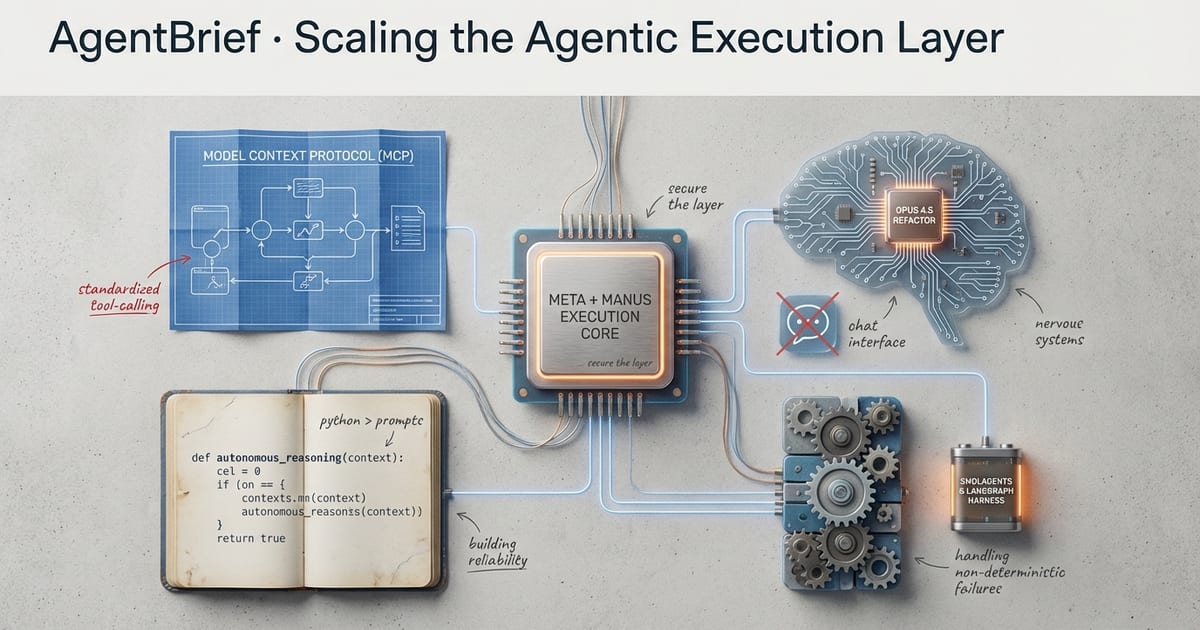
The agentic landscape is undergoing a tectonic shift. We are moving beyond the era of the 'helpful chatbot' and into a high-stakes race for the execution layer. Meta’s $2B acquisition of Manus AI serves as a definitive signal: the value has migrated from foundational model weights to the 'habitats' and infrastructure where agents actually perform work. This transition is echoed across the ecosystem—from the Discord-driven excitement over Claude 3.5 Sonnet’s coding dominance to HuggingFace’s focus on self-evolving systems like WebRL. Practitioners are no longer just optimizing prompts; they are building sophisticated nervous systems. Whether it’s Anthropic’s Opus 4.5 tackling complex refactors or the community’s rapid adoption of the Model Context Protocol (MCP) to standardize tool-calling, the focus is now on reliability, governance, and real-time execution. We are seeing a divergence where frontier models serve as the 'reasoners,' while frameworks like SmolAgents and LangGraph provide the 'harnesses' needed to handle non-deterministic failures. Today’s brief explores this shift from raw intelligence to autonomous world models, where Python is becoming the primary language of reasoning and the simple API wrapper is officially a relic of the past. The execution layer is the new frontier for 2024.description
The agentic landscape is undergoing a tectonic shift. We are moving beyond the era of the 'helpful chatbot' and into a high-stakes race for the execution layer. Meta’s $2B acquisition of Manus AI serves as a definitive signal: the value has migrated from foundational model weights to the 'habitats' and infrastructure where agents actually perform work. This transition is echoed across the ecosystem—from the Discord-driven excitement over Claude 3.5 Sonnet’s coding dominance to HuggingFace’s focus on self-evolving systems like WebRL. Practitioners are no longer just optimizing prompts; they are building sophisticated nervous systems. Whether it’s Anthropic’s Opus 4.5 tackling complex refactors or the community’s rapid adoption of the Model Context Protocol (MCP) to standardize tool-calling, the focus is now on reliability, governance, and real-time execution. We are seeing a divergence where frontier models serve as the 'reasoners,' while frameworks like SmolAgents and LangGraph provide the 'harnesses' needed to handle non-deterministic failures. Today’s brief explores this shift from raw intelligence to autonomous world models, where Python is becoming the primary language of reasoning and the simple API wrapper is officially a relic of the past. The execution layer is the new frontier for 2024.AMDAlibabaAnthropic+34604m saved2195 sources21 min read - WedDec31
Scaling the Agentic Execution Layer
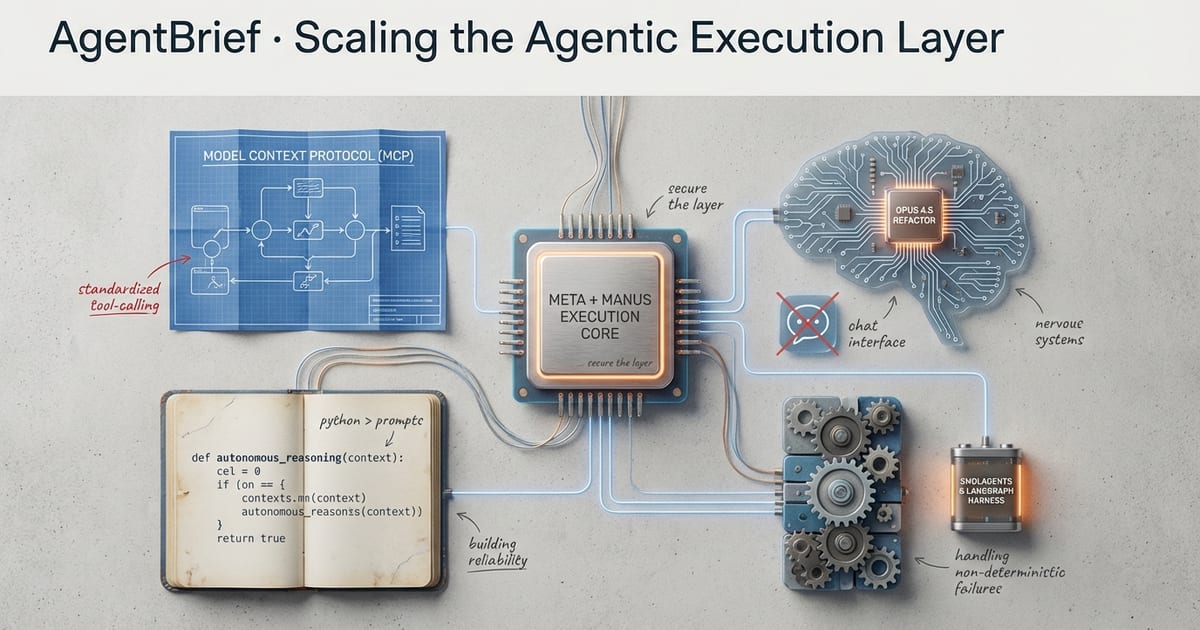
The agentic landscape is undergoing a tectonic shift. We are moving beyond the era of the 'helpful chatbot' and into a high-stakes race for the execution layer. Meta’s $2B acquisition of Manus AI serves as a definitive signal: the value has migrated from foundational model weights to the 'habitats' and infrastructure where agents actually perform work. This transition is echoed across the ecosystem—from the Discord-driven excitement over Claude 3.5 Sonnet’s coding dominance to HuggingFace’s focus on self-evolving systems like WebRL. Practitioners are no longer just optimizing prompts; they are building sophisticated nervous systems. Whether it’s Anthropic’s Opus 4.5 tackling complex refactors or the community’s rapid adoption of the Model Context Protocol (MCP) to standardize tool-calling, the focus is now on reliability, governance, and real-time execution. We are seeing a divergence where frontier models serve as the 'reasoners,' while frameworks like SmolAgents and LangGraph provide the 'harnesses' needed to handle non-deterministic failures. Today’s brief explores this shift from raw intelligence to autonomous world models, where Python is becoming the primary language of reasoning and the simple API wrapper is officially a relic of the past. The execution layer is the new frontier for 2024.description
The agentic landscape is undergoing a tectonic shift. We are moving beyond the era of the 'helpful chatbot' and into a high-stakes race for the execution layer. Meta’s $2B acquisition of Manus AI serves as a definitive signal: the value has migrated from foundational model weights to the 'habitats' and infrastructure where agents actually perform work. This transition is echoed across the ecosystem—from the Discord-driven excitement over Claude 3.5 Sonnet’s coding dominance to HuggingFace’s focus on self-evolving systems like WebRL. Practitioners are no longer just optimizing prompts; they are building sophisticated nervous systems. Whether it’s Anthropic’s Opus 4.5 tackling complex refactors or the community’s rapid adoption of the Model Context Protocol (MCP) to standardize tool-calling, the focus is now on reliability, governance, and real-time execution. We are seeing a divergence where frontier models serve as the 'reasoners,' while frameworks like SmolAgents and LangGraph provide the 'harnesses' needed to handle non-deterministic failures. Today’s brief explores this shift from raw intelligence to autonomous world models, where Python is becoming the primary language of reasoning and the simple API wrapper is officially a relic of the past. The execution layer is the new frontier for 2024.AMDAlibabaAnthropic+34604m saved2195 sources21 min read - MonDec29
Engineering the Autonomous Agent Stack
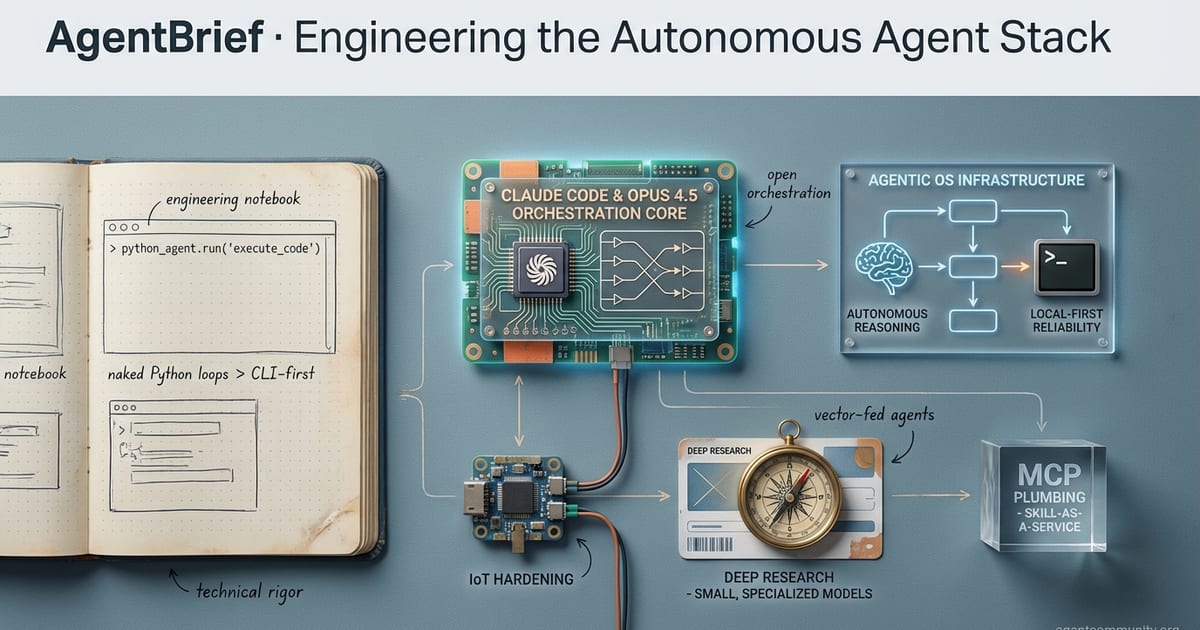
The agentic landscape is undergoing a fundamental shift from chat-based wrappers to robust, autonomous operating systems. This week across our community channels, a clear pattern emerged: builders are abandoning brittle JSON tool-calling and heavy frameworks in favor of direct code execution and CLI-centric workflows. Whether it is Hugging Face’s smolagents championing 'code as action' or the 'Naked Python' rebellion on Reddit, the trend points toward explicit control and engineering rigor over abstraction layers. While frontier models still lead, we are seeing the rise of specialization. Small, 3B-parameter routers like Plano-Orchestrator are outperforming GPT-4o in specific logic loops, proving that efficiency is the new benchmark for production agents. Meanwhile, the Model Context Protocol (MCP) is maturing into a commercial ecosystem, providing the plumbing for 'skill-as-a-service' models. Despite concerns about 'reasoning decay' in flagship models, the focus has shifted to hardening infrastructure—from IoT integration and sub-millimeter physical control to managing state in the terminal with Claude Code. We are no longer just building bots; we are architecting the autonomous web, prioritizing local-first reliability and synthesis-heavy reasoning over the 'vibe-coding' of the past year.description
The agentic landscape is undergoing a fundamental shift from chat-based wrappers to robust, autonomous operating systems. This week across our community channels, a clear pattern emerged: builders are abandoning brittle JSON tool-calling and heavy frameworks in favor of direct code execution and CLI-centric workflows. Whether it is Hugging Face’s smolagents championing 'code as action' or the 'Naked Python' rebellion on Reddit, the trend points toward explicit control and engineering rigor over abstraction layers. While frontier models still lead, we are seeing the rise of specialization. Small, 3B-parameter routers like Plano-Orchestrator are outperforming GPT-4o in specific logic loops, proving that efficiency is the new benchmark for production agents. Meanwhile, the Model Context Protocol (MCP) is maturing into a commercial ecosystem, providing the plumbing for 'skill-as-a-service' models. Despite concerns about 'reasoning decay' in flagship models, the focus has shifted to hardening infrastructure—from IoT integration and sub-millimeter physical control to managing state in the terminal with Claude Code. We are no longer just building bots; we are architecting the autonomous web, prioritizing local-first reliability and synthesis-heavy reasoning over the 'vibe-coding' of the past year.AnthropicGroqHugging Face+32577m saved3608 sources25 min read - SatDec27
The Architecture of Persistent Autonomy
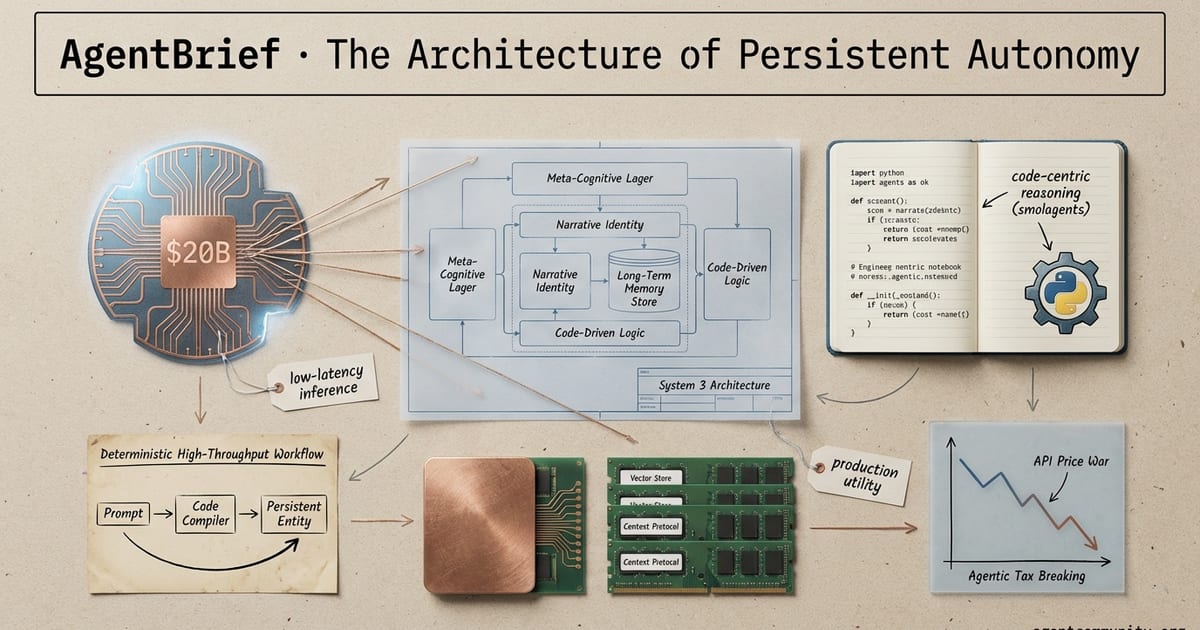
The agentic web is undergoing a fundamental transformation, shifting from stateless prompt-response loops to persistent, code-driven autonomous entities. This week, we are witnessing a convergence of architectural breakthroughs and massive industrial realignment. Hugging Face’s smolagents release marks a definitive pivot toward code-centric reasoning, proving that a Python compiler is often more reliable than a complex JSON schema for agentic logic. This computational layer is finding its home in 'System 3' architectures—meta-cognitive systems that provide agents with the narrative identity and long-term memory needed for true production utility. Simultaneously, the physical and economic infrastructure is catching up to our ambitions. NVIDIA’s massive $20B licensing deal for low-latency silicon and the arrival of high-VRAM consumer cards are enabling the deterministic, high-speed inference that agents demand. While frontier models like Opus 4.5 and Gemini 3 Pro prepare to set new reasoning benchmarks, a brutal API price war triggered by DeepSeek is making massive batch workflows economically viable. For practitioners, the message is clear: the 'agentic tax' is breaking. From formal 424-page design manuals to the Model Context Protocol, the tools for building deterministic, high-throughput autonomous systems are finally reaching parity with our engineering goals.description
The agentic web is undergoing a fundamental transformation, shifting from stateless prompt-response loops to persistent, code-driven autonomous entities. This week, we are witnessing a convergence of architectural breakthroughs and massive industrial realignment. Hugging Face’s smolagents release marks a definitive pivot toward code-centric reasoning, proving that a Python compiler is often more reliable than a complex JSON schema for agentic logic. This computational layer is finding its home in 'System 3' architectures—meta-cognitive systems that provide agents with the narrative identity and long-term memory needed for true production utility. Simultaneously, the physical and economic infrastructure is catching up to our ambitions. NVIDIA’s massive $20B licensing deal for low-latency silicon and the arrival of high-VRAM consumer cards are enabling the deterministic, high-speed inference that agents demand. While frontier models like Opus 4.5 and Gemini 3 Pro prepare to set new reasoning benchmarks, a brutal API price war triggered by DeepSeek is making massive batch workflows economically viable. For practitioners, the message is clear: the 'agentic tax' is breaking. From formal 424-page design manuals to the Model Context Protocol, the tools for building deterministic, high-throughput autonomous systems are finally reaching parity with our engineering goals.AlphabetAnthropicBlue Owl Capital+46448m saved2676 sources25 min read - MonDec22
From Chatbots to Persistent Operators
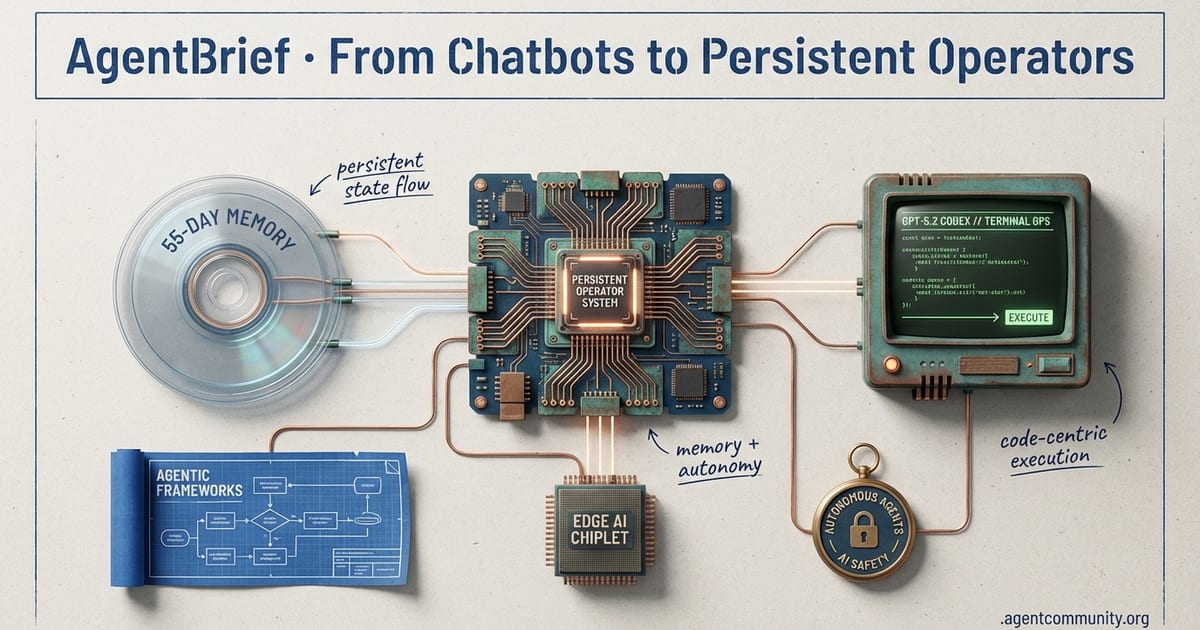
We have officially moved past the 'chatbot' era and entered the age of the persistent operator. This week, the agentic stack received a massive structural upgrade, led by Google’s Interactions API and its unprecedented 55-day stateful memory window. For practitioners, this solves the 'amnesia' problem that has long plagued long-horizon workflows. While Google optimizes for persistence, OpenAI’s 'Code Red' GPT-5.2 Codex release aims to push the ceiling on autonomous execution, treating the terminal as a first-class citizen. But the revolution isn't just happening at the frontier. The rise of 'code-as-action' frameworks like Hugging Face’s smolagents is proving that leaner, code-centric architectures can outperform heavy JSON-based tool-calling by nearly 2x. On the hardware front, the DOE Genesis Mission’s Blackwell superclusters signal a future of sovereign AI, even as developers navigate the micro-friction of token-based accounting in IDEs like Cursor. From 270M-parameter local models to standardized 'Agent Skills' repositories, the industry is hardening. We are no longer just building models; we are architecting reliable, stateful systems capable of navigating production environments without a human chaperone. Today’s issue dives into the plumbing, the power, and the persistent memory making this transition possible.description
We have officially moved past the 'chatbot' era and entered the age of the persistent operator. This week, the agentic stack received a massive structural upgrade, led by Google’s Interactions API and its unprecedented 55-day stateful memory window. For practitioners, this solves the 'amnesia' problem that has long plagued long-horizon workflows. While Google optimizes for persistence, OpenAI’s 'Code Red' GPT-5.2 Codex release aims to push the ceiling on autonomous execution, treating the terminal as a first-class citizen. But the revolution isn't just happening at the frontier. The rise of 'code-as-action' frameworks like Hugging Face’s smolagents is proving that leaner, code-centric architectures can outperform heavy JSON-based tool-calling by nearly 2x. On the hardware front, the DOE Genesis Mission’s Blackwell superclusters signal a future of sovereign AI, even as developers navigate the micro-friction of token-based accounting in IDEs like Cursor. From 270M-parameter local models to standardized 'Agent Skills' repositories, the industry is hardening. We are no longer just building models; we are architecting reliable, stateful systems capable of navigating production environments without a human chaperone. Today’s issue dives into the plumbing, the power, and the persistent memory making this transition possible.AWSAnthropicByteDance+42638m saved3845 sources26 min read - ThuDec18
The Hard-Pivot to Agentic Infrastructure
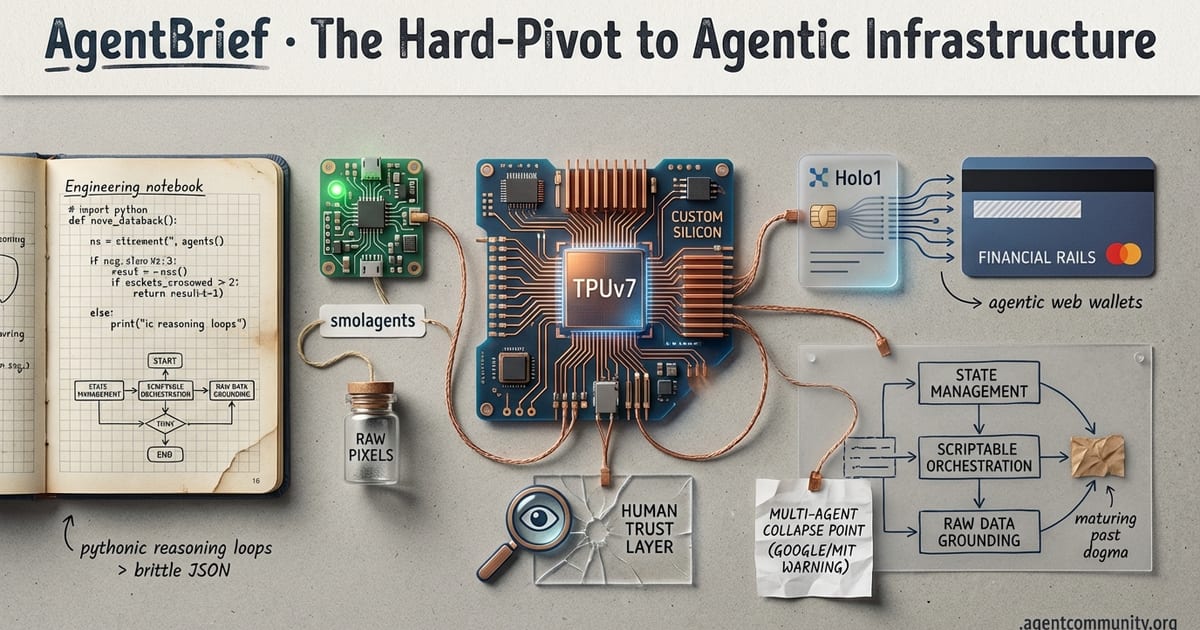
The agentic landscape is undergoing a decisive hard-pivot from chatbots with plugins to vertically integrated infrastructure. This week’s synthesis across X, Reddit, Discord, and HuggingFace reveals a community maturing past the more agents is better dogma. While research from Google and MIT warns of a collapse point in multi-agent coordination, the industry is responding by hardening the execution layer. Anthropic is doubling down on custom silicon and programmatic tool calling, effectively deprecating the brittle JSON-based patterns of the past year. Simultaneously, Hugging Face’s smolagents is proving that executable Python—not structured text—is the future of reliable reasoning. We are also seeing the Agentic Web get its first real eyes and wallets. Models like H’s Holo1 are bypassing metadata to act on raw pixels, while Stripe’s new SDK provides the financial rails autonomous systems have lacked. However, as technical performance in vertical domains like finance hits new highs, the human trust layer remains fragile, evidenced by recent community disputes over verification. For the practitioner, the signal is clear: the winners of this cycle won’t be those managing the largest swarms, but those mastering state management, raw data grounding, and scriptable orchestration. It’s time to move past the black box and embrace the code-centric agent.description
The agentic landscape is undergoing a decisive hard-pivot from chatbots with plugins to vertically integrated infrastructure. This week’s synthesis across X, Reddit, Discord, and HuggingFace reveals a community maturing past the more agents is better dogma. While research from Google and MIT warns of a collapse point in multi-agent coordination, the industry is responding by hardening the execution layer. Anthropic is doubling down on custom silicon and programmatic tool calling, effectively deprecating the brittle JSON-based patterns of the past year. Simultaneously, Hugging Face’s smolagents is proving that executable Python—not structured text—is the future of reliable reasoning. We are also seeing the Agentic Web get its first real eyes and wallets. Models like H’s Holo1 are bypassing metadata to act on raw pixels, while Stripe’s new SDK provides the financial rails autonomous systems have lacked. However, as technical performance in vertical domains like finance hits new highs, the human trust layer remains fragile, evidenced by recent community disputes over verification. For the practitioner, the signal is clear: the winners of this cycle won’t be those managing the largest swarms, but those mastering state management, raw data grounding, and scriptable orchestration. It’s time to move past the black box and embrace the code-centric agent.AnthropicCursorDeepSeek+37666.1m saved204 sources25 min read - TueDec16

AI Agents: The Open Source Rebellion
Another week, another seismic shift in the AI landscape. While the big labs like Anthropic and Google continue their impressive march, dropping models that push the boundaries of what we thought possible, the real story is bubbling up from below. The open-source community isn't just reacting anymore; it's setting its own pace. Across platforms like HuggingFace and in the feverish discussions on Reddit and Discord, we're seeing a Cambrian explosion of specialized, efficient, and—most importantly—accessible models and tools. The narrative is no longer just about who has the biggest parameter count. It's about who can build the most useful, adaptable agent for a specific problem. This is where the true innovation is happening. The gap between the state-of-the-art and what a solo developer can build in their garage is shrinking faster than ever. This week, we're diving into that dynamic tension: the polished, powerful releases from the titans versus the scrappy, ingenious builds from the community. It's a battle for the future of AI, and the front lines are everywhere.description
Another week, another seismic shift in the AI landscape. While the big labs like Anthropic and Google continue their impressive march, dropping models that push the boundaries of what we thought possible, the real story is bubbling up from below. The open-source community isn't just reacting anymore; it's setting its own pace. Across platforms like HuggingFace and in the feverish discussions on Reddit and Discord, we're seeing a Cambrian explosion of specialized, efficient, and—most importantly—accessible models and tools. The narrative is no longer just about who has the biggest parameter count. It's about who can build the most useful, adaptable agent for a specific problem. This is where the true innovation is happening. The gap between the state-of-the-art and what a solo developer can build in their garage is shrinking faster than ever. This week, we're diving into that dynamic tension: the polished, powerful releases from the titans versus the scrappy, ingenious builds from the community. It's a battle for the future of AI, and the front lines are everywhere.Abacus AIAnthropicCodeium+1313.3m saved39 sources6.1 min read - ThuDec11

AI's Search for a Business Model
The AI gold rush is getting expensive. This week, the conversation shifted from a breathless pursuit of capabilities to a sobering look at the bottom line. On one side, you have giants like Cohere dropping Command R+, a powerful model aimed squarely at enterprise wallets, a move celebrated and scrutinized across the tech sphere. On the other, the open-source community is in the trenches. On HuggingFace, developers are feverishly fine-tuning Meta's Llama 3 for every conceivable niche, while Reddit and Discord are filled with builders wrestling with the brutal realities of inference costs and vector database performance. The battle for the future of AI isn't just about who has the smartest model; it's about who can build a sustainable business. Nowhere is this clearer than the fierce debate around AI search, where startups are discovering that disrupting Google is more than just a technical challenge—it's an economic war. This is the moment where the hype meets the spreadsheet.description
The AI gold rush is getting expensive. This week, the conversation shifted from a breathless pursuit of capabilities to a sobering look at the bottom line. On one side, you have giants like Cohere dropping Command R+, a powerful model aimed squarely at enterprise wallets, a move celebrated and scrutinized across the tech sphere. On the other, the open-source community is in the trenches. On HuggingFace, developers are feverishly fine-tuning Meta's Llama 3 for every conceivable niche, while Reddit and Discord are filled with builders wrestling with the brutal realities of inference costs and vector database performance. The battle for the future of AI isn't just about who has the smartest model; it's about who can build a sustainable business. Nowhere is this clearer than the fierce debate around AI search, where startups are discovering that disrupting Google is more than just a technical challenge—it's an economic war. This is the moment where the hype meets the spreadsheet.AnthropicArizeArize AI+581570m saved524 sources32 min read - ThuDec11
Gemma 2 Ignites Open-Source Race
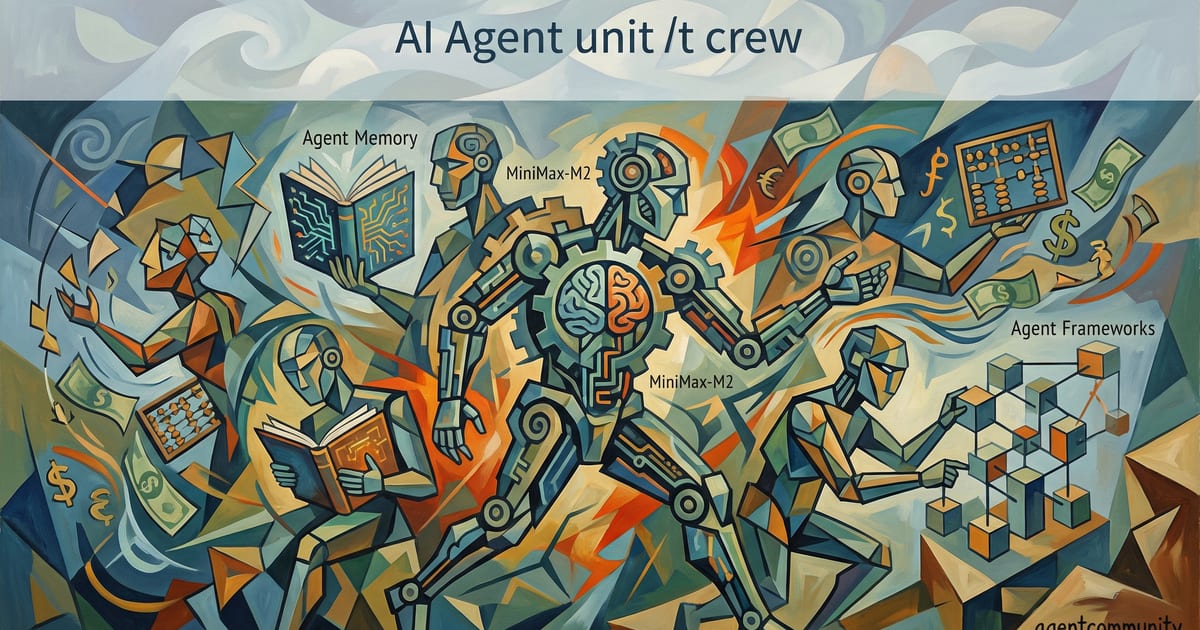
It’s an incredible time to be a builder. The biggest story this week is the explosion of powerful, open-source models, led by Google's new Gemma 2, which is already going head-to-head with Llama 3. But it doesn't stop there. Microsoft dropped Phi-3-vision, Databricks unleashed DBRX Instruct, and Apple entered the fray with OpenELM, giving developers specialized tools for everything from on-device processing to complex reasoning. This open-source renaissance is happening alongside intriguing developments in the closed-source world, with rumors of a smaller, faster GPT-4o Mini and Meta's impressive multi-modal Chameleon model. At the same time, real-world tests on agents like Devin and cautionary tales on API costs remind us of the practical hurdles still ahead. For developers, this Cambrian explosion of models means more choice, more power, and more opportunity to build the next generation of AI applications.description
It’s an incredible time to be a builder. The biggest story this week is the explosion of powerful, open-source models, led by Google's new Gemma 2, which is already going head-to-head with Llama 3. But it doesn't stop there. Microsoft dropped Phi-3-vision, Databricks unleashed DBRX Instruct, and Apple entered the fray with OpenELM, giving developers specialized tools for everything from on-device processing to complex reasoning. This open-source renaissance is happening alongside intriguing developments in the closed-source world, with rumors of a smaller, faster GPT-4o Mini and Meta's impressive multi-modal Chameleon model. At the same time, real-world tests on agents like Devin and cautionary tales on API costs remind us of the practical hurdles still ahead. For developers, this Cambrian explosion of models means more choice, more power, and more opportunity to build the next generation of AI applications.AnthropicAppleArize AI+601570m saved524 sources20 min read - ThuDec11
Llama 3.1's Tool Use Reality Check
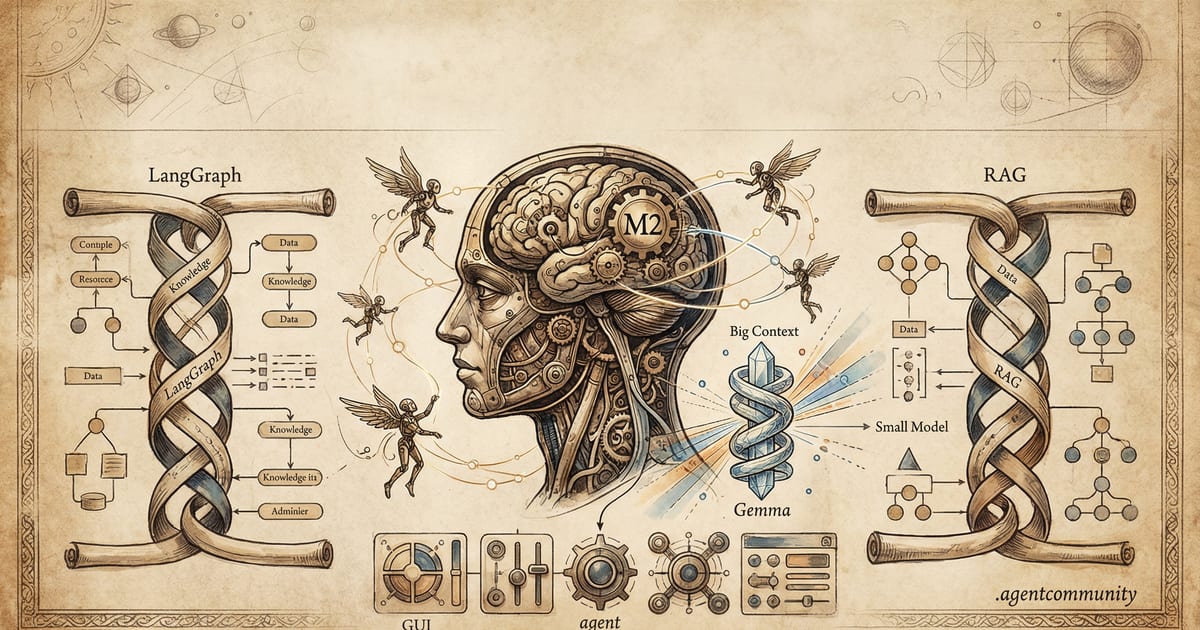
The release of Meta's Llama 3.1, particularly the massive 405B parameter version, has dominated the conversation this week. The model's headline feature is its near-perfect benchmark scores on tool use, seemingly heralding a new era for open-source agents. However, as practitioners get their hands on it, a more nuanced picture is emerging. Across X, Reddit, and Discord, developers are reporting a significant gap between benchmark performance and real-world reliability. While the model shows incredible promise, issues with complex JSON formatting, inconsistent instruction following, and brittle error handling are common themes. This isn't just about one model; it's a crucial lesson in the ongoing challenge of building robust agentic systems. The hype cycle is hitting the wall of production reality. This week, we dive deep into the Llama 3.1 debate, explore practical solutions like self-correction loops, and look at the broader ecosystem, including the impressive new Qwen2-72B model and the rising open-source agent framework, OpenDevin. It's a reality check on the state of tool use and a look at what it really takes to build agents that work.description
The release of Meta's Llama 3.1, particularly the massive 405B parameter version, has dominated the conversation this week. The model's headline feature is its near-perfect benchmark scores on tool use, seemingly heralding a new era for open-source agents. However, as practitioners get their hands on it, a more nuanced picture is emerging. Across X, Reddit, and Discord, developers are reporting a significant gap between benchmark performance and real-world reliability. While the model shows incredible promise, issues with complex JSON formatting, inconsistent instruction following, and brittle error handling are common themes. This isn't just about one model; it's a crucial lesson in the ongoing challenge of building robust agentic systems. The hype cycle is hitting the wall of production reality. This week, we dive deep into the Llama 3.1 debate, explore practical solutions like self-correction loops, and look at the broader ecosystem, including the impressive new Qwen2-72B model and the rising open-source agent framework, OpenDevin. It's a reality check on the state of tool use and a look at what it really takes to build agents that work.Alibaba CloudAnthropicArize AI+541570m saved524 sources36 min read - MonDec08
Meta Drops 405B Llama Bomb
What a week for builders! Meta just dropped a seismic release: Llama 3.1, crowned by a monstrous 405B parameter model, the largest open-weight model to date. The community is buzzing, not just about its power, but about the very definition of 'open source,' as Meta's new license introduces restrictions for major tech players. This release isn't happening in a vacuum. It's part of a massive wave of innovation, with Meta also unveiling its native multimodal model, Chameleon, Cohere pushing multilingual boundaries with Aya 23, and Perplexity letting users create custom AI Personas. For developers, this translates to an unprecedented arsenal of specialized, powerful tools. The barrier to building sophisticated, multi-modal, and multi-lingual agents just got obliterated. It's time to build.description
What a week for builders! Meta just dropped a seismic release: Llama 3.1, crowned by a monstrous 405B parameter model, the largest open-weight model to date. The community is buzzing, not just about its power, but about the very definition of 'open source,' as Meta's new license introduces restrictions for major tech players. This release isn't happening in a vacuum. It's part of a massive wave of innovation, with Meta also unveiling its native multimodal model, Chameleon, Cohere pushing multilingual boundaries with Aya 23, and Perplexity letting users create custom AI Personas. For developers, this translates to an unprecedented arsenal of specialized, powerful tools. The barrier to building sophisticated, multi-modal, and multi-lingual agents just got obliterated. It's time to build.AnthropicArize AIBittensor+751570m saved524 sources20 min read - MonDec08
Databricks Ignites Open Source Rebellion
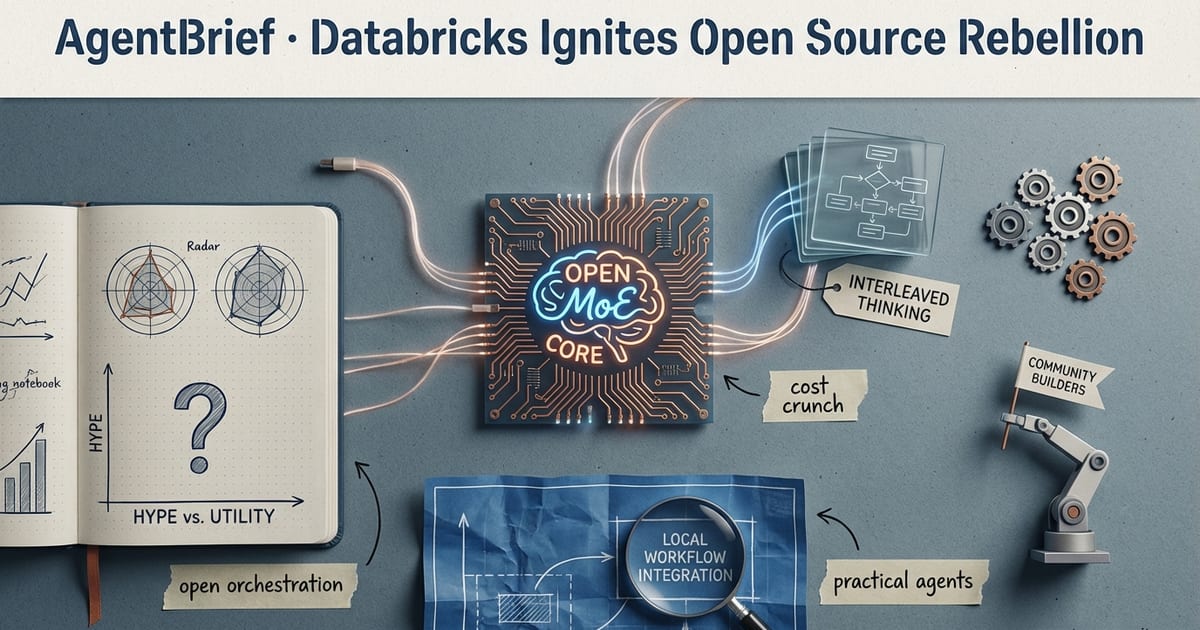
This wasn't just another week in AI; it was a declaration of independence. Databricks' release of DBRX, a powerful open-source Mixture of Experts model, sent a shockwave through the community, marking a potential turning point in the battle against closed-source dominance. The message from platforms like X and HuggingFace was clear: the open community is not just competing; it's innovating at a breakneck pace. But as the silicon dust settles, a necessary reality check is emerging from the trenches. On Reddit and Discord, the conversations are shifting from pure benchmarks to brutal honesty: Is this a hype bubble? How do we actually use these local models in our daily workflows? While developers are pushing the limits with new agent frameworks like CrewAI and in-browser transformers, there's a growing tension between the theoretical power of these new models and their practical, everyday value. This week proved that while the giants can be challenged, the real work of building the future of AI falls to the community, one practical application at a time.description
This wasn't just another week in AI; it was a declaration of independence. Databricks' release of DBRX, a powerful open-source Mixture of Experts model, sent a shockwave through the community, marking a potential turning point in the battle against closed-source dominance. The message from platforms like X and HuggingFace was clear: the open community is not just competing; it's innovating at a breakneck pace. But as the silicon dust settles, a necessary reality check is emerging from the trenches. On Reddit and Discord, the conversations are shifting from pure benchmarks to brutal honesty: Is this a hype bubble? How do we actually use these local models in our daily workflows? While developers are pushing the limits with new agent frameworks like CrewAI and in-browser transformers, there's a growing tension between the theoretical power of these new models and their practical, everyday value. This week proved that while the giants can be challenged, the real work of building the future of AI falls to the community, one practical application at a time.AnthropicArizeAutoGen+741570m saved524 sources31 min read