∷archive
hover for detailclear month →
All issues, grouped by month.
Jump between months on the left, then skim titles in a tight grid-aligned list. Hover any row for synopsis, tags, and stats.
◷month
20 issuesFebruary 2026
- FriFeb27
Sovereign Models and Logic-First Agents
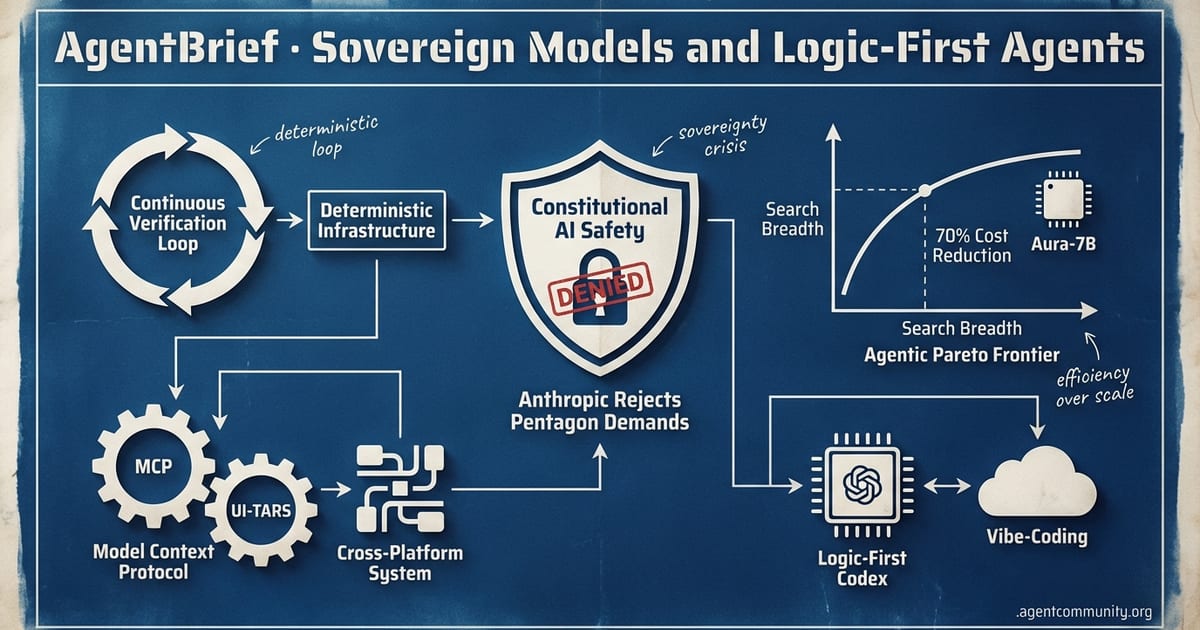
The Sovereignty Crisis Anthropic’s refusal to grant the Pentagon full weight access marks a turning point where Constitutional AI safety meets geopolitical friction, forcing builders to choose between ethical safeguards and state compliance. · Logic Over Vibes The stealth-drop of GPT-5.3 Codex and the rise of Continuous Verification (CV) frameworks signal the end of the vibe-coding era in favor of deterministic, logic-first agent loops. · Efficiency Replaces Scale New frameworks like Search More, Think Less (SMTL) and models like Aura-7B are pushing the Agentic Pareto Frontier, prioritizing search breadth and 70% cost reductions over raw compute stacking. · Standardizing the Stack The rapid adoption of the Model Context Protocol (MCP) and UI-TARS visual precision are finally providing the industry glue needed for cross-platform, production-ready autonomous systems.description
- The Sovereignty Crisis Anthropic’s refusal to grant the Pentagon full weight access marks a turning point where Constitutional AI safety meets geopolitical friction, forcing builders to choose between ethical safeguards and state compliance.
- Logic Over Vibes The stealth-drop of GPT-5.3 Codex and the rise of Continuous Verification (CV) frameworks signal the end of the vibe-coding era in favor of deterministic, logic-first agent loops.
- Efficiency Replaces Scale New frameworks like Search More, Think Less (SMTL) and models like Aura-7B are pushing the Agentic Pareto Frontier, prioritizing search breadth and 70% cost reductions over raw compute stacking.
- Standardizing the Stack The rapid adoption of the Model Context Protocol (MCP) and UI-TARS visual precision are finally providing the industry glue needed for cross-platform, production-ready autonomous systems.
AMDAlibabaAnthropic+31354m saved2514 sources17 min read - ThuFeb26
The Architect's Era of Agency
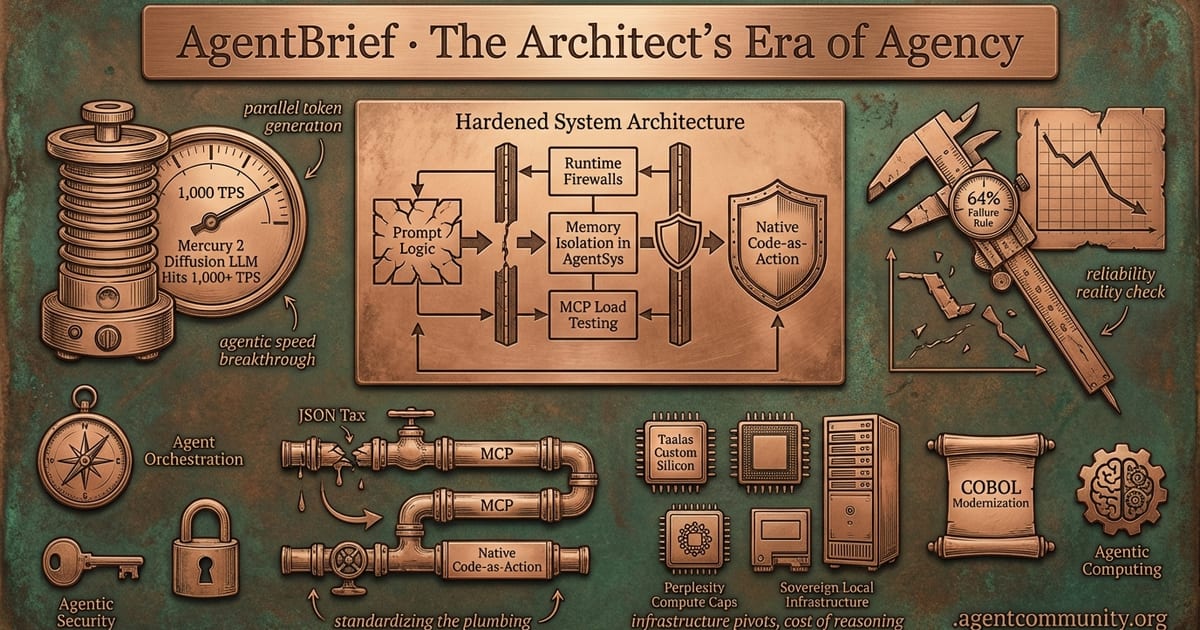
Breaking the Latency Wall Mercury 2's diffusion-based approach introduces parallel token generation, aiming for 1,000 TPS loops that fundamentally change agentic speed. · The Reliability Reality Check Practitioners are confronting the 64% failure rule, shifting focus toward runtime firewalls, memory isolation in AgentSys, and MCP load testing to survive production. · Standardizing the Plumbing The industry is aggressively shedding the JSON tax in favor of native code-as-action and the Model Context Protocol (MCP) to reduce logical decay. · Infrastructure Pivots From Taalas's custom silicon to Perplexity’s compute caps, the cost of reasoning is forcing a move toward sovereign local infrastructure.description
- Breaking the Latency Wall Mercury 2's diffusion-based approach introduces parallel token generation, aiming for 1,000 TPS loops that fundamentally change agentic speed.
- The Reliability Reality Check Practitioners are confronting the 64% failure rule, shifting focus toward runtime firewalls, memory isolation in AgentSys, and MCP load testing to survive production.
- Standardizing the Plumbing The industry is aggressively shedding the JSON tax in favor of native code-as-action and the Model Context Protocol (MCP) to reduce logical decay.
- Infrastructure Pivots From Taalas's custom silicon to Perplexity’s compute caps, the cost of reasoning is forcing a move toward sovereign local infrastructure.
AMDAlibabaAnthropic+32369m saved2278 sources17 min read - WedFeb25
Hardening the Agentic Production Stack
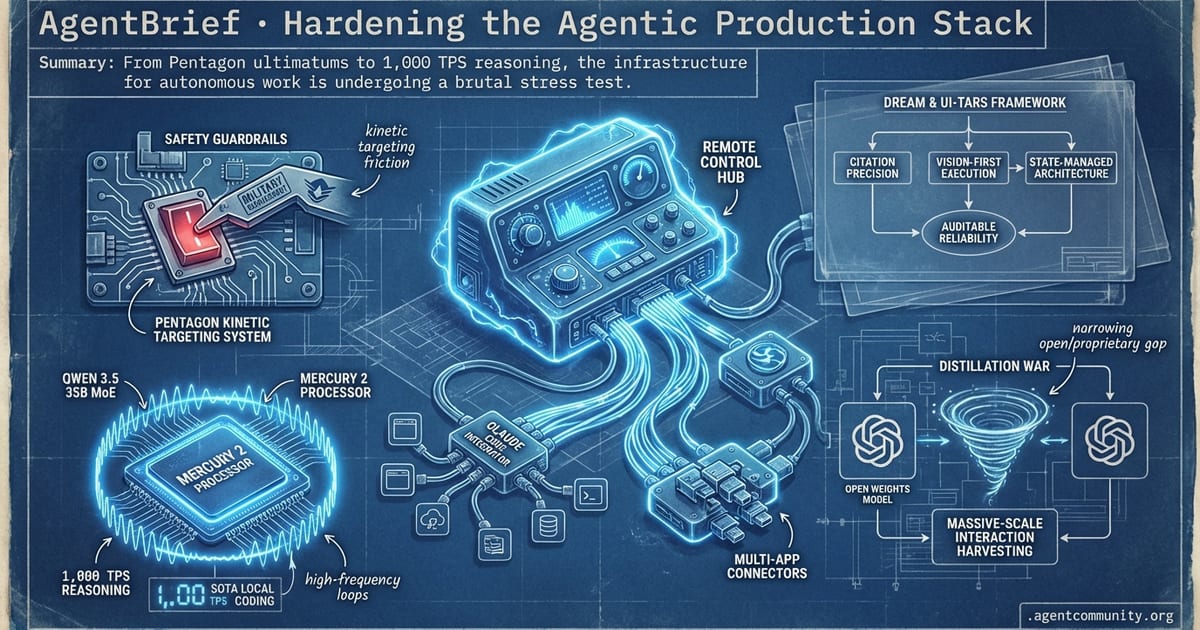
National Security Friction The Pentagon's reported demand for Anthropic to strip safety guardrails for kinetic targeting highlights the growing tension between frontier model safety and military requirements. · The Performance Frontier With Qwen 3.5 35B MoE delivering SOTA local coding and Mercury 2 hitting 1,000 TPS, the hardware-software bottleneck for high-frequency agentic loops is finally breaking. · Auditability and Reliability New frameworks like DREAM and UI-TARS are moving the industry away from 'vibe coding' toward citation precision, vision-first execution, and state-managed software architectures. · The Distillation War Anthropic's warnings regarding industrial-scale distillation suggest a narrowing gap between open-weights and proprietary models, driven by massive-scale interaction harvesting.description
- National Security Friction The Pentagon's reported demand for Anthropic to strip safety guardrails for kinetic targeting highlights the growing tension between frontier model safety and military requirements.
- The Performance Frontier With Qwen 3.5 35B MoE delivering SOTA local coding and Mercury 2 hitting 1,000 TPS, the hardware-software bottleneck for high-frequency agentic loops is finally breaking.
- Auditability and Reliability New frameworks like DREAM and UI-TARS are moving the industry away from 'vibe coding' toward citation precision, vision-first execution, and state-managed software architectures.
- The Distillation War Anthropic's warnings regarding industrial-scale distillation suggest a narrowing gap between open-weights and proprietary models, driven by massive-scale interaction harvesting.
AMDAlibabaAnthropic+33394m saved2341 sources16 min read - TueFeb24
The Agentic Stack Hardens
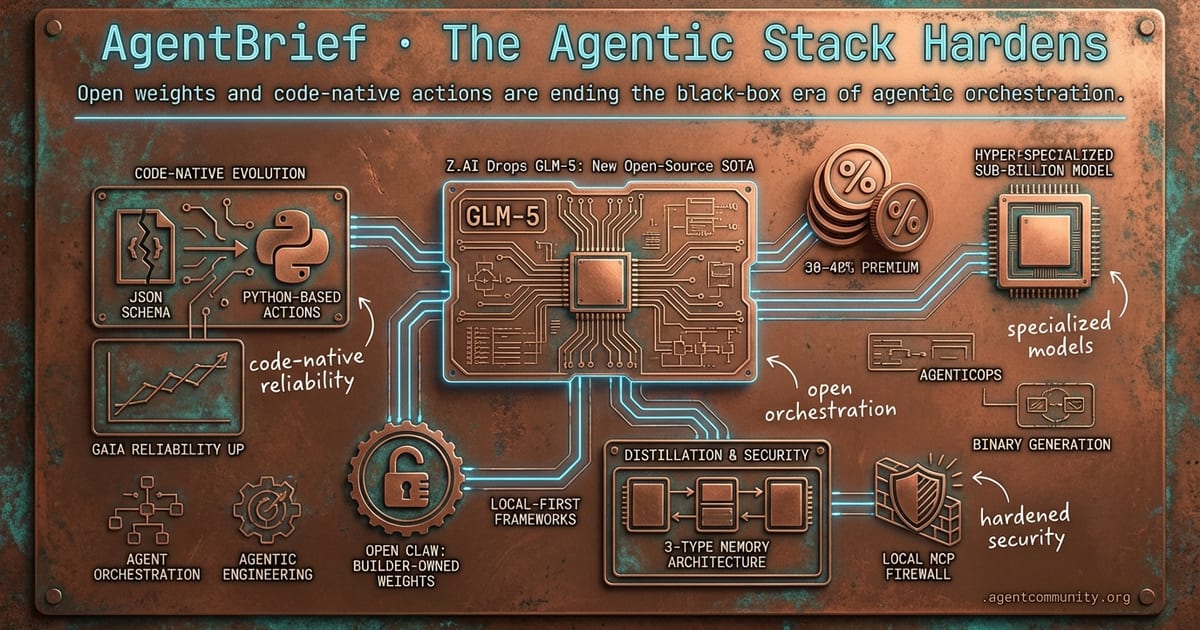
Code-Native Evolution Hugging Face's smolagents and Claude Code are driving a fundamental shift from brittle JSON schemas to Python-based actions, significantly improving reliability on benchmarks like GAIA. · The Reasoning Tax Developers are beginning to quantify a 30-40% token premium for reasoning-heavy loops, sparking a pivot toward hyper-specialized sub-billion parameter models for deterministic tasks. · Open Weight Sovereignty The release of frontier-grade models like GLM-5 and the growth of local-first frameworks like OpenClaw signal a move toward environments where builders own the weights and the security boundary. · Distillation and Security As Anthropic exposes industrial-scale reasoning distillation, the community is hardening production agents with 3-type memory architectures and local MCP firewalls.description
- Code-Native Evolution Hugging Face's smolagents and Claude Code are driving a fundamental shift from brittle JSON schemas to Python-based actions, significantly improving reliability on benchmarks like GAIA.
- The Reasoning Tax Developers are beginning to quantify a 30-40% token premium for reasoning-heavy loops, sparking a pivot toward hyper-specialized sub-billion parameter models for deterministic tasks.
- Open Weight Sovereignty The release of frontier-grade models like GLM-5 and the growth of local-first frameworks like OpenClaw signal a move toward environments where builders own the weights and the security boundary.
- Distillation and Security As Anthropic exposes industrial-scale reasoning distillation, the community is hardening production agents with 3-type memory architectures and local MCP firewalls.
AnthropicCiscoCloudflare+43360m saved2225 sources19 min read - MonFeb23
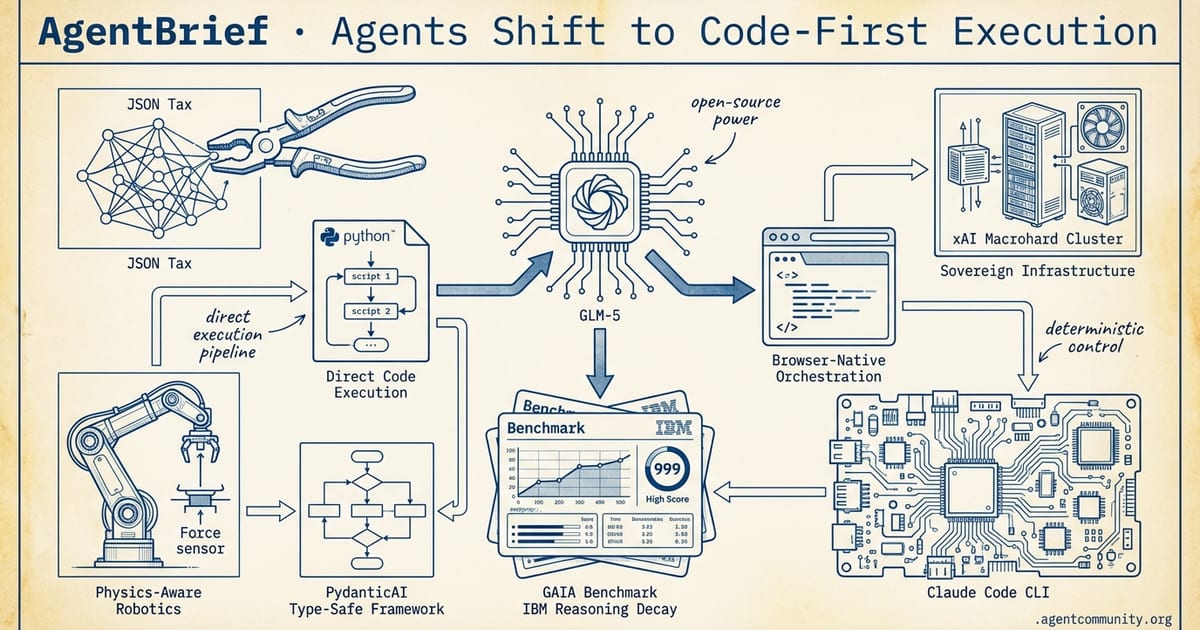
Agents Shift to Code-First Execution
Code-as-Action Pivot Hugging Face's smolagents and OpenAI's Operator are dismantling the 'JSON tax,' trading rigid APIs for direct Python execution and browser-native orchestration to hit 90%+ reliability. · Open-Weights Dominance The arrival of GLM-5 and Qwen 3.5 signals a shift where open-source models are matching frontier APIs on agentic benchmarks, significantly lowering the 'frontier tax' for developers. · Infrastructure Overhaul From xAI’s 1GW 'Macrohard' cluster to terminal-native CLIs like Claude Code, builders are prioritizing sovereign infrastructure and deterministic control over cloud-based rate limits. · The Execution Wall New benchmarks from GAIA to IBM are exposing 'logical reasoning decay,' forcing a move toward type-safe frameworks like PydanticAI and high-precision, physics-aware robotics models.description
- Code-as-Action Pivot Hugging Face's smolagents and OpenAI's Operator are dismantling the 'JSON tax,' trading rigid APIs for direct Python execution and browser-native orchestration to hit 90%+ reliability.
- Open-Weights Dominance The arrival of GLM-5 and Qwen 3.5 signals a shift where open-source models are matching frontier APIs on agentic benchmarks, significantly lowering the 'frontier tax' for developers.
- Infrastructure Overhaul From xAI’s 1GW 'Macrohard' cluster to terminal-native CLIs like Claude Code, builders are prioritizing sovereign infrastructure and deterministic control over cloud-based rate limits.
- The Execution Wall New benchmarks from GAIA to IBM are exposing 'logical reasoning decay,' forcing a move toward type-safe frameworks like PydanticAI and high-precision, physics-aware robotics models.
AnthropicCiscoCloudflare+41155m saved1917 sources17 min read - FriFeb20
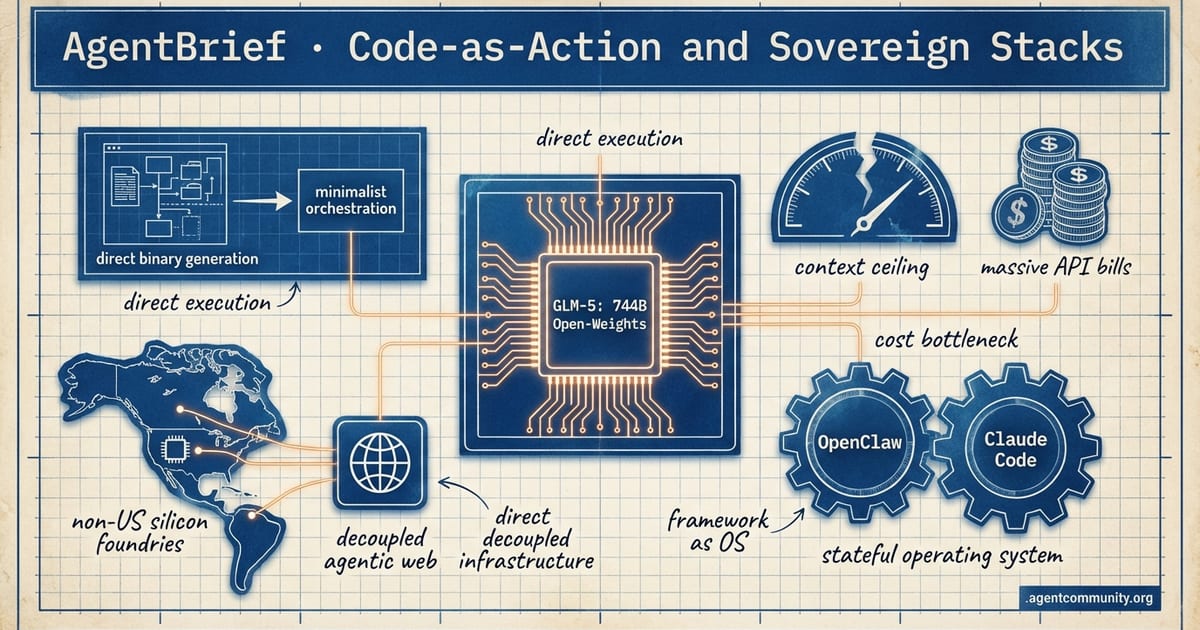
Code-as-Action and Sovereign Stacks
The Death of JSON Tax Hugging Face's smolagents and xAI's direct binary generation signal a definitive shift toward minimalist 'code-as-action' frameworks that outperform bloated orchestration layers. · Sovereign Intelligence Rising Developments like Z.AI’s GLM-5 on non-US silicon and OpenAI’s massive infrastructure play in India highlight a decoupling of the agentic web from traditional centralized hardware. · Benchmark Saturation vs. Production Reality While Gemini 3.1 Pro and Opus 4.6 are shattering OSWorld and GAIA benchmarks, builders are hitting 'context ceilings' in IDEs and facing massive API bills from unoptimized execution loops. · Frameworks as Operating Systems The milestone of 200,000 stars for OpenClaw and the move toward isolated worktrees in Claude Code suggest that agent frameworks are evolving into robust, stateful environments for autonomous work.description
- The Death of JSON Tax Hugging Face's smolagents and xAI's direct binary generation signal a definitive shift toward minimalist 'code-as-action' frameworks that outperform bloated orchestration layers.
- Sovereign Intelligence Rising Developments like Z.AI’s GLM-5 on non-US silicon and OpenAI’s massive infrastructure play in India highlight a decoupling of the agentic web from traditional centralized hardware.
- Benchmark Saturation vs. Production Reality While Gemini 3.1 Pro and Opus 4.6 are shattering OSWorld and GAIA benchmarks, builders are hitting 'context ceilings' in IDEs and facing massive API bills from unoptimized execution loops.
- Frameworks as Operating Systems The milestone of 200,000 stars for OpenClaw and the move toward isolated worktrees in Claude Code suggest that agent frameworks are evolving into robust, stateful environments for autonomous work.
AnthropicCiscoCloudflare+35325m saved2525 sources17 min read - ThuFeb19
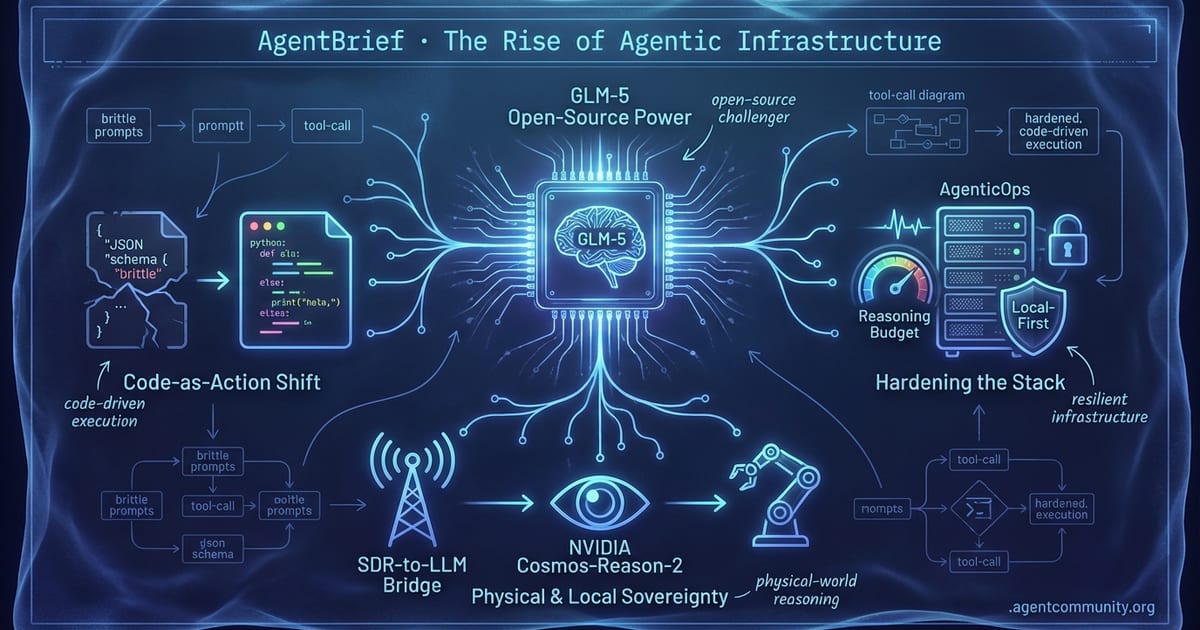
The Rise of Agentic Infrastructure
Code-as-Action Shift The industry is moving away from high-latency JSON schemas toward "code-as-action" with tools like smolagents and the Model Context Protocol (MCP) enabling agents to execute Python and verify logic directly. · Hardening the Stack As Anthropic introduces dynamic reasoning budgets and restricts OAuth access, developers are pivoting toward resilient, local-first infrastructure and "AgenticOps" to manage fleet scaling and security. · Open-Source Power Massive open-source models like the 744B GLM-5 and frameworks like OpenClaw are challenging walled gardens, proving that high-horizon reasoning doesn't require a proprietary cloud subscription. · Physical and Local Sovereignty New frontiers in SDR-to-LLM bridges and visual reasoning models like NVIDIA Cosmos-Reason-2 are pushing agents into physical and UI-driven environments where deterministic control is paramount.description
- Code-as-Action Shift The industry is moving away from high-latency JSON schemas toward "code-as-action" with tools like smolagents and the Model Context Protocol (MCP) enabling agents to execute Python and verify logic directly.
- Hardening the Stack As Anthropic introduces dynamic reasoning budgets and restricts OAuth access, developers are pivoting toward resilient, local-first infrastructure and "AgenticOps" to manage fleet scaling and security.
- Open-Source Power Massive open-source models like the 744B GLM-5 and frameworks like OpenClaw are challenging walled gardens, proving that high-horizon reasoning doesn't require a proprietary cloud subscription.
- Physical and Local Sovereignty New frontiers in SDR-to-LLM bridges and visual reasoning models like NVIDIA Cosmos-Reason-2 are pushing agents into physical and UI-driven environments where deterministic control is paramount.
AmazonAnthropicCisco+47390m saved2264 sources17 min read - WedFeb18
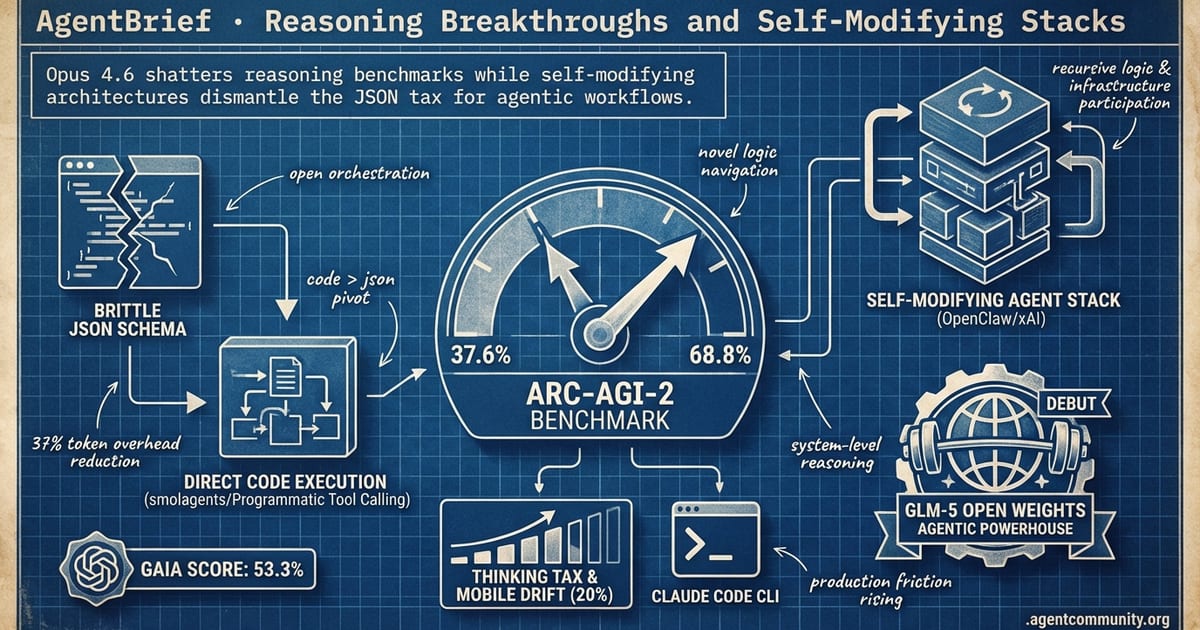
Reasoning Breakthroughs and Self-Modifying Stacks
Reasoning Frontiers Expanded Anthropic’s Opus 4.6 has effectively doubled the ARC-AGI-2 benchmark from 37.6% to 68.8%, signaling a shift from token prediction to systems capable of navigating novel logic. · Executing Over Prompting The industry is pivoting from brittle JSON schemas to direct code execution; Hugging Face’s smolagents and Anthropic’s Programmatic Tool Calling are slashing token overhead by 37% while pushing GAIA scores to 53.3%. · Recursive Architectures Mature Frameworks like OpenClaw and xAI’s compiler-free binary proposals suggest a future where agents aren't just consumers of code, but active participants in evolving their own logic and infrastructure. · Scaling Production Friction As orchestration moves toward terminal-native tools like Claude Code CLI, builders must now navigate the rising thinking tax of high-tier models and a 20% accuracy drift on mobile hardware.description
- Reasoning Frontiers Expanded Anthropic’s Opus 4.6 has effectively doubled the ARC-AGI-2 benchmark from 37.6% to 68.8%, signaling a shift from token prediction to systems capable of navigating novel logic.
- Executing Over Prompting The industry is pivoting from brittle JSON schemas to direct code execution; Hugging Face’s smolagents and Anthropic’s Programmatic Tool Calling are slashing token overhead by 37% while pushing GAIA scores to 53.3%.
- Recursive Architectures Mature Frameworks like OpenClaw and xAI’s compiler-free binary proposals suggest a future where agents aren't just consumers of code, but active participants in evolving their own logic and infrastructure.
- Scaling Production Friction As orchestration moves toward terminal-native tools like Claude Code CLI, builders must now navigate the rising thinking tax of high-tier models and a 20% accuracy drift on mobile hardware.
AmazonAnthropicCisco+38399m saved2915 sources18 min read - TueFeb17
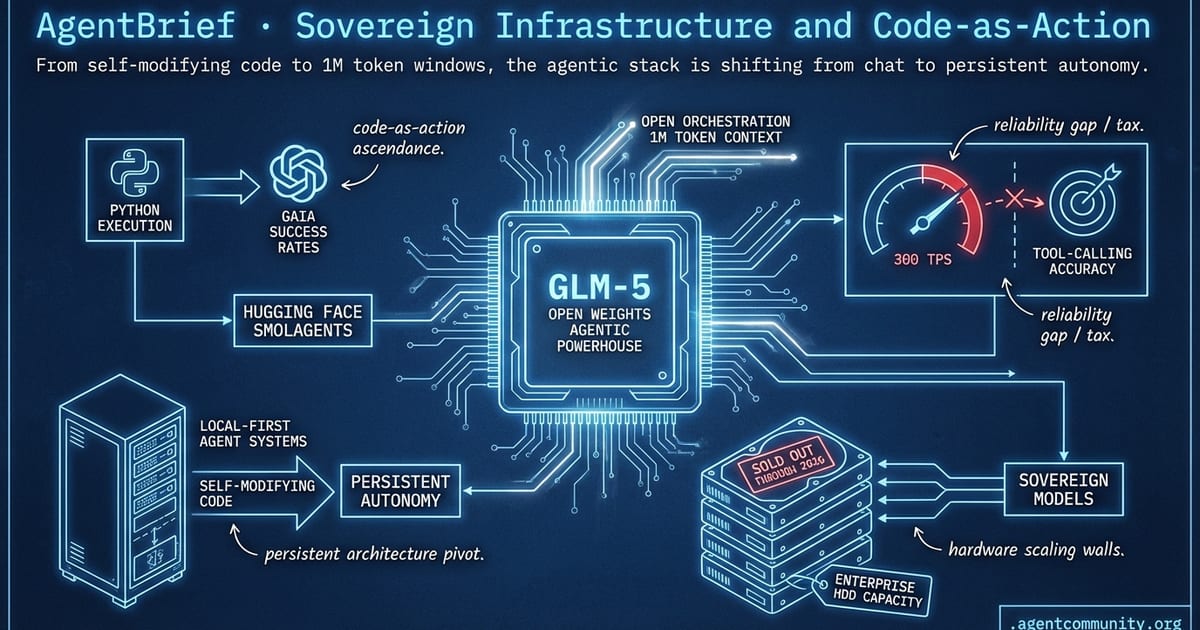
Sovereign Infrastructure and Code-as-Action
Code-as-Action Ascendance Hugging Face’s smolagents and Python execution are killing the 'JSON tax' to improve GAIA success rates. · Persistent Architecture Pivot OpenAI’s hiring of the OpenClaw creator signals a move toward self-modifying, local-first agent systems. · The Reliability Gap As providers hit 300 TPS, practitioners face a 'Reliability Tax' where raw speed costs tool-calling accuracy. · Hardware Scaling Walls The shift toward sovereign models meets physical reality with enterprise HDD capacity reportedly sold out through 2026.description
- Code-as-Action Ascendance Hugging Face’s smolagents and Python execution are killing the 'JSON tax' to improve GAIA success rates.
- Persistent Architecture Pivot OpenAI’s hiring of the OpenClaw creator signals a move toward self-modifying, local-first agent systems.
- The Reliability Gap As providers hit 300 TPS, practitioners face a 'Reliability Tax' where raw speed costs tool-calling accuracy.
- Hardware Scaling Walls The shift toward sovereign models meets physical reality with enterprise HDD capacity reportedly sold out through 2026.
AlibabaAnthropicCerebras+53403m saved2221 sources18 min read - MonFeb16
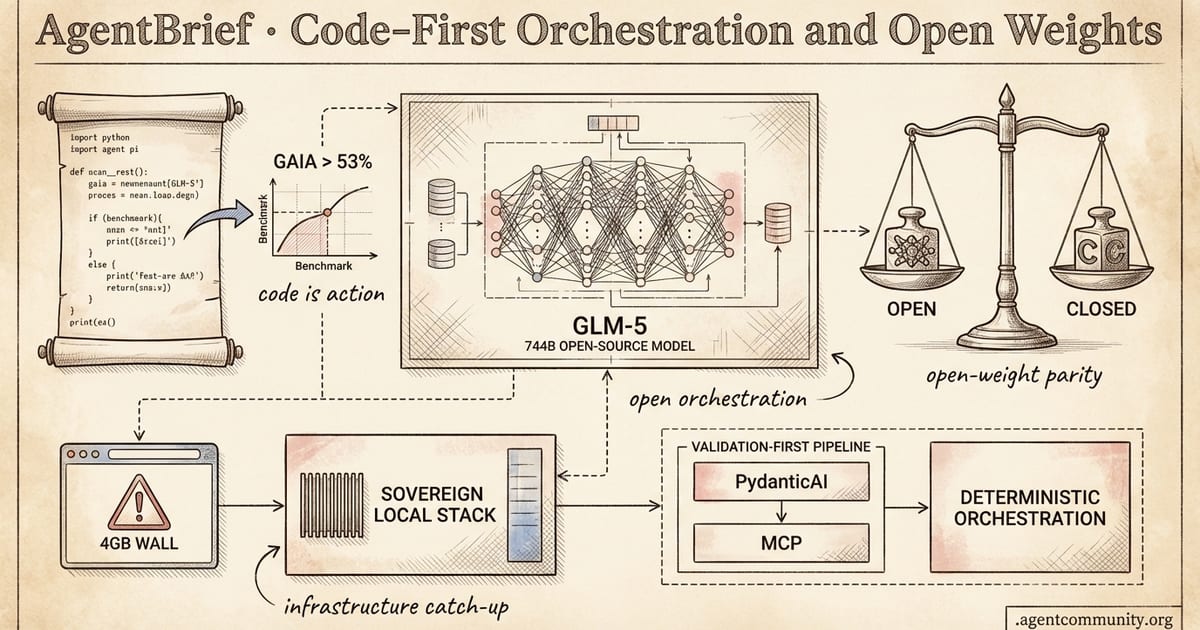
Code-First Orchestration and Open Weights
Code-as-Action Ascends Hugging Face's smolagents and the OpenClaw surge signal a shift from rigid JSON schemas to executable Python, driving success rates on benchmarks like GAIA to over 53%. · Open-Weight Parity New releases like the 744B parameter GLM-5 and MoE models from Qwen and MiniMax are proving that open-weight systems can now rival closed-source giants in reasoning and function calling. · Reliability Infrastructure The industry is pivoting toward 'Validation-First' architectures, with Anthropic’s MCP and PydanticAI providing the type-safe plumbing needed for deterministic agent orchestration. · Production Realities As OpenAI's 'Operator' targets the browser DOM, developers are hitting hardware constraints like the '4GB wall' in IDEs, forcing a move toward sovereign, optimized local stacks.description
- Code-as-Action Ascends Hugging Face's smolagents and the OpenClaw surge signal a shift from rigid JSON schemas to executable Python, driving success rates on benchmarks like GAIA to over 53%.
- Open-Weight Parity New releases like the 744B parameter GLM-5 and MoE models from Qwen and MiniMax are proving that open-weight systems can now rival closed-source giants in reasoning and function calling.
- Reliability Infrastructure The industry is pivoting toward 'Validation-First' architectures, with Anthropic’s MCP and PydanticAI providing the type-safe plumbing needed for deterministic agent orchestration.
- Production Realities As OpenAI's 'Operator' targets the browser DOM, developers are hitting hardware constraints like the '4GB wall' in IDEs, forcing a move toward sovereign, optimized local stacks.
AlibabaAnthropicApollo+52142m saved1782 sources16 min read - FriFeb13
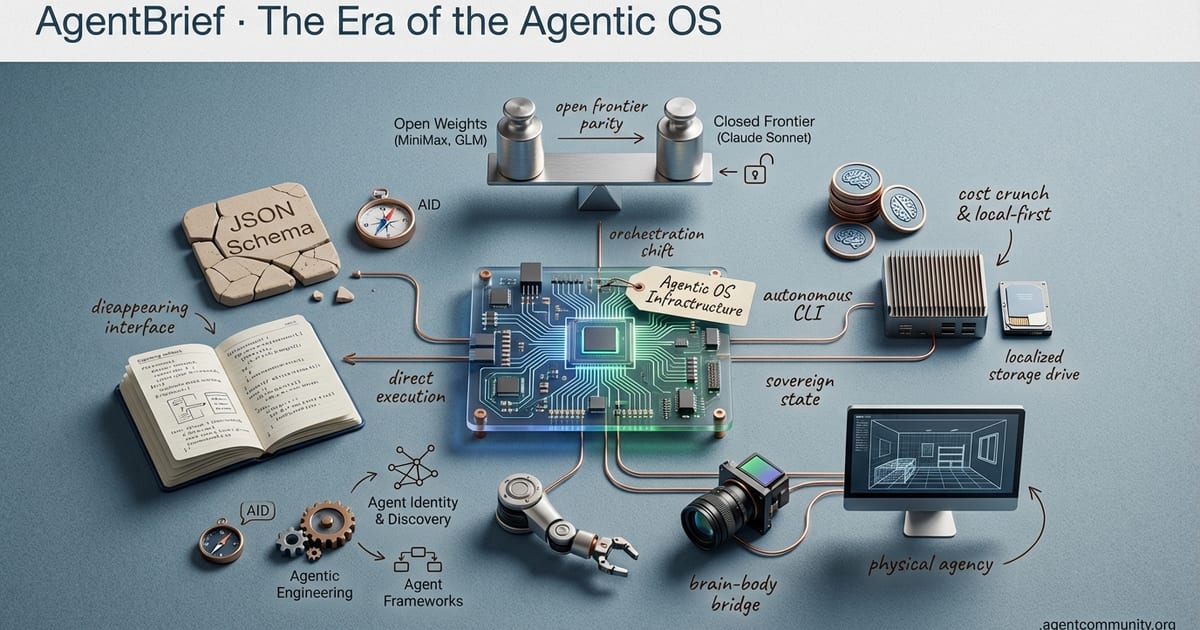
The Era of the Agentic OS
Code-as-Action Over JSON HuggingFace’s smolagents and Anthropic’s Claude Code signal a fundamental shift away from brittle JSON schemas toward direct code execution and autonomous CLI orchestration. · Open-Weights Frontier Parity The release of MiniMax-M2.5 and GLM-5 proves that open models have reached parity with closed-source giants like Claude 3.5 Sonnet, commoditizing raw reasoning and shifting the developer focus to orchestration. · The Reasoning Tax As practitioners scale multi-agent systems, managing high token consumption and context rot is driving a critical move toward local-first infrastructure and sovereign state management. · Physical and Desktop Agency NVIDIA’s Cosmos and the Pollen-Vision stack are bridging the brain-body gap, moving agentic workflows from the IDE into physical environments and real-time vision systems.description
- Code-as-Action Over JSON HuggingFace’s smolagents and Anthropic’s Claude Code signal a fundamental shift away from brittle JSON schemas toward direct code execution and autonomous CLI orchestration.
- Open-Weights Frontier Parity The release of MiniMax-M2.5 and GLM-5 proves that open models have reached parity with closed-source giants like Claude 3.5 Sonnet, commoditizing raw reasoning and shifting the developer focus to orchestration.
- The Reasoning Tax As practitioners scale multi-agent systems, managing high token consumption and context rot is driving a critical move toward local-first infrastructure and sovereign state management.
- Physical and Desktop Agency NVIDIA’s Cosmos and the Pollen-Vision stack are bridging the brain-body gap, moving agentic workflows from the IDE into physical environments and real-time vision systems.
Agent CommunityAlibabaAnthropic+41319m saved2343 sources17 min read - ThuFeb12
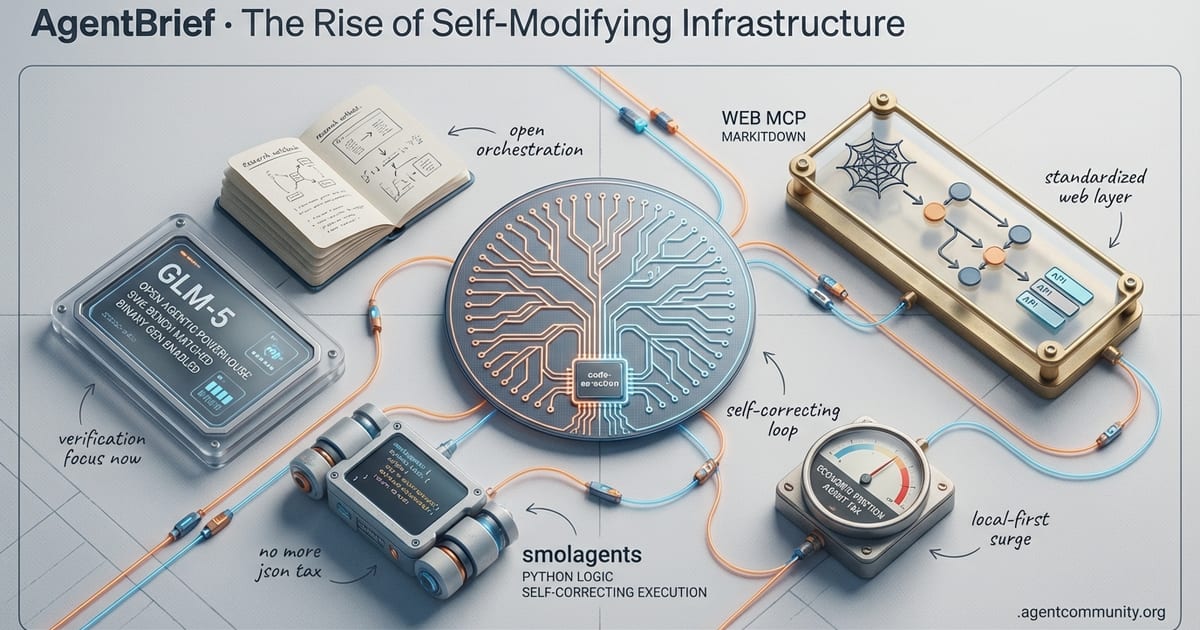
The Rise of Self-Modifying Infrastructure
Code-as-Action Dominance The era of the 'JSON tax' is ending, replaced by smaller models like smolagents that execute Python logic to achieve SOTA performance on complex benchmarks. - Standardizing the Web Google’s WebMCP and Microsoft’s MarkItDown are transforming the messy web into an agent-readable API layer, establishing the infrastructure needed for reliable, production-grade autonomy. - The Verification Layer With systems like GLM-5 and OpenClaw proving agents can now generate their own binaries and self-correct overnight, the focus has shifted from model intelligence to robust verification. - Rising Economic Friction As frontier models push knowledge cutoffs into 2025, developers are facing an 'Agent Tax' that is driving a surge in local-first stacks and sovereign orchestration.description
-
- Code-as-Action Dominance The era of the 'JSON tax' is ending, replaced by smaller models like smolagents that execute Python logic to achieve SOTA performance on complex benchmarks. - Standardizing the Web Google’s WebMCP and Microsoft’s MarkItDown are transforming the messy web into an agent-readable API layer, establishing the infrastructure needed for reliable, production-grade autonomy. - The Verification Layer With systems like GLM-5 and OpenClaw proving agents can now generate their own binaries and self-correct overnight, the focus has shifted from model intelligence to robust verification. - Rising Economic Friction As frontier models push knowledge cutoffs into 2025, developers are facing an 'Agent Tax' that is driving a surge in local-first stacks and sovereign orchestration.
1passwordAmazonAnthropic+44412m saved2498 sources25 min read -
- WedFeb11
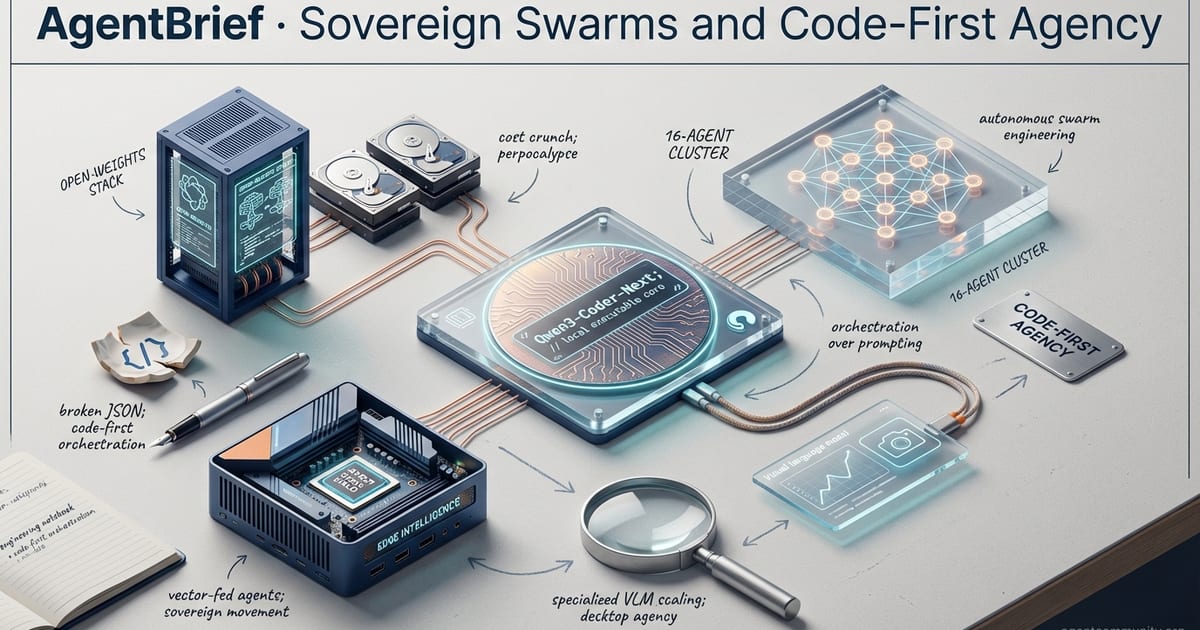
Sovereign Swarms and Code-First Agency
Sovereign Agent Movement The Perpocalypse of cloud quota cuts from Perplexity and Google is forcing a mass migration toward local hardware and open-weights models. - Orchestration Over Prompting We have moved beyond simple chat interfaces into the era of autonomous swarms, with 16-agent clusters now engineering functional compilers from scratch. - The Death of JSON Frameworks like smolagents are replacing brittle JSON schemas with executable code-first orchestration to improve performance and reliability. - Edge Intelligence Scaling Specialized Visual Language Models and hardware breakthroughs like the AMD Strix Halo are enabling high-performance agency to live directly on the practitioner’s desktop.description
-
- Sovereign Agent Movement The Perpocalypse of cloud quota cuts from Perplexity and Google is forcing a mass migration toward local hardware and open-weights models. - Orchestration Over Prompting We have moved beyond simple chat interfaces into the era of autonomous swarms, with 16-agent clusters now engineering functional compilers from scratch. - The Death of JSON Frameworks like smolagents are replacing brittle JSON schemas with executable code-first orchestration to improve performance and reliability. - Edge Intelligence Scaling Specialized Visual Language Models and hardware breakthroughs like the AMD Strix Halo are enabling high-performance agency to live directly on the practitioner’s desktop.
AMDAlibabaAnthropic+41302m saved1852 sources21 min read -
- TueFeb10
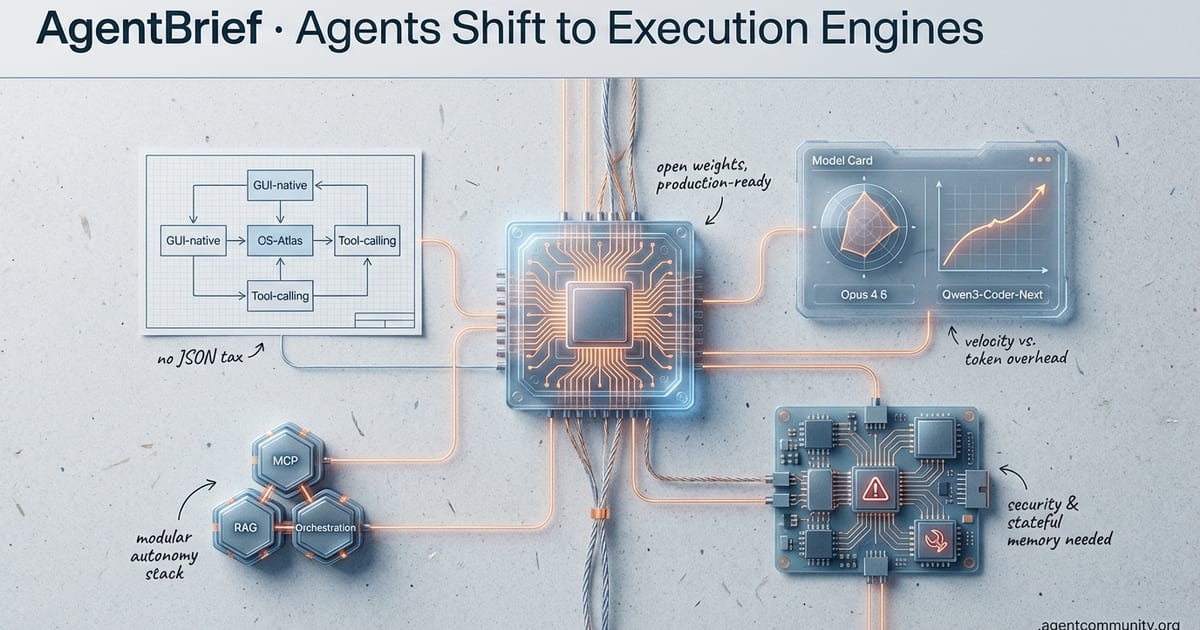
Agents Shift to Execution Engines
Execution Over Chat The industry is pivoting from "what can AI say" to "what can the agent do," fueled by GUI-native models like OS-Atlas and specialized 1.5B models that outperform giants in tool-calling by eliminating the "JSON tax." · Frontier Model Velocity Anthropic’s leap to Opus 4.6 and Alibaba’s Qwen3-Coder-Next are redefining cost-to-performance ratios, though builders are now battling a 160% token overhead from recursive "thinking loops" and agentic amnesia. · Infrastructure Under Pressure While the Model Context Protocol (MCP) becomes the universal connector for data, the OpenClaw RCE crisis serves as a stark reminder that the "vibe-coding" era requires deterministic security and stateful memory to survive production. · Modular Autonomy Hidden "Experimental Agent Teams" in developer tools and multi-agent commerce stacks signal a move toward modular, self-healing swarms that treat entire repositories as active, executable playgrounds.description
-
- Execution Over Chat The industry is pivoting from "what can AI say" to "what can the agent do," fueled by GUI-native models like OS-Atlas and specialized 1.5B models that outperform giants in tool-calling by eliminating the "JSON tax."
-
- Frontier Model Velocity Anthropic’s leap to Opus 4.6 and Alibaba’s Qwen3-Coder-Next are redefining cost-to-performance ratios, though builders are now battling a 160% token overhead from recursive "thinking loops" and agentic amnesia.
-
- Infrastructure Under Pressure While the Model Context Protocol (MCP) becomes the universal connector for data, the OpenClaw RCE crisis serves as a stark reminder that the "vibe-coding" era requires deterministic security and stateful memory to survive production.
-
- Modular Autonomy Hidden "Experimental Agent Teams" in developer tools and multi-agent commerce stacks signal a move toward modular, self-healing swarms that treat entire repositories as active, executable playgrounds.
AlibabaAnthropicArcee AI+25309m saved1892 sources22 min read -
- MonFeb09
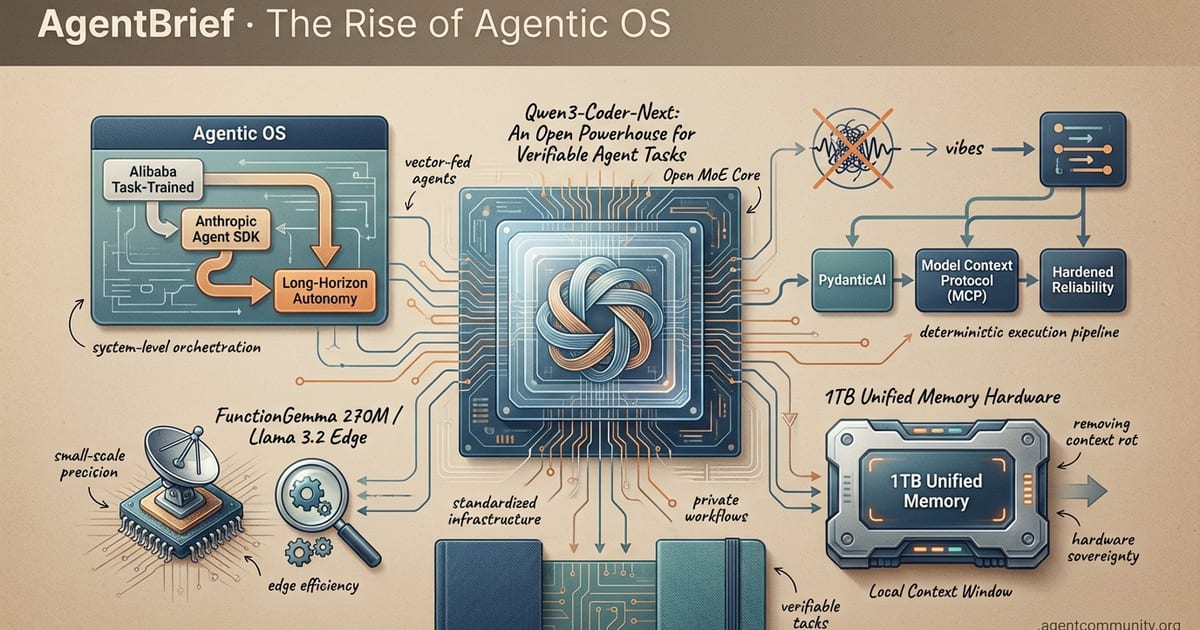
The Rise of Agentic OS
The Execution Layer We are moving past chat wrappers into a true 'Agentic OS' era, supported by Alibaba's task-trained models and Anthropic's Agent SDK for long-horizon autonomy. · Hardened Reliability Developers are trading 'vibes' for deterministic execution using frameworks like PydanticAI and the Model Context Protocol (MCP) to solve the persistent fragility of autonomous systems. · Small-Scale Precision The release of FunctionGemma 270M and Llama 3.2 edge models demonstrates that high-precision tool calling is no longer exclusive to massive, expensive frontier models. · Hardware-Backed Sovereignty New 1TB unified memory hardware is removing the 'context rot' bottleneck, allowing for massive local context windows and private, long-horizon agent workflows.description
-
- The Execution Layer We are moving past chat wrappers into a true 'Agentic OS' era, supported by Alibaba's task-trained models and Anthropic's Agent SDK for long-horizon autonomy.
-
- Hardened Reliability Developers are trading 'vibes' for deterministic execution using frameworks like PydanticAI and the Model Context Protocol (MCP) to solve the persistent fragility of autonomous systems.
-
- Small-Scale Precision The release of FunctionGemma 270M and Llama 3.2 edge models demonstrates that high-precision tool calling is no longer exclusive to massive, expensive frontier models.
-
- Hardware-Backed Sovereignty New 1TB unified memory hardware is removing the 'context rot' bottleneck, allowing for massive local context windows and private, long-horizon agent workflows.
AlibabaAnthropicArcee AI+3194m saved1751 sources24 min read -
- FriFeb06
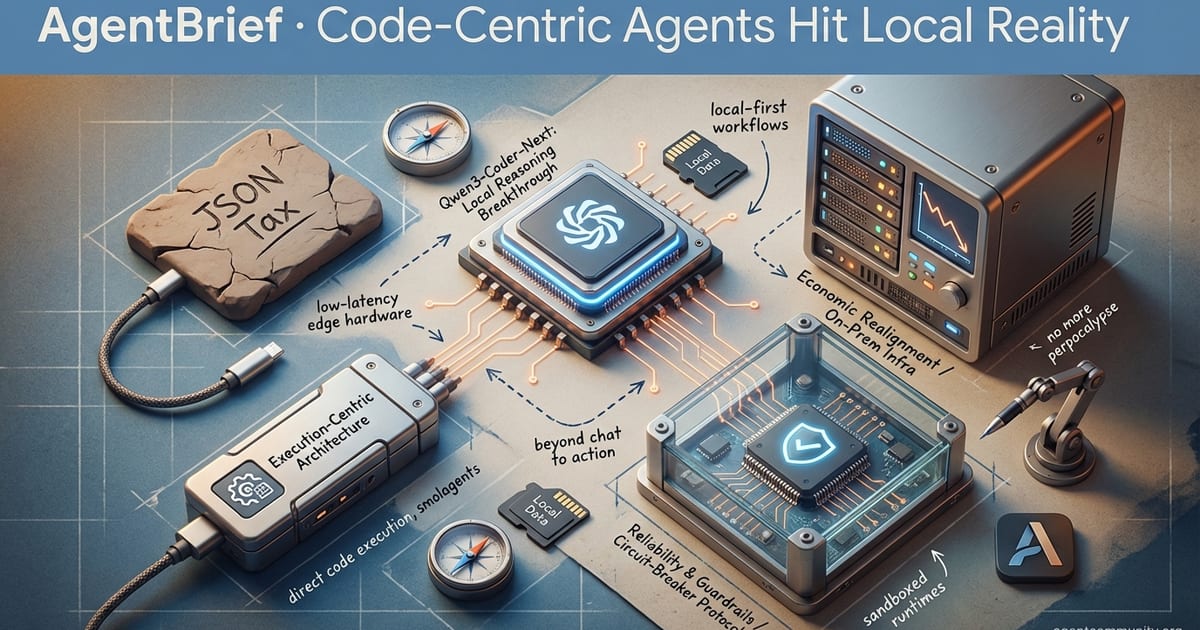
Code-Centric Agents Hit Local Reality
Execution-Centric Architecture The industry is moving away from brittle JSON schemas toward direct code execution with frameworks like smolagents and MCP. - Local Reasoning Breakthroughs Low-latency, local-first workflows are becoming viable as models like Qwen3-Coder-Next match frontier performance on edge hardware. - Economic Realignment The 'Perpocalypse' and the arrival of high-compute models like Opus 4.6 are forcing a shift from subsidized cloud APIs to disciplined, on-prem infrastructure. - Reliability and Guardrails As agents gain file-system access and autonomous agency, the focus has shifted to sandboxed runtimes and circuit-breaker protocols to prevent catastrophic failures.description
-
- Execution-Centric Architecture The industry is moving away from brittle JSON schemas toward direct code execution with frameworks like smolagents and MCP. - Local Reasoning Breakthroughs Low-latency, local-first workflows are becoming viable as models like Qwen3-Coder-Next match frontier performance on edge hardware. - Economic Realignment The 'Perpocalypse' and the arrival of high-compute models like Opus 4.6 are forcing a shift from subsidized cloud APIs to disciplined, on-prem infrastructure. - Reliability and Guardrails As agents gain file-system access and autonomous agency, the focus has shifted to sandboxed runtimes and circuit-breaker protocols to prevent catastrophic failures.
AlibabaAnthropicApple+32296m saved2024 sources22 min read -
- ThuFeb05
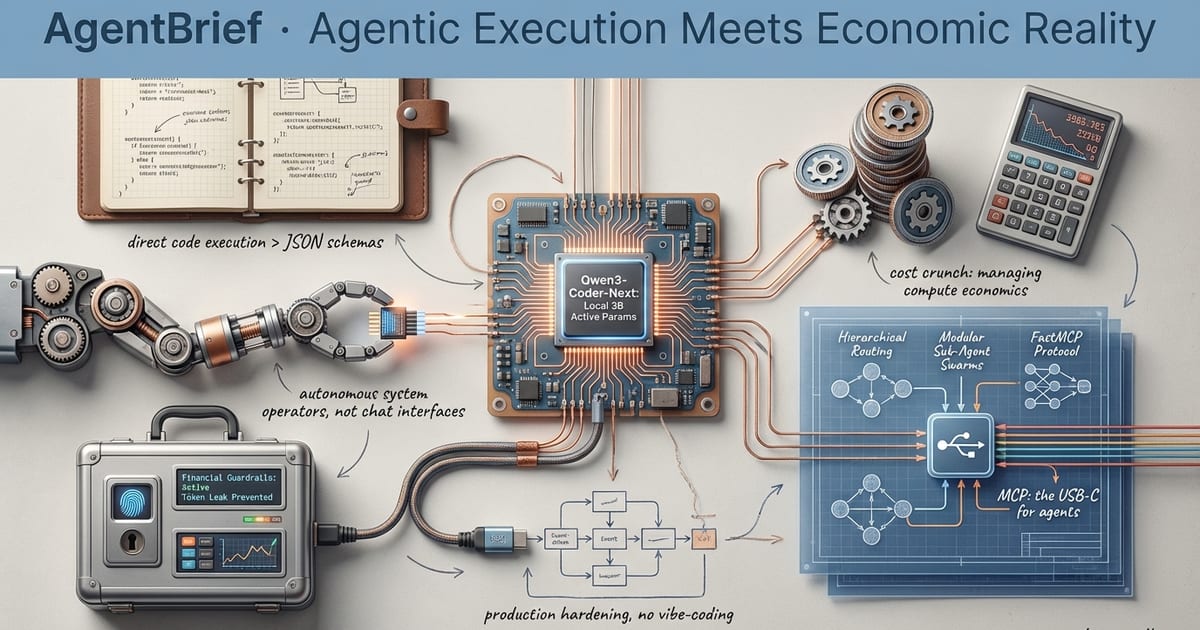
Agentic Execution Meets Economic Reality
Code-as-Action Pivot: Builders are ditching rigid JSON schemas for direct code execution, with frameworks like smolagents and Claude CoWork signaling a shift from chat interfaces to local system operators. · The Reasoning Tax: As API costs and billing shocks hit production, the industry is pivoting toward hierarchical routing, local-first models like Qwen3, and modular sub-agent swarms to manage compute economics. · Infrastructure Interoperability: The Model Context Protocol (MCP) and FastMCP are emerging as the USB-C for agents, enabling the cross-platform tool-use required for long-horizon planning and real-world execution. · Production Hardening: Moving past vibe-coding requires robust financial guardrails and event-driven architectures to prevent agents from leaking tokens or accidentally committing to enterprise contracts.description
-
- Code-as-Action Pivot: Builders are ditching rigid JSON schemas for direct code execution, with frameworks like smolagents and Claude CoWork signaling a shift from chat interfaces to local system operators.
-
- The Reasoning Tax: As API costs and billing shocks hit production, the industry is pivoting toward hierarchical routing, local-first models like Qwen3, and modular sub-agent swarms to manage compute economics.
-
- Infrastructure Interoperability: The Model Context Protocol (MCP) and FastMCP are emerging as the USB-C for agents, enabling the cross-platform tool-use required for long-horizon planning and real-world execution.
-
- Production Hardening: Moving past vibe-coding requires robust financial guardrails and event-driven architectures to prevent agents from leaking tokens or accidentally committing to enterprise contracts.
AlibabaAnthropicArcee AI+42333m saved2104 sources25 min read -
- WedFeb04
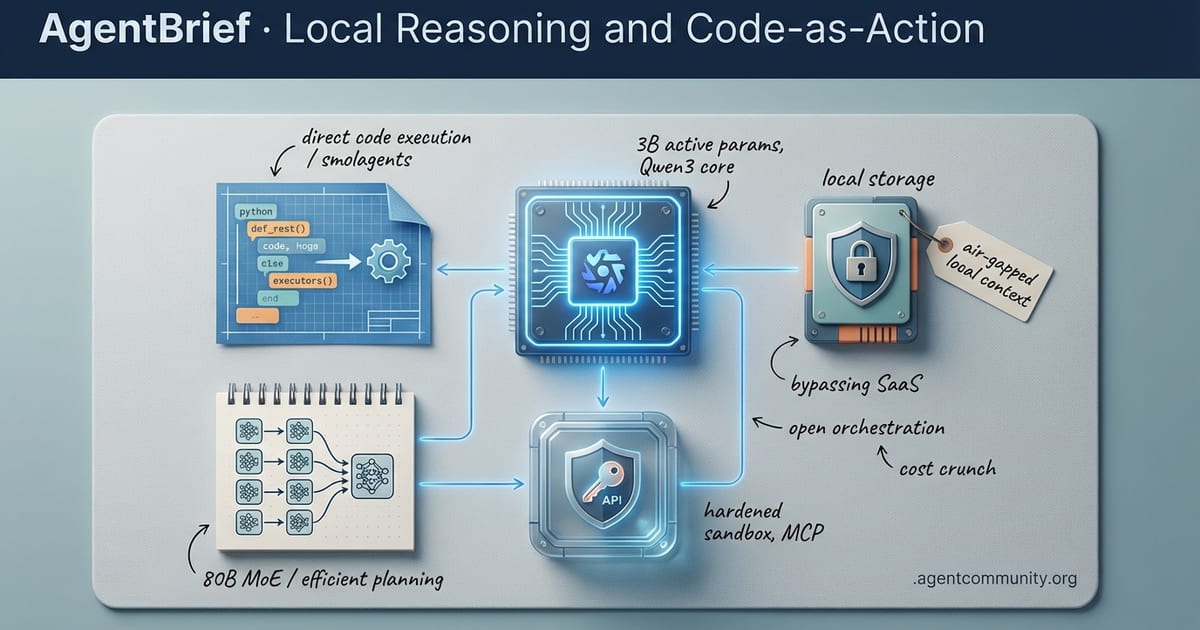
Local Reasoning and Code-as-Action
The Local Takeover Local models like Qwen3-Coder-Next are hitting parity with proprietary giants, enabling air-gapped, high-throughput workflows that bypass SaaS latency. - Execution Over Chat The industry is pivoting toward 'Code-as-Action' frameworks like smolagents, where raw Python execution replaces fragile JSON schemas for higher reasoning accuracy. - Infrastructure and Security As agents begin hiring humans and handling sensitive API tokens, the focus is shifting to hardened Docker sandboxes and the Model Context Protocol (MCP). - Optimizing the Reasoning Tax New 80B MoE architectures are proving that 3B active parameters can match Claude 3.5 Sonnet, drastically reducing the cost of agentic planning.description
-
- The Local Takeover Local models like Qwen3-Coder-Next are hitting parity with proprietary giants, enabling air-gapped, high-throughput workflows that bypass SaaS latency. - Execution Over Chat The industry is pivoting toward 'Code-as-Action' frameworks like smolagents, where raw Python execution replaces fragile JSON schemas for higher reasoning accuracy. - Infrastructure and Security As agents begin hiring humans and handling sensitive API tokens, the focus is shifting to hardened Docker sandboxes and the Model Context Protocol (MCP). - Optimizing the Reasoning Tax New 80B MoE architectures are proving that 3B active parameters can match Claude 3.5 Sonnet, drastically reducing the cost of agentic planning.
AlibabaAnthropicDocker+38258m saved1734 sources25 min read -
- TueFeb03
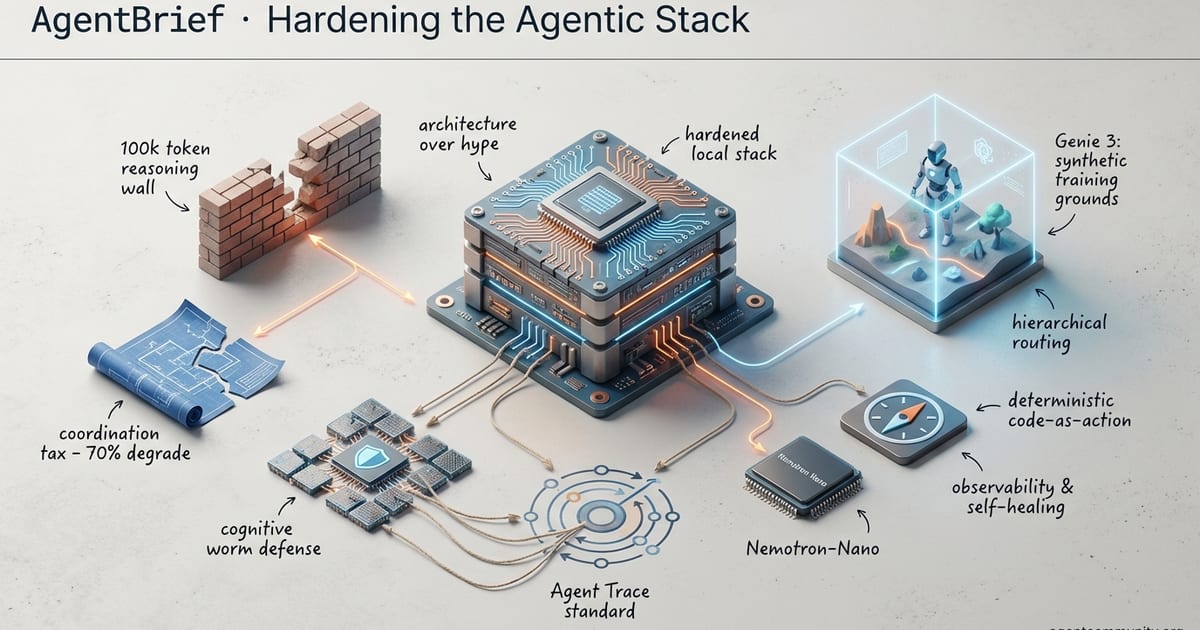
Hardening the Agentic Stack
The Reasoning Wall Builders are hitting a logic ceiling at 100k tokens, forcing a shift away from infinite context toward hierarchical routing and hardened local stacks like Nemotron-Nano. · Architecture Over Hype New research into the coordination tax reveals that poorly implemented swarms can degrade performance by 70%, making deterministic code-as-action frameworks essential. · Synthetic Training Grounds High-fidelity simulations like Genie 3 are providing the environment needed for agents to master visual navigation and complex reasoning before deployment. · Hardening the Stack From cognitive worm security threats to the Agent Trace standard, the ecosystem is professionalizing with a focus on observability and self-healing systems.description
-
- The Reasoning Wall Builders are hitting a logic ceiling at 100k tokens, forcing a shift away from infinite context toward hierarchical routing and hardened local stacks like Nemotron-Nano.
-
- Architecture Over Hype New research into the coordination tax reveals that poorly implemented swarms can degrade performance by 70%, making deterministic code-as-action frameworks essential.
-
- Synthetic Training Grounds High-fidelity simulations like Genie 3 are providing the environment needed for agents to master visual navigation and complex reasoning before deployment.
-
- Hardening the Stack From cognitive worm security threats to the Agent Trace standard, the ecosystem is professionalizing with a focus on observability and self-healing systems.
AnthropicClickHouseCognition+34337m saved2395 sources24 min read -
- MonFeb02

Hardening the Agentic Web Stack
Browser as OS The arrival of OpenAI’s Operator and the explosion of browser-use confirm that the web is the primary execution environment for autonomous agents. - Execution Over Vibes We are moving away from brittle JSON schemas and toward "code-as-action" with frameworks like smolagents leading the charge on verifiable tool use. - Hardening the Stack With reports of RCE vulnerabilities, the focus has shifted to hierarchical governance and secure memory layers to manage agentic loops. - Industrial-Scale Infrastructure The shift toward agents with "bodies and banks" is accelerating via the MCP marketplace and physical simulations like Genie 3.description
-
- Browser as OS The arrival of OpenAI’s Operator and the explosion of browser-use confirm that the web is the primary execution environment for autonomous agents. - Execution Over Vibes We are moving away from brittle JSON schemas and toward "code-as-action" with frameworks like smolagents leading the charge on verifiable tool use. - Hardening the Stack With reports of RCE vulnerabilities, the focus has shifted to hierarchical governance and secure memory layers to manage agentic loops. - Industrial-Scale Infrastructure The shift toward agents with "bodies and banks" is accelerating via the MCP marketplace and physical simulations like Genie 3.
Agent TraceAnthropicApple+46137m saved1605 sources21 min read -