∷archive
hover for detailclear month →
All issues, grouped by month.
Jump between months on the left, then skim titles in a tight grid-aligned list. Hover any row for synopsis, tags, and stats.
◷month
21 issuesMarch 2026
- TueMar31
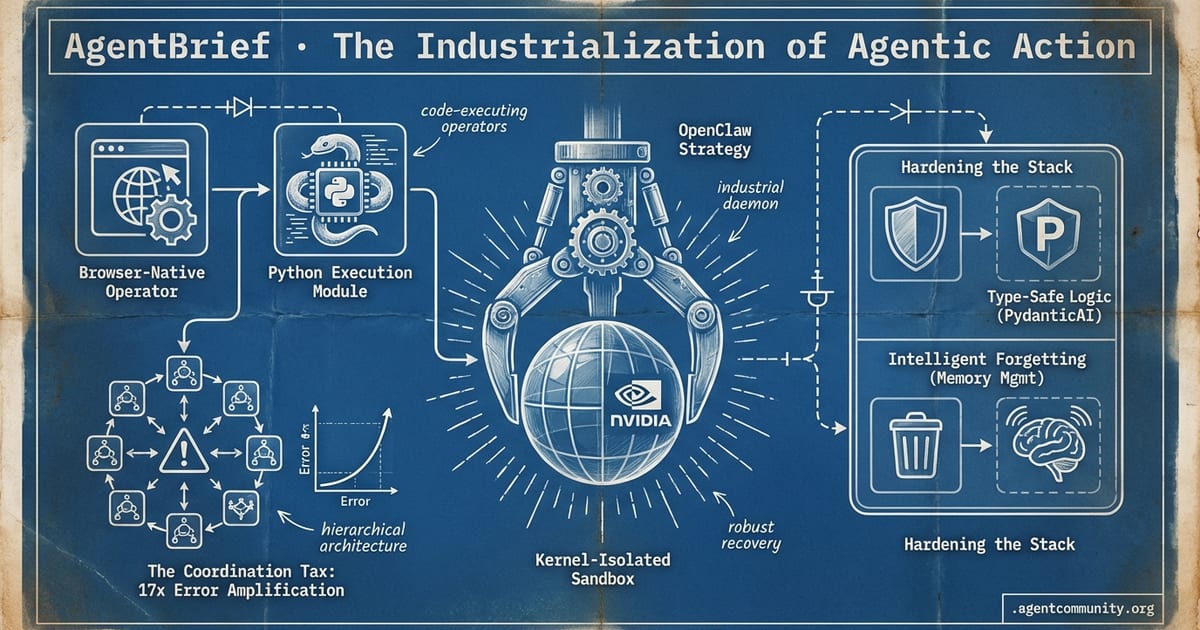
The Industrialization of Agentic Action
The OpenClaw Era Jensen Huang identifies the agentic web as the new Linux, signaling a shift toward industrial-scale persistent daemons and kernel-isolated sandboxing. · Execution Over Chat OpenAI’s upcoming 'Operator' and Hugging Face’s 'smolagents' represent a decisive move toward browser-native automation and Python-based reasoning over fragile JSON tool-calling. · The Coordination Tax Recent Google Research warns that multi-agent systems can suffer a 17x error amplification rate, pushing practitioners toward hardened hierarchical architectures and internal reasoning loops. · Hardening the Stack With 30% of agent failures linked to poor error recovery, the focus is shifting to type-safe logic via PydanticAI and robust 'intelligent forgetting' for memory management.description
- The OpenClaw Era Jensen Huang identifies the agentic web as the new Linux, signaling a shift toward industrial-scale persistent daemons and kernel-isolated sandboxing.
- Execution Over Chat OpenAI’s upcoming 'Operator' and Hugging Face’s 'smolagents' represent a decisive move toward browser-native automation and Python-based reasoning over fragile JSON tool-calling.
- The Coordination Tax Recent Google Research warns that multi-agent systems can suffer a 17x error amplification rate, pushing practitioners toward hardened hierarchical architectures and internal reasoning loops.
- Hardening the Stack With 30% of agent failures linked to poor error recovery, the focus is shifting to type-safe logic via PydanticAI and robust 'intelligent forgetting' for memory management.
AnthropicCiscoCrowdstrike+42281m saved1085 sources16 min read - MonMar30
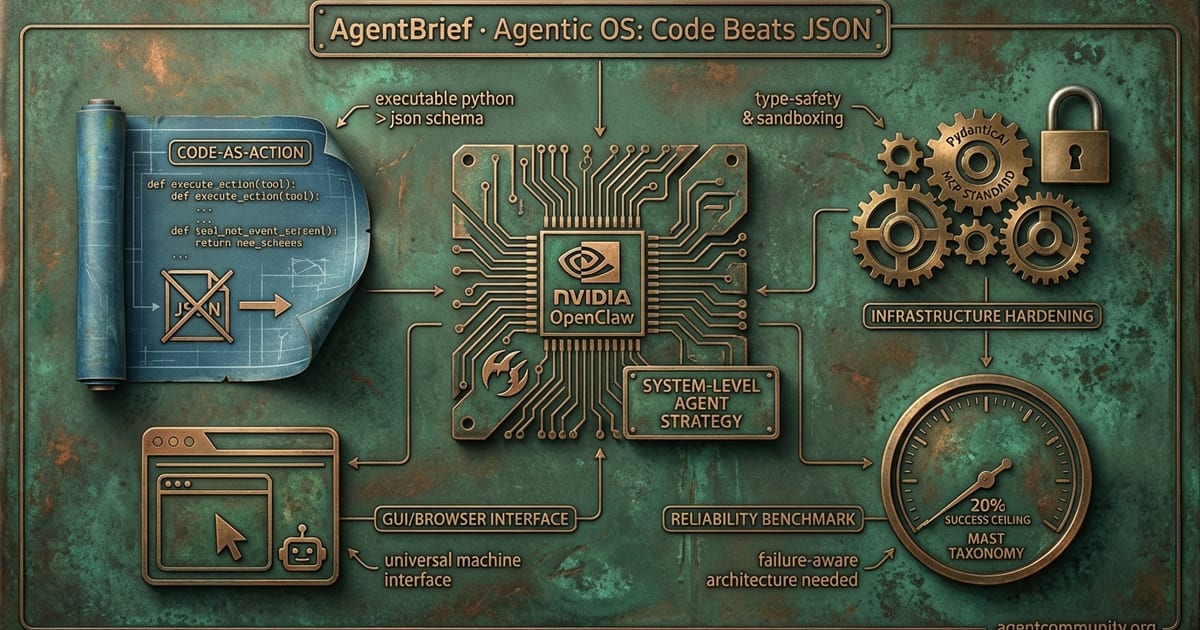
Agentic OS: Code Beats JSON
The Agentic Mandate NVIDIA's OpenClaw and OpenAI’s Operator signal a shift where agents move from the chat box to the system level, treating the GUI and browser as universal machine interfaces. · Code-as-Action Ascendance Hugging Face’s smolagents framework is challenging the JSON schema status quo, demonstrating that executable Python snippets can reduce operational steps by 30% and improve reliability. · Hardening the Stack Infrastructure is maturing rapidly with PydanticAI providing type-safety, the Model Context Protocol (MCP) standardizing tool connections, and sandboxing-as-a-service securing execution environments. · The Reliability Reality Despite the hype, new benchmarks from IBM and Berkeley show a 20% success ceiling for complex tasks, highlighting the urgent need for failure-aware architectures and the new MAST taxonomy.description
- The Agentic Mandate NVIDIA's OpenClaw and OpenAI’s Operator signal a shift where agents move from the chat box to the system level, treating the GUI and browser as universal machine interfaces.
- Code-as-Action Ascendance Hugging Face’s smolagents framework is challenging the JSON schema status quo, demonstrating that executable Python snippets can reduce operational steps by 30% and improve reliability.
- Hardening the Stack Infrastructure is maturing rapidly with PydanticAI providing type-safety, the Model Context Protocol (MCP) standardizing tool connections, and sandboxing-as-a-service securing execution environments.
- The Reliability Reality Despite the hype, new benchmarks from IBM and Berkeley show a 20% success ceiling for complex tasks, highlighting the urgent need for failure-aware architectures and the new MAST taxonomy.
AnthropicCloudflareDropbox+3997m saved832 sources17 min read - FriMar27
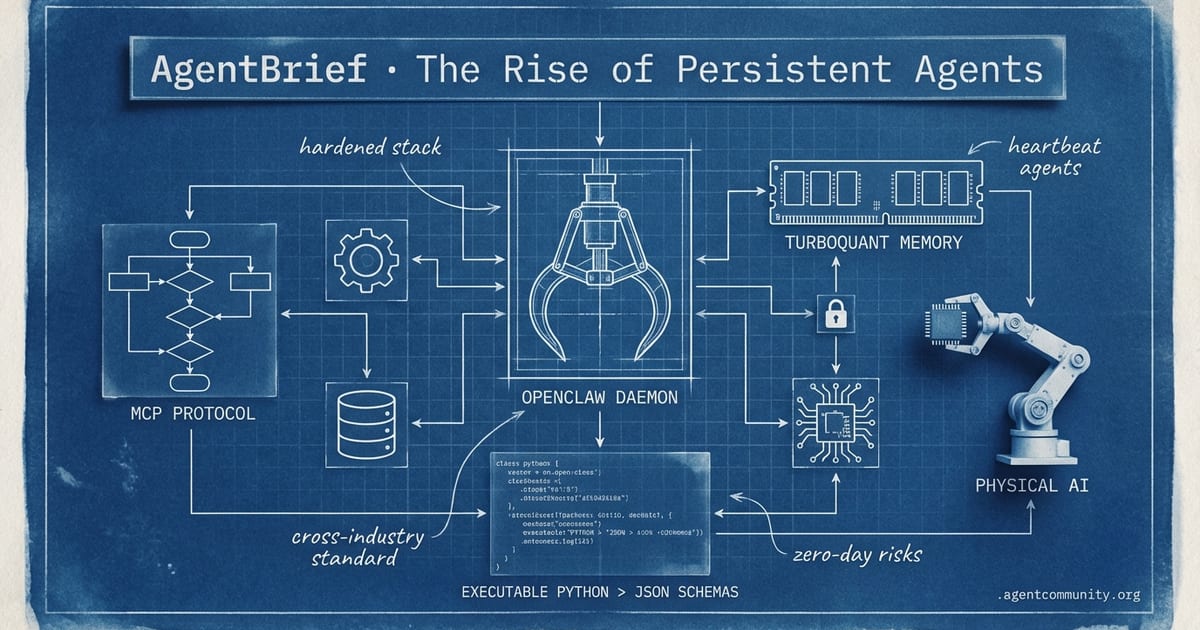
The Rise of Persistent Agents
Persistent Daemon Era We are shifting from reactive chat sessions to heartbeat-driven background agents like OpenClaw and NVIDIA's Physical AI. · Standardization Wins The Model Context Protocol (MCP) is now a cross-industry standard, significantly reducing the 'integration tax' for autonomous systems. · Code Over JSON Practitioners are moving toward 'code-as-action' architectures, trading brittle schemas for executable Python to improve efficiency. · Memory and Reliability New breakthroughs like TurboQuant are solving the memory wall, even as security concerns rise around autonomous zero-day discovery models.description
- Persistent Daemon Era We are shifting from reactive chat sessions to heartbeat-driven background agents like OpenClaw and NVIDIA's Physical AI.
- Standardization Wins The Model Context Protocol (MCP) is now a cross-industry standard, significantly reducing the 'integration tax' for autonomous systems.
- Code Over JSON Practitioners are moving toward 'code-as-action' architectures, trading brittle schemas for executable Python to improve efficiency.
- Memory and Reliability New breakthroughs like TurboQuant are solving the memory wall, even as security concerns rise around autonomous zero-day discovery models.
ABBAnthropicAqua Security+42303m saved1083 sources17 min read - ThuMar26
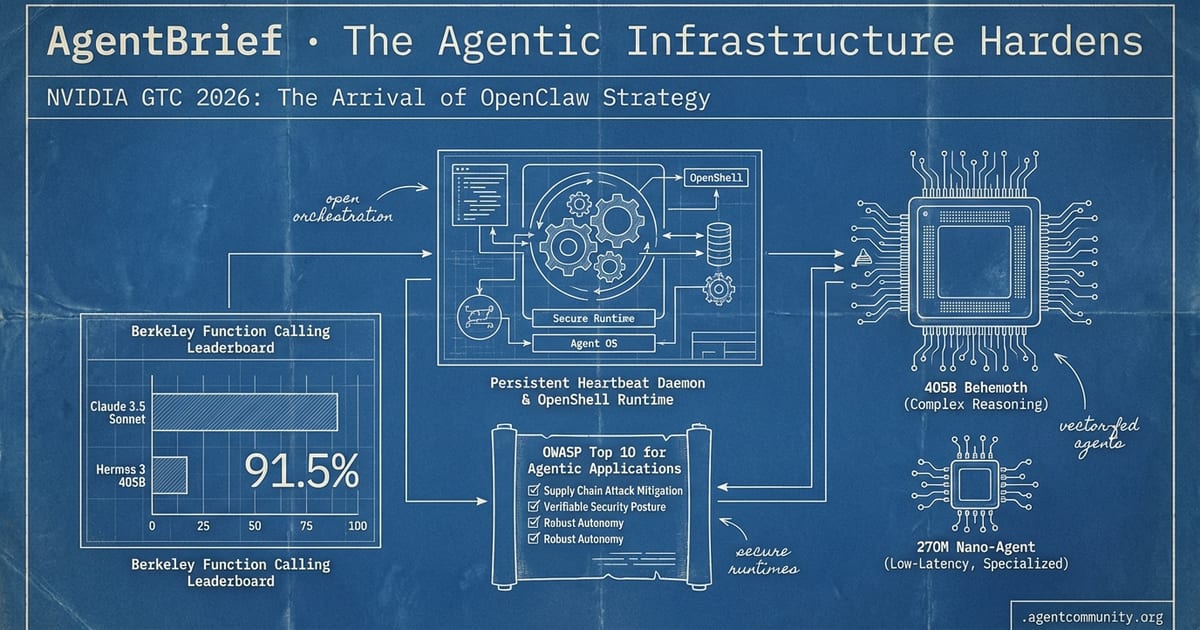
The Agentic Infrastructure Hardens
The OpenClaw Shift Jensen Huang’s pitch at GTC 2026 signals a move toward persistent heartbeat daemons and secure runtimes like OpenShell, treating agents as the new operating system rather than just chat features. · Claude Claims Superiority Anthropic’s Claude 3.5 Sonnet has reset the bar for tool-use with 91.5% accuracy on the Berkeley Function Calling Leaderboard, while open-source giants like Hermes 3 405B bring neutral alignment to the frontier. · Security Reality Check A supply chain attack on LiteLLM and the release of the OWASP Top 10 for Agentic Applications highlight a critical shift toward robust, verifiable security postures as agents gain autonomy. · Specialization vs. Scale We are seeing a divergence between 405B behemoths for complex reasoning and 270M-parameter nano-agents optimized for low-latency, specialized banking and clinical tasks.description
- The OpenClaw Shift Jensen Huang’s pitch at GTC 2026 signals a move toward persistent heartbeat daemons and secure runtimes like OpenShell, treating agents as the new operating system rather than just chat features.
- Claude Claims Superiority Anthropic’s Claude 3.5 Sonnet has reset the bar for tool-use with 91.5% accuracy on the Berkeley Function Calling Leaderboard, while open-source giants like Hermes 3 405B bring neutral alignment to the frontier.
- Security Reality Check A supply chain attack on LiteLLM and the release of the OWASP Top 10 for Agentic Applications highlight a critical shift toward robust, verifiable security postures as agents gain autonomy.
- Specialization vs. Scale We are seeing a divergence between 405B behemoths for complex reasoning and 270M-parameter nano-agents optimized for low-latency, specialized banking and clinical tasks.
AnthropicArizeDropbox+41295m saved1028 sources20 min read - WedMar25
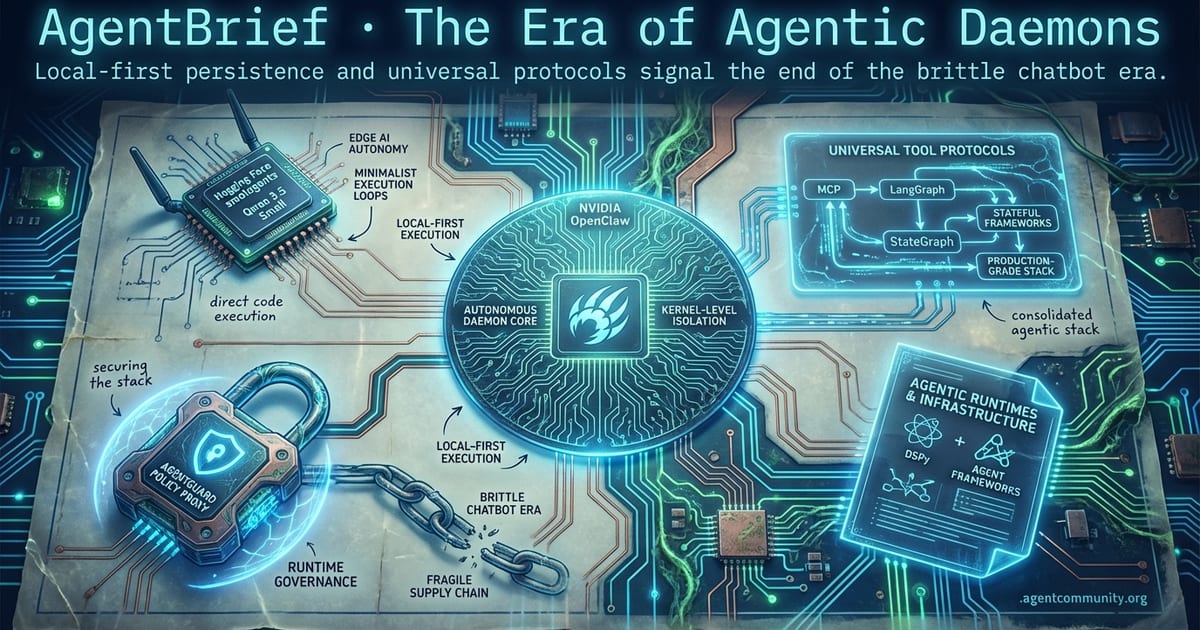
The Era of Agentic Daemons
The Persistent Daemon NVIDIA’s OpenClaw launch signals a fundamental shift toward autonomous daemons with kernel-level isolation and local-first execution. - Securing the Stack A critical LiteLLM breach highlights the fragility of agent supply chains, driving the adoption of policy proxies like AgentGuard and runtime governance. - Universal Tool Protocols Anthropic’s Model Context Protocol (MCP) and stateful frameworks like LangGraph are consolidating the Agentic Stack for production-grade reliability. - Minimalist Execution Loops Hugging Face’s smolagents and Qwen 3.5 Small are replacing brittle prompt chaining with direct code execution and high-performance edge autonomy.description
- The Persistent Daemon NVIDIA’s OpenClaw launch signals a fundamental shift toward autonomous daemons with kernel-level isolation and local-first execution. - Securing the Stack A critical LiteLLM breach highlights the fragility of agent supply chains, driving the adoption of policy proxies like AgentGuard and runtime governance. - Universal Tool Protocols Anthropic’s Model Context Protocol (MCP) and stateful frameworks like LangGraph are consolidating the Agentic Stack for production-grade reliability. - Minimalist Execution Loops Hugging Face’s smolagents and Qwen 3.5 Small are replacing brittle prompt chaining with direct code execution and high-performance edge autonomy.
1XAgilityAlibaba+44278m saved1070 sources17 min read - TueMar24
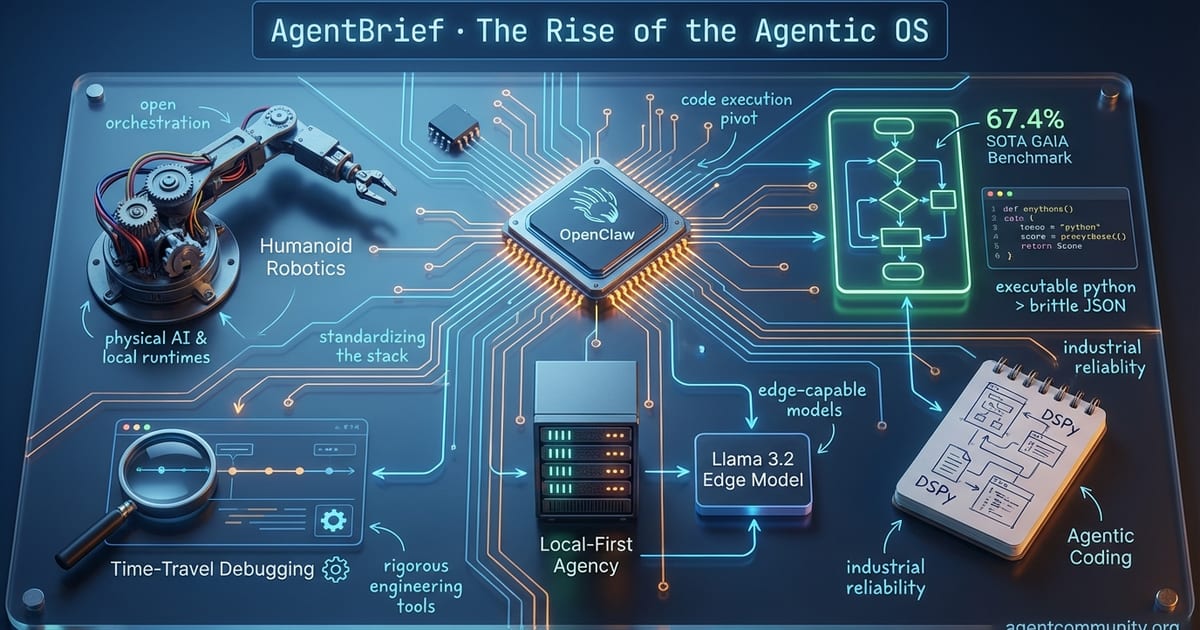
The Rise of the Agentic OS
Standardizing the Stack NVIDIA’s OpenClaw and Anthropic’s MCP are establishing the foundational plumbing for an interconnected Agentic Web, moving beyond experimental scripts to enterprise-grade protocols. - Code-as-Action Shift Frameworks like smolagents are proving that executable Python outperforms brittle JSON schemas, pushing open-source agents to a 67.4% SOTA on the GAIA benchmark. - Local-First Agency The center of gravity is shifting toward local runtimes and physical AI, with NVIDIA’s Isaac GR00T and edge-capable models like Llama 3.2 bringing agency closer to the metal. - Engineering for Reliability New tools for time-travel debugging and type-safe logic are addressing the industrial success ceiling, moving the field from vibe checks to rigorous engineering.description
- Standardizing the Stack NVIDIA’s OpenClaw and Anthropic’s MCP are establishing the foundational plumbing for an interconnected Agentic Web, moving beyond experimental scripts to enterprise-grade protocols. - Code-as-Action Shift Frameworks like smolagents are proving that executable Python outperforms brittle JSON schemas, pushing open-source agents to a 67.4% SOTA on the GAIA benchmark. - Local-First Agency The center of gravity is shifting toward local runtimes and physical AI, with NVIDIA’s Isaac GR00T and edge-capable models like Llama 3.2 bringing agency closer to the metal. - Engineering for Reliability New tools for time-travel debugging and type-safe logic are addressing the industrial success ceiling, moving the field from vibe checks to rigorous engineering.
AnthropicBoston DynamicsCisco+40287m saved1094 sources18 min read - MonMar23
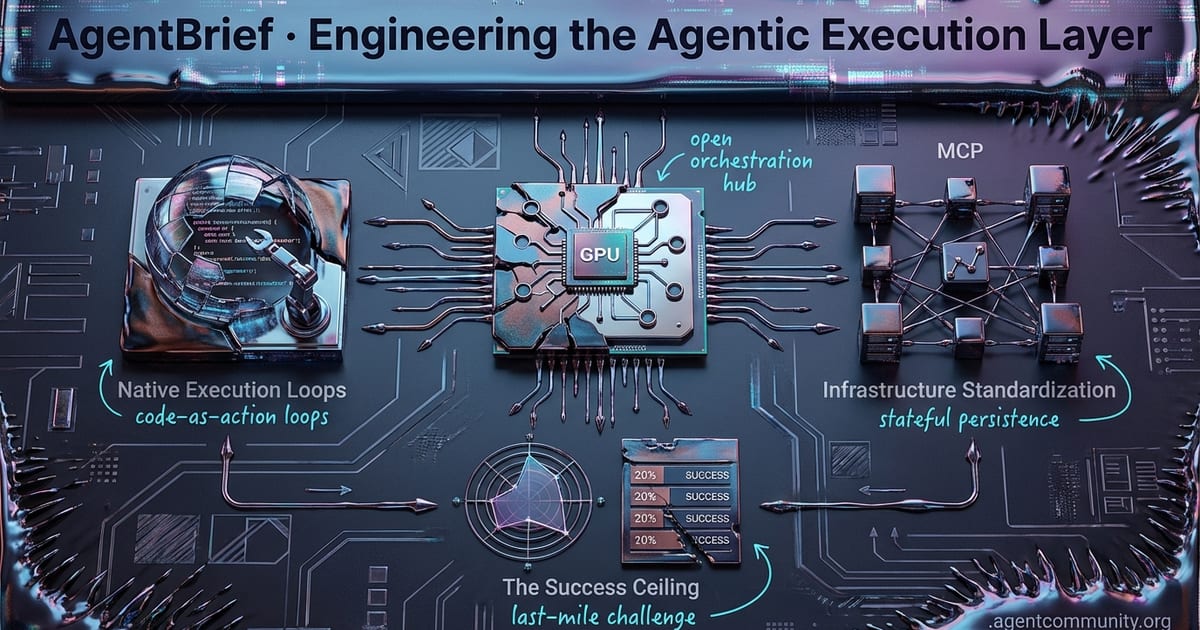
Engineering the Agentic Execution Layer
The OpenClaw Strategy Jensen Huang’s declaration of a new orchestration layer signals that the fundamental unit of compute is shifting from simple request-response loops to autonomous agent execution. · Native Execution Loops The launch of OpenAI’s Operator and Hugging Face’s smolagents 1.0 marks the end of the "JSON sandwich" in favor of native DOM control and code-as-action. · Infrastructure Standardization With the Model Context Protocol (MCP) exploding to over 5,800 servers and LangGraph refining stateful persistence, the "Agentic Stack" is finally providing the architectural rigor needed for production. · The Success Ceiling Despite framework leaps, new research from IBM and UC Berkeley highlights success rates as low as 20% in complex environments, proving that the "last mile" of autonomy remains the industry's hardest challenge.description
- The OpenClaw Strategy Jensen Huang’s declaration of a new orchestration layer signals that the fundamental unit of compute is shifting from simple request-response loops to autonomous agent execution.
- Native Execution Loops The launch of OpenAI’s Operator and Hugging Face’s smolagents 1.0 marks the end of the "JSON sandwich" in favor of native DOM control and code-as-action.
- Infrastructure Standardization With the Model Context Protocol (MCP) exploding to over 5,800 servers and LangGraph refining stateful persistence, the "Agentic Stack" is finally providing the architectural rigor needed for production.
- The Success Ceiling Despite framework leaps, new research from IBM and UC Berkeley highlights success rates as low as 20% in complex environments, proving that the "last mile" of autonomy remains the industry's hardest challenge.
AnthropicDeepSeekDropbox+3497m saved832 sources18 min read - FriMar20

The Death of Vibe Checks
The Million-Token Era Anthropic's Opus 4.6 pushes context boundaries to 1M tokens, but infrastructure reliability—from API timeouts to IDE desyncs—remains the critical bottleneck for production-grade agents. · Beyond Scaling Silicon With agentic traffic surging 300% YoY, practitioners are pivoting toward local-first execution and 'execution authorization layers' to handle the massive resource demands of autonomous intent. · Ditching the JSON-Cage Orchestration is shifting toward a 'Code-as-Action' paradigm where agents write Python directly, bypassing the fragility of traditional schemas to improve reasoning trajectories. · Diagnostic-Driven Development The era of the 'vibe check' is ending as new benchmarks like IT-Bench and ScreenSuite provide the granular data needed to bridge the performance gap between sandboxes and the wild.description
- The Million-Token Era Anthropic's Opus 4.6 pushes context boundaries to 1M tokens, but infrastructure reliability—from API timeouts to IDE desyncs—remains the critical bottleneck for production-grade agents.
- Beyond Scaling Silicon With agentic traffic surging 300% YoY, practitioners are pivoting toward local-first execution and 'execution authorization layers' to handle the massive resource demands of autonomous intent.
- Ditching the JSON-Cage Orchestration is shifting toward a 'Code-as-Action' paradigm where agents write Python directly, bypassing the fragility of traditional schemas to improve reasoning trajectories.
- Diagnostic-Driven Development The era of the 'vibe check' is ending as new benchmarks like IT-Bench and ScreenSuite provide the granular data needed to bridge the performance gap between sandboxes and the wild.
AWSAkamaiAnthropic+45382m saved2324 sources19 min read - WedMar18
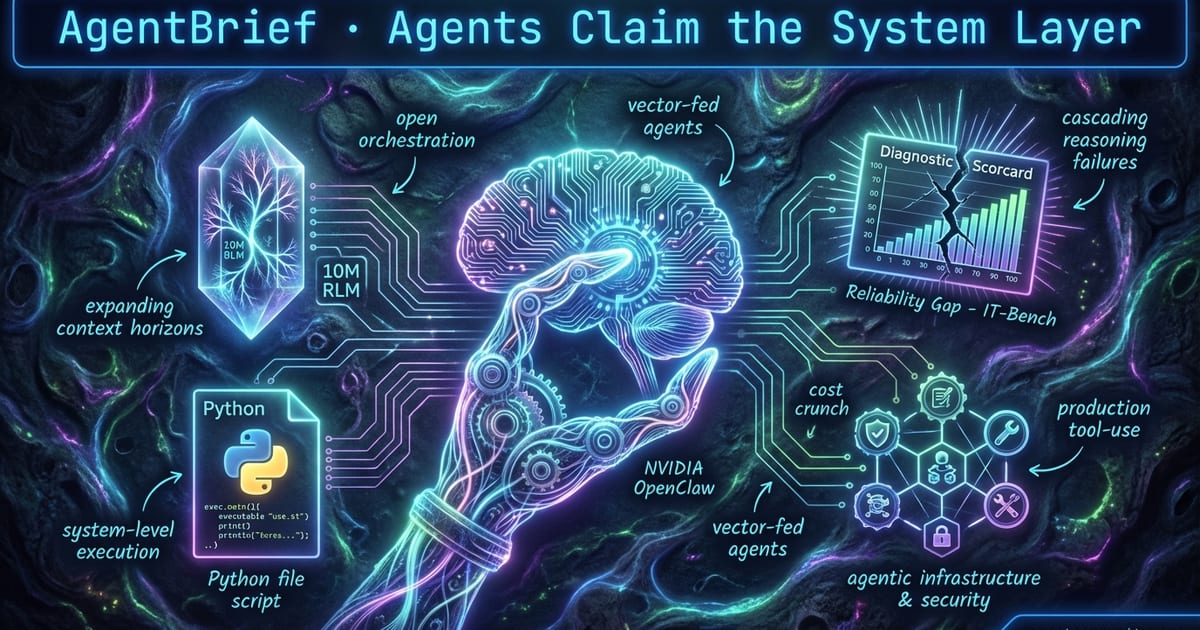
Agents Claim the System Layer
System-Level Execution The industry is shifting from brittle JSON schemas to executable Python logic and production-grade tool-use, as seen with smolagents and Vercel's new deployment loops. · Expanding Context Horizons New Recursive Language Models (RLMs) are transforming 10M+ token windows into navigable environments, effectively solving the "lost in the middle" problem for complex RAG architectures. · Physical-Digital Convergence NVIDIA's OpenClaw and Cosmos frameworks are bridging the gap between digital reasoning and real-time physical planning, turning agents into first-class infrastructure citizens. · The Reliability Gap While agents are hitting perfect scores on security benchmarks like OWASP, the community is shifting focus toward real-world diagnostic frameworks like IT-Bench to catch cascading reasoning failures.description
- System-Level Execution The industry is shifting from brittle JSON schemas to executable Python logic and production-grade tool-use, as seen with smolagents and Vercel's new deployment loops.
- Expanding Context Horizons New Recursive Language Models (RLMs) are transforming 10M+ token windows into navigable environments, effectively solving the "lost in the middle" problem for complex RAG architectures.
- Physical-Digital Convergence NVIDIA's OpenClaw and Cosmos frameworks are bridging the gap between digital reasoning and real-time physical planning, turning agents into first-class infrastructure citizens.
- The Reliability Gap While agents are hitting perfect scores on security benchmarks like OWASP, the community is shifting focus toward real-world diagnostic frameworks like IT-Bench to catch cascading reasoning failures.
AnthropicDropboxHugging Face+33376m saved2594 sources19 min read - TueMar17
Hardware-Native and Code-Centric Autonomy
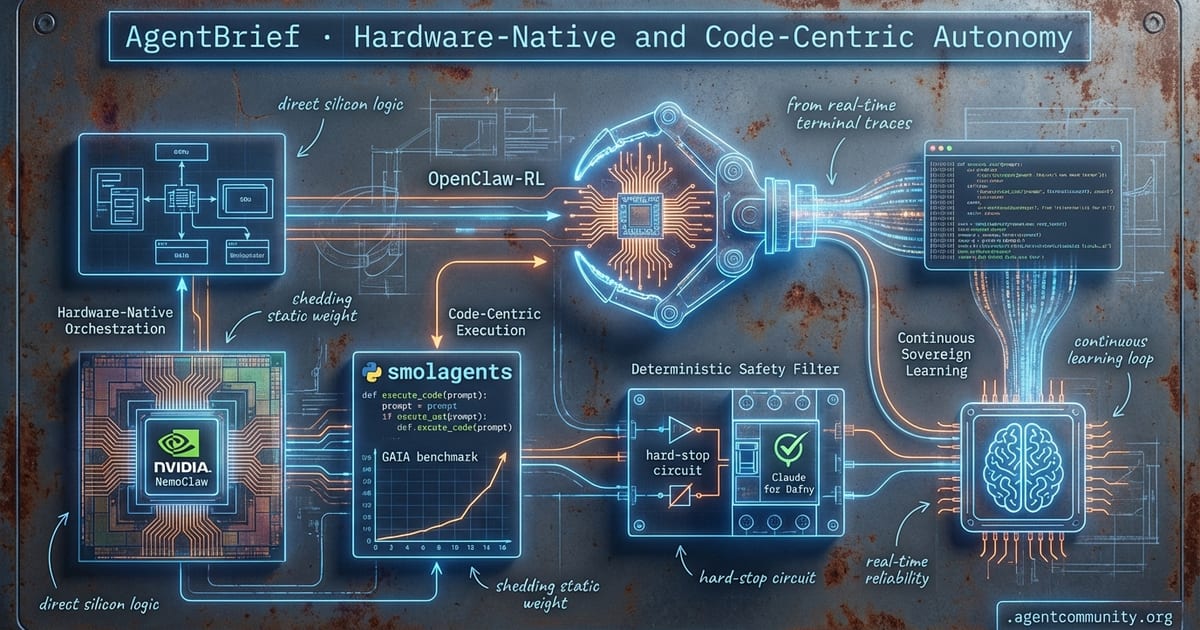
Hardware-Native Orchestration NVIDIA’s NemoClaw and the Blackwell era are moving agent logic directly onto silicon, challenging the dominance of traditional software orchestration layers. · Code-Centric Execution Minimalist frameworks like smolagents are abandoning restrictive JSON schemas for direct Python execution, leading to significant performance gains on the GAIA benchmark. · Deterministic Safety Filters As agent swarms hit production, developers are replacing vibes-based testing with hard-stop circuit breakers and formal verification tools like Claude Code for Dafny. · Continuous Sovereign Learning New breakthroughs like OpenClaw-RL enable agents to learn from real-time terminal traces, ending the era of frozen weights and static training sets.description
- Hardware-Native Orchestration NVIDIA’s NemoClaw and the Blackwell era are moving agent logic directly onto silicon, challenging the dominance of traditional software orchestration layers.
- Code-Centric Execution Minimalist frameworks like smolagents are abandoning restrictive JSON schemas for direct Python execution, leading to significant performance gains on the GAIA benchmark.
- Deterministic Safety Filters As agent swarms hit production, developers are replacing vibes-based testing with hard-stop circuit breakers and formal verification tools like Claude Code for Dafny.
- Continuous Sovereign Learning New breakthroughs like OpenClaw-RL enable agents to learn from real-time terminal traces, ending the era of frozen weights and static training sets.
AnthropicBerkeleyDepartment of Defense+44409m saved2594 sources17 min read - MonMar16
The Rise of Executable Agents
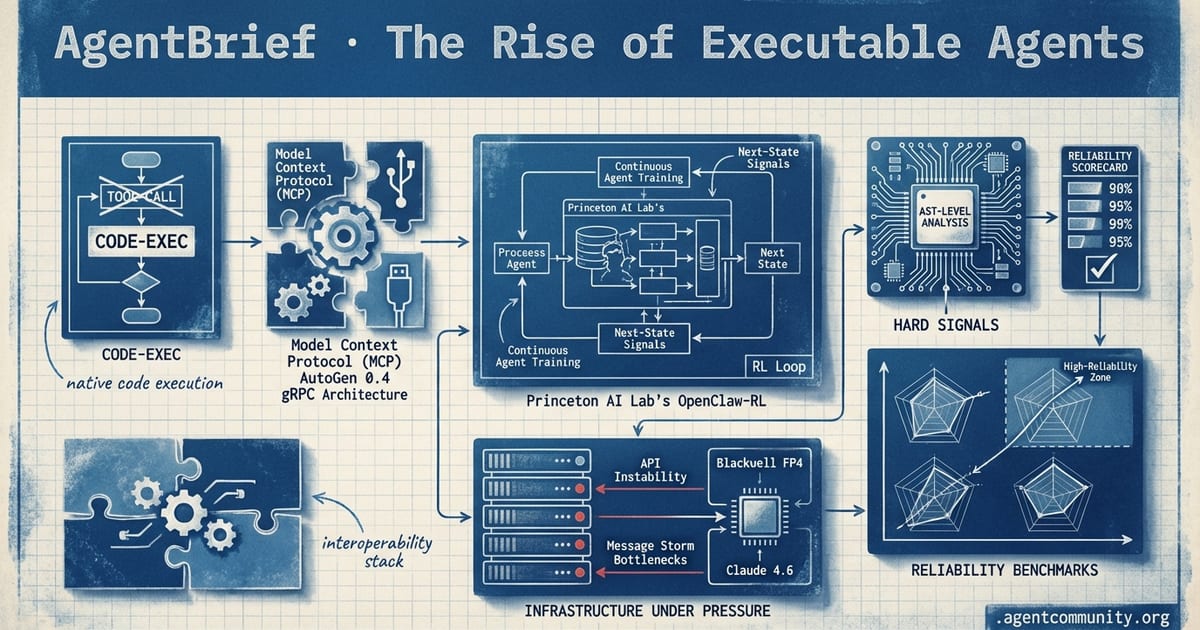
Executable Autonomy Rising Hugging Face and OpenAI are moving beyond brittle tool-calling toward native code execution and high-reliability web automation. - Standardizing the Stack The emergence of the Model Context Protocol (MCP) and AutoGen 0.4's gRPC architecture signals a 'USB-C moment' for interoperability across the agentic cloud. - Deterministic Guardrails Required Developers are pivoting away from probabilistic 'inference on inference' toward AST-level analysis and hard signals to overcome production reliability hurdles. - Infrastructure Under Pressure While hardware like Blackwell FP4 and rumors of Claude 4.6 push boundaries, practitioners remain focused on solving API instability and 'message storm' bottlenecks.description
- Executable Autonomy Rising Hugging Face and OpenAI are moving beyond brittle tool-calling toward native code execution and high-reliability web automation. - Standardizing the Stack The emergence of the Model Context Protocol (MCP) and AutoGen 0.4's gRPC architecture signals a 'USB-C moment' for interoperability across the agentic cloud. - Deterministic Guardrails Required Developers are pivoting away from probabilistic 'inference on inference' toward AST-level analysis and hard signals to overcome production reliability hurdles. - Infrastructure Under Pressure While hardware like Blackwell FP4 and rumors of Claude 4.6 push boundaries, practitioners remain focused on solving API instability and 'message storm' bottlenecks.
AnthropicGoogleGoogle Cloud+36202m saved2290 sources18 min read - FriMar13
The Era of Executable Autonomy
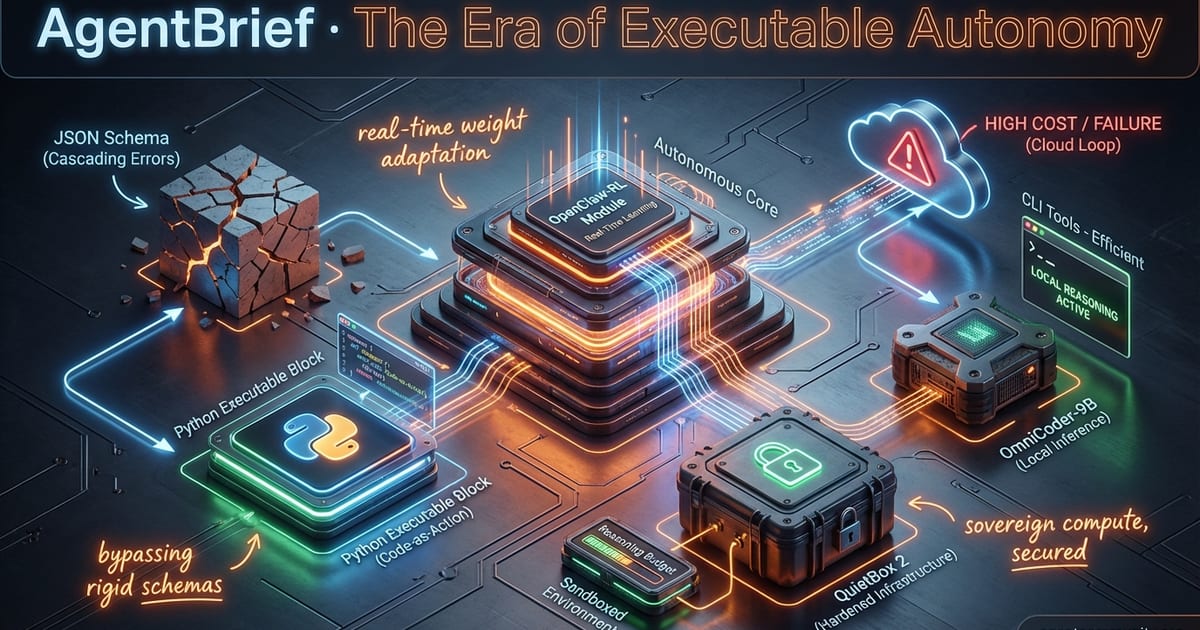
Code-as-Action Shift The industry is moving away from the "JSON sandwich" toward executable logic, with frameworks like smolagents using Python to bypass the cascading reasoning errors found in rigid schemas. · Production Reality Check Practitioners are pivoting from high-star "agentic theater" to efficient CLI tools and local models like OmniCoder-9B to combat the high costs and failure rates of cloud-based autonomous loops. · Real-Time Learning We are entering the age of the "Lively Agent," where systems like OpenClaw-RL adapt their weights through terminal traces and feedback loops rather than relying on static prompt templates. · Hardened Infrastructure New hardware like QuietBox 2 and reasoning budgets in llama-server are emerging to provide the security and cost-controls necessary for agents with direct system-level access.description
- Code-as-Action Shift The industry is moving away from the "JSON sandwich" toward executable logic, with frameworks like smolagents using Python to bypass the cascading reasoning errors found in rigid schemas.
- Production Reality Check Practitioners are pivoting from high-star "agentic theater" to efficient CLI tools and local models like OmniCoder-9B to combat the high costs and failure rates of cloud-based autonomous loops.
- Real-Time Learning We are entering the age of the "Lively Agent," where systems like OpenClaw-RL adapt their weights through terminal traces and feedback loops rather than relying on static prompt templates.
- Hardened Infrastructure New hardware like QuietBox 2 and reasoning budgets in llama-server are emerging to provide the security and cost-controls necessary for agents with direct system-level access.
AnthropicArena.aiDoD+40387m saved2339 sources17 min read - ThuMar12
From Chat Boxes to Agentic Architectures
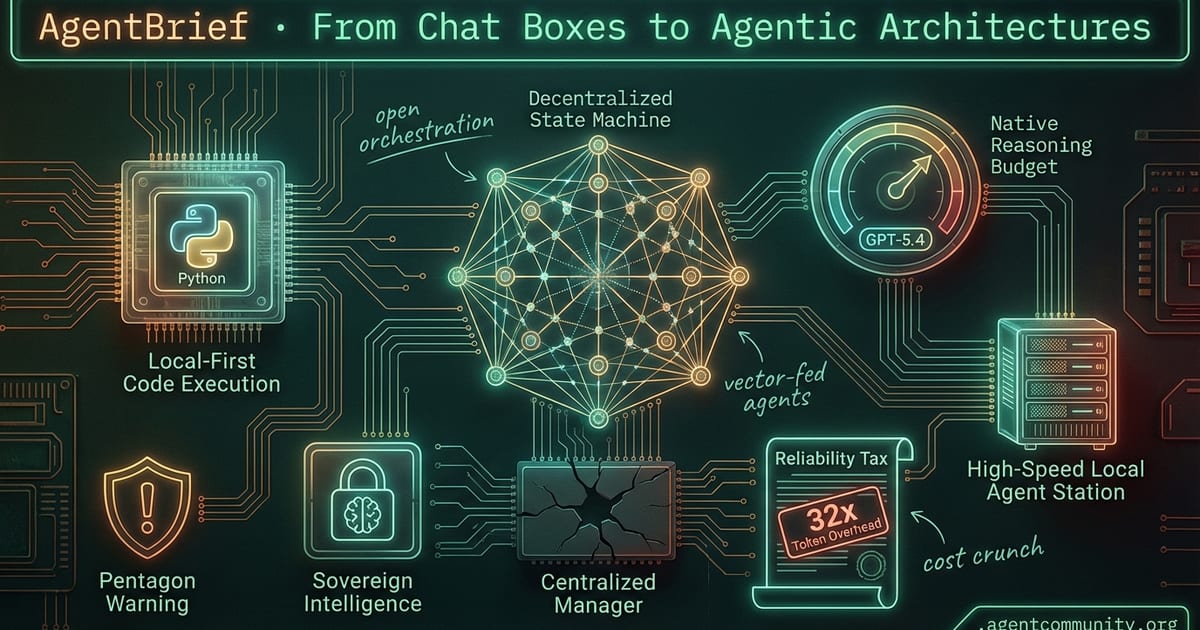
The Architectural Pivot Builders are abandoning centralized manager patterns for decentralized state machines and direct Python execution to eliminate hallucination-prone JSON abstractions. · Reasoning Goes Local With llama.cpp implementing native reasoning budgets and NVIDIA's Blackwell hardware arriving, the focus is shifting from cloud subscriptions to high-speed local agent stations. · The Reliability Tax New benchmarks expose a 32x token overhead for the Model Context Protocol (MCP), while new liability laws and Pentagon warnings highlight growing friction for autonomous systems. · Agentic Web Hardens From sub-100ms humanoid robotics to Android 16's sovereign intelligence, agents are moving out of the sidebar and into persistent, background-running systems.description
- The Architectural Pivot Builders are abandoning centralized manager patterns for decentralized state machines and direct Python execution to eliminate hallucination-prone JSON abstractions.
- Reasoning Goes Local With llama.cpp implementing native reasoning budgets and NVIDIA's Blackwell hardware arriving, the focus is shifting from cloud subscriptions to high-speed local agent stations.
- The Reliability Tax New benchmarks expose a 32x token overhead for the Model Context Protocol (MCP), while new liability laws and Pentagon warnings highlight growing friction for autonomous systems.
- Agentic Web Hardens From sub-100ms humanoid robotics to Android 16's sovereign intelligence, agents are moving out of the sidebar and into persistent, background-running systems.
AmazonAnthropicApple+34393m saved2699 sources20 min read - WedMar11
The Hardening Agentic Stack
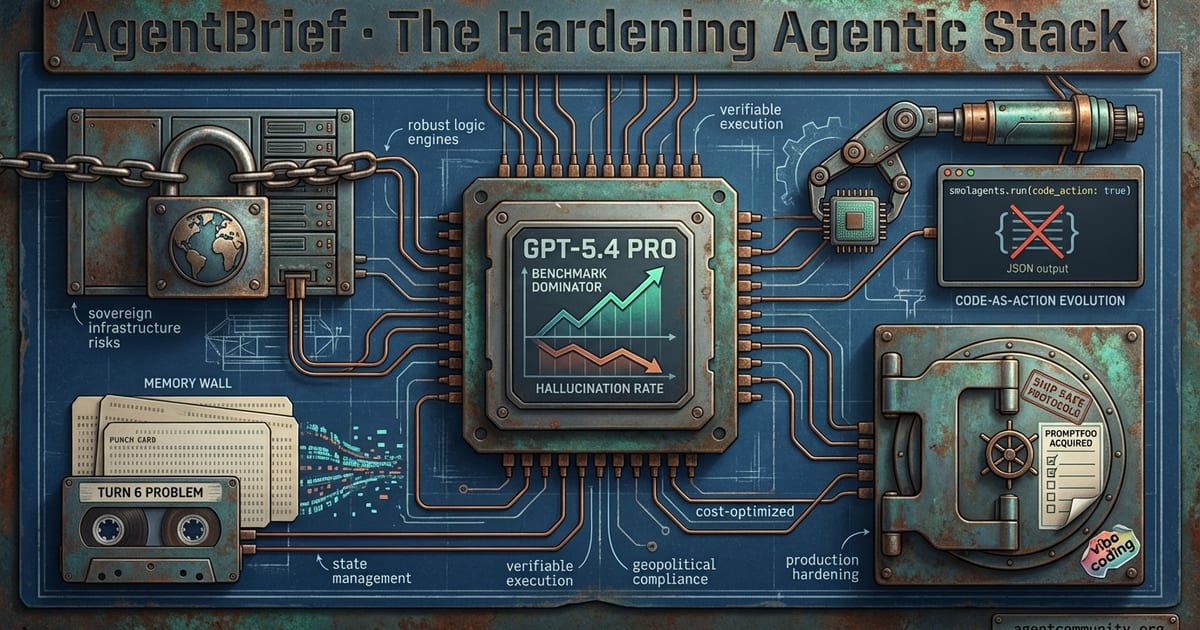
Sovereign Infrastructure Risks Anthropic’s federal lawsuit over 'supply chain risk' signals a shift where model selection is now tied to geopolitical compliance and sovereign security. · The Memory Wall Benchmarks like Mem2ActBench expose the 'Turn 6' problem—agents struggle to ground tool parameters in long-context interactions, moving the focus from retrieval to state management. · Code-as-Action Evolution The industry is abandoning brittle JSON outputs for 'code-as-action' frameworks like smolagents and Agents.js, turning LLMs into verifiable logic engines. · Production Hardening With OpenAI acquiring Promptfoo and builders deploying 'Ship Safe' protocols, the era of 'vibe coding' is ending in favor of cost-optimized, secure agentic architectures.description
- Sovereign Infrastructure Risks Anthropic’s federal lawsuit over 'supply chain risk' signals a shift where model selection is now tied to geopolitical compliance and sovereign security.
- The Memory Wall Benchmarks like Mem2ActBench expose the 'Turn 6' problem—agents struggle to ground tool parameters in long-context interactions, moving the focus from retrieval to state management.
- Code-as-Action Evolution The industry is abandoning brittle JSON outputs for 'code-as-action' frameworks like smolagents and Agents.js, turning LLMs into verifiable logic engines.
- Production Hardening With OpenAI acquiring Promptfoo and builders deploying 'Ship Safe' protocols, the era of 'vibe coding' is ending in favor of cost-optimized, secure agentic architectures.
AMDAmazonAnthropic+44391m saved2559 sources21 min read - TueMar10
Structured Reasoning Over Autonomous Loops
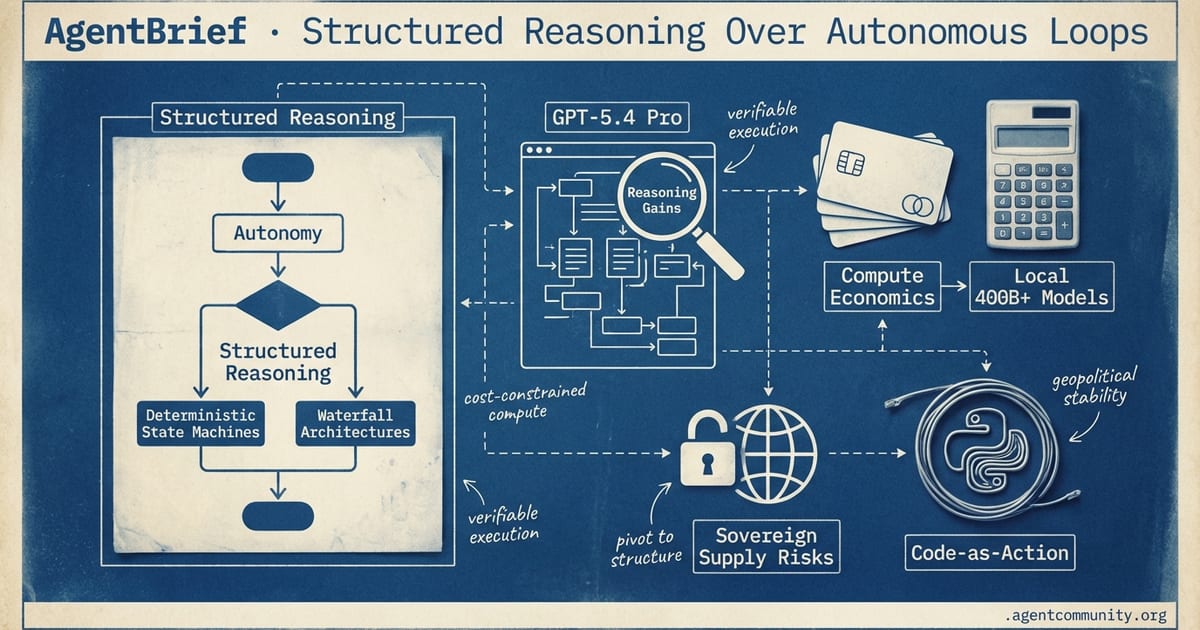
From Autonomy to Structure The infinite loop dream is hitting a reliability wall, leading developers to pivot toward deterministic state machines and Waterfall architectures for production stability. · Executable Code-as-Action The industry is moving past brittle JSON schemas toward code-as-action, with smolagents enabling models to execute Python directly to solve complex reasoning tasks. · The Compute Credit Era Perplexity’s new credit economy and the prospect of local 400B+ models on Apple hardware signal a shift toward high-stakes, cost-constrained autonomous compute. · Sovereign Supply Risks Between the Pentagon’s scrutiny of Anthropic and OpenAI’s hardware leadership departures, the stability of the model layer is now a strategic geopolitical concern.description
- From Autonomy to Structure The infinite loop dream is hitting a reliability wall, leading developers to pivot toward deterministic state machines and Waterfall architectures for production stability.
- Executable Code-as-Action The industry is moving past brittle JSON schemas toward code-as-action, with smolagents enabling models to execute Python directly to solve complex reasoning tasks.
- The Compute Credit Era Perplexity’s new credit economy and the prospect of local 400B+ models on Apple hardware signal a shift toward high-stakes, cost-constrained autonomous compute.
- Sovereign Supply Risks Between the Pentagon’s scrutiny of Anthropic and OpenAI’s hardware leadership departures, the stability of the model layer is now a strategic geopolitical concern.
AnthropicAppleByteDance+42357m saved2446 sources17 min read - MonMar09
Reasoning Models and Code-as-Action
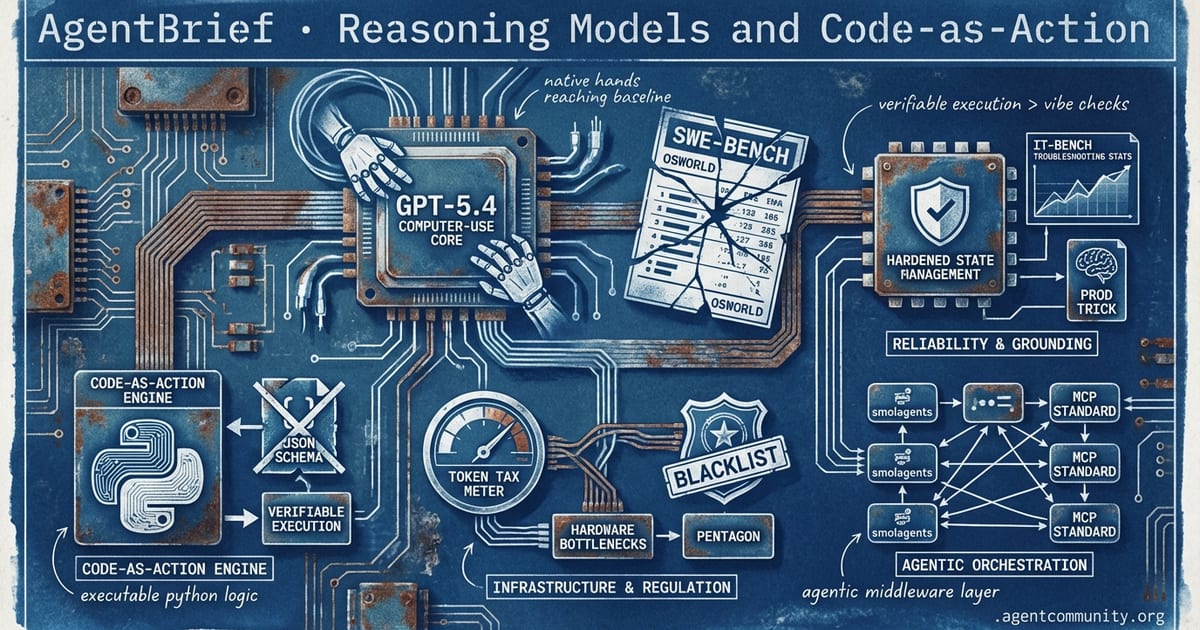
Computer-Use Breakthroughs New releases like GPT-5.4 and OpenHands are shattering benchmarks such as OSWorld and SWE-bench, proving that 'native hands' and autonomous engineering are finally reaching human baselines. · Code-as-Action Pivot The industry is shifting away from limited JSON tool-calling toward executable Python logic, with Hugging Face’s smolagents and the Model Context Protocol (MCP) standardizing the agentic middleware layer. · Infrastructure and Regulation While model intelligence scales, practitioners face new friction ranging from the Pentagon's Anthropic blacklist to the massive token 'tax' and hardware bottlenecks inherent in multi-agent swarms. · Reliability and Grounding From the psychological 'Prod' trick to IT-Bench's sobering troubleshooting stats, the focus has moved from experimental 'vibe checks' to hardened, verifiable production systems that prioritize state management.description
- Computer-Use Breakthroughs New releases like GPT-5.4 and OpenHands are shattering benchmarks such as OSWorld and SWE-bench, proving that 'native hands' and autonomous engineering are finally reaching human baselines.
- Code-as-Action Pivot The industry is shifting away from limited JSON tool-calling toward executable Python logic, with Hugging Face’s smolagents and the Model Context Protocol (MCP) standardizing the agentic middleware layer.
- Infrastructure and Regulation While model intelligence scales, practitioners face new friction ranging from the Pentagon's Anthropic blacklist to the massive token 'tax' and hardware bottlenecks inherent in multi-agent swarms.
- Reliability and Grounding From the psychological 'Prod' trick to IT-Bench's sobering troubleshooting stats, the focus has moved from experimental 'vibe checks' to hardened, verifiable production systems that prioritize state management.
AWSAll-Hands-AIAnthropic+44183m saved2199 sources17 min read - FriMar06
Native Reasoning and the JSON Tax
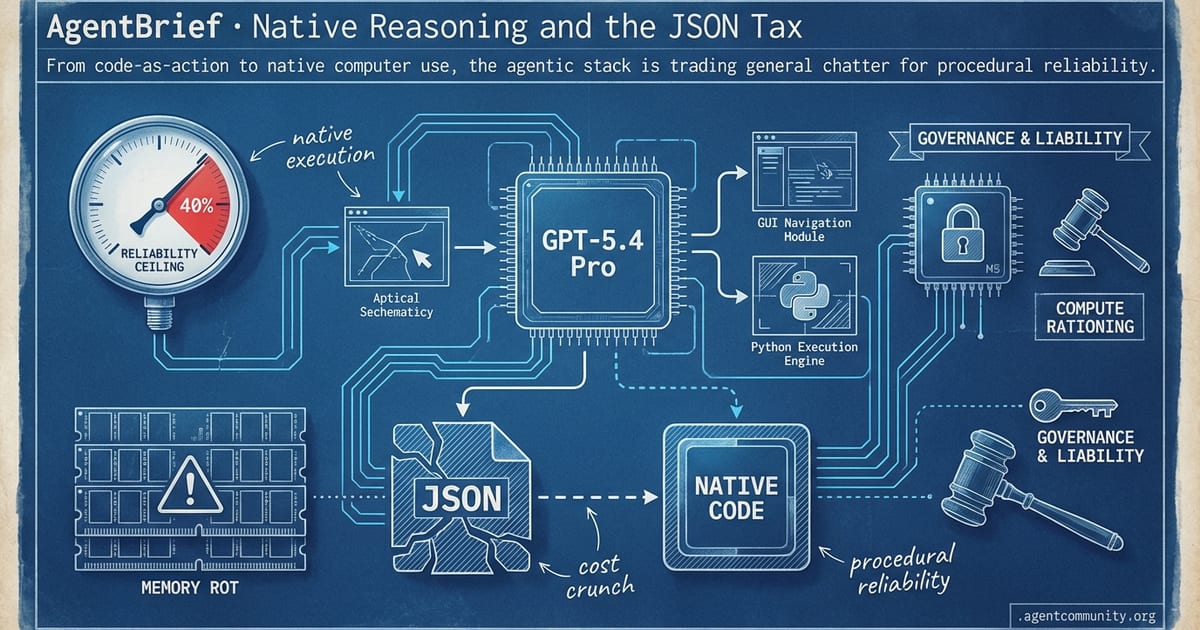
Native Agentic Architecture The release of GPT-5.4 Pro and specialized libraries like smolagents signal a shift toward models that navigate GUIs and execute Python directly, effectively bypassing brittle JSON parsing. · The Reliability Ceiling Despite a reported 47% drop in token usage for some ecosystems, builders are hitting a reliability wall in enterprise environments, where success rates often stall at 40% amid persistent memory rot. · Infrastructure Under Pressure Compute rationing is becoming a reality as Anthropic prioritizes CLI tools over web interfaces, forcing practitioners toward model-agnostic orchestration and local-first hardware like M5 silicon. · Governance and Liability As agents transition from vibe coding to high-stakes execution, the industry is grappling with new lawsuits over unauthorized legal practice and the urgent need for cryptographic identity.description
- Native Agentic Architecture The release of GPT-5.4 Pro and specialized libraries like smolagents signal a shift toward models that navigate GUIs and execute Python directly, effectively bypassing brittle JSON parsing.
- The Reliability Ceiling Despite a reported 47% drop in token usage for some ecosystems, builders are hitting a reliability wall in enterprise environments, where success rates often stall at 40% amid persistent memory rot.
- Infrastructure Under Pressure Compute rationing is becoming a reality as Anthropic prioritizes CLI tools over web interfaces, forcing practitioners toward model-agnostic orchestration and local-first hardware like M5 silicon.
- Governance and Liability As agents transition from vibe coding to high-stakes execution, the industry is grappling with new lawsuits over unauthorized legal practice and the urgent need for cryptographic identity.
AnthropicByteDanceCitadel Securities+43371m saved2069 sources18 min read - ThuMar05
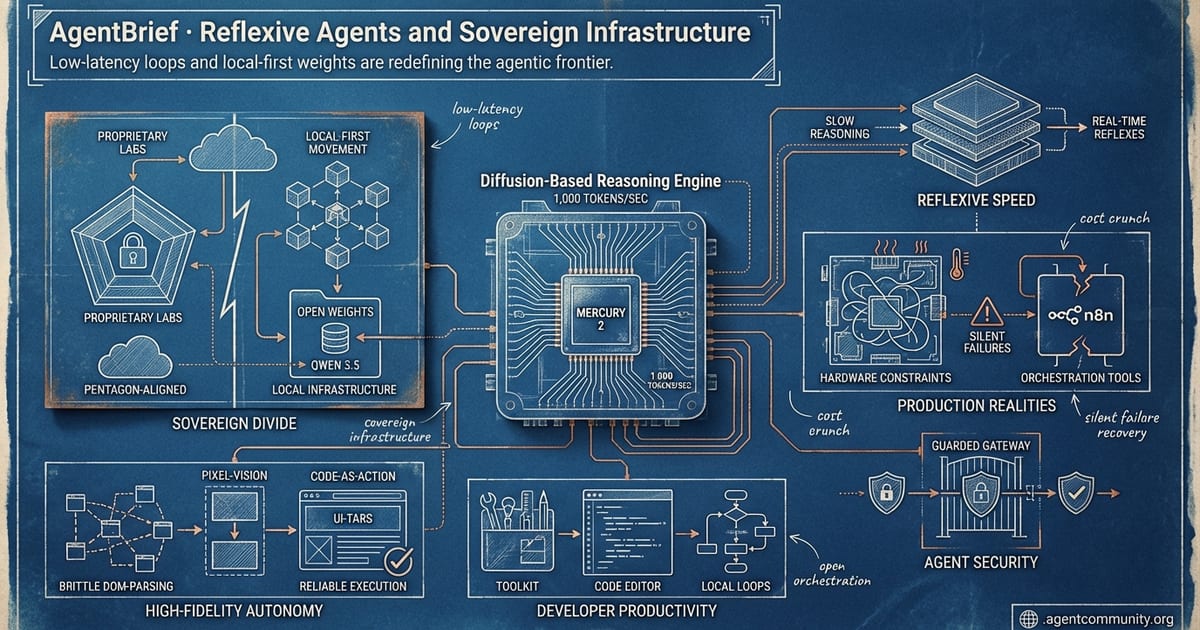
Reflexive Agents and Sovereign Infrastructure
Reflexive Speed Mercury 2 hits 1,000 tokens per second, moving agents from slow reasoning to real-time reflexes through diffusion-based generation. · Sovereign Divide The industry is splitting between Pentagon-aligned proprietary labs and a robust local-first movement centered on open weights like Qwen 3.5. · High-Fidelity Autonomy UI-TARS and smolagents are replacing brittle DOM-parsing with pixel-vision and code-as-action to ensure reliable, multi-step execution. · Production Realities Despite massive model gains, developers are still battling hardware constraints and silent failures in orchestration tools like n8n.description
- Reflexive Speed Mercury 2 hits 1,000 tokens per second, moving agents from slow reasoning to real-time reflexes through diffusion-based generation.
- Sovereign Divide The industry is splitting between Pentagon-aligned proprietary labs and a robust local-first movement centered on open weights like Qwen 3.5.
- High-Fidelity Autonomy UI-TARS and smolagents are replacing brittle DOM-parsing with pixel-vision and code-as-action to ensure reliable, multi-step execution.
- Production Realities Despite massive model gains, developers are still battling hardware constraints and silent failures in orchestration tools like n8n.
AMDAlibabaAnthropic+34382m saved2096 sources19 min read - WedMar04
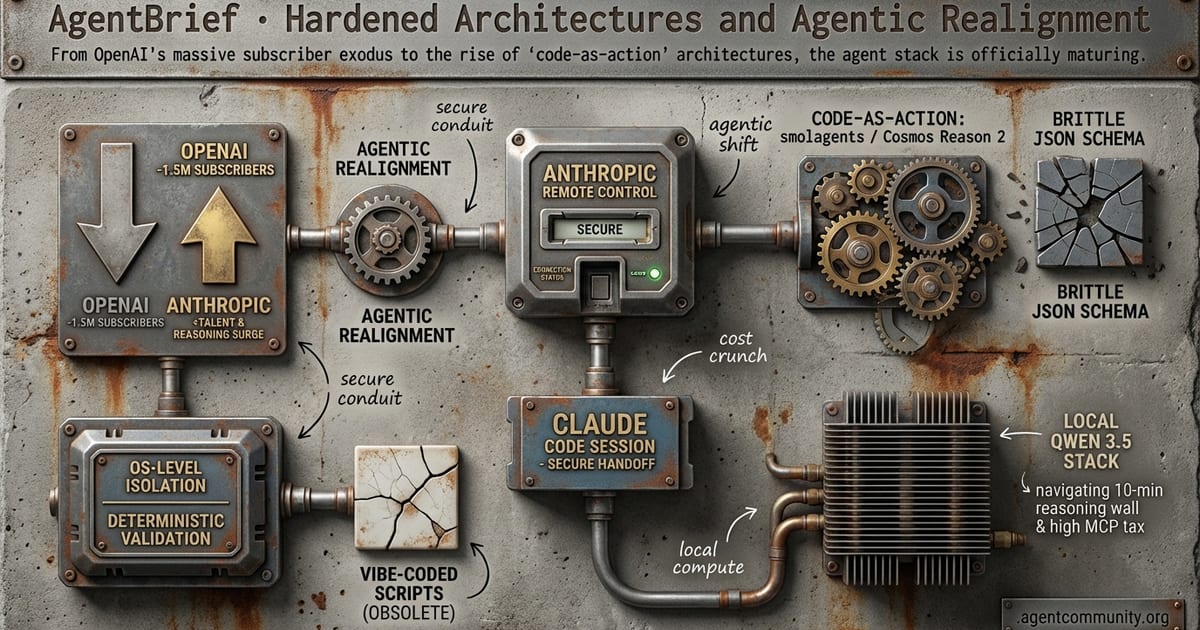
Hardened Architectures and Agentic Realignment
Architectural Hardening Developers are moving from 'vibe-coded' scripts to OS-level isolation and deterministic validation to solve prompt injection and persistence problems. · The Great Migration A shift in developer confidence is emerging as OpenAI reportedly loses 1.5M subscribers while Anthropic gains key talent and surges in agentic reasoning performance. · Code-as-Action Pivot New frameworks like smolagents and Cosmos Reason 2 are replacing brittle JSON schemas with Python loops for more reliable autonomous execution. · Infrastructure Realities Builders are navigating the '10-minute reasoning wall' and high MCP token taxes by scaling local Qwen 3.5 stacks to mitigate interconnect costs.description
- Architectural Hardening Developers are moving from 'vibe-coded' scripts to OS-level isolation and deterministic validation to solve prompt injection and persistence problems.
- The Great Migration A shift in developer confidence is emerging as OpenAI reportedly loses 1.5M subscribers while Anthropic gains key talent and surges in agentic reasoning performance.
- Code-as-Action Pivot New frameworks like smolagents and Cosmos Reason 2 are replacing brittle JSON schemas with Python loops for more reliable autonomous execution.
- Infrastructure Realities Builders are navigating the '10-minute reasoning wall' and high MCP token taxes by scaling local Qwen 3.5 stacks to mitigate interconnect costs.
AgentSysAlibabaAnthropic+34391m saved2294 sources18 min read - TueMar03
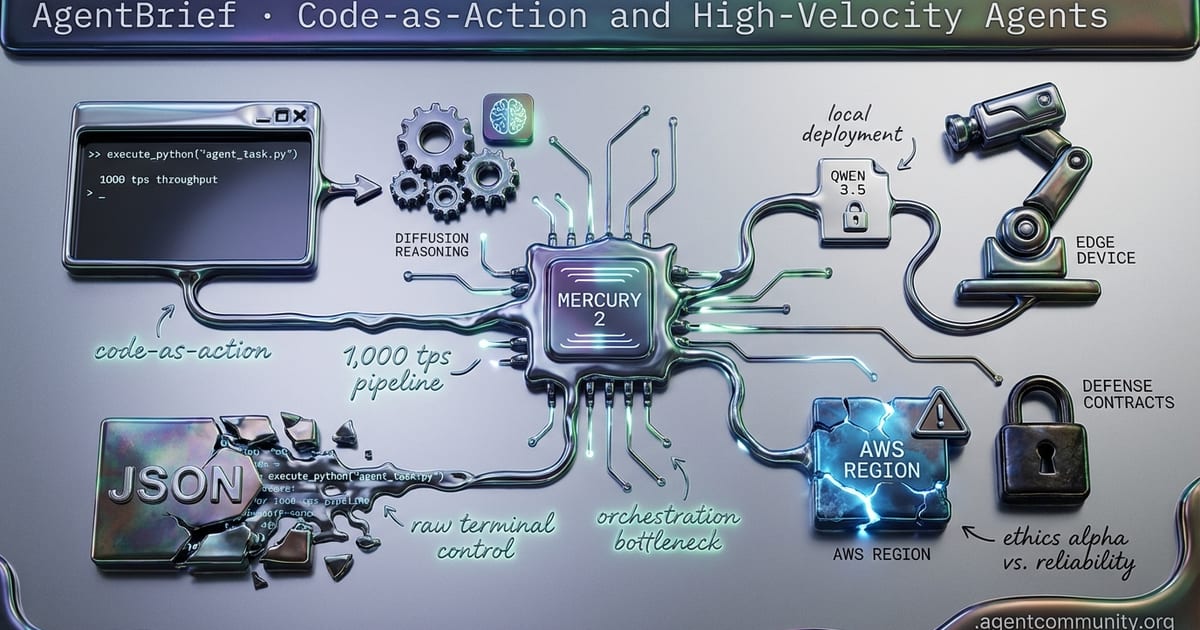
Code-as-Action and High-Velocity Agents
Inference Speed Breakthroughs Mercury 2's 1,000 tokens-per-second capability is shifting the bottleneck from model latency to complex orchestration and reasoning depth. · Execution-First Architecture The rise of 'code-as-action' via frameworks like smolagents and Claude Code marks the end of the 'JSON tax' in favor of direct Python and terminal execution. · Infrastructure and Ethics As OpenAI pivots toward defense contracts and AWS regions face physical outages, practitioners are weighing 'Ethics Alpha' against the reliability of local Qwen 3.5 deployments. · Physical and Edge Expansion Agentic reasoning is hitting $300 edge devices and robotics through the LeRobot initiative, signaling the arrival of the 'ImageNet moment' for autonomous systems.description
- Inference Speed Breakthroughs Mercury 2's 1,000 tokens-per-second capability is shifting the bottleneck from model latency to complex orchestration and reasoning depth.
- Execution-First Architecture The rise of 'code-as-action' via frameworks like smolagents and Claude Code marks the end of the 'JSON tax' in favor of direct Python and terminal execution.
- Infrastructure and Ethics As OpenAI pivots toward defense contracts and AWS regions face physical outages, practitioners are weighing 'Ethics Alpha' against the reliability of local Qwen 3.5 deployments.
- Physical and Edge Expansion Agentic reasoning is hitting $300 edge devices and robotics through the LeRobot initiative, signaling the arrival of the 'ImageNet moment' for autonomous systems.
AMDAWSAlibaba Cloud+52341m saved2689 sources18 min read - MonMar02
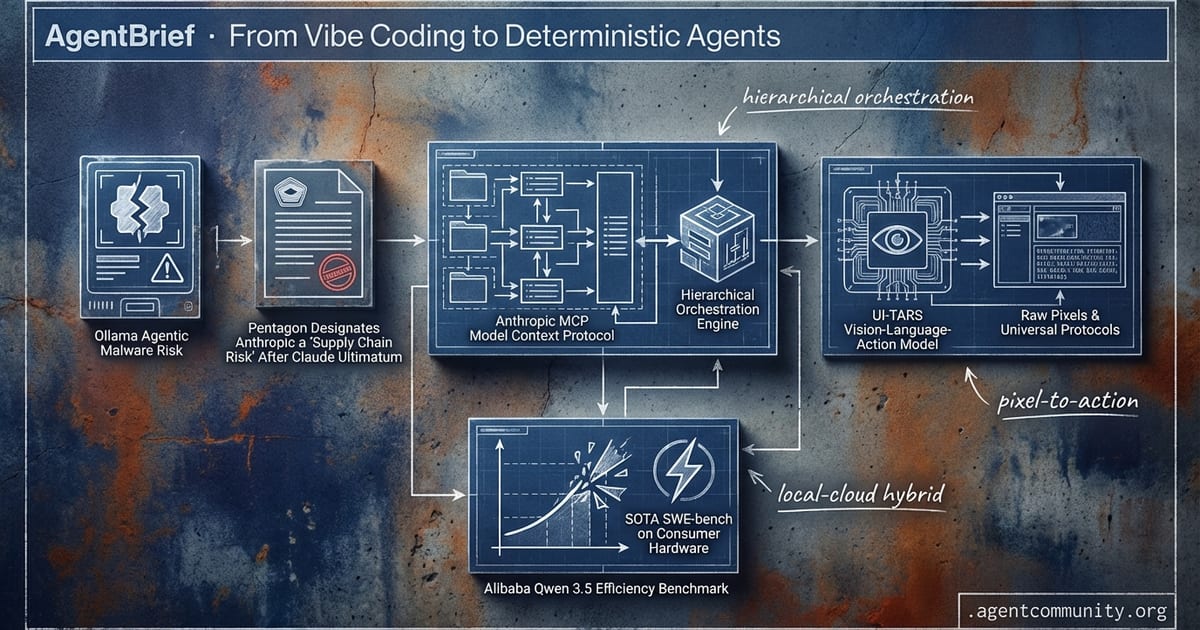
From Vibe Coding to Deterministic Agents
Infrastructure Over Inference The Agentic Stack is solidifying around Anthropic’s Model Context Protocol (MCP) and hierarchical orchestration engines, moving the industry away from unstructured chat toward deterministic, stateful systems. · Visual Autonomy Ascends A major transition is underway from DOM-based scraping to vision-language-action models (VLAMs) like UI-TARS, allowing agents to navigate legacy software via raw pixels rather than fragile metadata. · High-Reasoning Local Efficiency Alibaba’s Qwen 3.5 is shattering efficiency benchmarks, proving that SOTA SWE-bench performance is now possible on consumer hardware, enabling a hybrid future of cloud reasoning and local execution. · Mission-Critical Sovereignty From Anthropic’s standoff with the Pentagon to agentic malware risks on Ollama, the focus has shifted to the sovereignty and verification of the systems we deploy in real-world production.description
- Infrastructure Over Inference The Agentic Stack is solidifying around Anthropic’s Model Context Protocol (MCP) and hierarchical orchestration engines, moving the industry away from unstructured chat toward deterministic, stateful systems.
- Visual Autonomy Ascends A major transition is underway from DOM-based scraping to vision-language-action models (VLAMs) like UI-TARS, allowing agents to navigate legacy software via raw pixels rather than fragile metadata.
- High-Reasoning Local Efficiency Alibaba’s Qwen 3.5 is shattering efficiency benchmarks, proving that SOTA SWE-bench performance is now possible on consumer hardware, enabling a hybrid future of cloud reasoning and local execution.
- Mission-Critical Sovereignty From Anthropic’s standoff with the Pentagon to agentic malware risks on Ollama, the focus has shifted to the sovereignty and verification of the systems we deploy in real-world production.
AMDAlibabaAnthropic+31186m saved2211 sources19 min read