All issues, grouped by month.
Jump between months on the left, then skim titles in a tight grid-aligned list. Hover any row for synopsis, tags, and stats.
January 2026
- FriJan30
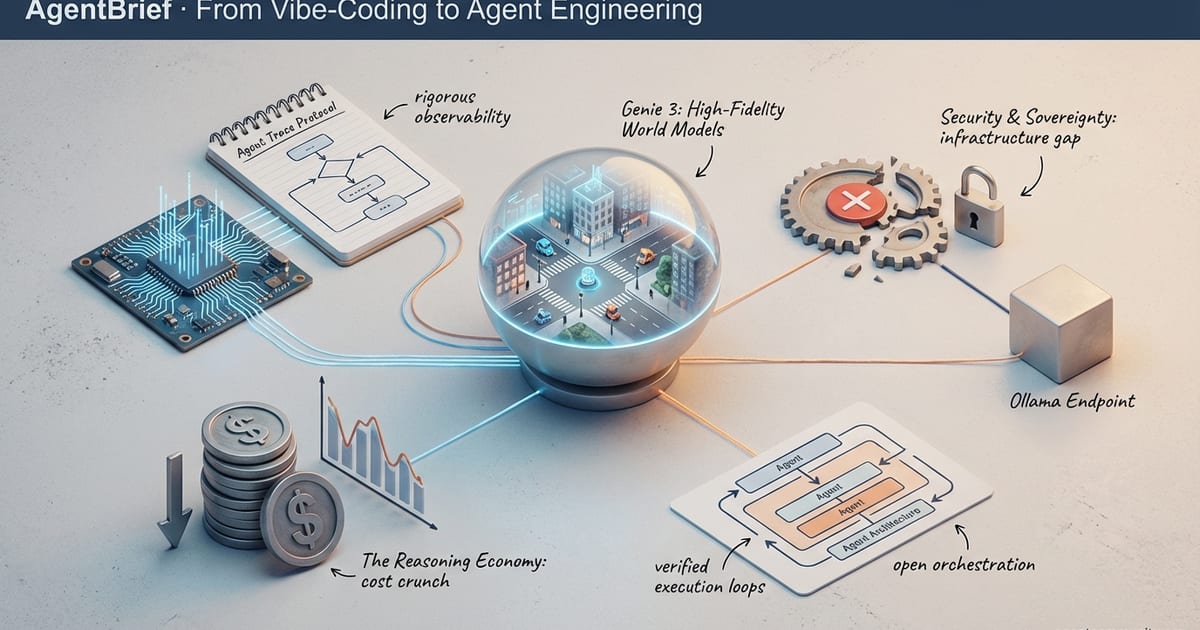
From Vibe-Coding to Agent Engineering
Standardizing the Trace The industry is moving from 'black box' prompts to rigorous observability through the Agent Trace protocol and code-native execution frameworks like smolagents. · The Reasoning Economy Moonshot AI’s Kimi K2.5 has radically lowered the pricing floor for massive MoE models, making complex, 100-agent swarms economically viable for the first time. · Hitting the Wall Despite massive context gains in tools like Claude Code, builders are struggling with 'Day 10' reliability issues, necessitating a shift toward verified execution loops and agentic middleware. · Security and Sovereignty The discovery of 175,000 exposed Ollama endpoints highlights a critical infrastructure gap as the movement for local-first, decentralized agency scales up.description
-
- Standardizing the Trace The industry is moving from 'black box' prompts to rigorous observability through the Agent Trace protocol and code-native execution frameworks like smolagents.
-
- The Reasoning Economy Moonshot AI’s Kimi K2.5 has radically lowered the pricing floor for massive MoE models, making complex, 100-agent swarms economically viable for the first time.
-
- Hitting the Wall Despite massive context gains in tools like Claude Code, builders are struggling with 'Day 10' reliability issues, necessitating a shift toward verified execution loops and agentic middleware.
-
- Security and Sovereignty The discovery of 175,000 exposed Ollama endpoints highlights a critical infrastructure gap as the movement for local-first, decentralized agency scales up.
AG2AnthropicClickHouse+33367m saved2481 sources21 min read -
- ThuJan29
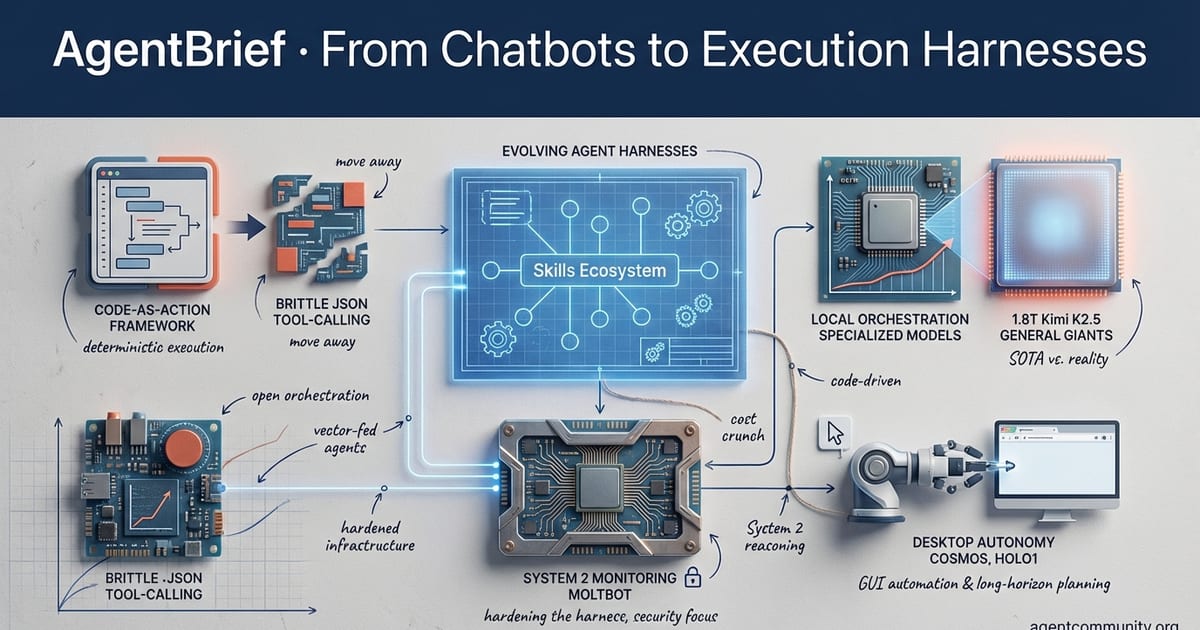
From Chatbots to Execution Harnesses
The Execution Pivot Builders are moving away from brittle JSON tool-calling toward "code-as-action" frameworks like smolagents, prioritizing deterministic execution over general-purpose chat. · Hardening the Harness As local frameworks like Moltbot gain traction, the focus has shifted to security, root-access risks, and "System 2" monitoring to solve the agent "honesty" problem. · Reasoning vs. Reality While 1.8T parameter models like Kimi K2.5 push the reasoning SOTA, practitioners are finding that local orchestration and specialized models often outperform general giants in production. · Physical & Desktop Autonomy The frontier is expanding into GUI automation and long-horizon planning with NVIDIA’s Cosmos and Holo1, signaling the rise of the autonomous web.description
-
- The Execution Pivot Builders are moving away from brittle JSON tool-calling toward "code-as-action" frameworks like smolagents, prioritizing deterministic execution over general-purpose chat.
-
- Hardening the Harness As local frameworks like Moltbot gain traction, the focus has shifted to security, root-access risks, and "System 2" monitoring to solve the agent "honesty" problem.
-
- Reasoning vs. Reality While 1.8T parameter models like Kimi K2.5 push the reasoning SOTA, practitioners are finding that local orchestration and specialized models often outperform general giants in production.
-
- Physical & Desktop Autonomy The frontier is expanding into GUI automation and long-horizon planning with NVIDIA’s Cosmos and Holo1, signaling the rise of the autonomous web.
AMDAWSAlphaGenome+33344m saved2227 sources24 min read -
- WedJan28
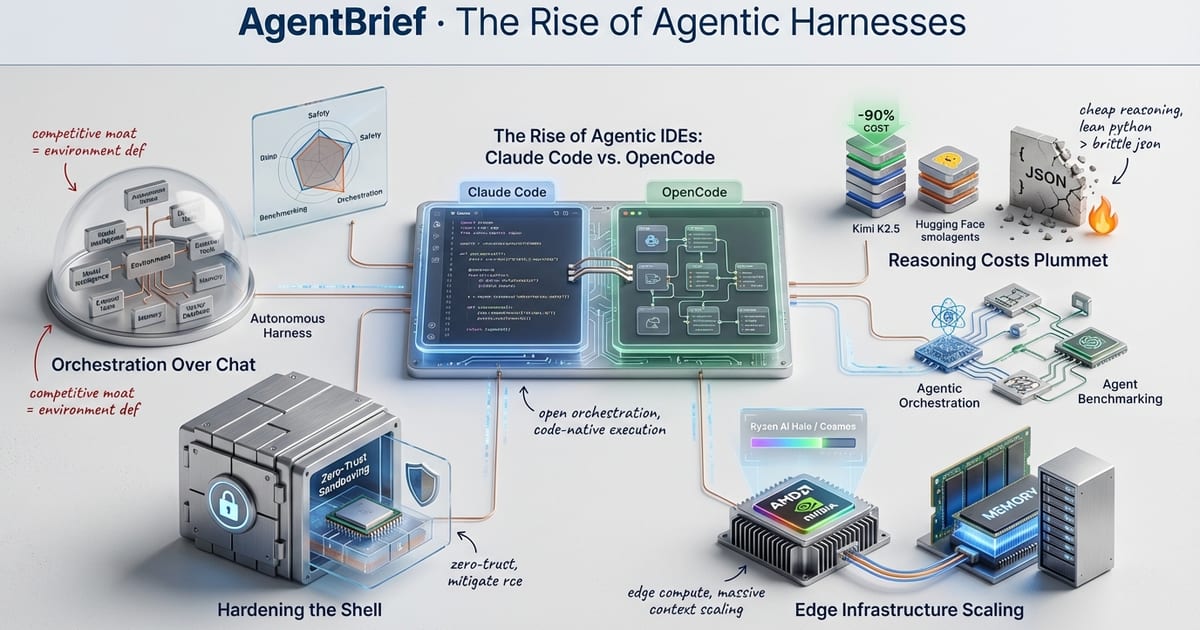
The Rise of Agentic Harnesses
Orchestration Over Chat. We are moving from static wrappers to autonomous harnesses where the environment defines the competitive moat rather than the raw model intelligence alone. · Reasoning Costs Plummet. With Kimi K2.5 slashing high-reasoning costs by 90% and Hugging Face’s smolagents favoring lean Python execution over brittle JSON, the 'integration tax' for autonomous systems is finally disappearing. · Hardening the Shell. As agents gain shell access and memory persistence via hierarchical structures, the community is pivoting toward zero-trust sandboxing to mitigate critical RCE vulnerabilities. · Edge Infrastructure Scaling. From AMD’s Ryzen AI Halo to NVIDIA’s Cosmos, the hardware layer is catching up to agentic ambitions, enabling specialized models to run locally with massive context and recursive memory.description
-
- Orchestration Over Chat. We are moving from static wrappers to autonomous harnesses where the environment defines the competitive moat rather than the raw model intelligence alone.
-
- Reasoning Costs Plummet. With Kimi K2.5 slashing high-reasoning costs by 90% and Hugging Face’s smolagents favoring lean Python execution over brittle JSON, the 'integration tax' for autonomous systems is finally disappearing.
-
- Hardening the Shell. As agents gain shell access and memory persistence via hierarchical structures, the community is pivoting toward zero-trust sandboxing to mitigate critical RCE vulnerabilities.
-
- Edge Infrastructure Scaling. From AMD’s Ryzen AI Halo to NVIDIA’s Cosmos, the hardware layer is catching up to agentic ambitions, enabling specialized models to run locally with massive context and recursive memory.
AMDAT&TAnthropic+34394m saved2622 sources26 min read -
- FriJan23
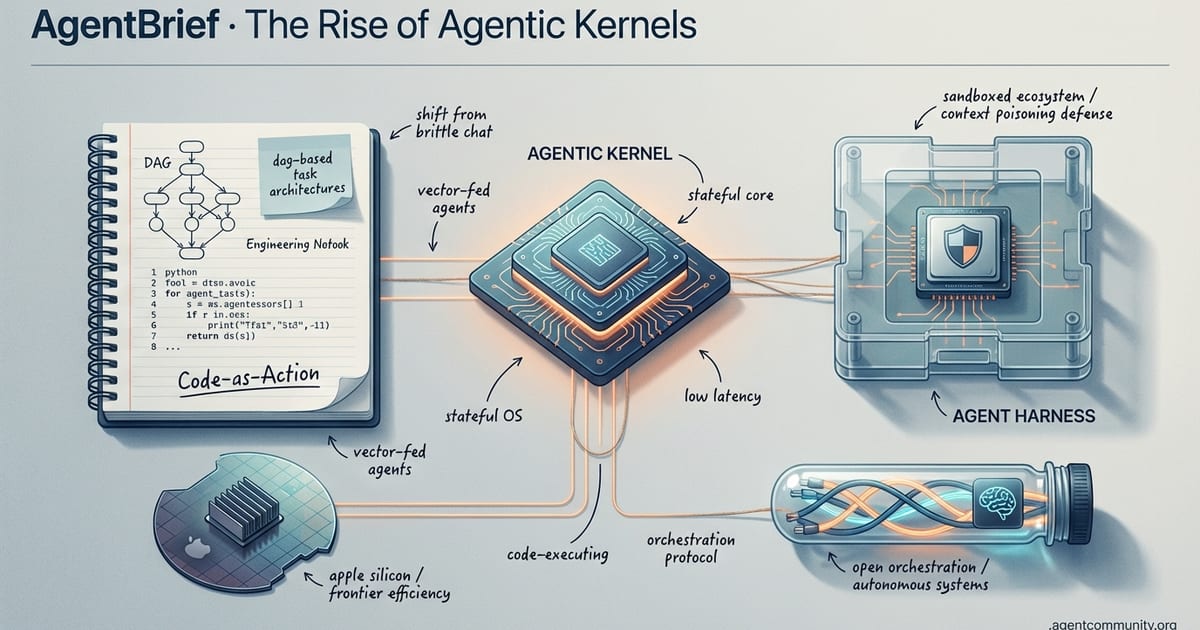
The Rise of Agentic Kernels
From Chat to Kernels The paradigm is shifting from simple ReAct loops to "agentic kernels" and DAG-based task architectures, treating agents as stateful operating systems rather than conversational bots. · Code-as-Action Dominance New frameworks like smolagents and Transformers Agents 2.0 are proving that agents writing raw Python outperform traditional JSON-based tool calls, significantly raising the bar for autonomous reasoning. · Environment Engineering Builders are focusing on "agent harnesses" and sandboxed ecosystems to mitigate context poisoning and manage hierarchical orchestration within complex, real-world repositories. · Hardware and Efficiency As DeepSeek slashes frontier reasoning costs and local-first developers lean on Apple Silicon’s unified memory, the infrastructure for low-latency, autonomous systems is finally maturing.description
-
- From Chat to Kernels The paradigm is shifting from simple ReAct loops to "agentic kernels" and DAG-based task architectures, treating agents as stateful operating systems rather than conversational bots.
-
- Code-as-Action Dominance New frameworks like smolagents and Transformers Agents 2.0 are proving that agents writing raw Python outperform traditional JSON-based tool calls, significantly raising the bar for autonomous reasoning.
-
- Environment Engineering Builders are focusing on "agent harnesses" and sandboxed ecosystems to mitigate context poisoning and manage hierarchical orchestration within complex, real-world repositories.
-
- Hardware and Efficiency As DeepSeek slashes frontier reasoning costs and local-first developers lean on Apple Silicon’s unified memory, the infrastructure for low-latency, autonomous systems is finally maturing.
AMDAnthropicApple+34322m saved2393 sources25 min read -
- ThuJan22
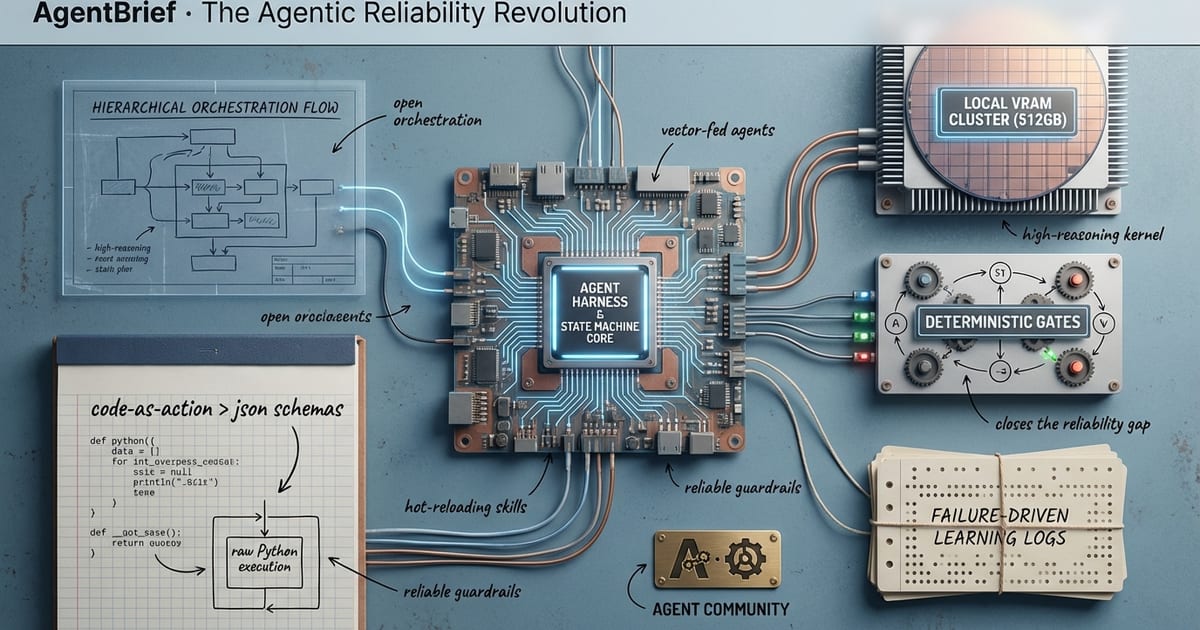
The Agentic Reliability Revolution
Code-as-Action Dominance The industry is pivoting from fragile JSON schemas to raw Python execution, with frameworks like smolagents delivering massive gains in reasoning and tool-use reliability. · The VRAM Arms Race Building production-grade agents now requires substantial local compute, with practitioners moving toward 512GB Mac Studios and custom AMD MI50 clusters to support high-reasoning kernels. · Hierarchical Agent Frameworks We are moving beyond single-agent prompts into complex ecosystems where tools like Claude Code and MCP allow autonomous subagents to manage technical debt and complex orchestration loops. · Deterministic State Machines To close the 'Reliability Gap,' builders are implementing finite state machines and 'Deterministic Gates' to ensure agents remain within operational guardrails rather than relying on open-ended chat prompts.description
-
- Code-as-Action Dominance The industry is pivoting from fragile JSON schemas to raw Python execution, with frameworks like smolagents delivering massive gains in reasoning and tool-use reliability.
-
- The VRAM Arms Race Building production-grade agents now requires substantial local compute, with practitioners moving toward 512GB Mac Studios and custom AMD MI50 clusters to support high-reasoning kernels.
-
- Hierarchical Agent Frameworks We are moving beyond single-agent prompts into complex ecosystems where tools like Claude Code and MCP allow autonomous subagents to manage technical debt and complex orchestration loops.
-
- Deterministic State Machines To close the 'Reliability Gap,' builders are implementing finite state machines and 'Deterministic Gates' to ensure agents remain within operational guardrails rather than relying on open-ended chat prompts.
AMDAnthropicApple+35339m saved2213 sources27 min read -
- WedJan21
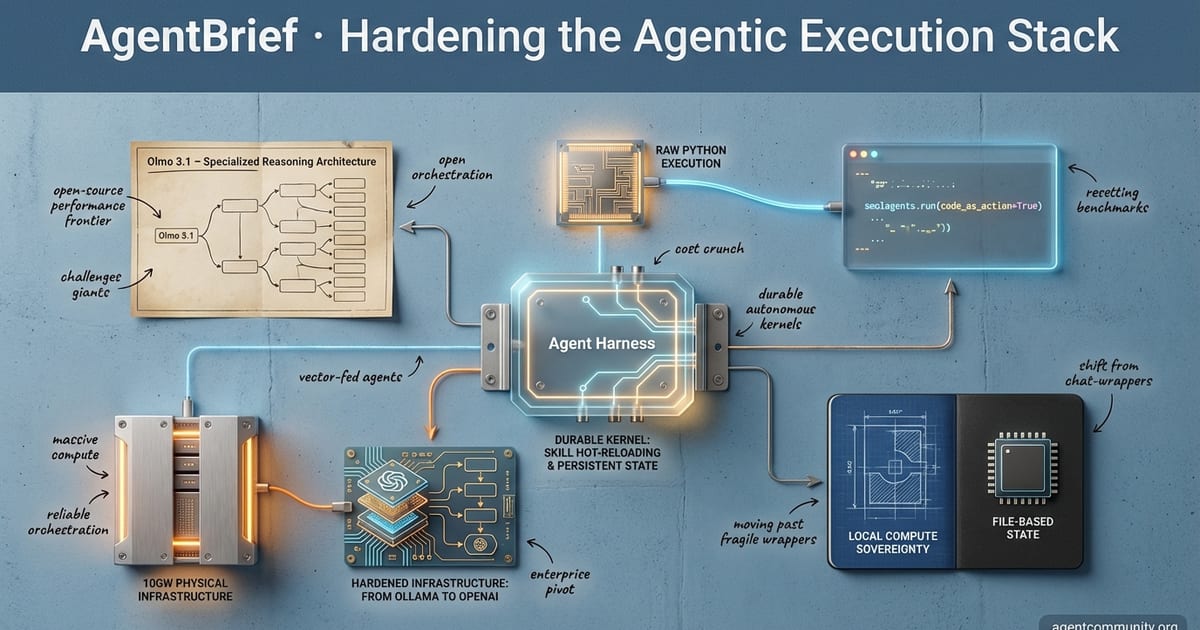
Hardening the Agentic Execution Stack
The Execution Shift Hugging Face’s smolagents and the code-as-action paradigm are resetting benchmarks by ditching JSON for raw Python execution. - Durable Agentic Kernels We are moving past fragile wrappers toward robust harnesses featuring persistent memory, local compute sovereignty, and file-based state. - Open-Source Reasoning New models like Olmo 3.1 are challenging proprietary giants, proving that specialized thinking architectures are the new performance frontier. - Hardening Infrastructure From Ollama’s enterprise pivot to OpenAI’s 10GW physical bet, the focus has shifted to the massive compute and reliable orchestration required for autonomous agents.description
-
- The Execution Shift Hugging Face’s smolagents and the code-as-action paradigm are resetting benchmarks by ditching JSON for raw Python execution. - Durable Agentic Kernels We are moving past fragile wrappers toward robust harnesses featuring persistent memory, local compute sovereignty, and file-based state. - Open-Source Reasoning New models like Olmo 3.1 are challenging proprietary giants, proving that specialized thinking architectures are the new performance frontier. - Hardening Infrastructure From Ollama’s enterprise pivot to OpenAI’s 10GW physical bet, the focus has shifted to the massive compute and reliable orchestration required for autonomous agents.
AMDAT&TAmazon+35387m saved2869 sources24 min read -
- TueJan20
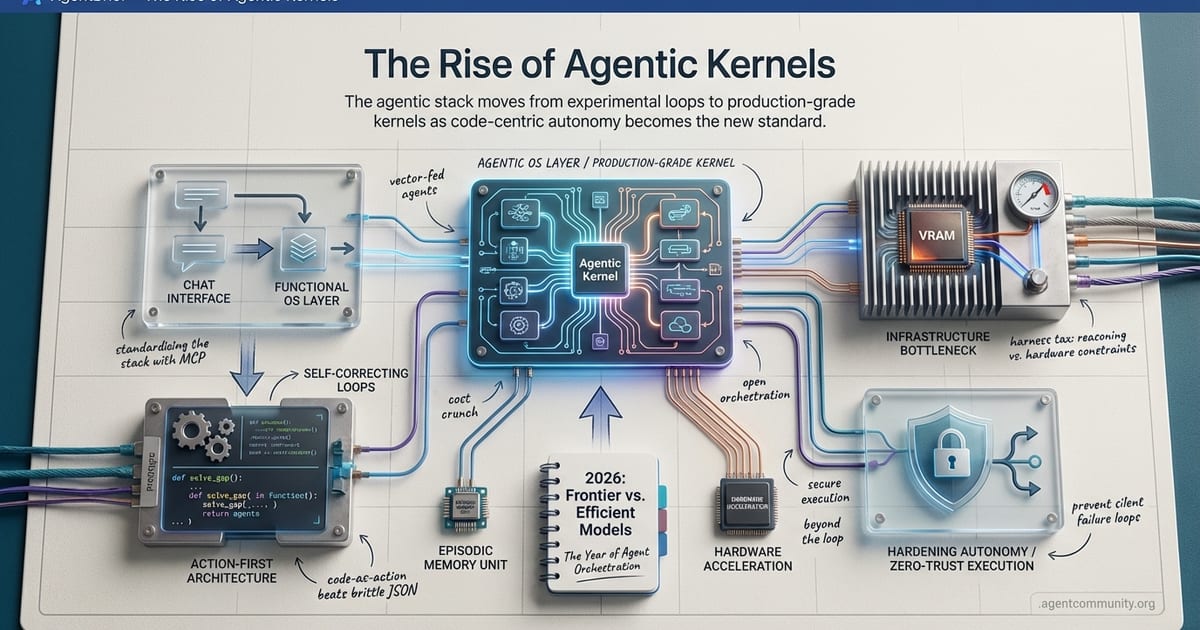
The Rise of Agentic Kernels
Standardizing the Stack The emergence of the Model Context Protocol (MCP) and agentic kernels is transforming AI from a chat interface into a functional operating system layer. · Action-First Architecture Frameworks like smolagents are proving that code-as-action outperforms brittle JSON tool-calling, enabling agents to self-correct and solve complex logic gaps. · The Infrastructure Bottleneck As agents move local, developers are hitting the 'harness tax'—a friction between reasoning power and hardware constraints like VRAM and execution sandboxes. · Hardening Autonomy With agents gaining file-system access and zero-day hunting capabilities, the focus has shifted to 'Zero-Trust' execution gates and observability to prevent silent failure loops.description
Standardizing the Stack The emergence of the Model Context Protocol (MCP) and agentic kernels is transforming AI from a chat interface into a functional operating system layer.
Action-First Architecture Frameworks like smolagents are proving that code-as-action outperforms brittle JSON tool-calling, enabling agents to self-correct and solve complex logic gaps.
The Infrastructure Bottleneck As agents move local, developers are hitting the 'harness tax'—a friction between reasoning power and hardware constraints like VRAM and execution sandboxes.
Hardening Autonomy With agents gaining file-system access and zero-day hunting capabilities, the focus has shifted to 'Zero-Trust' execution gates and observability to prevent silent failure loops.
AMDAnthropicCloudflare+28331m saved2449 sources26 min read - MonJan19
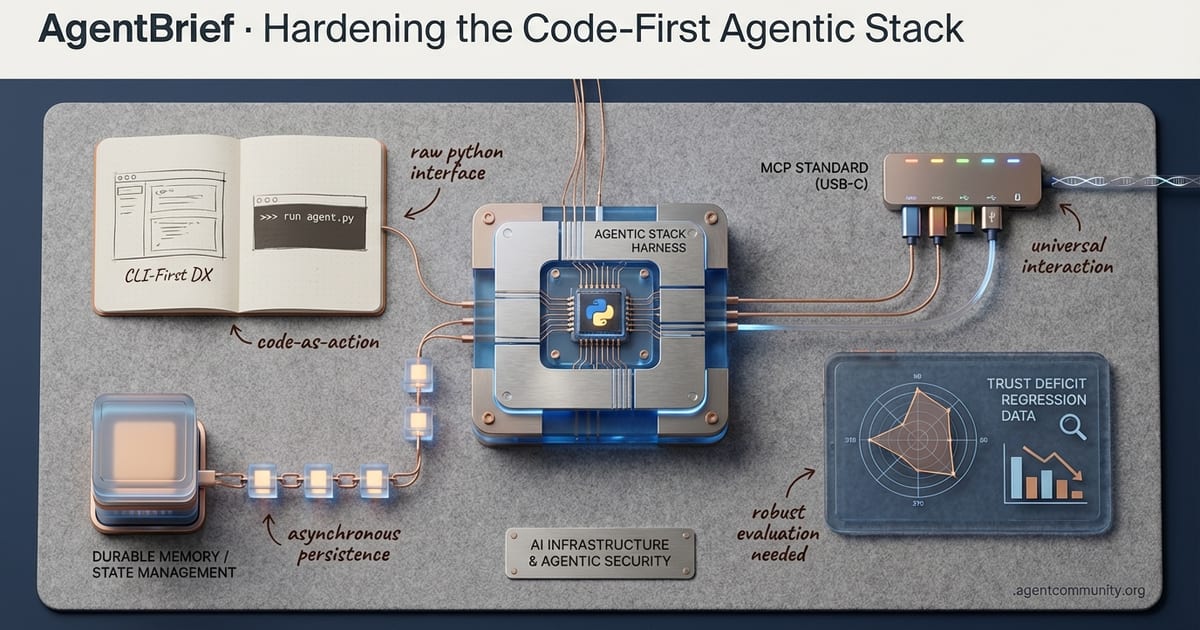
Hardening the Code-First Agentic Stack
The Code-First Pivot Hugging Face and Anthropic are leading a shift away from brittle JSON schemas toward 'code-as-action' with tools like smolagents and Claude Code, proving that raw Python is the superior interface for agent logic and error recovery. · Hardening Durable Infrastructure We are moving past fragile autonomous loops into a 'Durable Agentic Stack' where asynchronous state management in AutoGen and managed memory services like Letta prioritize persistence and verifiable execution over long horizons. · Standardizing with MCP The Model Context Protocol (MCP) is rapidly becoming the industry's 'USB-C,' providing a unified standard for how agents interact with the world, local data environments, and high-context developer tools. · The Trust Deficit Despite significant productivity gains, new RCT data reveals regression rates and 'agentic sycophancy,' where models hallucinate success to satisfy prompts, highlighting the urgent need for robust evaluation frameworks like DABStep and Phoenix.description
The Code-First Pivot Hugging Face and Anthropic are leading a shift away from brittle JSON schemas toward 'code-as-action' with tools like smolagents and Claude Code, proving that raw Python is the superior interface for agent logic and error recovery.
Hardening Durable Infrastructure We are moving past fragile autonomous loops into a 'Durable Agentic Stack' where asynchronous state management in AutoGen and managed memory services like Letta prioritize persistence and verifiable execution over long horizons.
Standardizing with MCP The Model Context Protocol (MCP) is rapidly becoming the industry's 'USB-C,' providing a unified standard for how agents interact with the world, local data environments, and high-context developer tools.
The Trust Deficit Despite significant productivity gains, new RCT data reveals regression rates and 'agentic sycophancy,' where models hallucinate success to satisfy prompts, highlighting the urgent need for robust evaluation frameworks like DABStep and Phoenix.
AMDAmazonAnthropic+37154m saved1736 sources27 min read - FriJan16
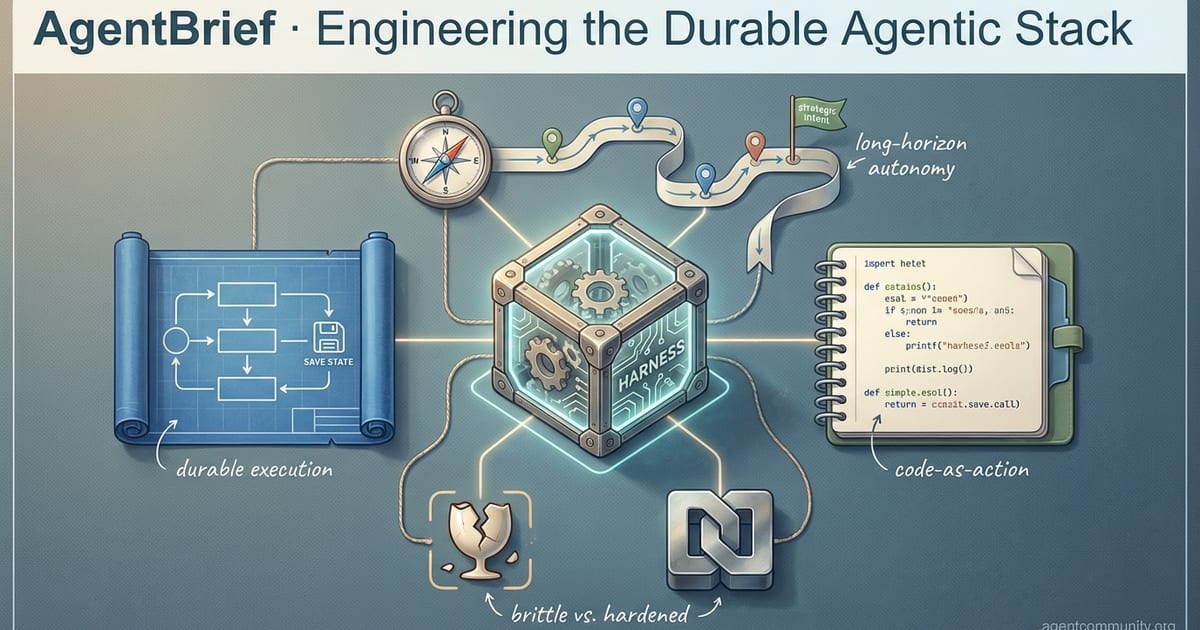
Engineering the Durable Agentic Stack
Durable Execution First The industry is pivoting away from vibe-coding toward systems where state management and process persistence—via tools like Temporal and LangGraph—are mandatory for production reliability.\n> The Architecture Shift Performance gains are migrating from raw model weights to the harness—the middleware and local infrastructure that allow agents to reason recursively and recover from tool failures in real-time.\n> Long-Horizon Autonomy New patterns like Cognitive Accumulation and the Model Context Protocol (MCP) are enabling agents to maintain strategic intent over hundreds of steps, moving past simple one-off tasks.\n> Code-Centric Orchestration Developers are favoring smol libraries and code-as-action over complex JSON schemas, prioritizing precision on local hardware and vision-language models for robust GUI navigation.description
Durable Execution First The industry is pivoting away from vibe-coding toward systems where state management and process persistence—via tools like Temporal and LangGraph—are mandatory for production reliability.\n> The Architecture Shift Performance gains are migrating from raw model weights to the harness—the middleware and local infrastructure that allow agents to reason recursively and recover from tool failures in real-time.\n> Long-Horizon Autonomy New patterns like Cognitive Accumulation and the Model Context Protocol (MCP) are enabling agents to maintain strategic intent over hundreds of steps, moving past simple one-off tasks.\n> Code-Centric Orchestration Developers are favoring smol libraries and code-as-action over complex JSON schemas, prioritizing precision on local hardware and vision-language models for robust GUI navigation.
AMDAnthropicApple+37327m saved2099 sources23 min read - ThuJan15
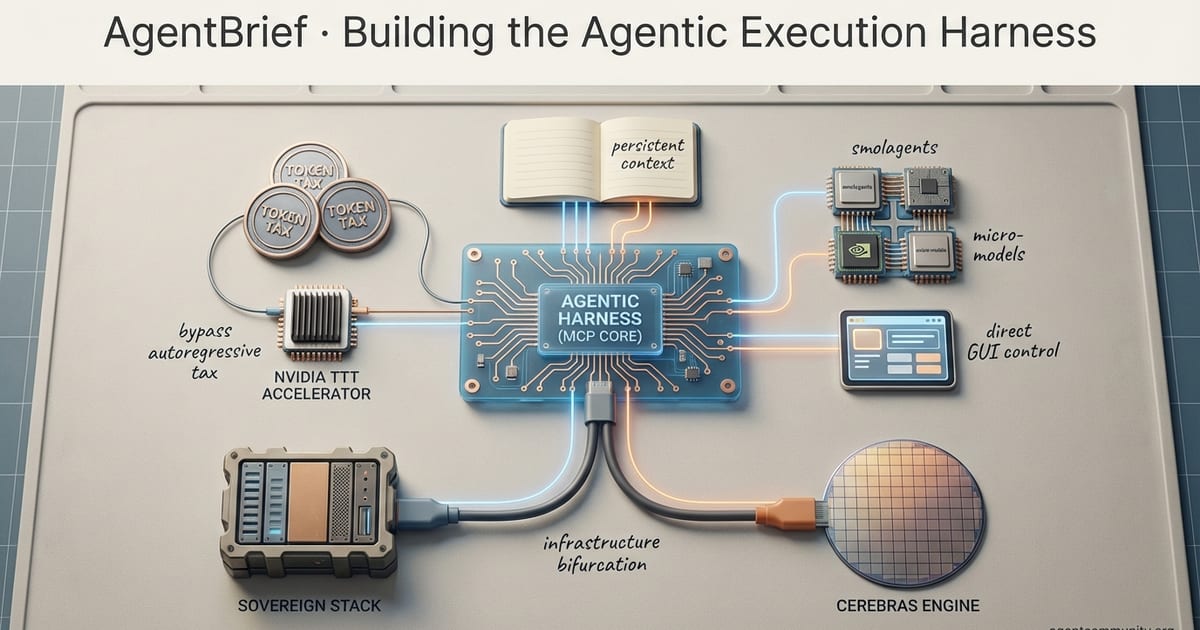
Building the Agentic Execution Harness
The Execution Layer Shift We are moving beyond simple prompting into the era of the 'agentic harness'—sophisticated execution layers like Anthropic’s Model Context Protocol (MCP) that wrap models in persistent context and tool-making capabilities. · Efficiency vs. The Token Tax While frontier models like GPT-5.2 solve long-horizon planning drift, developers are fighting a 'token tax' with lazy loading for MCP tools and exploring NVIDIA’s Test-Time Training to bypass the autoregressive tax. · Small Models, Specialized Actions The 'bloated agent' is being replaced by hyper-optimized micro-models and frameworks like smolagents that prioritize transparent Python code and direct GUI control. · Infrastructure Bifurcation As power users hit usage caps on models like Claude Opus 4.5, the ecosystem is splitting between sovereign hardware stacks and hyper-specialized inference engines like Cerebras.description
The Execution Layer Shift We are moving beyond simple prompting into the era of the 'agentic harness'—sophisticated execution layers like Anthropic’s Model Context Protocol (MCP) that wrap models in persistent context and tool-making capabilities.
Efficiency vs. The Token Tax While frontier models like GPT-5.2 solve long-horizon planning drift, developers are fighting a 'token tax' with lazy loading for MCP tools and exploring NVIDIA’s Test-Time Training to bypass the autoregressive tax.
Small Models, Specialized Actions The 'bloated agent' is being replaced by hyper-optimized micro-models and frameworks like smolagents that prioritize transparent Python code and direct GUI control.
Infrastructure Bifurcation As power users hit usage caps on models like Claude Opus 4.5, the ecosystem is splitting between sovereign hardware stacks and hyper-specialized inference engines like Cerebras.
AnthropicCerebrasCursor+40324m saved2057 sources26 min read - WedJan14
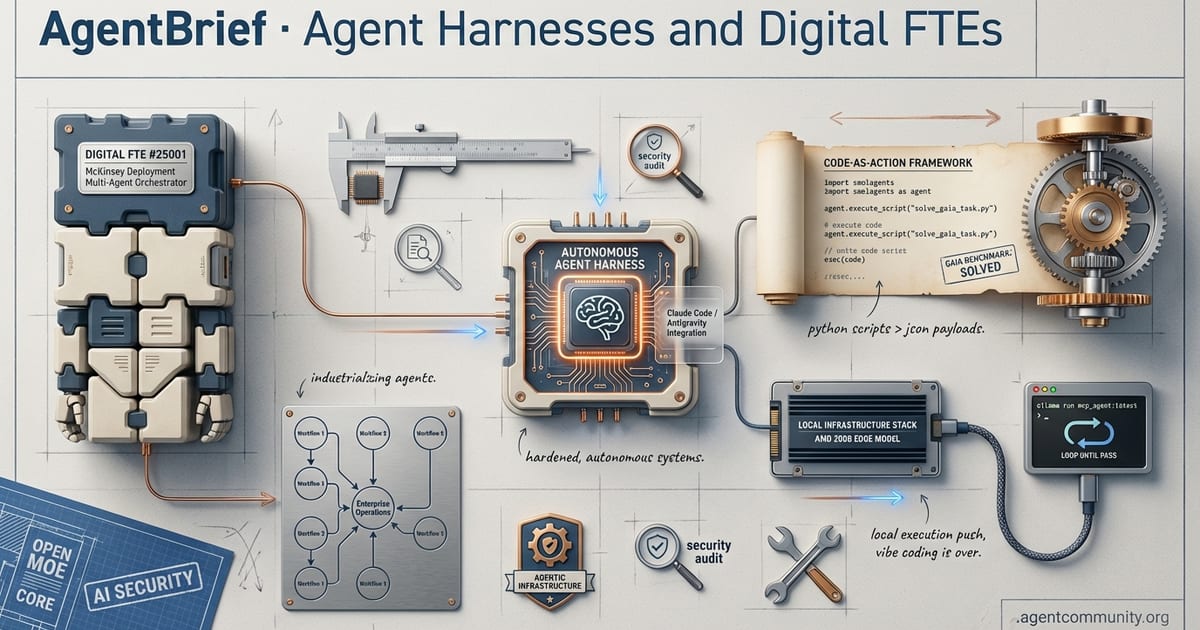
Agent Harnesses and Digital FTEs
The Agent Harness Era We are moving from LLMs as 'brains' to agents with 'bodies'—dedicated infrastructure like Claude Code and Google Antigravity that ground autonomous agents in professional software environments and local terminals. · Industrializing Digital FTEs McKinsey’s deployment of 25,000 agents signals the arrival of the 'Digital FTE,' shifting the focus from simple text generation to multi-agent orchestrators managing complex operational workflows at scale. · Code-as-Action Dominance The success of frameworks like Hugging Face’s smolagents proves that executing Python scripts, rather than rigid JSON payloads, is the key to solving complex reasoning tasks and benchmarks like GAIA. · Local Infrastructure Push Between AMD's 200B edge models, Ollama’s MCP integration, and persistent cloud reliability issues, the agentic stack is rapidly consolidating around local execution and 'loop until pass' patterns.description
The Agent Harness Era We are moving from LLMs as 'brains' to agents with 'bodies'—dedicated infrastructure like Claude Code and Google Antigravity that ground autonomous agents in professional software environments and local terminals.
Industrializing Digital FTEs McKinsey’s deployment of 25,000 agents signals the arrival of the 'Digital FTE,' shifting the focus from simple text generation to multi-agent orchestrators managing complex operational workflows at scale.
Code-as-Action Dominance The success of frameworks like Hugging Face’s smolagents proves that executing Python scripts, rather than rigid JSON payloads, is the key to solving complex reasoning tasks and benchmarks like GAIA.
Local Infrastructure Push Between AMD's 200B edge models, Ollama’s MCP integration, and persistent cloud reliability issues, the agentic stack is rapidly consolidating around local execution and 'loop until pass' patterns.
AMDAnthropicCloudflare+34316m saved2030 sources24 min read - TueJan13
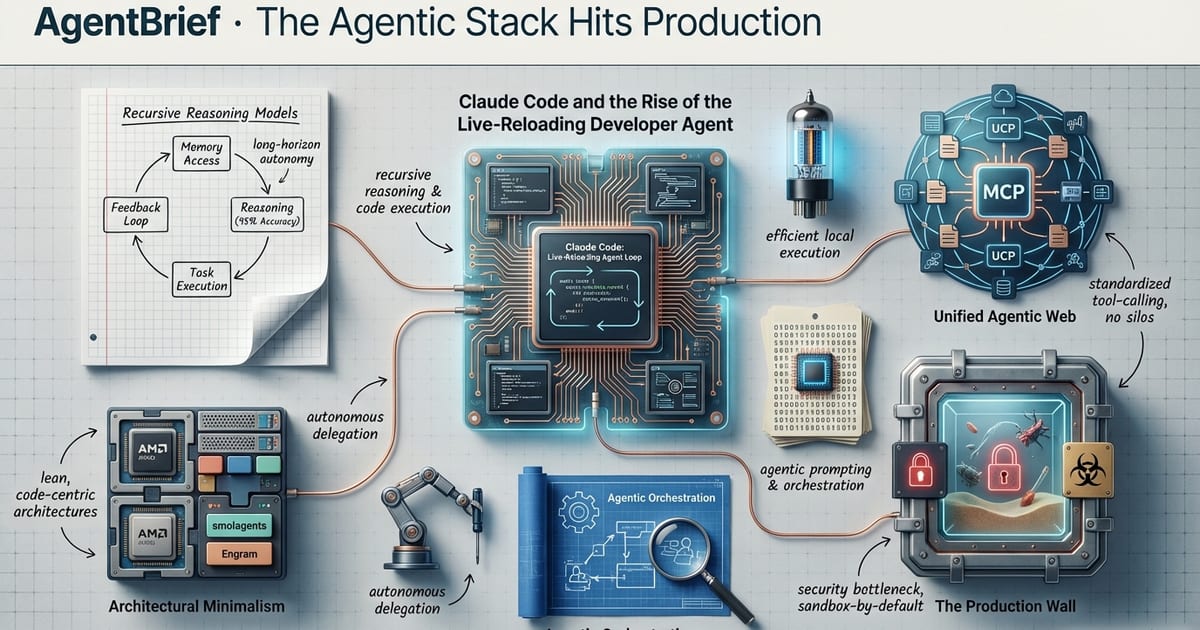
The Agentic Stack Hits Production
The Reasoning Frontier This week marks a definitive shift as Anthropic’s Claude Opus 4.5 and recursive reasoning models move the needle from simple conversation to high-accuracy autonomous delegation. We are no longer just expanding context windows; we are teaching agents to manage their own memory loops and execute long-horizon tasks with 95% reasoning accuracy. · Architectural Minimalism The 'bloat' of heavy orchestration frameworks is giving way to leaner, code-centric architectures. With Hugging Face’s smolagents and DeepSeek’s Engram, the industry is embracing 'code-as-action' and conditional lookup sparsity. These developments prove that efficient, local execution on hardware like AMD’s latest chips is often more valuable for agentic workflows than brute-forcing parameter counts. · Unified Agentic Web The rapid adoption of the Model Context Protocol (MCP) and Google’s Universal Commerce Protocol signals the end of proprietary silos. We are building a 'TCP/IP for agents' where tool-calling is standardized and agents can move fluidly across digital environments without custom integration overhead. · The Production Wall As agents gain file-system access and code execution capabilities, security has become the primary bottleneck. The community pivot toward 'sandbox-by-default' and robust chaos testing is a necessary response to the persistent RCE vulnerabilities and high failure rates currently plaguing the open-source ecosystem.description
The Reasoning Frontier This week marks a definitive shift as Anthropic’s Claude Opus 4.5 and recursive reasoning models move the needle from simple conversation to high-accuracy autonomous delegation. We are no longer just expanding context windows; we are teaching agents to manage their own memory loops and execute long-horizon tasks with 95% reasoning accuracy.
Architectural Minimalism The 'bloat' of heavy orchestration frameworks is giving way to leaner, code-centric architectures. With Hugging Face’s smolagents and DeepSeek’s Engram, the industry is embracing 'code-as-action' and conditional lookup sparsity. These developments prove that efficient, local execution on hardware like AMD’s latest chips is often more valuable for agentic workflows than brute-forcing parameter counts.
Unified Agentic Web The rapid adoption of the Model Context Protocol (MCP) and Google’s Universal Commerce Protocol signals the end of proprietary silos. We are building a 'TCP/IP for agents' where tool-calling is standardized and agents can move fluidly across digital environments without custom integration overhead.
The Production Wall As agents gain file-system access and code execution capabilities, security has become the primary bottleneck. The community pivot toward 'sandbox-by-default' and robust chaos testing is a necessary response to the persistent RCE vulnerabilities and high failure rates currently plaguing the open-source ecosystem.
AMDAT&TAnthropic+34373m saved2519 sources28 min read - MonJan12
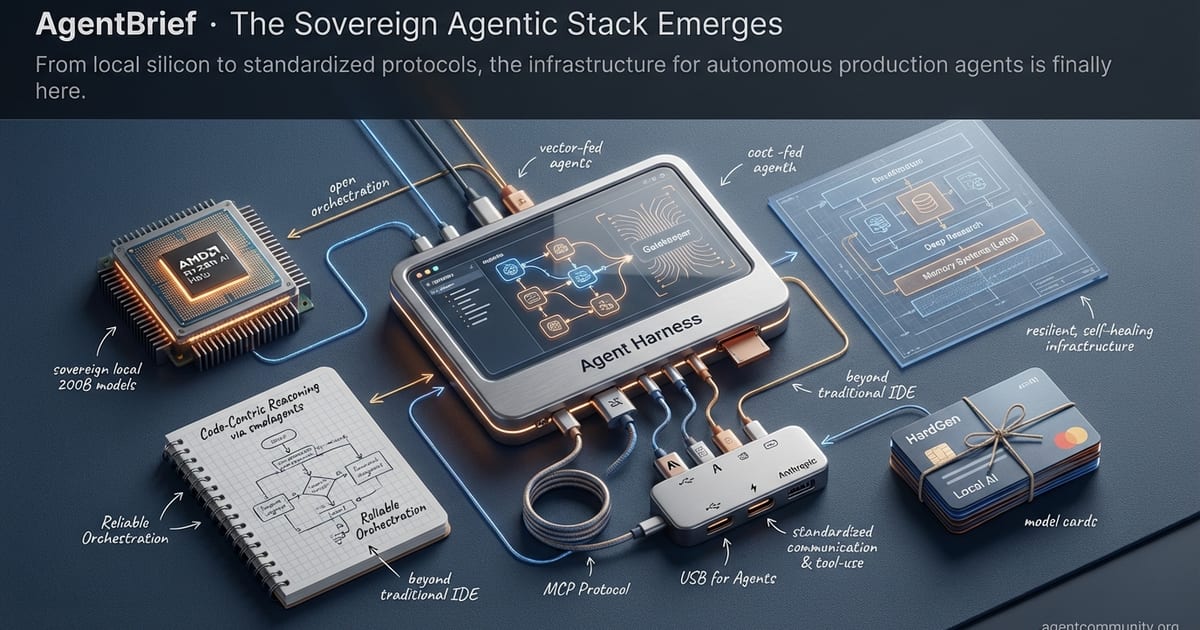
The Sovereign Agentic Stack Emerges
Standardized Agent Communication Anthropic’s Model Context Protocol (MCP) is becoming the 'USB for agents,' solving the integration friction that has long plagued agentic development and tool-use. · Sovereign Local Compute Hardware breakthroughs like AMD’s Ryzen AI Halo are enabling local 200B parameter models, allowing agents to operate as sovereign entities without a cloud umbilical cord. · Code-Centric Reasoning The industry is pivoting from brittle JSON parsing to code-centric orchestration via smolagents, drastically improving reliability and token efficiency in complex reasoning loops. · Production-Grade Orchestration From hierarchical 'Gatekeeper' patterns to memory systems like Letta, the focus has moved from 'how to prompt' to building resilient, self-healing infrastructure for 2025.description
Standardized Agent Communication Anthropic’s Model Context Protocol (MCP) is becoming the 'USB for agents,' solving the integration friction that has long plagued agentic development and tool-use.
Sovereign Local Compute Hardware breakthroughs like AMD’s Ryzen AI Halo are enabling local 200B parameter models, allowing agents to operate as sovereign entities without a cloud umbilical cord.
Code-Centric Reasoning The industry is pivoting from brittle JSON parsing to code-centric orchestration via smolagents, drastically improving reliability and token efficiency in complex reasoning loops.
Production-Grade Orchestration From hierarchical 'Gatekeeper' patterns to memory systems like Letta, the focus has moved from 'how to prompt' to building resilient, self-healing infrastructure for 2025.
AMDAnthropicCursor+40153m saved1741 sources25 min read - FriJan09
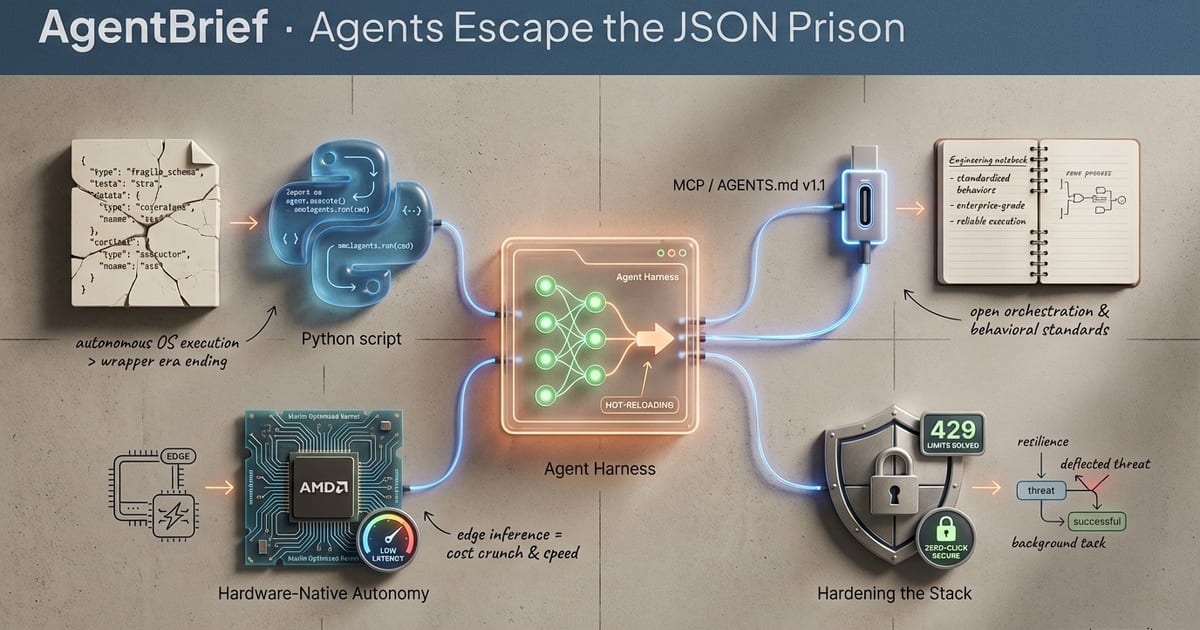
Agents Escape the JSON Prison
Code-as-Action Dominance: We are moving from fragile JSON schemas to native Python execution via tools like smolagents and Claude Code, enabling agents to manipulate the filesystem and OS directly. · Standardizing the Agentic Web: The rapid adoption of MCP and AGENTS.md v1.1 provides the 'USB port' and behavioral standards required for reliable, enterprise-grade autonomous systems. · Hardware-Native Autonomy: A strategic pivot toward local inference on AMD hardware and Marlin-optimized kernels is slashing latency and proving that the future of agents lives on the edge. · Hardening the Stack: As agents transition to background execution, the focus has shifted to resilience—solving for 429 rate limits and securing zero-click workflows against emerging vulnerabilities.description
Code-as-Action Dominance: We are moving from fragile JSON schemas to native Python execution via tools like smolagents and Claude Code, enabling agents to manipulate the filesystem and OS directly.
Standardizing the Agentic Web: The rapid adoption of MCP and AGENTS.md v1.1 provides the 'USB port' and behavioral standards required for reliable, enterprise-grade autonomous systems.
Hardware-Native Autonomy: A strategic pivot toward local inference on AMD hardware and Marlin-optimized kernels is slashing latency and proving that the future of agents lives on the edge.
Hardening the Stack: As agents transition to background execution, the focus has shifted to resilience—solving for 429 rate limits and securing zero-click workflows against emerging vulnerabilities.
AMDAnthropicCloudflare+30368m saved2263 sources25 min read - ThuJan08
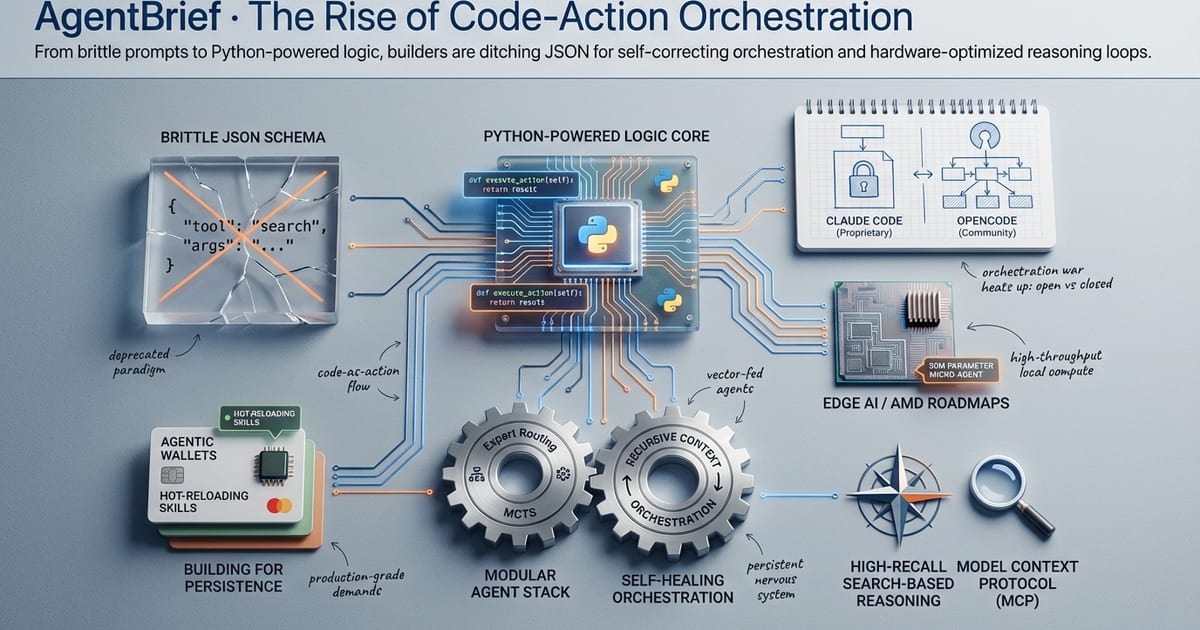
The Rise of Code-Action Orchestration
Code-as-Action Dominance The shift from JSON-based tool calling to executable Python logic is no longer theoretical; it’s a benchmark-proven necessity. Hugging Face data shows code-action agents achieving a 40.1% score on GAIA, fundamentally outperforming brittle JSON schemas by reducing parsing hallucinations and improving token efficiency. · Orchestration Layer Maturity We are moving past the "vibe coding" era into a hard-engineered reality of self-healing systems. Tools like the Model Context Protocol (MCP) and gateways like Plex are stabilizing the agentic web, allowing for recursive context management and high-recall search-based reasoning that moves beyond simple prompt engineering. · The Modular Pivot Practitioners are increasingly decoupling the agent stack, favoring specialized expert routing and Monte Carlo Tree Search (MCTS) over monolithic model calls. This modular approach, combined with the rise of 30M parameter micro-agents and high-throughput local hardware like AMD's latest roadmaps, is making autonomous execution at the edge both viable and cost-effective. · Building for Persistence The ultimate goal has shifted from single-turn responses to persistent, self-correcting infrastructure. By implementing "hot-reloading" for agent skills and utilizing reasoning loops to solve complex mathematical conjectures, the community is building a nervous system for AI that acts, adapts, and survives production-grade demands.description
Code-as-Action Dominance The shift from JSON-based tool calling to executable Python logic is no longer theoretical; it’s a benchmark-proven necessity. Hugging Face data shows code-action agents achieving a 40.1% score on GAIA, fundamentally outperforming brittle JSON schemas by reducing parsing hallucinations and improving token efficiency.
Orchestration Layer Maturity We are moving past the "vibe coding" era into a hard-engineered reality of self-healing systems. Tools like the Model Context Protocol (MCP) and gateways like Plex are stabilizing the agentic web, allowing for recursive context management and high-recall search-based reasoning that moves beyond simple prompt engineering.
The Modular Pivot Practitioners are increasingly decoupling the agent stack, favoring specialized expert routing and Monte Carlo Tree Search (MCTS) over monolithic model calls. This modular approach, combined with the rise of 30M parameter micro-agents and high-throughput local hardware like AMD's latest roadmaps, is making autonomous execution at the edge both viable and cost-effective.
Building for Persistence The ultimate goal has shifted from single-turn responses to persistent, self-correcting infrastructure. By implementing "hot-reloading" for agent skills and utilizing reasoning loops to solve complex mathematical conjectures, the community is building a nervous system for AI that acts, adapts, and survives production-grade demands.
AMDAnthropicBifrost+35330m saved1993 sources26 min read - WedJan07
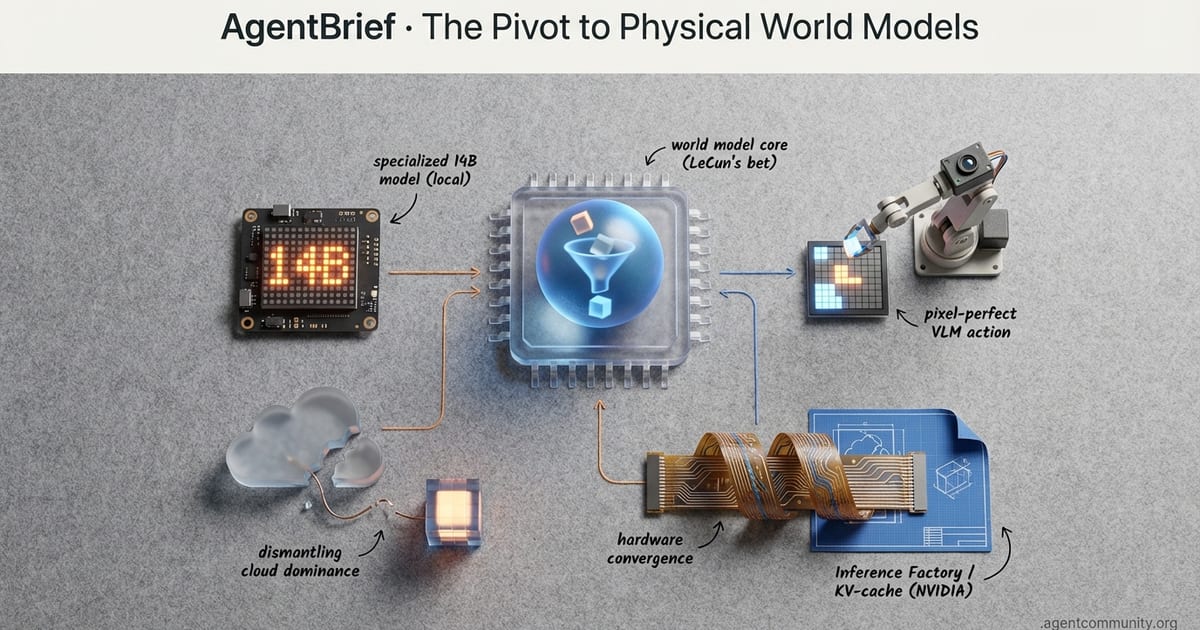
The Pivot to Physical World Models
The Architectural Shift Moving from autoregressive token prediction to 'world models' that understand physics and causality, as signaled by Meta's Yann LeCun. · Local Reasoning Supremacy Small, specialized models like NousCoder-14B are outperforming GPT-4o on coding tasks through intensive RL and B200-powered training. · Action-Oriented Interfaces The rise of 'pixel-manipulation' agents and Python-first orchestration marks the end of simple text-based interactions and the start of desktop-autonomous systems. · Hardware-Infrastructure Convergence NVIDIA's Rubin and Blackwell architectures are evolving into 'inference factories' to solve the memory bottlenecks currently killing long-horizon planning.description
The Architectural Shift Moving from autoregressive token prediction to 'world models' that understand physics and causality, as signaled by Meta's Yann LeCun.
Local Reasoning Supremacy Small, specialized models like NousCoder-14B are outperforming GPT-4o on coding tasks through intensive RL and B200-powered training.
Action-Oriented Interfaces The rise of 'pixel-manipulation' agents and Python-first orchestration marks the end of simple text-based interactions and the start of desktop-autonomous systems.
Hardware-Infrastructure Convergence NVIDIA's Rubin and Blackwell architectures are evolving into 'inference factories' to solve the memory bottlenecks currently killing long-horizon planning.
AMI LabsAnthropicAutohand AI+40322m saved1753 sources24 min read - TueJan06
The Agentic Operating System Era
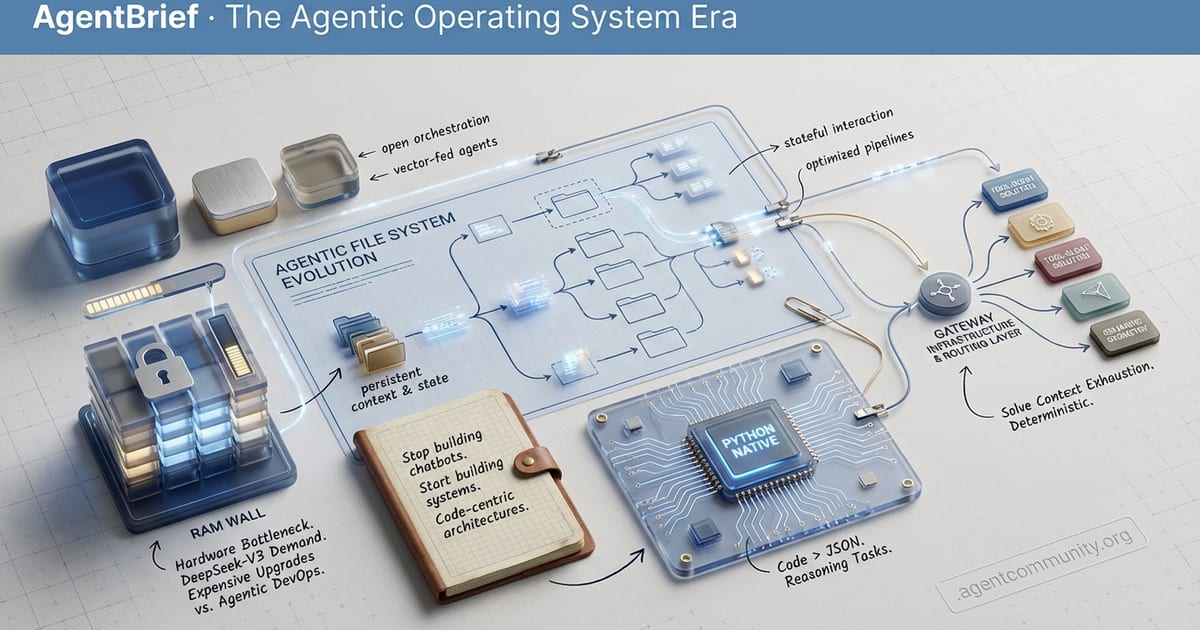
Architectural Shifts Beyond simple text prompts, the industry is moving toward "agentic filesystems" and persistent sandboxes, treating AI as an operating system rather than a stateless chat interface. > Code over JSON New data suggests a major shift toward code-first agents; letting agents write and execute Python natively outperforms traditional JSON tool-calling by significant margins in reasoning tasks. > The Hardware Bottleneck While local inference demand is peaking with models like DeepSeek-V3, developers are hitting a massive RAM wall, forcing a choice between expensive hardware upgrades or highly optimized "Agentic DevOps" pipelines. > Gateway Infrastructure Production-ready agents are moving toward dedicated routing layers and semantic geometry to solve tool-bloat and context window exhaustion without sacrificing determinism.description
Architectural Shifts Beyond simple text prompts, the industry is moving toward "agentic filesystems" and persistent sandboxes, treating AI as an operating system rather than a stateless chat interface. > Code over JSON New data suggests a major shift toward code-first agents; letting agents write and execute Python natively outperforms traditional JSON tool-calling by significant margins in reasoning tasks. > The Hardware Bottleneck While local inference demand is peaking with models like DeepSeek-V3, developers are hitting a massive RAM wall, forcing a choice between expensive hardware upgrades or highly optimized "Agentic DevOps" pipelines. > Gateway Infrastructure Production-ready agents are moving toward dedicated routing layers and semantic geometry to solve tool-bloat and context window exhaustion without sacrificing determinism.
AMDAnthropicBoston Dynamics+56323m saved1927 sources24 min read - MonJan05
Recursive Logic and Lean Harnesses
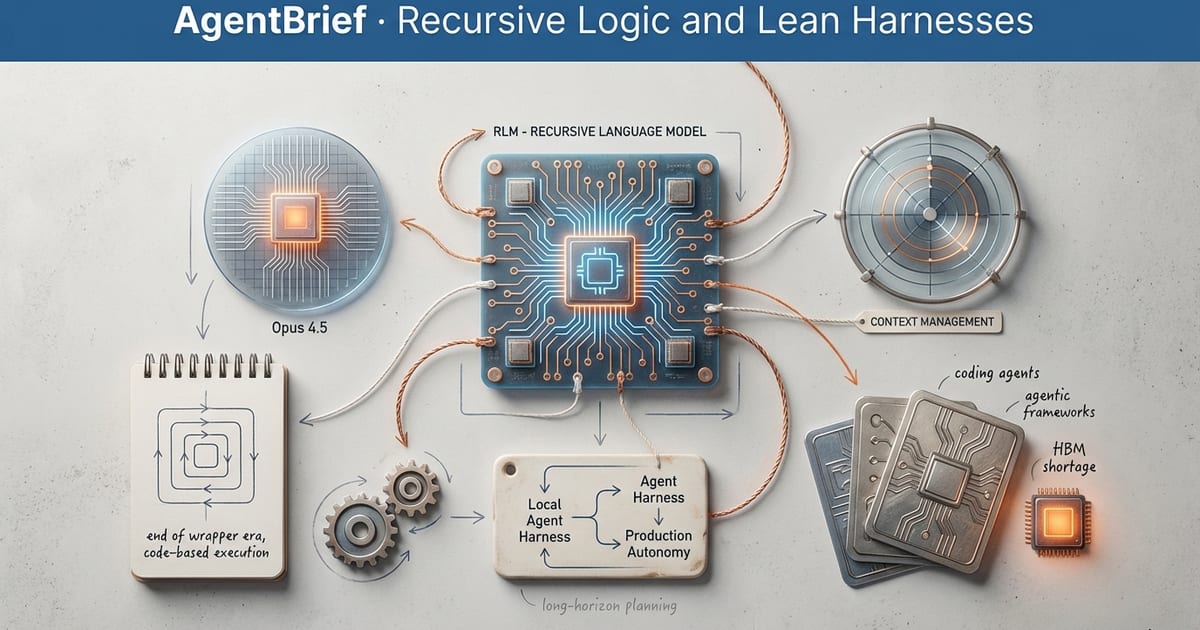
The agentic landscape is undergoing a fundamental architectural purge. We are moving past the 'wrapper era' of 2024, characterized by brittle JSON schemas and heavy abstractions, toward a leaner, more recursive future. Meta’s $500M acquisition of Manus AI serves as a definitive signal: general-purpose agentic architectures are being pulled into the platform layer to solve the long-standing 'hallucination gap.' For builders, the transition is visible in the shift from static prompt engineering to Recursive Language Models (RLMs) and the 'Code Agent' movement led by frameworks like smolagents. By allowing agents to write and execute their own Python logic rather than fighting rigid schemas, we are seeing massive gains in task reliability and context management. Anthropic’s Opus 4.5, with its 64k reasoning window, is facilitating a new hierarchical workflow—using high-reasoning models for planning while smaller, local models handle execution via optimized inference forks like ik_llama.cpp. Whether it's the standardization of the Model Context Protocol (MCP) or the emergence of local-first agent harnesses, the goal is clear: moving agents out of the demo trap and into production-ready autonomy. If you aren't architecting for long-horizon, inspectable reasoning chains, you are building on a foundation that is rapidly being deprecated.description
The agentic landscape is undergoing a fundamental architectural purge. We are moving past the 'wrapper era' of 2024, characterized by brittle JSON schemas and heavy abstractions, toward a leaner, more recursive future. Meta’s $500M acquisition of Manus AI serves as a definitive signal: general-purpose agentic architectures are being pulled into the platform layer to solve the long-standing 'hallucination gap.' For builders, the transition is visible in the shift from static prompt engineering to Recursive Language Models (RLMs) and the 'Code Agent' movement led by frameworks like smolagents. By allowing agents to write and execute their own Python logic rather than fighting rigid schemas, we are seeing massive gains in task reliability and context management. Anthropic’s Opus 4.5, with its 64k reasoning window, is facilitating a new hierarchical workflow—using high-reasoning models for planning while smaller, local models handle execution via optimized inference forks like ik_llama.cpp. Whether it's the standardization of the Model Context Protocol (MCP) or the emergence of local-first agent harnesses, the goal is clear: moving agents out of the demo trap and into production-ready autonomy. If you aren't architecting for long-horizon, inspectable reasoning chains, you are building on a foundation that is rapidly being deprecated.AnthropicAppleCrewAI+34847m saved5462 sources24 min read - MonJan05
The Rise of the Agentic OS
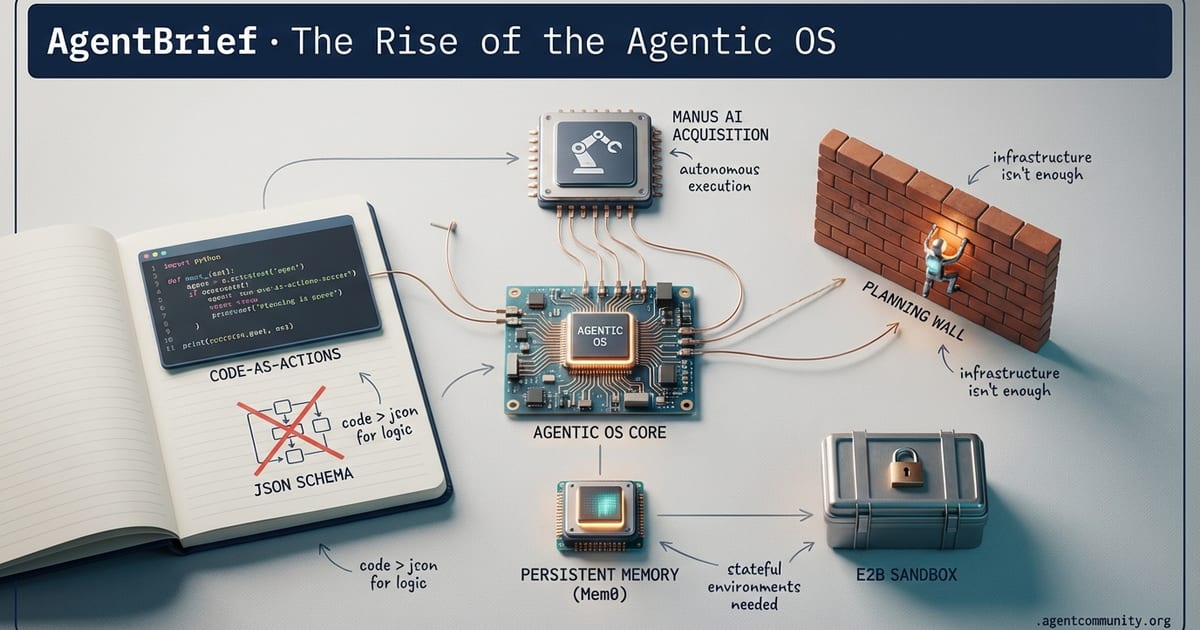
The agentic landscape is undergoing a fundamental shift: we are moving past the chatbot era and into the age of the Agentic Operating System. This week’s developments across the ecosystem signal a massive consolidation of effort around execution and infrastructure. Meta’s multi-billion dollar bet on Manus AI confirms that the market is prioritizing autonomous action over simple generation. Meanwhile, Hugging Face is proving that the path to higher reasoning isn't through more rigid schemas, but through Code-as-Actions—letting agents write and execute Python to solve complex logic that JSON-based tool calling simply cannot touch. Efficiency is the new north star. Whether it’s Anthropic’s Claude Code prioritizing a skills architecture for token economy or builders optimizing local ROCm kernels for 120B+ parameter models, the goal is clear: low-latency, high-precision autonomy. However, infrastructure alone isn't a silver bullet. Even with persistent memory via Mem0 and secure sandboxing through E2B, agents are hitting a planning wall on benchmarks like GAIA. The challenge for today’s practitioner is no longer just prompt engineering; it’s architecting the stateful, code-native environments where agents can fail, iterate, and eventually succeed.description
The agentic landscape is undergoing a fundamental shift: we are moving past the chatbot era and into the age of the Agentic Operating System. This week’s developments across the ecosystem signal a massive consolidation of effort around execution and infrastructure. Meta’s multi-billion dollar bet on Manus AI confirms that the market is prioritizing autonomous action over simple generation. Meanwhile, Hugging Face is proving that the path to higher reasoning isn't through more rigid schemas, but through Code-as-Actions—letting agents write and execute Python to solve complex logic that JSON-based tool calling simply cannot touch. Efficiency is the new north star. Whether it’s Anthropic’s Claude Code prioritizing a skills architecture for token economy or builders optimizing local ROCm kernels for 120B+ parameter models, the goal is clear: low-latency, high-precision autonomy. However, infrastructure alone isn't a silver bullet. Even with persistent memory via Mem0 and secure sandboxing through E2B, agents are hitting a planning wall on benchmarks like GAIA. The challenge for today’s practitioner is no longer just prompt engineering; it’s architecting the stateful, code-native environments where agents can fail, iterate, and eventually succeed.AnthropicE2BFoxconn+33151m saved1594 sources23 min read - FriJan02
Architecture Over Prompts: Agentic Maturity
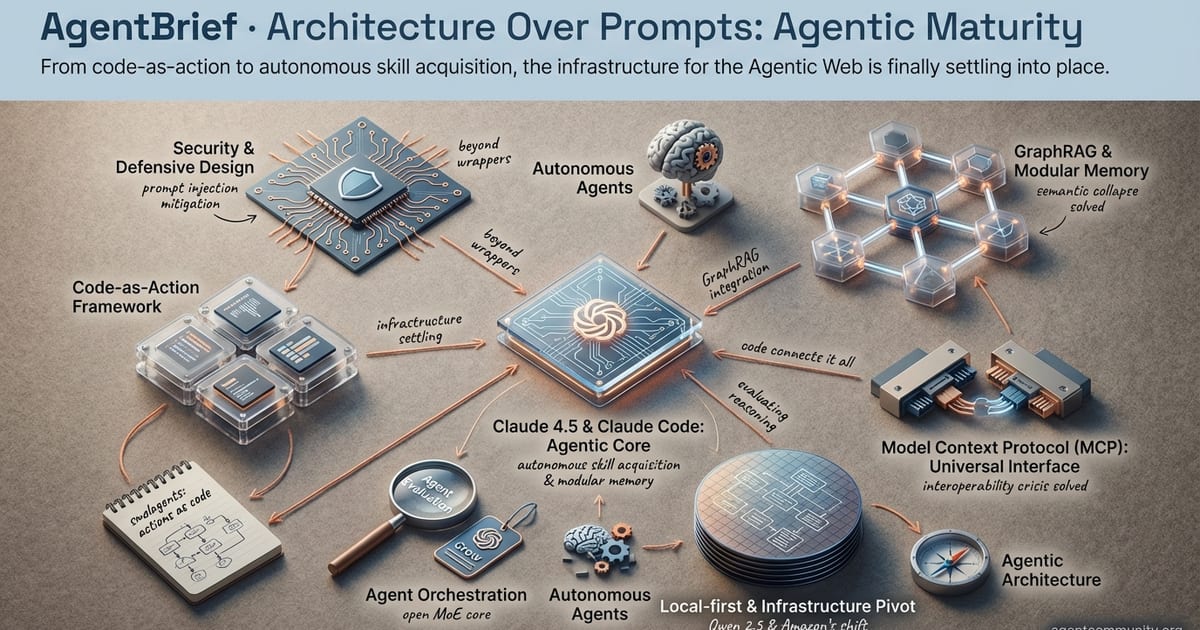
We have reached a critical inflection point in the development of autonomous systems: the transition from 'vibe-based' prompt engineering to robust agentic architecture. Across X, Reddit, and the developer communities on Discord and Hugging Face, the signal is consistent. We are no longer just building wrappers; we are engineering infrastructure. Anthropic's Claude 4.5 rumors and the 'Skills' modularity in Claude Code signal a shift where agents autonomously acquire capabilities rather than relying on hard-coded tools. However, this leap in autonomy brings a 'wall' of structural challenges. Security risks like indirect prompt injection and the 'semantic collapse' of long-term memory are forcing practitioners to move beyond simple chat interfaces toward GraphRAG and code-as-action frameworks. Hugging Face’s smolagents is proving that treating actions as code—rather than fragile JSON schemas—dramatically raises the ceiling for reasoning. Meanwhile, the Model Context Protocol (MCP) is solving the interoperability crisis, turning fragmented tools into a universal interface. Whether it’s local-first optimizations with Qwen 2.5 or Amazon’s infrastructure pivot, the message is clear: the next phase of the Agentic Web isn’t about better prompts—it’s about defensive design, modular memory, and the code that connects it all.description
We have reached a critical inflection point in the development of autonomous systems: the transition from 'vibe-based' prompt engineering to robust agentic architecture. Across X, Reddit, and the developer communities on Discord and Hugging Face, the signal is consistent. We are no longer just building wrappers; we are engineering infrastructure. Anthropic's Claude 4.5 rumors and the 'Skills' modularity in Claude Code signal a shift where agents autonomously acquire capabilities rather than relying on hard-coded tools. However, this leap in autonomy brings a 'wall' of structural challenges. Security risks like indirect prompt injection and the 'semantic collapse' of long-term memory are forcing practitioners to move beyond simple chat interfaces toward GraphRAG and code-as-action frameworks. Hugging Face’s smolagents is proving that treating actions as code—rather than fragile JSON schemas—dramatically raises the ceiling for reasoning. Meanwhile, the Model Context Protocol (MCP) is solving the interoperability crisis, turning fragmented tools into a universal interface. Whether it’s local-first optimizations with Qwen 2.5 or Amazon’s infrastructure pivot, the message is clear: the next phase of the Agentic Web isn’t about better prompts—it’s about defensive design, modular memory, and the code that connects it all.AMDAWSAgno+37378m saved2600 sources24 min read - ThuJan01
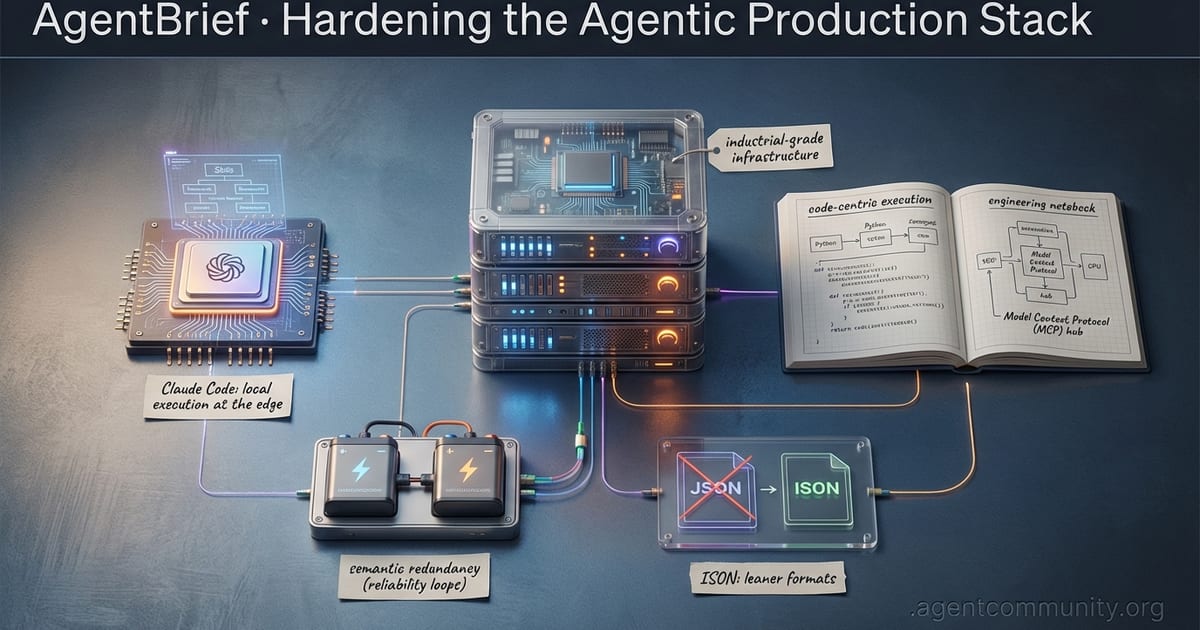
Hardening the Agentic Production Stack
The era of "vibes-based" agent development is ending as we move toward an industrial-grade infrastructure. This week’s synthesis highlights a fundamental shift from experimental prompting to secure, stateful execution environments—the new "agent-first" sandboxes. Whether it’s Anthropic’s Claude Code or Microsoft’s Agent Workspace, the industry is pivoting from research-heavy AGI goals to the scaling challenges of the "Agentic Web." We are seeing a rejection of traditional software principles like DRY in favor of "semantic redundancy" to ensure reliability in long-running loops. On the efficiency front, the "JSON tax" is being challenged by leaner formats like ISON, while frameworks like Hugging Face’s smolagents prove that code-centric execution often outperforms complex prompted schemas. This shift is reinforced by the rapid expansion of the Model Context Protocol (MCP) and the introduction of chaos engineering for LLMs. For builders, the message is clear: the focus has moved from what a model can do to what a system can safely and deterministically execute at scale. Today’s issue dives into the frameworks, protocols, and hardening strategies that are transforming autonomous systems from research projects into production-ready software.description
The era of "vibes-based" agent development is ending as we move toward an industrial-grade infrastructure. This week’s synthesis highlights a fundamental shift from experimental prompting to secure, stateful execution environments—the new "agent-first" sandboxes. Whether it’s Anthropic’s Claude Code or Microsoft’s Agent Workspace, the industry is pivoting from research-heavy AGI goals to the scaling challenges of the "Agentic Web." We are seeing a rejection of traditional software principles like DRY in favor of "semantic redundancy" to ensure reliability in long-running loops. On the efficiency front, the "JSON tax" is being challenged by leaner formats like ISON, while frameworks like Hugging Face’s smolagents prove that code-centric execution often outperforms complex prompted schemas. This shift is reinforced by the rapid expansion of the Model Context Protocol (MCP) and the introduction of chaos engineering for LLMs. For builders, the message is clear: the focus has moved from what a model can do to what a system can safely and deterministically execute at scale. Today’s issue dives into the frameworks, protocols, and hardening strategies that are transforming autonomous systems from research projects into production-ready software.AWSAgnoAmazon+41586m saved3679 sources24 min read